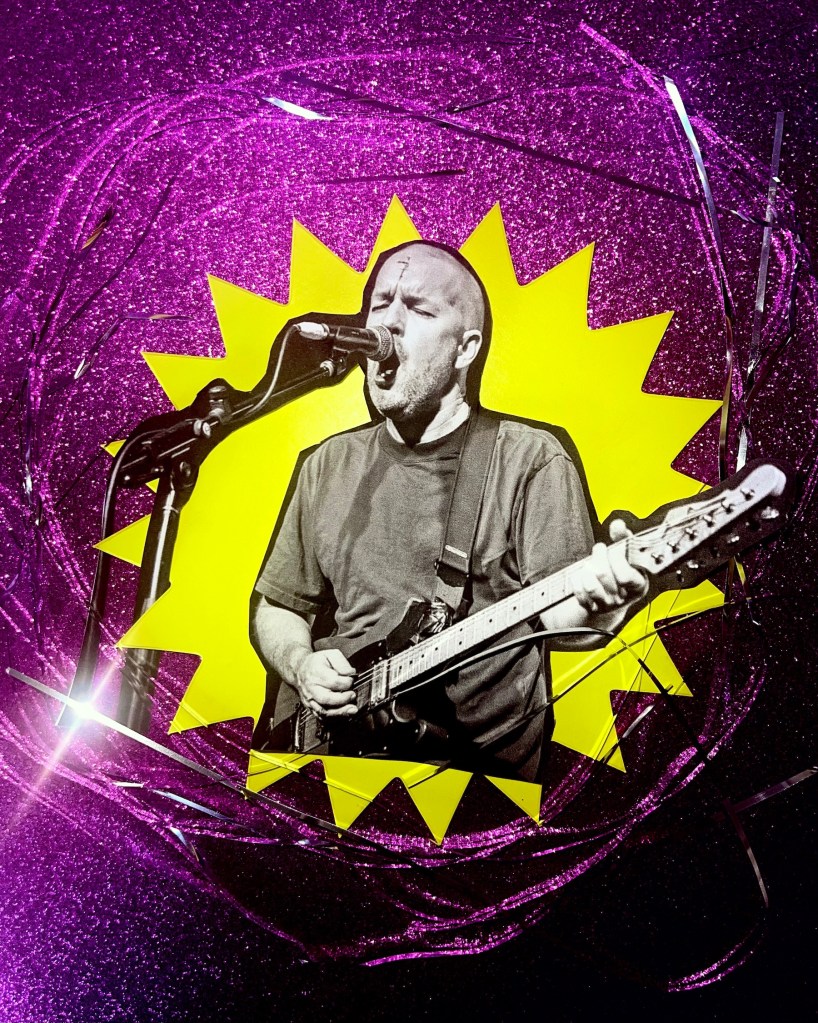
Tom Lyngcoln has spent decades carving out his own path through Australian underground music. Best known for his work in The Nation Blue, Harmony and his most recent band Metho, Lyngcoln’s world is one built on intensity: dissonant guitars, uncompromising expression, deep community ties and a lifelong suspicion of commodified art.
Gimmie yarned with him, while he was on a break from his day job as a carpenter. What begins as a conversation about music quickly unfolds into something much larger—grief, friendship, underground culture, environmental collapse, mental health, masculinity, creativity and the strange beauty of surviving long enough to keep making things. Thoughtful, funny and brutally self-aware, Lyngcoln speaks the same way his music sounds: raw, searching and completely uninterested in pretending.
TOM LYNGCOLN: I’m pretty fired up! I’ve got a lot of projects going and, maybe for the first time, I’m actually taking the label [Solar/Sonar] that I’ve got seriously.
I saw so much drop-off with people scaling back releasing music. It feels like a bit of an insane thing to do, but I just got keen!
I was able to put in for one round of production on a record, made the money back, didn’t spend it, and kept it to one side. And I’m going to keep doing that. I make no money from it, but it’s going to allow me to effectively keep doing thing after thing, hopefully for a while.
But it’s tough, you know? Growing up when I did, I was pretty fortunate that there were lots of people writing about music and listening differently.
I like the idea of trying to help younger bands; I’m trying to pay it forward. I got treated really well when I was coming up. I also had absolutely unsustainable ideas about music and selling out and all that kind of shit from growing up in Hobart.
It’s so good to hear that you’re feeling inspired and motivated. Sometimes, with the world the way it is, it can be a struggle to feel that. The last time you and I spoke about your music was when The Nation Blue’s Damnation came out in 2004. It’s been over two decades, and I’m stoked to say that we’re both still here, doing what we love to do, and helping other people out while we do it.
TL: Yeah, lifers! That is also a product of when we came up. For me, through the ’90s, all those people that I came up with are still engaged—still writing music, or writing about music, or painting, or whatever it is. We’re all kind of lifers in that way. You’ve got to be making things, and it’s got to be tangible stuff. I love it.
I think staying curious and staying engaged, does wonders for a person in life. As does pushing yourself and continuing to do things that challenge you.
TL: There was always a set way to do things. And now, through scarcity, that’s been obliterated, and you just have to be creative in those choices too. It’s kind of endless. I like problem-solving. But I’ve only got so much energy as well.
I hear that. I’ve been thinking about problem-solving a lot this year. If something goes wrong, it’s become more about: here’s the problem—how can I pivot?
TL: Yeah, I find reducing things down has helped. I’ve always been really focused on how things are trending in a macro sense, but I’m 46 now, and you start to realise it’s really about community and small collections of people. You can actually have a big impact there, and that’s really rewarding.
If you try and do too much, I don’t think it’s futile, but it’s less effective and less rewarding. You don’t get the drive to keep going because you just think, “Oh, fuck, that was a monumental failure.” You chalk up another one in the loss column.
But you can do a lot locally. That was always my focus when I was a kid. I had a total disregard for the mainland—couldn’t give a shit about anything happening there. And when I think about it now, it was probably a community of 100 people, but a lot of those principles are still informing everything I do.
Whereabouts in Tasmania did you grow up?
TL: I grew up in Hobart, on the Eastern Shore, which was pretty bogan. I went to a rough school and was around all that kind of stuff, but I decided to have a bit of a circuit-breaker.
For Years 11 and 12 down there, you go to a different place—college instead of high school. High school ends at Year 10 and then you move on. It was there that I started engaging with different people.
I went to a Fugazi show in ’93—the only band like that to come down to Hobart. And what I saw there were local bands that I didn’t even think existed. I was like, “Oh, there are people playing heavy music in Hobart.” That changed everything.
But they’re really small communities. Then you come to Melbourne, or anywhere else, and you see the same thing replicated on different scales. You realise the same rules apply.
It’s been 25 years in Melbourne now, and you start to meet everyone and see everything. It’s the same principle as Hobart—it’s just bigger. If you can not be a jerk to people, be supportive, and participate positively in a community, you get to do a lot. It feels good. It feels rewarding.
You mentioned that a lot of the ethics and principles that still guide you now came from growing up in Tasmania. What do you think it was about that environment and community that shaped you so strongly?
TL: Down there, releasing a CD in the late ’90s was considered a sellout. Even putting out a tape could be seen that way. Those anti-sellout politics were probably the most stringent of anywhere I’ve ever been.
But it served me well when I got to the mainland and started engaging with the industry, because there was no industry down there. You played music because you wanted to make something. I never subscribed to the idea of playing music to make money, get girls, or any of those stupid fallacies. The people who are really good at music are compelled to do it. It’s on a DNA level. The others fall off pretty quickly.
A lot of those principles were really strong. DIY was everything—learn every aspect of it. Songwriting, writing about music, booking shows. I was booking shows when I was 14.
When I had my 18th birthday at the same venue I’d been booking, they were like, “You’ve been working here for two years.” I was like, “Yeah.” They said, “You do a great job. It’s all right.” Nobody had ever asked to see ID, which I didn’t even have.
Older people in the scene used to get me into shows as their kid or whatever. I was always around, but I had no interest in drinking or anything except watching bands. People weren’t seeing me at the bar asking for ID. There were lots of young kids floating in and out of pubs back then. It was possible to do that.
There was a lot of backward stuff too, but there were also really strong women in the scene who informed my politics early and checked me on bad ideas. There was a strong queer scene as well, despite homosexuality still being illegal in Tasmania in the late ’90s. We’d stick up for members of that community, because there was really only one place they could go, and it became a target for bogans trying to get in there and start shit. It could get pretty heavy at times.
Again, it comes back to small community stuff. You’re growing up and absorbing all these pretty big concepts, and it was a good framework to do it in. Everybody was insanely mentally ill, and that’s why we gravitated towards each other. I think it helped me a lot. It made me look at things differently, gave me different ideas about creativity, and definitely made me want to keep doing it.
What were you listening to back then?
TL: Harsh shit. It was funny—you’d go to a Hobart show back then and I reckon 15 minutes of the set would just be tuning because nobody had a tuner.
I didn’t realise how much I missed that until I saw Alastair Galbraith play just after COVID. He spent about 20 minutes trying to tune to the bass player, and nobody could get it. Everything was out of tune, nobody had a tuner, and nobody cared.
Back then, I reckon I was 16 when I played with KK Null from Zeni Geva. We’d go to the Conservatorium and do Cobra by John Zorn as teenagers. It’d basically be me, a drummer and a bass player, alongside all these people from the Hobart Conservatorium with their hyper-flutes and tubas and all this bullshit. We’d just play this game of noise warfare against them.
So there was lots of pretentious experimental shit around. I loved SKiN GRAFT Records as a kid. In the ’80s I was into Mötley Crüe and Guns N’ Roses, and then my best friend Chris—kind of a proxy big brother because he was older than me—gave me a tape with Jane’s Addiction on one side and Dead Kennedys on the other.
I thought Dead Kennedys were a comedy band. I’d never heard anything like that before. I was like, what are we doing here? But the hooks were rusty, rancid hooks, and I was just like, oh, this is unreal. From there it just descended further.
Then bands like Butthole Surfers and Rollins Band, all those weird late-’80s, early-’90s crossover bands, really got me going. My favourite bands were stuff like Archers of Loaf and Girls Against Boys. Just weird indie-rock stuff. I loved it. Even things like The Jim Rose Circus—all those counterculture things—I was obsessed with them.
I went to a school where everybody was super metal. They used to make me go into the music room at lunchtime and play Metallica because that’s all the bogans wanted to hear. They’d be like, “If you don’t come play guitar in our band, we’ll bash you.”
So I’d go in there and try. I’m not a very good guitarist, so trying to play that stuff was rough. There was heaps of grunge around too, but I was already off somewhere else musically.
I still remember Debut by Björk. That record is still one of my all-time favourites. I’d sit by myself at lunchtime listening to it over and over on my Walkman.
It was back in the days where you’d take the batteries out and put them back in to squeeze another 15 minutes out of them. I reckon I had the same two non-rechargeable batteries for about 12 months.
Totally! Yep. You and I are the same age, so I get it! Or you try to rub the ends together to try and generate more juice or charge or something.
TL: [Laughs] Yeah, like why are you licking batteries again? It’s like, don’t fucking judge me! You have to eat, right? I’m just trying to get more juice!
[Laughter]. So you move to the mainland around 25 years ago?
TL: Yeah. I got run out of town effectively.
What do you mean “run out of town”?
TL: Oh, man. Some bikers tried to kill my best mate. I was already on the verge of leaving, and then I got spiked really badly on Y2K. I woke up during a CAT scan after falling two stories onto my head on a slate floor.
I was already going to leave, but that sped it up. I had to get out. The town was getting too small.
It’s the same thing I was talking about before: the good thing about knowing everybody is that, if things are going well, it’s really nice. But if things go badly, they’re going to find you pretty quickly.
So in 2000 I came over. I still had a few medical appointments to check on everything, and I just kind of cruised into Melbourne.
But Hobart’s really cyclical, and everybody left at the same time. There was probably a three-year window where around 30 people from this 100-person scene all moved away.
I walked straight into a share house in Brunswick with one guy I was playing in a band with and another guy I used to work for back in Hobart, so the transition was pretty easy.
It was still lonely and weird, though. I remember going to Supergrass and Stereolab on my birthday weekend and just standing there on my own. Then, as soon as you’d spot another Tasmanian, you’d immediately latch on. Old habits, even though I was only 20 or 21 at that point.
So yeah, I got out in 2000. With a bit of distance from the place, I realised some aspects of it were pretty insidious.
My wife used to say to me, “Why are you so fucking sarcastic? Why can’t you just talk normally?” And I’d be like, “I’m not being sarcastic. What are you talking about?” She’d say, “You’re doing it right now.”
I reckon it took me three years to unlearn the defensive sarcasm everybody used to communicate with down there. Unfortunately, that lined up with the overly sincere emo era, and I was just like, “I think I’m going back to sarcasm for a bit. I don’t know if I can be this earnest about everything.”
When writing songs, what feeling do they often start from?
TL: These days it usually starts with the feeling of, “I’ve got band practice tonight, I told them I’ve got four songs, and I’ve actually got one.” So I’ll sit here—this is just an office at work; you can see the wallpaper, it’s pretty bonkers—and try to write.
Back then, though, I’d just play every day. I never really went out. Tim Brennan’s wife Kathy says I’ve got “the most punchable head in Australia,” so even as a kid I’d mostly stay home. Even as a teenager, working in a pub, I’d finish work and go sit on a beanbag playing along to Tasmanian TV ads. That’s where I put in all the hours. I’d always have a guitar in my hands, just writing constantly.
Some days it feels like somebody’s greased the pan—it’s super easy. Everything becomes abstract and sits outside the framework of what you normally do, and songs just come naturally. Other days you’re just banging your head against the wall.
So I try to play a lot, because when those good days come around, I might get five songs out of a half-hour session just because it’s flowing. You hit this point where you realise, “These are the same chords I’ve always played,” but your fingers are suddenly moving all over the place. Sometimes you just hit the right combination.
I’m classically trained, but honestly, that doesn’t help as much as people think. A lot of it really is luck, which isn’t what you want to hear and definitely not what you want to rely on. But I don’t know—20 albums in, and it still feels fun to do.
Do you trust your creative instincts more now than you used to earlier on?
TL: Yeah, you’ve got to trust it. I work fast and I like things raw. A lot of the Harmony records, particularly the first two, are literally the first take we ever did of those songs, straight through. You can feel that “oh fuck” energy where nobody really knows the song yet.
I’ve always gravitated towards dissonance and mistakes in music. I love things that probably should’ve been deleted—to quote Torben Ulrich. That’s the stuff that gets me going. It’s that feeling of, “This is so wrong it’s right.”
Even outside music, I love stuff like Wesley Willis—things that shouldn’t work. There are these little moments where the two rocks grinding against each other suddenly slot together for a second, and that’s when the explosion goes off in your head. All the endorphins hit at once. Sometimes I almost lose consciousness. I’m just like, “Oh, there it is. That’s it. That’s the moment.” That’s the magic.
You do have to trust it. I feel fine about it now, but over time I’ve had to learn not to think about what other people are going to think. A lot of people don’t get it, and that’s fine. You just have to keep doing it. I do it for me. I don’t do it for other people. Not everyone will get it and that’s fine.
I’ve got a worldview and a way of doing things, and hopefully that comes through in the music. That’s really all I’m going for. I want people to hear me play guitar or sing and recognise a consistency across everything I’ve done. That’s the most important thing to me: making something that feels unmistakably mine. A lot of people don’t do that.
I’m always getting messages from people saying, “Hey, I want to start an SSD band—do you want to play in it?” or “Do you want to do this kind of thing or that kind of thing?” But people aren’t really going to get that from me. Unfortunately, it’s always going to sound like me. If you’re on board with that or not, honestly, I don’t really care.
I’ve heard a lot of people describe both your music and your live shows as abrasive, chaotic, or confrontational. But earlier you said that the music is really just an extension of who you are. Do you see yourself that way?
TL: No. I’d say this is more about not knowing what I’d be without it. I think music is a way for me to self-regulate. It’s a big vent.
I like intense expression. Whether it’s grinding dissonance, bleakness, or confrontation, I’m drawn to those things. This is how I get it off my chest so I can go back into the world and not be a liability as a parent or in everyday life. It’s like a filter where I can dump all the shit.
Honestly, I don’t know what I’d be without it. I don’t know what other outlet I could have that would stop me from becoming a destructive person. So getting it out on the page, writing, playing music—it’s not shtick. It’s not performance in that sense. It’s just all I’ve got, and I need to get it out somehow.
And when I play live, I’m not trying to hurt other people. If anything, I’m trying to hurt myself. I enjoy pushing myself physically. It means I never walk around wanting to throw a punch at somebody because I’ve already exhausted all that energy.
I enjoy confrontation in an artistic sense, but ultimately it’s mostly for me. It’s fun. It’s necessary.
I still do all the same things I’ve always done, simply because it’s fun. At this point, I don’t know what I’d do if I stopped interviewing. I’ve been doing it since I was 15 years old. I’ve done thousands and thousands of interviews with all kinds of people. And honestly, I probably have deeper conversations with the people I interview than I do with most of my friends.
TL: Yeah, I know.
I’ve learned so much from the people I talk to. And I like that they get something from our exchange too. Sometimes we’ll be having a discussion and I’ll point something out about their music or even about themselves, and they’ll go, “Holy shit! I never realised that.” It’s nice to have that two-way connection. Especially now, when everyone’s supposedly more connected online but it actually feels like we’re more disconnected from each other.
TL: Yeah, it’s the opportunity to actually talk to people on a real level. You realise there actually aren’t that many opportunities to sit with someone for a prolonged period and genuinely get to know them.
It ties back into community as well. In Hobart, people had their defences up for different reasons, but on the mainland people felt disconnected in another way. Nobody smiled at each other in the street. If you smiled at someone, they’d look at you like, “What the fuck are you looking at?” I had to adjust to that.
Having these thoughtful conversations is something that’s really important for me, even for my own mental health. Unless we go to a show or occasionally have a meal with family, we rarely see other people. It’s sad to say but more often than not, we’ve found that people just never seem to think of us, or if they do they never reach out and let us know.
My whole life, I’ve been the one that reaches out to say “hi” or check in on friends or be there when someone needs or that opens doors for people. But I’ve never really had people that do that for me. It blows my mind that I know so many people yet in my toughest times, no one has really been there for me.
TL: Yeah, and you’ve only got limited time. How long do you really get between songs to talk to someone? It can end up feeling pretty superficial.
I’m still the kind of person who’ll actually call people, and that’s horrifying for a lot of them. They see the phone light up and think, “Christ …” [laughs].
I’ve got a whole circle of friends, mostly people from bands, and my strike rate is probably one in ten. These are close friends, too. But it’s always good when they actually pick up. That kind of connection is important to me. A lot of the people I’m friends with don’t live near me anymore, so you’ve got to stay on them. You have to punish them a little bit [laughs].
The downside of social media, is it creates this feeling of, “Cool, we’re good for a while. I sent you some words in a Meta app. Hope you’re doing okay. Here’s a little love heart. And that’s nice, but it’s not really the same thing…Um, cool—friendship maintained
Sometimes I feel a bit like a counsellor. But yeah, it’s also why I avoid things like Facebook now. People see all the stuff that gets cross-posted from Instagram and assume I’m active there, and then six months later I’ll open Messenger and find someone telling me they were going through something really heavy. I’m like, I didn’t ignore you—I just genuinely didn’t see it. At this point, I’m pretty happy to limit all that. Just text me. That’s probably the best way forward.
I know you’ve described writing lyrics as a real grind at times, but I’ve noticed there are recurring themes running through a lot of your work—environmental collapse, greed, corruption, political disillusionment. Why do you think those ideas keep appearing in your work?
TL: It definitely occupies most of my thoughts, so it’s hard to avoid. Honestly, the hardest thing I ever did was write a Harmony record that was just about love. That was difficult.
The other stuff is easy—you just turn on the tap and it all comes pouring out. But trying to write one good song about love, let alone ten, took forever.
It’s always the same process, too: a pen, a blank piece of paper, and listening to the song 400 times over and over until I get so frustrated that something sparks. Usually it starts with one line or a song title, and then I can work from there. But lyrics are hard.
Honestly, the only reason I became a vocalist is because I hated singers. I really did. There are so few genuinely good frontpeople. We had Linda Johnston from The Little Ugly Girls and The Daisies locally, and she was incredible, so that was one exception. But there were just so many bad singers that I didn’t want to deal with one.
So I started doing it myself, even though I absolutely could not sing. The early Nation Blue recordings—and the band I had before that—are kind of hilarious in hindsight. What I thought I was doing and what I was actually doing were completely different things.
Which is funny, because I was classically trained. I played piano for years and years, but I just could not do this thing. I couldn’t sing. Eventually, though, I found a way of doing it that works for me. At this point it’s basically a magic trick.
We LOVE that Harmony record; why did you want to write a whole album about love?
TL: Because I’ve got 19 records about hate [laughs]. I don’t know if I was out of ideas, exactly, but I just hit a point where I needed something else.
I love sad songs, but with Harmony it was starting to impact my physical health, trying to be as sad as possible all the time. It was exhausting to sit in that headspace constantly. The first record is basically about all my dead friends, and every time I sang those songs I’d just feel miserable.
So I thought, “Well, I’m lucky. I’ve got a great relationship with somebody I love. Maybe I should try to put some of the subtler aspects of that into words instead.” I wanted to find a good way to write about love without it feeling corny or dishonest.
Before that, though, the Harmony stuff was so bleak. All the references were military operations, munitions, warfare. The best way I can describe my lyric-writing approach back then is that guy Elaine dates in Seinfeld who wears army fatigues everywhere. She asks him, “What’s wrong with you?” and he says, “I had a bad date once.” He’s not even military. And I was like, that’s me—miserable for miserable’s sake.
You mentioned earlier that a lot of the first Harmony record came out of losing friends. And unfortunately, as we get older, loss just becomes more and more present in our lives. At the end of last year we lost Jhonny’s mum, and I’ve already lost both of my parents, so it’s something I think about a lot. Is there anything you’ve found that helps you process grief—or at least live alongside it a bit better?
TL: Not doing it alone. That’s the main thing. Talking to people. Even though everyone worries about being a burden socially, I really think talking to people is the only thing that gets you through it.
Sometimes it’s just having a beer and sitting with somebody while you work through things together. I don’t think we’re designed to carry all of it internally. We don’t really have the capacity for that.
I’ve had some pretty bad losses, and I’m lucky that I can put some of it into songs and then, ten times a year, scream it out into the night. That helps. But if it’s not that, then it’s the quieter version—just talking to people. Because grief is universal. Everybody goes through it.
And the stuff people carry can be unbelievable. Even two weeks ago, on New Year’s Eve, we ended up at this small family gathering that my wife, kid and I basically house-invaded. Somebody asked, “How’s your year been?” and I said, “I broke my little finger playing basketball and it still really hurts.”
Then the woman sitting next to me said, “I was blind until a month ago.” She’d had an operation four years earlier that didn’t work, and then suddenly her eyesight came back out of nowhere. I was like, “Yeah, okay … what about my little finger?” The things people go through are just incredible sometimes.
Everyone I talk to lately seems to be having a rough time. A lot of my friends are really politically active as well, and with the way things are, it’s hard not to be engaged on some level. But it can feel relentless sometimes.
TL: Yeah, a lot of people choose not to engage with it at all. But I think that’s part of why so many people are struggling—because it’s hard to look at the way things are going and still just live your everyday life normally. Honestly, I sometimes wish I was blissfully ignorant. But once you see things a certain way, it’s hard to unsee them. And that can be pretty tough.
Totally. I think for some people, blind faith gives them a real sense that things will be okay, and I can understand the comfort in that. I just don’t think my brain operates that way.
TL: It doesn’t feel realistic to me either. Especially when you’ve got a child—you want things for them that, deep down, you’re not even sure are going to happen anymore. At that point, all you can really do is try to leave the world in a slightly better place and see how it goes. We’ll see how it all ends, I guess.
Fingers crossed. Ha. I just wish more people cared about the fact that if we don’t have a planet, we’ve got fucking nothing. That’s the one thing that affects every single one of us. And the whole scarcity mindset—the hoarding, the constant need for more, more, more—I’ve always found that really strange, even when I was a kid. I’ve always felt a little out of step with the world in that way.
TL: Yeah, absolutely. It’s a huge fixation for me. I think a lot of it started with growing up in Tasmania and seeing enormous trees on the back of logging trucks. It felt like people were cutting down dinosaurs just to turn them into woodchips.
That really stayed with me. And now, when you look at almost every major foreign-policy conflict happening in the world, so much of it comes back to natural resources. It never ends. It’s just hoarding for hoarding’s sake. At the core of it, it’s greed. And it sucks.
We’re incredibly lucky to live where we do, but at the same time it feels like nobody’s actually worried until it directly affects them.
Yeah. So, we’ve talked a little bit about community and I know that you like community, but then you’re not into scenes. For you, what’s the difference?
TL: For me, community is a broader thing. It’s about like-minded people, friendships and genuine connection. A scene feels much more rigid.
I don’t think scenes are great for creativity because they’re built around conformity. It’s like a fraternity or some kind of closed system where individuality gets crushed. You see it in hardcore, punk and all those kinds of spaces—people become so dogmatic and bloody-minded about traditions that nothing actually moves forward.
What I’m interested in is personality. I want to see that reflected in music, art and creativity. If people are constantly trying to conform to a scene, they’re limiting themselves. At that point it’s no different to organised religion.
I want to see the best in people. I want to see people treating each other well. I think you get more of that through community than through scenes. In scenes, people get rejected for having different ideas. Community allows more flexibility, but it also takes more work.
Anyone can get sworn into a scene, tick all the boxes and fit the dress code, but that often creates superficial relationships. Community feels more organic. You give something, other people give something back, and you build actual friendships through participation.
Whenever I get close to really rigid scene culture, though, I immediately back away. If somebody says, “You’re part of our scene now,” I’m like, “I’ll wait in the car.” I’m not interested.
That happened when I first moved to Melbourne. I looked at the hardcore scene and thought, “What the fuck is this?” Eventually I met people in it who were incredible, but around the edges there were all these foot soldiers policing everything.
And I’d think, “We’re not friends. You don’t know anything about me.” They weren’t even paying attention to the person standing in front of them. I just had no interest in that kind of behaviour.
I love being friends with people from completely different kinds of music and backgrounds. But as soon as somebody starts telling me how I’m supposed to act, what I’m supposed to like, or how I’m supposed to look, I’m out. It’s always some guy enforcing that stuff too. And I fucking hate it.
Sure is!
TL: It’s always some fragile little-minded dude going, “No, we don’t do that here,” or, “That’s not allowed,” or, “You can’t do that.” And I’m just like, “Cool, I’ll be in the car. Fuck off.”
[Laughter] Yeah. I love hardcore music, but no matter how many bands I’ve interviewed from that world, or how many people I know in it, I’ve never really felt like part of the scene. And the strange thing is that hardcore is always talking about being this community, but a lot of the time it doesn’t actually feel that inclusive. At least in my experience, it never really felt like there was space for me in it.
TL: Yeah, exactly. In every regard, really. I don’t like safe things, and I’m drawn to extreme expression, but scene culture often just becomes exclusion for exclusion’s sake.
Honestly, the happiest we ever were was after we lost all connection to that scene entirely. Around the Damnation era, we got completely rejected by that whole world. At the time it fucking sucked.
We booked this huge national tour, including a 400-capacity room on the Gold Coast, and nobody came. One night literally four people showed up. Two got kicked out for dancing, and one of the remaining two stole our merch at the end of the night. There was more merch in the room than audience members.
But I wouldn’t change any of it. It probably took three years before people started understanding the band differently. The turning point for me was when women started outnumbering men at the shows. I remember thinking, “Oh, this is the best it’s ever been. We’re finally getting the right people here.” And those people still come to the shows now.
People wanted us to be something else entirely. We turned down record labels and did everything our own way, and it was brutal trying to navigate that. But we’re still here, and most of those bands aren’t. The good ones survived, and there are still some great friends from that era, but we realised pretty early on that we were never going to fit neatly anywhere.
We don’t fit with rock bands, hardcore bands, punk bands or indie bands. We played a Dick Diver EP launch in Melbourne once, and I remember feeling like Metallica playing a Simon & Garfunkel concert. Before the set we were all like, “Just play the quiet songs. Don’t destroy anything. Don’t freak people out. Just stand there and play it straight.” And we still cleared the room.
Then we played with Flipper and cleared that room too. We started joking, “Who actually likes this band?” Eventually we just came to the conclusion that we did. That had to be enough. I hope some of that comes through.
It does. I’ve never thought of your band/s being one of those toxic masc bro bands.
TL: [Laughs]. I couldn’t think of anything worse! But I have spent so many hours sitting in cars waiting for those kinds of bands to finish. I got into and love skip-hop. I found that excitement and a vibe in going to hip-hop gigs.
Same. I remember talking to Michael Franti about it once and he said, “You’ve got to go where the energy is.” That’s exactly what happened for me.
At a certain point, hardcore stopped feeling exciting and started feeling really alienating. It became something I didn’t recognise anymore, especially in the way women were treated in the scene from the mid-2000s onwards. Whenever I spoke up about it, I’d get labelled difficult or crazy. So for a while, I stopped going to punk and hardcore shows altogether. Instead, I started going to hip-hop gigs, raves and pop shows—places where the energy still felt open, alive and welcoming.
Because by that point, the scene had become something I never signed up for.
TL: Yeah. All that individual-expression stuff has always mattered to me. But even that goes back to things like the straight-edge scene, where suddenly it became, “This is what we all look like now.”
I’ve never really fit into that. I’ve always dressed in workwear because I’ve worked shitty manual-labour jobs most of my life. That whole uniform thing just never worked for me.
After shows I’d sometimes go outside to load gear and then not be allowed back into the venue because security assumed I couldn’t possibly be in the band. They’d be like, “Sorry mate, you can’t come in.” And honestly, it felt like a giant metaphor for the whole thing.
You’ve collaborated with so many different people across all your projects, and when you look back over your work there are all these incredible connections and crossovers. Are there any particular people who’ve been especially important to you creatively or personally?
TL: Yeah, absolutely. All the early stuff still informs everything I do. All those people from Hobart are still incredibly important to me.
Even a couple of months ago, when we did the Damnation anniversary show, almost everybody onstage was from the Hobart scene in the ’90s. There was Linda Johnston again from The Little Ugly Girls, Tim Evans from Sea Scouts and Bird Blobs, Monika from Sea Scouts and Love of Diagrams—all these people I grew up around.
But in terms of wider influences, I’ve also been incredibly lucky. We had Marc Ribot play on ‘Rain Dogs’ by Tom Waits, which was a massive record for me growing up. When I first heard his guitar playing, I was like, “What is this?” It sounded like he was only hitting three out of every 10 notes properly, and I loved that. I thought, “Oh, that’s okay—that’s how I play guitar too.” It made me realise there was room for imperfection and personality in playing.
He was really into it. I honestly have no idea how that even happened. I just found his manager online and sent a message saying, “Do you reckon he’d want to play on this song?”
And she came back saying, “No, he actually wants to play on this other song.” I was like, “No, no, he has to play on the shit one because we really need help making it better.”
But yeah, I’ve just been incredibly lucky. I’m playing with Mick Turner this Sunday, and he’s probably my all-time favourite guitarist. I love Dirty Three, Venom P. Stinger, Fungus Brains—all of it. He’s another one of those people who approaches an instrument completely backwards.
The only problem is now I actually have to play guitar in front of him. I get “the claw,” where my hand just locks up and I lose all dexterity. I can feel myself tensing and freaking out. So after this I’m going to rehearse just to keep everything moving.
But honestly, since moving to the mainland, a lot of my life has just been about engineering interactions between people I admire. Half the people I’ve collaborated with had never met each other before, and now they’re lifelong friends.
I’d just think, “I want this person, this person and this person together,” and then see what happened. That’s basically been the approach with bands too. I’ll love somebody’s skill set or the way they think about music and just go, “Let’s put this together and see what happens.”
That’s a really important thing, though. When somebody has a genuine vision for bringing certain people together, and they can see how those personalities or creative approaches might connect, it can create something really powerful. Sometimes it’s less about technical ability and more about recognising a chemistry or energy between people that maybe even they can’t see yet.
TL: Yeah, exactly. You can maximise different qualities in people. For me, it always comes back to personality. I’ll look at somebody and think, “If I put this person together with that person, it’s going to turbocharge something.”
It becomes irrepressible at that point. It doesn’t matter what obstacles are in front of it, something powerful is going to come out. I might not know what it’s going to sound like, but I know the expression will be huge.
I love that. Honestly, that’s probably been my favourite thing over the last 20 years. All the smaller projects around the main bands have basically come from me thinking, “I’d love to see what these two people would create together.”
At some point I stopped being the liability and became the facilitator. Back in Nation Blue, I was the person nobody could rely on. Now I’m somehow the administrator. It sucks.
Why were you the person that couldn’t be relied on?
TL: I was really prone to destroying things back then. We’d have insanely bad shows depending on my mood. I was erratic.
With Nation Blue especially, I’d get completely skeeved out by industry stuff and just shut things down or deliberately sabotage them. There are emails from Westy where he’s basically saying, “Man, you fucking blew it.” And I’d just reply, “Yep.”
I related a lot to that famous The Replacements story where all the A&R people came to a show and Bob Stinson completely lost it. Apparently there were all these label people there because the band was blowing up—they were getting mentioned alongside bands like R.E.M.—and Bob got drunk, came out naked, ripped down the backing curtain and turned it into this giant cape, then threw a shoe full of shit at the industry people. And honestly? I can relate to that energy on some level.
It’s no secret that I find the music industry difficult. I’ve mostly existed outside of it, apart from when I was younger and thought working in the industry might actually be a cool job.
I did work at a big record label as a teenager, and one of my jobs was calling record stores at certain times of the day to check whether they were playing their artists. If they were, the stores would get points, and whichever shop had the most at the end of the month would win some kind of big prize. Basically, they were being rewarded for prioritising certain music. When I realised that was how the system worked, I was out.
I still see a lot of the same stuff happening behind the curtain now. I’ve watched the same artists receive big amounts of funding over and over again—for some we’re talking up to a hundred thousand dollars—while so many other, actually independent musicians, that could use a leg up struggle just to survive.
I find it frustrating when artists market themselves as independent or DIY while quietly having teams, all the industry connections and financial backing behind them. There’s nothing wrong with having support, but I think people should be honest about what’s actually going on.
TL: Yeah. I think we are the industry now, though. So there’s nobody left [laughs].
Ha! But there is. Tell that to the dinosaurs, gatekeepers still clinging to outdated ideas of power in the music industry.
You’ve got managers and publicists giving writers five or 10 minutes with an artist, and then everyone wonders why interviews feel shallow. You can’t have a meaningful conversation in that amount of time.
Then there are publicists who expect writers to cover their entire roster, and if you don’t, you get blacklisted from the interviews you actually care about. I know writers who’ve completely burned themselves out trying to keep up with those demands just to secure a handful of conversations they genuinely want to have.
People wonder why music journalism in this country is struggling, but the system itself is part of the problem. Fanzines to me, is the most important form of music writing.
TL: Yeah, it’s culture. That’s the thing people trying to commodify music never seem to understand. The culture is the most important part. People can smell what’s fake. Genuine artists usually recognise each other because there’s a kind of cohesion there, a glue between people who make good things.
I honestly think it’s really hard to make meaningful work within a commercial framework because everything becomes exploitable in that system. From the moment you have an idea for how something should sound to the point where it finally gets released and marketed, it often becomes a completely different thing. The perception changes, the intention changes—everything shifts. Whereas if you’re doing it yourself, you’re the only person shaping it.
The idea of getting notes on how to write songs? Fucking hell. That’s when I’m already in the car park mentally. The second somebody starts telling me how I should write, I’m like, “No. Show me what you’ve written first.” And then the confrontation starts.
I just don’t understand how people in the industry still don’t see how successful underground culture actually is. There’s no real sweet spot in a lot of the music industry here where people genuinely understand underground culture, because I don’t think a lot of them actually come from it. They’ve come up through other avenues that I don’t really understand.
To be fair, though, some of the people who do get it are slowly moving into those positions now. I look around at some of the major labels these days and think, “Fuck, I know all these people.” So you hope things might change. You hope they remember what it felt like growing up inside this world and don’t lose touch with it.
One thing I’ve been thinking about lately with the label isn’t even starting a blog, exactly, but just creating more space for people to engage with music. I made a post online and got all these responses from people saying, “I really want to write about music, but there’s nowhere to do it anymore. If you send me records, I’ll write about them.”
And I thought, if I’m getting 10 messages like that from one Instagram post, maybe people are actually hungry to communicate about music again. To listen deeply and talk about it properly.
There are still heaps of people who are genuinely into this stuff. The scene is definitely smaller now, but in some ways I think it’s more important than ever. Even talking to pressing plants, they’ll say that 150 copies is now a standard run for underground or local bands. But there are still heaps of people going to shows. The community is still big.
A lot of the things we grew up with that made us excited about music feel like they’re coming back around again. Kids are picking up guitars again instead of feeling like they need to save for 10 years to buy some vintage synth that costs $12,000.
A guitar is such an egalitarian weapon compared to a lot of electronic gear. You can pick one up and just do it. And funnily enough, that was the whole spirit of punk in the first place—the idea that you didn’t have to be Earth, Wind & Fire or The Alan Parsons Project to make music. You could just go out and do it yourself.
The way people have been talking to me about music over the last couple of years makes me think people are fired up again, which is good.
COVID really knocked everyone around, and we’re still walking through a bit of a zombie state after it. But I can feel a thirst for older underground ideas coming back pretty strongly.
And honestly, the bands are incredible at the moment. That’s the biggest thing I notice. These bands just sound completely like themselves. They’re just genuine outliers, and I love that. It’s a hard expression, but it’s exciting. It feels really good again.
Who are some of these bands?
TL: Oh God, Serpette, who are now called Whip down here, don’t sound like anything else. They count in four and then whatever happens, happens. It’s wild. So good.
Then there’s Sienna Thornton. I don’t even know how to describe it, but it feels like a direct line into some part of my brain. Every note feels perfect. It’s an incredible level of skill—completely different to Whip, who are just pure chaos and energy.
And then there’s Tongue Dissolver. That band is unbelievable. It’s like if you took ‘Exterminator’ by Primal Scream and put it on bath salts. It’s one of the most convulsive things I’ve seen in years.
What I love is that none of these bands belong to scenes. There’s no rigid identity around them. It’s completely unbridled. And there’s no careerist reason to do it anymore. Nobody’s thinking, “I’ll play music so I don’t have to work at a bank.” Everybody’s heavily invested for the right reasons.
When we were younger, especially around the time Jet blew up, labels were throwing contracts at anything remotely guitar-based because people at labels were panicking about missing the next big thing. Nobody cared what bands actually sounded like. It was just, “Here’s 30 grand for your garage band,” even though nobody was ever going to recoup it.
Now it’s different. The question is genuinely, “Why are you doing this?” And I think post-COVID especially, younger bands are doing it because they need the release. You can feel it. It’s electric.
We played in Brisbane this year at Branko’s Festival, and every band on the lineup was incredible in some way. A lot of them are probably getting courted by indie labels now, but the thing is, they’re undeniably good. There were just so many great bands.
We got there way too early because somebody told us to go see KNEE. We watched them, and then I basically didn’t move for eight hours. I don’t think I went to the toilet or even bought a drink because every band was so good that I couldn’t leave the front of the stage.
Brisbane’s always had a ridiculously high strike rate for bands!
Totally. I’ve always felt like bands from Brisbane tend to have their own distinct identity and approach, which I’ve always thought was a bit special.
Because a lot of bands we love don’t get up this way too much, going to Nag Nag Nag in Sydney or JERKFEST in Geelong is a real treat for us. We get to see all the bands we love in one or a few days. At JERKFEST we end up running from stage to stage trying to catch every band because everything is so good. Both events feel very community-centric.
Australian music has always been exciting to me. There’s so much incredible stuff happening if you’re paying attention.
TL: Yeah. Billy Gardner at Anti Fade Records always does a great job of building community. A lot of the same people from the very first festivals are still involved, just moving through different bands and projects over time. More recently, there’s also been this integration between younger and older musicians, which has been really good to see.
What’s exciting right now is that you can walk into a venue and even the first band or the opener in the front bar is absolutely firing. It feels really healthy.
That was a big part of why I wanted to keep the label going. For 20 years people have been sending me demos, so I’ve ended up with this huge archive of little moments and unreal songs. I want to turn that into a series of compilation mixtapes, press them onto vinyl and just get them out there.
I’m talking like 40 tracks on a record—just a massive snapshot of what’s happening. Then I want to keep working through as many local bands as possible, because at the moment it’s almost impossible for a lot of them to afford proper vinyl releases on their own.
We had a Gimmie compilation in the works with around 40 or 45 tracks. It was almost ready to go, and all the profits were going to charity, but we couldn’t get a few things lined up properly, so we had to shelve it for the time being.
Everything has become so expensive just to survive. We’ve both been record collectors our entire lives, but lately we’ve basically had to stop buying records altogether. I think I only bought a handful of releases last year. Even going to gigs is starting to feel unaffordable.
It’s a strange and pretty sad feeling to be priced out of something that means so much to you—something that brings so much joy, connection and nourishment into your life.
TL: Yeah, and imagine being a kid trying to afford all of this while still staying enthusiastic about music culture. Shows are $30 or $40, records are ridiculously expensive … I get that production costs have gone up, but not enough to justify some of the prices people are charging now. A lot of it is just greed.
I grew up playing shows where entry was $2 or $4. Maybe that’s why so many people from that era are still involved in music culture—it was affordable, so people could participate constantly. They could form ideas, build communities and create their own little worlds around it.
Now I look at the tickets I’ve bought for the first half of this year and barely anything is under $100. It’s insane.
Yep. Australia is actually one of the most expensive places in the world for concert tickets right now!
TL: And vinyl pricing especially is something I’m really fixated on. Records should not cost that much. Obviously there are production costs involved, but there’s also a lot of taking the piss. I honestly think it would only take a few local labels deciding, “We’re not selling records for $60 anymore,” to shift things a bit.
Like, a record should maybe cost $35. That should roughly be the ceiling. Fuck inflation—some of these prices just don’t make sense, and eventually it’s going to cannibalise the culture itself.
The records we put out—Guppy and Piss Shivers—were $35.
TL: Yeah. You see record stores are sitting on piles of unwanted stock, especially after things like Record Store Day. I bought this Roky Erickson bootleg a couple of years ago for something ridiculous like $110, took it home and it was completely unlistenable. It sounded like a phone recording pressed onto vinyl. I took it straight back and was like, “This is dogshit.”
So what happens when record stores start disappearing entirely? Because I’m sure they’re already under enormous pressure from rent and everything else. It all has a flow-on effect. I really think affordability has to be the starting point again. Otherwise younger people just can’t participate properly.
That said, in the ’90s I’d buy one CD every six months and listen to it obsessively for six months straight. And honestly, that kind of deep listening is still in my DNA.
I really love some of the things Bad Habit Records up in Nambour are doing. Borg has always had a real knack for building community wherever he goes.
He does things like selling cool records to younger people at cheaper prices to help them start collections, and he regularly puts out calls for donated instruments that he then passes on to kids so they can start bands of their own. When new records come in, locals get first dibs on Saturday mornings before anything goes online. He gets international and interstate bands to play shows, that might not usually make it to regional places.
I still remember being a teenager making my first zine, and Borg stocked it in his distro even though it definitely wasn’t really his thing. At the time, I was new to everything and didn’t really now anyone in the scene, and that gesture always stayed with me. It meant a lot. And I see him still doing it now with the next generation.
TL: Yes! It takes that kind of blend to spark something new. That’s how these shifts begin.
It’s the same as coming up through the late ’80s when everything was just cock rock. All it really takes is a change in mindset to suddenly create something genuinely exciting.
And I can see that happening now with younger bands. There’s been a real shift in attitude among people making music. A lot of them aren’t doing it because they want careers—they’re doing it because they have to make music. And I think that’s really encouraging.
If more people like that keep appearing, it’s going to trigger a whole wave of really interesting art. It has to. Because honestly, I don’t need to hear another bunch of private-school kids playing indie music. I want to hear different voices—that’s the important part.
Yep. Some of the most vital music being made right now is coming from traditionally marginalised people.
With Gimmie, a lot of the interviews I’ve done have actually been the first time those bands have ever been interviewed, simply because mainstream media either ignores them or doesn’t even know they exist.
We put Guppy and Pale Horsey on the covers of print issues before they’d really even released much music. People told us we should’ve put King Gizzard & the Lizard Wizard on the cover instead because they were in the same issue and it would’ve sold more copies. But we went with Guppy because we could—and the issue sold out anyway.
Over the years, I’ve seen editors at publications decide who gets a cover story or major coverage based almost entirely on social media numbers, not because the artist actually rules. And obviously mainstream media is heavily shaped by advertising, paid editorial and industry relationships too.
A lot of people don’t realise how much mainstream culture is influenced by those systems rather than actual merit. A lot of artists effectively buy their way into visibility and success.
With us: we cover things because we’re genuinely fans of them. There are so many incredible bands out there that people would absolutely love if they were just given the chance to know they existed in the first place.
TL: Yeah!. And that’s why it continues. People know what they’re going to get with Gimmie and they trust it.
I was talking to Josh, the singer from Rapid Dye the other day and he was honest and said, that he doesn’t always like all the stuff that Gimmie covers, but he knows there could be something cool coming. That we really have an eclectic curation of stuff. A lot of publications are often one note.
TL: That’s it! I used to write a lot for Unbelievably Bad.
We loved Unbelievably Bad!
TL: It’s the same reason, really. You’re not buying something because of whatever insanity is on the cover—you’re buying it because you know it’s going to be interesting. It might not even be to your taste, but that’s part of the point. If your tastes aren’t constantly evolving, then you’ve kind of given up a little bit. If you’re genuinely passionate about music, it never ends.
There’s always something new to discover. It’s always on to the next thing. That’s what’s exciting about music. There are only 12 notes, and yet it just keeps going forever.
It’s like cracking a safe over and over again. Different combinations of internal, external and environmental factors completely reconfigure the outcome every time, even though the raw materials never change. It’s still just 12 notes.
That’s why music stays exciting to me.
Guppy are a good example of that. I’ve seen Mitch play in so many different bands, but Guppy sounds completely different to everything else he’s done. Again, it comes down to big personalities and people being willing to fully explode with expression. It’s really fun to watch.
And honestly, how else do people hear about this stuff unless somebody is out there doing the work and talking about it properly like you guys are?
When I was a kid and first started making a zine, it was really just about wanting to share music with people. I’d hear something and think, oh my god, this is incredible. How do more people not know about this? I just wanted to write about it so other people could discover them and maybe feel the same excitement I did. That’s always been the whole reason behind it. Still to this day.
TL: Yeah, I can imagine we probably both hijacked the tape decks at school. That was the good side of being a little music dictator. Everybody else was still listening to Metallica or …And Justice for All and you’d be like, “No, check this out instead. Listen to this.”
I still have people I went to primary school and high school with telling me, “I’m still really into Rollins Band and Tool because of you.” And I’m like, “No, no—you’re supposed to keep going past that. Please don’t stop there.” I was only 12 or 13 when I was obsessed with those bands. The whole point is to keep moving forward and keep engaging with new things. But not everybody’s built to be a marathon runner with music.
Sometimes I genuinely think about quitting. There are days where I sit there wondering, why am I even doing this? Especially when people start treating you less like a person and more like a platform they can use. That part makes me really uncomfortable. It can make me want to step away from everything completely.
I’ve had people harass me for not covering their band. I’ve been called snobby or elitist because I didn’t write about someone’s band. There’s a bunch of shitty stuff that happens behind the scenes that we never really talk about publicly.
I’ve never wanted to turn any of that into a public spectacle. I don’t want to feed that energy. I’ve watched public conflict become its own form of currency in creative spaces. I’d rather people connect with what I do because they genuinely get something out of the work, not because I’ve shouted the loudest online about something.
I work a hectic day job as a book editor, helping fellow Indigenous and POC writers tell their stories, alongside doing Gimmie. A lot of the time I simply don’t have the capacity to cover everything. When you spend your days looking at words all day, looking at more words in your free time can be a lot.
TL: Yeah, that’s true. Fuck them. Those people usually quit pretty quickly. The opportunists never really last. I’ve met a lot of them over the years.
It takes stamina to push through all the bullshit. There are always people who just want to be famous, and the money side of it has always been the biggest red flag for me. I’m always thinking, “Why are you doing this? Why are you in this band? What’s actually motivating you?”
There’s one city in this country that’s especially notorious for it—people constantly jumping from one thing to another, using whatever they can to climb as fast as possible. Melbourne has a bit of it too, but nothing compared to Sydney.
I don’t know. That whole world just has nothing to do with me. I try to interact with it as little as possible. At the end of the day, you just try to surround yourself with the right people. That’s why community matters so much. And then, as soon as somebody figures out how to commodify something genuine, it’s like, “Cool, we’ve got to start again.” Burn it down and keep moving forward.
But yeah, thanks for doing so much heavy lifting for so long. It’s genuinely appreciated.
Thank you. I think I do it for the same reason you make music—you just feel compelled to do it. We have to. It’s either keep going or die.
TL: Well, definitely don’t do that! I think about this a lot. One of the benefits of being in bands is that it’s kind of like a marriage. It pushes friendships beyond their normal limits. A lot of my support networks have probably come from that, because those people have had to deal with me being radical or erratic or whatever I am.
Lately, though, I’ve realised I’ve probably closed myself off from people a bit too much. Just before Christmas I was at a gig talking to this younger guy I’d known peripherally for years. Because of old hardcore-scene baggage and preconceived ideas, I’d never really engaged properly with him. But this time I just thought, “Fuck it, I’m going to lean in.”
We started talking about family stuff, his dad, how he grew up, and I just kept asking questions. I reckon we talked through two whole bands without noticing. And I loved it. I walked away thinking, “Oh, I actually know this person now.” It was really nice.
The older you get, the more you realise we don’t tend to make many new friends—we mostly just lose people. So I’m trying to stay open to connection now instead of shutting it down.
I don’t know what advice I can really give, except maybe to trust that people do care and are interested in you more than you think. And honestly, call me anytime. I’d genuinely love to chat. These days I mostly just see missed opportunities, and I don’t want to keep living like that. There are too many good people out there that we don’t won’t to lose.
I saw a lot of loss pretty early on. Because of that, I think I started realising how precious a lot of this actually is. Even with all the nihilism I carried around for years, you still see the direct consequences of treating people badly. You can see the damage it causes and the bitterness that grows out of it. Trying not to become that way takes work. It’s not easy. But it’s rewarding, because you end up forming real bonds with people.
It’s the same reason I love starting bands with people. You want to see those personalities thrive. You want to create spaces where people can fully become themselves. It’s big stuff, really. It matters a lot. Even in the underground [laughs].
Yeah. I think a lot of people who are drawn to underground culture are also carrying some form of mental health stuff or emotional struggle. You end up with all these intense personalities and experiences colliding in the same spaces, and I think that’s part of why those worlds can feel so emotionally charged and complicated.
I’ve dealt with mental health stuff my entire life, and honestly, I think it’s something I’ll probably always be managing on some level. I don’t really believe there’s a magical point where everything suddenly gets fixed.
TL: Yeah, it took me a long time to realise that basically every person I surrounded myself with during my formative years was dealing with some pretty serious mental health stuff. And eventually you start thinking, “Well, it can’t just be everybody else. Maybe it’s me.”
So I’ve just kind of gone through life happily undiagnosed and unmedicated, probably under the false impression that I can manage it all on my own.
But then you start questioning where the line is. Is it mental illness, or is it just my personality? Maybe this is simply who I am.
At this point, I think I’m mostly just trying to manage myself in a way that doesn’t hurt other people. We’ll see how we go! [laughs]. Into the void.
Check out Tom’s label: SOLAR/SONAR. Follow @solarsonarrecords.


Great interview! The Nation Blue was one of the great Australian bands of the 2000’s, saw them many times in Adelaide. I was always surprised they didn’t have much success but I guess it didn’t fit emo or metal core moulds of the time..
LikeLike