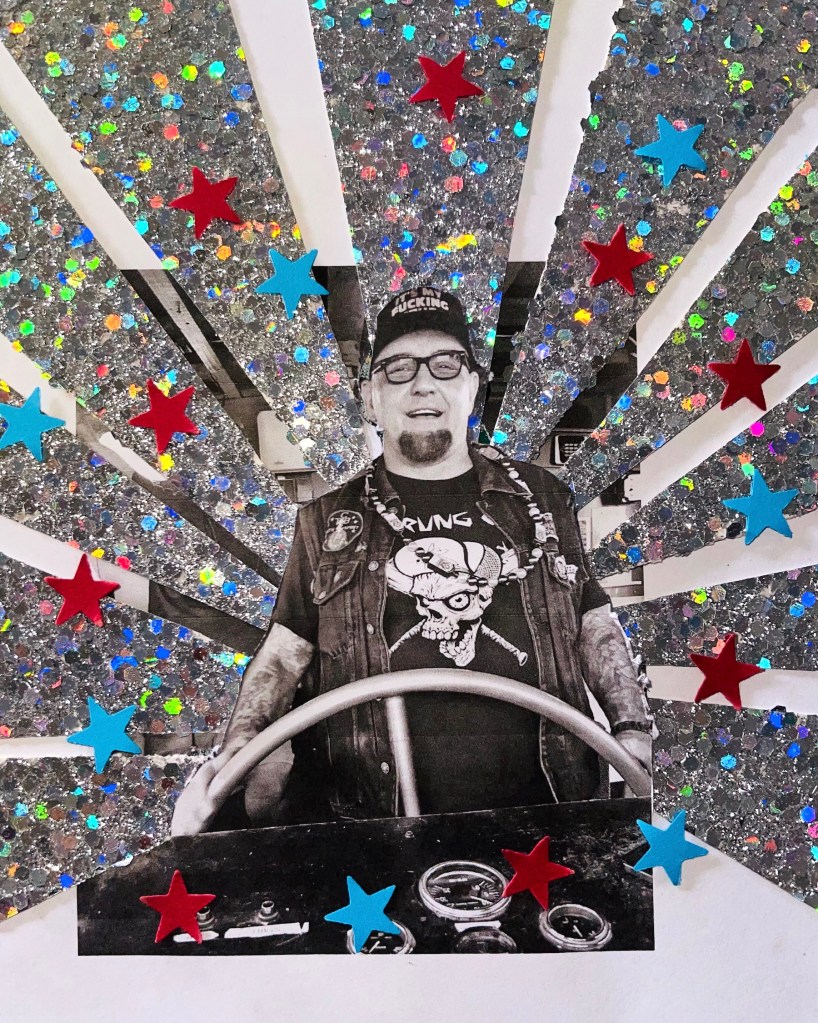
At 60 years old, James Drescher aka Jimmy G, is racing vintage Harley-Davidsons on beaches, jumping off stages, touring the world, hangin’ with his chihuahua cutie, Finley, and laughing louder than most. Speaking ahead of his NYC punk band, Murphy’s Law’s first ever tour of Australia and New Zealand, Jimmy moves effortlessly between hilarious tour stories, deep reflections on mortality, talking about NYHC history and explaining why he’d rather inspire kids to start bands than smoke their first joint.
More than 40 years after Murphy’s Law started playing parties and clubs like A7, Jimmy remains the band’s one constant member. In this in-depth conversation, he talks to Gimmie about friendship, ageing, spirituality, surviving a near-death health scare, the changing hardcore scene, upcoming new music and reissuing their back-catalogue and why, despite everything life has thrown at him, he still believes making people happy is one of the most important things you can do.
JIMMY: We’re doing a new record right now, we’ve been working on it for the past year. It’s been a while…
A while? Only 25 years!
J: [Laughs] Yeah. And we’re doing a deal with Trust Records right now, who’s going to put out our back catalog. We’re hoping it works out, because there’s a lot of legalities around it, but hopefully it’ll be out by next year. It’ll be nice for the new album and all the old records to be out on one single label, under a good trustworthy label.
Yeah. Trust Records do a really great job. All their releases have been killer, from the first release they did of Circle Jerks’ Group Sex to everything else. Good to know Murphy’s Law’s getting the Trust treatment!
J: Yeah, and we’re getting ready to go to Australia and New Zealand. And then we’re doing Riot Fest this summer.
Other than that, I race motorcycles. So I’m getting ready to race in the beginning of October.
That’s awesome. My brother races speed cars. And my dad was celebrated speed car driver in the 60s.
J: Oh that’s great!
Yeah, I’ve been around that stuff since I was young. When I was a kid, my family started the first motorcycle shop in our area. They had a playpen set up out the back in the mechanics area and when all the bikies would come to get their bikes fixed, they’d play with me while they were waiting.
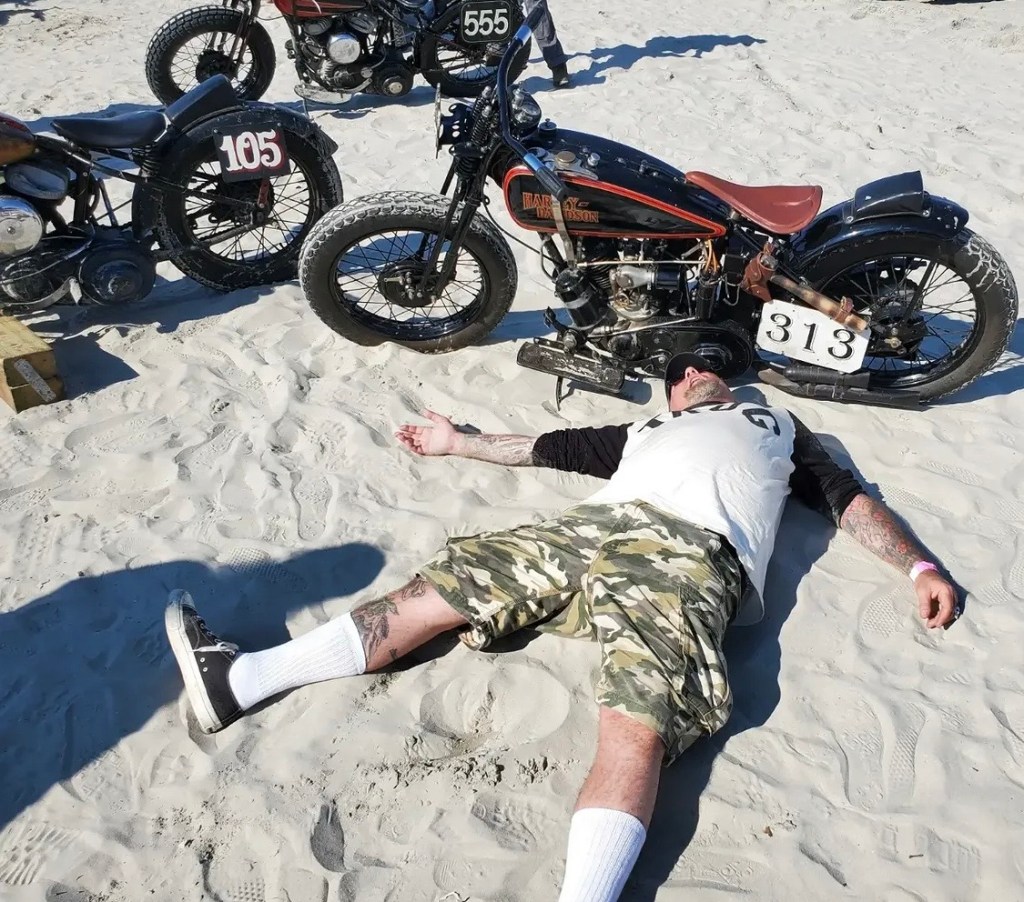
J: That’s really great! I race vintage Harley-Davidsons. I’m actually in Wildwood, New Jersey right now at the beach. I’m out at the ocean [turns camera towards the window], can you see it? I’m racing on that beach. We race with tank shift Harley-Davidsons.
Nice! How did you get into that?
J: I’ve always been into motorcycles, and my friend started this race called, The Race of Gentlemen. I had the opportunity to get one of these bikes designed to race on the beach, and I jumped on it. I’m getting better at it. Every year, I’m a little less scared when I do it.
What first attracted you to motorcycles?
J: Same thing as punk rock—it’s the same stupid, dangerous thing that you shouldn’t do [laughs]. You know, they go hand in hand: motorcycles and punk rock music and hardcore music. You’re on the street, you’re risking your life, you’re having fun at the same time. That’s pretty much it. And it’s just cool!
I know you live above a hot rod shop and that you’ve lived in Astoria, Queens forever; what keeps you rooted to there?
J: I get cheap rent right now. Unfortunately, where I’m living, with the hot rod shop, they’re selling the house, so I don’t really know what I’m doing anytime soon. But the house was there since 1920, and my landlord builds hot rods, so I’m above a garage, a lot of cool stuff. So there’s always something new and cool pulling up in front. And the block I live on, I’ve lived here for 60 years. I can see the Empire State Building from my window. So it’s pretty cool. I’m right by the city.
As far back as the lyrics of your song ‘A Day in the Life’ you’ve been telling the world: Astoria, Queens rules. Why does it rule?
J: Queens is where the Ramones came from. Where Tony Bennett came from. Where Christopher Walken came from… don’t get me started [laughs]. The band Reagan Youth is from Queens; Urban Waste, Kraut; Token Entry; Gorilla Biscuits! Not to brag, but all the best stuff from New York Hardcore and punk music is really coming from Queens. I’m very proud of that.
And it’s very multicultural. They say, there’s more languages spoken in Queens, New York, than anywhere else in the world. There’s more different cultures’ food that you can get in one spot than anywhere else. And it’s just badass. It’s two seconds from the city, you can see it right from your front door.
Cool! New York’s always somewhere I’ve wanted to visit. I’ve been through a bunch of America but never the East Coast.
J: The East Coast is beautiful in its own right. The West Coast is beautiful, very beautiful, but the East Coast has got a lot of different flavour. You could start down south in Florida, and it’s like the Bahamas of America. And then you work your way up to freezing your ass off all the way up north. It’s got a lot to offer. If you go at the right time of year, you can go from 100 degrees to 30 degrees along the whole eastern seaboard. It’s really beautiful from top to bottom.
Before music, what were you interested in?
J: I’ve pretty much been into music since I knew to know anything [laughs].
My grandfather, who I didn’t know, he passed before I was born, was a drummer and he made drums. And I had, there was one picture that I would see of him, I only have three pictures of the man. And his name was James Fioravante, Italian. Lived in Brooklyn, New York. And I had a music studio called Jimmy Pop’s Music Studio. And he made drums by hand and could play pretty much every instrument except for the fiddle or the violin. And I was really intrigued by it.
My mother was very, very into music. My mother always influenced me to listen. I was always listening to music in the house because she liked the oldies and Elvis and such. So I was always listening to the rock and roll in the house.
And my mom was always talking about my grandfather—this man I was intrigued with, who I would never get to meet. I wanted to impress him from the great beyond, I guess. But I wanted to be like him because he seemed so cool and so pure.
Aw, man, that’s so lovely. I’m glad you mentioned your mum—I was gonna ask about her, because I see you post photos of her every now and again. She seems like a pretty important person in your life.
J: She was! She went through a hard life.
What’s your mum given you that is still a part of you today?
J: My personality, and being supportive, understanding and loving, gave me the feeling of being Italian. I’m Italian American, but very much the New York Italian American experience came from my mom. We’d have meatballs on Sunday and sauce and the whole thing.
My brother—my other brother—he didn’t really feel the vibe of being Italian. But it really clicked with me. My grandfather and my mother, made me proud to be who I am. So that’s important.
My father wasn’t Italian, but I grew up in a bar that made Goodfellas look like a beauty parlour [laughs]. I grew up in this very hard bar with gambling guys, and my father was a shylock—not the nicest guy in the world. But I grew up around that whole element my entire youth, in a bar called Coretta’s Bar.
I’d shine shoes in the bar. There were slot machines in there. Guys would still be gambling from the night before, and I’d walk in wearing my hockey uniform on my way to play hockey for the church. I’d go shine shoes in my uniform and make my money for the weekend as a little kid, then go play.
Was the your first job?
J: I’ve worked my whole life. I sold lemonade on the corner, I sold newspapers, I shined shoes, I shovelled walkways when it snowed. Then I got a job fixing elevators, and then I started a band, and that ruined my life [laughs]. Once I started the band, that was it. I couldn’t go to work in an elevator shaft anymore. I started going on tour and here I am, forty-three years later, still doing it.
What drove you to work so early?
J: I needed money. My father wasn’t giving away money, and he was very big on work ethic with me. I had to work. If I wanted extra money, if I wanted a skateboard, I had to work for it. If I wanted a Bee Gees record, I had to work for it. If I wanted anything, I had to work for it.
And the same thing goes for the band today. Everything I do with the band, I have to work for. No one’s really given us anything. But Dave from Vinnie’s has definitely helped us out a lot now. He’s making sure a bucket-list item gets ticked off for me by getting down to see you guys. I’m nervous and excited because I don’t know what to expect. When I got on the plane to Japan, I thought I was going to another world. Now I see how far I’m going to see you guys and it’s like, wow.!
Who or what else inspired you to want to play music?
J: There was a guy, Doug Holland, who played guitar in the band Kraut and later on the Cro-Mags. He was a neighbour of mine and he taught me what music to listen to, and I give him a lot of credit for turning me on to a lot of music.
And Harley Flanagan from the Cro-Mags as well. He and I became friends when we were both very young, and he taught me a lot about music too.
Once I met those guys and they started turning me on to more music, I started going to shows. There was a guy, Jack Rabbit, who was a DJ and he turned me on to a lot of music too. It just spread from there.
The more people I met, the more music I learned about, and the more it drew me into the vacuum of music, the music scene, which is not a bad thing because I have some of the best friends I could ever imagine because of it.
You initially met Doug talking on CB radios?
J: Yeah, before we had these little boxes [smart phones]… Old guy talking now [laughs]… there was no way to communicate. If it was late, your parents weren’t gonna let you use the phone. So we had walkie-talkies and we’d all communicate through them around the neighbourhood.
Then we figured out how to put CB radios on our bicycles, and we’d talk to each other through CB radios. We’d have fights with guys from other neighbourhoods and talk on the CB radios while running back and forth. It was funny. We were nerds with CB radios, running around [laughs].
But Doug would play punk rock music over the CB radio, which I guess is illegal, but that’s how I started hearing it. I was like, ‘What the hell is this?’ Then he and I met up, and he just started playing more and more music for me.
Then when you were around fifteen you started DJ-ing at a club?
J: Yeah, I was fourteen or fifteen, when I really started getting into music and buying records, that’s when I started DJing at A7, which was an after-hours club. Which is pretty funny. I was a bouncer and a DJ at fifteen!
I’ve heard [documentarian/author] Drew Stone talk about A7 and mentioning that “for a hardcore band, A7 was like Madison Square Garden”.
J: I don’t know about that [laughs], but maybe not. The culture we were in was anti-Madison Square Garden. It was more like playing in somebody’s home, not in a big arena. It was much more grassroots than Madison Square Garden.
It wasn’t a cold, empty venue that anybody with a lot of money could play in. It was a place you had to earn the right to play. You had to gain respect to be able to get onstage, and you had to gain respect to not get pulled off the stage and thrown out the door.
So it was very different from Madison Square Garden. It was a very humbling place. Not everybody knew about it, but everybody who did was part of this cultural explosion happening in the Lower East Side, and also around SoHo.
Across the street was the Pyramid Club, and that’s where the whole drag culture was being born. That’s eventually where me and Raybeez from Warzone worked.
So there was this whole little scene stretching from one side of the street to the other that kept growing. The punk scene, and the drag scene. We were protecting the drag queens, and the drag queens were making us laugh and giving us work and security jobs. It was a big family community.
Unfortunately, that neighbourhood is very expensive now, very gentrified. It’s hard to have music like that now, any real grassroots stuff. It’s all twenty-dollar drink bars and fancy food and stuff. And that has its place, but not in that neighbourhood. Unfortunately, it’s been ruined. But there’s still a lot of that as I tour the country and the United States. There’s always a little dive bar and there’s always some little place that sprouts up. It’s like a joyous little wart that pops up with music coming out of it.
Yeah, a lot of people I know get really sad when local venues close. But because I’ve been around the scene for maybe thirty years or so now, you just know something else will eventually come along. And someone will get something together and something new will happen. That’s usually when shit is most exciting, when its forming.
J: Yeah, and a lot of times the people crying online about a venue closing haven’t been to that venue in fifteen years. There’ll be all these people complaining about it.
There’s the CBGB Festival now, and understandably, it’s not CBGB. It’s a festival celebrating what the venue was and the energy it brought.
We played it last year and there was a lot of back-and-forth nonsense online about it. But really, people should just celebrate anything that gives attention to music, especially punk and hardcore.
People say, ‘It’s too expensive.’ Okay, so don’t go. Or, ‘It’s not CBGB’s.’ Well, obviously. It’s just the internet, people get balls of steel online.
Morrissey is headlining this year. I saw that and thought, Morrissey playing with Agnostic Front? Who would’ve thought?!
Let’s see if he turns up.
J: [Laughs] That’s the bet. There’s a betting thing in America where you can bet on anything. You can bet on stuff like whether Morrissey will cancel for the CBGB Festival. People will bet for or against it, and you win money.
I saw people online saying, ‘Oh, so Patti Smith is headlining then.’ Because she was billed right under him.
J: Patti Smith deserves it because she played CBGB’s. Morrissey never did.
Yep. And, Morrissey also did a review of the Ramones bagging them out in 1976, I believe he called them “no-talents” and then in 2014 he did the Morrissey Curates The Ramones release!
J: Yeah, it’s amazing what people will do for money when they’re offered it. Yeah, they’ll back that! [laughs].
You know, Morrissey puts his foot in his mouth a lot, unfortunately, and then doesn’t really back it up with action. He misses shows and lets his fans down. I’ve never really been a fan, but that’s not my forte anyway. I like hardcore punk music. Obviously, that’s why we’re here. So whether he’s there or not, I don’t care. I won’t lose sleep over it. I wouldn’t go see him anyway.
I’m excited, if I’m in town, to see Patti Smith and, of course, Agnostic Front and A Wilhelm Scream. And I want to watch A Wilhelm Scream totally destroy the place, even though the place is made of stone! Literally, where we played was on the Hilly stage in an old stone quarry. There were giant boulders the crowd had to move between. So I’m looking forward to seeing them destroy the stone quarry.
Recently, I was revisiting American Hardcore by Steven Blush. In it, you talk about how, back in the day, there was a lot of chaos, riots, arrests and heavy partying around the scene. Did all of that just feel normal at the time, or did it feel kind of out of control even then?
J: We were crazy punk kids. And as far as doing shows back then, it wasn’t organised like it is now with professional promoters within our community. Now we have merchandisers within our community. We have businesses within our community, which is fine. I think everyone should be able to make a living within our community, and I think that’s a good thing.
Because when this music first started, it was people taking advantage of us. Now our friends take advantage of us [laughs], but it’s within our community.
Back then, though, it was the Wild West. We’d play shows and Nazi skinheads would show up and you’d fight them. Cops would show up because kids were jumping off the stage and they didn’t know what was going on. The bouncers would fight us. It felt like every day was another battle because nobody knew what to expect from it. They didn’t understand it.
It wasn’t on TV all the time like it is now, and you couldn’t look it up in a little box in your hand. It was a threat to people. We looked threatening to people and they didn’t understand us.
Now we do benefits for kids. We do benefits for animals. We’re a community of people who support each other. We love each other and we love everyone around us who loves us back. I’d much rather love than hate. It feels a lot better.
Was there ever a moment back then, where all the craziness that was happening, stopped feeling fun? Were there ever any really heavy moments?
J: When my bass player got murdered, Chuck Valle. We were on tour. He wasn’t in the band at the time, he was out doing sound for a band called Sugartooth. He was in Los Angeles and he got murdered. He got stabbed.
That really took the wind out of me. All of a sudden, you start realising things. Then, as you get older, your friends start dying. So there’s this push-pull feeling of sadness because, as you get older, you see people dropping off, naturally and unnaturally, through drugs and things like that. And now illness. Cancer has taken a lot of our friends.
But then I think about it and I’m like, if I wasn’t doing this, how unhappy would I be? I have my music to make me happy and I have people in front of me who make me happy.
This is like a gateway drug without any drugs involved. I’m going to Australia to make people happy. My job is to make people laugh and have a good time, not to be some lunkhead tough guy. I like to drink beer and have fun with people. I think word got out about that [laughs].
But you know, it’s easy to be sad. I think it’s easier to be happy if you set your mind straight. It’s a mindset. I don’t want to be the cliché guy saying ‘P.M.A.’, but it’s positive mental attitude. You need to keep your head up and understand that life is very short.
If you’re sad all the time, you’re wasting the chance to enjoy life.
Totally!
J: Like, I’m sitting here looking at the ocean as I speak to you. I’m at a hotel taking a break with my girlfriend. The ocean’s right there. You can see it from here.
You’ll love the town, Gold Coast, I live in. You can walk to the ocean from Vinnie’s Dive. It’s really beautiful. You’re going to love it.
J: But you guys get sharks that jump out of the water and shit, right? Don’t you?
Out from shore they have shark nets, so it lessens the chance of sharks coming near where you swim.
J: Shit, if you got to put up a net to protect me, I’ll go in the pool.
Ha ha!
J: I’m so excited to go there because everything I love is in Australia. I love Mad Max. I love sharks. I love The Saints. I think you guys have platypuses and wombats. You guys have all the stuff I love. Kangaroos.
There’s a big mob of kangaroos that live down the end of my street and they come into the park near my house. Sometimes there’s up to twenty of them!
J: I heard they’re kind of scary or they can punch you. That they get up and get in boxing stance. I’m more of a wombat guy in my older years now, they’re little chubby teddy bears.
They’re one of my favs too! I heard that one of your all-time favourite songs your whole life is ‘Dancing in the Front Lines by The Stimulators.
J: Where did you get all this stuff? This is great, I’m impressed.
It was about us in the front line. And this was before there were mosh pits, mind you. He called it ‘skanking’. We’d knock the seats out of the way and get up the front, and they’d do the ‘dancing in the front line’. And Harley Flanagan would jump over the drum kit and grab the mic and sing. That was when Harley played drums, which I think he does best. The Stimulators really changed my life too. Did you ever see that band? They were amazing.
I read that Murphy’s Law formed at a party?
J: We formed and then played a party. We only had, like, two songs. It was this guy, Giorgio Gomelsky, who managed The Yardbirds and The Rolling Stones and bands like that. He had this art space, and Jesse Malin’s band Heart Attack was playing, and I believe Reagan Youth too.
It was New Year’s Eve and they let us jump up and play some songs. We played the two songs we had and everybody wanted to hear them again, so we just kept playing them over and over. Then we did a cover of (I’m Not Your) Steppin’ Stone and that was it. The rest was history.
Do you ever get nervous before you play?
J: Every time I throw up before a show, I still get scared.
Really?
J: Yeah. And I feel like if I’m not nervous, or if any entertainer isn’t nervous… I don’t really consider myself much of a singer. I entertain people and I make people happy.
I think with any entertainer, if you’re not nervous, you probably shouldn’t be doing it because you’re overconfident. And overconfidence kills capability.
If you’re overconfident, you think you’re cool, and you’re not. No one’s cool. We all fuck up, we all make mistakes and we all make fools of ourselves. And it’s very easy to do that when you’re standing in front of a group of people with an amplified microphone in your face.
So yeah, it’s scary. I want to make sure that when I get out there, everyone’s laughing, everyone’s having a good time, everyone’s smiling, everyone feels as important as I feel on stage.
And when they leave, for that hour we’re up there playing, they’re not thinking about politics, they’re not thinking about what side they’re on, they’re not thinking about religion or bills or any of that stuff. They’re just enjoying the moment they’re having with me and the band.
It’s not about being afraid or angry. They should be laughing and having fun the whole time.
So being present and being in the moment?
J: Yes. Thank you. Very, very, very, very Buddha of you [laughs].
Ha! I did a whole project where I interviewed people from the very beginnings of punk like Suicide, Ramones, Devo, The Clash, The Saints and more, all the way through to people still carrying the torch today, about creativity and spirituality and navigating life on your own terms. It took me 20 years.
J: Wow, that’s impressive. Doing it on your own is very difficult because there’s no retirement plan for this and there’s no pension plan for this kind of life.
Now I’m sixty, and I have friends in their seventies still doing it. But what do you do? I can’t really see it going much further than seventy for me.
I mean, Charlie Harper from UK Subs is, I think, eighty-two now, and to me he’s still completely valid.
But now it’s the scary part, because you start wondering when it ends. The end isn’t too far away for what I do, because I don’t know how many more years I can keep doing this. So while I still can, I’m trying to do as much as possible.
I hear that! I try to get as much out of each day as possible too. Humour feels like a really big part of how you move through the world. Where did that come from?
J: Because I had a very hard childhood. I was picked on at school, beaten up at school, beaten up by my father. I had a very sad life when I was a little kid.
Then I found music and found a scene full of other kids who felt the same way I did, and it made me feel better. I realised that making fun of things and having fun with things felt a lot better than being scared and sad and afraid.
And I had a community of people around me watching out for me and supporting me. The hardcore punk community is very… well, obviously I’m talking to you in Australia, so it’s international now. It’s all over the world. It’s a great thing. It’s a very powerful thing and a very supportive thing.
Any interview I’ve ever read with you, no one ever really asks you about songwriting, I’m curious about that.
J: I’m not much of a songwriter. Most of the good stuff is written by other people [laughs], but the dumb, funny shit is written by me. Like ‘Fun’, ‘The Beer Song’ and ‘Crucial Bar-B-Q’. The fun stuff I write; the more serious stuff, other guys have written. I’m a terrible songwriter. I’m better at singing and making fun of them than writing songs.
For the new record, myself and Brendan—my bass player—it was just me and him. I’d come up with a title or a verse, and we’d go back and forth via text and build the song like that. He’s really good at structure, and that was where I was failing with the band. I didn’t have members long enough, or strong enough, to help write structure. So I could jot down all the stuff I wanted, but you need verse, chorus, verse, bridge, outro—and I couldn’t get that shit together.
Now Brendan and I have this record done. We’ve finally got 19 new songs, and now we’re doing another record, like a 10-inch EP. It’s going to look like a bootleg show flyer, and every band name is a song on the record. So there’s going to be a song called Agnostic Front. There’s going to be a song called Cro-Mags. There’s going to be a song called Reagan Youth. There’s going to be a song called Killing Time. Songs named after all our friends’ bands. Not necessarily about the bands themselves—the song titles are just the band names.
Are there any particular songwriters that you always go back to, that you think are really great?
J: My favourite songwriter is one of my best friends: Jesse Malin. He played in the band Heart Attack, and he’s one of my best friends. The way he writes—that’s impressive.
He’s just put out a book and has been doing this off-Broadway play about his life and telling his story. He wrote all of it. He writes a lot of songs. He wrote a song about our friend Howie Pyro called ‘Hollywood Forever’, and I did the ‘woo-hoos’ on it. Howie Pyro played in D Generation with him.
I’d say Jesse’s my biggest songwriting influence. He’s great. And the fact that he can get on stage by himself with an acoustic guitar and sing a song—huge balls to do that. I could never do that. That’s insane. Any folk singer who can get up there and perform acoustic by themselves with just a guitar—that takes an amount of courage I can’t gather. I can’t do it.
I saw that Jesse’s producing your album.
J: He’s executive producing it along with Brendan, and there are a lot of people involved in this record. We started recording it at Flux Studios—which is The Strokes’ studio—and we’re literally about four blocks from A7. So I wanted to make sure it was in the proper area. I wanted to record a New York record in New York. A lot of bands talk about New York hardcore and they don’t even live in New York. I live in New York, and I’m proud of it.
Then we did some of the other vocals at Little Steven’s studio from Bruce Springsteen’s band, which is pretty cool. And then we did everything else with our guitar player, Phil Caivano, who also plays with Monster Magnet. So we’re finishing it up with him now.
We’ve got a real star-studded event happening. Now we’re at the mixing and mastering stage, and we’re trying to figure out what we’re going to do there, because that’s a really important part of the process.
Sounds like you have a lot going on! Murphy’s Law hasn’t had a new release in a long time; why now?
J: It’s been time. It’s been over 20 years I’ve been trying to do it, and we actually have almost a whole other album recorded that I just didn’t like.
What didn’t you like about it?
J: It just wasn’t up to par with what I want people to hear, especially since there’s been such a long gap in time. I want it to be good. I want people to really like it. I don’t want to just throw some shit at the wall and see if it sticks. I want to make sure it’s good—a quality thing.
We also have another covers record coming out, a compilation of cover songs. It’s pretty funny. We did some interesting stuff. We did ‘Time’ by Pink Floyd, we did ‘Nice ’n’ Sleazy’ by The Stranglers, and ‘Zoom’ from the kids’ TV show. It’s all stuff we compiled throughout the years from people asking us to do songs for compilations. I took all of them and made a compilation out of it myself.
So that’s going to be called Covered, and the cover art is going to be a Waffle House. Waffle House is a crazy place to go after a lot of partying, so the cover is literally a riot in a Waffle House, with me running out of it.
And now the cover for this one kind of works as a storyboard with the cover for ‘Go Jimmy Go’. The idea I stole from Circle Jerks—they had a 1982 tour poster with the van and the Circle Jerks skanker running.
So on ‘Go Jimmy Go’ it’s me running while the van’s chasing me. Now, on the Covered artwork, the van is parked, all the people who were chasing me are inside rioting in the Waffle House, and I’m running out of the Waffle House.
The art was done by an Australian artist?
J: Yes, Mick Lambrou. I’m psyched. He’s become he’s the house artist for New York Hardcore now.
For the ‘Go Jimmy Go’ art there’s a van of people chasing you; tell us about the symbolism of the people chasing you.
J: Yeah, you’ve really got to look at everything. That’s why so many bands put such bullshit out—they’ll just use a picture of a foot or a boot or something [laughs].
When somebody holds the product in their hand—and a record is a product, I’m sorry to say; most people think we should give everything away—but no, we sell it. And when I sell something, I want people to be happy with what they’re buying.
When you buy the record, you’re holding a piece of artwork in your hand. I want somebody to look at it and be able to spot little details, like: ‘Oh look, there’s a little rat being chased by a pigeon,’ or ‘Oh look, there’s Vinnie Stigma standing in the doorway.’
There are all these little ‘Where’s Waldo?’ moments of hardcore music. Like, ‘Oh, there’s the Killer Beer fighting the Murph Man.’ You’ve got to sit with it for a while. You can’t just glance at it and be done with it. I like doing that.
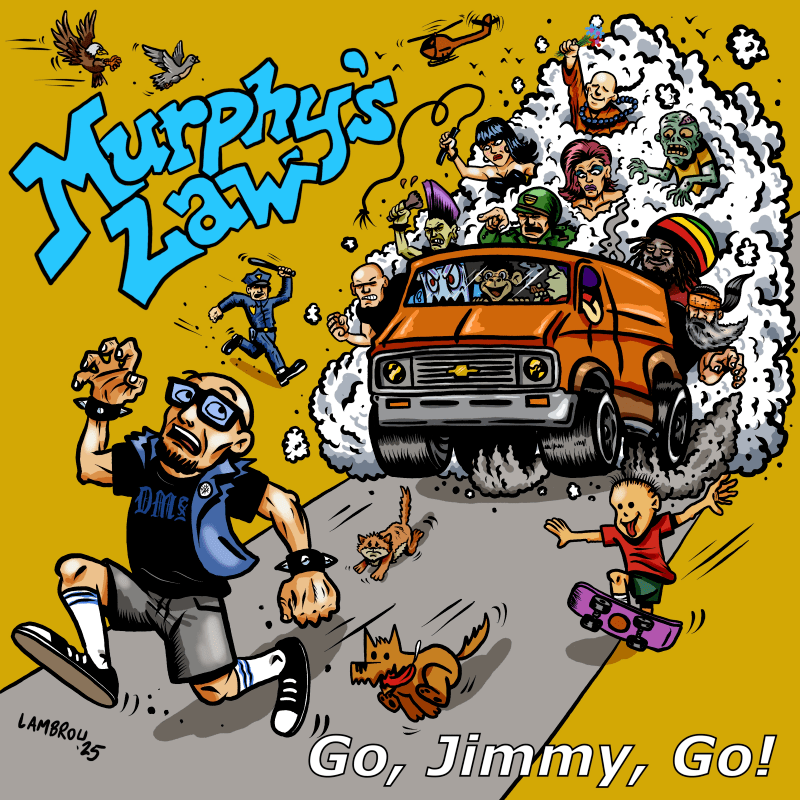
I noticed there a Hare Krishna guy in there.
J: That’s the running joke in our song ‘Crucial Bar-B-Q’. We have the line: ‘Hare Krishna, stay away, ’cause 18 bands are gonna play.’ It was just a poke at my friends, because there was a time when Hare Krishna got into the hardcore scene.
Ray Cappo is basically like a Hare Krishna monk now, and that’s great. But when you’re a little kid, you don’t understand shit and you make fun of it. Now I’m a big kid, and I know and understand it—and I still make fun of it [laughs]. But I love Ray.
I love all of Ray’s bands. But still to this day, Ray’s the only person who’s ever charged me to do an interview them.
J: What? That’s disgusting.
I paid it because I really wanted to chat with him because his bands have meant so much to me over the years. I sent him a big email telling him that. Then he charged me the equivalent of a private yoga lesson. I still have a photo copy of the International bank transfer I sent, at the time it was a lot for me to afford.
J: Honestly, though, I think Ray’ll do good with whatever money you gave him, because he’s not an idiot. He’s a spiritual guy, he makes people happy, he makes people healthy, and he’s a very positive person. That’s really funny, though. That killed me! [laughs].
Over the years, it seems like weed’s been a pretty big part of the Murphy’s Law universe—Bong Blast Demo, Back with a Bong and Beer, Smoke and Live…
J: Not as much on stage as it used to be. I try to clean things up on stage now, especially with much younger kids coming to the shows. I don’t want to be the influence that gets kids to have their first drink anymore, and I don’t want kids smoking their first joint with me.
I don’t want to influence underage kids to use drugs or drink. Honestly, this is probably the first time I’m really saying this, but I’m not comfortable with it anymore.
What I do in my own time is my own time. But I don’t want underage kids at my shows watching me drink and get fucked up and then thinking, ‘Wow, look, Jimmy’s cool doing that. Let me try it.’ I don’t want to be that guy.
I want kids to want to sing, or play bass in a band, or drums or guitar, or sell shirts and make shirts and be part of the community—not part of the problem. And I think drug use and drinking can be a problem. It’s been a problem in my life. It’s fun until it’s not. And I don’t want to be the guy who introduces a kid to it for the first time.
I love that. Nice work Jimmy.
J: There are a lot of bands that are the complete opposite of that. And obviously, I smoke—I’ve smoked all my life—but I don’t encourage it. I don’t want to be responsible for somebody going down a bad path, because for some people it’s just not good for them.
We’re getting offered shows with The Aquabats, and they were basically like, ‘Jimmy’s just got to do G-rated shows.’ Why do you think they call me Jimmy G for “Jimmy G-rated” [laughs].
The litmus test was when we did shows with The Interrupters. They’ve got a really young crowd too, with parents bringing their kids and everything, and it went well. People loved it when I was bringing kids up on stage.
You can still have fun without bringing a giant bong and a keg of beer on stage. You can have fun with kids and influence them into the community of making music—and that’s important.
I saw a picture on your Insta—it was from when you went to Jamaica. You were standing next to a Rasta guy with all these “trees” around you. I was wondering if you could tell me a little bit about that trip.
J: Sadly, the ganja man just got hit by a car. One of my best friends, Glen, owns a little hotel place across the street called Seagrape, and that’s usually where I stay because I get the hookup. The ganja man is right across the road. There’s a ganja man across the road everywhere in Negril [laughs], but he’s our ganja man.
Somebody was driving like an idiot down this little road (they drive crazy there) and he got hit by a car. So I’m really hoping he’s okay.
He grows organic ganja. He’d be like, ‘Do you want the mango ganja?’ and he’d grow giant plants surrounded by mangoes, or oranges, or all these different organic fruits and stuff. This literally just happened recently, so I’m hoping he’s alright.
I was right on the corner where he sits and smokes weed all day. He smokes weed and listens to music all day. He doesn’t deserve that shit.
But going to Jamaica is really amazing. I love going there to buy records and stuff, and I just love the whole culture. It’s a beautiful place, and it’s a sad place in its own way too.
You go there and some people are living very humble lives. Almost like they have nothing—but at the same time, they have everything they need. They wake up in the morning, grow organic vegetables, listen to music, make music, swim, go up into the mountains—that’s their life.
But there are also a lot of incomplete homes there. People had dreams that went beyond what they could finish. As you drive through the streets of Jamaica, you see a lot of incomplete dreams. That part is kind of sad. I really wish people the best there.
And now they keep getting hit with these storms. It’s hard. But there are so many wonderful people there.
You mentioned earlier that you turned 60, last year.What did that mean to you to get there?
J: I know I’m on my way out soon, so I’ve got to have fun.
It was intimidating, that’s for sure. It’s kind of scary to be 60 and not feel 60 or live like you’re 60, and then see people on TV who are like, ‘Yeah, I’m 58,’ and I’m thinking, ‘You look like you’re 80.’
It really shows how you live your life. Not necessarily eating healthy or anything—because I definitely don’t do that—but how keeping yourself happy keeps you healthy in your head. You stay younger by being happy, having fun with your friends and making music. That’s for sure.
Every year for my birthday we do this boat trip around Manhattan. We rent a boat, go around the Statue of Liberty, and one of our favourite friends’ bands opens for us. It’s like a three-hour trip—we go under the Brooklyn Bridge—a very New York experience.
What’s one of the most like 60 year old things you’ve caught yourself doing recently?
J: Rolling out of bed now instead of jumping out of bed [laughs]. The spirit is strong—the knees are not.
I’m constantly getting massages, constantly getting injections in my knees and hip, because of the motorcycle racing and because I still jump off stages like an idiot.
I’m not going to stop doing the things I love until I absolutely have to—until I physically can’t do them anymore. Once I stop, that’s when all the pain kicks in from jumping off balconies and all the dumb shit I’ve done over the years. That’s when it all catches up with you. A rolling stone gathers no moss, and I don’t want any more moss growing on my ass.
You’ve had a lot of health challenges over the years; has that changed your perspective on anything at all?
J: It’s scared the shit out of me!
Last night I got really sick again. I’ve had this infection in my kidneys that keeps going into my bladder, and it just won’t seem to go away. I’m on all these different antibiotics.
The funny thing is, when I came home from tour, I stopped drinking. I was like, ‘I’m not going out anymore. I’m not going to the bar. I’m only going to drink when I’m with the band.’ I wanted to focus on getting this record done because all of a sudden I’ve got a lot of work to do, a bunch of records coming out and a lot of responsibility on my shoulders.
Then I got sick anyway. My body was basically like, ‘Alright, fuck you.’ The infection wasn’t clearing up and the antibiotics weren’t kicking it. Yesterday I got in some bad shape again. As you can see, I’ve got sunburnt. I was out in the sun yesterday, and I don’t know if the heat just kicked my ass or what, but I was really not doing well. I’ve got to go get antibiotics again today.
As we get older, our parts start to fail. We run out of warranty. That’s when you really have to start focusing on maintenance, drinking fluids, taking vitamins and all that stuff, because God knows I’ve abused my body in more ways than one.
And it breaks my heart seeing some of my friends get cancer. I think about all the drugs I’ve done and all the horrible shit I’ve done to myself, then I see people who’ve been vegan and super healthy their whole lives getting fucking cancer anyway. It breaks my heart.
I get angry about it. Angry at whoever, or whatever, God is for letting this happen. It sucks. Cancer’s taken a lot of my friends recently.
Same, I’ve lost loved ones to that too. It totally sucks. I remember my dad telling me as a kid, that one of the lamest things about getting older is that you start to see all your friends pass away. For my dad, it got to a point where he no longer looked at the obituaries in the paper because everyone was gone. You wrote the song ‘Faith’ and even back then you were saying that you don’t really believe in God?
J: It’s kind of hard to believe in God when you see children being abused, or when you see the atrocious ways humanity treats each other.
I don’t want to be that guy right now, but it’s like, if there is a God, why is that God allowing this to happen?
People spend too much time looking up at the sky, waiting for something that never responds. What you really need to do is look at the person standing in front of you. That’s where spirituality comes from. We’re all spirits in our own right.
We’re here by magic. We live on this little fucking rock with this tiny membrane around it that keeps us alive. It’s a miracle.
And what do we do? We spend trillions of dollars on weapons to destroy each other. It’s fucking dumb. We should be saving each other, living and loving, not killing.
Talking with you, I get a sense that you’re an optimist; would you agree?
J: Very much so, very, very much so.
Murphy Law’s been around for over four decades, you’re the one constant member.
J: I’m not good at anything else!. This is the best I do. Bad time to become a baker [laughs].
Is there any particular members of your band that were hard to lose?
J: It’s like asking a lizard if losing its tail was hard. Another tail grows back [laughs]. I’ve never said that one before. That’s a good one!
A member leaves, another member comes in, and it becomes a new experience. Every person adds something different. Honestly, some of these songs were terrible when we first wrote them 30 or 40 years ago. But then members started families and left, got jobs and left, started some other stupid band and left, and new people came in with new flavour, new sounds and new ways of playing the songs. Everything kept evolving because of it.
Granted, it’s hard when somebody leaves, especially right before a tour. But anybody who runs a business, or anything where you rely on people, deals with the same thing. It’s just part of it.
Through the band, though, I’ve made friends I’ll have for the rest of my life. Vinnie Stigma has been my friend forever. Roger Miret and all the guys from Agnostic Front, that’s family to me. It’s a blessing.
When a member leaves, it hurts, but sometimes it’s for the best. Sometimes they’ve bought a house, or they’re moving their recording studio, like my guitar player Phil Caivano is doing right now, and they’re moving on to bigger and better things. That’s a blessing for them, and it’s nice to see.
But when somebody’s doing something dumb and leaves the band, that hurts. When they’re getting too fucked up and they’ve got to go, that’s when it sucks. When they’re moving on to something better, though, that makes me feel good.
I’ve never read anywhere, why you actually called your band Murphy’s Law in the first place?
J: Well, that’s pretty much fitting, because anything that can go wrong will go wrong. Especially with a band. If the band’s not messing up, then a show gets cancelled, somebody gets sick on tour, the cops shut the show down, you don’t get paid. There’s always something going wrong on tour.
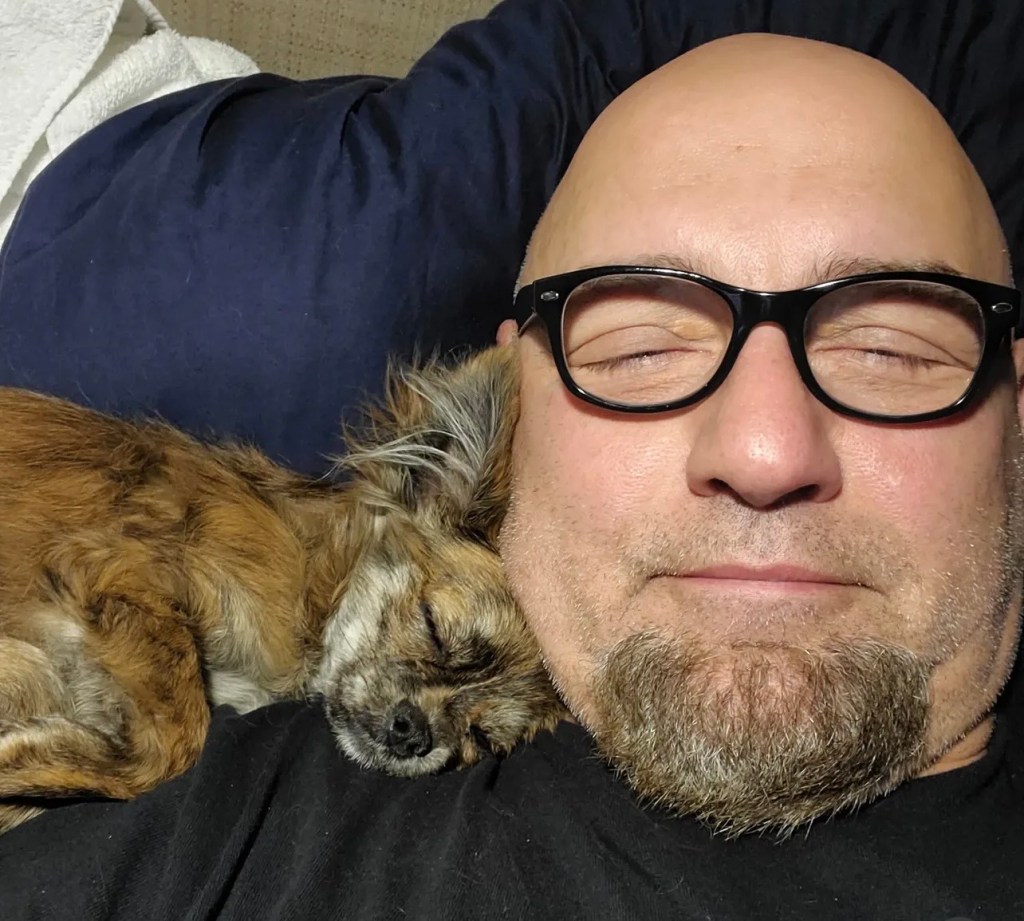
Lately, though, things have actually been going right, which is good. And now I’ve been touring in a camper, which has been great because I can bring my puppy with me. I’ve got a little dog named Finley, so he travels with me in the camper. We make pasta, cook food and just hang out at camp.
I’ve noticed that throughout your life, there’s always been like dogs present. What do you get from dogs that you can’t get from anyone or anything else?
J: My dear dog, spelled backwards, is God! [laughs]. Dogs are the purest souls there are. They’re amazing. I couldn’t imagine my life without them.
Same! Has there been an experience that’s really changed you?
J: It’s kind of hard to talk about. There’s a movie that Howie Abrams just did with my friend. A bunch of my friends did it.
Heavy Healing?
J: Yes, Heavy Healing. It was about an incident where I ended up in hospital and they destroyed my urethra with a catheter. I wound up with a septic infection and was basically dying in the hospital.
What should have been an overnight visit turned into over a month, and I’m still dealing with issues from it to this day. It really messed my life up for a while.
It also showed me who my real friends were. That’s why I always say you find out who your real friends are when you’re moving house or when you’re in hospital. That’s when you find out who actually shows up.
And it’s sad when you realise the people you thought were your closest friends aren’t really there for you. The people you think you can rely on most don’t come to the hospital or help carry a box when you’re moving.
But that’s part of life, and in a weird way it’s a gift to learn that. A lot of people go through life without really seeing it clearly.
It was really scary for a while. I honestly thought I was going to die. I always expected I’d die young, but when it actually felt like it was happening, when my blood was full of infection and I was lying there dying, my reaction was basically: ‘I don’t want to die. I’m having too much fun right now. This is a bad time to die.’
But it gave me a new lease on life. That’s why I want to race motorcycles as much as I can, play as many shows as I can and keep writing music. I’m gonna ride this donkey until it runs off the cliff.
Thank you for sharing, Jimmy. I totally get that. What’s something that’s made you really, really happy lately?
J: Well, going to Australia and New Zealand is a big one for me!
We started out playing on street corners and in the back of bars, and now we play all over the world. From little stick-in-the-wall places to giant stadium crowds. Sick of It All are doing the same thing, and I’m praying that Lou Koller gets better so he can get back to doing it too.
Same! We love Lou! I first met him almost 30 years ago!
J: Awesome. It’s a blessing to go from where we started to where we are now. I’m going to fucking Australia and New Zealand on the other side of the world. I’ve played Japan, I’ve played all through Europe.
We were just morons making stupid songs for fun, and now I’m travelling the world making people happy. That’s a blessing. I’m a happy place right now, for sure.
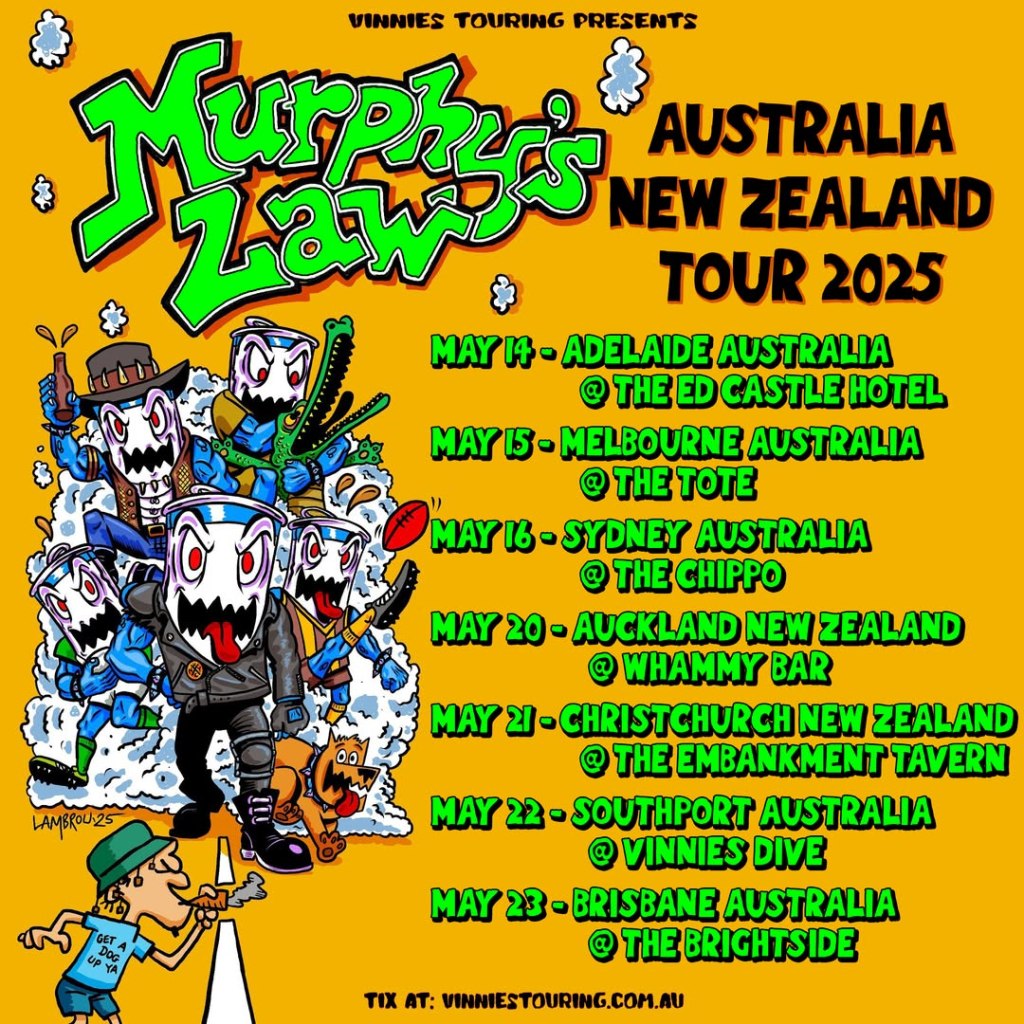
Follow @murphyslawnyc. Check out TRUST Records for future updates about the ML reissues. Tour info & tickets for the Australia/NZ tour via Vinnie’s Records.

