R.M.F.C.’s Buz Clatworthy: “Most of my favourite music was made by people who didn’t really know how to play”

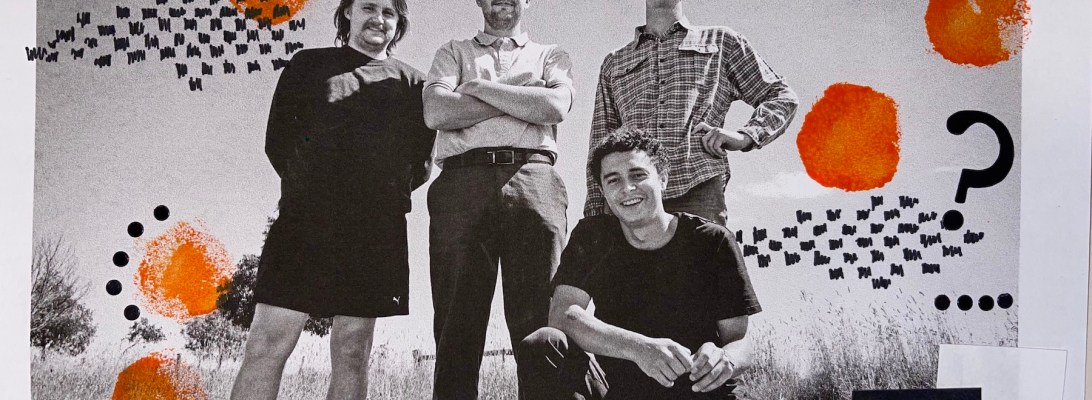
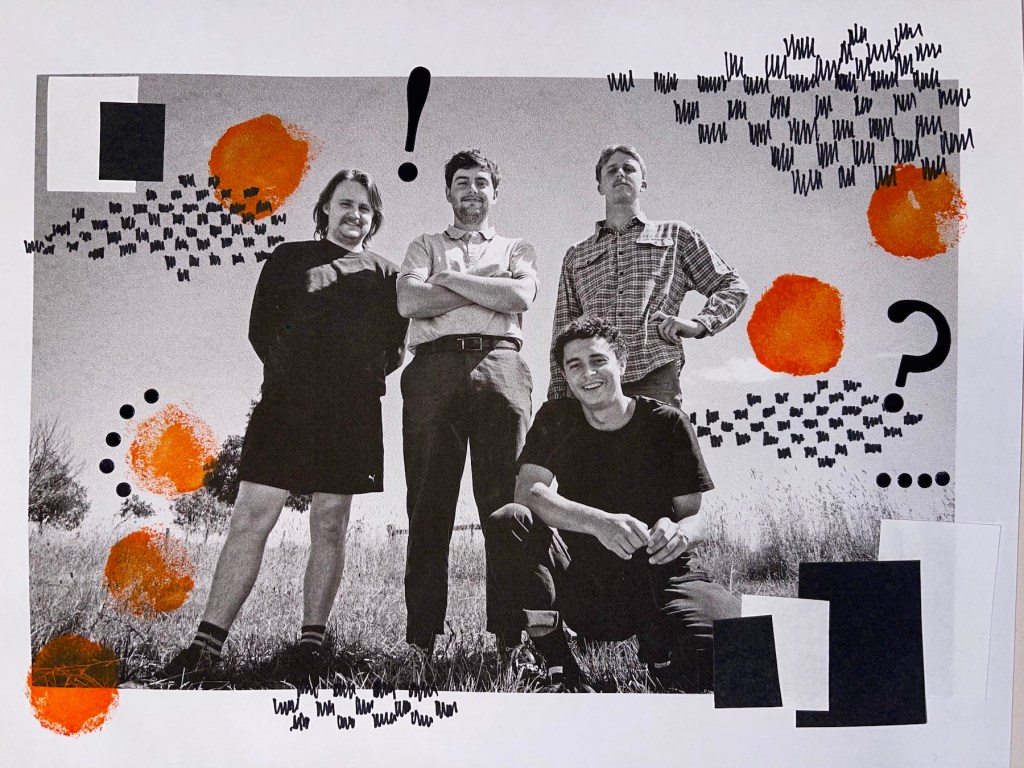
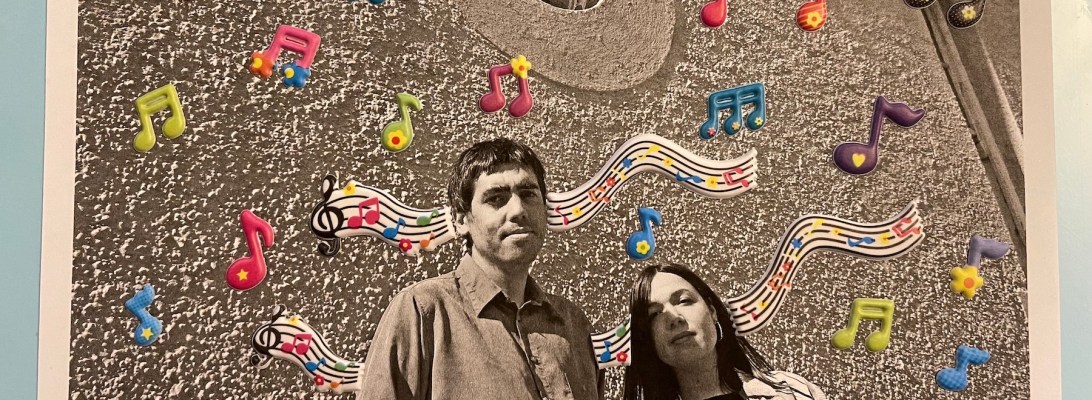
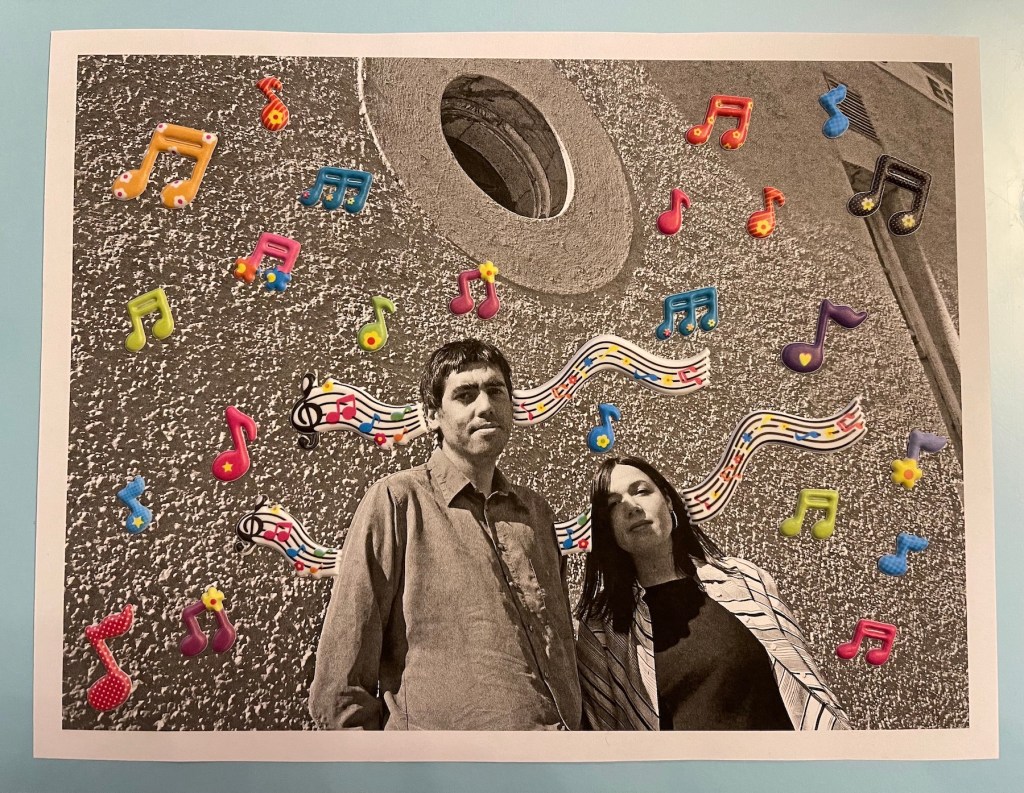
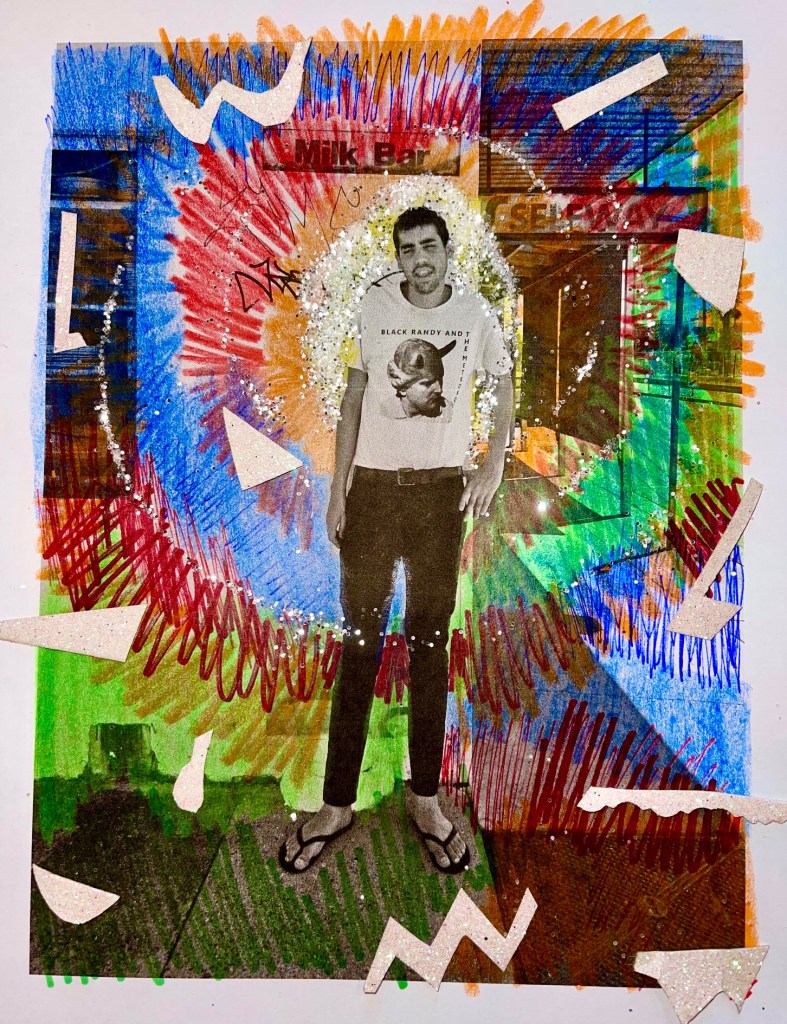
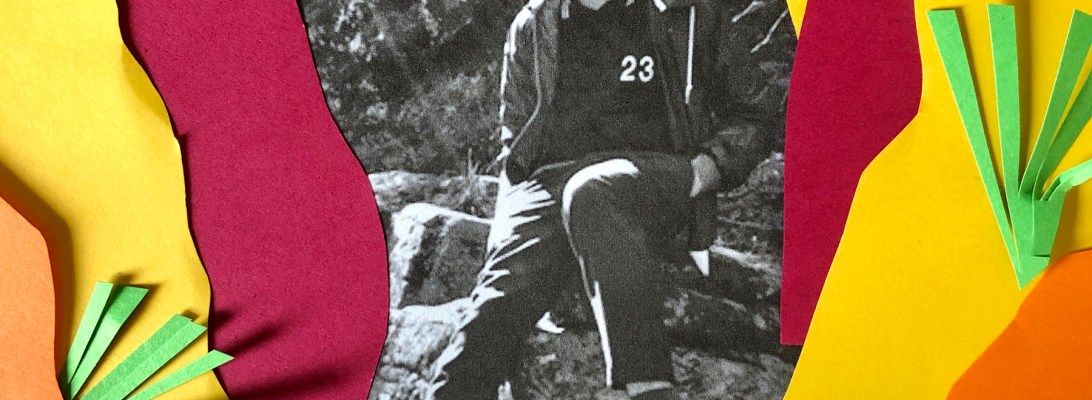
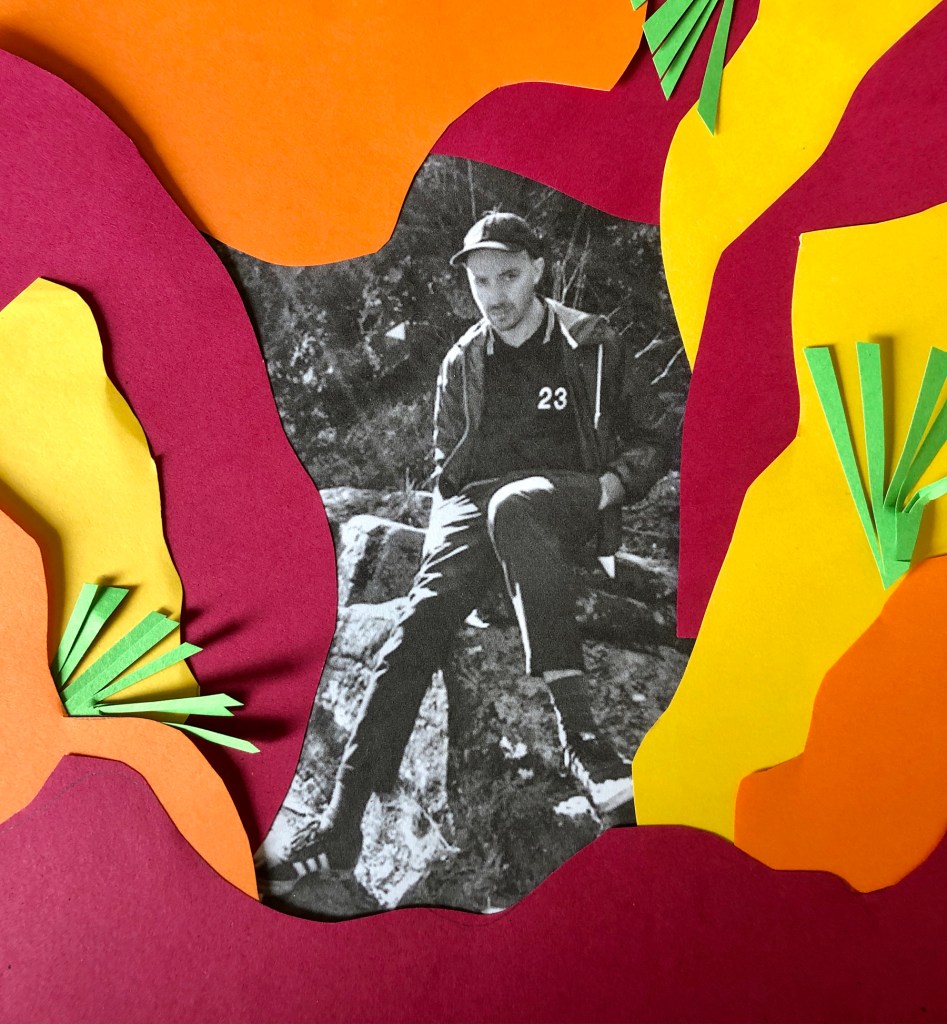
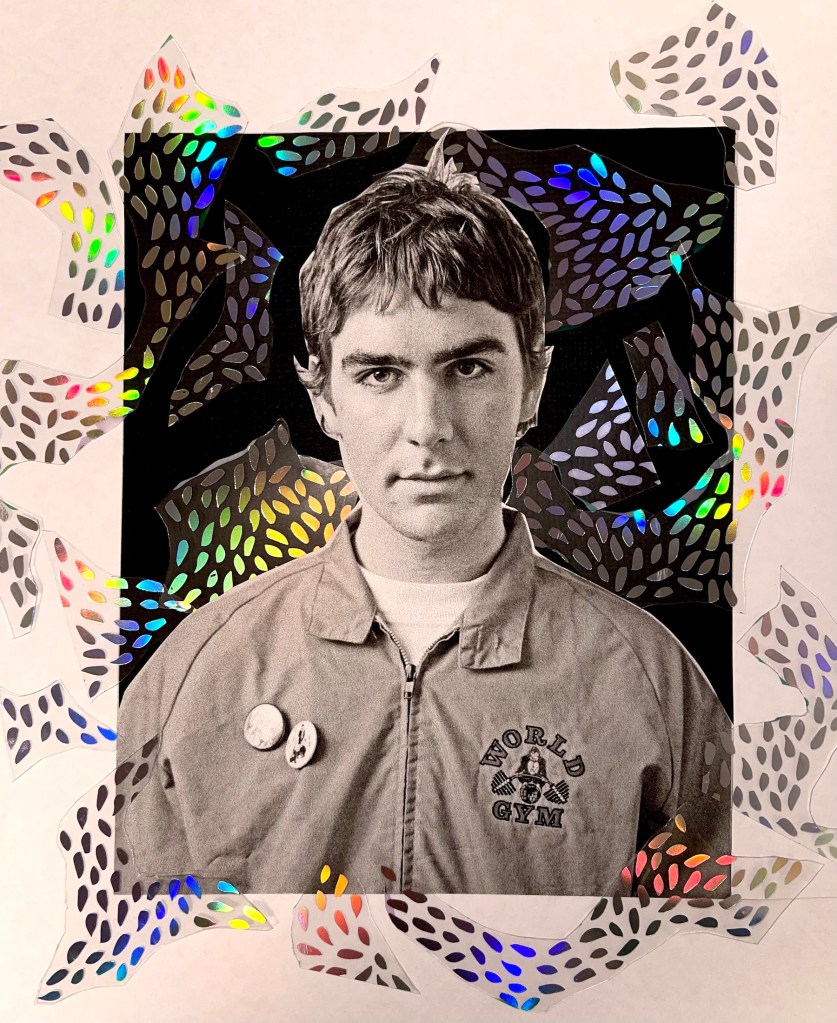
Original photo: Alex Wall. Handmade mixed-media collage by B.

We’re excited about the new R.M.F.C. 7” Access! Its addictive, energetic garage rock jangle with anarcho-punk drumming, and infectious melody. The combination is dizzying and sees R.M.F.C.’s sound transcend influences and fast track into a fervent lane of its own. The addition of 12-string guitar into the band giving us a fuller sound. Buz’s songwriting has taken leaps and bounds from first release Hive. This taster of things to come has us waiting with bated breath for the full-length album set for release in 2023.

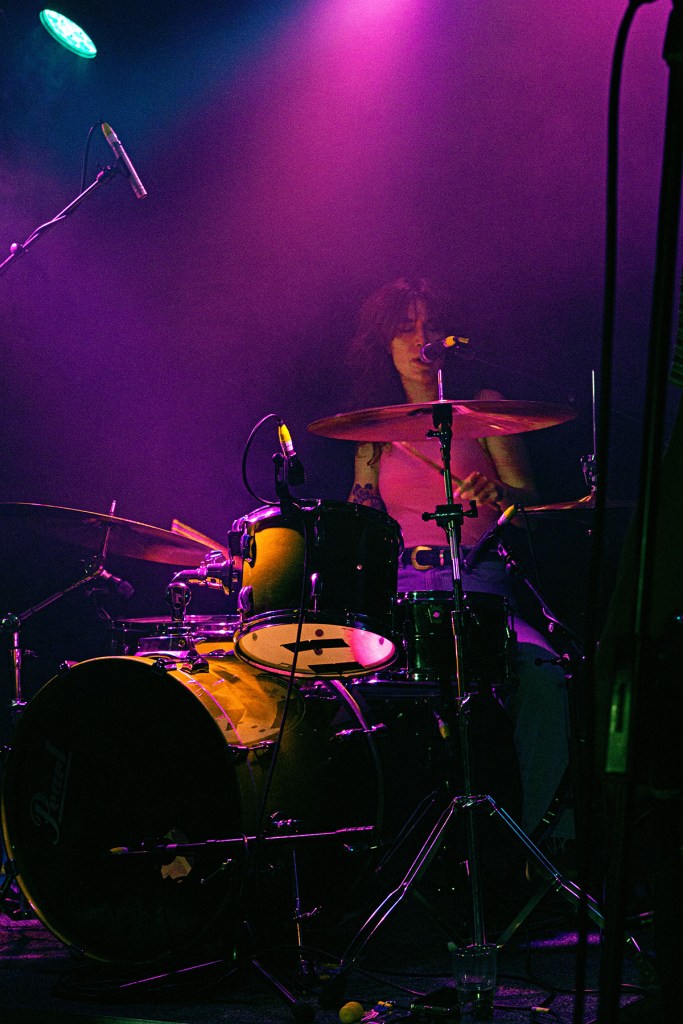
Whenever we see you play live, we’re always in awe of how great everything sounds. Playing the drums while singing isn’t an easy thing to do; what was it like for you when you started doing it? What helped you get better at it?

BUZ CLATWORTHY: It was difficult at first when the original live band formed but I’ve always found it way harder to play guitar or bass and sing than I have drums; drums have always been my main instrument. I think it’s maybe something to do with the way my brain works that drums just make more sense to me, but in saying that I’ve never gotten very deep into the technical side of things, my style of playing is very simple and straightforward.


Aside from naturally getting better at it by repetition, I’ve got some little cheats to make it easier like adding breaks in the drums when I structure new songs. My drumming & singing role in the live setting definitely had a part in informing how I wrote the newer songs. I think the very blocky/rhythmic phrasing of my words also helps a lot cause it slots in with what my limbs are doing on the kit. 
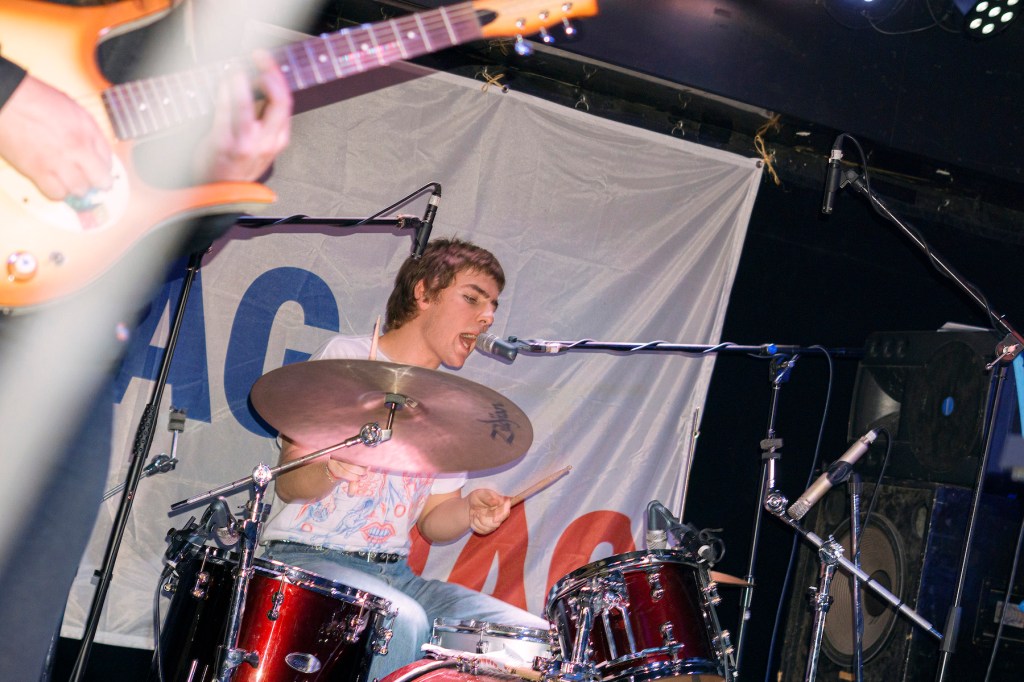
Photo by Jhonny Russell.

Are there any drummers, vocalists or songwriters that you’re inspired by? What do you appreciate about their style?

BC: Stephen Morris of Warsaw/Joy Division/New Order, Laurence Tolhurst from The Cure and whoever drummed on the first Gang Of Four album. Those three all have a similar snappy drum sound & semi-robotic feel and were big inspirations in my formative years style-wise. As most R.M.F.C. songs are built around bass lines, Klaudia Schiff from Kleenex/Liliput and Peter Hook from Warsaw/Joy Division/New Order are very important songwriting inspirations. I love their use of the bass as a leading instrument, the bass lines are what make most of my favourite tracks by those bands. 

I was talking with Kel from Gee Tee the other day and he mentioned that when you look back on your earlier releases you can really hear some of your influences coming through. You’ve been writing and making a new R.M.F.C. album; were you mindful of influences coming through for this one? How do you feel your sound had developed for those earlier releases?

BC: Yeah, being mindful of influences coming through is always something I keep in the back of my head when I’m writing/recording songs. There are definitely still subconscious attempts here and there to sound like whatever I’m enjoying listening to at the time but I always maintain a conscious effort to just sound like R.M.F.C. It’s usually more an attempt to replicate what I enjoy about the actual sonic aspect of older bands I like now.


For the earlier releases, I never thought anyone would care much for what I put out and I just wanted to make what I thought was cool at the time. When I listen to the Hive 1 & 2 releases now I just hear 17 year old me trying to sound like Jay Reatard and The Coneheads and that’s basically what it is, I was obsessed with bands like that. 
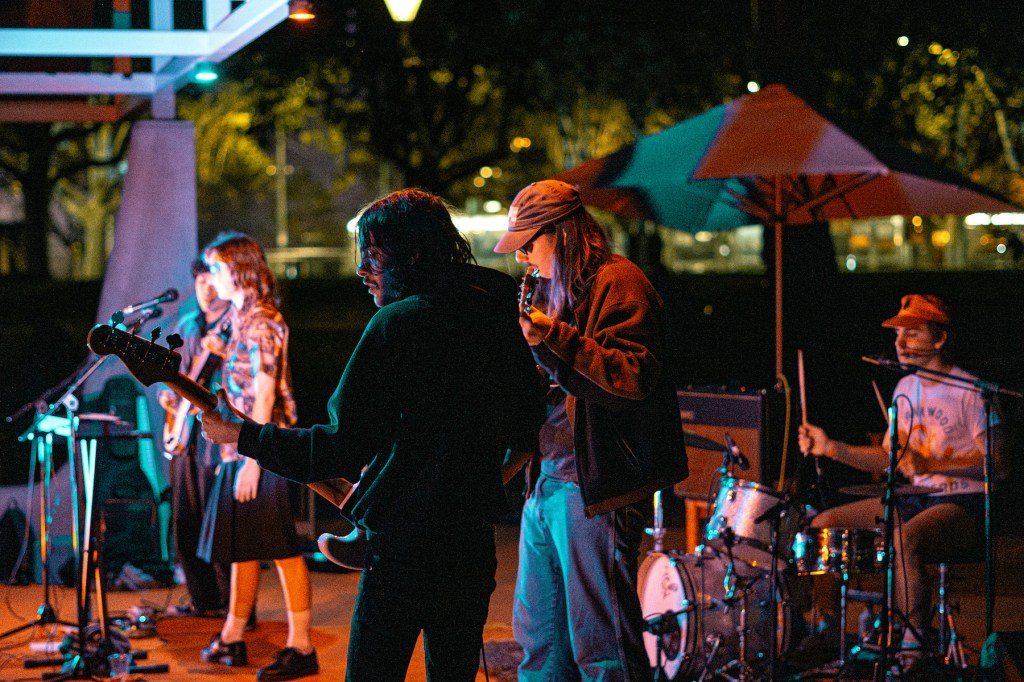
Photo by Jhonny Russell.

Kel and I were also talking about how everyone in you guys’ friend group are great song writers and supportive of each other’s work. He mentioned that you don’t record at your house, but you go back to your parent’s place in Ulladulla; where to my knowledge all off your stuff’s been recorded? Why do like to there to record? 

BC: On one hand it’s just hard to find a good spot in Sydney to record let alone somewhere consistent to leave your stuff set up but I also feel like that room has become kind of an integral part of R.M.F.C in a way, It would feel weird not recording there for this band. It’s good having that space down there to visit and have nothing to do but make demos or record songs. It’s all set up in my old bedroom so when I go down to record I’m spending the majority of my time in that space and don’t really have to think about anything else. Once I finish the album recordings I think I’ll bring my recording desk up to Sydney and set up in my room so I can make demos and focus on something different for a while. 

Last we spoke, you told us that you were finding inspiration to write a little harder than usual because you hadn’t been able to travel as much and hang out with your friends because of the pandemic and it’s lockdowns. Has that changed?

BC: Yeah that’s definitely no longer an issue but since moving away from home and not having my recording setup I’ve found it just as difficult to make songs as I was during that stint. With R.M.F.C being a solo thing I find it so much easier to develop song ideas when I have my recording desk on hand to place the different parts together and make necessary adjustments, It’s a good writing tool. 

We love that you’ve been taking your time with the album: things more often than not, turn out better when you don’t force them and allow the songs to unfold in their own time. Has there been a turning point moment during your album’s creation were songs and the process has started to progress quicker for you? 

BC: There hasn’t necessarily been any specific turning point where things have progressed quicker. It seems to come in waves, I’ll have an off period where it feels like nothing is working out and then I’ll have a wave of productivity and get a bunch done. Everything’s pretty much written now it’s just a matter of finding time to go down and record the songs and getting them right. 
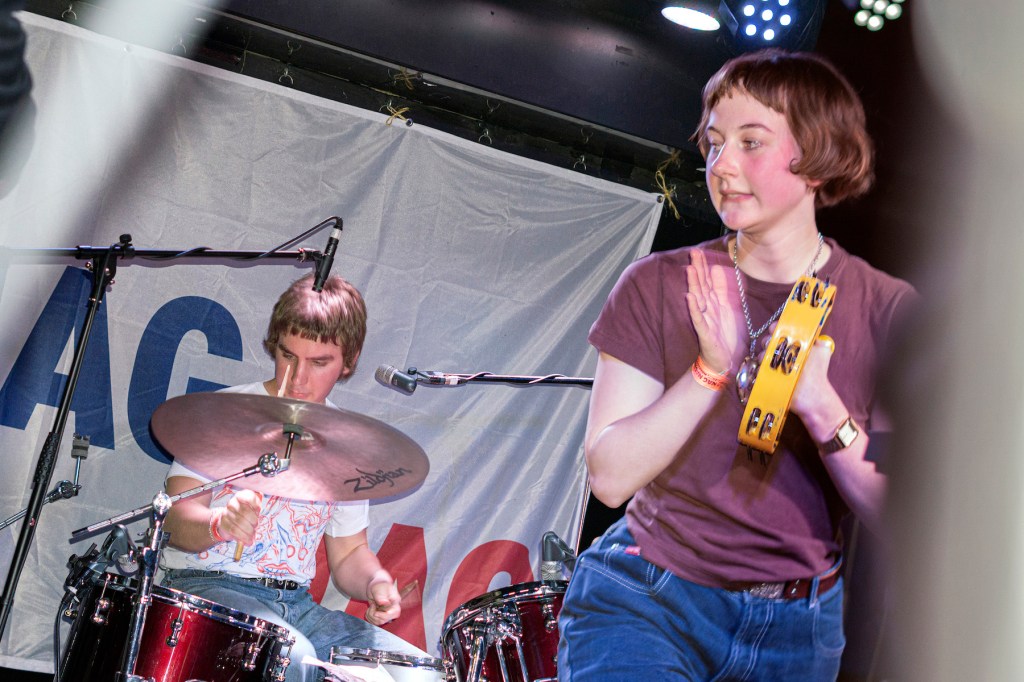
Photo by Jhonny Russell.

You’ve just released a new 7” on Anti Fade Records – Access/Air Conditioning; what made you choose these two songs? How do you feel they compliment each other?

BC: I basically chose ‘Access’ cause I felt it was the best song to have as a standalone release out of what I already had recorded, I have other songs I maybe like more but they just seem to work better in the company of the rest of the album. 

I mainly chose to cover ‘Air Conditioning’ (by UK post-punks The Lillettes) for the B-side cause I just really like that song but it also has that “human condition” phrase in it. I use the same phrase in two other songs that will be on the album which gives this 7″ an extra little connection. The two songs complimenting each other wasn’t necessarily a consideration but I think they work together as a good representation of where I want to go with the band. 

We love ‘Access’ and remember seeing you play it live when we saw you earlier in the year; is it challenging for you to get a song you’re used to playing live recorded the way you’d like?

BC: Every new song starts with a demo or final recording that I take to the band to learn so it’s usually the other way around, but the way I heard and thought about ‘Access’ definitely changed during the period between making the initial demo and making the final recording. I don’t think this is necessarily because I was used to playing it live but it took a while to get the final recording to sound right, I don’t think anything could make the process harder than I already make it for myself. 
Art by Ian Teeple.

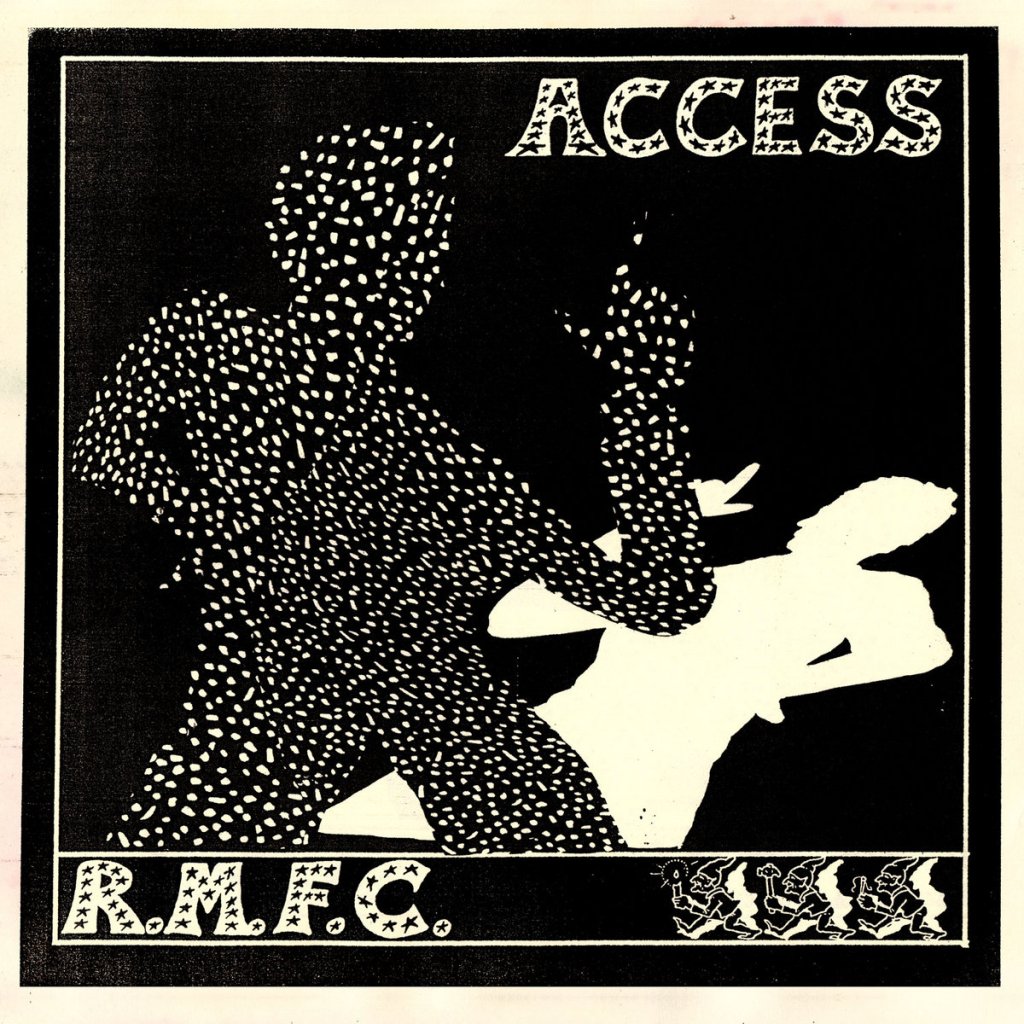
What was the idea behind the 7” art? 

BC: I pretty much just gave Ian [Teeple] a bunch of Wire 7″ covers for reference and we went back and forth with ideas. I was very pedantic with this design suggesting adjustments etc. which probably annoyed Ian but he was very patient and I think we both really like how the artwork turned out, I’ve had lots of good feedback on it too. Thank you Ian! ❤ 

You told us about the recent Other, Like Me: The Oral History of COUM Transmissions and Throbbing Gristle documentary. Thanks! What’s something, in relation to creativity or performance, that you took away from watching it?

BC:I really liked the emphasis they placed on the idea that you don’t actually need any form of training to make successful new radical music or art. I did music through to my final year in high school and while I did enjoy aspects of it, for the most part it contradicted what I felt music should be, so that resonated with me. Most of my favourite music was made by people who didn’t really know how to play/had a very basic level of knowledge and skill in regards to their instruments and TG’s influence was probably instrumental in the existence of a lot of those projects. 

I also really like how a lot of what COUM did wasn’t intended to be art, rather just something that existed and didn’t have to mean anything. 

What’s something that you’ve been interested in and getting into lately? 

BC: Angelica from G2g/Wanderlust got me onto this duo called Lives Of Angels who I’ve been obsessed with. I’ve also been listening to a lot of country music lately. My friend showed me this Numero Group compilation called Wayfaring Strangers: Cosmic American Music. Lots of great tracks on it that all sorta came in the wake of the first Flying Burrito Brothers album, shout out to Dyl Scott <3.  I’ve also been loving Operating Theatre/Roger Doyle. I heard their track ‘Spring Is Coming With A Strawberry In The Mouth’ on a radio show playlist Ian Teeple did recently and have been really enjoying exploring their catalogue. It’s so good having lots of friends to share music with 
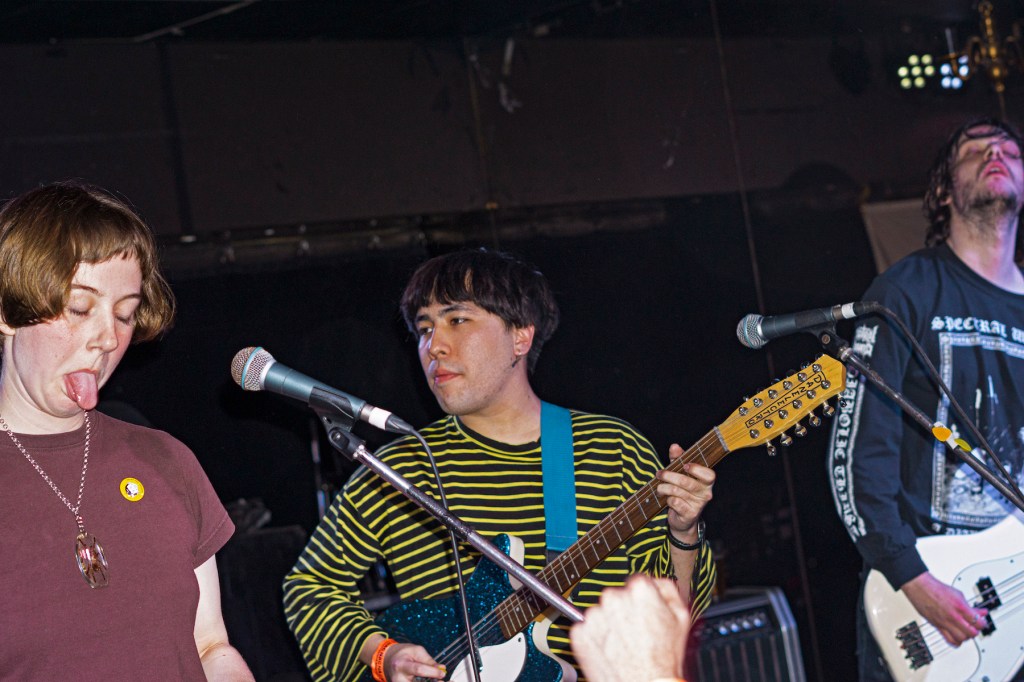
Photo by Jhonny Russell.

Is there anyone you know that’s working on, or created something really cool, that you’d like to shout out?

BC: Ian is currently working on the second Silicone Prairie album, I’ve heard it in its current form and it’s very very good. What The Toads have so far for a release they’re doing next year is also very very good. Carnations from Sydney should have a release out soon which I’m super keen to hear. Aside from that there are a bunch of friends working on things I’ve seen/heard that I’m very excited about and would like to shout out, but cannot share. 2023 is shaping up to be a good year for the underground. 

What’s the rest of the year looking like for you? 

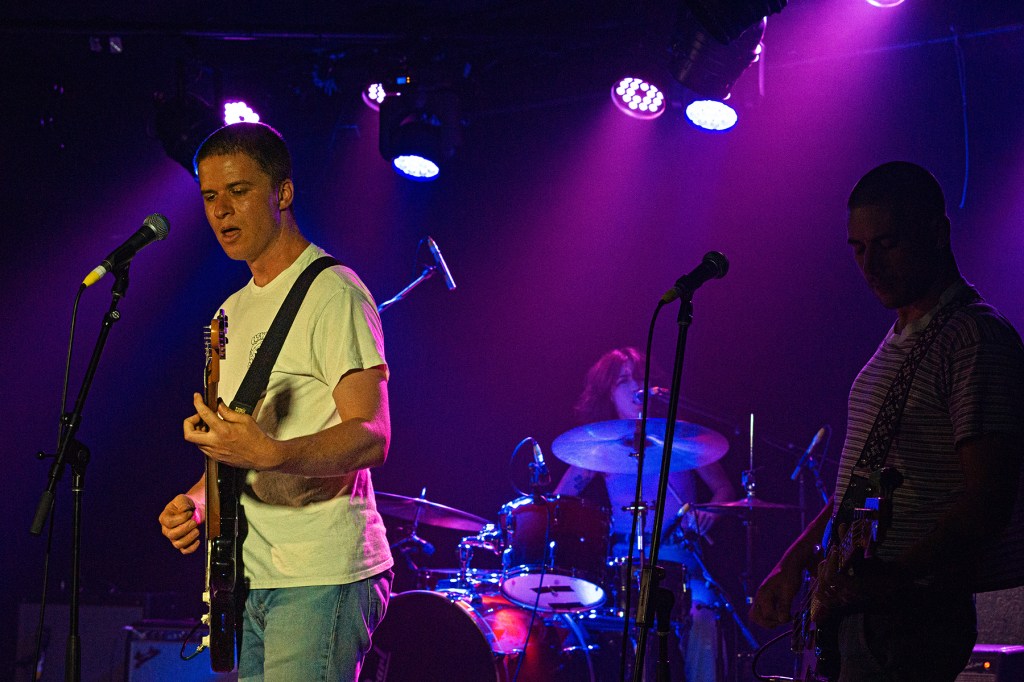
BC: I’ve made some time here and there over the next couple of months to finally finish recording the new album. R.M.F.C has a few shows coming up, playing with the Ramones and The Prize at the Lansdowne on the 28th of October which is very exciting. We also have an exciting show coming up in Naarm/Melbourne in November. 

R.M.F.C.’s Access 7” is out now on Anti Fade Records – get it HERE and in the US find it via Feel it Records. Follow @r.m.f.c.fanclub and @antifaderecords + R. M. F. C. On bandcamp.

The Prize: “Power pop always has great energy.”

Original photo by Izzie Austin. Handmade collage by B.

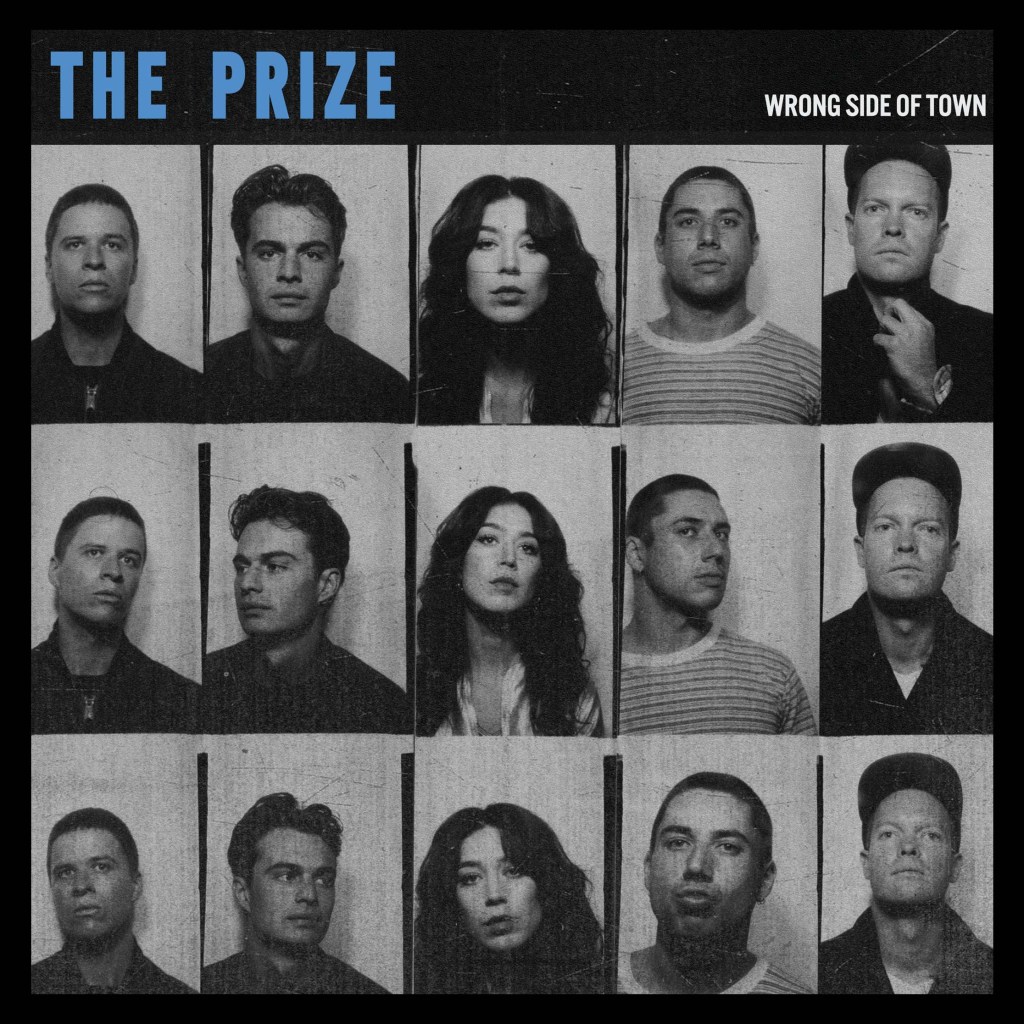
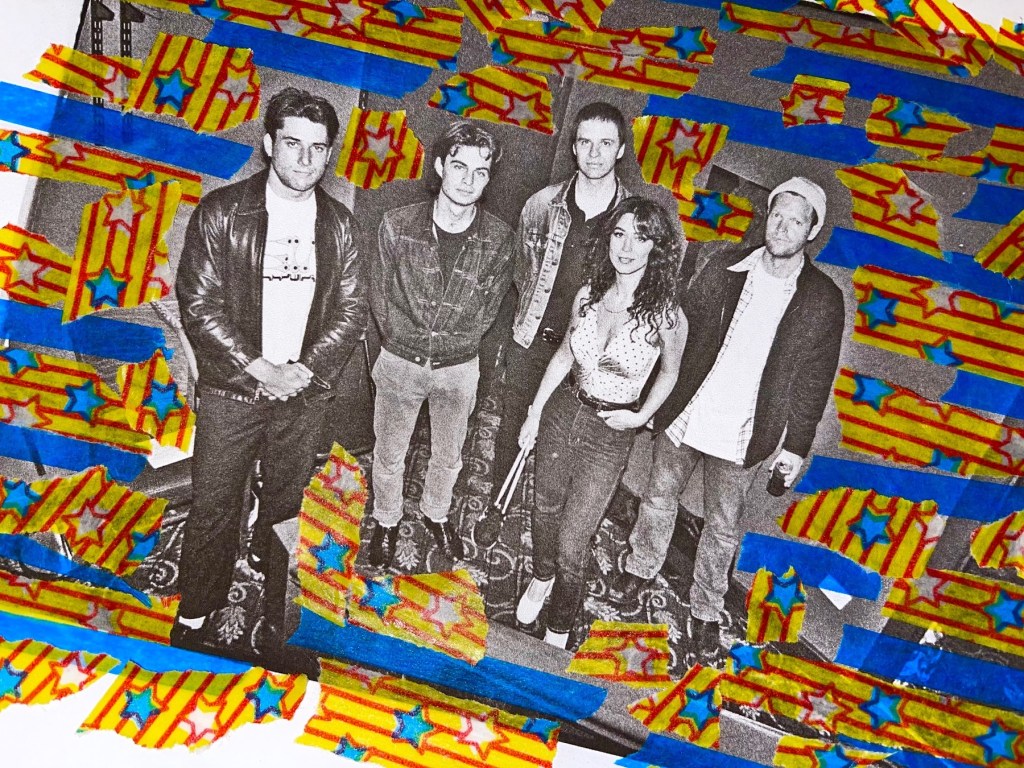
Naarm/Melbourne-based band The Prize give us everything good about power pop and rock n roll on their debut EP Wrong Side Of Town. Full of harmonies, hooks and energy, with melody to burn, the infectious 4-track release on Anti Fade will be running through your head all day. We’ve listened to it on repeat, over and over and over. Along with their dynamic live show—The Prize are ones to watch! 

Gimmie caught up with dummer-vocalist Nadine Muller and guitarist-vocalist Carey Paterson to find out all about The Prize.

What was your introduction to music? Nadine, your dad is a member of Cosmic Psychos; did he introduce you to lots of stuff?

NADINE: I was pretty fortunate growing up with my parents’ record collection! Dad has always played in bands and mum used to tour-manage, so they have collectively introduced me to a lot of great stuff!

CAREY: I got into it through the radio and Rage, and then just through my mates. My folks have great taste, but didn’t try and push any music on me, so I discovered it in my own way and at my own pace. Went through a couple of phases but it all clicked into gear at like fifteen when me and my friends got really into CBGBs bands and started trying to cover their songs.

When did you first start playing your instrument? Who or what influenced you?

NADINE: I first started playing around thirteen/fourteen. My dad is a drummer too. I was pretty lucky to always have access to a kit, but I think it really kicked-off when I saw the movie Josie and the Pussycats (which was based on a comic book from the 60s). I really loved the soundtrack to that movie and I brought it on CD and would play along to it in my bedroom. So I guess you could say I was influenced by a fictional drummer, in a cat costume.

CAREY: I wanted to play drums when I was about twelve, but my parents managed to talk me into playing guitar instead. It was a pretty reluctant switch at first but it eventually became the instrument that I got obsessed with. I had all the staple kid heroes like Hendrix, Angus Young and Jimmy Page.

What’s an album that has really helped shape you? What about it was so influential?

NADINE: I watched the Ramones movie Rock’n’roll High School very early on and fell in-love with the Ramones. The soundtrack to that movie really embedded itself in my psyche with artists like;

Alice Cooper, Todd Rundgren, Devo.. And the movie itself really shaped me and set me up for a future, 70s aesthetic. 

CAREY: An album that really shaped my tastes is probably Vampire on Titus by Guided by Voices. This album sounds like it was recorded on an answering machine but the songs are so good. I really like how this band would just hang out and get drunk and wind up recording such interesting music. Their albums are usually pretty inconsistent but you get moments of absolute magic like ‘Unstable Journey’ off this one.

Photo by Jhonny Russell.

Can you tell us a little about your musical journey? Nadine you were in Killerbirds and Wolfy and the Bat Cubs, (and both you and Carey were in) Mr Teenage. Carey I know you’re originally from Canberra and played in some bands there too, like The Fighting League and PTSD.

NADINE: I started Killerbirds while I was still in school and we got to play with some great bands like the Celibate Riffles and Bored! After that band wound-up, I started another band with some friends from Bendigo, called Wolfy and the Bat Cubs, which I played bass in. 

Joe and Carey had played together a handful of times before I’d actually met Carey and then we all ended up in Mr Teenage together, which was unfortunately short-lived but we decided to get something else going after that, which has resulted in The Prize!

CAREY: Fighting League felt like the first proper band I was a part of. I started on drums and got booted on to guitar. After that all started working and became a really fun band to be in. I also played in the live bands for TV Colours and Danger Beach for many years. Got to play some amazing shows and tour Europe. PTSD was something that got started when I was living in NYC in 2016 at the same time as Lachlan Thomas, who releases music as Danger Beach, and James Stuart who was drumming in an incredible punk band called Haram. There’s another tape’s worth of music in the pipeline for that band as soon as I sit down and finish the vocals.

When starting The Prize; what was on playlists of your musical influences?

NADINE: I had just been introduced to The Toms and I think we were all playing that first album on repeat for a few months! Also a power-pop band from the UK called ‘The Incredible Kidda Band’ we discovered in a deep YouTube hole and loved them so much that we covered their track ‘Fighting My Way Back’ which is on our debut release.

CAREY: Bands like the Toms, the Shivvers, Incredible Kidda Band and the Nerves. Also a lot of Badfinger, Cheap Trick and Thin Lizzy. I think the sound was born out of combining the poppier and rockier ends of that spectrum of bands.

Photo by Jhonny Russell.

Why the name The Prize?

NADINE: I wish there was a better answer for this question! We had booked in our first show, which was with Civic at the Croxton and they were holding off making the poster until we’d settled on a name. So there was a bit of pressure to come up with something asap… 

We just wanted it to be something straight up and simple. ‘Blondie’ was obviously already taken and Brownie just doesn’t quite have same ring to it.. Anything with a Z is a bonus for logos and designs… We were all sitting in my dad’s shed one night, which is full of vintage bits and bobs and ‘THE PRIZE’ was written on an old sign hanging up on the wall and we went, “that’ll do”.

The Prize came together in 2021, during the pandemic; how did you jam and write songs during this period?

NADINE: I was living with our bass player, Jack at the time and we had a jam room and some recording gear so we would muck around with riffs here and there and send them back and forth. 

Between lockdowns we would all get together, to try and work on songs but it felt like a pretty 

difficult and slow process during that time. Once restrictions were eased, we stared rehearsing pretty intensely as we had a bunch of half-cooked songs and a first gig already booked in.

What’s one of the biggest things you’ve learnt about songwriting or your process while writing your debut 4-song EP Wrong Side of Town?

NADINE: Probably to not overthink it. It’s important to get the structure right and spend time on each song but also knowing when to leave it be, is something that took me some time.

Artwork by Sammy Clark.

What attracts you to the power pop sound?

NADINE: I love a good hook and melody!!! Power pop always has great energy and its something that’s fun to dance and sing-along to. Its a real, feel-good genre!

What’s title track ‘Wrong Side Of Town’ about?

NADINE: Joe had written the guitar lead-line a few years ago and it’s such a great riff! When we were trying to craft the song around that I  really wanted to do it justice with the melody and the lyrics.

The lyrics were written during one of our later lockdowns and it was definitely getting to breaking point for a lot of people.. Myself included.

A lot of people were packing up and moving home or back to the country and it’s about wanting to get away and start again but really just ending up, right back where you started.

How did ‘Easy Way Out’ come together?

NADINE: Easy Way Out was actually the first song that we wrote and was also one of the first songs I had really ever written lyrics for. It’s about feeling burnt or letdown by someone.

What did you have on your mind when you wrote ‘Don’t Know You’?

NADINE: Joe and I really pulled that one out of nowhere! I’d been humming a melody for a few weeks and when he and I caught up one day, he showed me a new riff he’d written and the melody worked perfectly over the top. I think we had that song written and demoed in about two hours!

It’s about being close to someone and sharing experiences together and then, for whatever reason they are no longer a part of your life. You still see their face around but you feel like they’re a familiar stranger. 

On your 7” you do a cover of ‘Fighting My Way Back’ by The Incredible Kidda Band; what inspired you to pick this track? 

NADINE: Its such a great song! We actually found it while trawling the Internet for power-pop bands and when that song came on we were all like how have we never heard this band before?? 

It was unanimous to add that to our set. We reached out to TIKB ahead of our release and sent them a copy of the track and luckily, they seemed to really like it! 

Photo by Jhonny Russell.

What was the most fun part of recording?

NADINE: Collaborating and working with your friends to make something is always fun, although at times, kind of stressful! but listening to the finished product is alway the most fun part for me.

CAREY: I find recording stressful so probably realising we’d finished it

Nadine, as well as playing drums and singing in The Prize, you’re also a makeup artist and hairstylist working with Ed Sheeran, Charli XCX, Amy Shark, Meg Mac, Thelma Plum, Nick Cave, Amy Taylor and Harry Styles band; how did you get into that line of work? Who has been one of the biggest surprises to work with?

NADINE: I started out doing a hairdressing apprenticeship while I was still at VCE and living in Bendigo and then when I moved to Melbourne, I would help out friends bands for music videos and photoshoots and it just really snowballed from there! 

I did a short course in makeup and then started getting booked for some really fun jobs! 

The biggest surprise was working with Ringo Starr’s all Star band. I got to meet a Beatle! Which was very special and pretty surreal!

What’s been your favourite show The Prize has played yet? What made it so?

NADINE: Our first show was in November last year with CIVIC at the Croxton and I think that’s still my favourite to date. I had never done lead vocals before and to get to the stage where I was able to play drums and singing at the same time, took a bit of work for me- I nearly threw in the towel a few times! 

To finally get to the point where we could pull it all off live and play our first show, felt like a triumph in-itself and the added fact that it was the first show in 18 months of lockdowns (that any of us had played, let alone been to..!) The energy in the room was something I wont forget.

CAREY: I’ve really enjoyed playing at the Curtin this year but I reckon the arvo show at the Tramway in May this year was the funnest. Something about a good Sunday arvo show that hits different.

Who are some of your favourite performers to watch?

NADINE: There are so many good ones! But just to name a few; Grace Cummings, CIVIC, The Murlocs, RMFC, ROT TV and of course, Amyl and the Sniffers always put on a great show.

CAREY: As far as local bands go, I’ll go and see Civic and EXEK any time I can. Faceless Burial always blow my mind. I saw the Blinds play recently after a long hiatus and that was one of the best shows I’ve seen in ages.

Your debut is coming out on Anti Fade Records; what’s one of your favourite AF releases? Why should we check it out?

NADINE: I think I listened to CIVIC’s record New Vietnam an absurd amount of times when that was released on Anti Fade in 2018—every song is a banger! More recently, RMFC and Modal Melodies is great!

CAREY: I would probably have to split the honours between the Reader 7″ by RMFC and Civic’s New Vietnam. Buzz from RMFC is one of the best young talents making music in Australia today. New Vietnam is one of the best debut releases in recent memory.

What’s the rest of the year look like for The Prize?

NADINE: We have our first 7” coming out in September and the first single will be available this week (today I believe, when this interview comes out)!

We have a tour with The Chats and Mean Jeans starting in September, plus our launch show on October 1st (which I’m not sure if I’m supposed to announce yet butttt we have a very exciting lineup for that)!

The Prize Wrong Side of Town EP available via pre-order at Anti Fade Records. Out September 2.

Check out: facebook.com/theprizemelbourne + @theprize___ + @antifaderecords

The Frowning Clouds: “We’re like brothers, we did everything together.”

Original photo by Jamie Wdziekonski. Handmade mixed-media collage by B. 

The Frowning Clouds’ Gospel Sounds & More from the Church of Scientology is a great record. They unabashedly wear their 60s influences on their sleeve. The songs are sunny, folksy, at times wild and nostalgic; it has a homespun quaintness, their charm and the group’s chemistry coming through loud and clear. In 14-tracks the band captures the beating heart of why we love music, why we make music, and why we try to express ourselves and find ourselves, and our need to connect with each other. It’s all here, raw, flawed and honest, exploring love in its various forms, longings and infatuations. 

The Clouds are an important Australian band that were under-appreciated while active, but over time ignited a garage-rock scene in Djilang/Geelong and beyond, influencing countless creatives. Clouds’ members went on to evolve their craft, innovate and continue to inspire in bands Bananagun, Orb, Traffik island, Ausmuteants, Alien Nosejob and more. Gimmie chatted with Frowning Clouds’ guitarist-vocalist Nick Van Bakel to get an insight into the band and release what you could view as the Clouds’ sophomore album that never came out… until now. Over a decade after it was recorded it still feels fresh and rousing.  

What’s your earliest memory of The Frowning Clouds?

NICK VAN BAKEL: My earliest memory is probably just me and Zak [Olsen] playing a couple of originals, some Velvets & 13th Floor Elevator songs in my bedroom and our friend Danny recording it on his video camera. We took the audio off it for our first recordings [laughs].

I know that the band was very much inspired by the 60s, specifically the period 1964-1967, as well as the Back From The Grave series and Nuggets compilation; when did you first get into that kind of music and what is it about that period that resonated so strongly?

NVB: Probably about 16 or so, we’d heard some more obvious stuff like The Kinks and The Stones etc., but the deep garage comps were like even more outlaw than that. The attitude and spirit of it all. We were real young and those comps are mostly all teen bands, so it was what we wanted to do. Also they’re just amazing songs played with high energy.

How did you learn to write 60s-sounding songs? Previously you’ve told me songwriting for you back then was very much about craft. What kinds of things catch your attention in songs? 

NVB: Well, that was our introduction to playing/writing, so we just did what they we’re all doing. Seeing documentary Dig! just showed that you could go DIY. The crafty bit is like all the girl group stuff of the 60s and pop. There’s a billion 60s songs that all have the main chords and motifs, and that’s where you can get creative and bend your idea into this little 3-minute song. Like the professional writing teams going into a room and making five songs a day.

The Clouds have a new release coming out on Anti Fade, Gospel Sounds & More from the Church of Scientology, which is predominately songs from the 2013 Frowning Clouds European tour tape called Gospel Sounds For The Church Of Scientology, with a handful of singles and unreleased tracks; what do you remember most about that tour?

NVB: A Spanish label called Saturno released our first stuff and organised the tour; the best part of that was going to Nacho and Dario from Saturno’s home town Seville. Seville is a medieval city. Star Wars has been filmed there. It’s where Flamenco was invented. We just loved the lifestyle of having siestas, meeting all their friends in the park in the afternoon, having a relaxed beer and tapas. They were adults to us, so it was cool to see that you could be an adult and have a job and family, but not have the weird Aussie thing of all the milestones like getting married, a house, having kids etc.

During the tour you record in Berlin with King Khan; tell us about the experience. 

NVB: It was fun because he’s also, another big kid [laughs]. He came to one of our shows. We were hanging out at a bar and he invited us to record the next day. We had this super legend, but super regimented, tour driver who was like “C’mon guys we gotta go!” Then Arish being like “Oh, you know what? We should actually do a whole album!” He’s real lightning in a bottle, just having new ideas every five minutes and changing directions. We recorded four songs or so just in the lounge room live with a toy kit and practice amps.

That’s so cool. I’ve seen videos online. There’s a western instrumental you guys did during those sessions that Khan released on an album Let Me Hang You that features spoken word by William S. Burroughs; what do you think of it?

NVB: It was fun to do and it’s funny to have a song credited to me and William s. Burroughs!

What’s it like for you to revisit these songs on the new release now?

NVB: Over lock down I had some good nights getting drunk like an old man listening to all the stuff we did when we were young. Only good memories. I feel proud overall, that we didn’t half ass it.

We’ve been listening to Gospel Sounds & More from the Church of Scientology heaps, we’re really excited the songs are seeing the light of day. What do you like most about the release?

NVB: Well, it’s mostly stuff at the time, we thought we’d leave out and I still feel the same way, but not so precious now after some time away from it.

I also love the art that Millar Wileman (who plays percussion in Bananagun) did for the cover. He’s got a pretty distinct style, he uses a lot of old world-y stuff and has a Monty Python Flying Circus kind of vibe.

Album art by Millar Wileman.

What was the earliest song you wrote in this collection?

NVB: That’s hard to say exactly, maybe ‘Open Your Eyes’? Or probably ‘Stick Fight’. That was about me challenging this guy that my ex left me for to a stick fight [laughs]. Tender days!

I know that a favourite song of yours from the album is ‘All Night Long’; what do you love about it?

NVB: There’s always something about a recording or performance that bugs me, little mistakes, but I think we really nailed it with that take. It’s the band in a nutshell really—raw teenager energy.

I think it’s probably the best performance we ever did. It was the best vibe. We recorded it with Owen [Penglis].

Do you remember writing it?

NVB: I remember Jake [Robertson] came over to work on some songs together and I had the riff for ‘All Night Long’ and we made headway from there. I don’t remember all the details but I remember sitting in my room and writing it. I remember riding around on my bike with it in my head and doing little monos and banging the front tyre down getting real pumped! 

That’s how I think creativity emerges, just when you’re relaxed, like in the shower or washing the dishes. I’ve been running a lot and I get a lot of ideas running.

A lot of the songs (like ‘If Youre Half Then Ill Make You A Whole’, ‘Thought About Her’ & ‘Not the Fool’…) are love songs, yearning for love, breaking up etc. How do the songs reflect you as a person?

NVB: I guess it says I’m a sucker for love [laughs]. Love songs are pretty universal and eternal.

Most things that most people do deep down are trying to find themselves some love. I like emotional content, I can’t get into things as much on an intellectual level, or clever use of language is impressive but what is the transfer? What’s the communication? Besides being wordy usually. Mostly though, I was just trying to make stuff like my heroes, Ray Davies or John Lennon. Lots of genuine expression.

Yourself and Zak were the primary songwriters in The Clouds; what are the differences and similarities you see in both your writing?

NVB: Hard to answer, we both started writing together and grew up together and influenced each other and wrote together. Zak’s definitely more of a poet than I am and more collaborative, but I’m physically stronger and a faster runner, and could easily take him down with a single fly kick!

What do you feel each member brought to the Clouds?

NVB: There’s been member changes, but for the most part I’ll say:

Jake, brings chords, scales and proficiency, punk vibes.

[Jamie] Harmer, allowed us to write in more open terrain because he had a broader pallet. (Both Jake and Harmer were like phase two, the best bit).

Daff [Gravolin] is like a studio player, he can do anything in any style, but you can still tell it’s him. There’s only one Daff!

Zak is the researcher, finding all the awesome records and writing awesome tunes. 

We’d really need all night to cover this properly cos we’re like brothers, we did everything together. Everyone brought their own little things to the party. They are all super funny too.

The Frowning Clouds really inspired a lot of other bands that came after you; what are you feelings about this?

NVB: Can only be a good thing! We really got so lucky with our friend circle. We got a bit territorial sometimes which is kinda funny and fine for teenagers to do. 

When we first started, Geelong had just punk and hardcore gigs that we used to go to. The first one that I went to, I remember getting punched in the head in the mosh pit [laughs]. I was just like, ‘Fuck these guys!’ Heaps of them had big brothers and they were just these big punk bully dudes. We all just got bitten by the 60s bug because it was the coolest thing that we had heard. It does seem like we got the ball rolling for people to follow suit. 

Is there anything that you didn’t appreciate back then that you do now?

NVB: I have to give huge props to Katie Jones who saw us play when we’re underage and volunteered to drive us around Australia for four years; five rude, stinky kids basically. She was beyond generous to us. Did so much for us and never asked for anything in return. The real Queen of The Barwon Club, always will be.

The Frowning Clouds seem like they were a really tight knit gang; tell us about a funny Clouds moment.

NVB: I remember opening for Little Red at the Toff and we got so drunk in the green room and started throwing crates of wine bottles out the 4th story window [laughs]. We’d honestly get canceled so fast nowadays. It felt like actual family though, thick n thin, and The Living Eyes were our little brothers.

Are you going to play any shows for the album?

NVB: We’re hoping to! Bananagun are moving overseas to Portugal for a bit to do a bunch of touring, but we haven’t bought tickets yet. I’m hoping we can squeeze The Frowning Clouds stuff in before that happens. I’m working on album number two for Bananagun. 

Awesome! What have you been listening to lately?

NVB: I’ve been listening to a lot of Beach Boys this morning, it’s been a while. I gave Pet Sounds a spin. I’ve been listening to a lot of Sun Ra and spiritual jazz stuff. I’ve been listening o a lot of Gamelan music and Indonesian folk. I’ve been listening to a lot of 60s garage again over the last few months because putting together this release has reawakened my fire for it! 

Gospel Sounds & More from the Church of Scientology is out August 5th, 2022 on Anti Fade Records. PRE-ORDER HERE.

Vintage Crop’s new song and clip ‘double slants’: “‘The keys to the universe’ is the funniest thing to say at the start of a song!”

Original photo by Leland Buckle. Handmade mixed-media collage by B.

It’s exciting times, Geelong’s Vintage Crop have a new record on the horizon—Kibitzer—and Gimmie are here to share the first single and clip with you! Their fourth album of snappy punk has themes of resilience, identity and acceptance, while musically a welcomed extra dose of melody, and the introduction of horns on a couple of the tracks. Gimmie spoke to vocalist Jack Cherry. 

JACK CHERRY: We’re really happy with how the new record sounds. The songwriting feels like something to be excited about.

The album Is called Kibitzer! That’s a Yiddish word, right? It’s a term for a spectator, usually one who offers advice or commentary, which is kind of what you guys do with your songs.

JC: Yeah. Last year I got into playing chess and that’s a term used in chess. I thought it was too good of a word not to use for something else. It’s a cool looking word, has a great meaning and I felt like it connected with what I do lyrically. It seemed to fit.

What got you into playing chess?

JC: I went to a friend’s place and he asked me for a game. I haven’t played since I was ten or eleven playing with dad. It was horrible playing with dad because he would not let anyone else win. I threw it away and never wanted to play chess because it is so hard. When I played against my friend, about two years ago, I was like ‘This is a really interesting game.’ I got carried away with all the different strategies and techniques, it was really engaging. I don’t play as much any more, it was really just a hot minute where I really got into chess, and some of the ideas really stuck around.

That would explain the album art work as well.

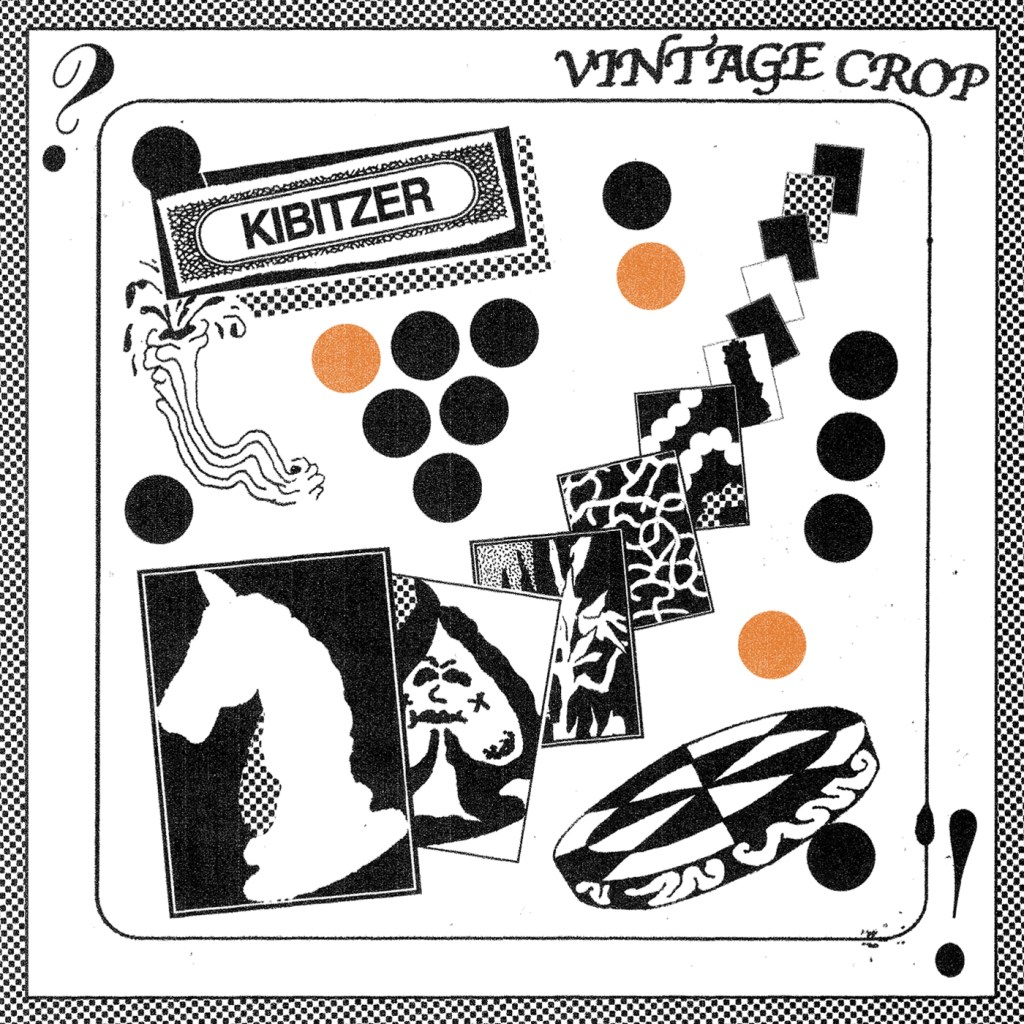
JC: Yes! We had a different idea for the album art that was literally a chess board but we thought it was a bit obvious and it didn’t click with what we were doing, so we didn’t use it. There’s definitely visual themes of chess as well. We had Robin Roche do the art again, they did Serve to Serve Again for us. We always love his work. He makes things look simple but there’s so much detail in them, that’s how we feel about the songs as well; simple sounding songs but there’s a lot in there when you listen to it. We think his artwork matches the songs.

Album art by Robin Roche.

How long were you writing this collection of songs for?

JC: As with anything we do, it starts pretty much right after the last one finishes. The first couple of ideas happened towards the end of 2020, we had two or three solid songs that we were happy with. Then it took all of 2021 to write another seven that we were happy with. So, there was the initial push. We didn’t really record the album until November 2021. Two of the songs were finished just the week before. 

Do you find your songs change very much during the process?

JC: To be honest, I think they change after even longer. We have songs from the first two records that we still play live and we find those songs have morphed a lot since we first recorded them but a lot of the newer stuff feels a bit more finished. We took that lesson from the first two albums of, well, we’ll make sure that we really investigate these songs and make sure we have all the parts that we want to play. I feel like with New Age in particular we went in and recorded it straight away without developing the songs to their fullest extent. We’re able to now write a song and finish it, really finish it earlier.

The new album sounds a lot more melodic to me.

JC: Yeah, that was conscious as well. Tyler our drummer had said to me, maybe eight months before we were set to start really writing the album, ‘This time let’s get a producer in and get someone to really push us to do different things.’ I was so deeply offended… in a nice way, that he would suggest that. Out of spite I started to write melodies and tried to actually sing a bit to prove that I could do it and we don’t need a producer [laughs]. It’s a good push for us. Three albums of doing the same thing, it’s nice to have the fourth one where we branch out a bit. Same with the trumpet on a few of the tracks, we really wanted to play with some new tools. 

I noticed that on Kibitzer you almost sing! 

JC: [Laughs] Yeah, it’s scary to fully let go but it’s nice to have a go. I’d rather it be a flop and those sort of songs not hit as well but have tried it, then do the same thing and get the same result.

They totally did hit though! Your singing and the trumpet were things that got my attention.

JC: Thank you, that’s the reaction we’re looking for. Glad it worked! I think it keeps it fun for everyone, not just us. 

You mentioned having a producer for this record; it was Jasper Jolley?

JC: Yeah, Jasper recorded it. Jasper is in Bones And Jones. He is a friend of ours, he grew up in Geelong as well, we’ve been friends for ten years or so. We’ve always been in similar circles but because Bones And Jones’ music is a little different to ours we thought recording with Jasper might make us sound like them, which isn’t a bad thing, it’s just we have our own sound and we don’t want to mess with it too much. Recording with him was a treat though, everything sounds amazing, he was so patient. I think we want to work with him again because it was so good. He didn’t really produce, he didn’t offer a whole lot of advice but he was a good set of ears and a good set of hands. 

Everything was recorded in one session?

JC: Yeah, we set up and started recording at 11am and was finished doing vocals by 7:30pm. It was eight and a half to nine hours in total and we had everything done. 

Was that out of necessity? Was it because you wanted it to capture a spontaneity? Or the vibe you have live? Sometimes I see bands I love live and they’re amazing but then I hear the same songs recorded and it disappoints me because it feels pretty lifeless.

JC: Because they’ve spent seven hours choosing a guitar sound [laughs]. I think for us, it’s not to capture anything in particular, but we like to record together. None of us have the patience to do it over more than one day [laughs]. We have the songs ready, we just want to go in, get them done and get the ball rolling cos there’s not much we can do after the initial recording, we do it all at once and then there’s only vocals and keyboard left. We don’t want to muck around adding too much to it because anything else we add we probably can’t play live and tonally it’s a very simple sound, it’s not like we have to find the right tone or tune the snare a certain way; it’s just going to sound like us because it’s us playing it. 

Lyrically, themes on the album have to do with resilience, acceptance, accepting your own limitations; were these things written from things you were experiencing in your own life? Often your songs are commentary and observations of other people’s experiences.

JC: Yeah, I find that with themes for albums, I develop them after I’m finished. I don’t try and dissect anything I’ve written a whole lot. Now it’s all finished I can look back and really figure out what I was trying to say. I think that looking inwards is more so a reflection of all of us settling in to full-time work and branching out, Tyler just bought house, my partner and I live together and we’re looking at buying somewhere as well—it’s a get-on-with-it attitude. 

Everyone else is in the same boat and it’s just how you react to things, if you can try your best to be positive and just keep on going, because that’s really all you can do. A lot of times you don’t have too much control over life, the best way is to roll with it. That’s a lot of what I’ve been thinking about at the moment. 

Maybe I will be in this job for fifteen or twenty years, or if I leave this job I’ll be in another job for fifteen or twenty years, thirty years or fifty. While it’s crushing to think that I’ll never be a rock star playing stadiums around the world, at least I have a job, somewhere to be and something to do, that’s all I can do.

I work another job as well as doing all the Gimmie stuff as well. My job pays my bills and then doing Gimmie we never have to compromise, we can keep it advertisement free and do whatever we want with it. It’s a wonderful thing not having to compromise on your art.

JC: For sure. With the band we’re paying for pretty much everything and we’re in control of everything, it’s our outlet. That’s the way that we can express those feelings, through the band. It makes it worthwhile in the end. Working 40 hours a week doing something you don’t really want to do, but the rest of your time you do get to spend doing what you want to do and you can afford to do it and it’s comfortable. It’s great. 

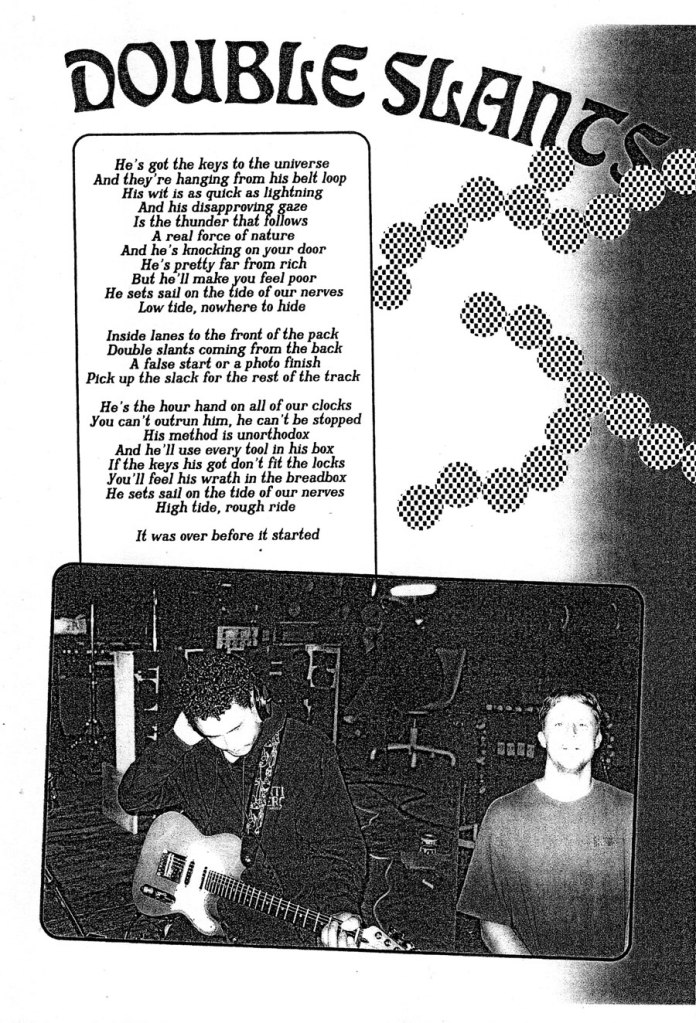
We’re premiering the song and clip for ‘Double Slants’! I love the first line of the song especially: He’s got the keys to the universe / and they’re hanging from his belt loop. It’s such strong imagery.

JC: I thought it was a really good fusing of reality and fantasy. “The keys to the universe” is the funniest thing to say at the start of a song! If you take those abstract thoughts and ground them in reality somehow it makes it hit a bit more. 

The whole song isn’t about anyone in particular, it’s an adversarial song. It’s nice to be able to poke fun at someone that everyone can relate to, everyone’s got that sort of person in their life. That’s all I can really give you; it just happens.

As Vintage Crop songs are often about everyday kinds of things, having that fantasy element in there was another unexpected surprise. Being surprised by music and art is one of my favourite things.

JC: That’s true. The belt loop part was a play on… that seems to be the trend, that for some reason people hang their keys on their belt loop, which is a little dig; to me, I just don’t get it. 

Being sardonic in lyrics is also another Vintage Crop signature. 

JC: Yeah! [laughs]. 

We love the clip for ‘Double Slants’! In it you get kidnapped; what do you remember from shooting it?

JC: We filmed most of it on the road out the front of the house I grew up in – which was totally coincidental! We just needed somewhere with a quiet road and no house, it just happened to fit the bill. It was actually a pretty painful day for me in the end; I was manhandled, thrown around and rolled down a few hills. But Leland [Buckle] did such a great job with it that it was worth it! 

We’d previously worked with him on the clip for ‘The North’, so we were naturally pretty keen to work with him again. We really like a lot of his reference points for filming and editing, he’s got great taste and a bit of an unusual eye which is something that you just can’t put a price on. We spoke briefly about a rough concept for the video and then by the end of the day he had taken the ball and run with it. We trust him with the vision and pretty much everything you see in the video is straight from his brain.

What’s your favourite moment from the clip?

My favourite moment of the clip is probably the woman in the front seat of the car smiling back at the camera in the front seat. A brilliant piece of irony and it just makes me laugh every time. 

Vintage Crop’s new album, “KIBITZER” is out June 24th through Anti Fade Records (AUS) – pre-order HERE – and Upset! The Rhythm (UK).

Duo Modal Melodies’ debut single ‘Occupants’ – “I was hoping for a positive outcome or something good to happen after a difficult time.”

Photo: Danielle Hakim. Handmade mixed-media collage by B.

Modal Melodies is a collaboration between Violetta Del Conte-Race (Primo!/The Glass Picture) & Jake Robertson (Alien Nosejob, etc.) made in the spirit of fun and experimentation without rules, they found in each other their biggest inspiration. 

Gimmie are premiering album opener ‘Occupants’, a joyful electronic synth-pop romp, with Vio’s vocals welcoming, intimate and daydreamy. We chatted with Jake and Vio.

How did the project get started?

JAKE: I approached Vio at Jerkfest 2021. I’ve always been a pretty strong admirer of her songwriting and ability to play and sing said songs. I had a bunch of songs that I was struggling with, this was around the last time I was speaking to you, I felt like all of my songs were sounding the same. So, I thought I’d hit up Vio and see if she could give us a hand with some stuff and if I could return the favour. I don’t know if it was ever intended to be a full album, it just panned out like that because the workflow was so languid. It was so smooth, I felt like it was no effort whatsoever to do this, probably because Vio and I work in a similar method.

VIO: Yeah, it was really easy to work together. It got even easier as it went along. We started out with a couple of ideas then started adding more ideas and realised that any ideas we could use; everything we shared with each other we were like, ‘We can do something with that!’ 

JAKE: We had very limited restrictions. There was no wrong answers.

You told me that the only rule for Modal Melodies is that it was only going to be a recorded project and that you’ll never play live.

JAKE: [Laughs] You know, rules can be broken. I always do this, where I go to record with someone and it turns into a live thing.

So Modal Melodies might play live?

JAKE: [Laughs] I’m going to say, no.

VIO: We haven’t talked about it. The cool thing with having the idea of not playing live meant that we could just play as many instruments as we wanted, add as many layers and not have to worry how we would actually do it if we wanted to play it live. It freed us up in that way. That meant that we could push ourselves. There was a song that we did two key changes in; I don’t think I’ve ever done a key change in a song ever. That was really fun! Just trying new things out.

JAKE: The way that we put the songs together was how I put demos together when I’m by myself. I’d never really shown anyone that process before. It felt a little bit weird recording it like that, it felt like demos the entire time, which made me more a little bit loosey-goosey with stuff [laughs]. Did you feel like that Vio? 

VIO: Do you mean adding stuff?

JAKE: Adding stuff. Or even just the writing. I guess because it was so free-flowing there literally wasn’t a single ‘No, let’s not put that in there.’ There was a couple of ‘Hey, we should take out that guitar or put in this guitar’ – the editing that goes with every recording. Because there were no rules or restrictions, I felt like I was in a demo process the entire time. It wasn’t until listening to the song back that I was like, ‘Whoa, this is the whole finished song!’

You mentioned you have a process; what is that process?

JAKE: We recorded the Modal Melodies stuff in the same way that I would write a song, where I would do it in loops of bits and pieces and layer different parts over the top of each other as opposed to when I would rerecord those demos into a album for a different project and do everything live or as live as possible, if it’s Alien Nosejob. So, I play drums along to the entire song. Or if it’s a three-minute guitar song record the entire three-minute guitar, whereas a lot of the songs Vio and I did were looped-based. Some songs we’d play the entire song on guitar or both of us have guitars plugged in, play an entire three-minute song then cut up little bits and pieces, like use the the 20 second or 30 second mark of Vio’s guitar and then the 40 second mark of my guitar. I’ve never done that with another person before, it was very easygoing and a free-flowing was of doing things. 

What’s your usual process Vio?

VIO: With Primo! a lot of the songs start with Xanthe or I bringing in an idea and we’ll learn it together or expand on it, maybe if there’s a verse and no chorus. Or maybe do a demo. Before this I was just using GarageBand demos and would send them to everyone. 

With Modal Melodies, like Jake was saying… I think that’s why it came together so fast because there wasn’t that extra step of taking it in to a group of other people and trying to make that live. It’s done already and you’re sort of shocked it’s already finished [laughs]. 

JAKE: A lot of this was done during lockdown when we couldn’t see each other, so we would email each other being like, ‘Let’s try and have a part that sounds like this or this song.’ It’d be, ‘I really like how this song from the 80s has a whistle in it.’ That’s a bad example though because there is no whistling, but something like that. 

Vio, how do you inspire each other musically? Last time I spoke with Jake he told me that one thing he really admired about what you do musically, is that you give things space, you know where things can breathe as opposed to when he makes stuff and it’s really jam packed. You’re the opposite in that way?

VIO: Yeah, I would agree with that. It was cool for me because I always feel that I work quite simply. I often repeat things a lot. If there was an idea that I initially brought in, I was always amazed by how much we could expand on it. I really loved what he added to all of the songs; I never would have thought of those things myself. All of the songs became better through our collaboration. 

I really love your singing on this album.

VIO: Thank you!

There’s so many really beautiful moments. I love how sound-wise it has an 80s feel but then I can totally hear elements of what each of you do in your other projects shine through. It definitely has it’s own sound though.

JAKE: Each of us had three or four half written songs we brought in. Before we got in the room together (it was a lockdown before we could actually meet up) there was so many emails back-and-forth, with each email having a YouTube playlist; we were sending each other different songs, different influences, so many songs I’d never heard of before. When Vio sent them to me I was like, ‘I’ll try and make something in the style of this.’ 

There was one song that we did instrumentally here that we recorded, we had no vocals and we went for a walk and then Vio went home, three hours later she sent me the recorded words and it was about the tawny frogmouths that we saw a couple hours before on our walk. I feel like you should talk about this Vio, because your lyrics are so much more of a large percentage than mine. It was really cool, I felt like the next day I was reliving the previous day from the words that Vio had written, which was real nice. 

What’s that song called?

JAKE: ‘Clearer Path To Hutton Street’, which is the street I live on.

VIO:  I think it’s ‘Fourth Stage’ Jake!

JAKE: It is? Oh, it is! It’s ‘Fourth Stage’. 

VIO: ‘Clearer Path…’ is another reference to your house, although the lyrics weren’t about your house but somehow the title ended up being about your house [laughs]. 

JAKE: I think it might have been one of the things where you record something on an iPhone and it says the location. I think it said ‘Clearer Path’ then the location was Hutton Street and I sent it to Billy [Gardener – Anti Fade Records] as a demo. He was like ‘Damn – A Clearer Path To Hutton Street – what a title!’ So, I kept it. 

We’re excited to be premiering Modal Melodies debut single ‘Occupants’!

JAKE: That’s one of Vio’s.

VIO: That was the first song that we ever worked on. It was an idea that I had on keyboard and I had some singing for it already; very minimal keys and vocals. I wrote it with my friend in mind, who is also my housemate. That’s where the title came from, we live in the same house…

JAKE: And, is your bandmate [in The Glass Picture]!

VIO: Yes, she’s also my bandmate Lucy [Emanuel]. I wrote it when we were coming out of lockdown at the start of last year. It’s really just me trying to write something to look forward to, my idea was to write something where I was hoping for a positive outcome or something good to happen after a difficult time.

It definitely has that feel and it’s a really cool way to kick off the Modal Melodies album.

VIO: I feel that was really musically interesting, to see what Jake came up with on the software synth; we worked on that a lot. 

When you were sending songs back-and-forth to each other over email was there anything that surprised you?

VIO: I found the song ‘Driving’ quite surprising because it was supposed to be a surprise, we did a bit of an experiment where Jake wrote all the music for that, he had a whole track with no singing and we were like, ok, let’s email each other vocals but not listen to the other person’s vocals until we’d done our own. It was interesting to see how different they would be or how different the melodies would be that we’d come up with. The only lyrical guideline is that it would be about driving, because it’s reminding me of it.

It sounds like you had a lot of fun making the album and there was a lot of experimentation. 

JAKE: It was super fun! Not to continually talk about lockdown, but we’d basically spent a year not seeing anybody and being locked in our rooms. Then it was our choice to lock ourselves in the room to do this, it was almost like a liberating thing [laughs]. It was experimental. It’s a hard one because I feel like it’s each of our ideas completely unfiltered and neither of us said no to the other person. What’s the style of writing called that probably [Jack] Kerouac did where it’s just continuous typing? Stream of consciousness kind of thing. Did you feel that Vio?

VIO: Yeah, I reckon, just because it flowed really easily that lends itself to that stream of consciousness approach. It already feels like you’re in it and it’s just a continuation. 

You mentioned that you were sending songs by other artists to each other inspiring your songwriting; what were some of them that you really enjoyed?

JAKE: The first email that Vio sent me was a Saâda Bonaire track. Our song ‘Starting Point’ was written after Vio sending me that. And what was that later era Wire song? I’m one of those people that only listen to the first three Wire records. 

VIO: It’s on the album with the purple cover… A Bell Is A Cup.

JAKE: Yeah, yeah. ‘Follow the Locust’! Vio sent me so many things I’d never heard of.

VIO: The songs Jake sent have become some of my favourite songs, like ‘Double Heart’ by Robert Rental. 

JAKE: Oh yeah, that’s amazing!

VIO: And that Vivien Vee song ‘Higher’ is so good. 

JAKE: That was kind of in my mind for the slow disco song… with the Italo disco Eurodisco-thing in mind. We wrote a few uplifters on there as well as a rocker, which surprised me. 

Because several of the songs were done from each of our houses, songs like ‘Clearer Path…” and ‘The Sun’ has that arpeggio in it… I was surprised at that when first hearing it, even though it was 50/50 my album. It was just exciting. For me to hear what Vio was coming up with. 

Vio, you did the artwork for the album?

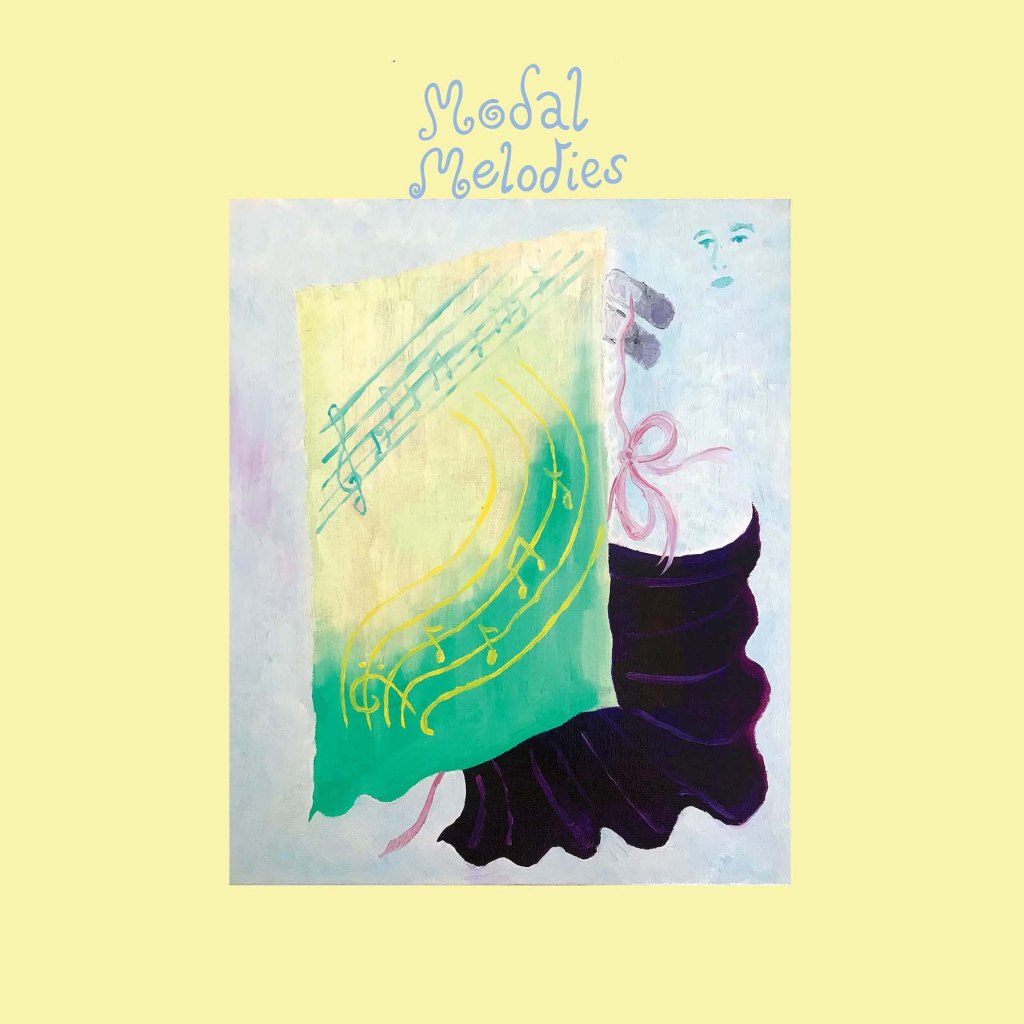
VIO: The painting has sheet music on it, and I can barely read sheet music. I was inspired by the Modal Melodies text which Jake came up with. He wanted to put a lot of clefs and notes in it, we didn’t end up doing that but the painting was inspired by that. Jake sent me a drawing on my phone and I redrew it and put it into illustrator. I guess that was collaborative as well. 

Where did the name come from?

JAKE: The first demo that I did had the name Modal Melodies, then Vio suggested it as the band name instead. We changed the song name to ‘Changing Lights’ which is the closer on the album. I called it Modal Melodies because it was the first song that I wrote on paper first, I tried to write it using my bodgey music writing skills, which is very minimal. I came up with the name before I came up with the song. 

Jake mentioned earlier that you write a lot of the lyrics, Vio?

VIO: Yeah. I wrote all through the process. Usually I’m really slow with lyrics but for some reason this time it didn’t happen. Often if Jake sent me a demo I would instantly get an idea, or even with just what it sounded like, with ‘Driving’, I think ‘Modal Melodies’ as well… I’ve never really experienced that before, writing to something that is already made, the music being made like that. I think it changes how you write. It’s challenging as well. You might not do what you naturally do when you’re just sitting down with an instrument and singing along with it. 

That’s something we both talked about as well, where we were both maybe stuck in a rut with our songwriting, just doing the same things that were quite instinctive, not knowing how it get out of that. 

JAKE: Before I approached you I felt the same as when I used to teach guitar. When I tried to write a song I would often find myself putting in little bits of ‘Layla’ [Eric Clapton] or whatever the student wanted to learn. I found myself doing that with my own songs because it’s all I ever tried to write. When I approached you, I was in desperate want of collaboration with you! 

VIO: I’m glad it worked out! [laughs].

JAKE: Me too! [laughs].

What’s your current favourite song from your record?

JAKE: I tend to like the ones that I had the least to do with, like ‘In The Rain’ and ‘The Sun’. I would say ‘Driving’ was the most 50/50 song I’ve ever been a part of, especially the process of recording it as well—it felt real special. That’s a favourite.

Why did it feel special?

JAKE: As Vio mentioned before, we wrote several parts of the songs without the other person hearing it and then put it all together when we were in the same room, hearing it for the first time together when we played it back. I’m not sure if other people will have the same feelings when they hear it but it makes me think of how we wrote it and what we were doing that day. 

VIO: Yeah, that’s one of mine too. It was cool because it could have been the first time that we both played guitars at the same time. We both just improvised some stuff. It was a really fun experience. I also like the songs that Jake sings on, because I do sing a lot.

JAKE: My voice is all like UUUGH! [laughs] and Vio is like [makes an angelic sound] Aaaaaah!

VIO: [Laughs].

I like the parts where you sing together. 

JAKE: Yeah, Vio kept trying to get me to do that… Vio, I apologise for how difficult I made that for you [laughs]. We’ll have to do it on album two!

Anything else you want to tell me about this project?

JAKE: We did a clip! I was watching a lot of Secret Life Of Us and me and Vio shot a clip in St. Kilda where they shot SLOU. Looking forward to that one coming out!

VIO: It features dancing by us [laughs].

JAKE: Yes, we made up a dance routine! [laughs].

MODAL MELODIES debut full length, self-titled album from May 13th, 2022 on Anti Fade Records (AUS).

Alien Nosejob’s Jake Robertson on new record, Paint It Clear: “Hopefully it will mean something to somebody.”

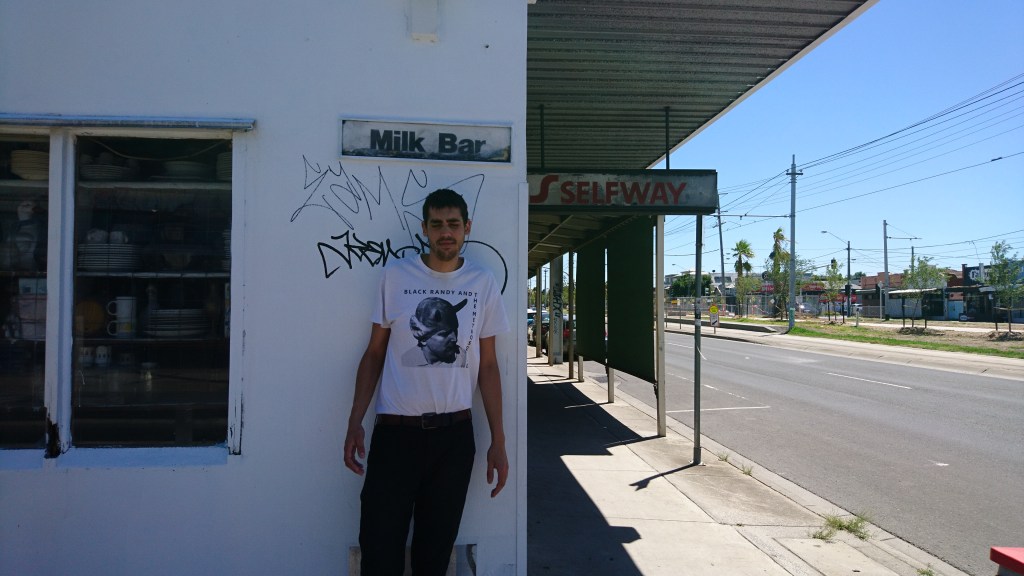
Original pic by Carolyn Hawkins. Handmade mixed-media collage by B.

One of our favourite creators, Jake Robertson (you might know him from Ausmuteants, Hierophants, School Damage, Swab, Drug Sweat, SMARTS and more) is back with a new album for his solo alter-ego project Alien Nosejob. Paint It Clear is ANJ’s fourth full-length. 11 brilliant tracks mixing post-punk with 80’s new wave and even a little disco. Recorded by Mikey Young, the record has ANJ sounding more dynamic and brighter than ever. Gimmie loves Jake’s quirky, humorous and wry observational lyrics and skilful songcraft. We’re excited to share with you, the first track released from the ANJ camp in thirteen months ‘Leather Gunn’ along with our chat with Jake, a sneak peek insight into the forthcoming album.

JAKE ROBERTSON: I’ve been working a lot, it’s taken a toll, I’m basically always tired. I still have a job, which half of my friends don’t since Covid, so I’m pretty lucky in that respect. It’s hard to come home and be motivated to do anything.

When we spoke the other day, you mentioned that you’ve been having a little bit of a break creatively, and that you’ve spent most of your spare time just chilling watching TV and reading.

JR: Yeah. I’ve been reading a bunch, and watching heaps of TV. Kerry my housemate, when he moved in, he brought a giant TV with him; we’ve been going to town on it. It’s the first time that I’ve had a television in ten years—I’m lovin’ it! [laughs]. It’s so good. I’m still writing heaps; I’m constantly writing in-between watching The Righteous Gemstones or whatever.

I feel like maybe a year ago, when I was working a little bit less, I’d finish work, come home and do music for a bit, then go see some mates. Since lockdown has happened, I can’t really see friends, and sometimes can’t be bothered doing music. It’s weird, like I’ve kind of got extra time, but I don’t [laughs].

I feel like you’ve been pretty prolific and released a lot over the last few years though.

JR: Yeah, I have. But everything I’ve released, even the album you’re interviewing me about, most of that was written a while ago. I probably would have recorded it around the time the last Gimmie interview happened.

Yeah, it was around November 2020.

JR: Yeah, that was when I recorded it, but some of the songs were written around 2015, at least the embryonic versions. I’ve just touched them up a little bit.

Having a bunch of songs you’ve written over a long period of time, how did you decide which ones to use for this record Paint It Clear?

JR: The majority of the stuff that I do under the Alien Nosejob name was written with other bands in mind. One or two of them were potentially going to be an Ausmuteants song back in the day. One of them was going to be a Leather Towel song. I have a little log of all my half-finished demos that is written up and pasted on my wall. Every now and then I’ll listen back to something and go, yeah, I could do something with this.

It’s interesting that you said a few of the songs were written with other projects in mind, I had wonder that, because I got that feeling from listening to the album. Jhonny and I were talking about how it doesn’t have one particular sound like other Nosejob releases. I commented that tracks sounded like a Ausmuteants track or even Hierophants or even reminded me of the Nosejob Italo-disco album. The album feels a little like an amalgamation of all the stuff you’ve done.

JR: Yeah, kind of. When I was putting it together, I was trying to be conscious of not making it sound like it’s being too influenced by something else, even though there’s definitely a couple of songs where I’m like, ‘Oh, I was listening to a lot of The Cure’ [laughs]. I haven’t listened to it since I got the test pressing in February. It’s like The Cure with a crappy singer, not Robbie Smith [laughs]. Those two songs are ‘Clear As Paint’ and ‘Duplicating Satan’, which is the Italo-disco-sounding one you were talking about; I remember trying to make it sound like ‘The Walk’ by The Cure, one of their singles from 1983-ish. Hopefully it doesn’t actually sound like it, but I was definitely going for it.

I can totally hear the in there. What can you tell us about the album’s title Paint It Clear?

JR: [Laughs] I literally just jumbled the words of the song ‘Clear As Paint’ around. That song and the title, it was an amateur attempt of a contranym, like painting something clear. If you painted something clear it could be see-through, like glass.

Nice. You mentioned you’ve been watching a lot of TV and films. I love movies, I have since I was a kid. I’d go to the video shop with my mum and we’d get out twenty VHS is $20 for the week. What have you been watching?

JR: We had a very similar upbringing, Bianca. We’d get seven weeklies for $7; you’d pick them up on a Thursday, spend the week watching them and then pick up another seven when you brought those back the following week. I did that from when I was about eight until I was eighteen. It would be a weird week if I didn’t get out at least three videos.

Rad! Whenever I look at those 1001 movies you have to see before you die or 100 best movies of the 80’s and 90’s lists, I’ve seen most of them except for a small handful of titles.

JR: In that 1001 movie list there’s probably another 800 I’d need to see! [laughs]. I’d watch and lot but also rewatch a lot.

Pic by Carolyn Hawkins.

What are some of your favourite movies?

JR: One of my favourite movies lately, because I’ve just rewatched it is, Blue Murder, the mini-series. I created a Letterboxd account the other day, so I was actually thinking about this. I really like the movie The Vanishing, it’s a Dutch one. It’s good if you’re a fan of eerie-ish horror movies. It’s so good. Not the remake with Kiefer Sutherland, but the original. I watched Blood Simple with my housemate, it was awesome, I’ve never seen it before. Movies! Woo! [laughs]. I love Mean Girls and stuff like that as well.

We were talking about comic books before too; I was a really big fan of Ghost World growing up and still am now.

I love ­Ghost World too, and the Mean Girls movie is a classic!

JR: You have to mix up the arty ones with the blockbusters.

For sure. I can’t watch too much of anything at once, mixing things up is essential. For example, if I’ve watched a run of horror movies or true crime, I have to watch something nice and fun and not dark and brutal.

JR: Yeah, it’s time for a Pixar movie! [laughs]. Pixar know how to rip your heart out more than anything else. I feel like the only time that I shed a tear is when I’m watching a Pixar movie [laughs]. The last time I got on a plane, which seems like a long time ago now, I thought it would be a good time to watch the Pixar movie Up. I feel very sorry for the person that was sitting next to me because I was crying, slobbering all over them [laughs].

Awww [laughter]. So, the first single for your album will be ‘Leather Gunn’…

JR: Yeah, it is. When Billy [Anti Fade], Sam [Feel It Records] and I were thinking of what the first single off the album should be, we were like, we’ll each say our top three. That wasn’t in mine, but they both had it in theirs, they have the outsider perspective. To me, all of the songs, I just shit them out and I’m done with it [laughs], I don’t think about them anymore. They both had that song first, so I was like, ok, let’s do that one first.

What was happening when you wrote it?

JR: John Douglas who plays in Leather Towel with me, he was moving back to Australia from New Zealand and we were talking about doing a new Leather Towel album. I was trying to come up with something that sounded different to the first album; that was the only song that I wrote for it. We played two or three gigs, then Covid happened and he went back to New Zealand. We didn’t even get to try that song as a band. It seemed at the point where it probably wouldn’t happened, so I made it a Nosejob song. I kept the ‘Leather’ in there as a nod to that, and the ‘Gunn’ was because the original demo of it, the guitar was single note surfy, like a Peter Gunn da na da na da na na na. Lyrically, it’s about people not doing what they’re told no matter how minuscule and pointless or petty the thing they’re not doing is.

What are the songs the you really love on the album?

JR: I really like ‘Duplicating Satan’.

Was that one of the songs on you top three list?

JR: My list was ‘Duplicating Satan’ and ‘King’s Gambit’ (which will be the second one released, I wrote it in 2015 but never put lyrics to it) that was probably my best written song on the album, it took me ages to write it. The other song is the last one ‘Bite My Tongue’. I get why that wouldn’t be a not-released-before-the-album-comes-out one. That’s another one that took me ages to write. It took me ages to learn how to play it too. ‘Bite My Tongue’ and a few songs that I have, are about… you know when you have a thought or a way of feeling about a certain situation but you can’t find the words to get it out. It’s almost like a block and you just can’t say your mind. It’s a feeling I have sometimes, I can’t even tell myself what it is. Basically, it’s about a mental block and not being able to get your words out properly.

I get that, it makes sense.

JR: Kind of, I think I was trying to make sense of it in the song. Hopefully it will mean something to somebody.

I really love the song ‘Jetlagging’ on the album.

JR: That one was originally written with Ausmuteants in mind, I wrote the lyrics on an Ausmuteants tour, travelling 400kms a day and just eating the same meal over and over again. It’s a very my-first-tour, Tours’R’Us or Tours For Dummies lyrics! [laughs]. I really love that song too.

Also, I love ‘The Butcher’ which is before ‘Jetlagging’ in the album sequencing.

JR: A couple of years ago, I was getting obsessed with Terry Hall and Fun Boy Three. I was trying to write something a little bit from that camp, and The Zombies’ song called ‘The Butcher’ as well; it was definitely an influence on it, but I didn’t mean to call it the same song [laughs]… I’m kind of noticing that now.

I got Mikey [Young] to record the drums; he recorded the drums, bass and guitar for the album. Except for ‘Duplicating Satan’ which I recorded at home, and ‘The Butcher’. I couldn’t work out what I had played in the demo, I had to drag the demo out and stretch it over the drums that I played. I don’t think anyone else will notice this, but if you listen closely the drums and the rest of the music keeps on going out of time because of that. I tried to relearn how to play it, but after a while I was like, I can’t be bothered! [laughs].

Is it weird sometimes listening back to your songs and being able to remember what was happening in your life or what you were doing at the time of writing or recording it? Kind of like having a sonic diary.

JR: Yeah, it is. I might think something is not about something, but it will be. I’ll generally listen to an album that I’ve done when I get it on record, and that’s it. I actually listened to an Ausmuteants album, Amusements, the other day, it was the first time since we recorded it. It was a nice feeling; I definitely like it more than I thought I would. It was good to have an eight-year distance of not hearing it, it was recorded in 2012 or 2013. I won’t rush to listen to it again [laughs], but I didn’t hate it as much as I thought I did.

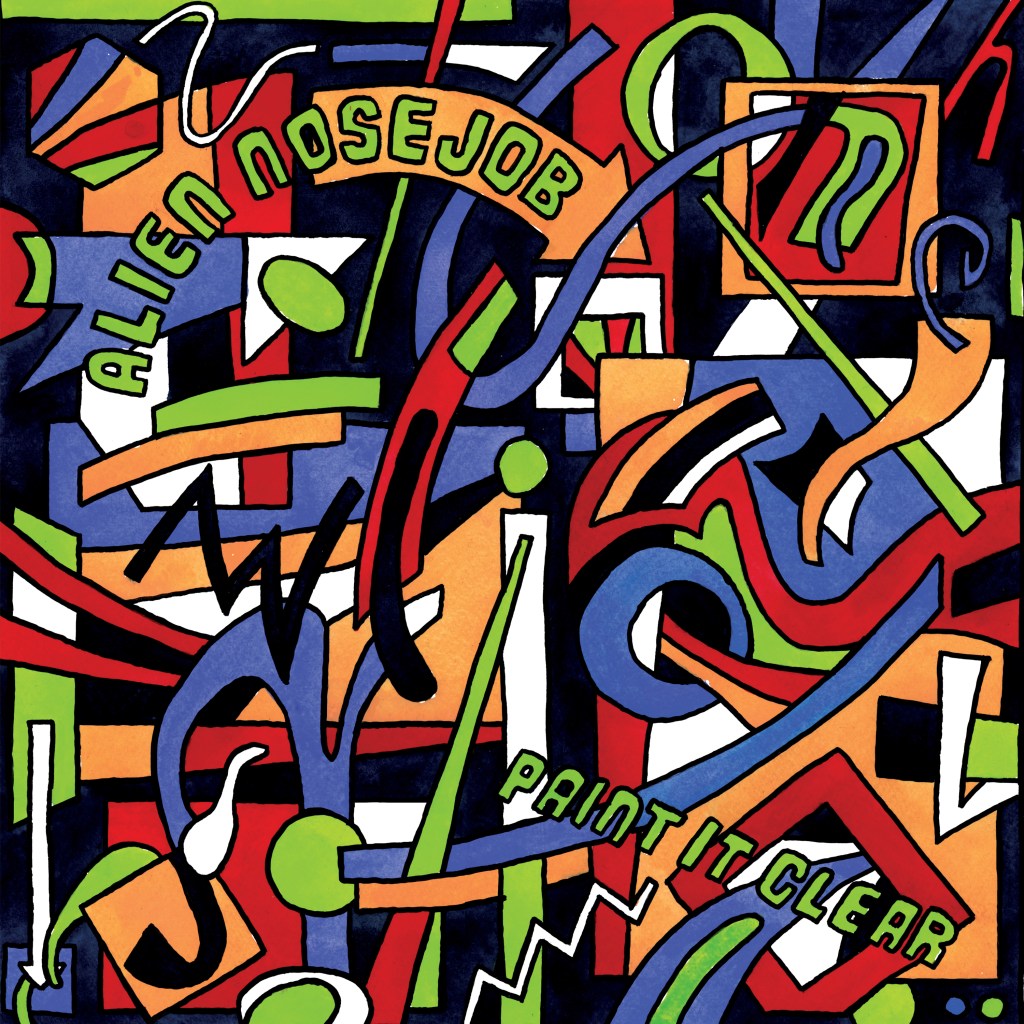
Album art by Nicky Minus.

Who did the album art for Paint It Clear?

JR: How good is it?!

Really, really good! That’s why I was asking, it’s very cool.

JR: It was done by Nicky Minus. They grew up in Hornsby in New South Wales, but they’re living in Melbourne now, and does a lot of work for the Worker’s Art Collective doing a lot of work for Union. I got onto them by following Sam Wallman who is a comic book artist/cartoonist.

Is that the same Sam who has done artwork for you before?

JR: Yeah, he did the first Ausmuteants 7 inch in 2010. I’ve been following his stuff before then, he’s besties with Nicky, I saw their stuff through that and was blown away by it. I just bought some of their art for my wall, and because I look at it every day, I was like, it could suit this album. They were into it, they wanted to make something from scratch. I’m glad they did and am super happy with the way it turned out.

What else have you been up to of late?

JR: I’ve been doing some home-recording with Vio [Violetta DelConte Race] from Primo! I’ve loved her songwriting for ages, she has a good idea of space, if it doesn’t need to be played, she won’t; the way I play is the opposite of that [laughs]. It’s kind of inspired by Michael Rother, and sounds basically like School Damage and Primo! If I could sound half as good as Primo! I’d be happy. It’s called Modal Melodies. The only rule of the project is that we’re not allowed to play live, it’s just a recording thing.

Cool! I can’t wait to hear that. I love Primo! too. They’re all such incredible songwriters.

JR: There’s a new Swab album around the corner too coming out on the label Hardcore Victim in around January or February. And, I’m playing drums on the new Ill Globo album!

Alien Nosejob’s Paint It Clear is out November 12. Pre-order now: Anti Fade (AUS) and Feel It Records (USA).

Anti Fade are also offering a bundle deal, including Paint It Clear on vinyl, the last record Once Again The Present Becomes The Past on cassette and a t-shirt and a ANJ shirt! Get it HERE.

Read another Gimmie interview with Jake: Alien Nosejob: “I wanted to make it sound like a mixtape that you’d give to your friends”

Please check out: aliennosejob.bandcamp.com

Power Supply: In The Time of The Sabre-toothed tiger

Photo: Matt Weston. Handmade collage by B.

Power Supply have come together to bring us an inspired record for grim times. The Naarm/Melbourne group features Leon Stackpole (The Sailors), Richard Stanley (Drug Sweat), Per Bystrom (Voice Imitator) and Mikey Young (The Green Child). In the Time of the Sabre-toothed Tiger packs a one two punch with its bright melodies and first-class songwriting. An invigorated, yet chilled and charming style of garage rock, that will have you smiling; the sincere and entertaining lyrics a highlight.

Gimmie are excited to premiere first single ‘Infinity’! We chat with vocalist-guitarist Leon about the track and forthcoming album, out October 22, a co-release between Anti Fade and Goner Records.

We’ve been listening to the new Power Supply album In the Time of the Sabre-toothed Tiger on high rotation all week. It’s such an incredible record. It has a really bright feel to it and it’s made us really happy. In grim times, like the world has been experiencing of late, it’s nice to have something like your record to lift the mood.

LEON STACKPOLE: That’s really nice to hear. It makes me feel happy too.

When I recently spoke to Billy from Anti Fade Records (who is putting the record out) he told me that you’re one of the funniest guys he knows. How important is humour in your life?

LS: It’s through everything really for me. I really like music that has a sense of humour. I also like music that is serious too, but I think that some of my favourite stuff has that extra little bit, that humour, in it. I gravitate towards those sorts of things.

One of the things that I really love about Power Supply is your lyrics. There is a comedy in there, but then there is also introspection and a lot of thought behind it.

LS: I think you could say that… [pauses]. Sorry, I’m just walking past my wife in the garden.

Lovely!

LS: There is humour. The lyrics that are on there are probably no particular theme, yeah?

I feel like it’s a real collection of thoughts, from everywhere, just from living life.

LS: Yeah, there is. I made up all of the album pretty much. Probably the ones that get on there are the ones that are the least ridiculous [laughs]. Some of the songs I’d take to rehearsal to play to the guys and they’d just go, “Oh my god, what is that?” [laughs]. They may consider it to play live once in a while, but other than that they just go, “All right, it’s a bit too absurd.”

[Laughter]. I understand that when you got back into the shed to write the record that “jams became songs, jokes became lyrics”; what is one of your favourite jokes that became a lyric?

LS: I think the ‘Time of the Sabre-toothed Tiger’ one makes me laugh. It comes from the concept of when people talk about anthropology and evolution, these sorts of concepts, and how all of our behaviours go back to early humans, back in the time of the sabre-toothed tiger. When my wife and I are talking about things, we’d be like, ‘what would they have done back in the time of the sabre-toothed tiger?’ That crept into the lyrics to the point where I suppose you hop into a time machine and go find out. To me, that’s funny! I don’t know if it is to anyone else though [laughs].

[Laughter] It is. I totally get that. There are a lot of moments lyric-wise on the record that had me smiling in amusement and laughing.

LS: I think ‘Infinity’ is funny as well. That song is completely absurd. I haven’t actually talked about these songs to anyone, you’re the first person I’ve spoken to. It’s funny you’re asking me these questions because I was just out in the bush taking the child for a ride, feeding the guinea pigs and things, it was getting closer to the time for us to chat and I thought, aww sheezus those songs, I have to talk about those songs! [laughs]. I called up Per and said, Per, what do you think are the themes of the songs on this album? He said, “It’s kind of like all these songs that you made up before lockdown that kind of predicted lockdown. Fuck, we’re soothsayers or something like that!” [laughs]. I don’t know if I honestly believe that, but it’s interesting to hear his perspective on it.

I love how the opening lyrics for ‘Infinity’ literally say that Mikey sent you an MP3 and the title was ‘Infinity’.

LS: [Laughs] That’s exactly how it happened.

Did you ask Mikey about why he called it ‘Infinity’?

LS: I never did ask him about it. My son became a but obsessed by that song. With the last verse about lying on your deathbed, he’s like, “What’s a deathbed, dad?”

Wow. That’s a big question.

LS: [Laughs] Yeah. Then he became obsessed with the concept of infinity as well. I pinched all of his little phrases that he says for the other song… what’s it called?

Photo: Raven Mahon

‘Infinity and 90′?

LS: Yeah. ‘Infinity and 90’.

I was going to ask you if there is a connection between the songs ‘Infinity’ and ‘Infinity and 90’?

LS: Yeah, there’s a connection… I’ve never really thought of this before. So, since hearing ‘Infinity’, my son was obsessed with the concept and we were driving along in the car and he’s like, “Daddy, I think I know the biggest number ever! Infinity and 90!” [laughs]. I wrote it down and when it came time to write the song, I thought they made good lyrics, so I threw Archie’s lyrics on there.

That was one of the songs that had me amused by the lyrics. I also love the line: Does the mountains make the mist or does the mist make the mountains?

LS: I love that one too. We were driving to Melbourne passed Mount Macedon, it was covered in cloud. My son was contemplating that and said that, that’s how that lyric came.

The next line too, about there being a bee in the car; that was real too?

LS: We were in the car and there was a panic. In absolute terror and fear he’s like, “There’s a bee! There’s a bee in the car!” But actually, it was a piece of dust [laughs]. I don’t know how he confused dust with a bee, by the way.

It’s funny because as a listener who has no idea of the backstory of the song, you could listen to the lyrics and it could sound like an abstract metaphor and you could read really into it like, oh this is such a deep concept! In reality though, it comes from the everyday ordinary life stuff you experience.

LS: Yeah, for sure. I love that.

The way you deliver the vocal for ‘Infinity and 90’ is almost whisper-like; what inspired that?

LS: I’d been listening to a lot of La Düsseldorf that day and somehow or another that voice ended up on that song.

I think the vocal delivery really suits it. I also love how every song on the record sounds different. I don’t want to sound too wanky, but the cohesiveness of the album feels like a journey.

LS: Yeah, yeah. There’s nothing wrong with a good journey here and there.

Are there any lyricists that you really love?

LS: Yeah. It’s funny, this morning the local radio station was asking people about that, to text in and say their favourite lyricists. People were writing in fairly regular things. I thought, what would I do? I’ve been listening to Kate Wolf lately, a lot. I ended up texting in and saying, Kate Wolf. Some of her lyrics, songs like ‘Green Eyes’, I love that song. It’s beautiful, just so perfect and genuine.

When did you first start singing?

LS: I used to sing in bed when I was a kid, until I’d finally fall asleep. I didn’t really sing that much until we started a band with some friends of mine called, The Sailors. It was a good band because we’d all jump in and have a go. With Power Supply, I’m trying to get everyone to do backing vocals. I think Mikey is finally coming around to the concept [laughs]. I like to hear backing vocals, I love them.

Same! I’m a big fan of backing vocals. The band No Doubt have some really cool backing vocals that Gwen Stefani does. They’re actually really interesting and have some cool harmonies.

LS: Yeah, right. I haven’t really listened to their records except for the hits and a bit of her first solo record [Love. Angel. Music. Baby]. I kind of like that record.

That record rules!

LS: I like the big hit off of that one. The one where she’s basically struggling to come up with new songs.

‘What You Waiting For?’?

LS: Yes! That’s a classic that song. I do like that record. When the harmonies are done really well it’s just wonderful.

Totally! Do you ever get self-conscious doing vocals?

LS: Not so much anymore. I remember the first gig that us guys played, I didn’t really have any lyrics [laughs]. I was driving to the gig trying to make them up; that was probably a bit nerve-racking.

How did the gig end up going?

LS: Well, it’s amazing what you can get away with! [laughs]. The gig was fine.

Art by Mark Rodda

How did a Mark Rodda painting end up becoming the album’s cover?

LS: That was Per’s research. How it went about it, I’m not sure. We did look at a few different things and a few different artists’ styles. Per looked at all that stuff and we discussed a few. In the end he said, “This is the one.” And, we all agreed.

When you look at the album cover, what do you get from it?

LS: I haven’t seen it for a little while, but it makes me feel warm inside.

[Laughter]. Awww.

LS: It probably looks a little desolate. I’m living in Central Victoria right now, so everything is a little like that sort of a landscape, which I feel pretty comfortable with. How about you?

I get more of a lush feeling from it. The tree gives me ancient forest vibes. I think it ties in with Time of the Sabre-toothed Tiger theme too.

LS: I do recall us making that connection. I do guess that’s why Per suggested it.

What’s one of your favourite things about the new album?

LS: I love the sound; I think it sounds amazing. We recorded it at The Tote in the front bar. We did a residency in September two years ago; we played each Sunday afternoon. We left our gear there on the last night and came in on the Monday and recorded it there, cos we were pretty well-practiced. You’ve got the traffic out the front, I thought it was all going to come through the windows, but it’s fairly well insulated and you couldn’t really hear anything else. In fact, the beer fridge was making more noise than anything else and we had to turn the beer fridge off.

What did recording at The Tote add to the songs or experience?

LS: It made it feel more comfortable because we’d just played there. It’s been hard for us to get together to play. I’ve been in Castlemaine, Mikey is down on the Peninsula, the other guys are in Melbourne. We have to make an effort. We played five gigs in a row over five weeks and recorded, we were hoping that we would feel comfortable, relaxed and well-practised. We do have fun together. We recorded in one day. We’ve added some overdubs and things in since; a few years for some overdubs! [laughs].

How does it feel to finally have the album coming out in October?

LS: A relief really. Just last year I was saying, oh, let’s just put this out on Bandcamp and be done with it. It kind of felt like that for me [laughs].

I’m glad you didn’t just release it digitally. It’s such a beautiful album and deserves a physical release. The album is too special for it to only be digital!

LS: It’s been such a long time since we recorded it all.

Have you listened back to it recently?

LS: Nah, but I probably should. We have been talking about playing some gigs, but I don’t think it’s going to happen for a while.

When we jam and it’s Mikey, Richard and Per just playing away, it’s the best thing for me, I just sit back and listen to those guys.

We’re excited to be premiering ‘Infinity’ the first single from the new album!

LS: That’s so great!

There’s a lot of stuff around water and the environment that seeps into the music.

I know that you work in environment protection roles, so obviously you have a passion for doing that.

LS: For sure. It’s probably the sub-theme in the whole sabre-tooth-tiger-thing—environmental change.

I totally got that. It’s interesting how a lot of the world seems so divided right now and people get so hyper-focused on particular things and who is right and wrong, but they also forget that there’s crazy stuff going on with the planet, climate change, depletion of land and resources. If we don’t have a planet then we’re not going to have anything! It’s pretty much the number one base thing we should be concerned about.

LS: Yeah. It’s pretty fundamental [laughs]… that’s just trying to add some humour to it, because it is fundamental.

Photo: Matt Weston

**Note: This interview is an extract. The entire chat where we talk more about the album, Sun Ra, turning every day occurrences into song, and more, will appear in the October print issue of Gimmie**

Here’s the first sneak peek at ‘Infinity’ from Power Supply’s forthcoming album, In the Time of the Sabre-toothed Tiger:

Available for pre-order HERE at Anti Fade and HERE (in the US) at Goner Records.

Constant Mongrel’s Tom Ridgewell: “TB RIDGE AS THE DIRECTOR is a comfortable place for me.”

Original photo : Sophie Woodward. Handmade collage by B.

TB Ridge As The Director is a solo project from Tom Ridgewell of Constant Mongrel, Woollen Kits and Calamari Girls. His Rock n Roll Heart EP is neo-traditional rock n roll; rock n roll 101 but with drum machine, synths, vocoder and strings. It’s a fresh and intriguing listen. Gimmie interviewed Tom to learn more.

How has your day been? What have you been up to? 

My day has been great, thanks! I have been in Lara with my partner Sophie visiting Mum and Dad and my brother and sister in law and their 8 month old. It was really nice to see them all, as we haven’t been able to for a while. Especially Michael, as he has changed so much recently. 

Do you listen to music every day? What have you been listening to lately?

I do listen to music every day! I work at a little cafe on my own so I get to pick what music plays for around six to seven hours. At the moment I am listening to jazz a lot- Krystof Komeda is my jam at the moment, his soundtrack to Knife in The Water is so, so good. I’ve also been enjoying listening to some 70’s folk stuff, Maddie Prior and Sandy Denny (with Fairport Convention) for my lyrical content.  I let my partner do the music at home, so Townes Van Zandt, OV Wright, Eno and Talking Heads at the moment. 

You were born in and grew up in Melbourne, right? Has music always been a big part of your life? 

I actually was born in Ararat and lived in different parts of country Victoria before high school. The reason for that is my dad was a Presbyterian minister (a job which can make for lots of moves).  I bring that up to answer the other part of the question. Music was always around my family, neither of my parents played instruments, but we all sang every Sunday at church. Dad has a bit of a shocker of a voice and ear but would always lead the singing with gusto and my Mum has a lot of natural talent musically (she actually got a cello for her 60th birthday and is doing really well at learning) . Apart from church music, we did grow up with some classic rock like Creedence, Van and Bob. Also Sound of Music and Mary Poppins were favourites, Julie Andrews is so good! 

How did you first discover your local scene? What was the first gig you saw?

I honestly can’t really remember a first gig! I can remember gigs if someone brings them up, but off the top of my head I couldn’t say what my first proper show was. Getting into my scene was probably through my friendship with Tom Hardisty, and us playing music together from around 19/20 years old. He was friends with my ex-girlfriend and we hit it off and started playing with each other pretty quickly. That’s how old Woollen Kits is now, haha. 

Previously you’ve said that you were trained to play classical cello when you were young and your parents persistence to make you continue with it, when you really didn’t want to, probably helped form the way you think and feel about music now; how so?

Yep, thinking about that now has made me sequence some things together with that. I played cello from when I was about 11 and enjoyed it at the start but as teenagers do I began to want to distance myself from the old fashioned instrument. I wanted to play bass guitar and then my cello teacher (and parents) encouraged me to try double bass with another teacher as it has the same strings as a bass guitar but similar playing method to the cello. The bass has also the same first four strings as the guitar (which I had started to teach myself). Continuing on double bass was awesome and I learnt a little jazz and got ok with a bow with more classical stuff.

How long do you think you’ve been writing songs for now?

It took me a long time to say I was writing proper songs, but it was around high school age that I thought I was doing it. I resisted for so many years to actually learn some theory behind how to make a song. I suppose I thought it was all natural and free, which can be cool, but never very good unless you are some kind of genius. 

As a songwriter, what kind of place do you feel you’ve reached with new solo project TB Ridge as the Director?

TB RIDGE AS THE DIRECTOR is a comfortable place for me. It feels natural and easy to write this kind of music and I have embraced it. I feel like it’s going to be fun to one day make a band and play the songs live but for now the EP is a snapshot of a good little moment for me! 

I know you like a minimalist approach when it comes to lyrics; do you find it hard to write lyrics? 

Yes and no. I just tend to write lyrics after the music for everything I’ve ever done. I find it easier to find the right words for the music than come up with music for the words. So by default the way I went about making this music, I didn’t have much room for long lines. There is a part in the Gimmie Danger doco where Iggy says something about 200 words or less theory he takes on, I really like that. Simplicity is really important to me. If I read a book that’s too wordy or descriptive, I’ll stop reading straight away. The ultimate writing for me is simple words with complex themes. 

Your new EP is called Rock n Roll Heart; where’s the title come from? Was it inspired by Lou Reed’s 7th studio album, Rock n Roll Heart?

Yeh, it was kind of inspired by Lou’s song. Funnily enough, Eric Clapton has a song called Rock and Roll Heart too. For me it was just a line I had been thinking of the whole time I was doing the music for the song. The riff kind of came out of nowhere and sounds like some kind of discarded Runaways song or a Stones B-side and I just was in this place where I’d become sick of worrying what people thought of my music in regards to artistic legitimacy. Fuck it, it’s rock music and I liked making it.

Was doing a solo release born out of necessity because of lockdown?

Not really, I actually have a whole album of more singer songwriter stuff recorded a year ago that one day might see the light of day and I probably have done over 200 demo recordings of different types of music over the last six years. Maybe one of these songs (The Garden) would have been an idea for a Constant Mongrel track, but because we haven’t been able to play together I turned it into something for me. 

Previously you’ve commented “I usually hate recording”; has that changed?

My dislike for recording back then came from a drummer’s perspective! Anyone that has had to sit through live recording in a studio as a drummer will get the pain. You are freaking out about getting it right the whole time, if you make a mistake the take is over or even worse and someone else and it’s heartbreaking. I’d say I kept that attitude in the studio even if playing guitar for a long time but it’s slowly changed to the point where doing a record is the most exciting part of making music for me now. 

When you started out making Rock n Roll Heart did you have any references of where you wanted to go? Was there anything you particularly enjoyed listening to at the time (or when recording)? Initially how did you want the EP to sound? 

I definitely wanted to make an interesting sounding rock record. One of my key reference points was an interview with Genesis P Orridge about the song God Star that Psychic TV made. They stated that it was a nod to the sixties counterculture, and in particular Brian Jones. I suppose that Gen had been known to push boundaries with their work so something like that song was in a way giving some kind of consideration to the past and those that blazed trails for contemporary music. I’m not saying my other projects are particularly out there or interesting but for a while I think with Constant Mongrel I have tried to darken or subvert punk music with technical tonal variations on traditional rock scales.  So the idea of going back to the source without the darkness was what I wanted. 

Was there anything you were mindful of when writing this collection of songs? 

Definitely making music that was ‘me’ was on top of the list.

For you, what are the elements that make up rock n roll?

Well, that’s interesting. I’m gonna sound like a dumbass, but I actually met Liam Gallagher backstage at Merideth last year (btw, he is easily the most famous person I have ever spoken too). We chatted for a while but what came up was a discussion about another artist on the bill that night, his name is Hooligan Hefs from West Sydney. He does this new school drill rap stuff that’s really taking off in NSW and QLD at the moment. We both noticed how good the show was. I said, “I think that that is the new rock and roll!” He replied, “It wasn’t rock though, was it?” I asked, “What is then?” He responded with some babble about guitars and drums, etc. I’m still not sure I agree with him because if you get to nitty gritty, Oasis use far too many minor chords in regular major keys to be what a classic rock n roll band should be, they are more pop, so they aren’t rock, are they? I suppose his brother would know that more than him because I think Liam just sings, right? I don’t know where you draw the line, it’s the same as punk. I’d say a band like Primo! is way more punk than most bands that call themselves punk, but I still can’t really explain why! It’s an attitude and an ethic above all else I think. 

You used Garageband and a drum machine to make the release; did songs often form around a loop first? I really enjoy that you’ve, in essence, built classic rock style songs but used a drum machine.

Yep, they are all loops and layers. I suppose using the drum machine as a rhythmic driver is something that just seemed natural to making the songs because I wanted drums for the tracks and that’s all I could get my hands on. I find it funny people think it interesting or cool when a band uses a drum machine, it’s not really that cool. Maybe when Young Marble Giants or Suicide did, it was, but that was 30-40 years ago, we should be getting used to it by now! It’s just a jazzed up metronome. 

I love the auto-tune, strings and synth in the mix. I understand you used an iPad too; for what parts?

So it was recorded on the iPad too!  I don’t really have a computer that I can use for recording, so I use our iPad. It has all the features on it that I needed and I used a direct line in with an iRig, which was awesome. It really is a mobile studio that makes decent quality recordings! I am glad you like the extra things I did, I took a while to get to the point where I used auto tune on every track but am glad I did. It gives it an unnerving vibe sometimes as we tend to not hear it with guitar music very often. 

What drew you to choosing Woollen Kits bandmate and friend Tom Hardisty to master the release?

He has the skills and I get to buy him a present instead of giving him cash. Having Tom involved is also just awesome cause it’s another set of ears I trust, because he has great taste and does recording himself (to a millions times better standard). 

I’ve heard that you have a love of country music? When did you start listening to it? What kind of things do you listen to?

I didn’t grow up with country music, so everything I listen to now is just from my own research as an adult. I like a varying realm of country music which maybe some hardcore fans would question why or how. Any way some of my favourites are Loretta Lyn, Porter Wagoner, Dolly Parton, Townes Van Zandt, Hank Williams, Gram Parsons, Carter Family, Steve Earl and, although she wasn’t always country, Bobbie Gentry. I also love early Cajun music. 

Is there anything happening on the Constant Mongrel front?

I wonder if we will get into a space and play together before the new year?! Maybe something might pop up soon in regards to a little release. I just can’t wait to hang out with the crew again. We have our Christmas party every year which is always a highlight of the season.

Anything else you’d like to tell us or share with us?

One time my Dad and I were watching an interview with Michael Stipe and Dad said, “Musicians have to be the most self-absorbed people in the world and if you ever become one, please be mindful of that.” So yeah, it’s funny that after all these years I have to be the sole answer for questions that might encompass self-involvement to answer. I hope and worry that I come across ok! On the other hand, Michael Stipe is boring and arrogant and I don’t like REM, even in any ironic 33 year old discovery of music I thought sucked when I was in my twenties kind of way.

Please check out TB Ride As the Director. Rock n Roll Heart EP out on Anti Fade Records 20 November.

Billly Gardner of Naarm/Melbourne punk band Smarts: “It’s been a wild year”

Original photo by Jamie Wdziekonski. Handmade collage by B.

Smarts’ new album Who Needs Smarts, Anyway? is one Gimmie HQ’s favourite releases of 2020. Frenetic, fun, clever, tight songs to lift your spirits and make you smile as we close out a year that’s been challenging for most of us. Gimmie spoke to bassist (and person behind Anti Fade Records) Billy Gardner.

You were the first official person we spoke to for Gimmie!

BILLY GARDNER: Woah. Really?

Yeah, and at the time you’d just put out your 61st release on Anti-Fade.

BG: I think that was Living Eyes, maybe.

Yeah. And now you’re at release 73 with the new Smarts record, I think!

BG: Yeah, I’m putting at tape out [TB Ridge as the Director – Rock n Roll Heart – next week, that’s 74.

Nice!

BG: Yeah, getting there.

What kind of stuff have you been listening to lately?

BG: Um, honestly, not heaps of stuff. Like, nothing new, really. I haven’t listened to too much new stuff this year. I’ve been listening to lots of stuff that my Mum played me when I was growing up. Classics like Toots and the Maytals and Ike & Tina Turner and stuff, and at the same time I’ve been going through a bit of a Metallica wave over the last two weeks—that kinda happens every few months.

Rad! So, has Smarts had a chance to practice since the lockdown has ended?

BG: Nah. Not as a full band since maybe like May. So we’re pretty keen. I think we’ll be able to do it in the next fortnight or so. There’s a few new songs that we’ve all sort of like made up in our own time, if you know what I mean, to work with.

Oh, nice. Is there anything in particular you’ve found yourself kind of writing about?

BG: No, I actually haven’t written any lyrics yet. I’ve just been making lots of riffs. I feel like it’s been a really dry year for lyrics. I just have no new inspiration this whole year, you know what I mean?

Do you think everything that’s happened in the world has sort of affected that?

BG: Yeah, well I feel like I usually get heaps of ideas from travelling and doing stuff and just getting out of the house, which I kind of haven’t really done at all this year. It’s been a pretty wild year.

And you keep a lot of memos in your phone for song ideas and that kind of stuff?

BG: Yeah, totally. There’s a lot of like little, loose, 30 second to 60 second riffs in there.

Do you just sing them into your phone or do you just like actually play them?

BG: Ahh, depends. Usually play ‘em, but sometimes sing them; that’s just like maybe if I have a riff in my head and I’m not near a guitar or anything. I feel like they’re usually the better ones, and I have to learn them on guitar later.  

I know creative ideas kind of come from everywhere, is there times more often than not that you get them?

BG: Yeah, I feel like it usually goes in waves. And I haven’t really been on a wave like that for the last month, or even two. But maybe like six to eight weeks ago I had a bit of a wave and a whole bunch of things came at once, and I was playing guitar every night. But I’ve been busy with like the label and other stuff lately, so I haven’t been doing as much of that.

You play bass in Smarts, and I know your Dad used to play bass in Bored!, I was wondering if he kind of inspired you to play bass? Because I know you started playing drums, I think?

BG: He definitely inspired me to play music. But the whole bass thing sort of came later. I do get to play his bass. I love playing his bass! It’s an old Fender Precision from the ‘70s, he’s got a Rickenbacker too, which is very special, but I think I prefer the Precision. I don’t know where the bass thing came from, maybe it was just like something different. I feel like with this band a lot of riffs are made on bass and then we’ll bring in the guitar later. Where in other bands I’d make riffs on guitar and bring the bass in later. So it’s kind of just a natural way of doing things a bit differently to what we’re used to. I saw this band called Vodovo in Japan about three years ago and they didn’t have any guitar, they just had two bass players, and that was definitely a big influence on Smarts.

Cool. I heard that when you came back from Japan you had the idea of the band name Smarts, because you were in Japan one of your friends you were with kept saying everything was “smart”.

BG:  Yeah, yeah. So Ausmuteants toured Japan in mid-2017, and saw Vodovo for the first time, and was getting a bit restless to do something a bit different, and our friend Shaun was just saying everything was smart, like you’d say something and he’d say, “That’s smart!” It was like his term of the tour, and I kind of thought Smarts was a cool name.

When you started you were just a 2-piece, you and Mitch?

BG: Yeah, I felt like we’ll just start it like that and just make a couple song and then try and flesh it out in to a live sense, and then it grew a lot there once we brought four people into the mix.

And you and Mitch play in Cereal Killer and Living Eyes together as well?

BG: Yeah, and Wet Blankets. I’ve been playing in bands with him for years.

How did you guys meet?

BG: In high school, actually. He’s a year younger than me and I met him on his orientation day and he was about to go in to Year 7 and I was going in to Year 8. We had heaps of mutual friends. We sort of had heard heaps about each other already and both skated and stuff, and we just kind of kicked it off from there.

I figured you guys had known each other for ages, because as far back I could see you had worked together heaps.

BG: Yeah, we had this funny band before Living Eyes called Hideaways when we were 14. Pretty cute.

Did you play drums in that one?

BG: We all switched around. So I played drums on a couple songs, sang a couple songs. I did really play guitar or anything back then.

What did that used to sound like?

BG: Kind of like a way more garage version of Living Eyes. Living Eyes sort of came out of that, as the bass player for Living Eyes was in that band too.

Wow. It’s nice to find out about all the connection and everything.

BG: It was extremely like garage days of like jamming in garage, quite little.

Then with Smarts, you added Jake and Sally and Stella. How do you think, when those guys joined, your sound started to evolve.

BG: Um, yeah, well that’s when it became much more interesting, I think. Especially bringing Sally and Stella into it. Although they were never in the band at the same time. Sally was originally in it, and she had never been in a band before, so that was cool, seeing her get all excited about playing music and stuff, and she brought heaps of cool bits to it like the keyboard line in ‘Smart Phone’ is like huge and that’s her. And then Stella came later, Stella actually came in after we’d recorded the album and played saxophone over the top of everything and really made it shine.

I was going to ask you what you love about having saxophone in the mix.

BG: It’s the best, I love everything about it! I think it’d be cool to work on new stuff with Stella, because we haven’t written songs together yet but we will now.

And with Smarts it’s a real collaborative process?

BG: Yeah, Smarts is so collaborative! Although Jake’s written a couple songs where he’s brought it in pre-written, and we’ll learn them and maybe add a tiny bit or like do a bit  twice as long as in his version but not really change it. But all the other songs, me and Mitch’s songs, they’re all just brought to the band and we’ll extend it from there.

With the new album, Who Needs Smarts, Anyway?, four of the tracks were on your first release, Smart World, I wanted to ask what do you like about the re-recorded versions?

BG: Mostly the fact that they feature everyone. Because the first release is just me and Mitch, so like a few people asked us why we did that, and that was just like because this is the full band version, and it’s got sax and keyboard and we’re all on our designated instruments now instead of it just being me and Mitch messing around, so I feel like it’s a whole different thing!

When you recorded, you kind of recorded the bones of it over a weekend and then people came by your place and did overdubs and stuff?

BG: Yeah, we just recorded it real basic. Just me, Mitch and Jake over a day and a half. We got a space in Geelong from like 3pm one day and set up and started recording that night, and then just did a whole day the next day, and then just took it back to Melbourne and over the next couple weekends people took turns at coming over and doing overdubs and really didn’t rush that, we sort of did the overdubs very slowly and it was a lot of fun days. So it was very layered. We kind of double tracked everything on the album except the drums and bass.

What made the days so fun?

BG: Just like hanging out and taking our time with it and having a few beers and stuff. It was always very fun.

And you enjoy recording?

BG: Yeah, we’ll I’m actually doing less of it these days. I used to record way more bands than I do and just felt like it was taking a little bit out of music for me. So I’ve sort of just been doing much less of that and keeping to my own stuff and you know, I’ll still record a few things here and there, but I don’t really wanna do it as a job or anything.

I often find people do get that after a while, like a lot of people I’ve talked to get that feeling.

BG: Yeah, I think I’d rather spend time on my own music a bit more than recording other people’s bands. I like doing it but I don’t wanna do it all the time.

Do you have things outside of music that you like doing?

BG: Yeah, just general stuff like me and Mitch blew up this little blow-up dinghy and took it down the river the other day. That was funny. Nothing out of the ordinary, just hanging out with people, cooking food and stuff like that.

What’s one of your favourite things to cook?

BG: Probably Mexican.

Tacos? Burritos?

BG: Um, yeah, are both good. I guess they both have their pros and cons. Maybe I’ll say burritos, just because they’re a tiny bit less messy. But when it’s a good night for it, I love a good taco sesh!

I always find though, tacos tend to go soggy quicker.

BG: Are you a hard shell or soft shell taco kind of person?

I’m soft.

BG: Yeah, me too.

That’s what a real taco is!

BG: Yeah, I grew up with the hard shell ones, and now I’m all about the soft.

Yeah, totally, I always tend to cut my mouth on the hard shell ones, believe it or not.

BG: Yeah! [laughs] Have you ever put a soft one around a hard one?

I haven’t actually! I’ve heard of this, but never done it.

BG: I’ve heard of it too, it seems insane but it makes sense because then the hard shell doesn’t all break up in your hands.

Photo: Jamie Wdziekonski.

I wanted to ask you about the cover photo for the album. I noticed there’s lots of references to the songs.

BG: Yes! You did? Well, I’m glad someone noticed that because I wasn’t sure if we really got it, because a few people have asked about things and I felt like I had to explain that but you noticed it, so thank you!

Yeah, totally, like as soon as I saw the obvious thing, which is the Cling Wrap. You just see it and your just like; wait a second, that’s that song! and then it’s kind of like ‘Where’s Wally?’ or something and you’re moving around the picture and you’re like going this is this, and like the globe is ‘Smarts World’..

BG: Yeah, yeah.. Did you spot the Maccas wrapper in the bin?

I did! I had it up on the computer first and I was looking at it, and I was like, “that looks like a MacDonald’s wrapper” but then I couldn’t see if it was or not, so then I had to go get out the 12” LP copy that we’ve got and I’m like trying to look at it.. Because I’m thinking it has to be a MacDonald’s wrapper because of ‘Golden Arches’, but then I know you guys wouldn’t want that overtly out there on it, so it’s more subtle…

BG: Nah, yep, well, thanks for picking up on that! I’m glad you noticed.

What else can you tell me about it?

BG: Well, it’s like a rip off of a Fall record cover. Did you notice that?

No.

BG: It’s not like an album, or one of their covers you’d see quite often, but it’s a 12” single for ‘Couldn’t Get Ahead’. It’s got Mark E. Smith sitting at a desk, and on the desk there’s like a pack of Marquis biscuits and a few references there. But we thought we’d do it with no one at the desk, because it’s like ‘Who Needs Smarts, Anyway?’ and the chair’s kind of looking as if someone’s just got up and walked away from it.

Yeah, totally, and I noticed the PP Rebel sticker.

BG: Yeah, well, that’s my laptop!

We’ve got the sticker. We put it on a magnet. You know how in the mail you get magnets from Real Estate places and local businesses?

BG: Yeah, and plumbers and things..

Yeah, we just got one of them that was the right size and stuck it over one, and it became a PP Rebel magnet for our fridge!

BG: Ahh, that’s genius! I might have to do that. I’ll keep my eyes out for some magnets.

So is there anything else you’re looking forward to doing creatively in the future?

BG: Just making more music really. I kind of haven’t done much of that this year, so I’ve got some catching up to do. Maybe some more artwork stuff, but that’s not really my field, but I wouldn’t mind doing some cut and paste things here and there.

When you’re writing stuff, is it just you start writing stuff and then you decide what band they go to?

BG: Yeah, I ‘spose, yeah, and even sometimes switch it up later, like I might have a song in mind for a certain band, but that band won’t be doing anything for a long time, and I’ll use it for a different band.

Are any of your other bands looking to do anything soon?

BG: Umm, probably more Smarts. We’ve got a few songs on the go, none of them are finished but have like maybe 7 or so half done, like riffs and stuff that we’re gonna start piecing stuff together. I don’t know what else, maybe there’s a couple Living Eyes demos that have been sitting around for a long time, maybe we’ll get there one day and record them.

As far Anti Fade Records goes, we’re not going to see anything til next year now because Smarts was the last release of the year? Oh, and the tape…

BG: Yeah, TB Ridge As The Director, which is Tom Ridgewell’s solo project, that’s coming out on Friday, and then yeah, that’s the end of the year. Will have to start planning 2021!

Please check out SMARTS on bandcamp; on Instagram. Who Needs Smarts, Anyway? out now on Anti Fade Records.