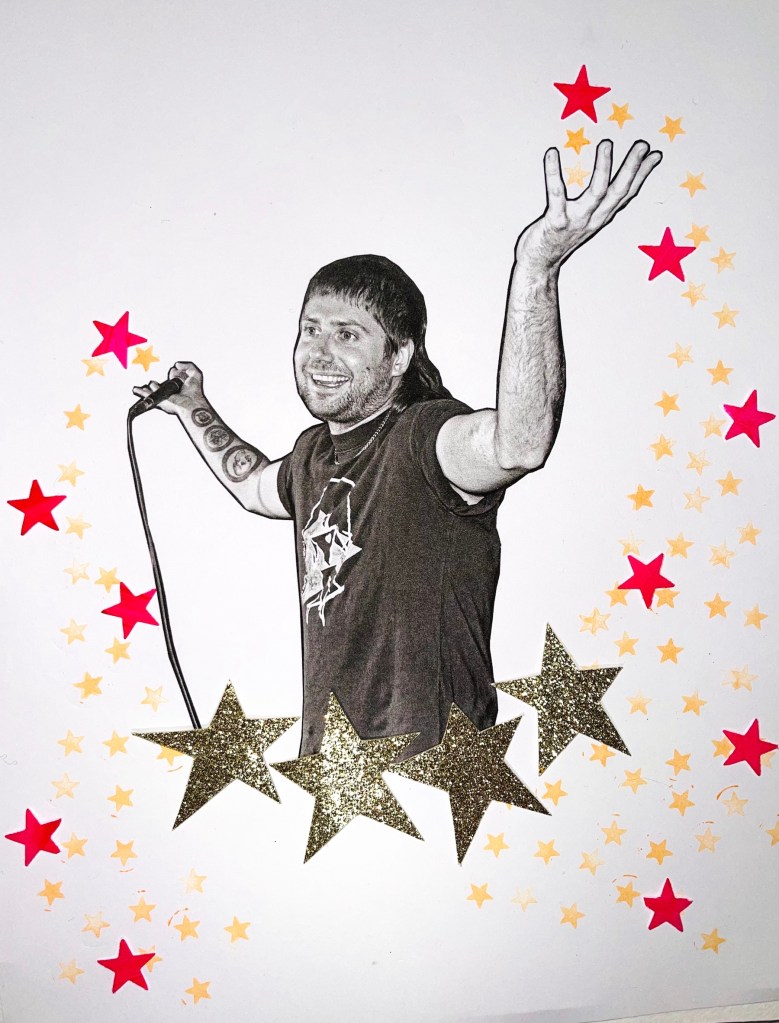
Private Function are a punk band that embodies more than just chaotic energy and humour. Beneath their wild shows, tongue-in-cheek attitude, and fun exterior lies a band that blur the lines between art and everyday life with witty commentary on modern life.
Gimmie recently caught up with Private Function’s frontman, Chris Penney, for a candid conversation that covered everything from his roots growing up in housing commission to his first experiences with therapy. He reflects on how his formative years and growing up with his metalhead single mum shaped him, and tells us about his first concert, and the time he sat on Ozzy Osbourne’s lap. He shares his theory on the moment he feels culture died, and his honest opinion on NOFX and Blink-182, while celebrating the revival of Australian music in the 2000s by bands like Eddy Current and Royal Headache. We hear the story of what drove their manager and booking agent to quit. And, talk about joy, creativity, and so much more. Chris’ blend of quick wit and sincerity makes for an unforgettable conversation.
CHRIS PENNEY: I’m the classic example of a housing commission boy, come good. I grew up in Redfern in Sydney on Morehead Street, which is a pretty gnarly street.
You know, how you can do that thing where you say the name of your first pet and the name of the first street you lived on, and that’s your porn star name? Well, mine’s Jesse Morehead—that’s pretty good [laughs].
Seriously, it was a pretty crazy place. It’s the most condensed housing commission in Australia, which, to be honest, maybe isn’t the best idea. I think there’s talk about maybe taking it apart, but there are easily a thousand different apartments on that one block. So it’s pretty fucking full on to live there. Especially back in the ‘90s, I saw some crazy, full on stuff. There’s many, many stories; a chick got stabbed to death once.
Whoa! Oh-no. I guess, high-density housing commission projects can face a lot of challenges like overcrowding, maintenance issues, strained infrastructure, and there’s also social stigmatisation. All these things can lead to deteriorating living conditions and lead to stress, anxiety, and depression, as well as diminished overall well-being and quality of life.
CP: Yeah! And these things do happen. There shouldn’t be that much housing commission condensed into one street.
Did the things you’ve seen growing up there have an impact on you?
CP: I don’t know. Maybe? I mean, the only thing I can think of is that I’m extremely emotionless—probably that. So this week, I actually went to talk to a psychologist for the first time in my life, which was pretty good.
That’s good to hear, I’m stoked for you. I’ve been to many over my lifetime and it takes a while to find a good one sometimes, but when you do, I’ve found it can help.
CP: Yeah, it’s interesting. I’ve never done it before. So I don’t really know what to do, because I don’t really know what I need out of it. I’m pretty together. Although it would seem very much like I don’t have it together [laughs]. But I have a bunch of crap going on.
It’s cool; I can talk to the guy about the end of the world, which is kind of fun. I made him squirm. I talked to my girlfriend; we’ve been sitting down and chatting, and I go on these crazy doomsday rants about the end of the world, or World War III, and the climate crisis running in direct parallel with each other. And we’re storming ahead into this apocalypse. It’s coming so soon. She’s like, ‘Yeah, I don’t want to hear any of this.’ [laughs].
A lot of people are like that. It’s constantly in our face in the news so they don’t want to spend much more time thinking about it. It’s a really interesting time. But no matter when you look back in history, there’s always been terrible things happening. As humans, how do we cope with this? What do we do with this information? Because obviously it can start to affect our day-to-day lives.
CP: For sure. It’s something I think about a lot. The news is always happening, right? The world’s always happening, always changing. There’s always people dying. I guess there’s more emphasis on that stuff now because of social media, how dramatic that is now. Is it any more or any less important than it’s been in history? I don’t know. I don’t know shit. But, things are always gonna wrap up, and things are gonna begin. And people should want to know about it.
Yeah. I don’t have answers either. The world can definitely be a difficult place so to stop from feeling overwhelmed, I chose to dedicate my life to things like music, art, connection, conversation, and community, and sharing knowledge, ideas and experiences with others. Through my work it’s important to counter the shitty stuff in the world and offer something that’s a more positive offering for people’s lives.
CP: Yeah, 100%. That’s absolutely what I try and do as well! All the art that I create, and that we create in Private Function, is hopefully that. I try to create art as escapism because everything else freaks me out! I try to keep this one escapist form of art that’s joyful, fun and stupid at the same time. I fucking swear to God, if this psychologist makes me cease it, if I become a more serious person because of this prick, and I have to release art that isn’t fun and dumb—I’ll be so upset! [laughs].
There’s definitely a place for fun and dumb art. Not that I think your art is dumb, by the way. There’s a place for all kinds of art. Art is more important to society than a lot of people think it is. I think often there can be a misconception that real art has to be serious.
CP: Yeah, totally. I couldn’t be serious, man, even if I tried. Private Function definitely has an element of humour, obviously. But it’s not jokes. The way I try and approach it is that it’s like a joke without a punchline. The vibe is funny, but there’s no actual joke here. I really like relying on humour and comedy in a song to bring these artistic ideas to life because I feel like humour is the only artistic avenue that still has innovation in it.
For instance, the scratchie record we did, people would think that’s a funny, stupid idea. But it’s also innovative because it hadn’t been done before, which, to me, is important.
I couldn’t think of anything serious that hasn’t been done, and hasn’t been done significantly better than I could ever hope for it to be done. Like, every song about love has been written, every song about addiction has been written. It’s set in stone, how they’re meant to sound and how that it’s meant to be shown to people. But with humour, there’s this depth of endlessness that you can continually find things in. BUT then you just have to deal with people being like, ‘You’re a fucking joke band!’ [laughs].
Frank Zappa used to get that too. Full transparency, it took me a little while to come around to Private Function, and to get it. On the surface level, and the way PF were pitched by publicists and seen in the media, it kind of seemed that way. But when I took the time to listen and saw a live show, I realised it wasn’t that, it was more that. You write great songs and you’re one of the most exciting and entertaining live shows around.
CP: Yeah, it’s funny, right? [laughs].
When I look back on all the things that people discounted as just publicity stunts, I see the innovation that we’re talking bout.
CP: This has been an eight-year project now. At the beginning, in the first few years, people were really into it, and then some of those people left. People come and go, and there are always new fans. Now it’s almost like, to get into Private Function, you need to understand this linear story, along with all the concepts and imagery that are repeated and consistently used, blending into each other. There’s themes about the whole thing. To jump into the band now, and to take it at face value, is like jumping into a podcast after it’s been going for years. It’s like, ‘Oh, fuck, what the fuck is all this? Who are these characters and these people?’ It’s hard to do.
I think the live show sells quite a lot. That’s the one thing that’s changed a lot of people’s minds about us. I like our albums but the songs are quite different live to how they sound in the studio. Recording is hard. Especially for me, because I’m not the best singer. When we’re jamming, I’m like, ‘This is fucking amazing!’ And then you hear it in the studio and it’s like, ah, maybe, my hubris has gone to my head somewhat [laughs].
How did you first discover music?
CP: My mum. I had a young mum. She’s only 19 years older than me—54. Because I grew up with a single mum who was a huge punk and metalhead growing up. She was massively into Metallica and all those kinds of bands. From a young age, she was taking me everywhere and making me go to shows.
My first show, I still got the ticket stubs, was in 1996, The Offspring. I was nine. There’s a photo of me with Ozzy Osbourne too, when I was 10 years old. She took me to a signing and I have a photo of me sitting on Ozzy’s lap! It’s really funny.
Ha. That’s awesome!
CP: [Laughs]. So she would just fucking blare music through the house. She’d be cranking Tool. So I was listening to all that stuff from a young age, and it just went on from there. My mum would listen to The Stooges, so I would.
Self-exploration is such an important part of being a music fan, and formulating who you are. Remember before the internet?
I sure do.
I think it’s the worst thing that the internet has taken away from us, like self-exploration and finding those things you like on your own and not just having someone hand them to you. In the pre-millennial age, finding stuff was a major part of formulating your self.
Now it seems like everything’s at your fingertips and there’s overwhelming so much choice. Back in the 90s and before, you had to really dig for stuff and it wasn’t just readily available. Things seem to hold more value because of the effort you’d go to to discover them. Music didn’t seem as disposable.
CP: Yeah, 100%. It was way more satisfying to find things yourself. I went and saw EXEK the other night.
We LOVE them! They’re one of our favourite bands!
CP: Yeah, they’re great. The singer Albert asked this question to the audience on the mic, he said, ‘Does anyone even have passion for music anymore? Does anyone care? And, there was a quietness and awkwardness from the audience. I was like, yeah, people don’t care! [laughs]. It’s funny to see that; you could really feel it in the room, people don’t have that connection to music like they used to back in the day, and what it used to mean.
Anyway, like I was saying, I was listening to all of this music way younger than I should have been because of my mum. Getting into my teenage years, it should have been pop-punk, like NOFX, Blink-182, and AFI, but I was like, ‘This is fucking shit!’ [laughs]. I missed all the music that I should have liked during my teenage years, and I’d think, ‘Well, we’ve already got The Stooges, so what’s the point in this?’ I jumped over this whole chunk of music that lots of people my age were into. It’s funny that older music was my teenage music. I’m pretty happy for that because that other stuff IS fucking shit—my mum was right [laughs].
Was there anything, though, that you discovered yourself?
CP: For sure. Billions and billions of things. You ever heard this album? [holds up a record] Rites of Spring! I bought this just now. I actually hadn’t heard them until last year, which is so fucking funny, I went through my stupid Minor Threat thing and then I was like, who’s another guy in Fugazi?
Guy Picciotto!
CP: Yeah. So I was listening to them all year and then I went into Rowdy’s Records today to go get a bunch of record sleeves. They had that album behind the counter and I bought it. It’s an original press, which is pretty cool. I’m always finding fucking new music. My fucking record player has been broken for over a year but I’m still buying records.
Nice! When and how did you first start playing music?
CP: High school. We just liked to play because we like rock and roll. None of us could play any instruments, AND some of us still can’t play instruments [laughs]. We jumped into it and figured it all out. That was a long time ago, I guess, I’ve been playing music for 20 years.
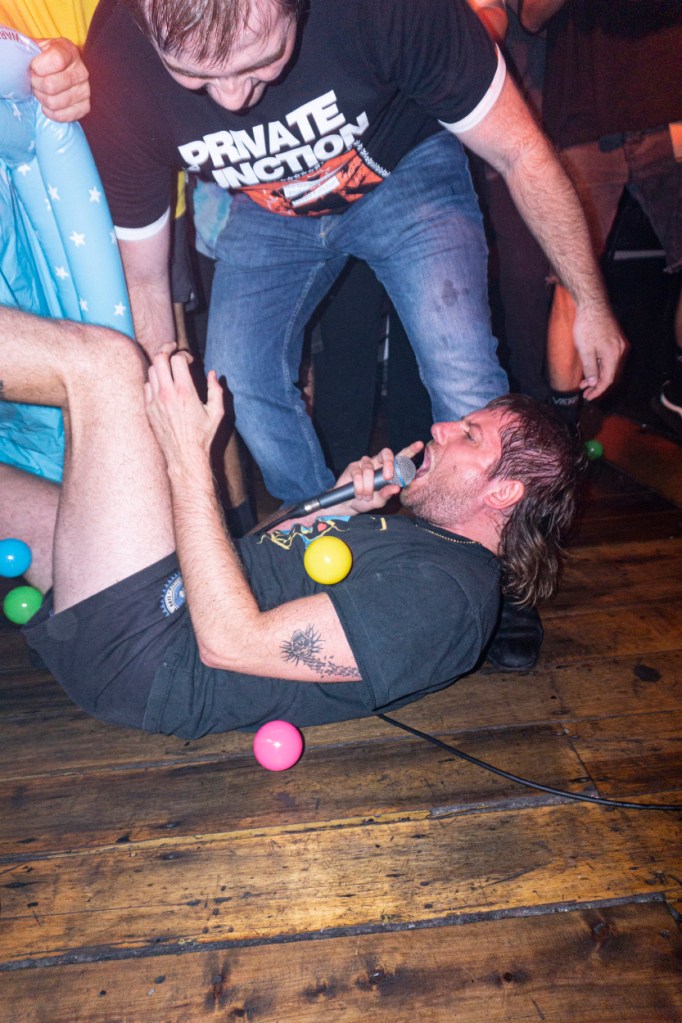
Did you ever think he’d be a front person?
CP: Yeah, I’ve been a front man for a long time, in every band except for Mesa Cosa. I’m still technically in Mesa Cosa, I guess [laughs].
Is there anything that attracted you to being a vocalist?
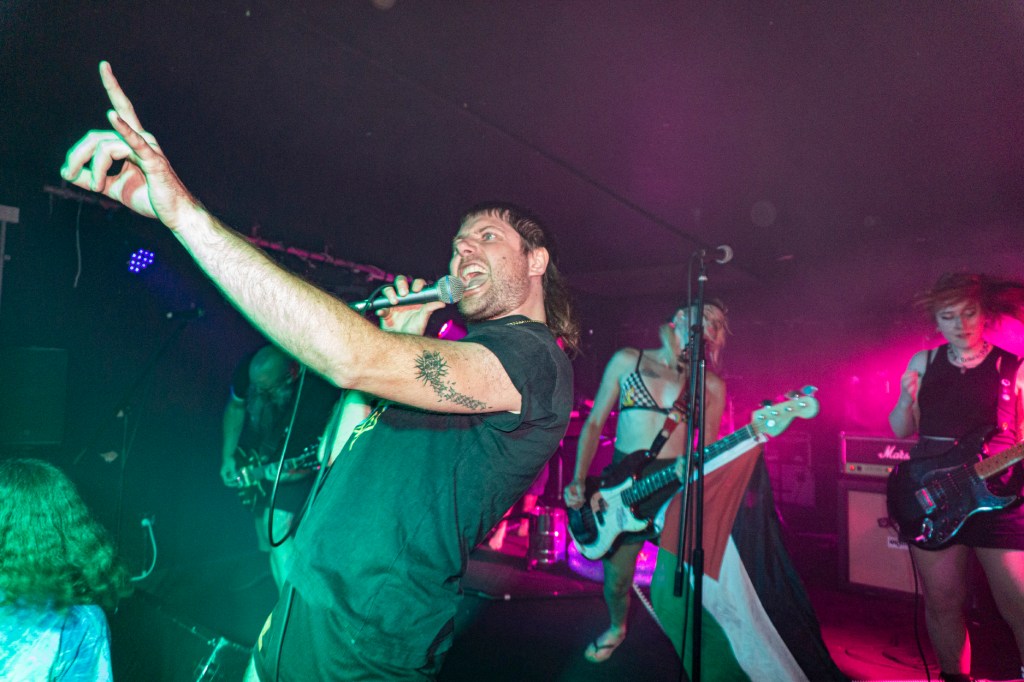
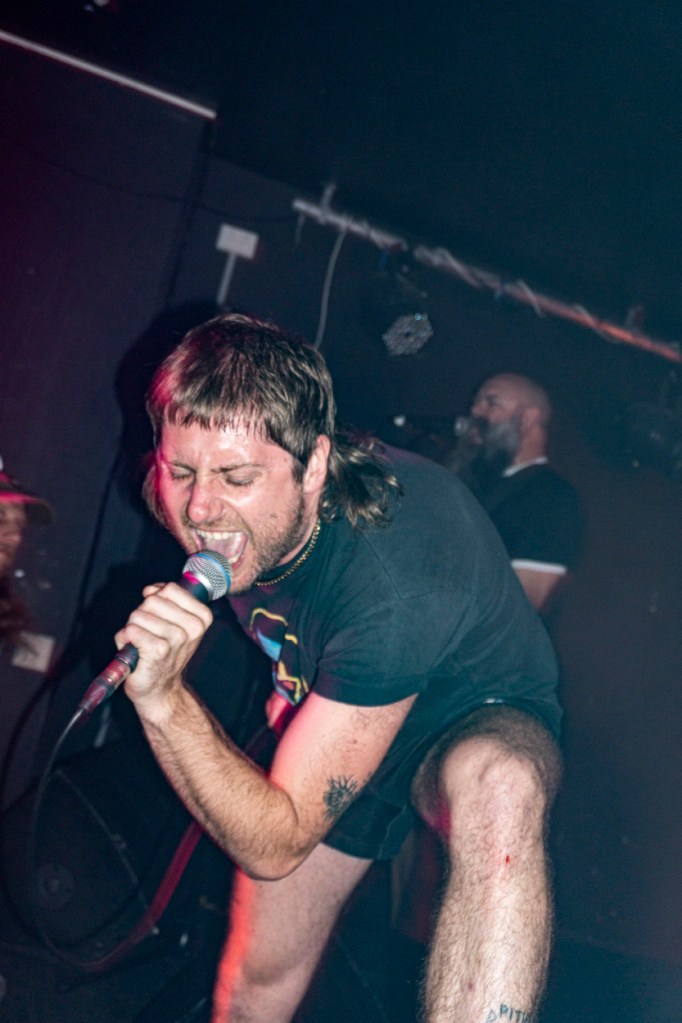
CP: Not being able to play an instrument [laughs]. And, it’s fun. I like a band with a front person, which sort of oddly it’s becoming kind of rarer. Especially front people that jump around. I like to jump around, it helps me sing, which is funny. Having a front person adds a whole other element to have a connection into the band, in a way, because you’re out in the crowd.
I noticed when you play live that you’re very aware of all the stuff that’s going on around you and you genuinely engage people.
CP: Yeah, yeah, totally. I like looking at people. It’s cool! [laughs].
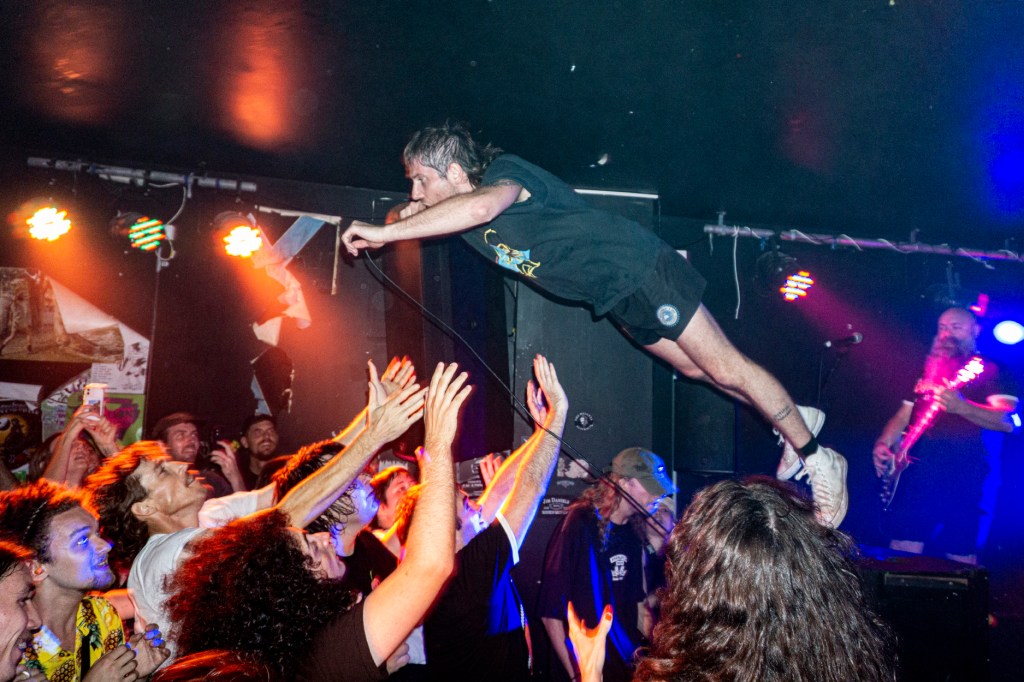
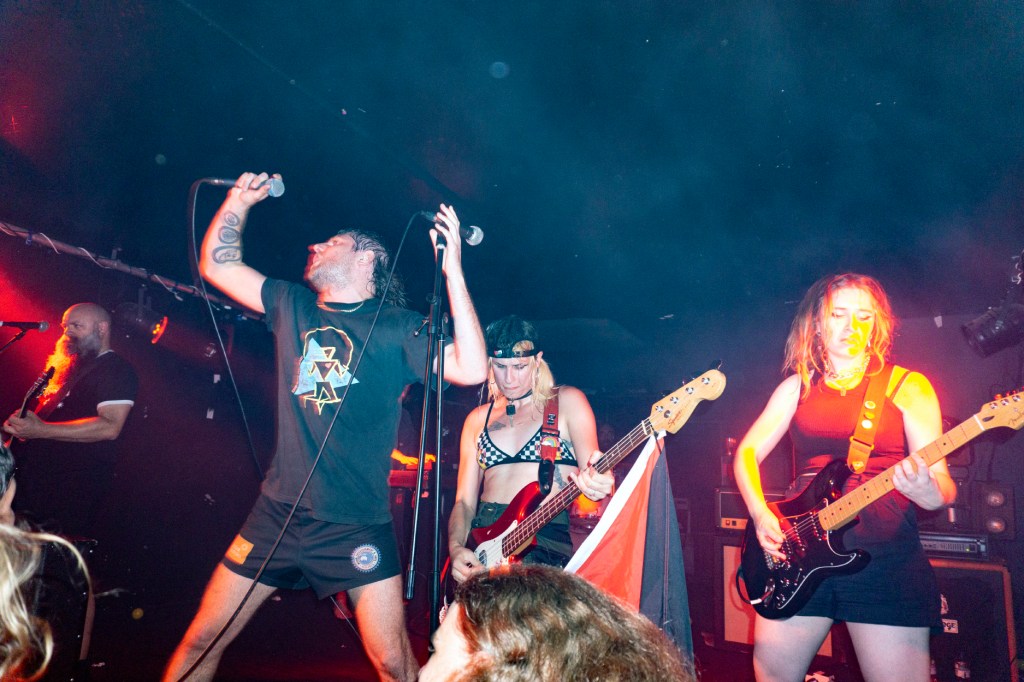
Not all bands do that, but it’s always nicer when they do. Sometimes, when a band gets lost in their own world and ignores the audience, it can be boring. When we saw you play, it was great how you involved the crowd by letting them choose your set through picking song written on pieces of paper they’d pull out of an old vacuum cleaner. Everyone was into it. The show’s vibe was chaotic but positive, with people looking out for each other. After going to some rough hardcore shows lately, where a bunch of the audience felt pretty thoughtless, it was refreshing to experience the opposite. Your show was joyful, and I wasn’t on edge, hoping I didn’t get hurt watching a band play. It was a real highlight of my week.
CP: I love that you got that from our show! Thank you very much. You used the word joyful, which often has connotations with it being kind of silly and stuff but it doesn’t need to be that. It can be joyful in the way that… [pauses]… it’s cool to have a show that’s kind of like a [Steven] Spielberg movie, where you’re like, [puts his arms in the air triumphantly]. I always find that it’s a good movie if it’s got me going like, ‘YES!’ [pumps fists in the air]. Like, watching Smokey and the Bandit, it’s like, YES! They got the beer to the party! They beat the cops—fuck the cops! It’s that kind of joyfulness that could take you on an adventure. It’s a different kind of joy.
What you said about the show, really means a lot. I don’t even mind when we get criticism. I love really respectful, truthful opinions. Criticism of anything should be more truthful—more real.
So, we just talked about Private Function shows being joyous, in your tour diary, you’ve written for Gimmie, you mentioned a show you played in Adelaide that wasn’t so great; what happened?
CP: I really fucked the cat with that one [laughs]. So basically, what had happened is, I was very drunk, obnoxiously drunk, and there was a balcony. I got up there to jump off the balcony… I’ve done it before. But this time, I had an idea that before the show, I wanted to hide a 6-pack up there, and during the show, I could throw beers out to the crowd. I had to buy a 6-pack, and it was $66 from the bar.
I was like, ‘Can I get it half price ’cause I’m playing?’ And they were like, ‘No.’ So, I was like, ‘Alright, I’ll do the 66 bucks!’ I went and put them in the balcony. But then, during the show, I got up there, and they were gone. I was like, ‘What the fuck?’ I was up there and looked like an idiot.
Then I, literally like a small baby, threw these chairs off the balcony into the crowd. It was nothing of a deal, basically like crowd surfing; everyone got them and put them down. But, mid-show at the bar, I was like, ‘What happened to the 6-pack?’ And this chick was like, ‘Oh, I took it away. You can’t have an unopened beer in the venue.’ I was like, ‘Oh, what? That sucks!’ She felt pretty bad about that.
It wasn’t joyous that I made someone feel bad. Like I said, this was mid-show, and it’s always important to remember how much power you can have mid-show. I apologised that night to her, and I wrote her the next day too. It’s good to acknowledge when you’re wrong.
The show was a little bit more violent than usual. We had found a ladder that we were jumping off into the crowd, and the crowd surfing got a bit wild. It was a bit much. I got in so much trouble for that show. Like, we no longer have a manager or a booking agent anymore.
Our mosh pit is a fun mosh pit. It’s not as wild as Speed shows, and that early-2000s hardcore vibe is back in a way, kind of like that weird energy at shows.
Its funny you mentioned early-2000s hardcore, because after going to shows since I was young, that’s the era that made go, nah, I’m out for a while. With all the macho-ness happening and the way women were treated, the vibe was not fun anymore.
CP: Should we talk about the early-2000s? It was full on. Like I was saying about Redfern, it was a different fucking time in the ‘90s and into the early-2000s—crazy, really bad shit happened. The art is bad as well, of the times. Does art imitate life here? Everything from the early-2000s fucking sucks. Especially rock and roll, man. From 2000 to 2009, it’s the most dogshit period of music [laughs]. It fucking blows, man. It’s like everywhere lost, what it is to be a human, for some reason. Maybe because of the introduction of the internet? You can see it in Australian music as well, you know, that’s a period when Australiana, or sense of a national identity disappeared completely. People were like, ‘No, we have to play the game of what it is to be an American artist right now.’ So, they’re replicating these ideas of post-9/11 America. It’s like you’re really pushing that into your art, into everything you’re making, and it’s made the worst fucking things possible.
Here’s a funny example, if you want to pinpoint what happened. The fan belt on my car broke and I had to wait on the side of the road for a fucking tow truck. So I watched the first episode of the show from mid-2000s, it’s called Supergroup. It’s this reality show where they get put together a super group of musicians like Sebastian Bach, Ted Nugent, Scott Ian from Anthrax, Jason Bonham, the dude from Biohazard, and so on. All these musicians who are washed up. Clearly, what’s happened is, the producer is like, ‘OK, guys, so you’re rock and roll icons, but we need you to play up to the South Park generation. Be a bit more pushy and a bit of a dickhead.’ I was watching it and was like, whoa! Scotty walks into this reality TV mansion and he’s like, ‘What a fag palace. Does Liberace live here?’ It’s like, boom, this is it’s so intense. I think it’s the pinpoint of the moment where rock and roll died. That TV show, everything about it, is everything I hate about rock and roll, and is what I had to grow up with.
In the 2000s, I started to look elsewhere to find that energy I once got from rock n roll, punk etc. I did an interview with Michael Franti once and we talked about how sometimes you just have to go where the energy is.
CP: Yeah, for sure. You chose the right time to get out [laughs].
I was going to a lot more hip-hop shows, and electronic shows, and doofs. I think there’s always good stuff going on somewhere, you just have to look harder for it and sometimes find it in unexpected places.
CP: I have this weird time thing in my head. 1997, I think, is where music and all culture die. A little after, there’s some cool stuff because things had been in the pipeline and were finally coming out. But by 2000, that’s when everything stops and becomes convoluted and strange. It doesn’t make sense, and it took almost a decade to figure itself out again. It really was this blurred idea of everything coming at you. Like you were saying, it’s jumping from scene to scene; there was just so much happening. Predominantly because of the internet, it was a bombardment from every angle, on everything you could possibly be shown. And because you’re shown so much, everything became nothing.
But then 2009 rolls around, I was in Sydney, and not long after Royal Headache’s first release came out. I saw Eddy Current Suppression Ring at the Excelsior Hotel and holy shit, it was so good! In my mind, Eddy Current, and then Royal Headache changed everything. Things got back to some sort of level of normality for a while.
I chatted with Shogun from Royal Headache recently for his new project Antenna, which I think is even better than Royal Headache. He told me about how he was struggling mentally for a lot of the band’s existence, especially when they gained so much popularity. He spoke of how he felt a little abandoned by the local punk scene. Have you ever had anything like that?
CP: Yeah, for sure. It’s always gonna happen. I spoke to him about it back in the day. They were going through some weird stuff. They seem to always be going through weird stuff, though [laughs]. But he hatred it, I never really understood it. But now I do. You mix music and bravado, and Private Function are always gonna be on top! [laughs]. Some people sometimes see us say that or write that and they give us shit. It’s like we’re not the first band, artist, or human in history to have a bravado or be like—I am the greatest! [laughs]. It’s a stupid joke. But I think it’s a very easy thing for people to hate.
Where did ‘PF still on top’ come from?
CP: My mate is this tagger dude, Metho. There was this wall he tagged and then a friend, Matt, had written above it ‘Metho sucks. Fuck Metho.’ Then Metho wrote above that ‘Matt’s got no friends.’ Then Matt came back and he went on top of that one, like, ‘Metho fucks dogs.’ Metho came back and it kept going. Eventually Metho got this huge, huge ladder and went to the very top of this factory and just wrote ‘Metho still on top,’ above everything. So Matt couldn’t get any higher than him. Me and Joe, the old guitarist used to always see it and laugh—fuck it’s funny. Shout out to Metho wherever you are!
I know a big thing for Private Function is concept over quality; where’d that approach came from?
CP: We’re all pretty artistically minded people in every aspect. We can all write songs, it’s very easy for us. We like to challenge ourselves with other things. We just recorded a new album last week. We went into the studio and figured most of them out in the studio while we’re recording.
Did you ever go to art school?
CP: I avoided all that stuff. I was too dumb. To me, art is innovation, and it doesn’t matter what the form is. It could be painting, it could be a movie, it could be whatever. But it has to have innovation in it, and the closer you get to innovation, the better the art gets. That’s my takeaway—that’s what I think art is. So that’s why I’m always trying to think about that, which is hard to do in rock and roll and in music because everything’s been done. You know, it’s been 70 years or whatever of people doing things, and it’s hard to really do more.
That’s why I try to focus on concepts because conceptuality is quality. Songwriting quality does have an end, but conceptuality—if you can think of an idea, there’s no limit to where it can go.
The scratchie album cover, I was pretty proud of that. I thought it was cool because it hadn’t been done before; it was a conceptual idea. Or the idea of putting piss in the records—which maybe only had been done before once before.
Or pressing bags of speed into records, that hadn’t been done before. Maybe innovation is too strong a word, maybe they were just unique, and that’s the satisfaction I get from making art—trying to do something unique.
That’s something a lot of people come up to me and talk about. It’s inspired them in some way to think about things a little bit differently, and that’s more important than teaching them how to write a good song or whatever. If you can teach someone to just think about things a tiny bit differently, you’ve really given them something. It’s important.
Totally. That’s the stuff that really excites us the most.
CP: Yeah, me too.
All of us have ADD. So we also want to do a show, where we would be able to sit through it and be mentally entertained the entire time, something that creates its own story. I want to give people something, no matter how small, that they can take away from it, and retell it and it can be part of their life. I want to give them a pub yarn.
You mentioned you were working on the new record; what kind of things have you been writing about?
CP: About things that I look at. Most of the times I’ll see a sign, her like I’ll see this bottle of water here and be like [sings]: ‘Cool Ridge, Cool Ridge, Co-cool Cool Ridge!’ I have these rules for songs which are, I don’t write about people I know, I think that’s really bad luck to write or get inspiration from people you know; that’s fucking instant karma for you, mate. I don’t write songs about sex, I can’t do it.
Why is that?
CP: I mean, I can do sex! [laughs]. Here’s the thing, Bianca, I respect sex too much. I really like having sex and when I write about sex, it either comes out as seedy or a joke—I don’t want to do that to sex. Sex is better than the songs I could write about it. There’s already a billion songs written. It’s hard to write a song about sex well.
That’s nice that you care about it so much you don’t want to fuck it up.
CP: Exactly. Yeah, somethings are off limits. I also try not to swear that much as well in songs, which is funny.
Why?
CP: I find it unnecessary. There’s a lot of words you can say. I swear, there’s a lot of swearing. But I tried not to do it. I really only swear when it like needs to be there. That’s the, I’m just not gonna swear for the sake of just like swearing rule. It has more impact then when you do.
Have you ever written la really personal song?
CP: No, I don’t think so.
You don’t use writing songs to process stuff in your life?
CP: I’m not smart enough, nor good enough as a musician to be able to put my problems and thoughts into a genuinely good song. It’s not going to come up, it’s going to be bad. I’m just going to stick to three chord songs about different signs and things I see. Otherwise, no one’s going to like it. I do like writing though, I liked writing the tour diary for you guys.
You know how in records, there’s sometimes those really long, waffling inserts about the history of the artists? They’re so shit! I always try and read one, then get halfway through it, and it feels arrogant, waffling, irrelevant, or like they’re probably lying [laughs]. I wrote one of those for the new pressing of 370HSSV 0773H (the scrathie record). It’s poorly written nonsense about the story of this album.
That’s cool. Looking forward to checking it out. I love what you write for Gimmie. In our correspondence you mentioned you took so personal stuff out; how come?
CP: I was going to bring up like what happened with the manager and the booking agent stuff. I showed it to the rest of the band they’re like, ‘Nah, now’s not the time.’ I really thanked them for the work they did for us, it can’t be underplayed how much they’ve done like for the band.
We took that out bits and bobs just to make it even. That was the most dramatic part of Private Function’s career. We were like, ‘Shit, we didn’t know, maybe the band’s breaking up, I don’t know,’ because everyone was like, ‘Fuck, what’s gonna happen now? No manager, no booking agent.’
We’re actually kind of stoked, to be honest, like we’re not doing anything much. We wanted to have a little break. But we were like, ‘What’s going on? I don’t know what to do anymore, what do we do?’ And then everyone’s got their own mental health issues they’re going through, just like every band. We’re all just dealing with our own shit, dealing with the reality of the modern world, and dealing with all the problems that every single other artist is dealing with right now as well. We’re not immune from any of that, we just don’t wear it on our sleeves as much as some other artists do. And I don’t think we get a lot of—it’s awesome if artists can get inspiration from things like that—but for me, it doesn’t work.
Is there any kinds of things that you do for your own self-care?
CP: Not really, I’m all right. I’m sweet. I was a workaholic. I’m always working on different things
What kind of things?
CP: I’m always doing jobs. I’m always writing songs. Always focusing on something.
You mentioned challenges of being a band; like what?
CP: There’s this real expectation when you’re perceived to be successful that you have heaps of money and that everything’s really easy, and it’s like, motherfucker, there’s no money. It’s also like, we’re a 6-piece band who’s going to travel around Australia. The fucking costs of just dealing with six people to go play shows like Vinnie’s Dive—there’s no money there. Like, we have to pay for six flights, have six people in accommodation every night, and then pay for the opening bands, the gear hire, the venue hire, and then, at that point, the manager takes 20% of every ticket, the booker takes 10%. There’s so much going out that at the end of the day, you’re like, ‘Oh, that barely covered the costs at all.’
I thought managers got less than that? Like, 10%.
CP: I guess the industry standard is now like 20%. I think it’s a bit much to be honest, but it’s a hard thing to argue with the industry about that and individuals about that as well.
I think there’s so many problems in the actual industry. The industry treats people as products for the most part. When I was young, I also wanted to work in the music industry because I love music, and then I started working in it and it was fucking horrible.
CP: Yeah, it can be. The only time I do interviews is when there’s an album cycle and I’m forced to do it. I fucking absolutely hate interviews. But this chat is different, it’s really, really lovely.
Also, for the record, you’ve mentioned you’re dumb a few times throughout this chat; you’re totally not!
CP: Aww, thank you very much. That means a lot. I’m excited about the future!
I’m excited for your new album!
CP: Me too. Have you ever thought of being a psychologist, you have a very calming aura, and you’re good at listening.
Thank you. I’m actually a book editor by day and work with fellow First Nations writers, helping them get their story on the page. It’s important to me, to try to do something that I think is worthwhile with my time because our time is really valuable.
CP: Absolutely. Time is all we have. That’s it. Nothing else matters. As you get older, you start to see the value in time. Even to conceptualise the idea of time is fucking crazy, man—it goes like that. I heard an interesting thing about time the other day. There’s this kind of worldwide collective feeling that time is speeding up, and we’re losing time; most of the world are feeling this. This report said we were losing time because now a majority of the world have like iPhones, and if you look at the amount of hours you use in a a day and in a week, sometimes it’s four or five hours a day. You do the maths, that’s 24 hours a week. Now we’re down to six day week, because a day has been used being on your phone. You don’t actually really get anything out of that really. What you get back is quite a small amount to how much time you’re giving away. You’re basically giving away your fucking time to companies for free so they can advertise you bullshit.
I haven’t used my personal Instagram, since September last year. It was a New Year’s resolution. I can’t do that anymore. It’s a fucking weird realisation where it’s like, I’ve been on social media for 20 years. How much more time do I give the machine? When is this end? Is the answer, never? It’s this thing that I have to chase and follow, especially to be in a band now. It feels like I’m giving my time, my life away, for something that I’m already giving so much of my time to, being in a band.
What do you reckon you’d do if you weren’t in a band?
CP: I ask myself that every single day. I have never known a reality as a man where I wasn’t there.
What do you kind of get from being in a band?
CP: The avenue to be able to make the art that I to make, is a big one. Everything I want to do at the moment, artistically works in the realm of a band. I love all the the record covers and these weird little conceptual ideas. It scares me as well, though, because I have a small skill set of things. If I was to ever stop being in a band and get a real job and grow up and be a real boy, this fucking Pinocchio little motherfucker, it scares me because I’m pretty skill-less. And, I have no inheritance coming my way. I don’t know what’s gonna happen when I stop playing in a band.
If you reflected on all the things it takes to be in a band, you’ll see you have many more skills than you think you do. It takes a lot to keep a band going for years.
CP: I guess, yeah. Hopefully with the end of this year the idea is to have a moment, after losing a manager and a booking agent and kind of like our mental state, and have some time off to reflect, recess, and reset. It’d be my first time in 20 years, where I’ve not been doing something. I don’t know how that’s going to go [laughs]. Expect a mental breakdown in the third quarter of this year.
Ideally, in the perfect world for me, I would be asked to go on the reboot of Supergroup. And I can be in a piece of shit.
Yeah, but you’d actually have like a grasp on what South Park is.
CP: [Laughs] Exactly! Yeah, instead of just effing and jeffing mindlessly.
I’m sure I’ll be fine. I’ve never been massively phased by anything. I’m the kind of guy that, when stuff really does fall apart, I’m always pretty good at figuring things out.
I noticed that on social media, a lot of people comment about your band, and not always in the most positive light. But I love how you handle those comments. I saw a snarky one where you responded with, ‘Is that the best you can do?’ You seem to use humour to diffuse what they’re saying.
CP: Everything on the internet is a fucking joke. I don’t care how anyone feels about anything, and I don’t even care about how people feel about the art or who we are. To save debate, it doesn’t matter to me, so it’s funny to make fun of all these idiots. But I don’t want to do it because I don’t want to make fun of anyone or anything. Really, nothing matters. Nothing that we’re doing actually matters, so for people to get upset about something that doesn’t matter is just ridiculous. The idea of being really famous — oh man, I would definitely lose my mind. Even now, I’m relatively known to an audience, and, like, jeez, going to the pub sometimes can be a bit of an ordeal.
I had a great chat for my book with Amy Taylor the other week and we were talking about how she’s in the public eye and always being scrutinised by people, and of what it’s like to grow up in front of people, and make mistakes and grow.
CP: I can imagine. She’s great! She’d have a pretty interesting story as well. Amy rules!
She does!
CP: She’s always been a very real person. She’s the best. So cool. The first Private Function show was with Amyl & The Sniffers. That was the night their original bass player quit. That was a funny show. Bryce and Declan, for some reason, when they were playing, were just yelling at each other. I think Declan punched Bryce in the face, and then they just started fighting. The bass player was like, ‘Fuck this,’ threw his bass, and walked off. Then they were fighting, got into the mosh, and were pulled apart, dragged downstairs. And then they started fighting on the street. I think Amy was still on stage. So I hopped on the drums, and then my friend, my flatmate, got on bass, and we jammed for a while. Then they broke up for a bit, and Gus joined the band. I love seeing a show where everything just falls apart, and it becomes chaos.
Follow @privatefunction69 and get a piece of them HERE.
 Gimmie Gimmie Gimmie Zine