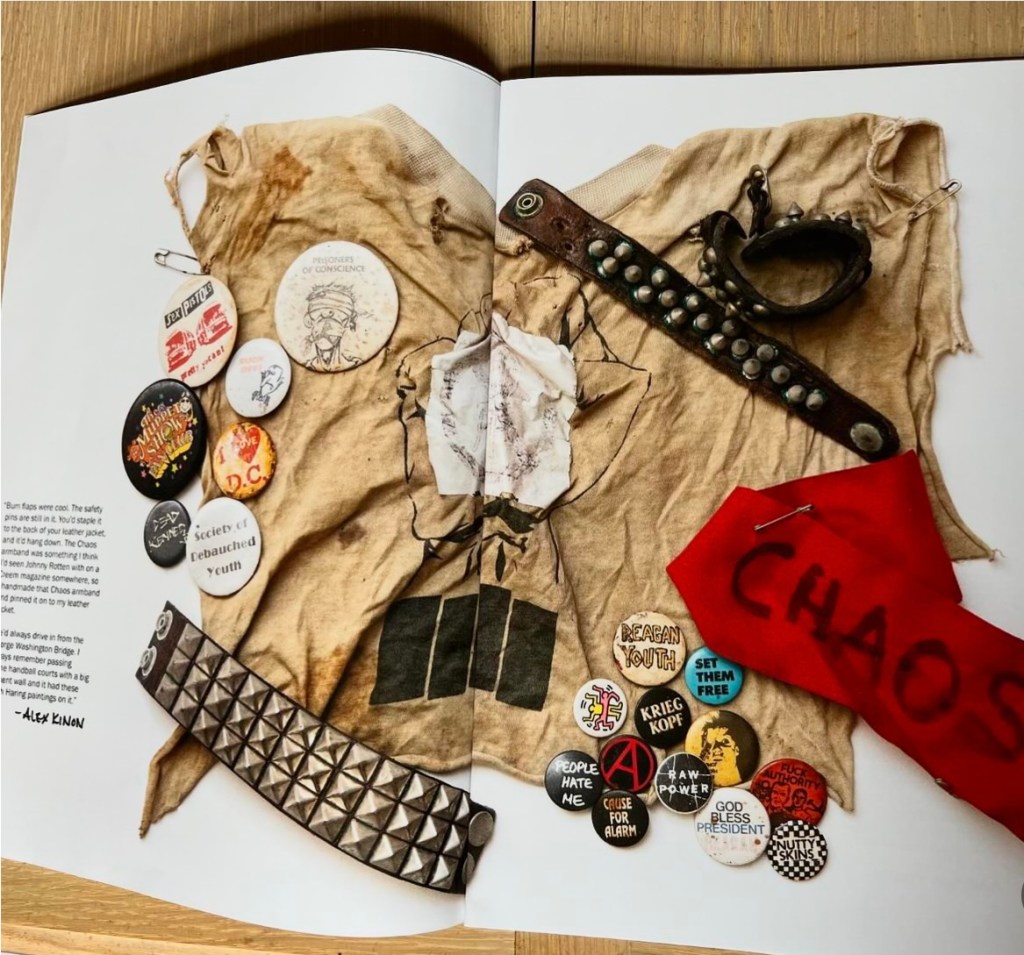
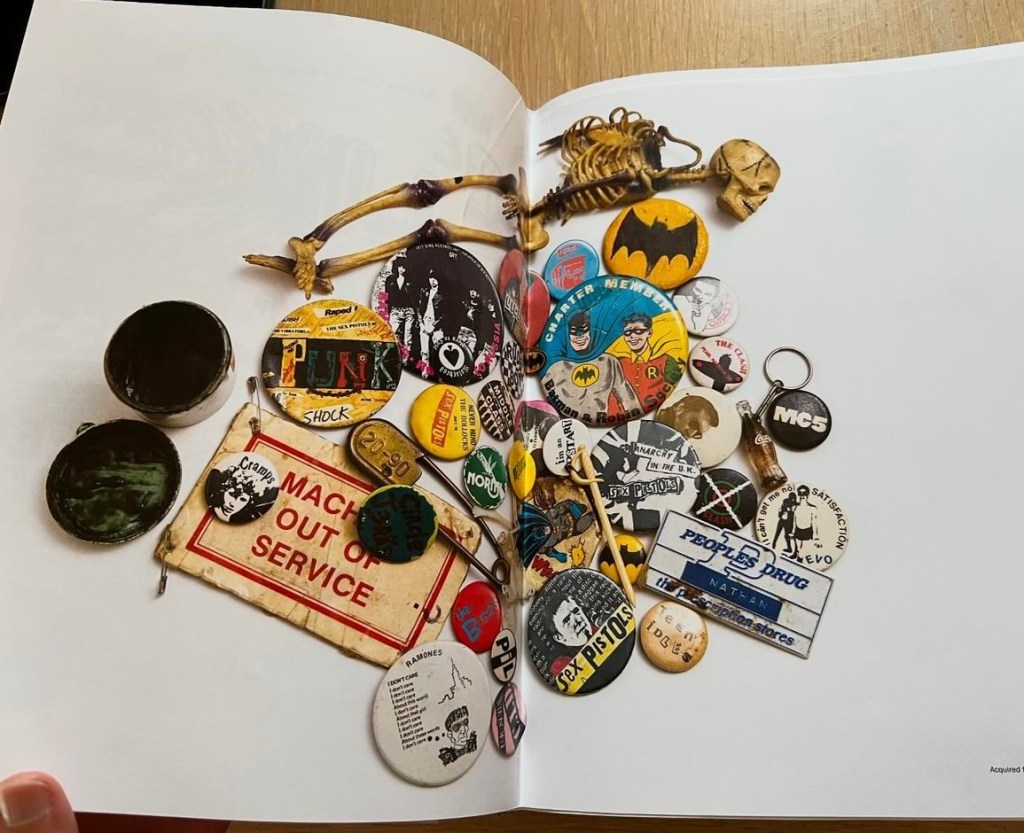
Gimmie was really, really excited to talk with our good friend, Brian Gorsegner, about his new book, Ancient Artifax. It’s one of the essential punk-related releases of 2024. A hefty tome at 242 full-colour pages, it showcases rare and sometimes one-off 1970s and 1980s artifacts from his personal punk collection, lovingly curated over many, many years.
Commentary throughout, provided by those who have connections to the items and speak of their provenance, gives an insider’s snapshot of the New York City, Washington DC, and Midwest punk scenes. We learn all kinds of nerdy stories and trivia: why Roger Miret really joined Agnostic Front; who taught John Brannon from Negative Approach about creativity; which hardcore drummer has the neatest handwriting; which punk has kept every Christmas card they’ve ever received; what songs Ian MacKaye was putting on a mixtape for a friend in 1979; which 45 Brian offered Tesco Vee from Touch & Go $4,000 for on the spot to be left to him in Vee’s will; why Creem magazine blows; the contents of a letter to the Screamers from a punk-icon-to-be living in NYC in 1978; why Brian LOVES the Necros, and much, much more!
If you’re a true music nerd, especially a punk music nerd—you’ll love this chat. AND you should 100% buy, Ancient Artifax. It’s truly a cave of punk rock wonders on the page. Brian’s love for what he does is palpable and infectious.
How did the book get started? And, how have you been?
BRIAN: I shot what was supposed to be a TV show. We shot the pilot and then three more episodes. When I did the second one, I decided I didn’t want to play music anymore. While I was working on the show, I got brought in to work on that [Punk] museum project in Vegas. While that was happening, I started working on the book. Then the band [Night Birds] broke up. And the TV show went away, I stepped away from the museum too, and I finished the book. The book came out and sold out [if you missed out it now has a 2nd run – but don’t snooze].
Last night, I was like, ‘Oh, fuck. That’s it. Oh, no! What’s next?’ I don’t have my next thing figured out, planned or even even thought about like, I just have never gave myself time to think about it. I would get up in the morning and go in some direction. But yesterday, I was really like, ‘Oh, shit. What do I? What do I want to do now?’ I don’t think I’ll ever make another book. That really feels like a one and done project.
What was the TV show? Was it about collecting?
BRIAN: Yeah. I drove from New Jersey to Detroit, like 18 hours, it’s not close. I went out to see John [Brannon] from Negative Approach. He found all of his old boxes, his fanzines, and his flyers, and a ton of cool stuff, in his mom’s attic after she passed away. He called me and he’s like, ‘You know how you’re always asking if I have stuff and I’m always saying no?’ And I’m like, ‘Yeah!’ He’s like, ‘I just found a bunch of boxes.’ And I’m like, ‘Yeah?!’ I was like, what the fuck?!
He started sending me pictures. He’s like, ‘You got to come out here.’ I knew it was going to be interesting. I was doing the TV show with the new revamped Creem magazine. I mentioned it to them and they gave me a crew and we flew out there. It was a big thing. We had a seven person camera crew and we shot the pilot. It went fucking really well. Then I ended up doing three more episodes that were all very good. I was feeling really good about it all. And then… Creem fucking sucks! They totally dropped the ball, they never knew what to do with it. It might get picked up at some point by somebody else, but they own the rights to all the footage.
Oh-no! I’m so sorry that’s happened to you.
BRIAN: Yeah. It just ended up being a headache. So, the book was kind of a secondary thing, so I could still get my favourite stories across. I could still show images of my favourite things from those collections—that’s exactly what it is. It helped me be like, ‘Alright, I can still do this!’ But there’s still so much cool footage that I think people would really get a kick out of.
I hope it sees the light of day! I would LOVE to see it. I love all those collecting and picking shows like King Of Collectables, Antiques Roadshow…
BRIAN: Yeah. When I started watching American Pickers, it was like, I don’t necessarily care about old motorcycles, but when you watch those episodes you’re like, these guys make me care about it because I like old stuff and I like a story!
Yes! Same.
BRIAN: So when I started doing this, it was very much the same kind of thing except the stories are like, ‘We were living in an abandoned building in Detroit and they were shooting shotguns at us. Then we lived out of the van. Then Nirvana came over and they stole my sweater. Like, what the fuck? stories! They were like a more dangerous edgy punk rock kind of American Pickers, with just crazier people. It was really funny too, everything about it was just like… man, this is great! This is really fun. Obviously a way more niche audience, though.
I feel like they could do those shows about anything, if you can prove that it’s important. What’s important and what’s not, I think is very subjective, but we were kind of getting the point across that—without this there would be no Nirvana, no Foo Fighters and no Beastie Boys. We made a pretty good case as to the cultural importance of early punk rock and hardcore. I think we would have had a wide audience.
Agreed. Look at the Agnostic Front documentary or the Kathleen Hanna documentary success and appeal. People love stories, and tend to pay more attention to things once they have a documentary about them. It’s like it legitimises things more in people’s eyes.
BRIAN: Yeah, it’s a more easily digestible thing. Somebody’s more likely to sit down and watch an interesting 30-minute thing that’s on TV, which is they already have it sitting in front of them, versus having to make the effort to buy a book and read a book. You have to be interested in the subject matter to buy a book. But anyone could be sitting around watching TV.
Hopefully the show comes back around at some point. But right now, I was hoping that the book did well and would generate a little bit of interest. It only came out this weekend.
AND it’s already sold out! Congratulations. It doesn’t surprise me. It’s such a quality, cool book. You did such a great job! I’m so proud of you.
BRIAN: It surprised me! Everybody kept saying, ‘A book is a really hard sell!’ I was like, ‘I don’t know. It’s not a book about me, though, it’s a book about stuff that people are already interested in.’ I put it together in a way that I thought people would dig it and it would be digestible. I think people were ready for it.
Yes. People always say ‘Print is dead’ but I can tell you as a zine and book creator for three decades, that’s not true. You know what I’m talking about, though, you love paper stuff too. Are there any books on punk that have made an impression on you?
BRIAN: Banned in D C: Photos and Anecdotes from the DC Punk Underground [by Cynthia Connolly and Leslie Clauge] was a really big one. That got me really into the early early stuff.
Brian Ray Turcotte’s first book, Fucked Up + Photocopied: Instant Art of the Punk Rock Movement, that was a huge one! That was the first time I was seeing so many flyers. It even just got me thinking about flyers as being a thing that is designed for advertisement, then they get torn off of walls when you’re a teenager and they get thrown away. They get destroyed. Thinking about them as being like an artefact 40 or 50 years later—that shit fucking blows my mind. It got me really into collecting the paper stuff even more than records. Records have always been designed to keep and collect, you keep them in nice shape. Even back as far as 45s, they’re a tangible thing, but not paper so much.
American Hardcore: A Tribal History [by Steven Blush] was a cool one. That was the first time I read about so many bands in one place, that didn’t have as much coverage.
Better Never Than Late: Midwest Hardcore Flyers and Ephemera 1981-1984 is a flyer book that the people that did my book, did. I’ve flipped through this thing a fucking million times, I love it!
Also, Why Be Something That You’re Not: Detroit Hardcore 1979-1985 is a book about Detroit hardcore that my friend Tony [Rettman] did. So many cool stories that got me enthralled with the fucking Midwest hardcore scene.
One that got taken off the shelves very quickly, Scream With Me: The Enduring Legacy of the Misfits,everything in there is fucking eye candy, all crazy, crazy collector shit.
And then, the Radio Silence: A Selected Visual History of American Hardcore Music was another book that friends – Nathan Nedorostek and Anthony Pappalardo – did that has a lot of cool artifacts.
The thing that I thought was unique about my book is that it’s my personal collection that I have purchased from people. I think the transition of the property from one generation to the next is cool and interesting, in the way of preserving some of that stuff.
Otherwise, it’s interesting how many people sit on the stuff for their life. Like, ‘I’m never gonna get rid of it!’ And then it’s like, well, how much of that stuff ends up in dumpsters when people come clean out someone’s place when they die, because people don’t know what it is, so it doesn’t end up where it belongs. That shit happens a lot. People don’t have a game plan with their stuff. I guess once you’re dead, you don’t really give a fuck anyway, but… I don’t know, a lot of stuff that should have been preserved has been destroyed over the years. That’s an interesting point to convey.
Now you got me thinking! We don’t have a plan for our stuff.
BRIAN: Yeah. You got a lot of records there behind you. So what happens tomorrow if you guys go out skydiving and you fucking splat on the ground?
I totally see your point.
BRIAN: it’s funny, I’m sort of the same, I don’t have any of my stuff in a will. But I make notes with certain things. Like, if I get something from someone, I put a note in there and I say: ‘This is from Brian [Baker] from Minor Threat.’ Or ‘This is from that or this,’ just so the provenance can continue to live, to move on, if something happens to me. My wife can give something to a friend or sell something. I want to be able to track it back to its original place it came from. Or be like, ‘Hey, this is valuable!’ I point things out every now and again, incase something happens to me, just so she knows. If something happens to both of us, there’s not really any great plan, so I guess the idea is to just not die ever! [laughs].
[Laughter].
BRIAN: I was talking to Tesco Vee from Touch and Go Records at one point. He had a record that I really wanted. I offered him $4,000 right then and there to leave me the record in his will. At the time it was a $10,000 record. I’m like, ‘I’ll give you $4,000 now while you’re alive, and then if you die in the next 30 years, I get the record.’ I was kind of kidding, but also dead serious [laughs]. He told me, I was fucking mental! [laughs].
What was the record?
BRIAN: The Fix – Vengeance, the second record that they put out on Touch and Go.
I’m guessing his collection must be pretty amazing!
BRIAN: I don’t know. I’ve never seen it. I’m hoping to maybe bother him to let me come take a look at it when we go do our Detroit pop-up book release thing, because it’s not super far from where he is. But I would like to see his archives!
Same!
BRIAN: The first two records, the first two singles, that he put out in 1980, they’re each like $10,000+ records. Because they just did 100 of one of them and 200 of the other, and they sat on them forever. Nobody wanted them. Eventually they sold out and then eventually they came big collector items.
I used to love the Touch and Go fanzine.
BRIAN: Yeah. That’s my favourite early fanzine too.
To give people context for Ancient Artifax, it started as an Instagram profile, the first post was 21st of December 2016 and you posted a Big Boys 7”.
BRIAN: Wow! So almost eight years ago, huh? Doesn’t feel that long [laughs]. Yeah, I was working a really boring job that I fucking hated. So I sat on the internet more than I should. I started a separate account to just post punk shit. My daughter was little. So, at that point, I wanted to have a traditional Instagram account with pictures of food and my daughter, and then have my punk account for all my bullshit. Before having a kid, my family didn’t really follow me on social media. But once I was posting baby pictures, all my fucking aunts came out of the woodwork. And I was like, ah, maybe I should keep these things separate. That’s funny, I haven’t even really thought about that, but that’s exactly how and why it happened.
It was a way to share your collection with others? Did selling things come after that?
BRIAN: I’ve always sold stuff a little bit. I’ve been buying collections for a really long time. I bought my first collection, when I was probably 19 or 20. I spent every single dollar I had, but I knew that if I bought the collection, I could keep the things I wanted, and could sell some of the other things, and make a bunch of my money back. So then in the end, I get a pretty good deal on the stuff that I kept. I’ve always had stuff to sell, and I was never a big eBay seller.
At that time, I was working at a screen printing shop with everybody else that collected records. If I bought a collection, I would literally just come in there with boxes of records and at lunchtime everybody would flip through the boxes and I would sell a bunch. So when I started the account, I definitely had stuff that I wanted to sell. Before that, I had started posting things here and there on my personal Facebook. It was just a nice way to kind of like generate trades; I like trading a lot.
I really love how in the introduction for your book, you talk about how you started to realise that it’s not even just about the item you find or what it is, it’s the stories that go behind it that became really interesting and exciting for you. Do you remember when you first felt that?
BRIAN: Going back, the first collection I bought was from this guy Jim, he had done a really early New Jersey fanzine. I thought it was cool that I was getting records from him that bands had sent in for review. They were rare records. It wasn’t like a Ramones radio station copy or something that was on a major label. It really made me think about these tiny bands that only put out 400 copies of a record, and they were popping this in the mail to this guy. I always liked the provenance of stuff and knowing where things came from.
When COVID started, I was at a work, so I put a lot more focus on trying to find stuff and hitting people up. That definitely generated a lot of the really neat stuff I have from people’s personal collections. Because I think the other thing about COVID is that so many people were doomsday buying and doomsday selling. There were people who were like, ‘You know what? As a matter of fact, I just cleaned out my closet for the first time in 45 years, and I found stuff.’ That’s what happened with John, it was a perfect storm timing-wise.
That makes sense. We go to a lot of the car boot sales locally, and we figured that during COVID people would cleanup around the house and want to get rid of stuff when things opened up again.
BRIAN: What’s a car boot sale?
It’s kind of like a swap meet. They have a market, usually in a carpark somewhere, and people sell stuff basically out of the boot of their car.
BRIAN: Oh, that’s so fucking Australian!
Yeah. Just this weekend we ended up getting a bunch of 7”s. I find other stuff too, like I just got a Winnie the Pooh stuffed toy from 1950s for $2!
BRIAN: Oh, that’s fucking awesome. I wish I was more well-versed in stuff that wasn’t just punk. When I go buy collections, or if I’m in somebody’s basement, there’s always stuff that I’m like, fuck, I wish I knew more about, like, postmodern furniture, or even jazz and other music, or comic books, or toys. I’m getting better with some stuff.
We also went to a big secondhand book fair recently too and got a lot of old Mad magazines from the 70s.
BRIAN: That’s cool!
Yeah. We love all that kind of stuff. Old stuff in general, pop culture stuff, and old underground comics.
In your book, the very first image is of you spreading out Necros flyers on the floor. What’s that band mean to you?
BRIAN: I always loved the Necros! There’s like a weird something I always liked about them. When I got into playing in bands, it was so we could go play with our favourite bands, and we would make flyers and we would do fanzines and we were just really enthusiastic about the whole thing. That was always the impression I got from the Necros, they were always a very hands on band. They were record collectors, they did fanzines. They were just fucking hardcore kids through and through.
The book really shows that they were doing a Ramones fanzine that’s like the most archaic fucking thing you’ll ever see. They went to see the Ramones when they were 17, and came home, and were so excited that they had to participate somehow. It’s like starting a band almost seemed secondary to them from being fans of hardcore.
A lot of bands start because somebody takes guitar lessons when they’re a little kid or whatever but you know the hardcore movement, a lot of it were like—the Ramones came to town, you saw the Ramones, and then you went home and said, ‘We don’t know how to play an instrument, but we want to emulate what we see going on.’ I was always able to relate more to that because I’m not a musician. I just wanted to be a part of my generation’s hardcore scene. Necros were the pioneers of that stuff, everything they were doing and their fucking records are just terrific.
When I was just getting into some baseline punk shit, my friend Evan introduced me to the Necros, he had a CD with like a million songs on it. It was so fucking raw and so wild. I thought it was the coolest thing I ever heard. That was really it.
Doing the book and buying collections from some of them and getting to know them all a little bit, they’re still the coolest people, who are still super enthusiastic about the whole thing. Extremely supportive of the book and what I do. At this point, I call some of them friends, which is pretty awesome.
Yeah! That’s exactly how I feel about all the people I interviewed for my book, Conversations With Punx. I grew up really inspired by these people and now I call a lot of them friends too. If you told teenage me that would happen, it would have blown my mind. I noticed that the next image in your book is of John Brannon’s handwritten lyrics for the song, ‘Can’t Tell No One.’ Was there a reason why you started the book with that piece?
BRIAN: Somewhere in the middle of when I was putting the book together, but I wasn’t even thinking about putting the lyrics there, I wrote the last little bit about listening to ‘Can’t Tell No One’ for the first time. Or at least my recollection of hearing it when I was a kid and being like, jesus christ, this is the fucking meanest, but like such a meaningful, powerful song! I was like, oh, what better way to start the book than to put his hand-penned lyrics right next to the thing that I’m referencing? It was very organic in that way.
I didn’t know how to put a book together. So when I started doing it, I knew I wanted to do it with three separate regions, and I would pull the things from each that were really cool. The first thing I did was chronologically laid everything out for each region, and then conducted my first rounds of interviews based on that and based solely on specific things that I wanted some feedback on. Once I did the first round, I realised that there was a real cohesive story in there. It’s cohesive while being very disjointed, intentionally disjointed in the book, because it’ll start a story and it’ll kind of skip to something. And it might not even ever go back to a story that it started. But there is a flow to it all.
Once I realised I could put that all together, I went back and did some secondary and third interviews to help tie some of the stories together or to even help give some idea of the cultural landscape of what was going on in this city at this time. Or what was going on in politics, or what were the drugs of choice, whatever I thought needed to help paint the picture.
I can see that. I think everyone is going to get something cool and different from your book. One of my favourite stories from it, is when John Brannon was talking about how his mum kicked him out of home, and he went to live with Larissa from L7. He said that he’s really, really lazy – which I would have never thought because he’s done so much – and he said that she would wake him up every day and be like, ‘What are you gonna do today? Are you gonna write lyrics?’ And she’d say something like, ‘To be a creative, you have to create.’
BRIAN: Yeah. I absolutely love that same thing for the same reason! It’s cool. I think the Midwest section shows a little bit of a softer side to a more fucking meat and potatoes, raw, angry kind of hardcore scene. They were kids, they were teenagers, and 20-year-olds doing what kids do and learning how to do shit. The stuff about Larissa is super sweet. I like that part a lot, too. It made me think a lot. I don’t know what came first, whether it was the interview or the image of the notebooks, (probably the image of the notebooks} but then having that as a segue. That was fun.
I would see those little segues where I’m like, oh, fuck yeah! When I would put something together, I’d be like, god damn it! That gets me excited! I don’t expect anybody to like this book as much as I like it, because it’s so cultivated to my very specific tastes.
I conducted hours and hours of interviews, but there’s not a lot of text in the book overall. I pulled the bits that I thought should be in there. Which I guess is the closest thing that makes me to an actual author with the book, the fact that I kind of carved the way that the whole thing was going to go.
Another part in the book I really loved was I think it was when Parris Mayhew was talking about writing the set lists for the Cro -Mags because he had the neatest writing. When you look at the setlist included in the book, you really notice that. Also, I loved the boot print and Adidas shoe print on it! That’s telling another story visually and there’s so many layers if you really look at each object featured and start to dig down, it speaks to the culture and the time. I really nerded out on that.
BRIAN: Yeah, yeah, same! Because I already have a Cro-Mags set list in there that’s more interesting because I think it is their first set list ever. So really, the only reason the other set list made it in there is because of the boot and the Adidas print. You can picture people running across the stage and stage diving. What is more, 80s, more ’85, ’86, ’87, then an Adidas print and a fucking boot print?
Totally!
BRIAN: That’s New York City shoe wear, through and through. I thought that was the coolest thing. When I got that set list, I was like, ‘Oh, man, that’s fucking rad.’ And, that’s one that I was like, I’ve been in a bind where I’m like, ‘Maybe I should sell something? Maybe I sell that Cro-Mags set list?’ And I’m like, ‘I can’t do it. I can’t do it because of that fucking Adidas print!’ [laughs].
The stuff in the book is my personal collection and not stuff I’m going to sell. That finalised that stuff. If it made to the book, I’m like, ‘No, no, no, this is my stuff! This is my collection.’ When that set list went in there, I had to make a firm decision—this is definitely staying.
[Laughter]. Being a massive fanzine nerd, collecting zines, and having made zines most of my life, I was really, really stoked to see the inclusion of the Ramones magazine masters in your book.
BRIAN: Yeah. There’s like 10 copies of those. That’s another thing, like when I dig through somebody’s collection, I’ll find stuff that I didn’t know existed. I don’t think anybody knew that existed and nobody’s ever really seen it. This will be the first time that people put eyes on it. And it is just the most… it is a fan-zine! It’s exactly what it fucking is! I LOVE the Ramones. Here you go. It’s this goofy, immature, fucking perfect thing.
I know you love the Ramones as much as I do. We’re both big Ramones fans, they’re my favourite band in the world. So seeing the zine, it kind of takes you to a place in a time and you can imagine what it would have been like, to be that age in 1980 1979, go see the Ramones and come home and be like, I need to do something creative. You just have to do something. And that’s the fucking thing he made. It’s so funny and so weird. That’s one of my favourite things in the whole book. It’s the kind of thing that somebody might look at and be like, ‘Yeah, whatever.’ But that’s the kind of shit that I’m like—no, this is fucking counter culture! Like, here it fucking is, this is incredible.
Exactly. And someone was so moved by the Ramones that they just had to make something themselves. I immediately identified with it when I saw those pages—I got it! Because as a teen, I’d go see local bands, and I wanted to be a part of what was happening so much and I found zines and that made me realise I could write about the bands and music I loved. I could be a part of it! You can use what you have on hand to make it. You can make something. There’s no rules. My first zine featured a hand-drawn illustration of a punk on the cover flipping the bird and drinking a beer! [laughter]. It may seem silly and immature but at the time that’s how I was feeling.
BRIAN: How old were you when you did that?
14-15!
BRIAN: And there’s the fucking thing! That’s kind of it. The thing to remember is, hardcore especially, maybe not so much the first run of punk in ’76 and ’77, but hardcore was a youth movement. A lot of it was a counter action to what the 25 year olds were doing. It was people telling them, ‘Ah, punk’s dead, move on, find something else to do.’ And everybody’s strung out on drugs. And these were kids were like, ‘We’re going to do it our way! The songs are going to be faster. We’re going to do it with other kids. We are going to put on shows and put out records and put out fanzines.’ I love so many current and new bands, but it’s a totally different thing.
The first era of hardcore, it’s exactly that. I can relate to it because when I was 15, it was the same thing. The songs were sloppy and stupid and the fanzines were goofy looking. And, you know, we didn’t know what the fuck we were doing. It was an artistic output because something in life sucked and we were looking for something to feel a part of. It’s interesting that things didn’t change from 1980 to 1997.
When I was 17, years later, when I was doing the same thing, it was just that instinct to do it the same way. And I didn’t know what Touch and Go magazine was when I made my first fanzine. You’re just learning and figuring it out on your own.
Seeing original mock-ups of flyers, and also seeing the hand-screen printed items in the book, like Tesco Vee’s shirt and his wife’s shirt was so cool!
BRIAN: Yeah, that’s the same kind of thing. Again, we had no frame of reference. Somebody in my middle school or high school had just taken silk screening classes. So we were like, ‘Oh, we can put any image we want on here.’ Then they were like, ‘Oh, you could put it on a t-shirt or a poster.’ I was like, ‘We’re going to do our band.’ Of course we’re going to do our band. So we printed our own band shirts. And then we once we knew how to do it, we went home and we did it on our own.
Hearing that’s exactly how Youth Brigade did it in 1980, and that’s how Cause for Alarm did it in 1983, it’s like, man, that’s so fucking cool. There was like never a point… I’m sure there are some cases and people would slap me on the wrist for getting this incorrectly, but it’s less likely that a lot of major label stuff ever had to do that. Like being DIY on that kind of a level, booking your own shows, booking your own tours, making your own shirts, making your own records, making your own flyers, doing all your own shit. That’s fucking punk ethos, that’s hardcore. I’ll always think that’s the coolest shit in the world because you’ve got to work hard for what you want. No major label is going to cut you a big check and you’re not going to get any tour support. You just got to fucking go out there and do it yourself—make it happen. You have to really want it to to do that. When I was a kid and I did all that same shit, I really did. It was the only thing I cared about.
There’s so much that I’ve picked up from getting out there and doing things myself, from making zines, to booking shows, running a distro, printing shirts, making a book. Before I did them, I had no idea how to do it but, like we’re talking about, I figured it out. I never waited around for someone to do it for me or to allow me to do something or expected anyone to do it for me—I just did it.
Another story from the book I really love is, you were talking to Todd from Necros and he just casually said that the chain from his boot he pulled out of a box was like, ‘Oh, I wore this when I first stage dived and it happened to be Fear on Saturday Night Live.’
BRIAN: Yeah! That was the other thing, once I had the regions, I coincidentally purchased multiple archives from the same cities, I realised, man, there’s cultural significance to a lot of these stories.
That was another thing with the book, you could show a Beastie Boys flyer that nobody’s ever seen, like an impossibly rare, wildly archaic Beastie Boys flyer! Or talk about Fear on Saturday Night Live in a different way then it had been before. That stuff is really, really interesting, because some of those bands and some of those people did go on to have quite a legacy, even some of them being household names.
To be able to put something in there and show my mom the book and be like, ‘Okay, well, you know what Saturday Night Live is, right? You know who the Beastie Boys are, right?’ It was a nice way where I was like, some normal ass people might be able to kind of digest some of this stuff.
That’s right! Punk has had an influence and impact on the world beyond our little underground communities whether people like to admit it or not. I’ve actually sold more copies of my book to more “normal” people than I have punks.
BRIAN: Yeah, I guess the other thing with your book, like mine, is more of a niche thing. But normal people think punks are weirdos. So if they see that book, they’re like, ‘Oh, I want to know what these people are talking about, I want to know what’s going on.’ And then, the weirdos, they get their fill of like plenty of fucking weirdo stories. And you know, it delivers in that, in a very thoughtful, cool way that I bet changes a lot of people’s perceptions.
Even explaining punk to my parents, when I was a kid, I was like, ‘This isn’t the evil thing that they make it out to be. It’s a really positive thing.’ You don’t even know the trouble that it’s keeping me out of. Just because my hair looks funny, or I come home smelling like smoke, or whatever they didn’t like about it… I learned so much in those years, about so much shit, that I’m still fucking doing it. I’m 40. The stuff that I was doing that was so impactful, my particular trip during that whole thing was just very fucking productive. We were always being very productive.
Same! I’ve been going and going since I begun without a break—always doing something. I get you. I really love the handwritten mixtape tracklist that Ian MacKaye made for Nathan Strejcek (Teen Idles). Seeing the songs he picked and he thought were the best at the time (1979) to share with his friend was so cool.
BRIAN: What a crazy time capsule, man. You’re like, ‘I wonder what they were listening to?’ Here’s exactly what they were listening to! I literally took that list and I went on YouTube, and put every one of those songs on a YouTube playlist. So when the book comes out, it’s like, here it is, check it out. Here’s Ian’s playlist. You can hear the influence that it had on those bands that it had on his bands.
Yes! I really adore the letter written by Kid Congo Powers to the Screamers in the book.
BRIAN: Yeah. That was pretty special. That thing is fucking insane. So Howie Pyro passed away last year, he was a New York guy, his collection ended up in Los Angeles, and I got a phone call. The book was done, totally done. I got a call to go out and look at his stuff. I bought a bunch of flyers and I came home and I was going through them. I looked at the back of a Blondie flyer, and there was that fucking letter. I read it and I was like, holy shit! The page before it in the book, I had the Johnny Blitz benefit button, the CBGB brochure, and Cynthia Ross from the ‘B’ Girls talking about things changing in the city and how he had gotten stabbed; it all fit. I don’t know how Howie ended up with the letter. Kid wasn’t in The Cramps yet, but he was writing to the Screamers telling them what’s going on New York. He talked about like The Cramps being his favourite band in town and then he joins the fucking Cramps. It’s like, holy shit! He’s tells them there’s gonna be a show this weekend with Blondie, The Cramps, Ramones and The Dead Boys. Jesus christ! Imagine all of that at one show in one venue—that’s so mind blowing that was all coming out of the same place.
Yeah. And then Kid talking about being kicked out of the place they were living and how they’ve got a new place, it really paints a picture for us.
BRIAN: Absolutely. I thought that that was so crazy the fact that something like that existed, it just ended up in a pile of paper in a box. And then it ended up across the country 3000 miles away, and then to go out there to find it and not even realise that it was on the back of the flyer when I got it and I came home, literally, it was the week that we were sending in the final files, and to flip it over and read that and be like, what is this?! What the fuck are the odds? I had to put that in the book. Such a fucking trip. That might that might be my single favourite moment of doing the book. It felt really… I don’t know, I don’t believe in anything, really. I’m not a God guy. I’m not a karma guy or anything. But that felt right! It was just like, holy shit, I was fucking meant to find that to put it here. It felt really cool.
I love those moments! Synchronicity. Something else I really thought was cool in the book, was a quote from Roger Miret saying that, ‘My girlfriend made me join Agnostic Front.’
BRIAN: I hope he’s not mad at me for putting that in!
[Laughs]. I’m sure he’s not. Roger is a sweetheart. It’s true! If it wasn’t for her we may not of had Agnostic Front as we know it, right?!
BRIAN: I know. Yeah, so crazy! He was a bass player, played in The Psychos doing what he was doing. And, for whatever reason, she pushed him in that direction.
I’m sure there’s a lot of unknown stories like that in punk and hardcore, moments where women helped shape things more than people know. Like, the one we talked about with Larissa from L7 pushing John Brannon to create every day.
Another moment in your book I thought was neat is Alex [Kinon] from Cause For Alarm and Agnostic Front telling you about how he saves all his Christmas cards! And in the book you have envelopes from people’s correspondence. It made me feel not so crazy because I keep all the stuff that’s been sent to me over the years, I’ve got mailers with handwriting from Keith Morris, Tim Kerr, Jesse Michaels, Toby Morse, all kinds of people. I kept them all. To some they’re just pieces of paper and card but to me they’re important. I’m a big fan of handwritten things AND paper! Handwriting is so personal.
BRIAN: That’s it, right?! People hold on to stuff. Even back then people knew what was going on in punk rock and hardcore and that it was going to have an impact. They knew that it was special, it was really cool, unique, and different. Initially, when I started doing the book, I wanted to get more people talking about why they held on to stuff. Obviously, some of it is a coincidence. Like, ‘I forgot I had it,’ or ’It was in this attic.’ But a lot of people intentionally kept it safe for all these years, which makes me feel really good that, I was the person who they were.
What’s something that you’ve come across in your collecting that absolutely floored you?
BRIAN: I’ve got four Teen Idles buttons, and they made 100 of them. I remember when I did my first band before we ever made a piece of music, a shirt, anything, going to make buttons, because there was a place that made them. And, when I got those Teen Idles buttons, it was like, fuck! It really like took me back. I was like, ‘I can’t believe that this exists.’
The Dead Boys contract that’s in there for the record release show of Young, Loud and Snotty, showing how much they made and their very funny rider, with the flyer that says ‘free chips’ on it!
Then there’s the absolutely bananas set lists for the first Rites of Spring show and for the second Minor Threat show.Those are both really cool.
Is there is there anything that didn’t make it into the book?
BRIAN: There was a couple things that as we were putting it together, it just didn’t have a place. Because it was going to only be the three regions, I had to go back and I pulled out some really cool Poison Idea stuff, like the bracelet that Jerry’s wearing on the cover of Kings of Punk. There was a ton of stuff that didn’t make it.
Do you have any holy grail item you’re still chasing for your collection?
BRIAN: I would love one of the Globe posters for the last Minor Threat show – especially like a ‘Minor Treat’ poster; they only made a very small handful that were spelling errors that they put the word ‘treat’ instead of ‘threat’. I love those old Globe posters.
Putting the book together, collecting for so long, and all these conversations you’ve had for it; is there anything surprising or new you’ve learned about punk or the people that create it?
BRIAN: I guess when it gets to that really early stuff, not that I didn’t necessarily know it, but it really puts it in perspective just how much those bands and those people, like… there wasn’t punk before it. So the bands that had such a large influence on them, whether it was Aerosmith or Black Sabbath or Kiss, that’s what they all grew up on, and how much of an impact a lot of that stuff had. Even going into the early-80s, because again, it’s like, if you’re 16 in the 80s, you’re not necessarily buying a Dead Boys record when you’re 15, you know, maybe like you’re buying an Alice Cooper record. So it’s not that it only influenced early punk, it influenced early hardcore too.
The other thing I did think was surprising, is it seems like every-fucking-body that got into punk, even as early as ’79, everybody knew the Sex Pistols, which is interesting of how much of a household name they were. My impression is that they got coverage on the news, they were popping up. It seemed like everybody was like, ‘I read about the Sex Pistols.’ They were in the newspaper, and on the TV. But it’s funny because we think of punk as being underground. But some of the stuff was way above ground. It wasn’t a secret. It doesn’t seem like the Sex Pistols were a secret to anybody in 1979. You didn’t have to dig too far to find it. A lot of people cite the Sex Pistols as such a huge influence because it was out there. It was available for people to discover. That’s pretty interesting. Who would have fucking thought that their antics and their bullshit would have such a lasting impression on so many people.
Yeah! And the Ramones desperately wanted to be popular, they wanted to write a hit. I always think it’s funny how people want to gatekeep punk and keep it underground and are so precious about it like it can only be their and their friends’ secret little thing.
BRIAN: Who would have thought that it would have got so much attention and something so small and trivial made such giant waves in our world.
I still hear people hating on underground bands for crossing over into the mainstream. It’s like, yeah, go on, hate on someone for actually being able to make a living out of doing what they love. That kind of mentality to me is so silly.
BRIAN: True. Yeah, that’s another thing people say, ‘Well, punks not about making money.’ I’ll never have an argument with somebody about what punk is and what punk isn’t because I don’t give a shit. There’s not enough time in the day. But if you want to call the Ramones the pioneers, it was a fucking goal for them to make a million dollars. They wanted to get fucking paid.
I do believe it was more part of the hardcore way of thinking. When you’re 16 and you’re doing it just because life sucks and you’re looking for somewhere to go and you don’t know where else to turn, making money on something was never in anybody’s vision of sight, that it could have ever been a possibility. So I believe the Ramones were like, ‘No’ and thought, ‘You get signed to a major, you do this, and then you hit the road, you put in the work, and you fucking make money like a rock band.’
But then hardcore was very, you’re doing it for the passion, you’re doing it because you love it and no you’re not chasing a shiny object because there’s no shiny object to chase. Playing in front of your 18 friends in the basement, that’s your biggest payoff.
That’s another thing: what’s not to love about people doing something for the most pure possible reasons and not because they think they’re gonna get something out of it?
GET a copy of Brian’s ANCIENT ARTIFAX book here. Follow @ancientartifax.
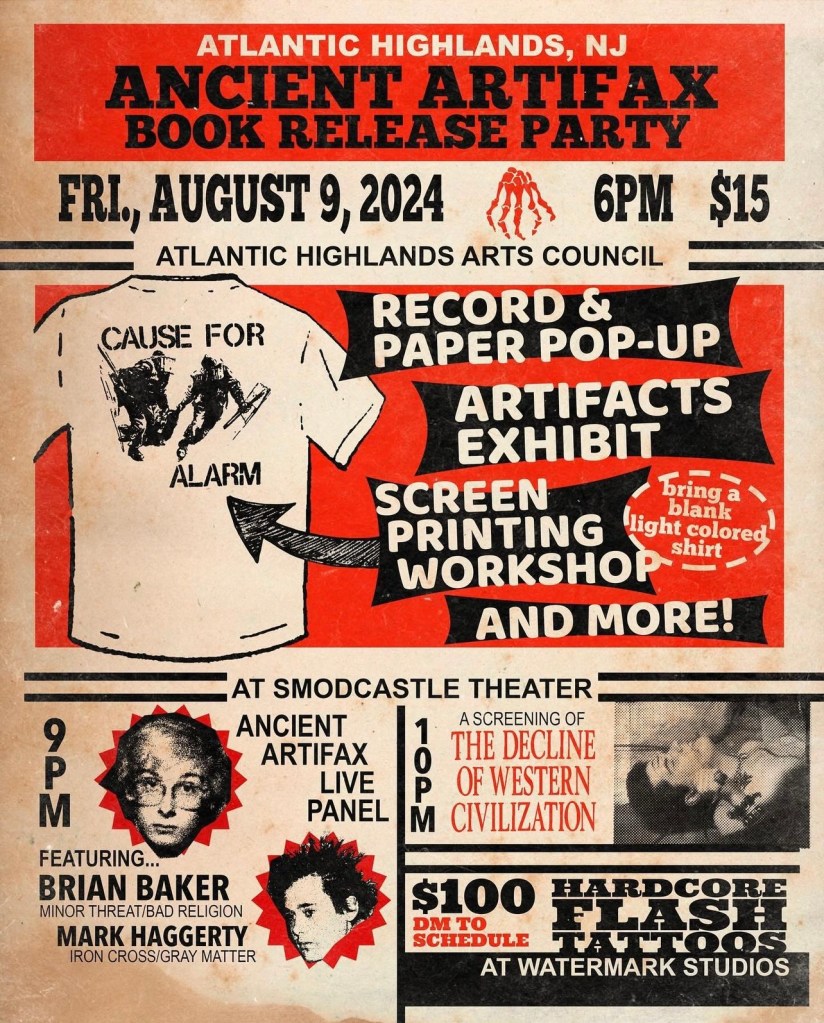
GET to the book release partyAncient Artifax pop-up shop this weekend if you’re in NJ (wish we could be there)! We ❤ you Brian!
 Gimmie Gimmie Gimmie Zine