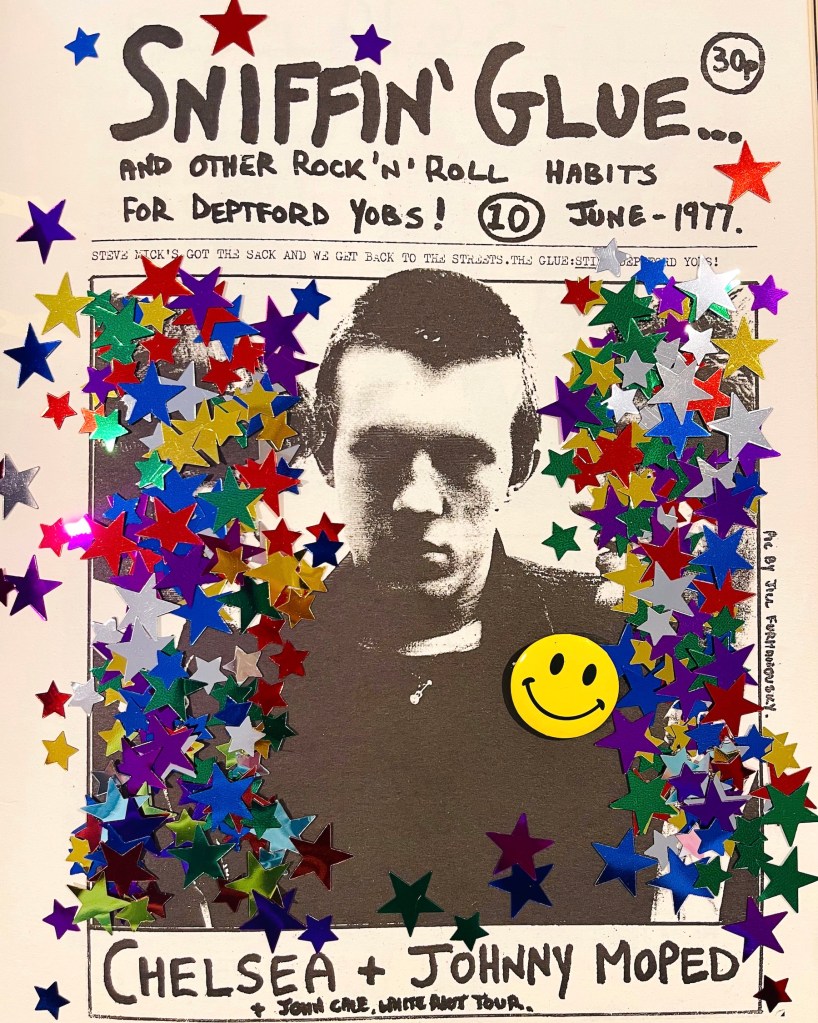
Few people embody the original spirit of punk more than Mark Perry, even if he’d probably roll his eyes at the suggestion. In 1976, inspired by seeing Ramones play in London, the then bank clerk stapled together the first issue of Sniffin’ Glue, a scrappy, photocopied zine named after a Ramones’ song, that would help ignite Britain’s DIY punk movement. Written in felt-tip pen and fuelled more by urgency than polish, Sniffin’ Glue became essential reading for a generation disillusioned with the mainstream music press, documenting punk before the establishment even realised something was happening.
But Perry has never seemed especially interested in mythologising himself or reliving the past. Within a year, he shut the zine down—worried it was already becoming absorbed into the machine—and shifted his focus to band, Alternative TV, the experimental, shape-shifting project he still fronts nearly fifty years later.
Speaking from his home in Cornwall, Perry is thoughtful and deeply introspective. He talks openly about depression, ageing, artistic dissatisfaction and the danger of punk becoming cabaret nostalgia. He lights up most when discussing creativity itself—about Mark E. Smith, Throbbing Gristle, underground print culture and the thrill of hearing something genuinely new for the first time.
Do you think that part of that punk spirit is experimentation?
MP: The idea of this punk spirit has been exaggerated because it’s always existed in music. Before there was a thing called punk, there were people playing improvisational jazz and all that. Before punk came along, rock music was edgy; it was rebellious. Even the Rolling Stones, early Rolling Stones, the Beatles, John Lennon, to the people at the time, it was frightening. Even Elvis Presley was frightening, wasn’t it? I think it’s been exaggerated, this idea that punk sort of holds the copyright on free spirit because I think it’s always existed in rock music, independent music, jazz, whatever. Punk is just one of those little things along the way. People love to put labels on stuff, don’t they? They’d like to put, this is punk, that’s not punk and all that. I mean, but it’s rubbish, really. All those labels don’t mean anything, really. It’s all just music
What’s one of the sort of strongest memories that you have from your early creative life?
MP: I suppose the early years of punk, because people still talk about those years so much. They do over in the UK, anyway. They’re always banging on about them. I suppose they were important. The first time I saw the Ramones in the UK in July 1976. That was a memorable time. Of course, that inspired me to do my fanzine, Sniffin’ Glue. Later on when I formed the label Step Forward record. So much happened in those years. It took so much, I did so much in that short amount of time. People keep banging on about that time because it’s seen as an important milestone in popular culture. The Sex Pistols, Malcolm McLaren, all that. Being part of that obviously was very exciting.
I read that you wrote a rock opera when you were 17 about being a bank clerk.
MP: I think the word is tried to, because I was a big fan of The Who. They had just released the original Quadrophenia, in 1973. I had a go at it myself, inspired by that. I mean, I didn’t do the music, it was just thef lyrics, the libretto. I didn’t get very far with it.
Your zines really inspired me to start my own. As a teen, I used to see Sniffin’ Glue mentioned in books about punk. In 1996, I bought the book And God Created Punk that you did. I remember flicking through it, reading your stories, and looking at all the black-and-white photos, thinking it seemed like such an interesting and exciting time.
MP: Yeah, because back in those days, you were just getting on with it. Things moved so quickly, and you didn’t really have time to think about what you were doing. It’s funny—Sniffin’ Glue now is actually considered an art book. People talk about it in academic art books when they discuss the DIY style, and they mention Sniffin’ Glue.
But at the time, I didn’t think I was making some massive statement or influencing anyone. You just got on with it and then moved on to the next thing, you know what I mean? It’s only in retrospect that it seems so important and influential now.
And remember, Sniffin’ Glue only lasted twelve issues. It barely lasted a year—maybe a year and a month. Then I moved on to other things. I started making music instead.
So I never really saw Sniffin’ Glue as a defining thing or saw myself as a writer in that sense. It was just something I got involved in at the time, but as soon as I could, I shifted to making music. I wasn’t particularly interested in writing about music.
Why did you start doing the zine?
MP: I didn’t really think of myself as a musician at the time, I suppose. I was always a big fan of rock music. I used to buy loads of rock magazines, and I’d seen PUNK, the New York zine. When I saw PUNK I had a sort of spark. It was one of those things—you just get this great idea.
My great idea was to do a fanzine in the UK. I think it was the easiest thing to do. Probably the easiest way to get involved. Looking back, it seems like a really hard thing to do, but it was actually really easy for me at the time.
It was only after that that I realised maybe I had another contribution to make. That’s when I got involved in writing songs, forming the band, and all that.
I try to be honest in my writing. You say love—it’s not about boy meets girl and all that. No, it’s about getting into the little sticky bits, like our first experiences of love and life. Alternative TV’s first record is about the sorts of problems that come with having sex, the challenges of negotiating all that—boy, girl, and everything in between. I’ve always been interested in that.
Personal politics—that’s what we’ve always been about. We’ve never been a band focused on big issues. I can’t remember a single song where we’ve been overtly political. As a punk band, we’ve always been more about personal politics—negotiating relationships, life, and identity.
I’m not really interested in politics. Politics comes and goes, doesn’t it? There’s always something to get upset about in politics. I’ve never been interested in singing about current issues or affairs.
You said you’ve listened to the recent stuff, like Primitive Emotions. I like that album—it explores different ideas. Oh, actually, that’s probably got a protest song on it. There’s a piece on there called ‘Rebel Proof Glass.’ It’s railing against the way the punk scene has turned out, with punk festivals and all that.
That’s a protest song?
MP: Yeah, it is. I don’t know about you, but some people—I’ve never been a person who’s like some people—there’s something they’re into, and they still want to stick with it forever. Again, I don’t know what the scene is like in Australia. Over here, they have these big punk festivals, the Rebellion Festival, all that, that we have in the UK.
It’s full of people of my age, 65, with, mohicans and wearing all their punk clothes. It’s like they’re trying to relive the past all the time. They’re trying to recreate what it was like 40 years ago. I’ve never been interested in that. I always want to move forward, get on with stuff, look towards the future. But I think a lot of the punk scene has turned into this nostalgia scene.
It’s like cabaret. That’s a real shame. So instead of punk being creative and being forward-looking, it’s become this nostalgia scene. This cabaret of the past.
I know what you mean. When I first got into punk, when I was a teenager, obviously the coloured hair and things like that seemed exciting because to me it was different to the norm that was around me.
MP: Yeah. But then once you really listen to a lot of the artists that have a substance and stuff, it starts you thinking about things and then you start questioning lots of stuff. You grow as a person. How much you know about Alternative TV? Have you heard our song ‘How Much Longer?’?
I do!
MP: We put that song out in late ’77. It came out in September, and it was having a go at punk. It was criticising the punk uniform. It was criticising everyone dressing the same because people felt that they had to dress like that.
So I was criticising this over 40 years ago, and I’m still doing it now. It’s become a cliché. That’s the worst thing of all, for things to become boring and cliché. It’s the worst!
I don’t even care if people sell out, because I used to worry a lot about bands selling out. Like, when The Clash signed to CBS, I got all worked up about it. I don’t even care about it anymore, as long as people remain true to themselves. They could get on with it.
But when they try to make out that what they’re doing is still rebellious or something, I think it’s nonsense. Punk is not rebellious anymore. It’s marketing. It’s all marketing.
Every punk fest is sponsored by Doc Martens or Budweiser or Jack Daniel’s. There’s no rebellion about it anymore. It’s just become commercialised.
Punk has become a label. It’s a cheap way of saying, ‘I’m rebellious,’ because you get these bands who wear a punk badge because they want to be seen as rebellious. It’s become a cliché.
I love your song ‘Negative Primitive’. It touches on purpose and searching for it. Back in 1993 you also write the song ‘Purpose In My Life.’
MP: I hate the stuff I did in the 90s [laughs]. It was self-indulgent. But ‘Negative Primitive,’ actually, that’s inspired by a Franz Kafka book, The Trial.
In the book, the main character—Joseph K—is just always waiting. He’s waiting to find out what he’s on trial for. He’s always waiting.
That’s an idea—that’s what life’s like. You’re always waiting for something to happen or waiting to find a purpose or waiting for this sort of grand thing. It all seems to be this endless waiting around for ideas or for your life to change or whatever.
I don’t mind being honest about it, but I’ve suffered with depression quite a lot in the past because I’m a person who— I look into myself a lot. I question everything and all that, and sometimes that’s a good thing. But other times, it can almost stop you from just enjoying yourself.
I’ve never been one of these people to just go out and have a good time. With me, it always has to mean something. It always has to be for a reason. It’s the same with music. I’m not the sort of person to go out and watch a band on a Friday night or on a Saturday night just to have a good time. To me, music is about information, about moods and all that. It’s not just about having a dance or having a good time.
I’m quite a serious person. I’m an introspective-type character, which probably comes out in my lyrics and my work.
I get that. I’m like that.
MP: I think I’m a miserable bastard.
Well, there’s a lot to be sad about happening in the world. Maybe rather than being a miserable bastard, maybe you really, really care about stuff? You’re not just going to take something someone hands to you. You have your own critical thought and tastes. A lot of people are more comfortable not having to think.
MP: Yeah.
I understand that even pre-punk, you suffered with depression.
MP: I’ve always been prone to that, but I think you actually learn to turn that—if you’re that sort of person, or prone to those sort of faults—because I’ve never been the sort of person that’s been suicidal, because I’ve always thought that was a ridiculous, pretty silly thing to do.
But what I’ve done, I’ve turned this idea of depression and that sort of way of looking at things into a positive thing. You put it into making art. You either make fanzines or you make records or you write songs, so you turn that view of the world into just doing stuff.
Let’s face it, that’s quite a common thing in rock music. If you look at the obvious things, like Kurt Cobain, Joy Division and all that—but if you go through rock history, there’s loads of people: Ray Davies of the Kinks, Pete Townshend—they’re all sort of quite depressive characters, but they managed. They found songwriting was a way out of that, a way of expressing themselves, about being lonely as a teenager, about understanding the world. Although I was like that, I’ve managed to actually find a way to express myself. That release valve, if you like, for those sort of ideas.
How do you feel when you have to perform your songs live? When you’re singing about these things and you’re sharing them with everybody else in the room.
MP: Quite funny. It’s like a therapy. We were joking about it the other day because, as I say, there’s a lot of bands out there—they play to have a laugh. I mean, they play because it’s fun. There’s a few bands down here, so-called punk bands, and they wear sort of silly hats and glasses on stage and they do all this. It’s like, because it’s fun, it’s a laugh and all that.
To me, that’s the antithesis of what we do. But I still find it quite good getting those ideas out. We still do a song—one of my most introspective songs, depressing songs. It’s a song called ‘Lost in Room’. It was on the B-side, and we still play that live.
So every time we play that, it’s like me pouring out my sort of feelings of loneliness, introspection, can’t-get-a-girlfriend and all these feelings of alienation. I’m sort of pouring that out, and it’s quite a release. It’s like a therapy, isn’t it? It’s like a group therapy.
Totally! Why did you call your album, Primitive Emotions?
MP: Because I think all the songs deal with what I call primitive emotions—the very basic emotions we have: our sexuality, our sort of lust, our loneliness, depression, all that. They’re basic sort of emotions. They’re deep within us and they’re all there, and I guess I like to feel that I’ve sort of brought those out on the album in those songs. It just seemed like a really good idea for the title of the album.
Plus, at the time, I was talking to an artist, Sophia, who showed me this brilliant series of photographs for the front of Primitive Emotions. She’s an amazing artist, and she takes these photos of herself going through this primal scream thing, and I just thought it was brilliant. So with that photograph on the front, working with the print, I just thought we had a brilliant title and image for the album.
Yeah, it’s such a compelling image. It’s really beautiful.
MP: I’d rather give an artist—someone like Sophia—a chance to use their work, use other artists’ work. It’s the same with the last few things I did. The album before that, Opposing Forces—there’s an artist, Sam, I know, and I chose to put his work on the front rather than have a picture of the band. Use something sort of different from another medium of art. Use that as a way to put ideas across. I like the idea of doing that, because Sophia also did our next release. We put out a twelve-inch called Was It Working?
Sophia did the art on that as well. So it’s like you’re still bringing lots of people together to help share ideas?
MP: I like the idea that when you buy these records, or you see records by—I’m thinking recently there was a new record by a band called Chelsea, or there’s a lot of these punks, like 999, you know, putting out new albums with themselves on the front cover. Their album—it’s just a picture of them. Who wants to buy a record by a bunch of sixty-five-year-old blokes, you know? I mean, that’s the way I look at it. I can understand it, but I’d rather put something interesting on the cover that makes people think and maybe feel, oh, this looks interesting. I wonder what this album is about?
If I put a photo of myself on the front, it’d just mean they know it’s some sixty-five-year-old bloke trying to be nineteen again or something. I don’t know. But yeah, I like to use other people’s art. I like to bring lots of people together, get lots of people involved and put ideas out there.
What do you get from collaborating musically with other people?
MP: Well, it changes the music. I’ve always done that. The whole issue of Alternative TV, the whole discography, if you like—Alternative TV has always been about who’s in the band. Because I’ve only got so many ideas. Obviously, I always do the lyrics, so Alternative TV is basically my lyrics. But then the different people that I’m playing with, they add their influence.
I’ve always been very open to these other people and, like the current version of Alternative TV, for example, they put their influence in, so it changes again. I quite like the idea that it evolves. Evolves as different people come on board, you know what I mean? I think it’s healthy.
What’s unhealthy is, like what I said before, a lot of these bands—they just play the same songs in the same way every gig they play. And I just think that’s really boring. That’s like cabaret. That’s when it becomes cabaret. I’m not really interested in that. I like the stuff to evolve.
Same. A lot of people say there weren’t many women involved in the punk scene, but I feel like they’re wrong and women have always been involved—especially in the beginning.
MP: Yeah. With regards to women, there were the obvious bands at the start and all that, and then there was Siouxsie Sioux, Poly Styrene, The Raincoats and stuff like that. But hopefully people don’t think that way anymore, because before punk the whole rock scene was pretty misogynistic.
There weren’t many women involved and, if there were, they were usually singers—someone fronting the band, like Stevie Nicks or Sonja Kristina from Curved Air. So you did have those people.
But I think one healthy thing punk did was bring in a lot of people who wouldn’t necessarily have been involved in music otherwise. It got a lot of different people playing together and making music, and that’s been healthy.
I understand that you once refused to do an ad for The Adverts in Sniffin’ Glue?
MP: Yeah. It was for Stiff Records.
They put Gaye Advert’s head on top of a picture of a naked woman and they wanted to run that as an ad in your zine.
MP: Yeah, I said no because it was naff. It was sexist!
On the flipside, I know that you’ve previously mentioned how sometimes you’ve realised you made mistakes in the past with Sniffin’ Glue.
MP: Oh God, yeah. But with anything like that, there’s going to be loads of things. A lot of things I said back then, I’m embarrassed about now. But then, when I did that, I was nineteen years old.
Because it’s so immediate, isn’t it? When you do a fanzine like Sniffin’ Glue, you’re writing it and then, within a week or two weeks, it’s out there. You’re done—that’s it. So you can’t go back and edit it. And there was loads of stuff I said that was rubbish. Loads of stuff!
I finally got an original print issue of Sniffin’ Glue. Issue six. When I slipped it out of the plastic bag, I actually cried, because I’d always wanted to own an original copy of Sniffin’ Glue. I’ve got original copies of PUNK and Slash too. I’ve been making punk fanzines myself, since I was fifteen.
MP: That’s great!
I remember reading through it and getting to the last page, where there was a review of a The Saints’ record. Do you remember that one?
MP: Yeah.
There was a line in it about Aboriginal people, and it really upset me because I’m Aboriginal myself. I was just like, “What the fuck?”
MP: What did I say in the review?’
It was talking about The Saints, and said something to the effect of, “I reckon they’re beating all the Abos up with baseball bats” or something like that.
MP: Oh yeah, that’s right. But what were we trying to do there? I think we were trying to comment on the racism against Aboriginal people. But it’s one of those throwaway lines that, looking back on it now, was actually totally immature.
Absolutely. I guess that’s the strange thing with old fanzines and early punk writing — it was all so immediate and reactionary. Sometimes people were trying to critique racism or violence, as you were, but the language itself could still be careless or hurtful.
I think it’s important to acknowledge when something was immature or harmful without immediately trying to “cancel” someone for a mistake they made fifty years ago. What matters to me is whether someone can reflect on that honestly now.
MP: Yeah. In one of the other early issues, I said something about women… I think there was this girl who was going to stay up and help write Sniffin’ Glue, and I made some stupid throwaway line like, “Women are only good for shopping for glue,” or something like that. It’s just silly.
Again, I was nineteen, you know? You come out with these stupid throwaway lines, but they’re forever there. Once you’ve said it and it’s printed, that’s it. You can’t undo it.
Yeah. That’s why I wanted to ask you about it directly, because like I said, nowadays people can be very quick to go, “This person said this thing twenty years ago—cancel them.” And everyone piles on without going to the source or even doing their own research and making up their own mind. The world would be a much better place if it had more understanding and empathy.
MP: Yeah. Well, I was criticising White Australia. It’s one of those things… But yeah, we recently put that review of the first The Saints single online. I put that on Facebook because, obviously, Chris Bailey died recently. And I remembered that, because I was doing Sniffin’ Glue, Chris sent me a copy of the single to review. But most of the review is actually part of his letter to me.
I’m actually from Brisbane, home of The Saints.
MP: Oh, great.
I wanted to ask you a little more about life in general and navigating it on your own terms, which is what it seems you’ve been able to do, for the most part with all your projects.
MP:I’ve always been thinking about why we’re here, why we’re doing this, why this, why that. I’ve always been one of those reflective sort of people.
What I’ve found is that nowadays there’s even more of a tendency to just get stuck in what they used to call becoming a couch potato, because there’s so much stuff being chucked at us now, isn’t there? Through social media, your Netflix, your Amazon and all that. There’s a tendency to just get stuck watching stuff and buying stuff all the time. It’s so easy now—you go on Amazon and it’s here the next day.
I find you can just get buried under all that sometimes. I went through a bit of an aimless period during lockdown because you didn’t have any gigs and everyone was separated physically, and in other ways as well.
But I’ve found that now I’ve got myself back into music again, and playing live music, it’s actually much better because instead of just consuming stuff, you’re getting out there and making stuff.
It gives you much more satisfaction, I think. Rather than just watching and listening to what other people are doing, you’re actually doing it yourself. For someone like me, I think that’s much healthier.
Definitely. Me too! And I think having that positive output, in a way, kind of helps to counterbalance all the crap things in the world.
MP: Absolutely. Yeah. The more people do stuff, the better! That’s what it’s all about, really.
Yeah. When you were doing Sniffin’ Glue, you’ve previously mentioned that people would come up and say, “I want to write for Sniffin’ Glue,” and you’d tell them, “No—make your own zine.” I get that a lot with our zine, Gimmie, and often tell people that same thing.
MP: Well actually, I think Sniffin’ Glue did sort of start a bit of a movement. I don’t know if I should slap myself for saying that, but in the same way the Sex Pistols inspired people to start bands, Sniffin’ Glue inspired people to make their own fanzines.
And there was a particular one—and he keeps saying this because there was a book that came out recently. There’s a guy called Tony Drayton. He did the fanzine Ripped & Torn. Which was like the second punk fanzine. He always quotes that story. He says the reason he did Ripped & Torn was because I told him to go and do it. Because, like you said before, he was one of those people who said, “Oh, can I write for Sniffin’ Glue?” And I said, “No—go and start your own fanzine.” And he did, and it became a great fanzine.
And Tony went on to do another great fanzine as well. I don’t know if you’ve heard of it?’ Kill Your Pet Puppy. It was an ’80s fanzine, all about Adam and the Ants and the goth scene. Brilliant. It’s a classic ’80s fanzine. But his first one was Ripped & Torn. He not only did one great fanzine, he did two great fanzines!
But yeah, it’s nice to hear that Sniffin’ Glue influenced other people to go and do something themselves. I think I said in one of the issues—I can’t remember which one—“Don’t believe what we write. Go out and do it yourself. Flood the market with punk writing.” Go out there and create. I’ve always been that type of person—trying to encourage people to do their own stuff.
I’m the same. I think it’s important to encourage other people to be creative themselves. And I think zines are really important because they help get the word out about things. You could have the best album in the world, but if nobody knows about it… I think zines are really underrated. Especially ones like yours, the contribution Sniffin’ Glue had for giving punk legs.
MP: But do you feel like nowadays the problem is that there’s just so much stuff out there on the internet? Blogs, this, that and the other, all these different sites. Do you think there’s still a place for the printed fanzine?
100%! Yes. We started doing a print version because I’ve always believed in print. I love books and all kinds of print media. I work in libraries too and as a book editor for my day job as well.
People are often like, “Why don’t you do a podcast or something like that? Or a radio show?” And I’m like, no—I believe in reading, and I want people to read. So I’m going to continue to produce something people can hold in their hands and read. I also believe in long-form interviews. Some of the chats in our print issues go for over ten pages. All of our print issues have always sold out. People still want print, despite what industry tells you.
And recently we started going to shows again. We went down to Melbourne and people kept coming up to us saying, “Thank you so much for everything you’ve done with your zine, especially for our local scene.” We were like, “Oh, really?” And they said that during the pandemic it helped them still feel connected to the music community and connected to everything. They also said that reading about what other artists were going through during lockdown made them feel less alone and they got all these other really positive things from what we do.
There’s so many great Australian bands at the moment. Real underground stuff, people doing really interesting things. I’ll send some to you.
MP: Great. I’d love to check it out!
Over here, there’s a guy who does one called Safety Pin Magazine. He’s based in Sheffield and he’s quite good. With each issue, he gives away a free seven-inch single.
A couple of issues ago, we had an Alternative TV single on the front of it, so he’s doing quite well. He also does all the print material for Rebellion Festival, so he’s connected with them. I guess he gets some sales out of that.
But yeah, like you say, it’s nice to hold something in your hands. It’s nice to hold a magazine in your hands, flick through it and then put it on the shelf afterwards. It’s nice to actually have something physical rather than just stuff online.
Because, again, like I said before, there’s so much stuff on the internet now. So many blogs, this, that and the other, but you’ve got nothing to keep afterwards. Once you close the page, that’s it. So there is value in having a physical magazine or zine in your hands.
Like I said, I believe in print—especially independent print media—and I’ll always stand by that. It’s appalling to me how much the media is controlled and censored, and even how some books get banned. People should be able to make their own choices about what they read and what they don’t.
Even when people tell me zines are dead, punk is dead and all these things are dead, I’m like, “Maybe to you, but not to me.” I have my own mind and I don’t need validation from things outside of myself.
I’m curious, how you define success? Because you’ve done lots of things and to many people, me included, you seem like a success.
MP: So on the financial side, I’m an utter failure. I haven’t made any money out of it. But artistically, it’s different. For example, with Sniffin’ Glue, it didn’t make any money whatsoever. None at all. But I guess it was a success because people still talk about it now. I mean, we’re still talking about it! So in an artistic and creative sense, it was a massive success.
There’s a different kind of success when you feel like you’ve actually achieved something. Though it would be nice sometimes to make a bit more money out of it. But the problem is I’ve never been someone who could compromise in order to make money.
Because I think with anything like what we’re doing now—fanzines, independent music, music on that level—if you want to make real money out of it, you usually have to start compromising yourself and compromising the message. Most people, like you said, still have another job, don’t they? You have to be doing something else to make money.
I know loads of people over here who’ve got what you could call successful record labels. They put out great stuff, but they’ve still got day jobs. That just seems to be the reality of it. So I’ve always looked at success more in an artistic way: being satisfied with something you’ve done. And I’m satisfied with the work I’ve done. I’m satisfied with Sniffin’ Glue. I’m satisfied with what Alternative TV has done.
What kind of songs do you think Alternative TV will write next?
MP: The newest song I’ve written was actually the last song I wrote ‘Chinese Burn’ which was on Primitive Emotions, because I don’t write that many songs now.
Back in the early ATV days, when I was making music in the early 70s, it was a very creative atmosphere. It wasn’t quite a collective, but there were a lot of people in the same area of London making music, playing in bands and putting on gigs. The creative juices were flowing all the time. It sort of comes in patches now, in a way. And then you start. So you’re writing a lot of stuff. You get a lot of ideas. As I’ve got older, I don’t write as many songs because, I guess, I’m not in that environment where it’s organic.
I don’t mind. You can only write so many decent songs. That last song was just an old man bemoaning loss and all that—the usual stuff. I don’t know, really. I won’t know until it happens. When it happens, it happens.
It might be like what I said before about ‘Negative Primitive’. I wrote that after reading The Trial by Franz Kafka. Sometimes it works like that—you read a book and it inspires you to talk about something in a song. Or you might see a film or whatever, and that inspires you to write something. You can’t really predict it. It all depends on what you’re reading or watching at the time.
Yeah, absolutely. That’s what art is, really. Everything inspires everything else, and something just resonates with you. Sometimes it’s even hard to talk about because it just happens and you don’t even really know why.
MP: That’s right. Sometimes you can’t describe it in words—it just happens. Whatever inspiration is, sometimes it just appears.
And the good thing about the way I work is that the people I’m playing music with—whoever’s in Alternative TV at the time—they put their own ideas into it as well, so it evolves into something else. The Alternative TV of now doesn’t sound like the Alternative TV from forty years ago. Why should it? It’s constantly evolving with new ideas all the time.
If I didn’t have new ideas, I’d probably stop doing it because I’d get bored with it. Honestly, I think I’m probably most excited about ATV now.
I’m familiar with a lot of your catalogue and your songs, and just the other day I was listening to Primitive Emotions while I was driving around in my car. And it’s so cool—every song sounds completely different.
MP: Yeah, well, that’s what we try to do.
I hope you keep making more music!
MP: You probably know the label, actually. I’m working with this label in Poland called Fourth Dimension Records. They’re the ones who put out Primitive Emotions. They’re great—absolutely brilliant. They’ll put out pretty much anything we want to do.
But recently we’ve been approached by Damaged Goods. You probably know them?
Yeah. They put out the first Amyl and the Sniffers record in the UK.
MP: Yeah. Damaged Goods are more of a punk and garage-punk type label, and they’ve asked me to do a record for them. So the next thing we do might be a bit more punky. I’ve got this idea of doing a sort of retro 1977-style punk record for Damaged Goods. That’s probably the next thing we’ll do.
Nice! Do you think you’ll ever write a book about your life?
MP: No, I’ve never… Funny enough, I always say I’d never write an autobiography. I’m just not interested in that at all.
But at the moment I am working on a book about Alternative TV’s music. It’s going to be like an illustrated discography, so it’ll talk about the songs, how the albums were made and all that. It’s really focused on the music. Obviously there’ll be some things about me in it as well, but it’s centred on the music itself.
I’m really not interested in doing any sort of autobiography. I mean, I’ve been offered it loads of times. I’ve even been given money to do it before—I had an advance for a book and everything—and I still ended up not doing it. I’m just not interested in it.
Why?
MP: Because I don’t like reading other people’s autobiographies. Probably the best ones I’ve liked about punk are the most unlikeliest ones. I think the best one I’ve read about the punk scene was probably Steve Jones Lonely Boy.
Yeah, I’ve read that. It’s fascinating because Steve Jones—you wouldn’t have thought he could write something like that, but I actually found it the most interesting.
MP: Most of the others I’ve tried haven’t really grabbed me, though. I quite enjoyed Cosey Fanni Tutti’s one because I’m a big Throbbing Gristle fan, so I was interested in her perspective on all that. But most music autobiographies I just find really boring—really cliché. It’s always people growing up on housing estates, being dissolved and all that, and then punk comes along and changes their life. I just find it really tedious.
Yeah, but punk did change your life though, didn’t it?
MP: Yeah, but that’s pretty obvious. That’s what I mean—when you read a lot of these autobiographies, they’re just stating the obvious. Unless it’s really well written and genuinely brilliant, I lose interest.
I’m actually reading a biography about Nico at the moment and I’ve nearly given up halfway through because it just keeps going on about drugs all the time. It doesn’t really say much about the music.
That’s what I like in books about artists—I want to know why the music was made. I like the intricate details behind it. Actually, one I really enjoyed was—have you read Peter Hook’s books?
No, I haven’t.
MP: He wrote Unknown Pleasures—the Joy Division one—and then there’s another one about New Order and The Haçienda. They’re brilliant.
Peter Hook was the bassist in Joy Division, and the thing I like about his books is that, yeah, he talks about himself, but he also talks about why the albums were made, the tracks, how the songs were written. I love all that sort of stuff—the technical side of it.
I love those nerdy details too.
MP: I really don’t want to know what Johnny Rotten had for breakfast [laughs]. I’m not interested.
I met him once and he wrote “I hate you” on my T-shirt.
MP: Oh, did he?
Yeah. I didn’t really expect anything else. I feel like he’s probably been misunderstood a lot. I hope I get to interview him one day.
MP: I guess he’s just living up to the persona he became. The thing with John Lydon is that he always seems to be “on” all the time. He drinks too much, doesn’t he? Too much booze. He’s always performing, always worked up. I find him irritating, really. Which is a shame.
Steve Jones, on the other hand, is lovely. Have you seen Jonesy’s Jukebox? He’s great. Really nice guy. Cool. He doesn’t seem to have any issues.
But every time you hear John Lydon open his mouth, it’s like—what is he so worked up about? He’s a multimillionaire, he made some great records. He should just chill out a bit, shouldn’t he? It gets boring after a while.
Is there anyone from the punk scene that you found particularly inspiring at all?
MP: Yeah. I suppose the most inspiring person for me back then wasn’t really from the punk scene. It was probably Genesis P-Orridge. But that wasn’t exactly the punk scene, even though it was connected to it. Genesis came more from an art-practice background.
Then later on I really got into Mark E. Smith from The Fall. Mark was just an incredible character—a real force of nature. Someone who knew his own mind, wouldn’t take any bullshit and didn’t fit into any categories.
Before that, obviously there were people like Ramones and Richard Hell. Looking back musically, I still find the actual New York punk scene much more interesting than the UK one. Even though I was part of the UK punk scene, I actually find the whole CBGB scene more interesting, particularly musically.
If I put on a punk record now, I’ll usually play something like Marquee Moon by Television or Horses by Patti Smith. I find that stuff much more inspirational than a lot of the UK punk records. The Ramones, Talking Heads, Television, Patti Smith, Blondie—all that stuff.
Why do you think you found that scene more inspiring than the UK stuff that was around you?
MP: The trouble with the UK stuff was that, because I was part of it, I knew it too well. It was too close to me. The Clash were singing about the same streets I walked around in London and all that.
But the New York scene still had this sort of romance about it—not romance in a love sense, but an artistic romance. Like, “Wow, this is really cool.” I also think the New York scene didn’t get commercialised as much. It felt more like an art scene. Mostly small clubs and all that.
The Ramones, for example, were actually more successful in the UK than they were in the States. They didn’t really have that audience in America at first—they had to come to the UK to be recognised.
It also goes back to things like Andy Warhol, The Factory, The Velvet Underground—that whole late-’60s New York scene running through to 1977. I just find all of that extraordinarily interesting.
You mentioned Throbbing Gristle. I’ve always found them they’re really fascinating.
MP:What was interesting to me about them was that they were bringing me stuff I’d never heard before. Most punk, really, is basically rock music, isn’t it? It’s rock music played a bit faster, or a bit rougher, or whatever.
But Throbbing Gristle were totally original because they were using electronic instruments, tape loops, and cut-ups. What they were doing didn’t just feel like rock music with a new name. It genuinely felt new.
Before Throbbing Gristle, maybe the only people doing things remotely similar were bands like Kraftwerk or Can. But Throbbing Gristle were completely original in what they were doing. They came from that art background. That performance-art background. They approached music from that angle, so it became something totally different.
I’m actually reading Genesis P-Orridge’s biography Nonbinary at the moment.
MP: I read it. Yeah, he’s a bit… not very nice to me in it. He said something silly that really annoyed me. He wrote that I didn’t visit Sue in hospital, which was bullshit, because I did visit her in hospital. In fact, I was the one who told Genesis P-Orridge which hospital she was in. So that really pissed me off.
Oh-no. I’m glad you shared that with me, because when I read that part, I was like, surely you wouldn’t do that to your girlfriend when she was really unwell in hospital.
MP: It was so long ago. Maybe he just forgot. It’s a shame with Genesis’s book, though. It sort of peters out, doesn’t it? Because he died before he could finish it, so it feels incomplete.
I actually preferred Cosey Fanni Tutti’s book to Genesis’s. I think the trouble with Genesis’s book is that he’d obviously read Cosey’s first, so parts of it feel a bit defensive because Cosey criticised him a lot—about abuse and things like that. So naturally his version feels a bit defensive in response to what she said.
As an Australian person reading it, I found it really interesting just hearing about life in Britain back then.
MP: Well, both Cosey and Genesis came from the north of England, so you really get that sense of it. In Cosey’s book, the descriptions of making art in Hull and the north-east are incredible—the art collectives, what they were up against, living in those old squats. It’s fascinating.
And Genesis was the same. He came from Manchester, so it wasn’t this glamorous London art-scene thing. These people were true pioneers. They were making performance art on the streets of industrial Britain. They weren’t doing it in some cosy art space in Chelsea. They were in the north of England doing this really confrontational, experimental work. It’s incredible, really, what they did. To come from that background and transform their lives into something so creative is amazing. And Cosey’s still doing it!
Do you think where you live now influences your creativity? You mentioned before that it’s a lot quieter and more removed from the action than where you used to be.
MP: Not really. The way we’re talking now, it’s like the world’s in your home, isn’t it? Through the internet and all that. It’s not really like the old days.
Back when punk happened, things were much smaller. Unless you read about something in the music papers, you just didn’t know about it. For example, the only way I found out about the New York scene was by reading about it in the NME. That’s how you discovered things back then.
If you’d been living somewhere like this in West Cornwall, you really would’ve been cut off. You only found out about things through the music papers, and getting anywhere was difficult. From here it takes about six hours to get to London by train, so it’s a long way away.
But nowadays I don’t think Cornwall really influences the way I make music. I’ve already had forty or fifty years of influences from elsewhere. So it doesn’t really affect it that much.
Last question, what’s something that’s made you really happy lately.
MP: How do you know I’ve been happy? [laughs]. I might’ve been miserable for the last five years.
Have you been miserable for the last five years? I don’t know what the situation’s been like where you are, but with COVID and the lockdowns… and in Britain at the moment they’re still banging on about Brexit. People are still arguing over it. Prices are going up, food costs more, energy costs more. Everyone’s basically living hand to mouth.
It’s not terrible, but it’s a challenge. Me and my wife—we haven’t really had a holiday in years. We went to Torquay in 2017, which is only about two hours up the road. That was our big holiday. My wife says Torquay was lovely, though.
But I don’t really think in terms of happiness or sadness. You just get on with life. And let’s face it—if you didn’t have the bad bits, the sad bits, the depressive bits, I probably wouldn’t make music at all. If I was completely happy, I wouldn’t have anything to write songs about.
Like we discussed before, most of my work is about picking over the darker side of life, isn’t it? Songs like ‘Dark Places’. That stuff’s emotional. It’s about people going through pain, trying to understand things, trying to discover something. That’s just the way I am, really [laughs].
Obviously, I’m laughing now, but I don’t really think about it in simple terms like “happy” or “sad”.’
Does making music bring you joy?
MP: Yeah, it’s great to do. You just get on with it.
I think I’m an eternal optimist. Even when things are terrible, I still try to find something positive in it. When I interviewed Don Letts, he said: punk was always about turning negatives into positives. That was the whole spirit of it for him.
MP: Yeah, that’s actually quite a good way of looking at it. I suppose it is like that, really. Because a truly depressive person—a true nihilist—would never do anything, would they? They’d just lie down and give up. If you can still be bothered to do gigs, make records, make fanzines and all that, it means you’ve still got some optimism about the future. Otherwise why would you bother? You’ve got to have some optimism somewhere.
For all things SNIFFIN’ GLUE go HERE.