
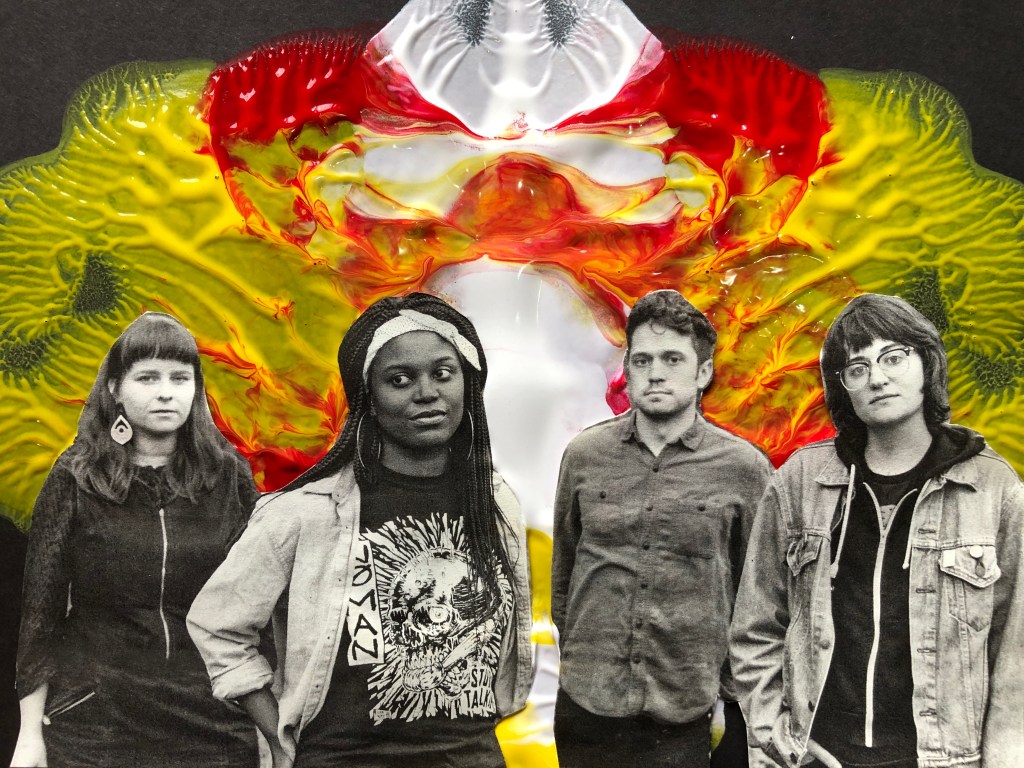
Bacchae (pronounced Bock·Eye) are from Washington D.C. The punk quartet – Katie McD, Rena Hagins, Eileen O‘Grady and Andrew Breiner have just released their new LP, Pleasure Vision. The band jump between styles and mix genres, from synth-driven pop to heavy riffed, experimental post-punk; their songs are full of melody and bounce, lyrically tackling themes both personal and political. Bacchae are a band to watch.
How did you first discover music?
KATIE McD: I grew up going to church every Sunday and that was my first exposure to live music. At home, my mom would play a wide variety of music and watch VH1. One of my first memories of popular music was watching the music video for the B-52’s song “Love Shack” in the kitchen while my mom was singing along and preparing dinner. The line, “I got me a car, it’s as big as a whale” seemed like the height of comedy to my preschool self, but the music also gave me chills.
RENA HAGINS: My mother is really into music and would always take me to shows growing up. She is really into reggae and we would listen to her tapes and I would go with her to festivals. I expanded upon my musical tastes by buying compilation CDs. I remember getting every Punk-O-Rama and Give ‘Em the Boot and learning all the words to every song. I found local bands through friends at school and attended shows whenever I could. My favorite local venue was an indoor soccer arena called The Corner Kick. That is where I first saw one of my fave DC bands, The Max Levine Ensemble. My first major rock concert experience was Blink 182. Between songs they said “Let’s give it up for blow jobs and cumming!” and my 14 year old self was completely mortified to be witnessing that with my mother.
EILEEN O’GRADY: My extended family on both sides loves to sing. All of my aunts and uncles and cool older cousins sang at every family gathering. I have an early memory of listening to the band, Weather Report, on the radio with my Nana. The DJ was listing off the lineup of players on a particular song and apparently made a mistake, so Nana called and corrected them. She already had the radio station’s number from doing call-in quizzes.
ANDREW BREINER: First, I was into my parents’ albums: Michael Jackson and ’60s pop rock like the Byrds and the Monkees. That, plus the newly-available Napster, was the basis for developing my own taste. I got into what I thought was more “edgy” and “obscure” 60s stuff as a tween, you know, like the Beatles. Or even the Sonics. As silly as it seems now, what really excited me about music at the point was the feeling that it was countercultural and saying something different from the main narratives of the world. That’s how I went from 60s rock to anarcho-punk like Crass, and then learned that pretty much all genres can give some window into other worlds. Still, I will not comment on my nu-metal phase that somehow fit into my early musical development.
Who or what inspired you to want to make music yourself?
RH: I used to play cello and viola up until I was about 12 years old. I couldn’t afford to purchase any instruments, so I had to eventually give it up. I always loved to perform and participated in chorus and was also in a few plays during my school years. I’d always been fascinated by bassists when I went to see live music and made it a point to learn and join a band one day. I was given a bass by my partner about 4 years ago and started learning immediately.
KM: I started learning how to play piano when I was 8 or 9 years old. When I was 13, I decided to teach myself how to play guitar (because it was cooler) and began writing songs. I listened to WHFS and idolized Gwen Stefani and P!nk at the time; middle school was miserable for me, which also helped inspire me to write music. The songs were terrible and I never shared them with anyone; I just played them alone in my room.
EO: I played bassoon in school band growing up all the way through college and was actually pretty good. I’d always wanted to play drums but was intimidated for a long time, especially since I was used to seeing boy drummers. There was an extremely cool woman who taught drums at band camp who I never uttered a word to but was quietly obsessed with for years.
Then I grew up and came to DC and saw local punk bands with great drummers, like Ashley Arnwine from Pinkwash and Daniele Daniele from Priests. Those folks pretty much directly inspired me to start learning myself.
AB: I think my youthful excitement about music was always tied up with the idea of playing it. I had tried and failed to stick with piano lessons when I was pretty young, cause I was totally unmotivated by the goal of being able to play classical pieces. But I wanted a guitar basically as soon as I got into rock music and I’ve been playing on and off (sometimes off for years at a time) since then. It was a totally different experience, being able to actually learn the things I heard and loved. I think the amazement of being able to recreate or create something as cool as music myself is still why I do it.

How did Bacchae come together?
Katie, Eileen, and Andrew began playing music together as the backing band for a friend’s experimental rock musical. Around the same time, Andrew met Rena when they played together in a one-time band as part of Hat Band DC, a fundraiser for Girls Rock! DC. Bacchae was formed shortly after in the summer of 2016.
Your new LP, Pleasure Vision, came out at the start of March, congratulations! We’ve had it on high rotation here at Gimmie zine. How did the record get started? What was the first song you wrote for it?
RH: Happy to hear that y’all are enjoying the record, thanks! I don’t think we really have a defined start date of writing specifically for this album. Some songs we started writing 2 years ago (ex. “Turns Me”) and others came together in their final form at the studio (Ex. “See It Coming”).
AB: We spent some time playing shows off of our previous EP (S/T 2018) before we decided what we were going to work towards next. I don’t think we were certain this one would be an LP until a few months before recording or so. We just started working on new songs and it took shape from there as we tried them out at shows and tweaked them. “Everything Ugly” was the first one that we finished. I remember Katie brought it to us not long after the EP and it came together almost immediately.
Where was your head at when writing, Pleasure Vision? What kinds of things were inspiring your songwriting? I’ve noticed that all your lyrics are written in the first person.
KM: Half of the songs on Pleasure Vision are about emotions that almost everyone experiences and hides (sadness, longing, heartache) and the lyrics are inspired by a mix of my personal experiences and friends’ experiences. Half of the songs are more political and invoke anger, exasperation and hopelessness. “Older I Get,” and “See It Coming” are two examples of this–they’re both about being angry and dissatisfied at society/Capitalism and feeling sort of powerless in the face of it all. As for the first person thing: if you pick an album at random, the majority of the songs will usually be written in first-person. For example, Green Day’s album, Dookie, is written entirely in first-person.
What’s the significance of the LP’s title, Pleasure Vision?
AB: Pleasure Vision is interpreting the world around you through the lens of optimization and acquisition. Our world is increasingly uninterested in things unless they offer a straightforward, often quantifiable, benefit. If you have a hobby, for example, it’s supposed to help you develop a marketable skill, help you network, or make you healthier. Even if it’s for enjoyment, you’re encouraged to validate it by saying it’s to decompress (from work) or that you’re engaging in self-care. I imagine an overlay on anything we look at: Taking a bath gives you two pleasure points, which counteracts the two stress points you picked up by working a 10-hour day. Everything has to be done with intense purpose. Nothing can be idle or casual or meaningless.

What’s one of your fondest memories from recording your record?
EO: The recording studio has a little chillout area with a TV and collection of VHS tapes. While J was doing the first rough mixes, we crowded around the TV and watched Wallace and Gromit and ate snacks. It was a perfect way to decompress after a somewhat stressful process and be reminded that we’re all friends and love each other.
RH: We brought a Nintendo Switch to the studio and hooked it up to the TV and watched Andrew and Eileen play the Untitled Goose Game. It was so fun to see them wreaking havoc as a goose on the loose!
KM: Listening to everyone do overdubs and everybody’s words of support before and after takes.
What’s your personal favourite song on the record? What do you love about it?
RH: It’s so hard to choose just one song as a favorite! I love the record as a whole. If I REALLY have to choose, I guess I would say “Losing War”. It’s unlike any song we have previously released as it is a bit heavier and grungy. We played it for the first time at the Pleasure Vision record release show and it was so much fun to play live. It’s got a good groove to it and the bassline just puts me in a zone. I also love that we had the opportunity to have Shawna Potter of War On Women add some guest vocals on the recording. It was so much fun to work together!
EO: “Hammer”–it’s such a bop. Andrew’s guitar solo always makes me want to stop playing and just dance around.
AB: “Leave Town”. I’m a sucker for intense fast songs like that. It has a type of heaviness that I don’t feel like we’ve gotten into before, stop-starts, and a tempo change, while still sounding pretty straightforward. And Katie’s singing on the breakdown part still surprises me with its force every time I hear it.
KM: I think “Older I Get” is my favorite because it’s heavy but fun; I really like the ascending guitar thing and the beat.
How did you feel upon first listening to your record in its entirety for the first time once you got the
mixes back?
AB: Honestly, the first time hearing mixes was when I was most fatigued from playing and hearing the songs over and over again. I had just listened so many times it was impossible to try and form any kind of objective judgement. Also it was hard not to just listen intently to my own parts to look for flubs. I spent a few days totally avoiding listening to the songs, and when I got back to it was much more “wow, we did this??”
RH: It’s really tough to listen to mixes and try to give any feedback on changes. When I had some time away from them, it was incredible to listen back and think about everything we accomplished with J. Robbins at the Magpie Cage studio. I am really proud of how far we have come as a band.
Where did the idea for the Rorschach Test style art on your album cover come from?
AB: It fits with the ideas about Pleasure Vision being a way of twisting and interpreting what you see around you to fit certain purposes and to have a particular kind of meaning. The Rorschach Test is the perfect example of that kind of thing: it has no inherent meaning and is entirely about the interpretation you bring to it. We were also experimenting with the idea of doing something based on a vision test chart, and while that’s not exactly evident in the final design, that is how they ended up being laid out as a kind of chart.
KM: Eileen has a good story about this!
EO: My parents are both therapists and they flipped out when they saw the cover. My mom didn’t know that the Rorschach inkblots are in the public domain, so she texted me frantically asking if I had found the inkblots in her office and, like, stole them. Once they realized it was all above board, they were just very interested in what underlying psychological reasons led us to the design. Typical.
Can you tell us about the best and worst live show you’ve ever played?
EO: My favorite was playing House of Independents in Asbury Park. It was the best line up basically of any show I’ve ever been to: Paint it Black, Screaming Females, Give, HIRS, and us. The energy was WILD. Rena had this stellar crowdsurfing moment that our photographer friend Farrah Skeiky caught on camera and it looks like a literal Renaissance painting. Also we got to spend a lot of time at the beach that weekend and ate ice cream and boardwalk snacks.
RH: I started a spreadsheet to keep track of every show we have played since forming in 2016. It’s wonderful to look back and see how much we have accomplished over the years. There’s a note section so we can add highlights like “Katie’s keyboard fell on top of her during Leave Town and she didn’t miss a beat!” or “A transformer blew and the show got shut down after our set!”
I don’t think there have been any shows I would consider to be the worst, and it’s really hard to narrow it down to the best one. Our first official show together was on August 8th, 2016 at a DC venue that no longer exists. The show wasn’t particularly amazing aside from the fact that it was the first time the 4 of us played live together and that was a really special moment. Our “Bandiversary”is August 8th because of this show.

Why is music important to you?
RH: Many of my favorite memories involve music and I am just happy to experience it in any way I can.
KM: Playing music and writing songs is cathartic; practicing music is something that can help you grow alone or with others.
AB: Related to how I found music: I think music can say things that aren’t generally said, both through words and the sounds of it. Music lets people smuggle kind of weird or new ideas into reaching an audience since there’s something universal or at least widely understandable about it, but also so much room for inventiveness and uniqueness.
When not making music what would we find you doing?
RH: I have gotten really into birds lately. There’s a Sparrow, that I’ve named Bird Alex, that lives in the awning by the front door. I recently put a bird feeder up on a tree outside my bedroom window so I can watch all the birds coming by. I’ve seen lots of Robins, Blue Jays, Cardinals, Mockingbirds, and Woodpeckers. There is one Woodpecker that had it out for me. It was coming to the bedroom window and pecking at the frame very early in the morning and waking me up before my alarm. I figured out a way to divert this unwanted wake up call by putting a stuffed Owl in the window as a decoy. Haven’t had any trouble with the Woodpecker in a few weeks. Fingers crossed the Owl decoy continues to work!
EO: I like pro wrestling. DC just got a new local pro wrestling promotion called Prime Time Pro Wrestling, which has put particular emphasis on LGBTQ wrestlers. They produced an explicitly queer show last month called Butch v. Gore where I saw a wonderful match between Effy and Faye Jackson. Effy wears a pink spiked leather jacket, fishnets, and a tiny speedo that says “Daddy” on the back. Faye has this famously great ass, and she kept shaking it at Effy (who is gay) to his visible horror. I was screaming the whole time.
KM: I’m a beekeeper; at this point I’m not sure if it’s a hobby or a lifestyle. Checking on my hives has always been a pleasure, but during the pandemic it also feels like a particularly special weekly event. Now that we’re confined to our homes, I’m also trying to focus on improving my drawing skills and taking better care of my houseplants.
AB: I like reading history a lot lately!
What’s something important that you think more people should know/care about?
EO: More people should know the power of a being in a union. Workers joining together is the only way we will end capitalism.
AB: We can have either decent human lives or capitalism, not both.
RH: Health care is a human right and everyone should have access to quality coverage.
KM: I keep thinking about how much violence and sorrow the pandemic is going to cause across the world. I wish that more people knew this: if you’re thinking about suicide, the best thing to do is to tell a friend about your feelings. You can also call your national suicide hotline. In the U.S, it’s the National Suicide Prevention Lifeline (1-800-273-8255) and in Australia it’s Lifeline (13 11 14), but also if you type “I want to kill myself” or “suicide” into Google, it will show you what the number is in your country. Most of these organizations also have 24/7 online chats.
Please check out: BACCHAE. Bacchae on Facebook. Bacchae on Instagram.

 Gimmie Gimmie Gimmie Zine