More than a decade has passed since I first interviewed Ecca Vandal, back when her first single ‘White Flag’ had just arrived and she was preparing to play her first live show under the Ecca Vandal banner. Even then, our conversations usually drifted beyond music. We’d end up talking about films, art, subcultures and records we loved, bonding over just how much those things meant to us, but also about what it means to exist in punk spaces as women of colour.
A lot has happened since. The South African-born, Sri Lankan Tamil artist raised in Melbourne, has spent her career moving between genres, touring internationally and building a sound that’s never sat neatly in one space. Her new album Looking For People To Unfollow emerged from a couple of years spent offline, skateboarding, and reconnecting with herself creatively. The record feels deeply grounded in the present and instinct.
Ahead of the album’s release this Friday, and in the middle of a whirlwind year that’s seen her play Coachella and tour with her heroes Deftones and Limp Bizkit, Ecca opens up to Gimmie about isolation, mindfulness, fearlessness and learning how to back herself again.
ECCA VANDAL: Great to see you! I haven’t seen you in so long!
Yeah, it’s been a looong time. I was looking through my interview archive this morning and realised I first interviewed you twelve years ago, in 2014, when your very first single ‘White Flag’ dropped. Then we spoke again just as you played your very first live show under Ecca Vandal.
EV: Oh wow, that’s super cool. Love it.
Congratulations on your album, Looking For People To Unfollow.
EV: Thanks so much. I can’t believe it’s been so long.
You seemed like you were on this trajectory going up and up, and then disappeared. I was like, where did she go? All of a sudden you weren’t there.
EV: There was definitely a lot happening around the [self-titled] album release. Then I was touring overseas, and it was great. It was just that COVID came about, and I found myself reassessing everything. Like, okay, what do I want to do? What do I want it to sound like? I wanted it to have meaning, and I felt like a lot of things getting released around that time were a little watered down.
I was pretty uninspired during that pandemic period, but that reassessment allowed me to go back into this mode of digging deeper — going back into the woodshed and crafting something again. Creating, rediscovering my own creativity, and writing with Richie. That was really the start of the process for this album. I just needed to take that time to figure it all out again.
You’ve mentioned that you just wanted making music to be fun again. Was there anything in particular that made it stop being fun?
EV: Yeah, there were lots of elements to it — the realities of touring life, the financial pressures of trying to get overseas from Australia, getting a band around and paying them, and all these opinions and voices coming from the industry and labels. You know, the regiments of releasing music and the rules that kind of came with it. Those were things I just was never really here for, do you know what I mean?
I never started doing music that way, and to me there weren’t really rules to making music and putting it out. It was more like: make a song, click a button, put it online — and that was that. But then suddenly there were all these hoops we had to jump through just to release music, and it was kind of zapping some of the fun out of it, if I’m honest.
That’s what happened towards the end of that first album cycle — going on the road and figuring out the realities of all these different voices and personalities I had to manage. Thankfully, I think COVID and the pandemic came at a really good time for me because it allowed me to hit pause — not only on my creativity and where I fit in this world of music, but also on my life personally.
So, in a lot of ways, it ended up being a really important time for me, and a lot of positives came out of that period.
It’s interesting because when your debut album came out, we spoke around that time and you were saying you felt a little isolated and lonely because your friends were moving away and things were changing around you. But with this album, it almost feels like you consciously chose to self-isolate.
EV: Mm-hmm. It’s true. Yeah, I definitely was feeling that sort of isolation. Then, obviously, during the pandemic, Melbourne was one of the most locked-down cities in the world. We couldn’t travel more than five kilometres from our homes, and Richie and I live in Bayside in Melbourne, so we couldn’t see any of our friends or anything like that. It was definitely an isolating time again.
But I think, in the long run, it ended up being a good thing because I really had to tap into my own voice and figure out what I actually wanted — what I liked and what I didn’t like. There wasn’t anyone else to bounce ideas off. No friends’ opinions, no team, no industry voices. It was really just about following my own instincts and gut feelings.
That was one of the really positive things that came from that introspective period and not socialising much during that time. So, yeah, this time around, the isolation actually ended up being good for me.
So many songs on the new album deal with movement — there’s cruising, diving, running, crashing, falling. Why do you think motion became such a recurring language throughout the album?
EV: It came from that pandemic period. Not only did I kind of go inward in terms of my writing and discovering these creative extremes in my world, but it was also the time I finally decided to learn how to skateboard. It was something I’d wanted to do my whole life, and I thought, okay, this is the moment I’m going to try.
There was something about the motion of skating — the fluidity of it, the beauty, almost the dance of it — that translated directly into my songwriting. There’s a fearlessness that comes with skateboarding. You really have to trust yourself, and those two things flowed straight into the writing room.
We’d actually go to the skate park first during the day. Richie would teach me things on the skateboard, and I’d try them, and I’d fall and crash and really hurt myself. Then I’d have to get back up and try again in order to improve. There was this whole process of learning to skate, hurting myself through it, embarrassing myself in front of other people.
Then I’d go straight from the skate park into the rehearsal room or the studio and apply that same energy to the music, and it really translated. Obviously there’s a lot of motion in the album lyrically, but it was also about trying to be fearless and express myself in every raw way I possibly could.
There are all these parallels between learning to skate at that time — crashing, falling, then eventually cruising — and what was happening creatively. There was also a kind of self-soothing that came with it. It became this cathartic process for me, both through skating and in the studio.
So it helped you reclaim your confidence in a way?
EV: Exactly. That’s a better way of putting it.
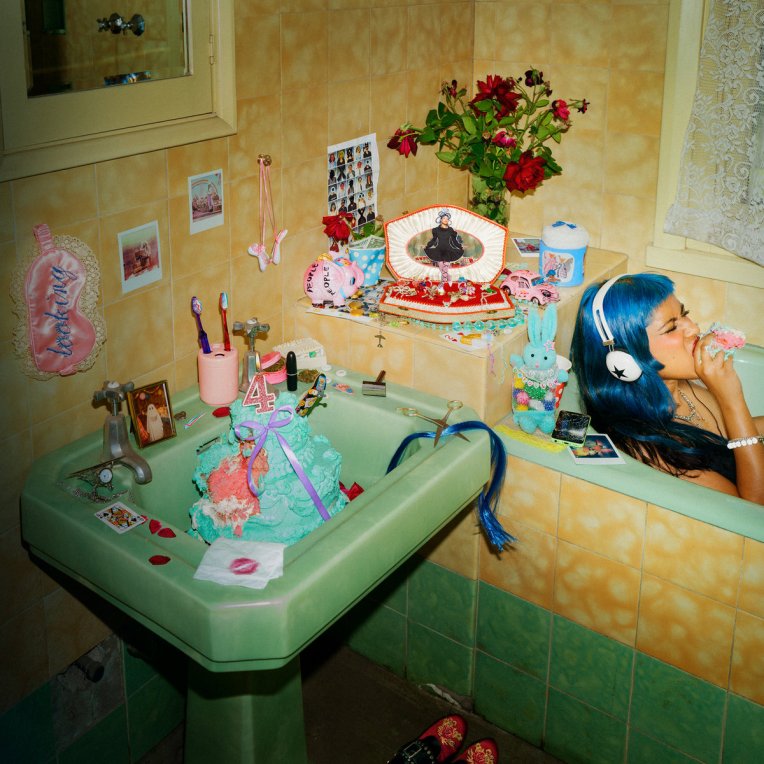
Like, in the lyrics on your song ‘Bleach’, it almost feels to me like it’s about destroying an old version of yourself and becoming something new. And kind of transitioning into the person you always wanted to be.
EV: Absolutely. I sort of discovered that the thing you’ve always wanted to do, or the person you’ve always wanted to be, actually isn’t that far away. It really just comes down to making that decision for yourself. That’s what happened through this whole process for me. It was about gaining that confidence again.
It’s funny because during that period everyone was giving themselves “box dyes” and cutting their hair, and transforming themselves through these DIY approaches, which is something I’m very familiar with. I cut and colour my own hair myself. There was this real sense of transformation and rebirth happening at the time, and I noticed it in a lot of people around me, in family and friends, and definitely within our own world with Richie and myself.
We were pushing the reset button on the industry, our association with it, and where we wanted to be musically. That’s where songs like ‘Bleach’ came from.
And honestly, it’s not always that hard. If you want pink hair, just go to the shop, buy the dye, and do it. You know what I mean? It’s the same thing with learning to skateboard. I’d always wanted to do it, so eventually I just thought, I’m going to try.
Yeah. And all of that stuff you’re talking about is also captured in your song, ‘Do It Anyway’.
EV: Exactly. It’s kind of just a reminder that we’re all human, so sometimes you’ve just got to do the thing instead of overthinking it. I’m definitely one of those people who can overthink things a lot, so in many ways it was me reminding myself that it’s okay to live a little. Even if it’s something small, or something you think you maybe shouldn’t do, or even just eating the thing you want to eat. Whatever it is, it’s okay.
Totally. I’m a bit of an over thinker, at least I used to be until I started doing mindfulness meditation again. It really helped free up my mind from constantly thinking, thinking, thinking. It helps me look at what’s in front of me, right now.
EV: Exactly. That’s really what happened through that whole process. Mindfulness became a big thing for me during that time, and the entire period of writing this album was about bringing myself back to the present moment. It was about enjoying what was right in front of me, being offline, and understanding what that offline space can actually do for you mentally and creatively.
That also meant coming back to listening to albums in full again, from start to finish, and really sitting with that experience. In itself, that’s a kind of mindful listening practice. I think we all do it in some way, but there’s something really powerful about being fully present with music like that.
Your song ‘Molly’ feels suspended somewhere between escapism and clarity. I was wondering if you were trying to capture that push-and-pull between those two feelings.
EV: Yeah, it is. It’s a little all over the place, and I think that’s sometimes what it feels like when you’re trying to search for that confidence again. When you’re trying to build yourself back up after a fall, or after something’s cut you down, there’s this real tug of war happening internally because you don’t always know which voice to listen to.
I was trying to capture that feeling in the song. You can hear it there. It’s like you’re everywhere all at once. But at the end of the day, you really just have to back yourself. That’s what’s at the core of it.
One of the lines that really stood out in that song was: I’m waiting to learn the reason why. It almost feels existential in a way.
EV: Yeah, it’s cause you’re constantly searching, right? You’re searching for meaning and searching for the reason why things might not have gone the way you thought it would or why it hasn’t met your expectations or why you need to manage your own expectations in the first place.
Looking back at writing ‘Bleed But Never Die’; what do you remember most clearly about that period and where your head was at?
EV: That song was about just tapping into how strong women are at the core of it, and how comical it is that sometimes there’s confusion as to how strong women are. It’s actually quite funny that that’s ever been a question on people’s minds.
But also, it came from a time when I actually got diagnosed with Endometriosis. So I had endo, and I had surgery for it, the song kind of came from that. It was always a terrible time for me, and it’s not anymore, but women are so powerful and we go through so much shit, but yet we still do everything!
Yes! When I heard the lines: I’m bleeding through my jeans again; and, who doesn’t love a good cry? I was like, yeah, I totally get it. That sisterhood and solidarity too.
EV: Yeah, it’s like, it’s not funny… We bleed for five days and some would call it certified critical, you know? But it’s pretty amazing. I’m always in awe of the female form, and smart, powerful women who do it all, and mothers who maintain a sense of grace, power and strength all at the same time.
Looking back at your new album, what do you think it was trying to teach you?
EV: Look, it sort of sounds a bit corny, but it’s the truth, and I’ve seen it time and time again, even post-writing the album and throughout the journey we’ve been on over the last year and a half. It’s really just about backing myself and listening to my own voice.
It’s that niggly feeling I get all the time, or that little thing in my gut that says, I don’t know if we should do that, or maybe we should lean into this. I know it’s a bit different to the norm, but let’s go this way.
This entire album, the creative process, making it with Richie, and everything that’s happened since then, has really just been telling me to believe in myself a little bit more.
Last question. You’ve experienced a lot of really pinch-me moments over the past year. It’s been such a wild ride to watch, even just through my little screen and stuff. Has there been one moment in particular that’s felt especially significant for you?
EV: A lot of them have been. I mean, one that’s probably the most relevant right now, with everything happening, is that we’re on tour with Deftones, and that’s amazing and so special for me because I’m such a big fan.
But the way I met Chino Moreno was that I was in Los Angeles and, long story short, I was sitting in a cafe with my manager. He said, “Hey, I’ve got ten minutes. Can you just go for a walk or something so I can really lock in and do some emails?” And I was like, “Oh yeah, I can just sit here, I’ll be fine.” But he was like, “Nah, go for a walk. I really think you should get some fresh air.”
So I walked out of the cafe, turned left, and as I’m walking down the street, Chino is walking towards me. At first I didn’t quite clock that it was him, but then he shouted out, “Oh hey, Ecca. Hi, how are you?”
And I said, “Oh my god, Chino, I’m such a big fan.”
He said, “Hey, I really like your music. It’s great.”
He’d discovered my music and started following me, and we ended up having this little chat in the street about the touring I was doing at the time. That was a real pinch-me moment because I’m such a huge fan, and I never, ever would have expected that to happen.
And if I hadn’t gone for that walk at that exact moment, we absolutely would have missed each other. I would’ve gone one way and he would’ve been behind me, and that would’ve been it.
Looking For People To Unfollow is out Friday via Loma Vista Recordings. For all things ECCA VANDAL go HERE.

