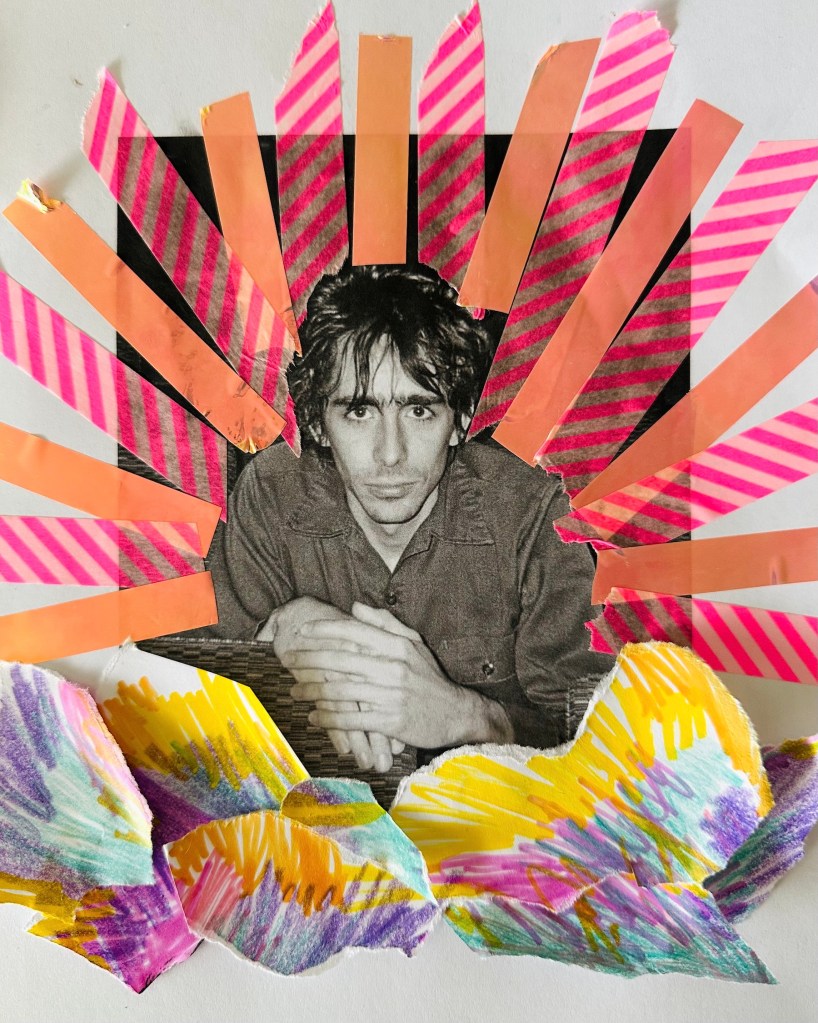
Whether he’s fronting Institute, drumming in Glue or recording solo as Peace de Résistance, Moses Brown is always chasing the next creative idea. In this conversation the New York-based musician talks to Gimmie about skateboarding, Dada art, the Austin punk scene, writing songs under pressure, the new Institute’s 7-inch release on Anti Fade Records, his solo works, and of another project that’s so new it doesn’t have a name yet.
MOSES BROWN: I just got home from work. It snowed 18 inches two days ago. So it’s been kind of nasty here. I like being outside. Even if you’re in the city, you want to go hang out at the parks and do fun stuff.
Is that your bicycle behind you?
MB: Yeah. I usually ride to work because it’s so much faster, and it’s nice.
What do you do for work?
MB: I work at a gallery, I’m an art handler.
Cool. You do all the art for your band, Institute. Has art always been a big part of your life?
MB: Not really. I’ve never really done visual art, except for bands. I used to do scenic painting and set design stuff in college. Then got into working in galleries through that.
I know your inspired by the Dada movement.
MB: Totally. You go back and look at some of that stuff and it’s obvious when you see the Sex Pistols and early punk culture pulling from it; their attitude on the world. Dada and Fluxus—it’s a very punk attitude. It looks so good too.
For Institute stuff, I would pull from this guy, Kurt Schwitters. Go look at old Kurt Schwitters stuff, it looks like a punk tape, it’s crazy.
We’re big fans of Dada too!
MB: I need to dive back in. Now that I’ve lived here in New York, I’ve been more into Fluxus stuff, which I would argue, is the continuation of Dada.
The anti-authoritarian stance, the challenging of traditional values, the humour and absurdity. And the commentary on what was going on in the world at the time.
MB: Yeah. I’m sure they were kind of going through similar things, right? Fascism.
You’re originally from Texas. What was it like growing up there for you?
MB: All three of us in Institute grew up in Austin. Especially when we were kids, it was much more of a liberal bubble, like a small college town. It kind of insulated us from a lot of the stereotypical Texas. You definitely still had people who were super into football and competitive sports. It definitely had an air of toxic masculine and patriarchy. But Austin was pretty sick, so I can’t complain too much.
What were you into?
MB: Me and Arak [Avakian], and I think everybody in the band, were big into skateboarding. I was probably eight or nine, playing soccer, and then figured out that I could ride a skateboard. I slowly got more skilled at it and would watch all these skate videos.
The Flip Sorry video, was a big one for me. At that time all those guys were rock stars, they were punk. You’d watch and be like, dude, this is I want to do! But I was not good at skateboarding then. But the skateboarding culture that I was exposed to really had a big effect.
One of my favourite skaters was a Flip skater, Geoff Rowley. He co-owned it too.
MB: Yeah. I would like all the music they would skate to. Through skate videos, you would hear The Stooges and Velvet Underground and Sex Pistols and Devo. It was all like a blueprint. This is great.
My dad, he’s a huge music nerd, and I would watch a skate video and be like, Dad, what, what is this? Like, what’s, what is this song? Oh, that’s on the first Stooges record. Okay, can we go get it?
Can you remember one of the first songs you really obsessed over?
MB: As a kid I was obsessed with The Beatles, until I was seven. It was the only thing I listened to. I remember thinking that so many of their songs were about love. I was like, can you write a song that’s not about love? [laughs]. I had a huge poster in my room and would watch the Yellow Submarine movie all the time.
Do you have any brothers or sisters?
MB: I’m an only child. But my dad and my mom were big music heads. So just absorb things from them.
Your dad really loved PiL, right?
MB: Oh yeah. I remember being in fourth grade and bringing a CD player out to my backyard where I had some skate ramps and just blasting Second Edition. I still love it.
But to me now, it’s more adult appreciation of it, and seeing the dub and Can influences in there. Something that I now aspire to do. I’m like, wow, these guys were really doing something.
It’s so funny to think about me being nine and being obsessed with them. Like, what was I getting out of this? [laughs].
I’ve always loved the groove they have, it goes on forever and becomes kind of hypnotic.
MB: Yeah. Obviously with Can, it’s a result of jamming for hours and editing after the fact, which is something that I’ve been trying to do with a new project that I’m working on. It’s been pretty fruitful. You play something for at least 20 to 45 minutes, maybe use three minutes of it.
But you find things after that 20-minute mark that you weren’t expecting to find. I feel like I would grow up and people would be like, “Do you want to jam?” It’s like, no, I don’t want to. I don’t want to just play music to play music. I want to write songs, I want to have something coherent to put forward. And now I’m finding, oh yeah, jamming is extremely productive. You figure out a lot of things.
It’s cool that after being more regimented with song writing you’re now more open to jamming and enjoying it. There’s a lot of different ways to make stuff and it’s good to try new ones, it keeps things interesting.
MB: Yeah, it’s been nice. If I kept trying to write songs the other way, like I have been forever, you start to hit a brick wall and it’s not fun and you’re just going to get angry.
Totally. The new project you’re talking about, is it something other than Peace de Résistance or the Moses Brown stuff?
MB: Yeah, something totally new. My friend has a studio. He’s recording a new Peace… record. But then on top of that, me and a handful of friends have been going in there and jamming. Just pressing record and seeing what happens. Nobody’s in a rush. We know we won’t play a show so it’s like, dude, we can take as much time as we want to.
Does it have a name yet?
MB: No, we haven’t figured that out. We’re slowly getting artwork figured out. We don’t know exactly what we’re going to do. It’s too amorphous to really give a solid answer right now.
I was reading an interview with Arak and he mentioned that when you guys were young, your dad had a little studio and with sick gear that you could use.
MB: He was a songwriter and made a handful of tapes in the ’90s. The house we lived in originally had a laundry room that he used as his studio. I remember being four or five and him closing the laundry room door while I heard him playing music in there.
Eventually, he wanted to build a kind of shed out the back in our backyard. He set it up as a studio for himself, but then he got too busy and developed carpal tunnel in his hands, so he had to stop playing guitar.
I’m sure that, in the back of his mind, he was thinking, If I leave this here, the kids are going to use it. And we certainly did. So many of those Austin bands wouldn’t have started if it wasn’t for him building that.
Wow. Your dad sounds like he’s pretty cool.
MB: Yeah. If you were in a band with me, you had a place that you could practice and didn’t have to worry about paying or having gear. So it was huge.
It’s nice that you a Arak have known each other since you were 10.
MB: We’ve been friends for probably 21 years now, 22 maybe.
Do you remember your first impression of him?
MB: Totally. We were at a skateboard camp and he was trying really hard. I thought he was super cool. I felt like he was a skater, but I could also tell he was a rocker, and I remember thinking, this guy seems very cool.
I had other friends who skated, but they didn’t take it that seriously. He was in a similar skill range to me and took it as seriously as I did. I remember thinking, I want to get to know this guy.
We met at skate camp and then, about a year later, found out we were going to the same middle school. That’s when we really became friends.
I don’t know many people who have friends with decades long history together. That’s really lovely.
MB: Yeah. I got a couple of them. It’s awesome. Dude, so many people I went to school with, from elementary through high school, also ended up moving here and getting involved in music and the arts. It feels like our little corner of Austin produced a lot of like-minded people who stayed in touch.
Arak said that he’d like to go out late and break into abandon buildings and things like that. But then you’d be more of a good kid and be like, I’m going home to get up early tomorrow. You guys seem a bit opposite.
MB: Yeah. He’s a boundary pusher and I’m a respect-the-line guy. He’s more whimsical and careless and I have so much crippling fear. Like, no, we can’t do that. I’ve been working on it and trying to cut myself more slack and being open to not having so much control. That’s a lot of what’s happening there with the fear.
Previously, you’ve talked about not letting yourself have much fun when you were younger. But I noticed that when we started the conversation, you were bummed out because of all the snow and not being able to go outside to have fun. I thought, that’s nice that you’re open to fun now.
MB: Yeah, I am. When I was younger, I used to impose these imaginary rules on myself. I’d do things in such a structured way that, looking back now, I’m like, what was I doing?
I was about thirteen and would wake up at eight in the morning on a Saturday, ride my bike to the skate park, and skate by myself for as long as I could until someone else showed up. Then I’d go back home. Why did I feel like I needed to do that? I could have been doing what everyone else was doing — smoking weed, sleeping over at friends’ houses — and honestly, that probably would have been sick.
The first band you had was called Lemonade Sten Syndicate, and your influences were The Hives and Dead Kennedys. That’s a pretty fun combo.
MB: Yeah, the band was actually pretty good for a middle school band.
In the old photo you used for the cover of your solo Stone Upon Stone album where you’re working on the house you grew up in, I saw that you’re wearing a Distillers shirt!
MB: That’s what I was all about. Skateboarding and Distillers shirts [laughs]. I was like—this is my shit.
Stone Upon Stone was an interesting record. The idea was sparked from a novel [Wiesław Myśliwski’s novel of the same name] that you read? You wanted to soundtrack it?
MB: That was the initial idea. I was working on these songs, and they were quite repetitive but carried a lot of emotional weight. I started thinking that this style of music is often presented as a soundtrack to something (not always, but frequently) and it felt like a good way to frame the project.
Before the writing was finished, I decided to try making more songs and turn it into a soundtrack for something like a book or a movie. That idea was mostly inspired by talking to Owen from Straw Man Army, since they’d done their own score.
At first, I tried doing it for the book, but it didn’t really work. It was too hard to reread a book with the mindset of scoring it. You end up reading while constantly making notes like, oh, this could be a song… this could be a song, and I realised that’s not how I want to read. It felt frustrating.
So I decided it needed to be something from my own life, something more personal. That’s when I came up with the idea of making it a soundtrack to the construction of the house I grew up in, and that ended up fitting really well.
Do each of the musical projects you do fit a different function for you?
MB: Yeah, totally it’s all different parts of my musical brain.
What about Glue?
MB: I don’t know how to write a Glue song. I know how to write a Glue drum part. Glue is just fun. I’m just me, playing. Drumming is a whole other section that definitely is an identity that is doing something for me. It satisfies the drummer thing.
They often say the drummer is the heartbeat of the band, right?
MB: I think so. Bass and drums hold it down.
The engine that drives things. What about Institute?
MB: Institute is great because I grew up doing so much punk music. Institute is the band where I get to create, sing and write music that probably has the most relevance to my 18-year-old self. I don’t think my 18-year-old self would really care about Peace de Résistance or the more recent Moses Brown records. So it’s cool to do something for that guy.
When you started Institute, you were recording on a 4-track. Were you writing all the songs initially?
MB: Me and Adam [Cahoon] wrote all of the songs on the Demo. I was using a 4-track to demo the songs. But then what’s on the Demo, our friend Hans recorded it on quarter-inch or half-inch tape. I never liked using the 4-track, it was hard to use.
The lyrics that you write move between, social critique and more inward-looking stuff. Is songwriting ever a challenge for you?
MB: Totally. I have to write lyrics for this new Peace… record. It’s taking a long time. It’s a little like pulling teeth. I’m not somebody who naturally writes a bunch of stuff. I’m writing words down on paper because I have to.
Institute was the first time I started a band and thought, this is it. I’m going to sing and write the lyrics. For years I was like, I don’t want to do that. That’s crazy. It sounds hard and scary.
What helped you overcome the scariness?
MB: I was not very excited to record and sing, I just did it.
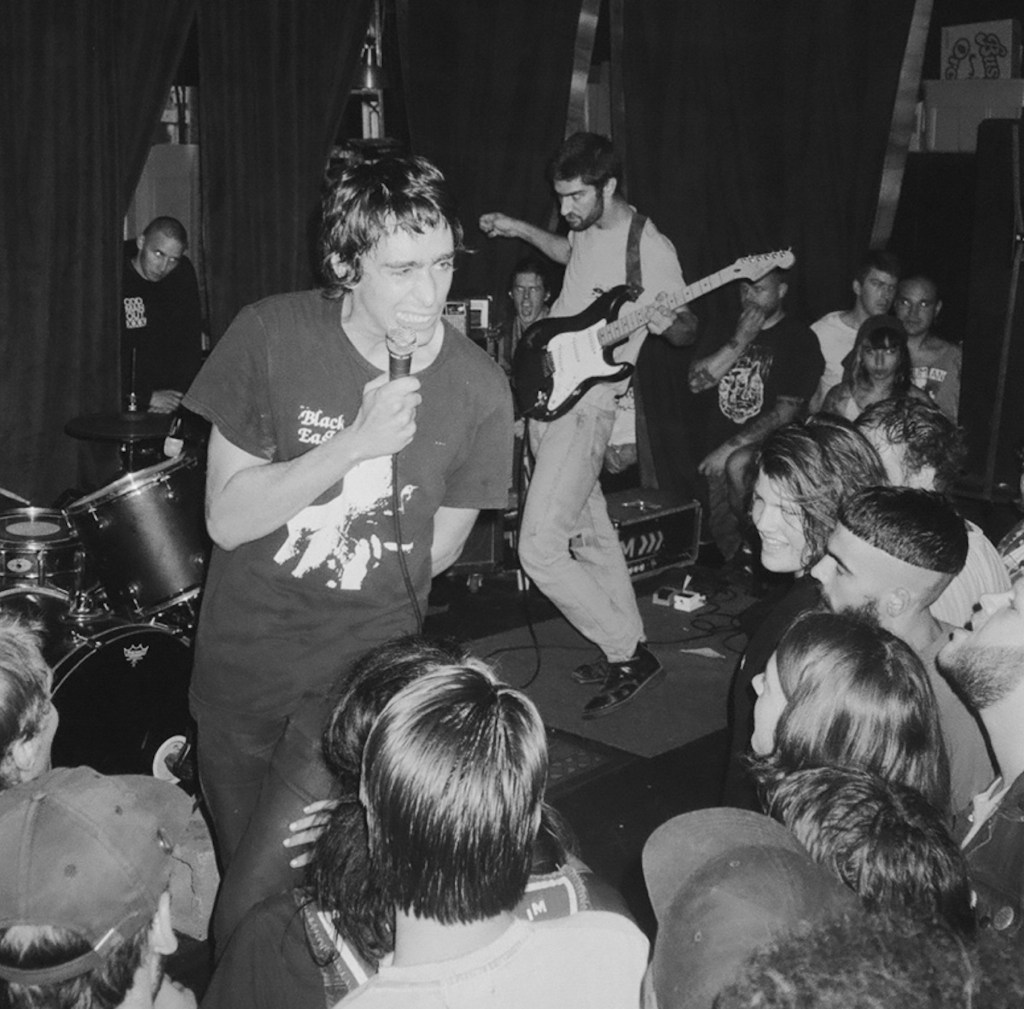
Your live shows, I’ve seen in online vids, look pretty exciting!
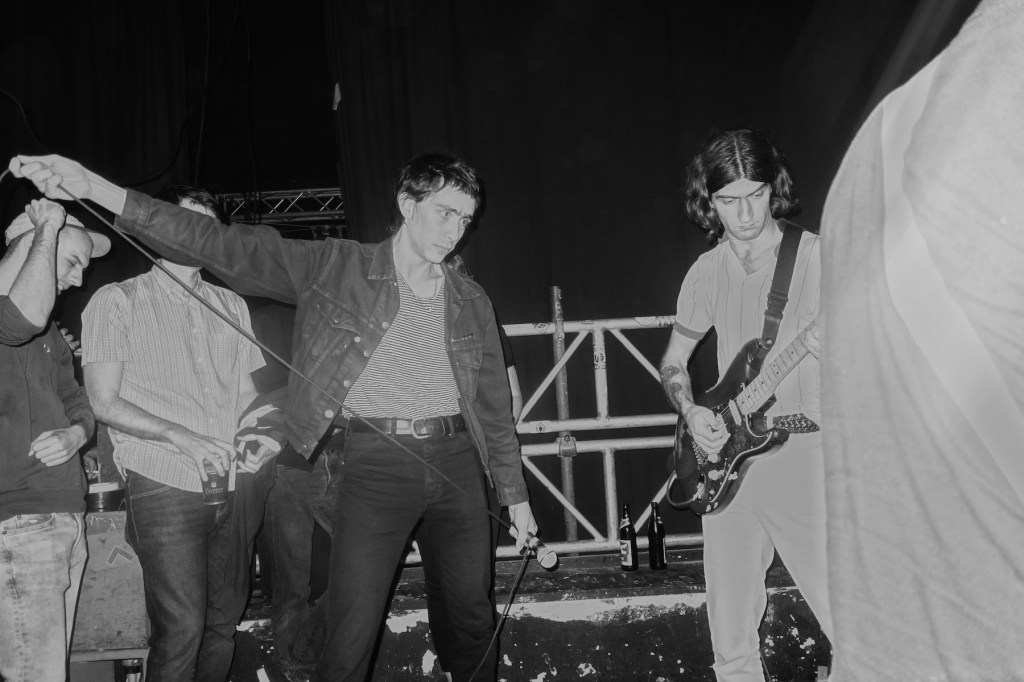
MB: Oh, totally. Institute was a punk, kind of post-punk, anarcho rock band, but we were playing in Austin, which at that time was really dominated by hardcore. There were all these hardcore bands from North Texas coming through, so we ended up playing with a lot of hardcore bands. It was really funny.
All these kids in tall tees and Jordans were coming to the shows, and they were totally into it. When you look back now at some of those line-ups, it’s wild. It’d be Institute with Power Trip, Wiccans, Glue. It’s funny that we were so well accepted by that crowd.
Obviously a lot of us had played in hardcore bands before, so people were like, “Oh, those guys are doing this preachy band now.” But when Giddy Boys started happening, people were kind of like, “Okay… this is interesting.” And honestly, I’m here for it.
Cody and Harris from Glue, are more well-versed in hardcore. I feel like I absorbed some things about it from playing in Glue. But I did not grow up going to hardcore shows. I didn’t know who integrity or SSD or Antidote or anybody was until meeting those guys. I was doing my own thing.
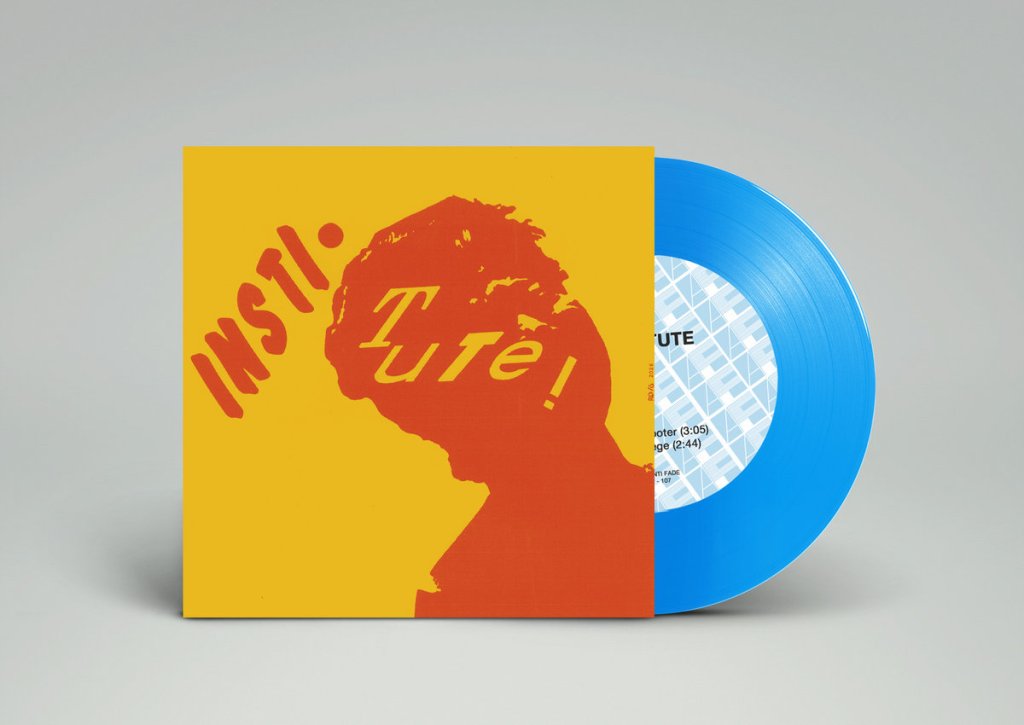
Institute have an Australian only release on Anti Fade for your tour here. What inspired that collection of songs? The songs seems connected in a way.
MB: We were coming over and planning to just bring copies of the last record with us. Christina, who is helping book the shows, and Billy from Anti Fade were like, “It would be sick if you guys had a physical release to coincide with the tour.”
And I was like, okay… you’re kind of asking me to move mountains here [laughs]. Getting even one song out of this band is hard because everyone’s in different places. We can’t practice together and writing music from a distance is difficult. So I was like, I don’t know.
But that weekend I thought, okay, let me try to write a song. I wrote ‘The Shooter’ and texted it to Adam. Me and him are kind of the two guys who bring in the skeletons of songs, so I asked him, “Do you have any skeletons lying around?”
He sent me what became ‘Privilege’, and I was like, dude, this is great. Suddenly we had two songs and I liked them. Then I remembered this other funky jam I’d done in a practice space with Owen [D4MT Labs], and I thought, I’m pretty sure this could be an Institute song too. So we just smashed that in there.
We basically had these skeletons of songs, and then we showed up to record them. Nobody knew any parts. We had to learn them and record them on the same day, and write a bunch of parts as we went.
It was this burst of madness. The guys flew in, we had one day to write and record a 7-inch, and we also had to practice the set we were playing the next day.
Lyrically it was the same thing. Total pressure cooker. I was like, dude, I need to write some lyrics right now. I needed them yesterday.
And honestly, we’re just so consumed with political madness here that I thought, you know what, I’m sorry if everyone’s already bombarded with this stuff every day, but that’s what I’ve got. That’s what I’m thinking about. That’s what’s on my mind.
When you write lyrics, do you hand write them or do you type them on your phone or computer?
MB: I’m doing it in a Word document on my computer. I’ve handwritten other ones.
You mentioned you were working on a new Peace record right now; what themes are you exploring lyrically?
MB: I’m trying to get more okay with things being a bit vague, with them making sense to me but maybe not to other people. I feel like the past couple of records have been all about very clear, concise message delivery. Right now I’m just like, dude, I don’t have it in me.
Peace de Résistance started during the pandemic.
MB: It started because I had this idea to do a band that was a combo of Templars and Chrissy Zebby Tembo. I felt like there was some crossover there that needed to be explored. That was the first idea.
But then people were like, “This kind of sounds like The Velvet Underground.” And I thought, okay, I want to try that now. That’s basically what led to the first LP.
For Peace you usually play all the instruments on the recording…
MB: On the new one that I’m working on that’s not the case but traditionally, yeah.
Is there an instrument that you feel particularly at home with?
MB: Playing bass is pretty comfortable. Guitar is fun, but my hands just… I don’t know. They don’t really know how to do things the right way, and I run into a lot of problems because of that.
With bass, you don’t have to worry about what your hands are doing as much. You’re mostly just using a finger or two.
And then drums were the first instrument I learned how to play, so I feel pretty at home with that. But I need to work on expanding my boundaries with the drums because, at this point, it’s become a pretty mundane instrument for me to play.
I’m like, dude, I don’t even know how long I’ve been doing this for. Maybe I need to make some kind of avant-jazz drum album or something just to get excited about it again.
That’d be cool. I read that Madonna’s ‘Ray Of Light’ was an inspiration.
MB: Oh god, I love that song, yeah.
I love it too. It’s one of my fav Madonna records. Have you heard the original song from where ‘Ray Of Light’ comes from?
MB: No.
Curtiss Maldoon, an English folk duo released the song ‘Sepheryn’ in, maybe, 1971.
MB: Interesting. I’ll check it out.
Why doesn’t Peace do shows?
MB: Being in Institute and Glue is enough for me. That scratches the itch of playing live. And honestly, half the fun of doing Peace songs is that I don’t have to figure out how to play them live.
The madness of trying to translate them into a live band just doesn’t sound like fun. I feel like I’d be pulling my hair out, and who knows if they’d even sound good with a full band.
I imagine it would just be me in a room with five people who’ve dedicated a lot of time to it, trying things out. We’d spend two hours learning a song, and at the end I’d be like, “You know what? Sorry, we’re not going to play this one. It doesn’t sound good.”
It’s just not a record that was written with live performance in mind. I mean, maybe at some point it could be fun to try, but I don’t really need that to happen right now.
What are the things that matter to you creatively?
MB: Doing new things. There’s a song on the new Peace thing I’m working on that sounds exactly like what you’d expect a Peace song to sound like. And I’m like, dude, I should probably cut this one. Why do another song that just sounds like the band already sounds? Let me try something new. Otherwise it’s boring. I’m always trying to push the boundaries.
Is there anything that you haven’t done yet that you would just love to try?
MB: Musically or anything?
Anything, it doesn’t have to be music-related.
MB: Oh my god, so much stuff. I like to play this game where I ask people: if you had to work 40 hours a week, but you could spend those 40 hours doing anything you wanted, what would it be?
People usually say things like gardening, or something quiet like that. But for me, I just want to try new activities. I want to go mountain biking. I want to do oil painting. I want to jump off a skyscraper with a parachute.
Honestly, I think everything is valid.
Yep. Have you been reading anything interesting lately?
MB: Right now I’m reading Sergio De La Pava. The book’s called A Naked Singularity. It’s good. It’s this kind of weird postmodern novel.
De La Pava was a public defender in New York City, and the book really throws you into that world. Sometimes it’s conversations between characters, but a lot of it reads almost like raw court transcripts. You’re just dropped straight into the madness of being a public defender in New York City.
That sounds fascinating. What’s a book that’s had a real big impact on you?
MB: My partner wanted to read a fiction book because she’d mostly been reading nonfiction. She asked me, “What should I read?”
And I was like, you have to read The Melancholy of Resistance by László Krasznahorkai. When I read that book I just thought, this is it. This is what I want a novel to do.
People in the literary world always call him the master of the apocalypse, and honestly I kind of agree. His books always feel like something terrible is about to happen, and everyone is scrambling to take stock of their lives. They’re interacting with each other in the middle of this vague crisis, and nobody really knows what’s going on.
In that book, a travelling circus brings a giant taxidermied whale into town, and somehow that triggers what feels like the end of the world. It sounds crazy, but it’s incredible.
You’ve totally sold me. I’m gonna go find a copy of it.
MB: You should definitely read it. It’s awesome.
What pushed you towards living in New York?
MB: I’d visited here when I was a teenager and thought it was cool. Then I came back again as more of an adult and started meeting people. I realised, oh, I could actually live here.
From a work perspective it made sense too. In Austin I was working at galleries and museums, but there were maybe three places you could really work. Here there are hundreds.
So I thought, I could move here and actually make a living doing the same kind of work. It suddenly felt feasible.
If I’d been like, “I’m going to move to Portland and figure it out,” I probably wouldn’t have done it, because I’d have no idea what I’d do there. But here it felt like, okay, boom, you’re good to go.
Do you like your work that you do?
MB: I do like it, yeah. A lot of music people I know do it too. It’s actually great for creative people who need something semi-interesting to do that isn’t, coding or something. You’re working with your hands, you have to do a bit of math, and you’re constantly figuring things out.
A lot of the job is like, “Okay, how do we build a box for this sculpture that’s a giant snail?” You’re just solving problems like that all day.
That sounds so fun. Last question. What’s something lately that’s made you genuinely really happy?
MB: We had two snowstorms back-to-back, about three weeks apart. The first one happened while my partner was out of town, so I had to deal with it by myself. I was basically stuck in the house for a day.
But when the second storm came through she was back, and I was like, “Oh my God, you’re going to be my snow buddy.” We were going to play Overcooked!, read books and take baths. I was really excited to have her home to hunker down in the snow with.
Get ‘The Shooter’ 7-inch via Anti Fade Records. Don’t miss the Australian tour shows presented by Blow Blood! TICKETS HERE.
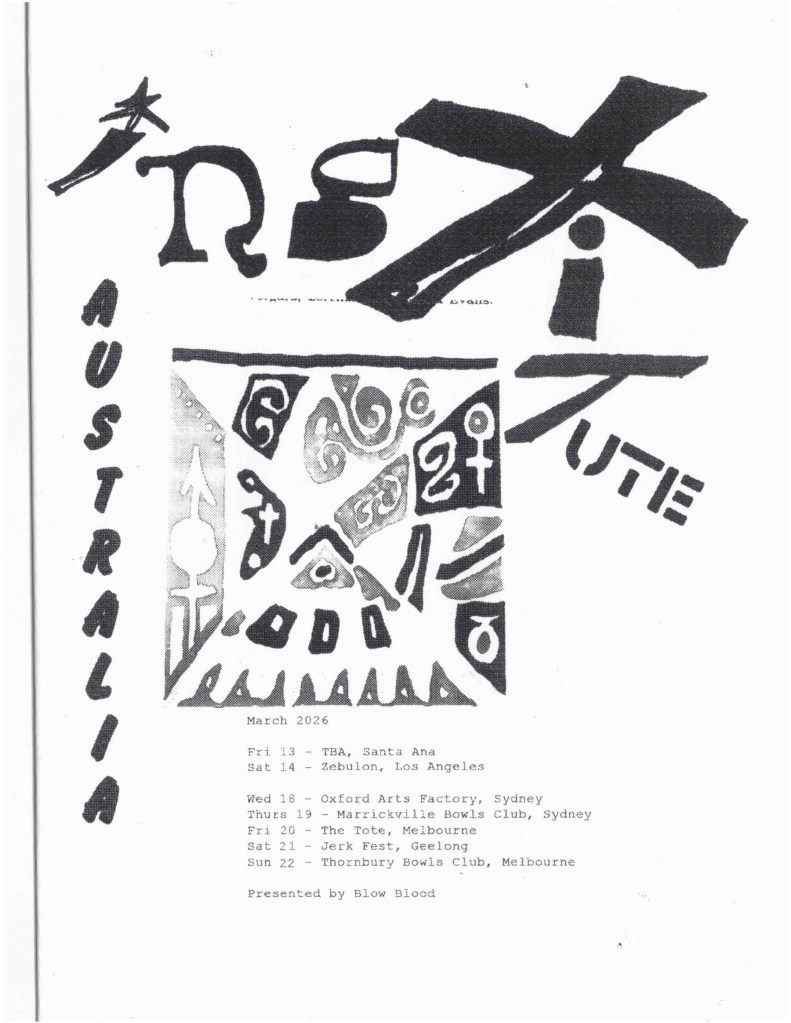
✨ Wed 18 @ Oxford Arts Factory
Institute (USA)
R.M.F.C.
Negative Gears
Station Model Violence
The Horribles
✨ Thu 19 @ Marrickville Bowlo
Institute (USA)
TOY (BNE)
Gift Giver
Vasta Ruína
✨Fri 20 @ The Tote
Institute (USA)
Rapid Dye (SYD)
Station Model Violence (SYD)
Body Maintenance
MK Naomi
✨Sat 21 @ JERK FEST 11
✨Sun 22 @ Thornbury Bowlo *DAY SHOW*
Institute (USA)
Constant Mongrel
Possible Humans
Zipper
Check out more INSTITUTE.
 Gimmie Gimmie Gimmie Zine