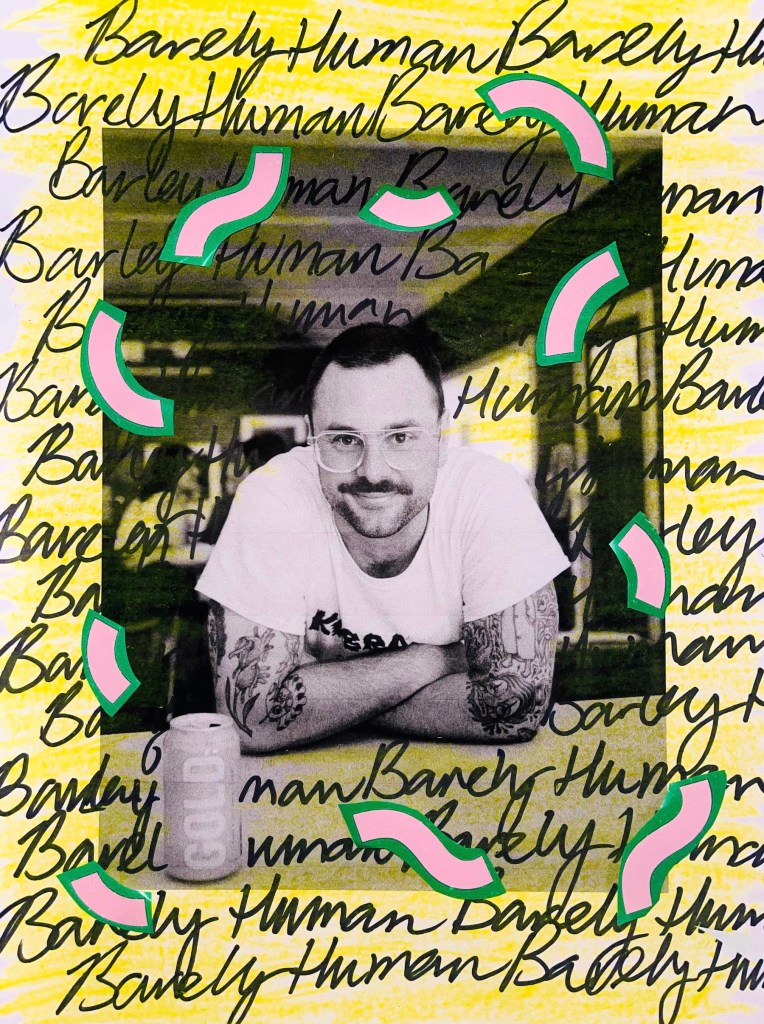
Barely Human’s Max Easton: ‘Punk taught me to think more critically.’

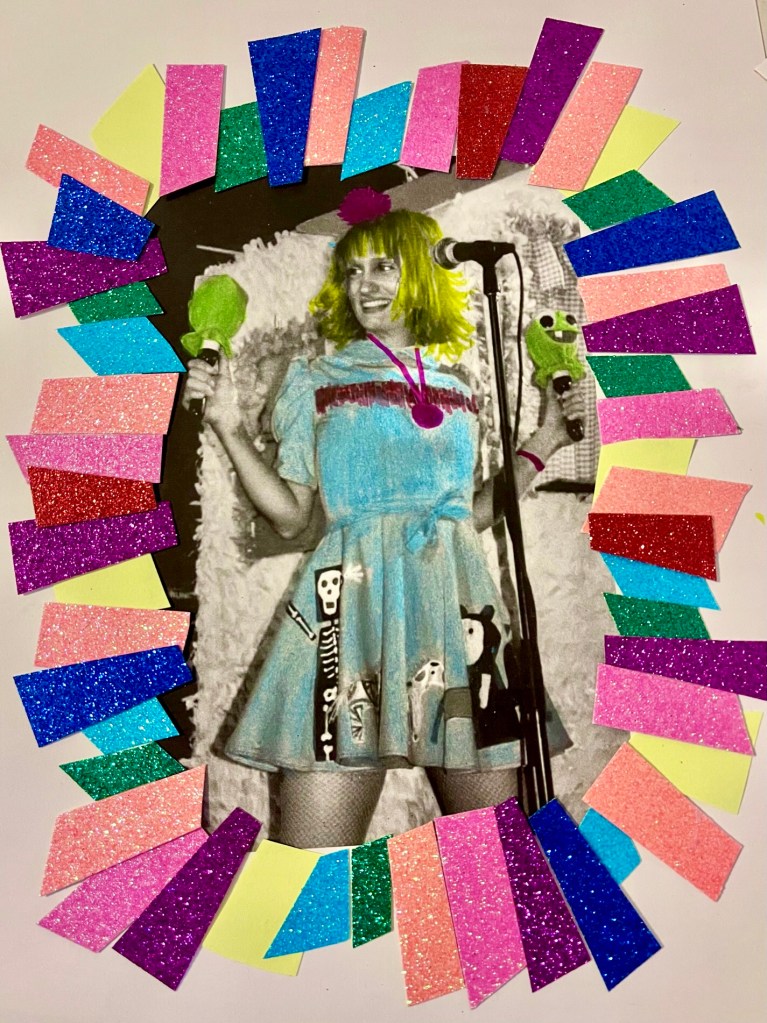
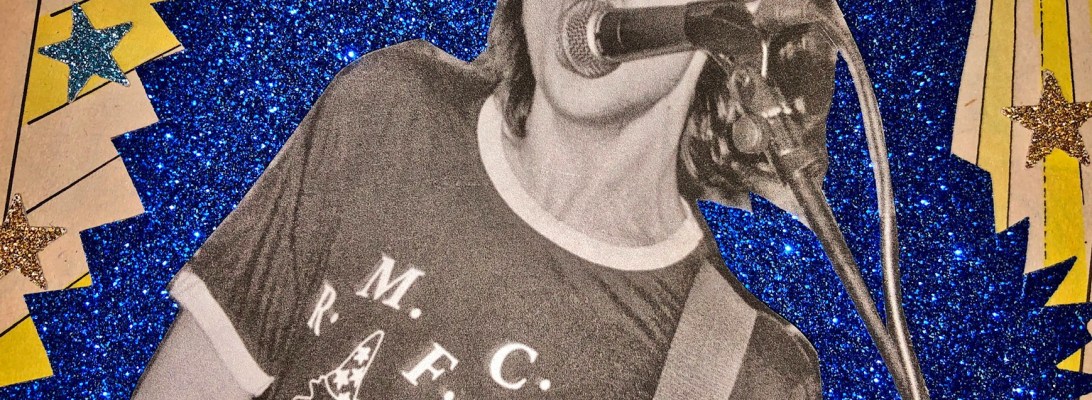
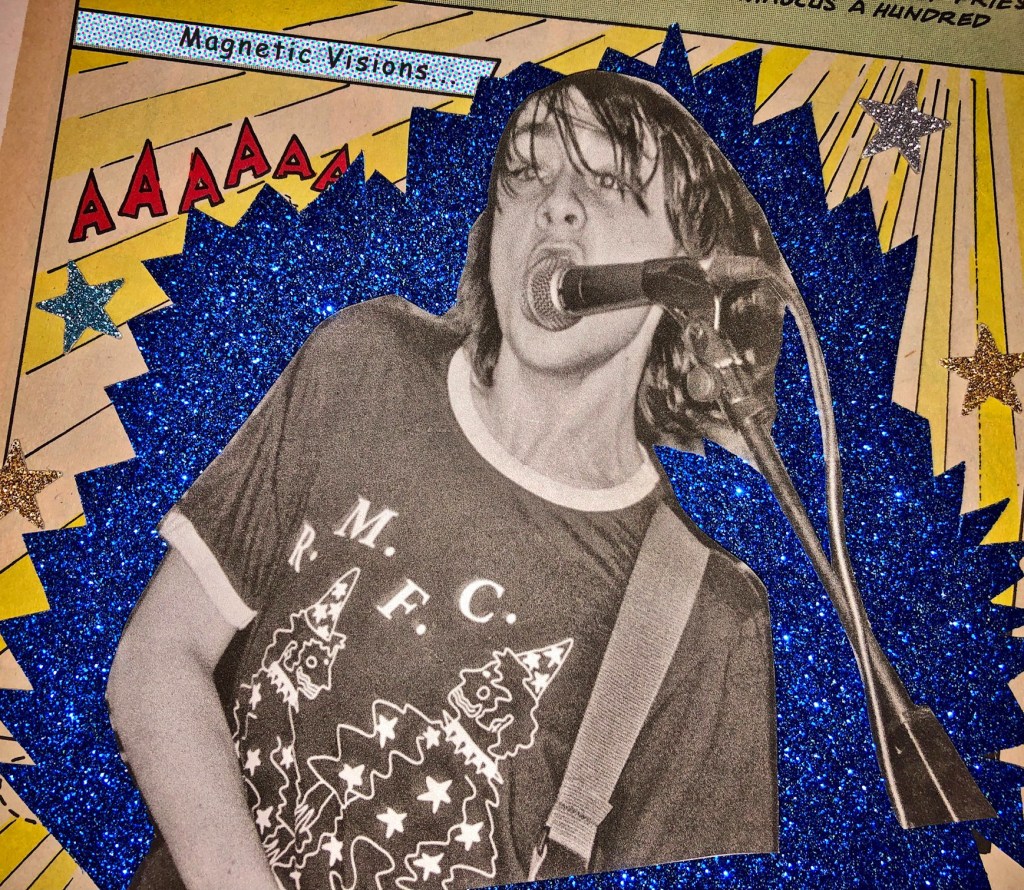
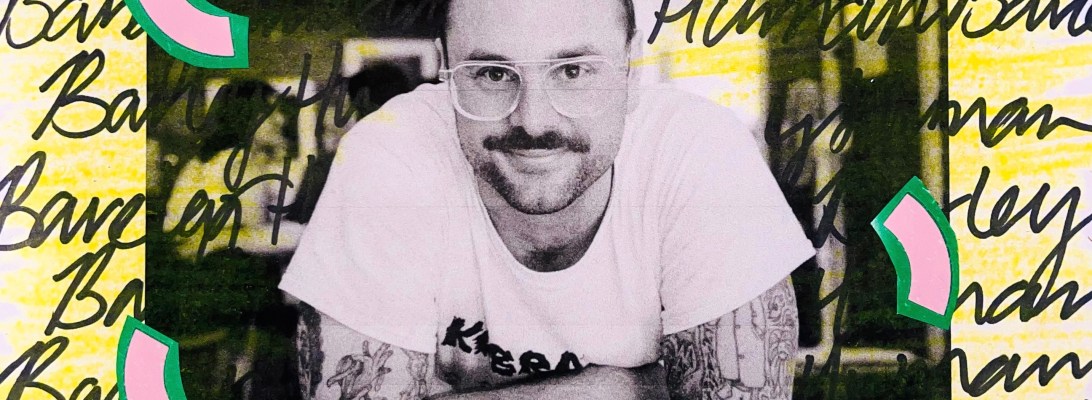
Original photo: Lauren Eiko / handmade collage by B.

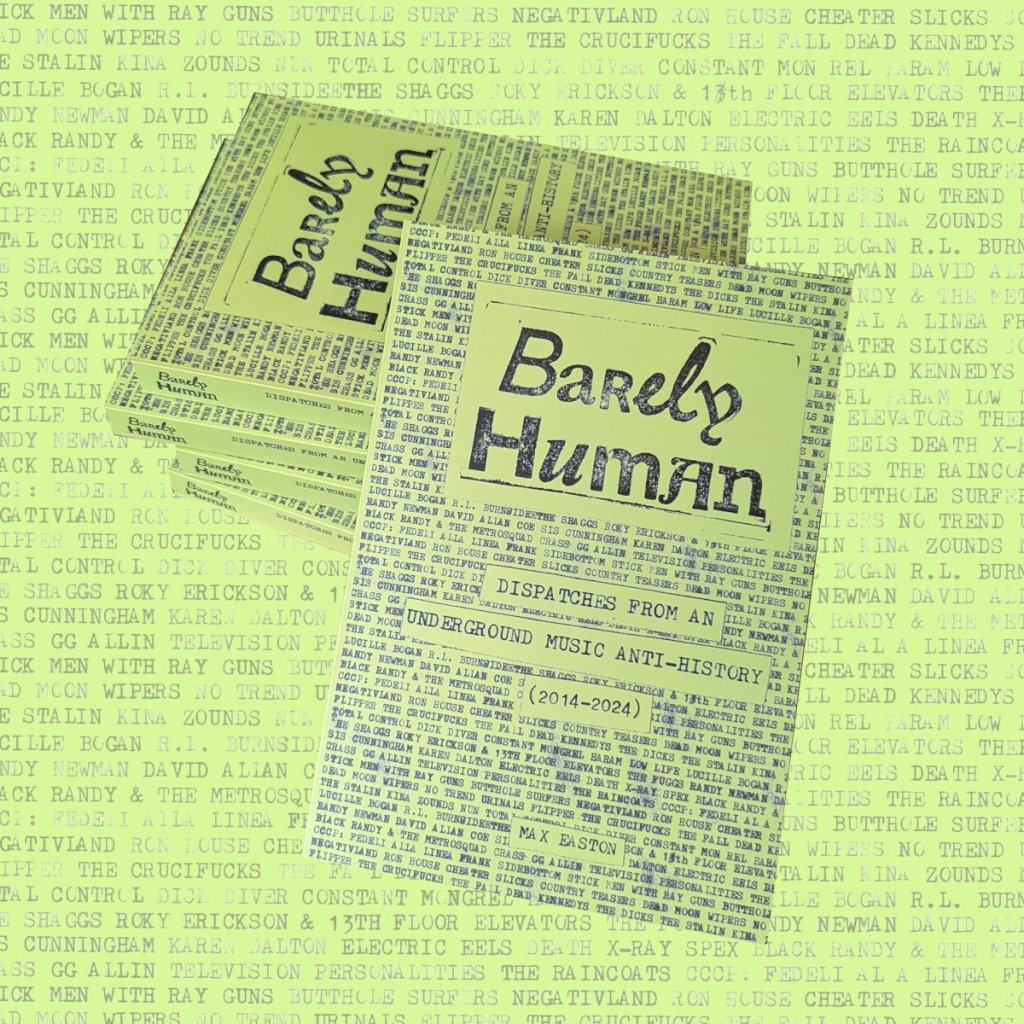
Max Easton is a writer from Gadigal Country/Sydney with a deep love for music and storytelling. He’s the mind behind BARELY HUMAN, a zine and podcast exploring underground music’s ties to counterculture and subculture. Now, ten years of that work has been collected in his self-published book, Barely Human: Dispatches From An Underground Music Anti-History (2014–2024), featuring print essays, podcast scripts, zines, polemics, and lost writing on Australian underground music and beyond. He’s also the author of two novels published by Giramondo—The Magpie Wing (2021), longlisted for the Miles Franklin Literary Award, and Paradise Estate (2023), longlisted for the Voss Literary Prize and Highly Commended for the Victorian Premier’s Literary Award.

With a new novel in the works for 2025–26, Gimmie caught up with Max to talk writing, DIY music, and the impact of bands like Low Life, Los Crudos, Wipers, Haram, and The Fugs. We also discussed the influence of zines like Negative Guest List and Distort, along with his own experiences playing in Romance, The Baby, Ex-Colleague, Double Date, and Next Enterprise.

GIMMIE: Honestly, I don’t really enjoy a lot of music writing that’s out there. Your work with Barley Human is one of the exceptions.

MAX EASTON: That’s so nice to hear.

Your work is thoughtful and explores the underground, but it also gets you thinking about your own life by the time you’re finished listening to a podcast or reading the zine or book.

ME: That’s cool. That’s a nice effect. 

How’s the year (2024) been for you?

ME: Good. I’m doing pretty good. I’ve been very lucky this year. It’s the first year since I was a teenager where I haven’t had to work a regular job. I got a grant to write a novel.

That’s great! This is for your third novel?

ME: Yeah, which is amazing because I’ve never had anything like that before. It’s been this really interesting, small-business-y type year where I’m trying to be very careful with my spending and accounts—just doing my best to make it last as long as I can. I’ve been able to write whenever I want, which has been great.

It’s also given me more time to focus on music. I’ve been working on archival projects and putting together a collection of music writing, something I’ve always wanted to do but never had the time for. I’ve even been starting bands and putting on shows again. Being free of full-time work for a year has been really, really good. I’m so lucky.

It’s like you really want to make the most of it!

ME: Exactly, because the money will run out in January or February. Then I’ll go back to work, which I’m honestly looking forward to as well. I’m going to be very grateful for this time.

Congratulations on being longlisted for the Miles Franklin Literary Award too. How’s that feel? 

ME: Super weird! Especially with the first novel I wrote, I didn’t really realise it at the time. I didn’t think anyone would actually finish reading it. Like, I never thought anyone would get to the end.

When I was drafting it, my process was very much like, oh, maybe I like this joke in the back; maybe I should put it in the front—that kind of thing. Because, in my mind, no one was going to get to the end anyway.

Why did you think no one will get to the end? 

ME: I just didn’t think there’d be any interest in it. I had never written fiction before and then suddenly locked into this book deal. It’s one of those weird things—I didn’t expect it to do much.

Even with the Miles Franklin longlisting, I didn’t know what that was. I’d never heard of the award before until my publisher was like, ‘Oh, we’ve got some really good news for you.’ So yeah, it’s been really weird to enter into the world of literature.

Especially because I was more familiar with being a blog writer or a zine writer—writing about bands I had connections with and that kind of thing. It felt strange to step out into the public and suddenly be seen as a fiction writer.

How’s the third book going? 

ME: Good. I’ve got a lot of words, but the quality is not really there yet. 

That can be fixed in editing. 

ME: It can. I’m really impatient. I want it to be done so I can start editing, but I need to be done first. You edit as well, right?

Yeah, I edit book manuscripts. I work in publishing as a freelance editor.

ME: That’s sick. So, you’ve dealt with a lot of frail writers.

That’s my specialty. I always tell writers that they have to push through and get words on the page, even if they’re not the greatest. Then you can finesse them. But if there’s nothing on the page, you have nothing to work with. Progress not perfection, that can come later. Being a writer too, I know how hard it can be to get ideas onto a page.

ME: Yeah, it’s a really interesting mental game—trying to write, think, and navigate all the different steps and phases. I’m trying to get better at not overthinking things, panicking, or stressing out, but you can only control so much in your brain.

I saw you mention that with this book, you wanted to have a more positive view on the ideas of independence and autonomy. 

ME: Yeah, because I think the second book was quite cynical. It was a satirical novel, kind of satirising everyone, including myself. It had this flat cynicism to it. The first one, on the other hand, had a kind of flat existentialism.

For the third book, I really wanted to do something different. I wanted to capture the joy of organising things and doing things with your friends—the joy of being in a band, the fun you have, and the creativity involved. Like, what happens when you decide to organise a show in a weird, unexpected space that hasn’t hosted a show before? I feel like the first two books were missing that fun side.

So with this third one, I’m aiming for more positivity and optimism, while still grounding it in reality. You know, not everything works out, and that’s okay. It’s about trying to strike that balance at the moment.
That sounds interesting. I can’t wait to read it. I’ve been thinking a lot about joy lately, especially because there’s a lot in the world not to be joyful about that we’re constantly encountering every single day without even leaving our own home. Stuff we see online, on TV, and in the media.

ME: Yeah, 100%. It’s like a very stressful dark time. There’s a lot of stressful dark information, which is very serious. And I think like we’ve got to engage with it and think about it in a serious way. But, like you said, you still have to appreciate the good things that are happening and try to rally around that instead of letting the bad stuff pull you down, which it’s just really easy to do. 

We were talking earlier about having shows in spaces that haven’t had shows before. I recently did an interview with Rhys who does Boiling Hot Politician. He mentioned how his album launch show at a pub got bumped last minute for a wedding and he ended up having it in a rotunda, guerrilla-style. The Sydney Harbour Bridge and Opera House were the backdrop. He told me how joyful it was, so much so he literally hugged every single person that came.

ME: Wow. That’s perfect. 

He knew of the spot because, during the Olympics, he had taken his big-screen TV there, plugged it into a power point, and watched the skateboarding with his friends.

ME: I love that. That’s real community to me. It’s about autonomy, which I’ve been thinking about heaps lately. There’s so much you have to do, so many people you have to ask permission from to get something going.

It’s often a missed opportunity. Like, we want to play a show this weekend, but we have to ask these 10 venues if they’ll let us. I miss the idea of truly doing it yourself.

A few outdoor shows with generator setups have been some of the best I’ve been to, even if they sounded awful. It’s fun. You’re doing it together, without asking anyone’s permission. It’s hard to find that kind of experience.

I felt that way watching the drain shows, especially after the lockdown in Naarm (Melbourne). Like the one Phil and the Tiles played—it looked wild and so cool.

ME: They’re awesome. 

It’s the best when people come together and think outside the box and achieve something cool.

ME: We played a show at a pub recently where no one really wanted to play this show at the venue, everyone I spoke to didn’t want to be there. We all talked about how anxious the place made us feel, how we don’t really get along with anyone who runs it, or it’s just a bit difficult.

Then it was like, well, why are we doing this? It’s because we don’t have as many choices as we’d like, but I’d love to just open a pub where we wouldn’t feel so bad.

I’ve always had a dream to open an all-ages space. Being a teen in the 90s, we had a lot of those spaces. It was so cool to have something fun to do, and to be able to go to a show where people didn’t need to (or couldn’t) drink.

Drinking is a massive part of the culture for a lot of people. I’ve done a lot of interviews with creatives lately, and I’ve noticed that people get to a certain age and get stuck in a bad cycle with that, and it really starts to affect their life. Often, there’s not a lot of support for that. It can really start to impact mental health too.

ME: It’s really hard to break those habits, especially if it becomes part of how you make music. Isn’t it the same?

It’s only been in the last few years with band practices where I’d always bring a six-pack, you know, because it makes things easier or whatever. It’s just the way it is. Then, over the last few years, I started asking, ‘Wait, why?’ Now I just bring a big soda water—it’s the same thing.

Once you’ve got the habit, it’s like you’re in your head thinking, ‘That’s how you do it.’ I’m still the same. When I start a show, I feel like I need two or three drinks before I play, but I don’t know why. It’s just what I’ve always done. It’s funny, these habits we develop over time, and then one day you stop and think, ‘Why do I do that?’

As I’m heading into my late 30s, part of that is becoming a bit more cynical and negative. This year, I’ve really wanted to make sure that if I get into a negative mode, I do something to counter it. Like, if I’m going to complain about a venue we have to play, then I have to put on a show at a venue everyone likes to make up for it. I really don’t want to become that kind of complaining, older person.

Like, old man yells at cloud! 

ME: Yeah, totally. It is easy to fall into. 

Do you think anything in particular is impacting you feeling more negative?

ME: I’m just finding it hard to find the conditions that helped me discover the idea of DIY and punk music. I didn’t really discover this kind of music or this world until my early 20s, because I grew up in Southwest Sydney. I was trying to be a rugby league player. That was all I cared about. I liked music, but the music I liked was just whatever was in Rolling Stone. I’d buy the magazine from the newsagent, and whatever they told me was good, I’d say, ‘Oh, yes, this is good.’ I just didn’t know.

Moving into the city and going to DIY spaces like Black Wire and warehouse spaces in Marrickville was when I realised I’d never really liked music before. I realised what I’d been looking for was there.

What were you looking for?

ME: A sense of community and a sense of connection. I did access that through message boards and fandom, but there was this huge distance. The bands in Rolling Stone would never be bands I’d play in. I never thought about playing music either.

The DIY spaces were different. Within a couple of months of going there, people asked if I played any instruments because they were starting a new band. I’d never thought of it before, but I said, ‘Yeah, sure, I play bass.’ I went and bought a bass and tried to learn it before the first practice.

It was really exciting. It changed the direction of my life.

I think about Sydney now, though, and the lack of all-ages DIY spaces. How would someone discover that now? It’s like going back to this idea of the band on stage, the punter off stage. The band is ‘king’, and you are watching them.

That’s sort of informed a little bit of negativity over the years, but like I said before, I really don’t want to get bogged down in that. I want to build something so people can discover this stuff on their own.
How did you feel when you first realised, I CAN play music or I CAN be a part of that?

ME: Just happy. It was that simple. It was happiness. When I moved to the city, I didn’t have many friends, and I didn’t really understand or believe in depression or anxiety at that time either. It was the late 2000s, early 2010s – it wasn’t really a conversation.

But playing music, having scheduled band practice every week, planning how to play a show, how to record – it really gave me a lot of meaning. Especially since I couldn’t play rugby league anymore. I missed that teamwork aspect, the purpose of going to something two days a week. Music gave me purpose again.

It also opened things up. Because I could play in a band, go to a show, organise a show, and then start talking about worldly political ideas I’d never been exposed to before. I was really just a centrist, working-class guy who voted Labor and thought that was it – that’s all he had to do.

Punk taught me to think more critically, to consider all the intersecting ideas in the world. It opened my world so much.

Same! What compels you to write underground music histories with your zine and podcast, Barley Human?

ME: Like you, I had written in the past. When I started writing for stress press, it was mostly to get free CDs and gig tickets. Then, discovering punk, I realised there was a purpose – telling people about the stuff you’re seeing rather than just mooching off the industry. It was about finding the connecting elements between all these small scenes in the cities.

Eventually, it turned into more international history stuff. Like I said, I discovered punk in my early 20s, and everyone else already knew the references to all these bands. I didn’t know who Crass were, for example, so I’d have to look them up, research them, and figure it out. I learned about anarcho-punk, then had to dig deeper into these worlds.

At the time, I was doing the work for myself. I thought if I could use that research as a primer for others interested in the scene, it could help people who don’t know all the main names. It would make the transition easier.

Even with some less positive bands, I think it’s important to understand why people are interested in figures like GG Allin – the positives and negatives. He’s a very present cultural figure. It was cool to wrap that into a story or explain why X-Ray Spex and Crass were so influential. Why were they cool? Why are these people interesting?

That’s cool you do primers. In my experience of punk culture, there’s often times people can be very pretentious and clique-y and condescending to people because they might not know whatever band. Not everyone can know everything. I’ve always hated that elitist attitude and the ‘I’m better than you’ vibe. It’s lame.

ME: As a community, it should be about saying, ‘Hey, have you checked this out?’ You should be able to explain things to people without judging the fact that they don’t know. It’s a real bummer too because everyone had to learn something at some point, right? A lot of it is a replaying of the treatment someone felt when they first started going to shows. It’s like, ‘Oh, everyone was snooty to me for not knowing all the bands, so now I’ve got to be snooty.’ But no, you’re supposed to help them in. You’ve done it, so give yourself credit for learning all this stuff, and use that to bring others through.

And that’s not even just for punk stuff, but everything in life. Life’s better for everyone when we help each other.

ME: 100%—you get it. 

Being a part of the Sydney scene is there anything that you might know of that’s unique or lesser known that outsiders might not easily discover or know about it? 

ME: It’s hard to say because I can’t really get a feel for what is well-known and what isn’t. I feel like a lot of bands do a pretty good job of making themselves known these days. But, I don’t really look at much social media to get a feel for which bands are really popular and which ones aren’t.

Is there a reason why you don’t really look at that much social media for that stuff? 

ME: I mean, I do look at it, but I don’t really get a feel for it, you know? My favourite band in Sydney right now is my friend’s band, Photogenic. They’re so good. I feel like a band like Photogenic deserves a little more recognition. They’re the best band in town. They taught themselves their instruments not that long ago—about six years ago. I feel like that’s a part of it too. I love their music, I love them as people, and I love the message it sends to others. It’s like… anyone can be the best band in town if you get together and try to make something happen.

I wanted to ask you about the band Low Life, because you did that episode, ‘I’m in Strife; I Like Low Life’, and I was reading on your blog, where you mentioned that Low Life are probably the band that for you, has most closely dealt with aspects of your upbringing and present. I was wondering, what kind of aspects were you talking about?

ME: A lot of it was that sort of Low Life mentality. Maybe they were the first band I got excited about in that 2012–2014 period. A lot of it was because they seemed really depressed, and the world around the music was quite violent. They dealt with stuff like childhood trauma, the resulting depression, what it’s like to be at the hands of violence, and also to feel anger and sadness. There was this mentality of coming together with people, not in a super positive way, but more about finding your way in the world, a world that doesn’t really want you there. It resonated with me, especially with the backdrop of crappy experiences. They really meant a lot to me when I first heard them and got excited about them.

Isn’t it interesting how a band can write about all those things you just mentioned that aren’t so positive but then listening to it felt like such a positive thing for you?

ME: Yeah, it wasn’t even an album track; it was a song called ‘No Ambition’ that they just put out on the internet. It was maybe one of the first songs of theirs I heard, and it really hit me. It was weird—it made me realise I was depressed. Like, this buzzword I’d seen everywhere was a real thing. Stuff like that is why I think I care so much about music. Sometimes, it just accesses a part of your brain that you didn’t even know needed accessing.

Do you feel like you were kind of going through depression at the time, partly because of the sporting injury, losing that whole community, and then moving to the city, not knowing many people—like, all those things?

ME: Yeah, that was all a big part of it. But it was also childhood stuff I’d never dealt with that I was dealing with at that time. Plus, I was really stressed with work and uni. So, it was like high levels of stress, anxiety, and depression hitting at the same time, without the language to understand what it was or how to deal with it.

I’ve dealt with severe anxiety and depression throughout my life too. I remember the first time I had a panic attack—I thought I was dying. I had no idea they were even a thing. Even when I think back to being a child, I used to get a lot of stomach aches and things. Knowing what I know now, I understand it was probably from all the stress I was going through.

ME: Yeah, when you’re experiencing those things for the first time, especially as a kid, it’s hard to know what they are. I would get anxious, and people would just tell me I was worked up. The first time I had a panic attack, I thought my childhood asthma had come back, so I went to the doctor and got a puffer. With depression, I thought it was just a being lazy thing.

But you learn and now you know better, which is great. You mentioned on your blog about going through multiple versions of the Low Life episode, and you mentioned you were sort of having a bit of an identity crisis. How did that sort of shape the final direction of the narrative? What did you learn from that process? 

ME: A lot of it was because they came on really strong, which was exciting. They were this unknown band that brought a lot of people together, and people got really excited about them at first. Over time, though, it was like the realisation that, even though their lyrics were often satirical, they made people uncomfortable. The crowds were violent, and some of my friends didn’t feel comfortable going to the shows. But by that point, I’d already gotten a Low Life tattoo. I thought it was just like getting a Black Flag tattoo—this was the best band in Sydney during our lifetime, and they were playing right then.

I was reading when you wrote about that, and you were talking about how, you’d seen a bunch of Black Flag tattoos and had a lot of band tattoos yourself. But then you were like, why don’t you have any local band tattoos? 

ME: We’re always so backwards-looking—always looking back to 50 years ago, and now it’s even more so. Before the Barely Human stuff, all I cared about was what was happening in the moment. But the last 10 years or so, it’s been more about trying to look back while still focusing on the present. I feel like there are lots of lessons for us to learn, but we act like they’ve already been learned, like it’s over. It’s that “end of history” feeling. There’s so much we can learn from the past and apply now in a new context.

You’ve called Barely Human an anti-history.

ME: When I was trying to outline which bands to profile, I asked myself, what’s the unifying theme? Part of it was that, if I wanted to talk about the birth of punk as a genre, I didn’t want to talk about The Clash or The Sex Pistols. I’d rather introduce it via X-Ray Spex. When I wanted to talk about blues music, I didn’t want to focus on Robert Johnson alone—I wanted to talk about people like R.L. Burnside and lost versions of the genre, the kind of stuff people usually skim over.

Same with post-punk: I thought the stories of bands like the Television Personalities and The Raincoats would be the best way to tell that story—not the typical narrative people think of when they think of post-punk as a genre. The anti-history part was to take the mainstream history, read it, and then ask, who’s being left out?

For example, when we talk about hardcore, we mention Black Flag, Dead Kennedys, Minor Threat, or some variation of that story. But Los Crudos, who came in the ’90s toward the end of that movement, represent one of the best versions of what hardcore became—a community-driven movement, an identity discussion, and the expression of personal struggle or the struggles of your background.

I wanted to pull out those hidden aspects that lie beneath the mainstream story. I’m not sure if it’s truly anti-history, but for me, it felt like I wanted to retell the accepted version of events.

I’m not sure if you experienced this when you were writing for street press, but there was a point when I wanted to make music writing my living. It shifted from writing about bands I was genuinely interested in to writing about whatever band the editor sent an email about. They’d say something like, ‘We’ve got this touring band, we can pay $100 for an interview, and it’ll be published across all these different magazines.’ And I started saying yes to that kind of stuff.

It was so depressing. There was this one band, I can’t even remember their name, but they were a huge touring power-pop band in the early to mid-2000s, and I thought their music was terrible. The things they said in interviews were like, ‘I just love changing the world with my music,’ and that kind of stuff. I just couldn’t handle it anymore.

I got paid $100, which, at the time, felt like a big win, but for what? For all that suffering? I never want to go back to that, writing about things I don’t actually want to write about.
I’ve totally been there. Almost every publication I’ve written for, except my own and when I wrote for Rookie, has been like that. I really hate the way the industry works, especially with PR companies. 

For example, I have a friend who runs a podcast, and he’s been getting really depressed and worn out from it. He told me that certain publicists have said, ‘If you want to interview this band, the one you really want to interview, you’re going to have to interview these four other bands on our roster first.’ So, he’s spending all his time doing interviews with bands he’s not interested in, just to get the one he actually wants, or they blacklist him.

ME: Wow!

Yep. It makes me so angry. I had an interview set up with a band through a publicist not too long ago, but then something terrible happened. A family member, he’s a teenager, was with his friends, and a horrific accident happened and his friend tragically died. Understandably, we went to be with our family, and I had to cancel the interview. I told the publicist, ‘I’m really sorry, I can’t do this, I need to be with my family right now.’ I offered to reschedule when I could, but she seemed annoyed with me. They even asked, ‘Can’t you at least post about the show on your social media?’ It just felt so cold and transactional and heartless.

ME: Oh my god! 

Yeah, true story. At the time, I had another interview lined up with a different publicist, but that publicist’s response was the opposite. He immediately asked if we were okay, if there was anything he could do, and assured me that he totally understood. We ended up rescheduling the chat for another time. He was like, ‘Don’t sweat it,’ which is the right response—the human response.

ME: Yeah. That’s unbelievable. And just the idea of blacklisting your friend for not doing all the interviews.

That happens more than you’d think. Back in the day, I was blacklisted by a promoter because I didn’t turn up to review one of their shows, even though I explained I was with my mum who was very sick in the hospital! I have so many terrible stories like this about publicists and the industry here in Australia, and my writer friends have told me heaps they’ve experienced too. 

ME: I want to blacklist whoever that is. I have a very quiet, small boycott list. I will never book a show for anyone with a manager, anyone who’s a publicist, or anyone who demands a guarantee from a DIY show. There are all these things, and I’ve got a little list. I’m never doing any work for them because, when I put on a show, I don’t take a cut or anything. So, it’s like, if I’m going to work for free, I’m going to do it for like-minded people who are here to have a good time and try to bring people into this world together so we can keep building it and go somewhere with it. But the idea of what you went through with your family member—heavy stuff, like the death of a teenage boy—it’s not like a broken fingernail. It’s repulsive behaviour.

It is! This is why Gimmie exists outside of the industry and we only work with with good people.

ME: 100%! Same here.

What have been some of the aspects that you found most fascinating about underground music that you’ve discussed with Barely Human

ME: Once I started making it a bigger project, where I was connecting different bands together, a lot of it was the connections that bands from completely different sounds, completely different cities, and worlds all kind of had similar to each other. Or the things that they’d be inspired by and the way that a movement or a kind of style developed. There’s so much in common between, say, The Fugs and Crass, which is like a hippie band and a punk band. Those ideas and notions I found really interesting, and something I hadn’t thought about until I started looking into them. Same with a lot of the proto-punk bands and the post-punk bands: they had this similar kind of response to what was going on around them and this antagonism. Or, like, Electric Eels were influenced by a poet like E.E. Cummings. It’s finding all these different connections as you read about a band, which you don’t get when you just play their music.

I really like the idea of bands coming together through time. It’s really almost a conspiracy-theory-type way of looking at the world—all this stuff kept happening through this process, and we kind of connected back to another time. 

One of the coolest bits was I did a Stick Men with Ray Guns podcast episode, a documentary-style thing, and then the guitarist from Stick Men with Ray Guns emailed me in the middle of the night, a year later, saying I’d made all these mistakes. 

Oh no! 

ME: I emailed him back. He’s like, ‘Let’s talk to each other about it.’ And we had this two-hour-long conversation. I posted him some stuff, and he posted me some stuff, and I got a channel to the guitarist from one of my favourite bands in this late ’70s, early ’80s era.

Stuff like that is really, really cool. And you find out that, so much of what motivated those musicians motivates my friends now. Or talking to him about how they just wanted to annoy their audience, and wanted to be so loud that it made them hurt. They wanted to feel violence. It’s kind of like, the second band I played in, Dry Finish, we had to play at this pub that I didn’t want to play at. And I was like, ‘Let’s do a noise set instead of our punk set.’ It was like almost like what he was saying to me was something I said 10 years ago to our friends. I love those sorts of things. 

Barely Human started as a zine series; how did you first find zines? 

ME: Through the punk scene, Negative Guest List and Distort were the first zines I ever saw. It was at a time when I was discovering punk too. It was like, okay, cool, I can read what these people have to say, what’s new that’s coming out. They’d also have these historical type things. Whatever obsession they had at that time would just end up in the zine. It would be books as well.

So much of Dan Stewart’s writing with Distort was philosophy. I’d never thought about philosophy before. That was my first exposure to the big historical thinkers. Same as Negative Guest List. It was movies. Sometimes, they’d just talk about a movie that had been really influential on me. Both of those zines were super influential.

Why did you decide to shift into a podcast? 

ME: When the zine started, it was with the long essays that I couldn’t get published anywhere. So it was like self-publishing these thoughts. The podcast wasn’t something I’d ever thought of.

But then this guy emailed me out of the blue and asked if I’d be interested in any audio work. They were kind of doing seed funding for new creatives, and if the podcast went well, they’d give you a deal with Spotify or something like that. So it was like, yeah, sure, I’ll do it.  

The podcast did, by my standards, really well. I think about 2,000 people listened to every episode, which is crazy. But to them, it was like nothing. Still, I got it going, and it got me thinking in that way. So I’ve continued back via the zines and mixtapes in the years after that, even when it didn’t get picked up or whatever. And now I want to try and see if I can DIY it and do more episodes, on cassette. 

What led to the decision to evolve Barely Human into a 300 page book? 

ME: It got to the point where I was starting to think about doing a new podcast season, trying to figure out how to do it. I was going through all my old notes. Even just searching through Gmail—it’s like, I don’t know where I wrote about this band, I can’t find where it was. So I just started putting everything together, archiving all my stuff.

And then, as things go, a lot of this writing is quite old now. It’s 10 years old or stuck somewhere. You can only listen to it on a podcast, so it’s stuck somewhere on the web. I thought it would be nice to bring it all together, just to wrap up that 10-year period for myself.

Then I thought that would make sense, especially when every now and then someone emails me, like, ‘Oh, I’ve always been looking for your Butthole Surfers zine.’ It’s like, so out of print. The podcast I hear is like half of what you wrote. That’ll happen once a year, so it’s not a huge demand. But I thought it would be good to have everything in one place, in case someone wants to find some of this stuff.

So it was kind of just this idea of wrapping everything together, putting it down, and then I could move on and think about the next thing. It’s nice to have as a document.
Was there a band or artist that is featured in your book that you found had an interesting or unexpected story? 

ME: Stick Men with Ray Guns’ story. I didn’t realise how dark their story was. I just thought they were a fun Texan hard punk band. That was a surprise, and to the point where I had to wonder whether I should finish writing about them too. I just started hearing about the singer and cases of domestic violence in his past. It’s like, I don’t think I should be talking about this band. But then it was kind of, well, should I not talk about it? Should I finish telling the story? It seemed important for me to finish that story.

Some of the other bands, were bands that were very present in the world. I didn’t really know much about bands like Dead Moon and Wipers. I wanted to write about them, kind of like at the start, just wondering, ‘Why are they on punk t-shirts everywhere? Why have I seen them on t-shirts everywhere, but I’ve never listened to them? What makes them so interesting?’ And I thought I wouldn’t find anything interesting. But they’re so cool. They’re like, they were two of my favourite bands after I started thinking about them, you know, and finding out the way that they made music and the way that they were so defiantly independent for so long.

I really loved reading about band Haram in your book. You mentioned on your blog that it was a tough section to write; why?

ME: Because I really wanted to write about them, it was more from the podcast, the way that that started. It started with these bands trying to provoke the FBI and the CIA, like The Fugs and their run-ins with the FBI and the CIA, and their run-ins with Crass. So, I kind of wanted to do this full-circle type thing, because their arm was tracked by an FBI anti-terrorism task force purely because they sang in Arabic, which is also something they played with in their imagery, you know, like just using Arabic script to write ‘Not a terrorist’ on a t-shirt. Then to find out that this FBI task force never translated this stuff and just the pure anti-Arabism, pure Islamophobia. The hard thing for me, writing that, which was once I was already in and doing it, it’s like, this isn’t really my story to tell. I felt like I was really writing about things I didn’t understand. No matter how I put it together, it felt like I was sensationalising the fucking horrible experiences that Nader had growing up and then as a punk musician being trailed by the FBI. I did the best job of it I could, but it was really important to me to tell that story of a punk band of today in New York getting tailed by the government, by the racist government.

Whenever we, you know, are all like a little bit like, ‘Man, it’s just so hard playing punk music in Sydney’ and like, ‘Oh, no, I have to play a venue around the corner that I don’t really like’ there’s a bigger context, like, people are being watched and isolated and surveilled. 

I liked that you told the story using a lot of archival and interview stuff, so it was being told in Nader’s own words.

What have you been listening to lately? 

ME: II was listening to The Spatulas this morning, they’re a really interesting DIY type folk adjacent type thing. Celeste from Zipper was in town, I’ve been listening to them a lot lately.

We LOVE Zipper! What have you been reading?

ME: I just finished the Tristan Clark’s Orstralia book, the 90s one. I loved it. It was really, really interesting, especially the Sydney stuff. f

I’m three quarters of the way through Alexis Wright’s Praiseworthy, on a fiction front. It’s wild. It is so good. It’s the trippiest, it’s hilarious. It’s really funny. 

I love Alexis’ work. She just writes with total freedom. What are you doing music-wise? 

ME: The last two bands broke up. I was playing in The Baby with Ravi from OSBO, and the band Romance. We got our last releases out and kind of broke up. We’ve started new bands now—a band with Greg and Steph from Display Homes called Ex-colleague. We played the other night. My partner Lauren, who used to play years and years ago, has taught herself drums for this other new band we’re in with my friends. We’re called Double Date. We’re both couples. Then, starting after Witness K slowed down a bit, Andrew and Lyn started jamming, and I’ve been jamming with them as well. We’re playing our first show soon—we’re called Next Enterprise. It’s been really fun to play again!

Check out: barelyhuman.info.

GIMMIE ZINE ISSUE 7

Gimmie 7 is here!

Featuring:

Civic – Lewis Hodgson & Jim McCullough chat to us about their new dystopian sci-fi punk rock n roll surf thrill ride of a record. And, working with Radio Birdman’s Rob Younger + their own interesting and colourful creative & personal histories.

Pale Horsey – who are one of THE bands to check out from Meanjin/Brisbane right now. They’re on our cover this issue. Their shows have a manic energy that is all at once feral, gripping and magnetic.

Tee Vee Repairmann – we get the goss on his solo project that’s morphed into a live band & news on Satanic Togas, RRC, 3D & The Holograms.

Sex Drive – vocalist Beau talks their beginnings through to their new full-length album, Shopping Blitz.

Santigold – we chat about personal power, being seen, generational trauma, the book she’s writing, the power of nature, valuing yourself and album, Spirituals.

Shove – Bella opens up about her challenges of the past few years, the importance of talking about hard things & sitting with uncomfortable feelings + the power of community!

Tha  Retail Simps – the Canadian band’s vocalist-guitarist Joe explores their hot record, & we learn more about his zine, label and art.

Nadine from The Prize made selections for our DJ playlist & gives us insight into why she loves them.

Get it HERE! 

❤️ Bianca & Jhonny xo

ISSUE 4 (U.S. Edition)

Cover illustration by Jhonny Russell

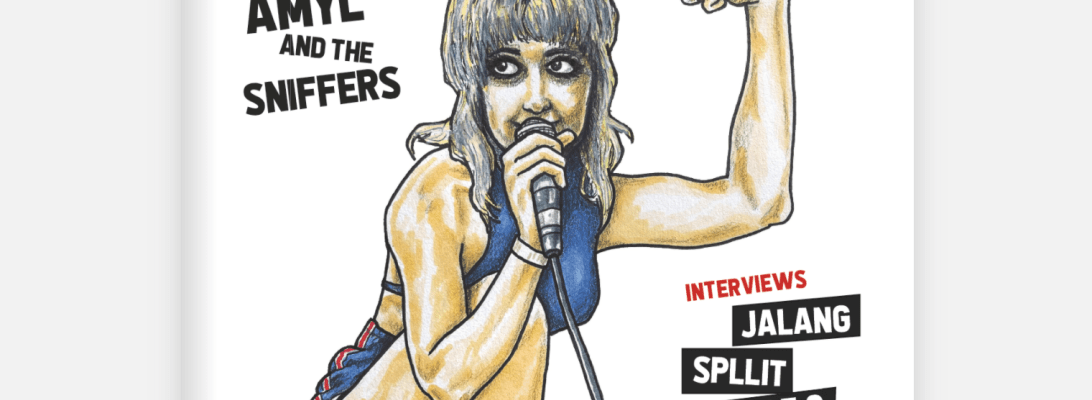
Gimmie Zine Issue #4 has just been released in the U.S.A. via Total Punk Records. This version has a limited edition Amyl And The Sniffers cover variant!

People outside of Australia please get it from http://www.totalpunkrecords.com

We have a very limited amount of import copies of this one available for people in Australia here.

We are sold out of the Australian edition covers, but keep your eyes peeled on AUS record stores as limited copies will be popping up at places like Rocking Horse, Repressed, Lulu’s, Sonic Sherpa and Rudderless.

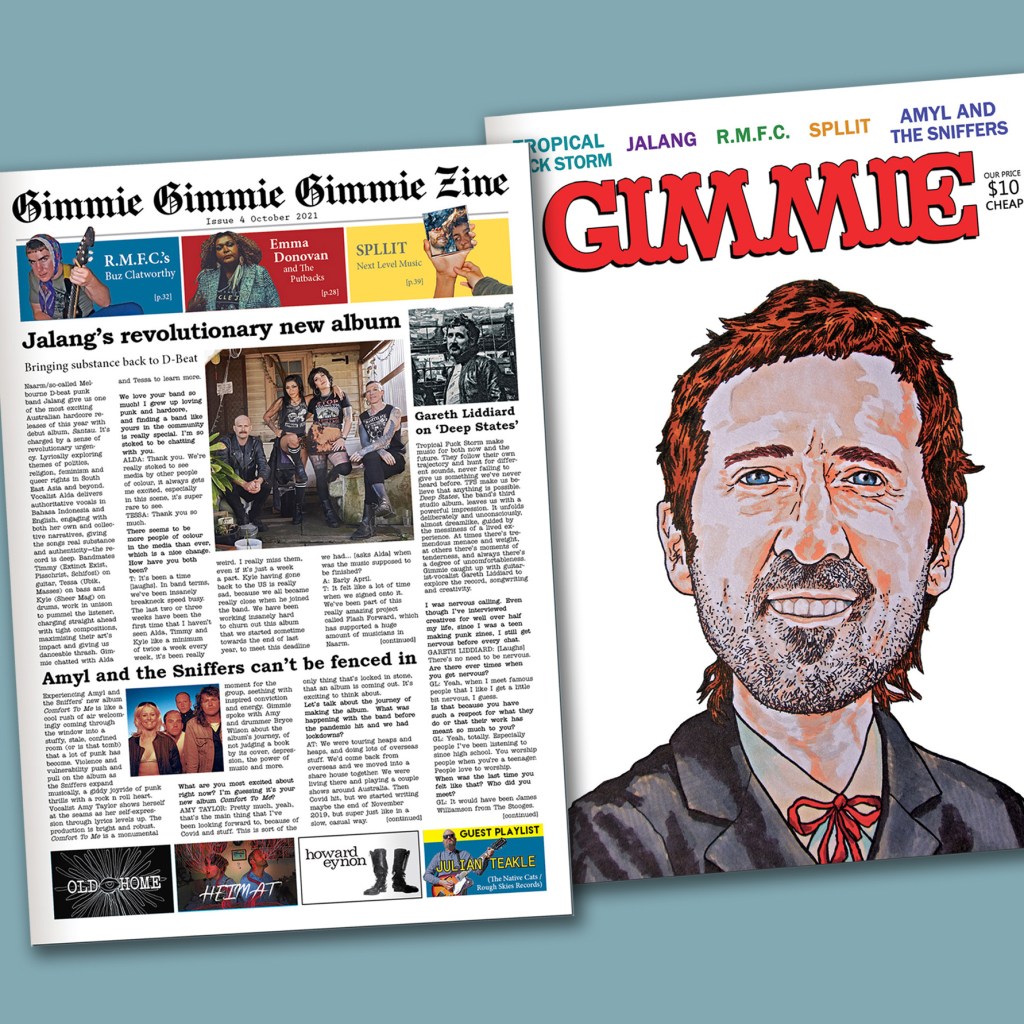
We chat in-depth with Tessa & Alda from D-beat band Jalang! They’ve released Australia’s best hardcore record this year. We explore the album themes: politics, religion, feminism and queer rights in South East Asia and beyond. A really important chat.

Gareth Liddiard from Tropical Fuck Storm speaks about new album ‘Deep States’, songwriting, creativity, fanboying and collecting weird shit.

R.M.F.C.’s Buz Clatworthy talks, a new album in the works, lockdown being a creativity dampener, finding inspiration in films and friends.

We yarn with Emma Donovan and The Putbacks. New record ‘Under These Streets’ draws on soul, R&B, funk and the protest music of Indigenous Australia—a dynamic portrait of Blak pain and joy in all its complexities.

Amyl and the Sniffers’ Amy Taylor and Bryce Wilson check-in to tell us about their new album’s journey, experiencing depression, keeping busy and the power of music.

French duo Heimat play off-kilter experimental-pop with folklore influence, cinematic-like soundscapes, and vocals in multiple languages. A chat on experimentation.

Old Home vocalist Dylan Sparks gives us a peek into their visceral performance poetry coupled with spontaneous musical composition.

We speak with Louisiana band Spllit just days after a hurricane hit their area. We adore their lo-fi weirdness. Next level music.

70’s acid-folk legend Howard Eynon has had a storied life: appearing in films including Mad Max, supporting Hunter S Thompson’s tour; performing in theatre. Recently, he’s been working on music with Zak Olsen. A brilliant chat.

Julian Teakle of The Native Cats and Rough Skies Records selects some of his favourite tracks for us.

52 pages. A4 size. Limited Edition. 

gimmie zine issue 4

It’s here! Our biggest Gimmie yet! Issue 4. Two covers to choose from!

We chat in-depth with Tessa & Alda from D-beat band Jalang! They’ve released Australia’s best hardcore record this year. We explore the album themes: politics, religion, feminism and queer rights in South East Asia and beyond. A really important chat.

Gareth Liddiard from Tropical Fuck Storm speaks about new album ‘Deep States’, songwriting, creativity, fanboying and collecting weird shit.

R.M.F.C.’s Buz Clatworthy talks, a new album in the works, lockdown being a creativity dampener, finding inspiration in films and friends.

We yarn with Emma Donovan and The Putbacks. New record ‘Under These Streets’ draws on soul, R&B, funk and the protest music of Indigenous Australia—a dynamic portrait of Blak pain and joy in all its complexities.

Amyl and the Sniffers’ Amy Taylor and Bryce Wilson check-in to tell us about their new album’s journey, experiencing depression, keeping busy and the power of music.

French duo Heimat play off-kilter experimental-pop with folklore influence, cinematic-like soundscapes, and vocals in multiple languages. A chat on experimentation.

Old Home vocalist Dylan Sparks gives us a peek into their visceral performance poetry coupled with spontaneous musical composition.

We speak with Louisiana band Spllit just days after a hurricane hit their area. We adore their lo-fi weirdness. Next level music.

70’s acid-folk legend Howard Eynon has had a storied life: appearing in films including Mad Max, supporting Hunter S Thompson’s tour; performing in theatre. Recently, he’s been working on music with Zak Olsen. A brilliant chat.

Julian Teakle of The Native Cats and Rough Skies Records selects some of his favourite tracks for us.

52 pages. A4 size. Limited Edition. 

Get it: gimmiezine.bandcamp.com

U.S.A. pressing coming via totalpunkrecords.com

Gimmie Zine Issue 2

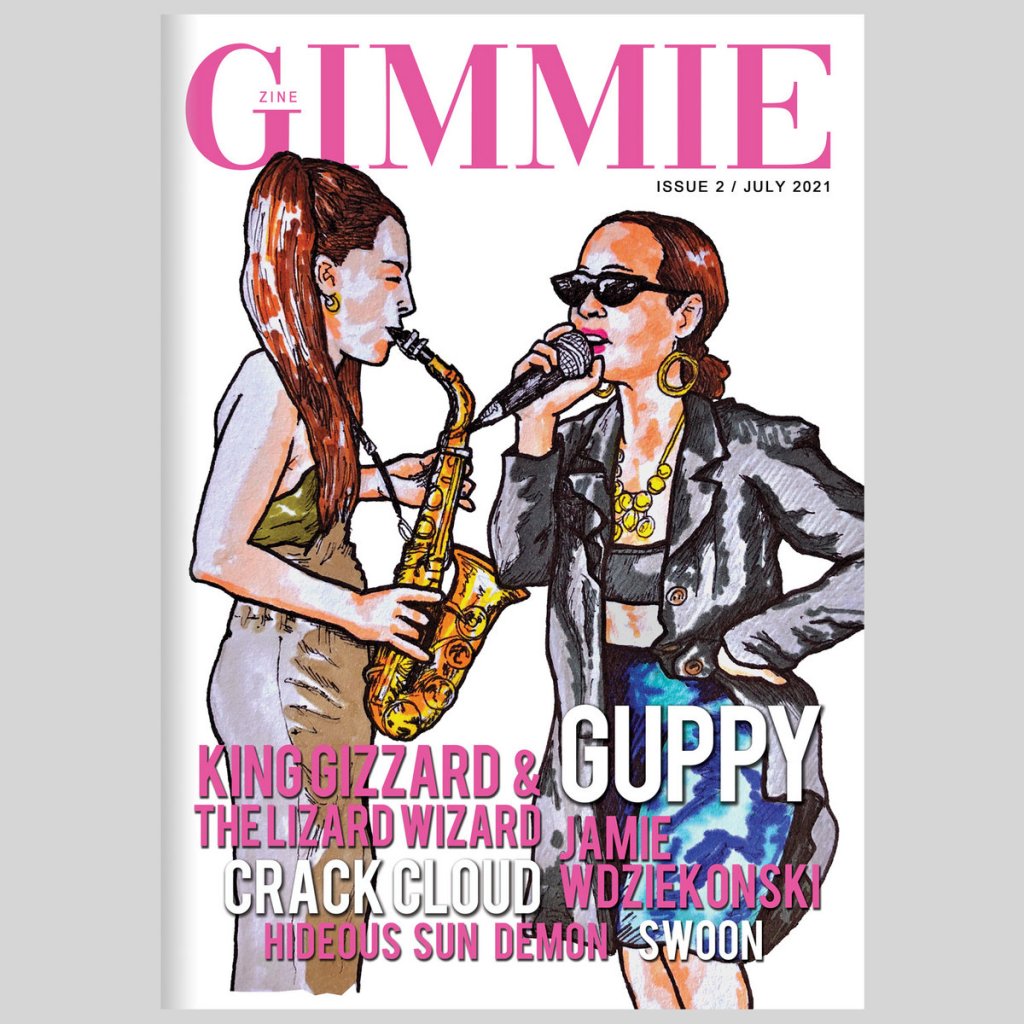
Hand-drawn cover art by Jhonny Russell

We’re excited to share Gimmie print issue two with you! In-depth interviews with:

Zach Choy from Crack Cloud tells us about the new record in the works! We deep dive into the importance of storytelling through music & art, collaboration, and creating longevity for a creative collective doing things your own way, continuing to look out for each other, and not letting the industry burn you out. Inspiring stuff.

Joey Walker from King Gizzard & the Lizard Wizard gives us a look into their new LP Butterfly 3000, songwriting, of initially being profoundly inspired by Indigenous musicians as a child, talk of new Bullant + more!

Brisbane band, Guppy (f/ members of Clever, Cured Pink & Come Die in QLD) have been blowing away the Brisbane music community with their live shows, we believe they’re the most exciting and original new band in Australia (big call, we know!). They’re currently putting finishing touches on their debut album recorded by Dubsy from Blank Realm. We chat with them about their DIY creative world & bringing light and fun to weird times.

We get insight into the heart and mind of one of Australia’s most vital underground documentarians photographer Jamie Wdziekonski aka Sublation! We talk craft, his journey, knowing better & doing better, having purpose in your work, new projects in the works incl. a book of photojournalistic documentation of Indigenous social justice rallies in Naarm over the last 6 years!

Hideous Sun Demon’s Jake Suriano put together a tour diary for us! + told us about early days in Perth, democratic songwriting, realities of touring, studying to be a teacher’s aide, the joys of working as a furniture removalist, community, & new Dr Sure’s + Kosmetika.

First Nations musician Swoon frankly shares his beautiful, isolating, confusing, eye-opening, hard, journey in discovering and exploring his identity, and in healing family intergenerational-trauma; channeling it into EP Rainbirds. A powerful read.

Plus, a super cool contribution from Parsnip & School Damage’s Carolyn Hawkins, & other fun stuff!

52 pages. A4 size.

Colour cover w/ Black + White inside.

Limited Edition.

$10 + postage.

Get a copy at gimmiezine.bandcamp.com

Miss Pussycat: Secret Projects, Capers and (most importantly) Having Fun!

Original photo: Doug Hill. Handmade collage by B.

We adore NOLA-based musician, artist, puppeteer, zine creator and all-round creative Miss Pussycat! She’s a true original, one of the most individual, loveliest and happiest people you’ll ever meet. She creates her own world full of colour and magic and brings a whole lot of that, as well as joy, to ours. Along with her equally amazing creative partner Quintron (read our conversation with Q here) they’ve released a banger of a new record Goblin Alert. Gimmie got an insight into her wonderful world.

MISS PUSSYCAT: Hi Bianca! How’s it going?

Really great! It’s wonderful to speak with you again, we first chatted in 2012!

MISS P: Yeah, it’s been a little while! [Laughs].

I’m excited there’s a new Quintron and Miss P record! How have you been?

MISS P: I’ve been good, all things considered. I’ve had a lot of projects to work on through the whole pandemic, I’m pretty good at entertaining myself. I guess Quintron told you we’re in Mississippi, it’s so beautiful here now. We’re on a little trip.

What did you do today?

MISS P: Today we just walked around, it’s soooo beautiful! As you know, everyone’s been cramped up in their houses, us too. We met our friends Julie and Bruce Webb from Waxahachie, Texas. We’re just getting out of town.

Lovely. Why do you love to make things?

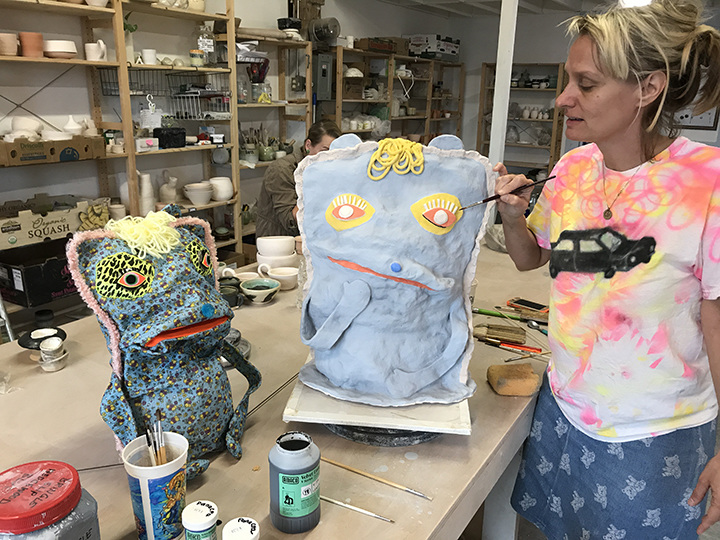
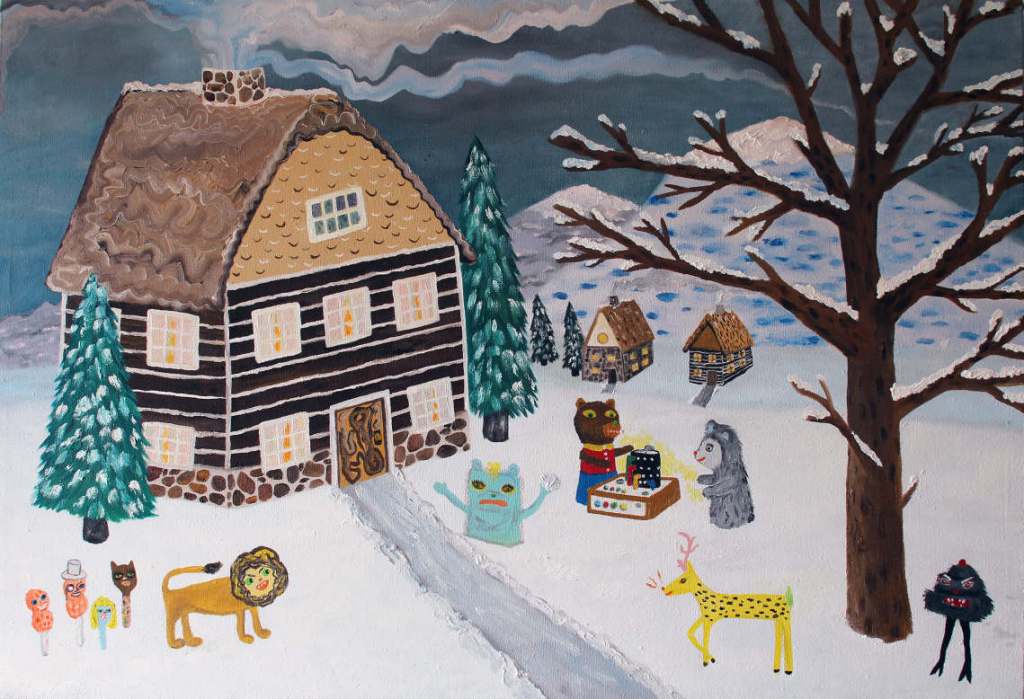
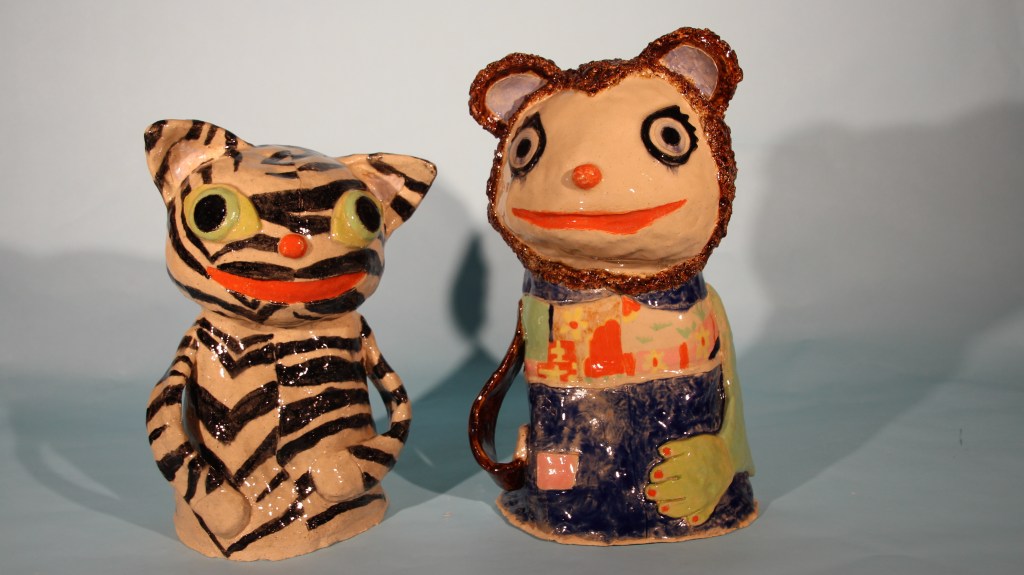
MISS P: I like making all kinds of things! Lately I’ve been doing a lot of painting, oil paintings of my puppets doing things like camping or playing in the snow. I’ve been making a lot of ceramic statues of my puppets too, it’s really fun to do. I can’t do live puppet shows right now.

I saw that you had some art shows happening.

MISS P: Yeaaaaaahhhhh!! One of them is at the Webb Gallery, that’s why we’re meeting our friends Bruce and Julie, so we can give them the art for the show, it’s their gallery. I just had another one open in Pensacola, Florida at the Pensacola Museum of Art. They’re different shows.

The one in Pensacola, I made maracas—I’ve always wanted to do that! I made maracas I shaped them out of brown paper and wood glue, it was very intense glue it turned my hands yellow! It looked kind of gross for a while. It was worth it! My favourite maracas I made are Mr & Mrs Circus Peanut. There’s one that’s a witch. I made nine maracas; I call them ‘maraculas’. I put aquarium rocks inside of them to make the rattling sound, I think they’re going to work really good but right now they’re in the museum for the art show. I made them all little satin pillows ‘cause they’re resting because they can’t do a rock show right now, they’re doing performance art, laying down on a little stage in a museum [laughs].

That’s so cool! I remember last time we spoke you were just making the covers for them, the little outfits. Now you’re actually making the maracas.

MISS P: Yeah, that’s new, I did that in the summer for the first time. I’ve made the covers, the little outfits for my maracas for years and years and years and I always thought it would be so fun to make the maracas, so I did it!

Where did you get the idea to use aquarium rocks for the insides?

MISS P: I was just like; I wonder what would sound good? I’d taken some of my maracas and cut them open last year to see what was inside and the best ones had little seeds inside, it looked like gravel, like an irregular shape. I looked around our house and I had these speckled aquarium rocks and they sounded good. I had to try things out.

You mentioned you’ve been doing a lot of painting; have you always painted?

MISS P: I haven’t painted much in the last few years but I used to paint a whole lot! My grandmother taught me how to paint, she didn’t start painting until she was a grandmother. She was a nice country lady; she liked to sew and cook and play piano. She took a painting class and started to paint pictures of barns, flower bouquets and meadows. When I was growing up, I’d go hang out with her and she’d show me how to paint. I think anybody can paint really, you just do it and then you’re doing it. But she showed me her tricks.

This year being home so much and having all this time I thought I’d paint, it’s really fun. I thought, ok, I’m going to paint pictures of my puppets doing all these funny things like having a campfire in the woods and roasting marshmallows or going to the beach. It got really hot in New Orleans this summer and we don’t have very good air-conditioning in our house so I thought I’d paint puppets in the woods and it’s snowed [laughs] they’re having snowball fights; it was a way to pretend that I had air-conditioning. It’s like a fantasy, I want to think of something that will make me really happy and paint that.

What’s one of the best tricks that your learned from your grandma about painting?

MISS P: That the sky changes colour the closer it gets to the horizon; you can make it go from light to dark or dark to light. Another one is that you can take a sponge and put a little paint on that and dab it on the canvas, that can make really good tree foliage or bushes [laughs].

Do you have any favourite colours that you like to work in?

MISS P: Well, one of the fun things about painting is that you can make any colour you want and colour combinations are really fun. In general, I like a combination of warm and cool colours. I have a whole thing about colours, I like pink and red together and I like pink and orange together but I don’t like orange and red together. Cambrian yellow is a good colour, straight out of the tube it’s an intense yellow.

Art by Miss P.

You’ve been making things for so long and have lots of experience making all kinds of things; what’s one of the best things that you could tell someone about creativity?

MISS P: First of all, go have fun of course! The more fun you have the harder you’ll work. Always when I have something that I am working on I say: this is my secret project. I keep it a secret and that makes me feel like I’m getting away with something, like it’s a caper, that makes it a fun secret. I don’t talk about it much until kind of the end, I think that’s good advice.

I love your new record Goblin Alert, it’s super fun.

MISS P: Thank you! It was really fun to record with our friends and do the record in Florida. I always wanted to record in Florida.

Why is that?

MISS P: I just like Florida, it’s one of my favourite states. Different parts of Florida are different but I just thought it would be fun to record in Florida.

Like I told Quintron, one of my favourite songs on the album is ‘Block The Comet’.

MISS P: We were in Oklahoma – that’s where I’m from – in the summer and there was this big meteor shower called the Perseids meteor shower, we were laying in the backyard at one in the morning watching the shower. The song is inspired by that, it’s literally about comets/meteor shower [laughs].

All the songs on the new record are pretty fun and upbeat for the most part. You think about how people might react to it and I always want people to dance and have fun—I just want to make party music!

What was the inspiration for the album cover idea?

MISS P: In the picture Quintron is a chef and I’m a crawfish… [coughs] wait a moment let me have a drink…

No problem.

MISS P: I’m outside and I think there must be a lot of pollen here. [Clears throat] We took that cover picture, our friend Tony Campbell did it, he’s also took the picture for the Organ Solo record cover. We took the photo on Easter Sunday in his backyard.

Before that on Madi Gras, Quintron and I had a show in the French Quarter and we pretended it was a crawfish boil. We dressed up like on the cover. A bunch of my friends played maracas with me and we had backup dancers and everyone dressed like crawfish or the ingredients that go in a crawfish boil like potatoes and celery; my friend was an ear of corn and her outfit was sooooo good! Quintron dressed as the chef. We made these pots out of aluminium foil and carboard and they had fake flames on the side, so it was like we were being boiled alive while we played the show!

We made a video, someone taped that show, we never have people tape our shows. You look at the footage now and it’s so great, people all close together at a show and they’re dancing and sweating and that’s something that can’t happen right now. The video is for the song ‘Goblin Alert’

Are there any ways that ideas come to you most often for your creative projects?

MISS P: I always carry around a notebook and some pens and pencils. I feel like I’m just waiting for the ideas. Sometimes they come to me in the middle of the night and sometimes in the morning, I feel like I’m there and I have a net, that’s my notebook, and I’m ready to catch them. I feel with really good ideas, you don’t have them, they have you. It’s like they’re a ghost that’s haunting you and you have to do what it says. I try to just make myself available [laughs].

I asked Quintron this next question too when I spoke to him because you have a song on the album called ‘Teenagers Don’t Know Shit’; what were you like as a teenager?

MISS P: I grew up in a really small town, in Antlers, Oklahoma. I was a pretty angry teenager because I was so weird and living in a small town, you had to act tough because you were different from everybody else. I was a real loner. I was a typical teenager in the angry-rebellious-teenager-type way.

What was the first creative things you started making?

MISS P: As a kid I painted with my grandma but I didn’t take it too seriously it was just something really fun we did. I liked to write, I always liked to write stories and plays. Growing up in a small town, I didn’t study art or go to shows because none of that was available. I was in marching band and played tuba [laughs], that’s how I learnt about music. I sewed because my grandma would sew some of my clothes, probably the best clothes I ever had was sewn by her and homemade. That’s how I learned to sew and crochet, that’s just what you did. So, I had a very dorky approach to the Arts [laughs], I guess it wasn’t very cool. I still sew, I still crochet, I still paint and I still play music!  

I started doing puppet shows when I was a kid ‘cause I was in the Christian Puppet Youth Ministry through the church [laughs]. We told Bible stories with puppets. We’d go to other churches to do this too. I’m still doing puppet shows; I’m doing all the things I used to do.

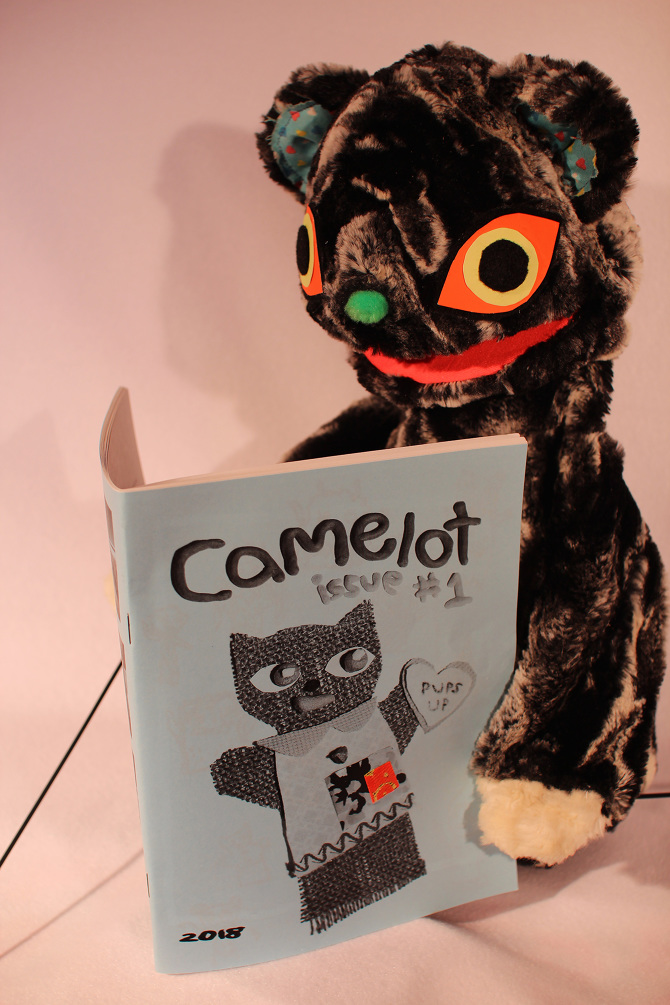
I noticed you’re doing a zine called Camelot about puppeteers.

MISS P: Yeah, I’ve done one, I want to do another one! It was a kind of secret project [laughs], a caper, so I could interview and talk to some of my favourite puppeteers. I thought if I had a zine, I could interview them, and it worked! One of my favourites is Peter Allen, he lives in Missouri now in a small town and there’s not a whole lot written about him; his puppet shows are mostly in libraries and places like that. He’s such a good puppeteer! I thought if I interviewed him, I could ask him all of these questions and find out what his secrets are! [laughs]. That interview ended up being over 9,000 words long.

I also interviewed Nancy Smith. She has a puppet theatre in Arizona. I’ve known her a long time but more like, oh, she’s this great puppeteer, one I really, really respect but because of this project I got to sit down and ask her lots of questions. It was so great. A zine can really open doors! [laughs].

Totally! That’s why I’ve made zine for over two decades. I know that feeling of seeing people make really cool stuff and it gets you curious like; how did they even do that? How does that exist? They’re doing something you think is so cool and awesome and you just wanna know everything about it.

MISS P: Yeaaaaah! You totally get it. Transcribing interviews can be very hard work though.

It can be, but I’m one of those weird people that actually enjoy it. It’s part of the process and you learn lots while doing it, things that can’t be taught in a classroom or from a book. It can roughly take around three hours to transcribe and edit a one-hour interview. I like transcribing interviews and putting them out there in that format because I love to encourage people to read, I think reading is important.

MISS P: Oh my god! [laughs]. I bet you’re really good at it now and faster than most.

Yeah, this year alone I’ve interviewed over 100 people already and like I said I’ve been doing it for over two decades, since I was a teenager.

MISS P: Who’s the craziest person you’ve interviewed this year?

I would have to say maybe Damo Suzuki from Can.

MISS P: Oh whoa! Cool!

I did the interview without any pre-planned questions and we spoke for a couple of hours about creativity, freedom and of discovering yourself through doing all these creative things and the importance of not taking on other people’s information and of tapping into your own and the things that spring from within yourself.

MISS P: That sounds like such a great interview to do.

Out of all the people you’ve interviewed for your zine, was there anything cool or interesting that you learned?

MISS P: There was! I don’t know much about Punch and Judy. Peter Allen is this Punch professor, that’s what they call it when you’re good at doing Punch and Judy shows. Do you know what a swazzle is?

No.

MISS P: A swazzle is like this little reed that you put into your mouth and that’s the voice of the puppet Punch. It sounds crazy! It’s amazing. You have to learn how to do that and he showed me how to make a swazzle. You put it in the back of your throat and you have to learn how to talk through it, and not swallow it [laughs]. The joke is, if you swallow two then you’re a professor [laughs]. You’re supposed to tie a piece of dental floss to the swazzle and tie it to a button on your shirt, so that if you’re choking or swallowing it you can pull it back out. I’ve never swallowed one but I can see how you could, they make such a crazy sound that just makes me laugh, then it would be very easy to swallow it.

How did you get into making ceramics?

MISS P: Ceramics is soooo fun! When I was in college, I did a lot of ceramics, then you get out of college and you don’t have a kiln or all of the space to do it. Two years ago, I woke up in the middle of the night and I was like, I have to do ceramics again—an idea had me! I thought I want ceramic piggy banks that are shaped like my puppets, it would be so funny. I found a community ceramic studio and have been making ceramics of my puppets, I haven’t figured out the piggy bank thing yet though. I will though. I made one and it wasn’t very good. It’s such an intuitive and earthy thing to do, I think it’s really healthy.

I love the mugs you made with the lion on it.

MISS P: Oh, you saw Mr Lion! They’re fun. Mr Lion is a stuffed toy that was Quintron’s mother’s and now we have it. It’s this big stuffed lion that’s at the foot of our bed.

What are the things that make you really, really happy?

MISS P: A whole lot of things make me happy. Things like working on a secret project and the feeling of working on that project, of it being so fun, that’s one of my favourite things, just being inspired.

My cat Coco Puff makes me really happy. She’s a Siamese and loves to wear hats.

Quintron makes me happy, he makes the best things like The Bath Buddy. He’s just so funny and so good! Seeing what he does makes me very happy.

Live shows are really fun but it’s the building up to the live shows too that’s really fun for me.

What is it about the build up?

MISS P: It’s exciting! It’s terrifying! It’s an adrenaline rush. It’s like an adventure movie and things come up and you have to overcome those things.

That’s a fun way of looking at it. You seem like such a happy, positive person; do you have days when you’re feeling down too?

MISS P: Sure. I’ve had times when I was really sad. I try to avoid being sad because I can get soooo sad, so depressed. I try to ward that off by always having bright colours, like every room in our house is painted a pretty colour. I try to be really careful not to go down that dark road [laughs] because it’s a looong dark road that just never ends. The best way is to just always be happy… of course though, I’ve been sad.

Is there anything in particular that helped you in those times?

MISS P: Getting busy. I think I’m the saddest when I’m not busy or not working on a project. Having secret projects to work on makes me not sad.

I won’t ask you about your secret projects your currently working on then because if you told me they wouldn’t be secret anymore but, is there anything you’re really excited about right now?

MISS P: A lot! The things that I feel like I’m at the harvest fest point of, all these secret projects all at once. The art show in Texas, I’m excited to show things to people. It’s a weird time though because people aren’t really going out. When my friends have come over, I shut the door to where I’m working so they can’t see it, so I haven’t showed anybody yet.

Anything else to tell me?

MISS P: I’m really excited to do puppet shows again, for the longest time ever I haven’t really been working on one. I have some idea for one I want to work on for sometime next year.

The songs on your new record are each like little stories; do you have a favourite story?

MISS P: One of them is ‘Weaver Wear’ and it’s the theme song for a puppet show that I’ve been working on for years but I really haven’t done the show or not in the way that I thought I would, I thought it would be a puppet movie. I made all these little shows for it; it’s about puppets that are fashion designers.

Amazing!

MISS P: They are multi-generational fashion house, they’re The Weavers. They’ve been fashion designers since the middle ages, they started out during the plague and made these capes that could either be a cape or if there was a dead body you could through it over that so you don’t have to look at it [laughs]. They had their own sheep that they grew and they made wool from the sheep called ‘Weaver Wool’ which is patented. In the ‘60s they come up with these really high fashion designer jeans. There’s a grandfather names William and the grandmother Betsy was a model but now she’s really elderly, she only models for charity events [laughs]. Their grandchildren live with them but are in their twenties and there’s one being groomed to take over. Mindy is the youngest child but doesn’t look anything else like anyone else, she might be illegitimate, she does all the work and she’s going to go blind because she sews all the time. The grandfather goes missing but they find his finger in a letter and they think he’s been kidnapped by their rivals, who make everything in China and they want to get Home Economics out of school so nobody knows how to sew… Betsy and Mindy and the family need to come up with a new Fall line, so they come up with shoes ‘The Weaver Walker’. Shoes for dancing. For some reason I haven’t made the movie yet though; Hollywood didn’t come knocking at my door yet for that one! [laughs].

I did the live puppet show just about Mindy. It’s about Mindy and a moth, the moth wants to eat all of her clothes she’s making. They make a deal that the moth will help her sew and then she’ll give it all the wool scraps after the fashion show. I wrote a theme song, that’s ‘Weaver Wear’! That’s on the album. There’s a lot behind that song [laughs].

I really love how you completely create your own world! It’s amazing.

MISS P: It’s all just so fun! That’s the most important thing.

Please check out: QUINTRON & MISS PUSSYCAT; find Goblin Alert here out on Goner Records; find Miss P’s projects here.

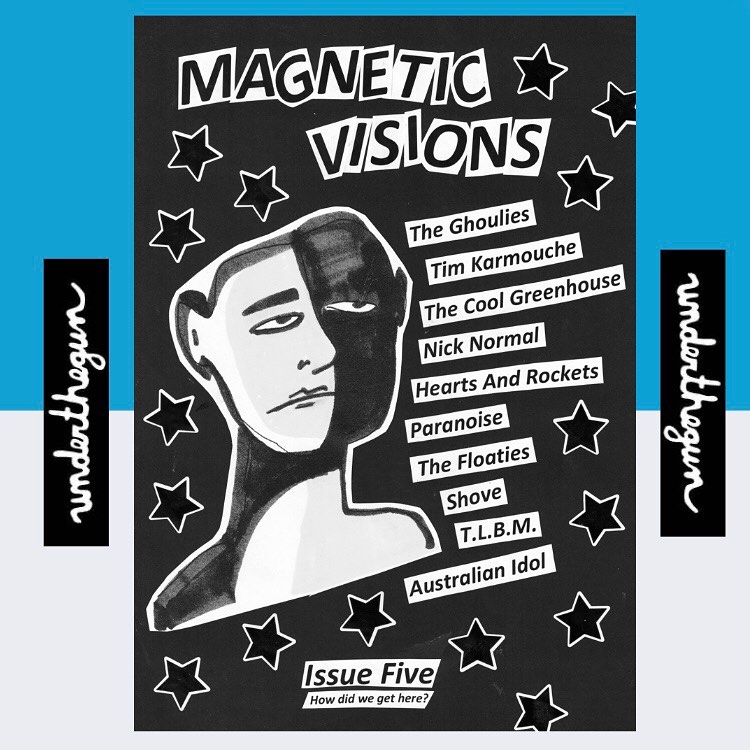
Naarm-based zine Magnetic Visions: “I put it out and I found that it was a really freeing process because it allowed me to be connected…”

Handmade collage by B.

Zines are really important! Good ones burst with life and can capture a culture, a scene, community, document a time, and share ideas and stories in a way that conventional publications can rarely, if ever; they offer an alternative narrative to the mainstream. There’s a genuineness, imperfection and sometimes awkwardness on their pages we resonate with. They’re written with unfiltered voices and self-expression of someone finding themselves (aren’t we always?), navigating the world and exploring their local creative community, likes and dislikes. They spread music, art, thoughts, feelings, information and perspectives. Anyone can make a zine. Making zines hones your skills or teaches you new ones you might not have known you had! Making one can sometimes save your sanity. A zine gives creative freedom. It can help you use your voice. A zine most importantly connects people.

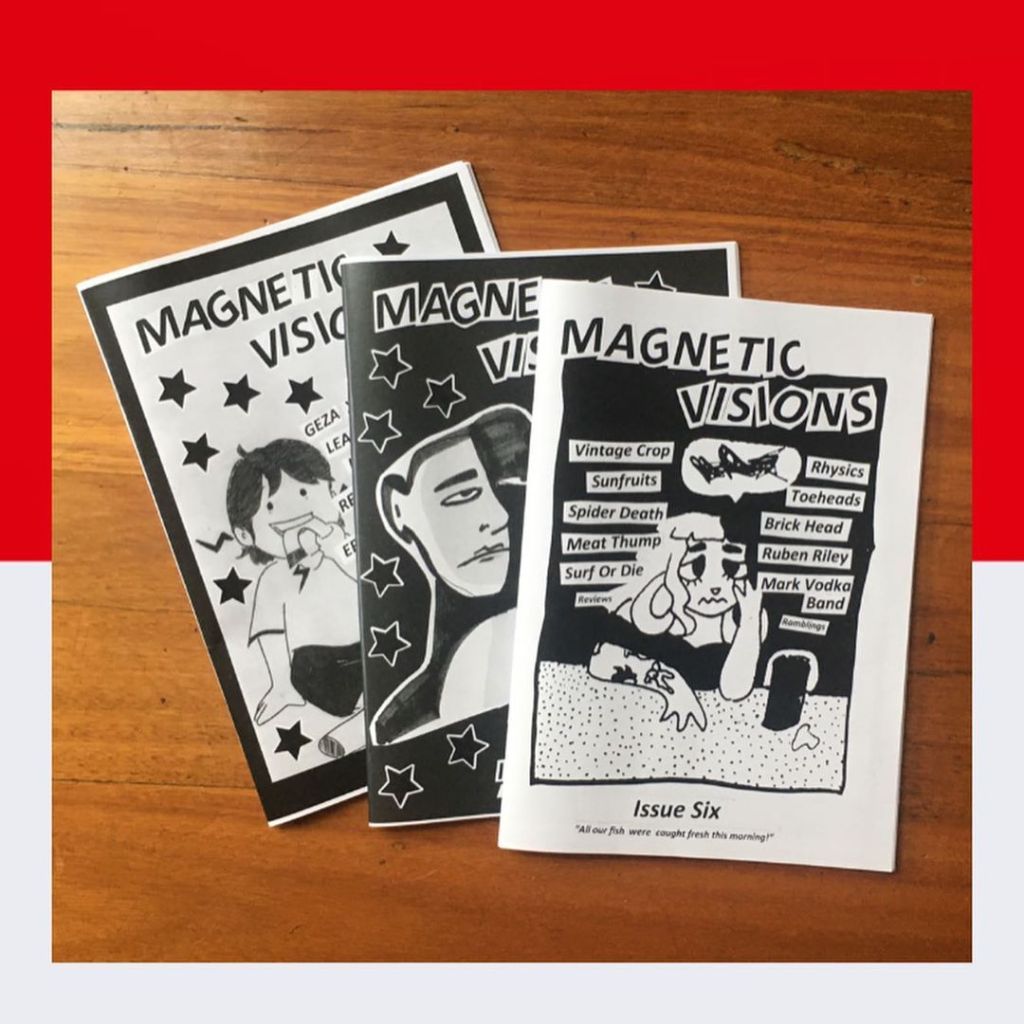
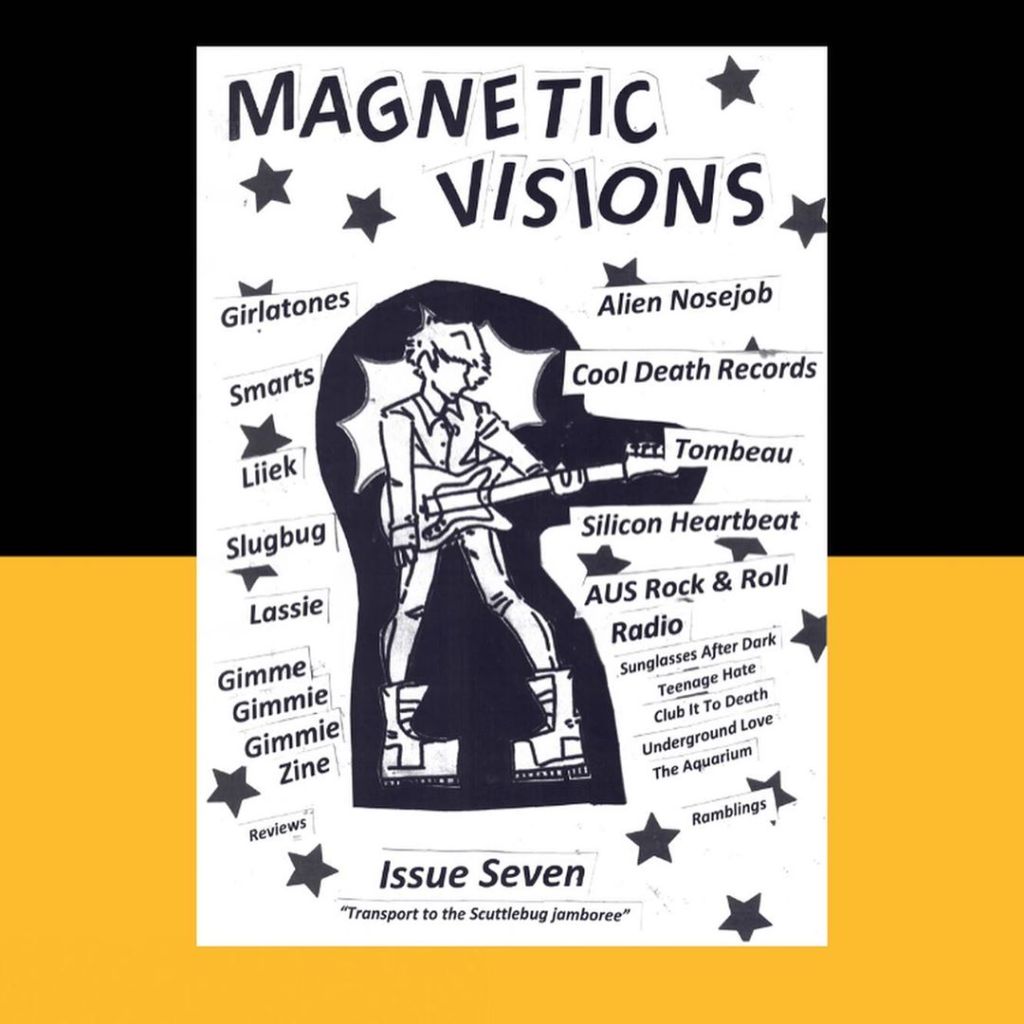
Through making Gimmie zine this past year, we’ve connected with so many amazing creatives throughout Australia and the world! One of the coolest is Billy who creates Magnetic Visions zine, a predominately music-based print zine from Naarm/Melbourne. He also makes music: Disco Junk, Billiam, Collective Hardcore, TOR, Dot Com, Aggressive Hugger, GDU and Under Heat Records. We love his passion for music and compulsion to share it—a kindred spirit.

A few weeks back Gimmie’s Editor Bianca sat down for a chat with Billy, they did an interview collaboration! Billy interviewing Bianca can be found in the new issue (#7) of Magnetic Visions, which also features interviews with Alien Nosejob, Lassie, Girlatones, Cool Death Records and more! Bianca interviewing Billy is below.

It’s important to support each other! The more people making interesting, unique rad stuff and expressing themselves creatively the better!

How did you first discover zines?

BILLY: A while ago Strangeworld Records had a flood and they needed to get rid of a lot of the water damaged 7-inches so I went in there and bought quite a few. Richie who runs Strangeworld Records threw in a couple for free. One of them was Meat Thump which is the band ran by Brendon Annesley who made Negative Guest List zine. I ended up contacting Matt who put out the Meat Thump 7-inch to ask if he had another cover for it, because it was completely destroyed from water damage. When he sent the cover, he sent a few copies of Negative Guest List. I remember being completely blown away by them, the journalism and the whole formatting of zines. I developed a curiosity about them and I’d find a couple at Lulu’s and eventually I discovered Sticky Institute in Melbourne. From there I learnt about zine culture. I’ve probably learnt the most since doing Magnetic Visions because it’s put me in contact with a lot of people that know a lot more than me.

Nice. I used to have my earlier zines stocked at Sticky back in the early to mid-2000s.

B: It’s a really great place! I don’t think I’ve asked to stock there but maybe post-pandemic I should see if I could get a few put in there.

Totally! Do it. What inspired you to take the plunge and start making your own zine?

B: Initially it was just meant to be a one-off thing. I’ve always wanted to do a comp tape with a zine, so I put together five or so of my friends’ bands; I interviewed them and I put an exclusive track on a cassette. I put it out and I found that it was a really freeing process because it allowed me to be connected to music without actually making music. I sat on it for a bit and I started working on issue two during February, as that turned into COVID time, I plunged completely deeper into zine making, making it properly, properly publishing it and trying to put in as much effort as possible as I can to make it as good as I possibly can.

What are the zines that you really enjoy?

B: Negative Guest List is the main one, which ended in 2012 when Brandon died. I absolutely love Distort from the issues I’ve been able to get, there aren’t that many. There’s a zine in Europe called Rat Cage which is starting up at the moment that I really like, it’s focused on European hardcore and post-punk. Of course I love Gimmie Gimmie Gimmie zine! A friend of mine runs a zine called DST that I really like that’s based in the US, its half writing like short stories and half interviewing bands.

Do these zines have any similar qualities?

B: I like really good interviews, I like interviews that are very conversational and have good graphic design. I’ve always loved the visual appeal of a zine, making it as visually appealing as possible because you are paying for that physical visual aspect.  

Is there a difference for you reading a zine digitally vs. reading print?

B: Digitally I have less of an incentive to read it. If I buy a zine I’m more inclined to read it because I’ve spent money and there’s an investment in there so I might as well get as much out of it as I can. I also find I’m able to get more value or enjoyment out of something on paper because I put more of myself into it.

What are your favourite and least favourite parts of making a zine?

B: I’ll start with least favourite, it can be very intense trying to put something together that you think you’re truly proud of, hoping people will buy it, that’s not particularly fun. I’ve had a lot of trouble dealing with that and at times the zine has been quite taxing on me. I think I’m a lot better at it now. I’ve figured out the main parts.

The best part is being able to be involved with so many music scenes around the world and being able to talk to artists that I absolutely adore, in a somewhat conversational way is absolutely fantastic!

Yeah, it’s pretty cool getting an insight into people who make stuff that you admire and appreciate.

B: Yeah, I did an interview with Jake from Alien Nosejob for the next issue. Even though I’ve talked to him a bunch this was the first time that I think I felt really comfortable really talking to him and it was absolutely incredible!

Amazing! I can’t wait to read it.

B: It’s really good. It’s a good issue, I’ve also done an interview with Lassie and Silicon Heartbeat—awesome bands.

I love all the zines, they’re all really good.

B: Thank you, it’s good that people are actually seeming to enjoy them. I didn’t really know there was much of a zine market until I started doing it, I had no idea that people would actually consume and enjoy them.

For me growing up in the ‘90s zines were such a normal thing, there were lots of them and there was a vibrant zine culture.

B: Yeah, back then I guess it was more essential to have zines. That was the only way to publish things on somewhat of a budget.

Yeah. I used to have friends that would have access to photocopiers and I’d get to photocopy my zines for free a lot of the time.

B: That’s what I’ve been trying to do at the moment. I started off printing them at school but they put the hammer down on that so at the moment I’ve had to go through Office Works.

Here in Brisbane there’s a really great place in Fortitude Valley called Visible Ink, it’s a Youth Arts Hub and you can go in there and photocopy your zines for free. They have lino printing resources and a badge maker you can use too. Do you stand there and photocopy it yourself or do you leave it with them and get them to print it and come back later to pick it up?

B: When I’m printing the final version that’s what I do but when it comes to designing it and all that, I’m usually just there getting specific things or trying to get a specific paper stock that will stick better to the background and all that.

I’ve been there! I love doing zines with a coloured paper cover, I’ve done full colour and A3 folded and A4 folded sizes.

B: I think right now at the moment doing just A4 black & white is the best for me because colour printing is so expensive. For this issue I might do colour covers just for fun, I like the way it looks.

It’s always good to keep trying different things and evolving.

B: Plus colour covers stand out more when everything else is in black & white.

Yes. What’s something that making zines has taught you?

B: I don’t know? I guess it’s taught me how to put together a complete artistic product. I’ve done albums before but I feel like putting together a zine is a lot more than just releasing an album because you’re involved in every aspect, asking every question, cutting out everything, paying or the printing and all that. I hadn’t really had much experience doing that until making a zine. I’d done tapes but some part of them I was able to rely on other people, this one, a zine, was all me. The main thing it’s taught me is to create a completed product.

Do you set deadlines when making zines?

B: No, not at all but they’ve all somehow been finished! Since issue three they’ve all come out, one a month or at least thirty days in between them. I sort of want to slow down but no matter how many brakes I put on like, I’ll only do one interview a week, or don’t work on it during this time period, I always manage to at least finish one by the end of the month. There’s no deadline but one forms naturally, I guess.

That’s how I felt when we started doing Gimmie, it’s been six months now and I’ve done over 100 interviews up on gimmiezine.com, I think there’s 113 maybe at this point.

B: That’s pretty fantastic!

Yeah, I just started and kept going. I love interviewing so much and I like making the art that goes with each interview. I love sharing new bands and music with people.

B: Yeah, it seems to be going pretty well so far.

One of the things I love about your zines is when you write your personal pieces; are you every scared of putting your thoughts out there, committing them to paper? Do you ever censor yourself?

B: Not really, I’m not really self-conscious of putting out my actual thoughts. I often find that I’m just not able to put them in words. There isn’t very much of it in issue six, because mainly when I would write about something I wouldn’t be happy with it, it would feel show-off-y or not correct. I’ve put the brakes on it for issue six but issue seven will have a lot more of it. I’ve been doing some writing on bands I like. I’m doing a big piece right now on probably one of my favourite bands right now, Bis.

I love Bis!

B: I don’t get why more people don’t talk about them. I don’t know if you’ve heard the new TOR single, but TOR is basically my love letter to Bis—I love that band so much!

I’ll have to check TOR out. I’ve seen Bis live!

B: Did they ever tour Australia?

Yeah, they did. I have the ticket stub somewhere here.

B: That’s awesome! I have an old poster I was able to get on eBay that I have in my room, it’s a promo poster for The New Transistor Heroes; it’s probably the coolest piece of art that I own. Mandarin’s art is fantastic!

Agreed! We have a lot of art on our walls here.

B: I’ve got a lot of posters from gigs or prints that I’ve bought from photographers, or flyers.

That sounds like our place. We have a pretty big collection of posters some from the ‘70s through to the ‘80s and ‘90s to now.

B: That’s awesome!

How do you choose what bands you’ll feature in your zines?

B: I pick bands that I’m listening to at the moment or that I think could give an interesting interview. I don’t like to just pick bands that have a record coming out, but that sometimes helps because they have a reason to talk, things to talk about and they’re in that mindset of sharing it. I really just try to pick people that I think are interesting. I don’t try and pick from one particular scene or a particular area of music to follow, I just pick what I find interesting. Issue six has a mish-mash of a bunch of different things: Toeheads, are from Detroit, they’re an amazing garage rock band; there’s an interview with two of the members of Meat Thump and we were able to talk about Brendon Annesley, it was fantastic. I interviewed Jack from Vintage Crop and that went really well. Even Mark Vodka who is this obscure Canadian artists who is probably the closest thing to a second Ramones we’re ever going to get.

Is there anyone you’d like to interview that you haven’t yet?

B: A lot! Usually it’s because I don’t feel comfortable asking them. The dream interview, the one I’ve always been desperate to do is someone from Razar, the Brisbane punk band—that’s the dream! I’ve never been able to find a single interview with them. I consider them to be pretty close to being the most important Australian punk band of all-time. I’m still on the chase for it so if anyone knows any of them send me a message!

ABC put out a punk compilation, I bought it because it had Frenzal Rhomb on but I heard ‘Task Force’ on it and [Psychosurgeons] ‘Horizontal Action’ and it set me on the path towards what I’m doing now.

What’s been one of your favourite interviews you’ve done so far?

B: Issue one I was pretty proud of the one I did with CB Radio and Glue Eater, I think they both turned out really well. Issue two, Mikey Young I was really happy with, same with the one with Spoil Sport Records. Issue three, I think I did a good one with Drunken Sailor and Dr Sure’s Unusual Practice, those were ones I was really proud of. Issue four is where I think I start to get it down and I’m more or less happy with every single one in there, Research Reactor Corp, I was really happy with. Issue five, I was really happy with my interview with The Ghoulies and Hearts & Rockets. The one I did with Australian Idol I was extremely proud of and I still think that tape is the most underrated thing released this year. I’m really happy with everything in issue six, all of those are pretty good.

What makes an interview good for you?

B: It’s having a conversational feel and revealing interesting information. The interviews I really like I feel they show the artist’s personality really well and they’re interesting to read. Not every interview I read is with a band I like but, if the person is interesting to talk to I can get something out of that.

Get MAGNETIC VISIONS issue seven HERE and read Billy’s interview with Gimmie Gimmie Gimmie zine!

Please check out: BILLIAMVILLE.com. Billiam on Instagram. Magnetic Visions on Instagram.