

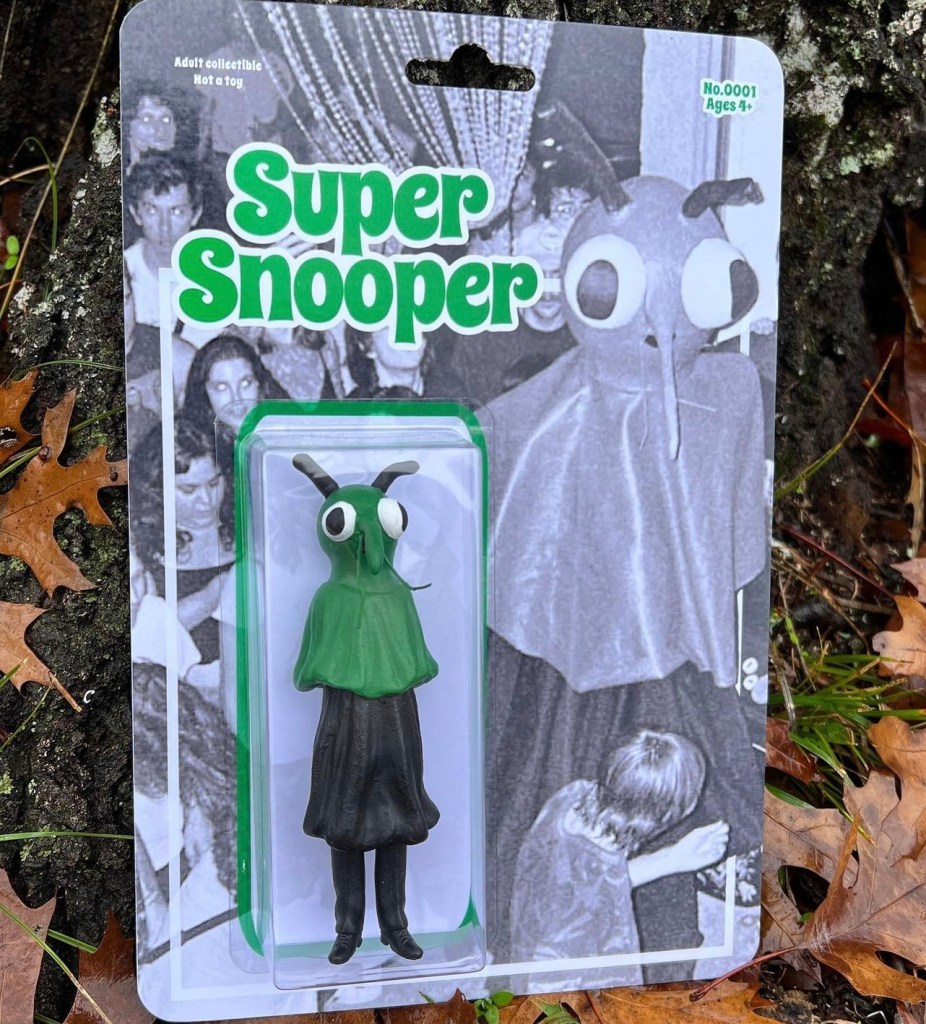
Gimmie love Nashville punk band, Snõõper! They’re bringing fun back to punk rock! Their debut full-length Super Snõõper is a heady adrenaline rush. The band breathing life and a freshness back into the genre with their highly entertaining, mighty, live shows that reach a level of sublimity, complete with puppets and props. Their videos are art works full of wonder and humour, made by vocalist Blair Tramel.
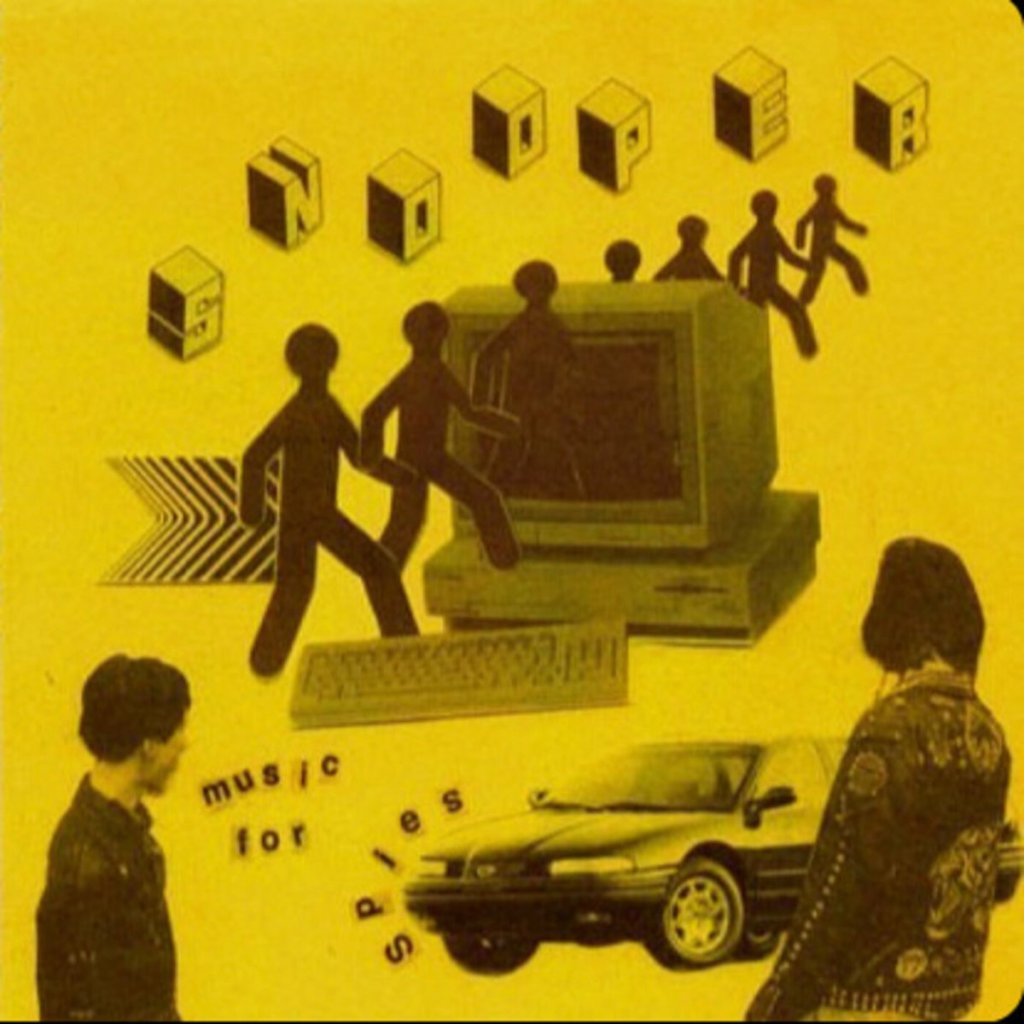
We first heard Snõõper when Billy Reily vocalist for RRC/3D & The Holograms sent us a couple of tracks a few years back from a band that he had discovered and really loved. So much so he put out their first seven inch release Music For Spies on his DIY Australian label, Computer Human Records.
This week sees them in the country to kick off their first ever Australian tour with Gimmie favs Gee Tee. Gimmie caught up with Snõõper co-founders and all-round sweethearts, Blair, and Connor Cummins about a month ago to get an insight into their creative world.
We’re excited that you’re coming to Australia!
BLAIR TRAMEL: Us too! We’re so excited. We feel like we’re visiting friends there, even though we’ve actually never been there. It feels like we’re returning home in a way, because we had Billy and RRC stay over here recently. It’s going to be fun.
CONNOR CUMMINS: Yeah, we’re really excited!
Billy put out your first seven inch on his label, Computer Human Records.
BT: Yeah. It was over COVID. We were like, sure, let’s do it. We were very thankful for him.
Yeah. I remember we first heard of Snõõper through Billy. He was like, “You have to check out this band, they’re amazing!”
BT: We played with them at Gonerfest recently, and then they played a really fun show with Gee Tee here in Nashville. It was awesome.
CC: Mikey and a bunch of other people all stayed at our house for a couple of days. It was really nice.
Lovely. What’s something that you took them to see or that you did together?
CC: Well, it’s funny because everyone was partying so much at Gonerfest, we just sat around and had pizza. We went for walks around the neighbourhood, but we didn’t really do too much.
BT: My memorable experience was when we took them to Kroger, which is a grocery store close to our house. Have you ever heard of Kroger? It’s a Southern specific general grocery store. They had so much fun there. They were like, “The carrots here are so weird!” because they’re pre-sliced. Everything was just so American at the grocery store and they were so weirded out. Ishka rode the electric shopping cart! They had so much fun, and everyone was like, “You guys are definitely not from here!” The cashiers loved them.
Nice. It’s so awesome that you get to come here and do it all again with them.
CC: Yeah, we’re really excited.
I still can’t believe you’re coming, it’s so exciting. I never thought I’d get to see you play live.
BT: Yeah, it is great. I feel like RRC, Gee Tee, we’re all kind of part of the same scene, and that’s felt really nice because there’s not a tonne of bands close to us, that are making similar music. Australia just seems to have everything cool going on.
We do! That’s why we started doing Gimmie.
CC: Before I knew about a lot of the garage punk bands in Australia, I was a huge fan of Total Control, Eddy Current Suppression Ring, Royal Headache and all those bands since I was younger. I’m really excited to come over and see everything.
BT: It seems like you guys have all the cool stuff, like all the bands, but then also there’s this really cool puppet group called, Snuff Puppets. They’re awesome. I think they’re in Melbourne. They make huge giant puppets. They did a lot of stuff over COVID, they made these big noses and ears and all kinds of cool stuff and they were all trapped in houses. It was really fun watching their videos; we reached out to them. We’re like huge nerdy fans of theirs. We’re like, ‘Please hang out with us. We want to see the puppets!’ That’ll be cool too.
I love that Snõõper use puppets live. It reminded me a little of Quintron and Miss Pussycat. I love how Miss Pussycat makes puppets and does shows.
BT: Totally. We are huge Quintron and Miss Pussycat fans. They played Gonerfest a couple of times and they’re in New Orleans, not too far away from us, so we get to see them often.
New Orleans is really cool, they have tonnes of stuff like Mardi Gras and everything. But the parades and the puppets there, oh my gosh, it’s super cool! New Orleans is a unique place in that way.
What’s it like where you live?
CC: Kind of like the country, I guess. But we’re in the city.
BT: We live in the city, but if you do go 15 minutes in any direction, not towards the city, you end up being in the country. A lot of farmland and stuff not too far from us.
CC: Nashville is like a big circle, we’re on the west side of the circle. If you go outside of the circle, which is not really that big, it’s just like hills and trees and stuff.
BT: It’s nice. The nature is so pretty, but politically, it’s a little bit crazy. In Tennessee, it’s the South, so it’s funny. You have the prettiest land, but then some of the meanest people living on the prettiest land, a lot of unhappy people. I feel like it can be pretty closed off.
CC: There’s a lot of good people, too.
BT: Yeah, totally. It’s a good place. I think there’s just a lot going on with abortion stuff here, gun rights, very extreme kind of politics.
It’s really full on. Watching it unfold in the news from over here in Australia, seeing a lot of the stuff that’s happening in the US, things like a lot of books being banned that relate to identity, race, gender…
BT: Especially in Tennessee, that’s a very big thing in the South. But what’s cool about it is that Nashville itself is such a hub of diverse people, and so the community within Nashville is so strong because the surrounding areas can be a little bit..
CC: Yeah, Nashville, I would say, is very blue.
BT: Yeah, totally. So that’s great in a way, you know, when you live in a not so great place, but you have a great community of people.
CC: Yeah. There’s not really much of a punk scene, there’s a lot of young kids who are really excited, but they’re just not starting bands. Kind of unfortunate.
BT: People, I feel right now, want to move away from Tennessee because politics are so crazy here. The people that are staying and trying to really maintain the community, that’s really important right now.
Yeah. Do you think you guys will stay in Tennessee for now?
BT: Yeah. I’m from California originally. My parents moved out here not too long ago, and I’m very close with my mom, so we’ll be here for a while.
CC: I’m from middle Tennessee, so I’ve just been here forever. I would love to move away someday, but we have a pretty good thing going here.
BT: And it’s a small town in a way, everywhere you go you know each other, so that feels nice.
Yeah, that’s like what Brisbane and the Gold Coast is kind of like.. Sydney and Melbourne are a lot bigger and more spread out, but here where we are it’s really nice.
BT: That’s awesome. The only thing that I wish we had is a beach; we do not have a beach.
CC: It’s very hot and humid. Especially like today, it was a very thick heat. It’s nice, though.
BT: The bugs are really loud in Tennessee, there are certain things where it’s like, you know you’re in Tennessee when…
CC: Yeah. We have chickens and stuff like that.
BT: People seem to have all kinds of fun nature projects in Australia.
There’s so many cool things happening all the time. I’m glad that I get to be a part of it all. Connor, I know that you’ve played in about a million bands: Body Cam, Chainshot, Brothers, G.U.N., Pissbath, Safety Net, Sex Hotel, Vacant Future, Soft Option, and you’re Spodee Boy.
CC: Yeah, that’s true. Brothers and Vacant Future, those are like deep cuts. That’s cool that you know about them.
What inspired you to start making music?
CC: Growing up, I always liked fast, aggressive music, and would go to shows. I definitely always wanted to start. Where I’m from is like, 30 minutes from Nashville, it’s a college town, and they wouldn’t really be punk shows, but there would just be lots of house shows all the time. When I was 14 and 15, I would tell my parents I was going out and I would go to house shows. Everyone was really supportive of younger people going to shows. It was a really inspiring thing. I wanted to start my own band, and I wasn’t really good at an instrument, so that’s how Pissbath started. It was a noise punk band, and so I was learning how to play guitar, but I had a lot of distortion pedals, so I could hide it a little bit. After that band happened, I just kept trying to learn new instruments and then did Vacant Future on bass and Brothers on drums. After a while, after I learned a little bit on each instrument, that’s when I started doing Spodee Boy and putting them all together.
I’m so glad you have, because with Spodee Boy and Snõõper, I love that it combines so much stuff I love. It’s like there’s no rules with what you do.
CC: Thank you. Sometimes it’s hard because I feel like people can’t really relate, but I guess I don’t really mind because I’m just doing it for me. I like a lot of post-punk, and stuff like the Gun Club; that comes out a lot in the Spodee Boy stuff, which is really fun for me. Sometimes I feel like it’s not hardcore enough for really punk people and then it’s too, I don’t know, sometimes I feel like my friends don’t really understand, but I love it.
I’m so glad that you’ve done it. Even if your friends don’t understand.
CC: Snõõper is the most fun band I’ve ever been in, because it’s just me and Blair.
BT: Connor likes to record his own music, do all the instruments and do specific things, which I understand because I like to do my own visual stuff. I have no experience with music so he can really be creative in that way. I write the lyrics and do the vocals, but mostly I do that so that I have a place to show the puppets and the things that I make. We work really well together because we both really let each other do our own thing within the band, which is nice.
CC: Yeah. I guess what I was saying about Spodee Boy too, it’s not really about my friends minding too much, but sometimes it gets kind of lonely because it’s just you all the time. It’s great because you have complete creative control, and then sometimes in bands I’ve been in where it’s been too many people, there’s too much going on and people can’t make decisions and stuff. Just me and Blair has been the perfect balance because we live together and we’ve been together a long time. We can just be like, “Hey, what do you think of this idea?” And we’ll just be like, “Yeah, let’s do it!” Versus talking to five people about something.
BT: What’s important to him isn’t necessarily important to me. So he’s like, “I made this song.” I’m like, “That sounds awesome! I made this random puppet or prop or whatever…” so we combine them and it works out well.
I love that. Creative couples are my favourite. That’s like me and my husband. It’s just us two that do all the Gimmie stuff.
CC: Yeah. That’s awesome. It’s a beautiful zine.
BT: So special.
CC: We had a small shop, just kind of like a distro for a little bit, and we carried Gimmie. They were great. They’re beautiful zines.
BT: We were very thrilled when you asked us for an interview. It felt like a big honour. When we were getting your zines in the shop, we were only open for a little bit, but people were like, “I have to get the new one!” whenever we’d post about getting it in. People were so excited.
Awww, that’s awesome to know that there’s people in Tennessee are reading Gimmie!
BT: Yeah, it’s great. I was going to say, one more thing that makes living together with someone that you’re in a creative thing with so cool is, we just leave everything out, it’s become part of our life having the props out and the music stuff out.
CC: We run a small label together too, called Electric Outlet, so there’s always stuff scattered everywhere around the house..
BT: Then you can just pick stuff up and make something, like, “Let’s make a video!” and it’s right in front of me. That feels nice.
Totally. That’s exactly what we do as well. Jhonny built me my own art space area because I was putting too much glitter over his area, because I use a lot of glitter in my art, the Gimmie collages I make.
CC: That’s awesome.
Yeah. I like using things that people often say is kids’ stuff. They say, “That’s not real art stuff.” I’m like, ‘Well, it is!’
CC: We’re big fans of that. We totally understand. Blair does so much papier-mâché and all kinds of crazy stuff.
BT: I love that stuff. I’m a teacher, so I work with young kids, and the way that they get excited about just stickers or whatever little thing, it’s amazing. So I’m really big into anything that’s fun, it’s awesome.
Totally. How did you guys first meet?
CC: We met when I was playing in Vacant Future, and the guitarist Blair was dating at the time, we have been friends for a really long time…
BT: Yeah, it was really nice because me and this guy broke up and then Connor was just still my friend after, even though I had been dating one of his friends. And then we were friends first and he dated other people and I dated other people. Then one day we were like, wait, we always end up hanging out with each other, though. And then it just went from there.
CC: Yeah, we’ve been dating for six years, but we’ve been friends for about nine.
Just having someone that understands being creative is the best if you’re a creative. Because when you with someone that’s not, they just don’t get it.
CC: Yeah, we’ve talked about that a lot.
BT: It’s hard to even imagine, honestly, because everything for us feels so normal that sometimes I have to take a step back and be like, wow, this is totally not what the majority of people do in their relationships. But to us, we come home and we’re really deeply immersed in our projects that we have going on. It means so much to us, but to anyone else it doesn’t mean anything at all, probably. It’s funny and it’s a nice thing to have with someone.
Snõõper originally started as a recording project? You didn’t think you’d ever do it live?
CC: We really weren’t sure. It was cool because Blair had been doing animations for a while and she’d done an animation for Spodee Boy and some other friends bands, and did a Liquids one. She was making animations during COVID and I just had the 8-track over here and we were like, “Okay, let’s just try…”
BT: I was trying to learn how to play drums, so I was like, “Play music with me, play music with me!” I never really took drums that seriously. It was like the fourth or fifth time I’ve been trying to learn. Then we were playing music more often together and I was making more videos and we were like, “Let’s just do a song.”
CC: It was good because it was also a break for me with recording. Before Snõõper, I used to be like, if I record it, I want it to sound almost identical live. I don’t want it to sound like a different band or be like worse or something. And so there was like a sense of when we started using the drum machine, I was like, I don’t know, we can never play this live. We’re never going to be able to bring the drum machine and do all this stuff. But then it was good because creatively, I started being like, well, let’s write whatever we want and let’s not worry about playing live, let’s just plan to never play live, then we don’t have limitations on the music.
BT: Totally. We could sound as crazy as we want if we never feel like we’re going to play it live.
CC: We got more and more excited about it. That’s kind of become what the LP [Super Snõõper] is. The way I look at it now is the seven inches are like our demos, because when we recorded them, we were like, wow, these are fast!, and now the way we play them live, it’s like double speed. Cam, our drummer rewrote all the drum machine parts and wrote them his way. So the LP to me feels like a totally different band from just me and Blair on the 8-track.
BT: As soon as we did start playing live, it was a whole different thing because obviously we had live members and everything. We were really nervous to play live at first. I remember the pandemic ending and feeling like now we have to. The pandemic went on for so long, and there was no live music for so long. It was three months, then four months, then a year, and then we kept getting crazier and crazier with the home recording stuff. We’re like, surely it’ll never end, and then it did and we’re like, oh, no.
CC: I remember when we started playing live, our set was like ten minutes because we were nervous to integrate the drum machine songs. I remember being in the practice space and starting to sweat and being like, “Oh, yeah, you just got to play like this.” And they were like, “What do you mean?” And we were kind of all stressed out. Now it’s a breeze. Now we know how to write with everything and it’s great. But I remember at the start of the band, when we were prepping for our first show, we were just like, I don’t know if this is going to sound.
BT: We would record it and be like, ‘We only have eleven minutes worth of music!’ It worked out, ultimately. I’m glad we played live.
CC: I would also see a lot of the bands, like American bands, that are kind of inspiring to Kel and Ishka, like The Coneheads and stuff like that. And sometimes, specifically the one time I saw the Coneheads, it didn’t sound like the recording and it really bummed me out. I was like, oh, people have this expectation for these 8-track artists and it sounds so good on recording and then you see it live and you’re disappointed. I was always really afraid with Snõõper. I was like, I don’t ever want people to be like, they can’t play that fast. We were really nervous. We were like, if it doesn’t represent the music correctly, then this is a total failure.
BT: Yeah, I remember feeling like a lot of those bands in that early scene. They seemed tired while they were playing their songs or a lot of the recordings were so fast and kind of sped up and then you’d see them and they didn’t have the energy. I remember feeling really stressed about that and coming out of COVID people were so excited to see live music again and everything felt really intense. I would go on runs and try to prepare and was like, we’re not going to be able to keep up!
CC: Yeah, we tried really hard. We would take big breaks from drinking and we would just practise all the time and we really wanted to be as fast live as we are on the recordings.
BT: We felt like we would look like posers if we didn’t because we built up hype a little bit too over COVID.. we were making videos, people were seeing our stuff, and then it was like, either we never play or we have to play really good. It was an interesting transition to playing live, for sure.
CC: The pressure was kind of on too. Well, not on, but it felt like we were coming up with kind of the post-Coneheads American punk scene. Prison Affair was starting. Kel had been doing Gee Tee since Spodee Boy days, but then you could kind of see the change where he started going in a specific direction and it was like Gee Tee, Prison Affair, Research Reactor Corp, Snõõper… It felt like we were all in this scene together and we all had the same ideas.
BT: Well, I think also a difference between the American style of this music and the Australian style that Gee Tee and all those bands are doing, is the American egg punk bands were really anti-social, in my opinion. It’s great, but it wasn’t super fun. But all the Australian bands that are doing this style, they’re fun, they party.
CC: Yeah, in America. I felt like, not to name specific names, but there are a couple of people who are doing home recordings who you would meet them in real life and you’d be like, ‘I’m so excited to meet you! You’re kind of like a hero to me.’ And they’d be like, “Oh, cool..”, and kind of like cool-guy you and they had to stay mysterious or something, it was a huge bummer. It was really not fun. It made everyone not really like each other. I feel like in the Australian scene everyone’s really good friends and even if they do their own recordings, like Ishka does Tee Vee Repairmann stuff, it’s still like a community. Here it’s very divided. Like, the Liquids person doesn’t really hang out with the Lumpy and the Dumpers person; Lumpy and the Dumpers person doesn’t really hang out with the Coneheads person. And everyone’s kind of jealous of each other. It’s a very strange thing.
BT: It’s just this thing of like, “I’m weirder than you..”
CC: “I’m weirdest and most anti-social.” It kind of sucks all the fun out of it.
BT: There’s also an element in America where it’s like, “Oh, you took your home recordings and then now people are listening to them? You’ve sold out!” And that’s such a funny thing. For us, we’ve always wanted to just have fun with it and there’s not much thought, and I think that’s the same with what we’ve seen in the Australian scene, it’s great. Everyone has been so welcoming and just down to have a good time together.
CC: I feel like I owe a lot of Snõõper to Billy (Research Reactor Corp) because in the past, any of my bands, I always thought you always do the band thing in a certain way; you do a demo tape, then you do maybe a second demo tape, and you get a seven inch record, then maybe in three years you put out an LP. But, we only had two songs recorded, and Billy was like, “I want to do a seven inch.” And I was like, ‘Wow, he wants to put out a seven inch! We don’t even have that many songs yet.’ It was really cool, and then it was like, ‘Alright, now we’re going to take this really seriously.’ He kind of kicked us into gear. The support from everyone in Sydney really kind of started the band because we didn’t really have much support at home.
BT: That’s why I felt, like I said earlier, it’s like we’re coming home in a way. I know that sounds so weird because we’ve never been to Australia, but everyone has been so nice to us. It’s been awesome. It’s like the origin of Snõõper.
CC: When we were discussing this summer, we were technically offered stuff in Europe first and some other places and we were just like, ‘No, we just want to go to hang out with our friends in Australia.’ That was the number one goal. We were like, ‘We can do all that other stuff later but this is what we need to do now.’
Yeah, I can’t wait to see your live shows! I see all online videos and it just looks like the most fun ever. You look at everyone, you’re having fun, the crowd is having fun.
BT: I always feel like if people are spending their time and money coming to a show, it should be a party.
CC: Growing up and playing in hardcore bands, Chainshot and stuff like that, I really love playing hardcore music, but Blair pointed out it’s not really fun for everyone else because it’s just so mean sometimes. I still think it’s really fun to play really fast and tight, but it’s cool to make it fun for everyone and not just aggressive and angry.
BT: Punk and hardcore sometimes, I like all of that because at least everyone’s really intense in some way. But sometimes I feel like if you put any effort into anything, like the outfits, having any thought goes along way. I feel like the littlest things can make a difference in a live show. It’s like magic to me. When I see people playing music, I’m like, wow! I’m blown away.
CC: Yeah. Blair really changed my whole perspective as a musician in Snõõper, I’d never really thought about having props or anything. At first I was like, ‘Oh, props… we’re a gimmick or something.’ Now I understand. I don’t think I could go back to doing a band that doesn’t have some kind of visual element. I love Kel from Gee Tee wears a mask, or having some kind of outfit, makes it better than just seeing four people be really good at their instruments. The props and visual elements have changed my perspective on performing.
I couldn’t imagine Snõõper without that visual element and all the other fun things like your videos. Every time I watch your videos there’s so much to look at, so much happening, you pick up different things every time you watch it.
CC: That’s awesome. We were looking at an old picture the other day, and we were wearing matching tracksuits, the guitarists do that now; we were looking at one of our first shows and we’re all in t-shirts and jeans. We were like, ‘This seems like a different band.’
BT: ‘This seems wrong! How did we ever play like this?’ [laughs].
CC: It’s been happening for about six months, we kind of accidentally started doing choreography. We would be at practice and one person would kick at a certain time and then everyone else in the band would be like, ‘We’ll do that.’ Then we kept working on it and someone would turn to the left at a certain time. And then we’re like, ‘Oh, let’s all do that.’ Now we’ve got stage moves! [laughs].
Previously you’ve mentioned how you just do whatever you want to do and people have no expectations of you. Now that you’ve signed to Third Man Records for your debut record Super Snõõper that’s coming out soon, and it seems like lots of people are finding out about you; how does it feel that people do care now?
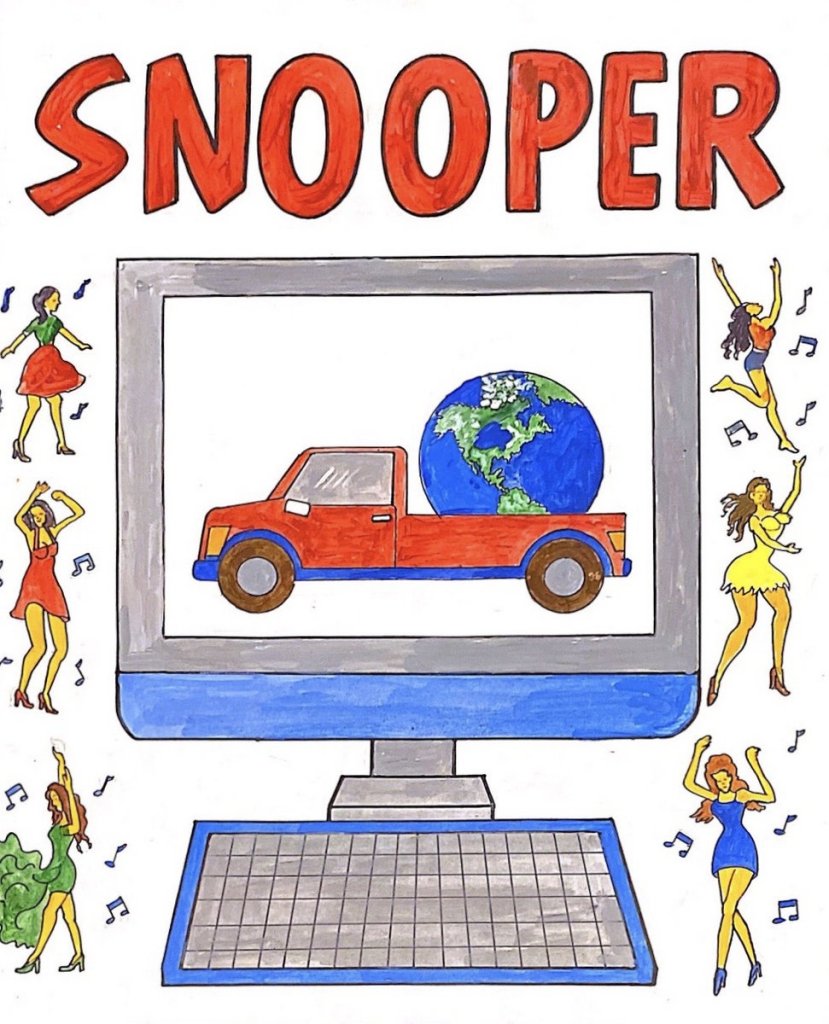
CC: It’s strange. It doesn’t feel really that different yet because when we signed with Third Man, we basically were like, we’re going to be really controlling still about everything. We changed all the art to exactly how we want it. We involved all of our friends from before. Like Ian Teeple, who did the second seven inch cover; he made the insert. Our friends from New York, who do a lot of posters for us, made the inner labels. We had to include everyone that’s been a part of this.
BT: What we care about now is keeping our original vibe the same.
CC: We don’t want it to seem like anything has changed, because nothing has.
BT: I do think it’s gotten more overwhelming. There’s a lot more emails, which is so hard for me personally, but Connor does a great job with all of that. Navigating this new element has been stressful because we really did go into this without any thought at all. So this was never something that we were like, we really want this and we’re prepared for, but it’s been great and we’ve been learning a lot. Connor does most of the booking, he’s basically the manager of the band, which he never wanted to do going into it.
CC: Yeah, I think we really won’t relinquish control because if we ever do, then the band is kind of over. It’s our baby that we made.
BT: My mind is completely not thinking about what people are expecting of us, I’m just more focused on getting things done.
CC: A lot of our friends work at Third Man Records, so it doesn’t feel like there’s any pressure. They all know us, and they know we’re going to do it exactly how we want to, for better or worse.
BT: But Third Man has been so helpful. We have all of the props around everywhere. Let me see if you can see this big phone [pans camera to giant papier-mâché phone in their living room] it’s all gotten bigger and crazier. Third Man has really helped us out because we were having to rent vans and stuff to go to even just local shows. They’ve lent us their van to go to a show. It’s been great.
The craziest part of all of this is that we are here making these crazy puppets and stuff, literally just for fun, and now people are giving us money to help us out with like, ‘Oh, you want a music video?’
How did you first become interested in puppets?
BT: I’ve been doing papier-mâché for a really long time and I used to just make random stuff. Actually, I would make a lot of masks, they would fit on your head, just have a hole on the top, it’s just hollow. I would think it was funny to put them on and take pictures around the house. My friends would come over and we just thought it was so funny. I was doing that for a long time. I really like Bread and Puppet Theatre; they’re a lot like Snuff Puppets. They make these huge puppets. We were looking at a video of theirs online one day and I was like, ‘Wait, I could just make a puppet backpack.’ So now it’s like this big PVC pipe thing and the heads fit on top of that and you wear it like a backpack and it has a big long pole. They’re really tall and you can move around in them.
CC: I was trying to think of how we got to the puppets. I guess one of the first things was actually the video game. [Turns to giant papier-mâché arcade machine sitting behind them].
BT: That was the first prop. We have a papier-mâché weight. It was really funny because the weight was the first thing that we used and people were so responsive. When I would bring out the weight on stage, people were like [does funny actions] and it was just fun. We started wanting more moments like that with the audience.
CC: I used to get in trouble at the beginning of the band because people would be so excited that I would throw the weight out in the crowd and they would go crazy, but then it would just get destroyed.
BT: ..and I’d be like, ‘No, I have to make another one!’
CC: They would tear it apart in like two seconds.
Is that the same weight that’s in the ‘Fitness’ video clip?
BT: Yeah. I’ve probably made 30 of them now…
Wow!
BT: Someone would get excited and throw it off the stage or someone would grab it, and it was always chaos. Now I’m a little bit more protective over it, and I place it behind the drums when I’m done with it. Everything is so delicate because it’s all just papier-mâché. In the back of the van, it’s just me constantly being like, ‘Oh, no, what was that?!?’ And then having to get out the hot glue gun or make repairs on the way.
CC: That’s a funny thing that’s kind of been brought up recently, the guitarists all have our pedal bags and stuff, and then Blair now has this big bag that has duct tape, glue gun, paint, all this stuff; that’s her pedal bag [laughs].
BT: Everything is very lightweight. People will come pick up the props, like these big guys, and then they’re like, “Wow, it’s really light.” And I’m like, ‘It is, it’s all paper!’
What’s the story behind the cover image on Super Snõõper?
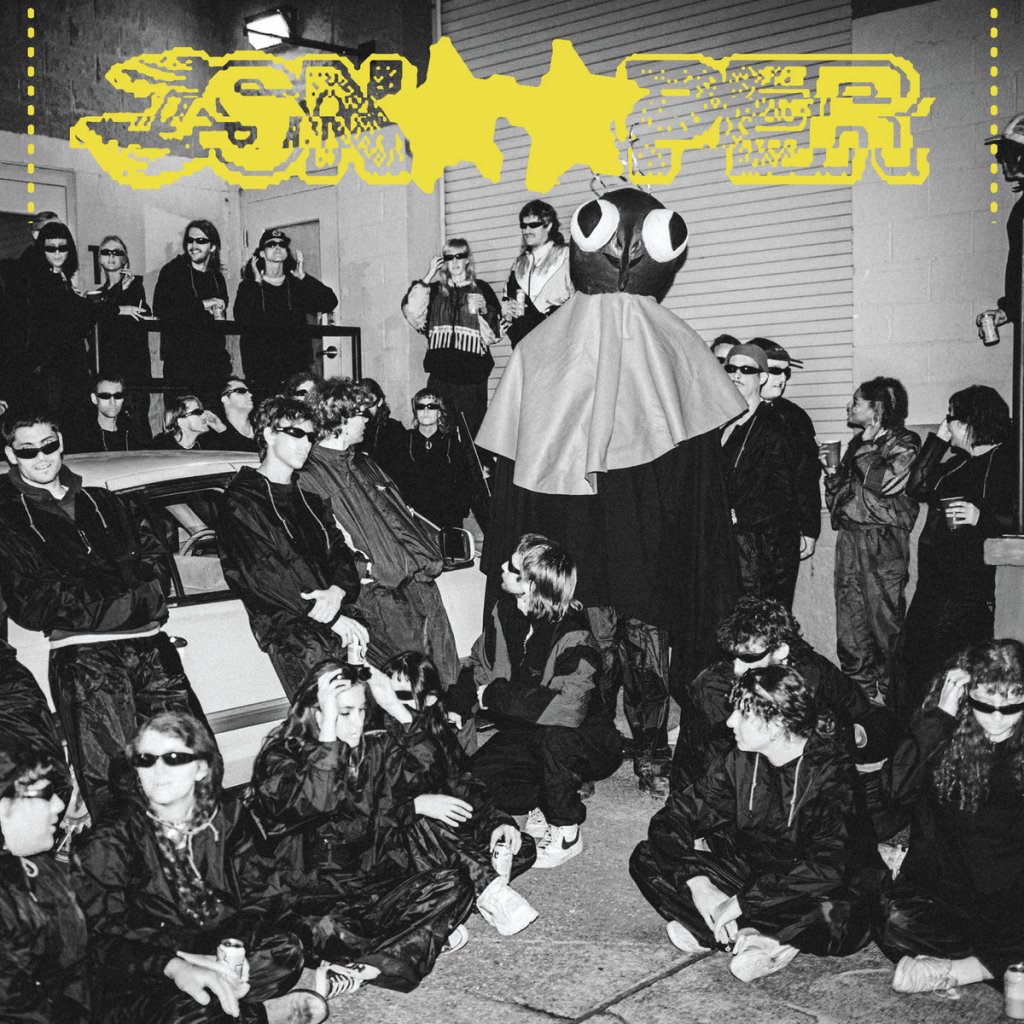
CC: That image is from outside of a venue here called, Soft Junk. That’s an art space that’s really cool. That’s where we do all of our shows; the sound is good and it’s DIY.
BT: It’s the best space!
CC: Everybody can bring their own beer. It’s a really cool venue. You’ve maybe seen it in pictures; it’s got two stories. It’s really fun. There’s giant hands in the background. There’s a picture of us playing live, well it’s not actually of any of us, but it’s a picture of The Bug, and he’s in the crowd.
BT: We love that picture so much!
CC: We thought that picture was so cool. We were like, we should recreate this for the album…
BT: But with everyone in tracksuits, because we had been wearing tracksuits for a while at that point. We got there and then we started doing all the shots in the exact way we had envisioned them and immediately we were like, ‘Oh no, this looks like a cult photo or something.’ It got real spooky real fast. The photographer was so sweet. She’s like, “Everybody hold hands around The Bug.” She’d be like, “Put the hoods up. Put your hands down.” We were like, ‘This looks so weird.’ So we kind of tried to loosen up and go outside for a couple of shots.
CC: Everyone was taking a break and the photographer was like, “Hey, let’s just try some out here.” It just looked cooler.
BT: You should have seen the first ones, it was cult Bug worship [laughs].
All the songs on Super Snõõper are from other releases except for all the ‘Stretching’ kind of sample interludes…
BT: Yeah. The way we do the live set now is that we don’t stop in between songs, but we have to tune, so we started making samples that go in between the songs to give us 30 seconds to tune our guitars, take a sip of our beer and then get ready for the next song. All the ‘Stretching’ parts are samples that we’ve made at home.
Do you have a favourite sample you’ve used?
CC: The second one. I actually don’t know the song we took it from, but it’s an old country song. The lyrics are: all the roads lead back to Nashville. It’s really funny because sometimes I think people don’t really know where we’re from, they think we’re from LA or something [laughs]. No, we’re actually from Nashville. People are always really surprised. I like to keep the hometown pride going.
There’s also the Suburban Lawns cover you do!
CC: Yeah. All the other songs are from the seven inches except for the cover of ‘Unable’ by Suburban Lawns. The set is laid out in a specific way where all the songs should flow. There’s the intro sample, then there’s ‘Bed Bugs’ which goes into ‘Pod’ which goes into ‘Fitness’. Then there’s the break and it’s kind of like mini sets. The first three songs should all be listened to kind of back-to-back. The middle four songs should all be listened to back-to-back. Live, it all flows.
BT: We’ve put a lot of thought into our live set, which is what the layout or the track listing on the record reflects, how we play it live. It’s very specific because we want to keep our stamina and energy up and we’ve calculated what’s feasible in this first set.
CC: It’s almost more of a theatrical play or performance. We can’t really switch up the songs. When people come to multiple Snõõper shows, it’s usually like the same set. We might switch the first and middle song, but the set has to flow the right way to give you the full experience of how it’s supposed to be.
You re-recorded the songs for the album?
CC: Yes. On all the seven inches, it’s me on all the instruments and Blair singing and doing some of the samples. On the LP is the full band. Our bassist Happy and our drummer Cam, have added little parts and stuff…
BT: The songs are faster and have more energy because we feel more confident playing them now. I personally have had such a hard time listening to this record. There was a night where Connor and I came home, we put it off for a really long time listening to it, and we would send it to the rest of the band and be like, what do you guys think? And let them make edits. It’s kind of embarrassing to say, but it was so hard for us because it sounds so different than the way we first recorded them. We put off listening to it forever, and the rest of the band would be like, “Have you guys listened to the record?” And we just wouldn’t text back. So we had to listen and we didn’t even make it through the whole thing. As soon as it sounded a little bit funny to us, we were like, oh, we can’t do it.
CC: The demos were hastily recorded, I would record the song and then Blair would be like, I’m stoked, I’m going to do vocals right now. She would do vocals and then we would just upload it and not mix it or master it. We would rush it so fast because we were just so excited, and now….
BT: …now we’re thinking about it! So back to your question earlier, now we’re thinking about things and it’s just so hard. When we were doing it the first time, we weren’t thinking about it at all and it sounded perfect to us because there was no thought or expectation. It was great. Listening to this record we’re like, I wonder if people are going to like it.
CC: These songs now on the LP are like how they should be. Sometimes when I listen to the demos, I still really love the way they sound, but I’ll be like, that was a terrible drum take. I was just excited. So I was like, I don’t want to redo it, I just want to move on to the next thing.
BT: I’m confident in the way that the new record sounds and confident enough to not really overthink it.
CC: We did the LP recording in four days. We didn’t spend too much time on it. We only did one day of overdubs and we were like, let’s just do it like we do live and not think about it too much.
Did you record it yourself?
CC: The entire band recorded it.
BT: At our friend’s studio.
CC: Erik Nervous came down and mic’ed everything and produced a little bit.
Nice. I’ve seen lots of people online call Snõõper, nerd punk. I also saw a person had commented: This band is about to blow the fuck up.
BT: [Laughs] That’s so funny. It’s really nice. The internet community has been so nice. I’m always looking at comments being like, are they going to say something mean? And then people say such nice stuff. I’m shocked that everyone’s been as nice as they have. The internet has gotten nicer lately. Something is up [laughs]. There was a time where people were being so mean on the internet, lately we’ve experienced everyone being pretty nice on there.
That’s because you’ve made something amazing!
CC: Aw, thank you.
It sounds so cool. I had to get used to the album though, because I’m used to hearing the seven inches and then also seeing the live videos. The album seems more polished.
CC: It’s just because it wasn’t on the 8-track in our living room. I feel like in some ways it’s a little bit of a curse because we didn’t really mean for it to sound that lo-fi. I learn more about recording every time I record. We just put out the single ‘Waste’ right before the album and I was like, ‘Okay, only sounds like how I think the 8-track should sound.’
BT: We’re going to continue recording in the way that we always have, that’s the plan for Snõõper. Something we don’t want, is for people to listen to this and be like, ‘Oh, they’re doing something different now’—we’re not. The way we look at it is, this is for some people and then our 8-track or original recordings might be better, more geared for other people.
CC: We would show early recordings to people who didn’t get it and they would be like, “This sounds like shit recorded with your cell phone. This is terrible.” We were like, maybe we should make the record where it’s the same songs but just digestible for other people.
BT: There was a reddit thread that was so funny, our friend sent it to us and was like, ha ha; did you see this?
CC: It was like, “Would this band sound good if it didn’t sound like shit?” And they continued “It sounds like shit, but it works for them.” We were like, ‘Okay, that’s kind of a compliment, I guess.’
BT: We live pretty close to a music school called, Belmont. They do a lot of audio engineering. The thread on there was popping off. People were like, if it was really polished, it just wouldn’t be the same.
CC: We were aware of that, that’s why we were nervous about the LP. It was actually really scary. We were like, ‘Are we going to alienate everyone?’ And they’re going to be like, “Oh, they did big production. It’s not good anymore.” The response has been so good that I don’t care anymore. It is what it is. Can’t do anything about it now.
I read another comment online and they said that you sound like Ween.
BT: That’s the highest compliment. I love Ween. And Connor loves Ween now, too.
CC: We were listening to a lot of Ween when we made the second EP. Like ‘Fruit Fly’ is kind of a Ween song. And our covers that we do, I feel like, not ‘Unable’, but the ‘Come Together’ cover and ‘Bring Me Down’ are very Ween inspired.
Do you have a song on the LP that you really love?
BT: Let’s see, so ‘Fruit Fly’ is my favourite Snõõper song, but it’s not my favourite re-recorded song.
CC: I think ‘Powerball’ is my favourite off the album. I think it sounds way better in the demo.
BT: I mean, ‘Pod’ now sounds like a real song to me. I like ‘Pod’. It was our first single, I’m going to go with ‘Pod’.
Is there anything else you’d like to share with me?
BT: I think we’ve covered everything. Thank you so much for listening to us. We’ll be meeting you soon! We’re so excited.
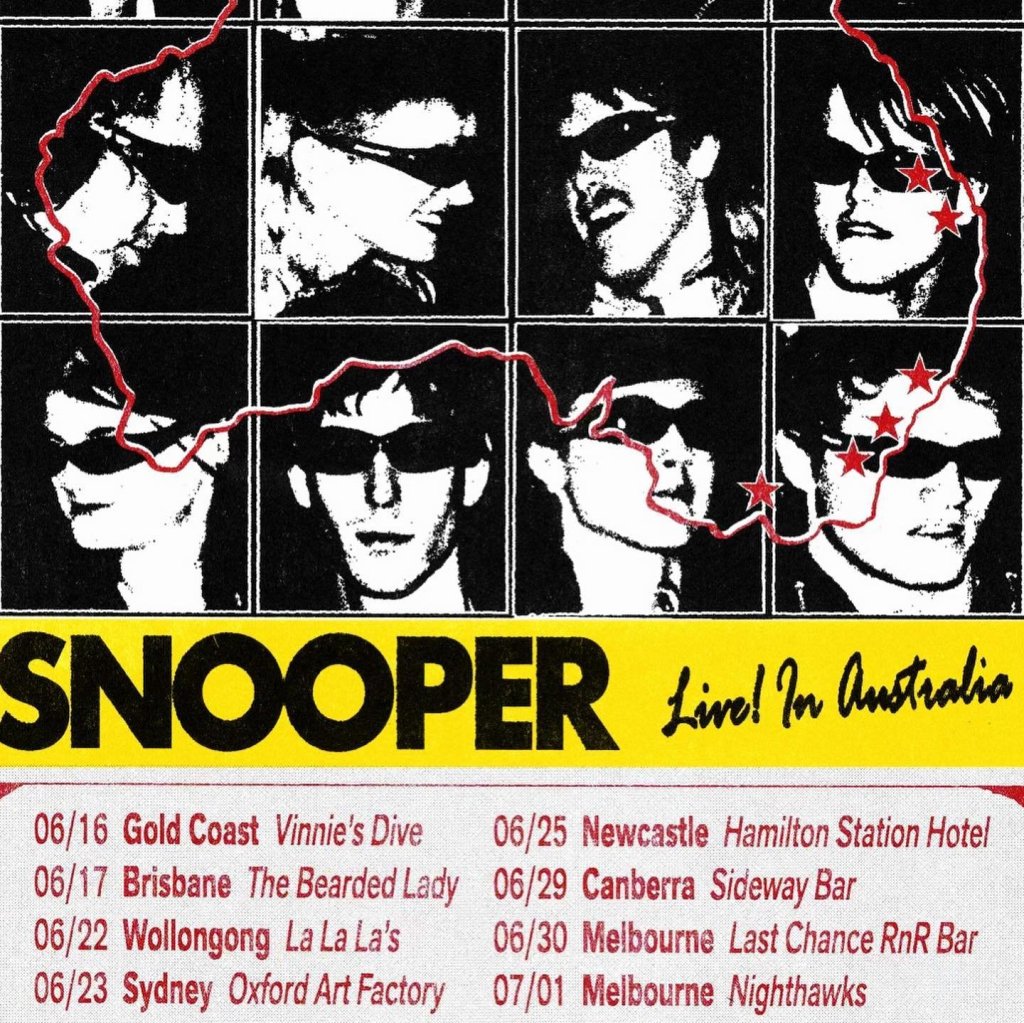
Snõõper’s album Super Snõõper out now on Third Man Records. Follow @snooper_7. Find Snõõper on bandcamp. On tour in Australia now: GET tickets.



 Gimmie Gimmie Gimmie Zine