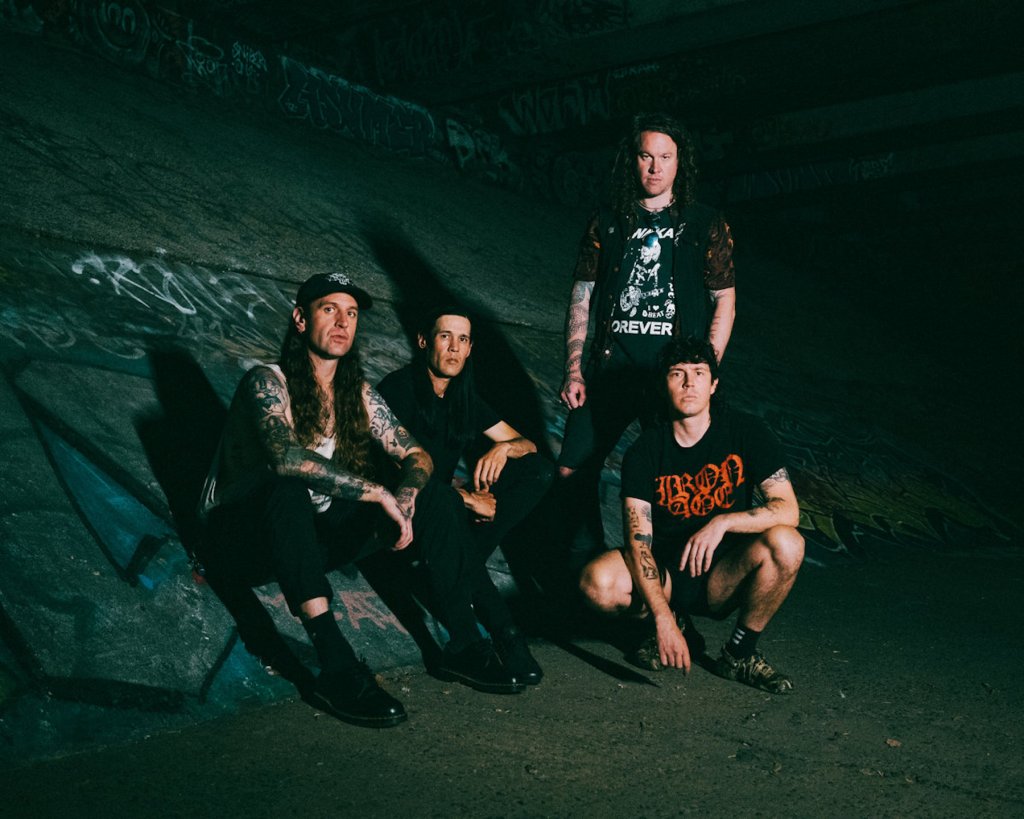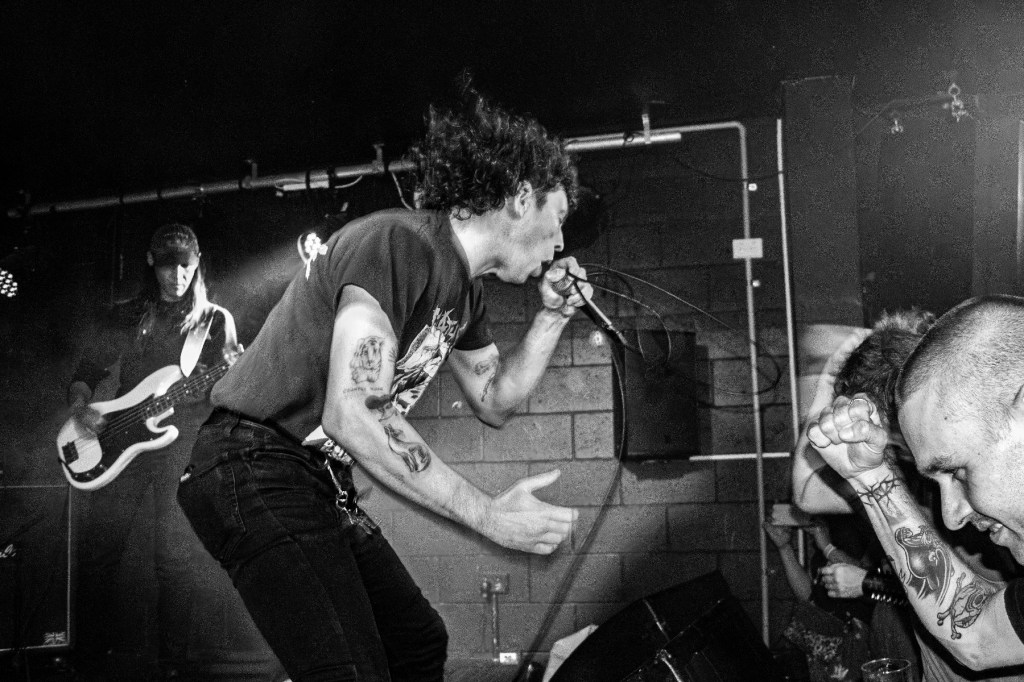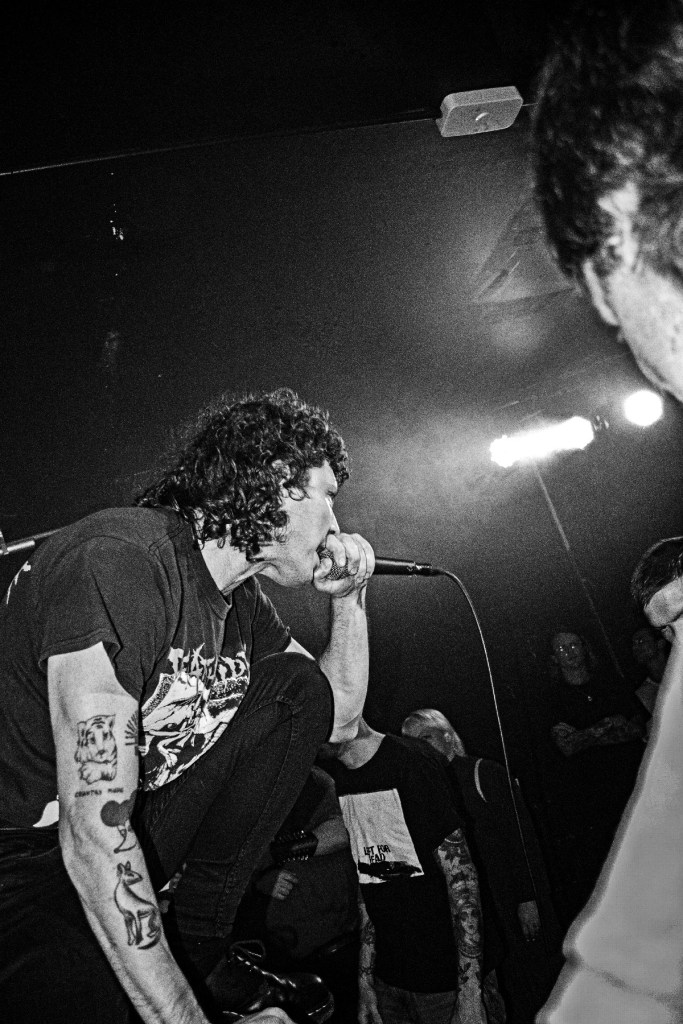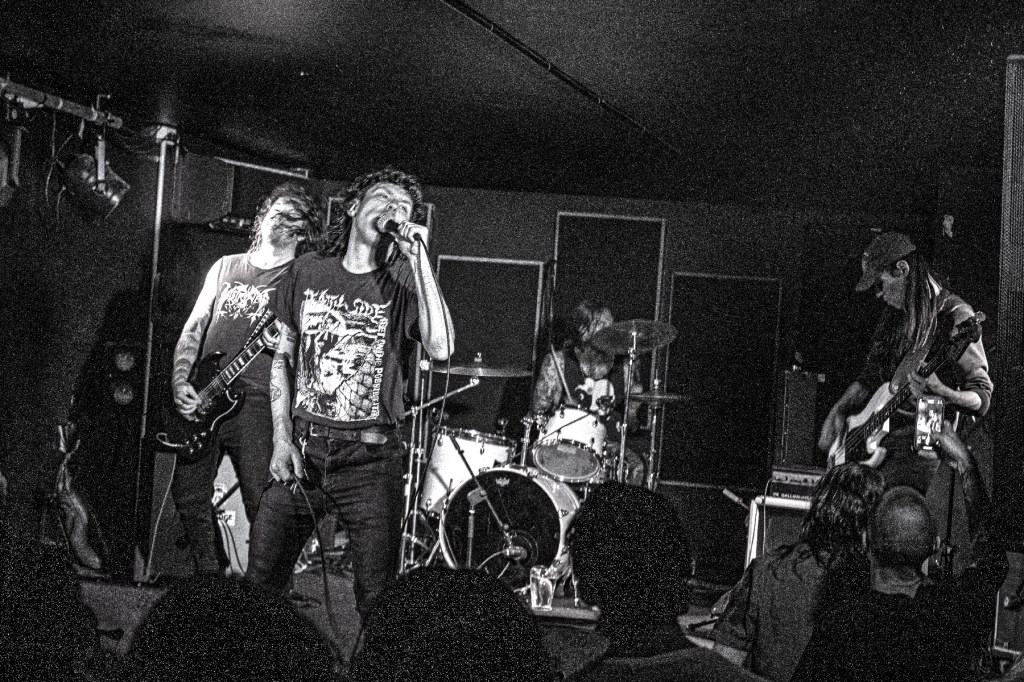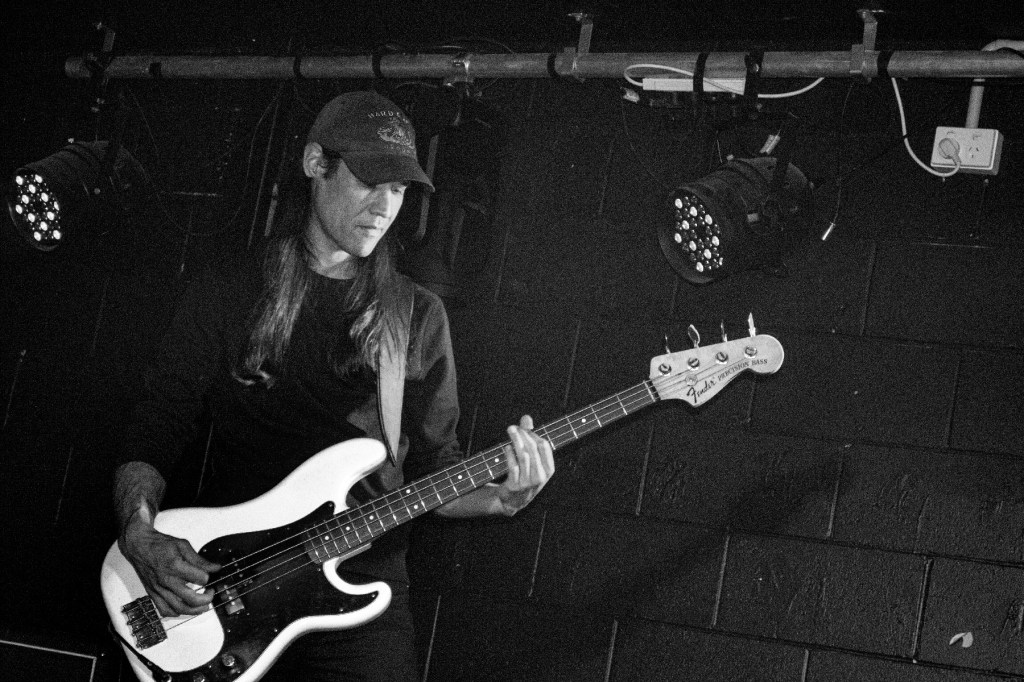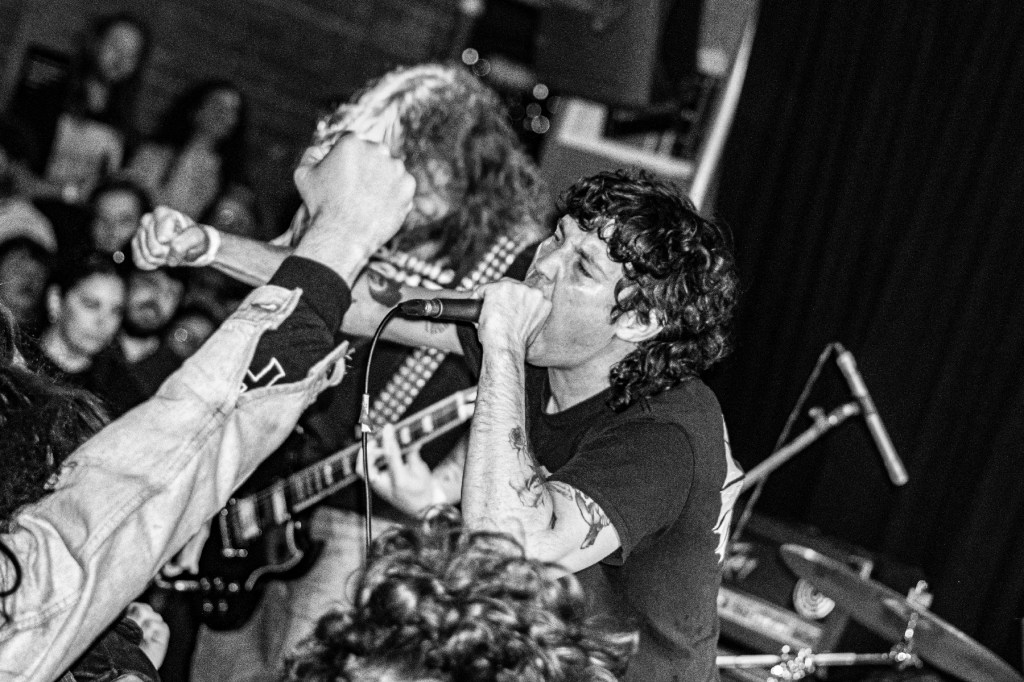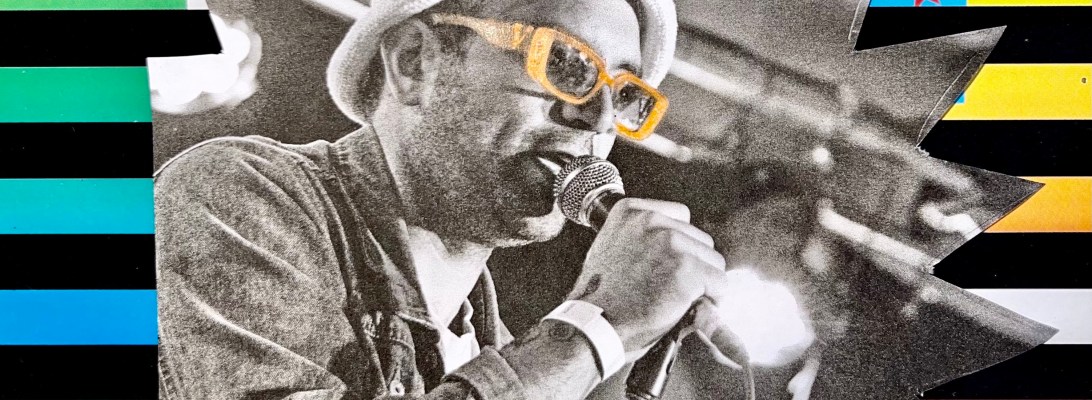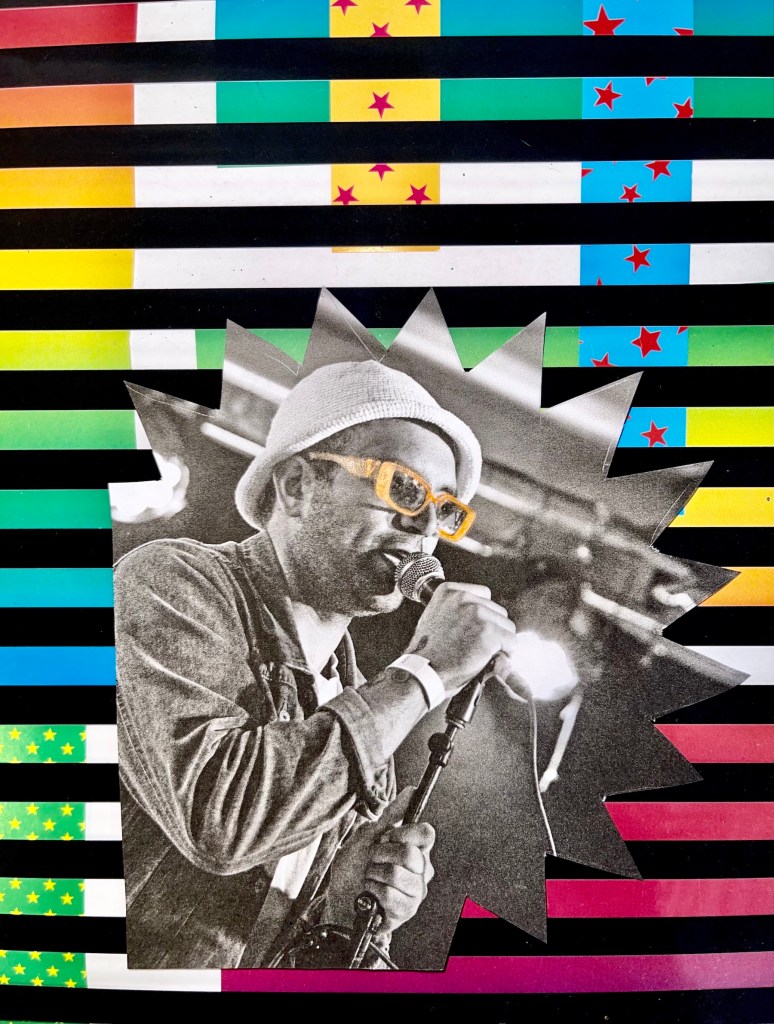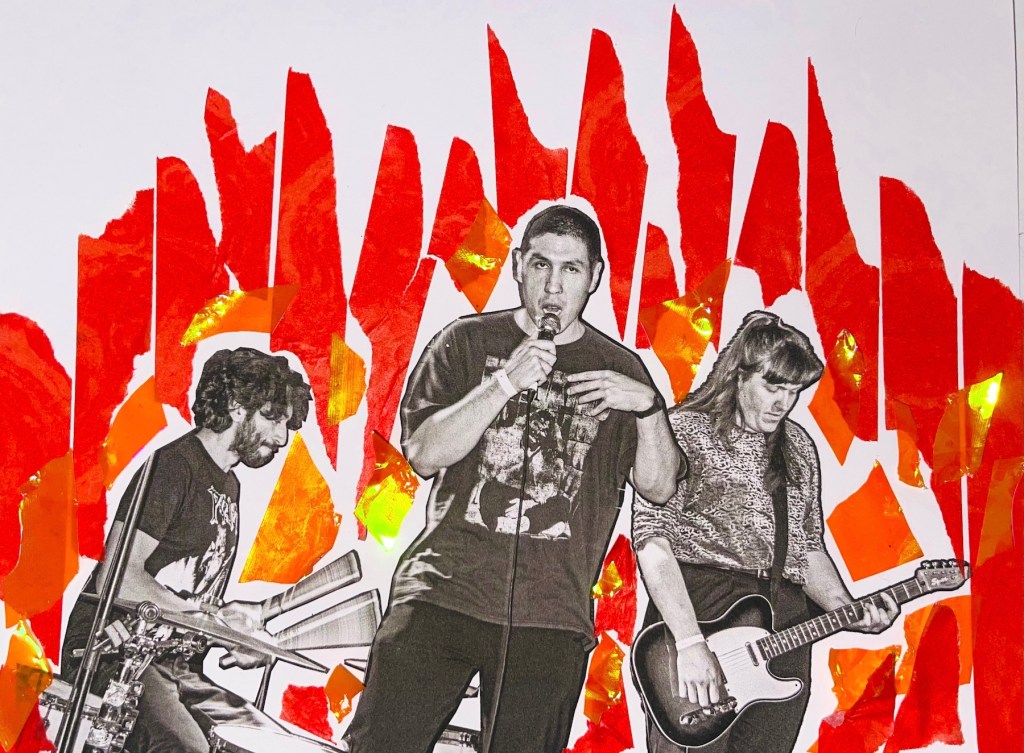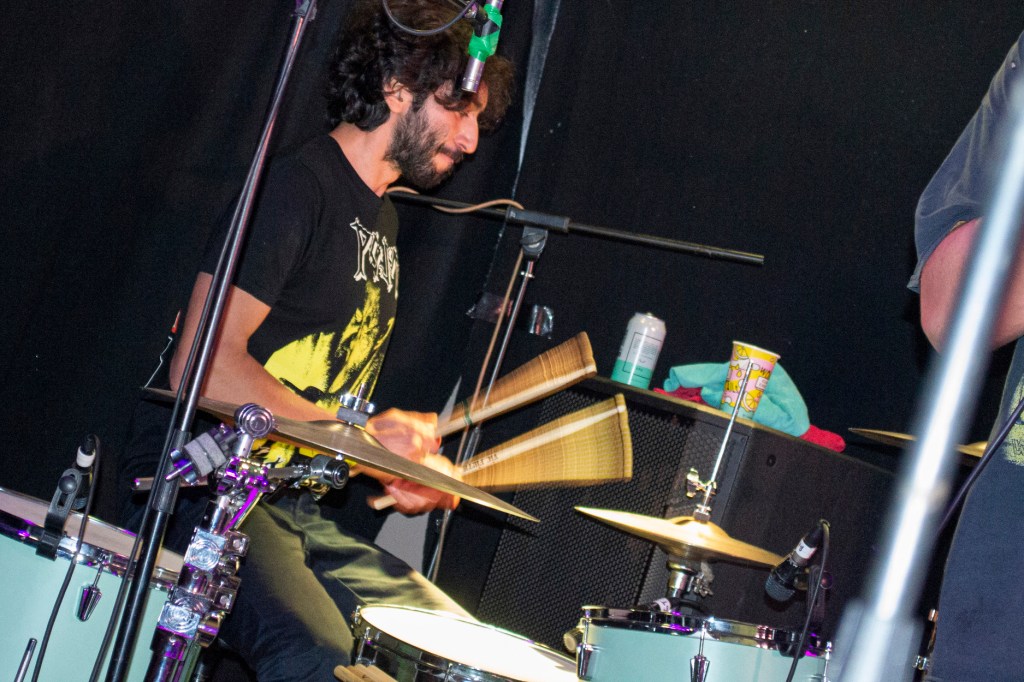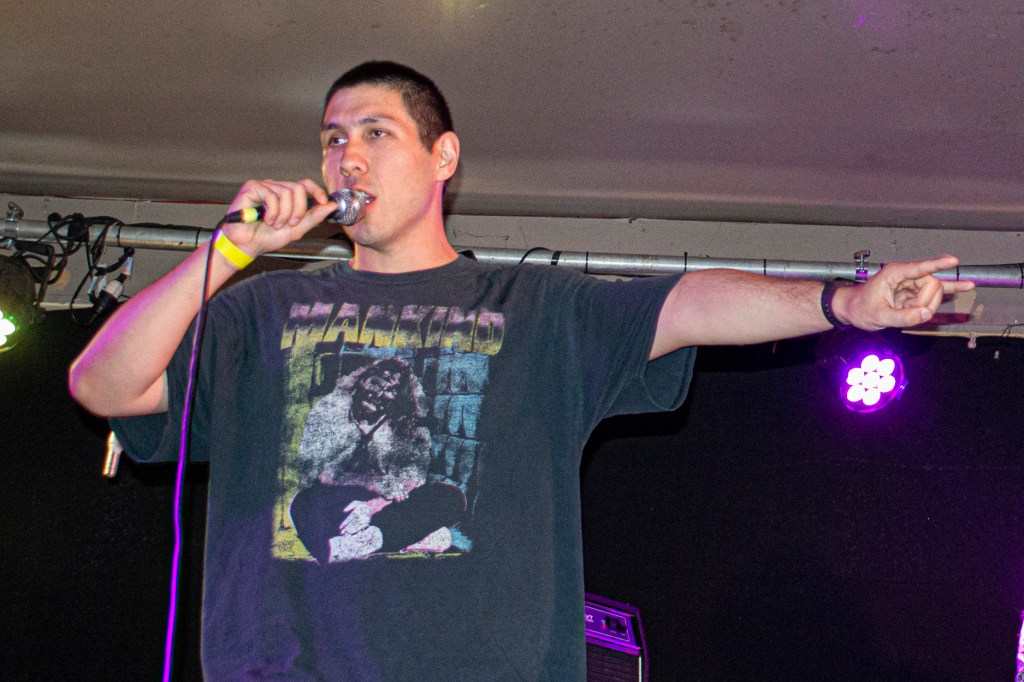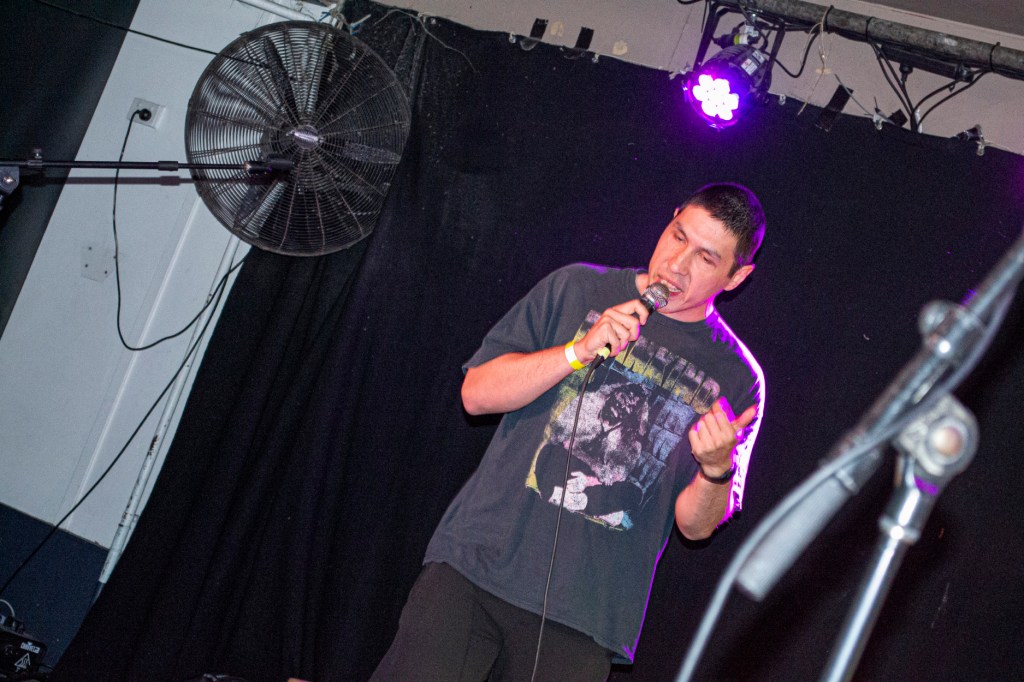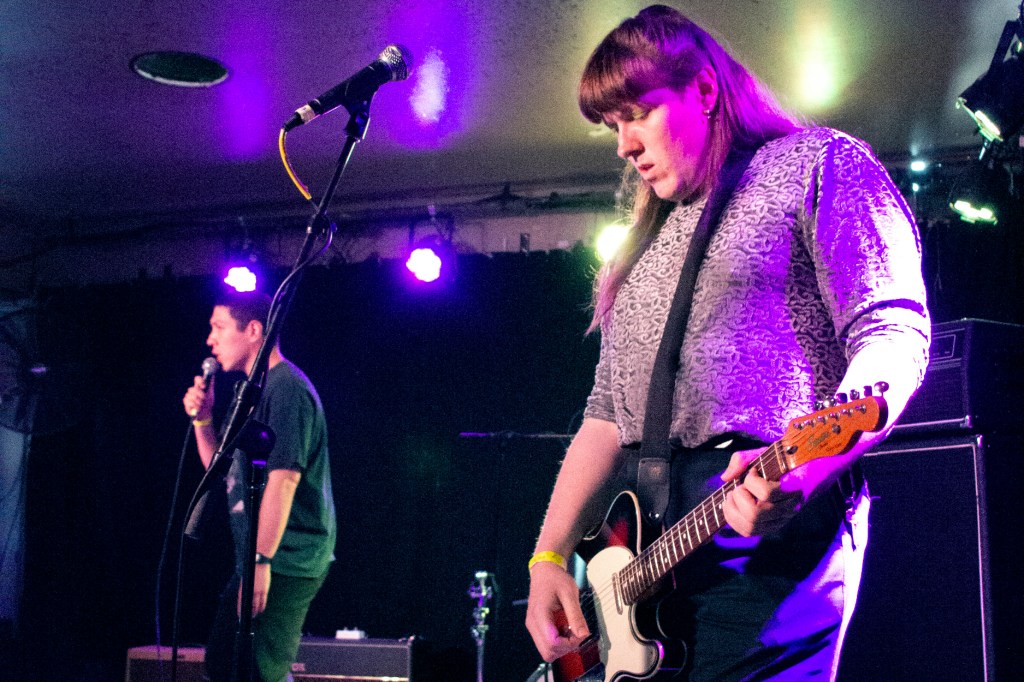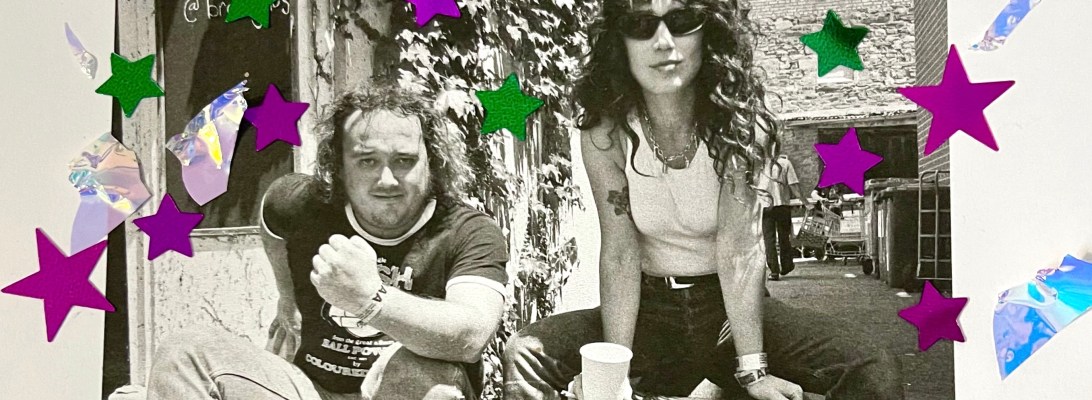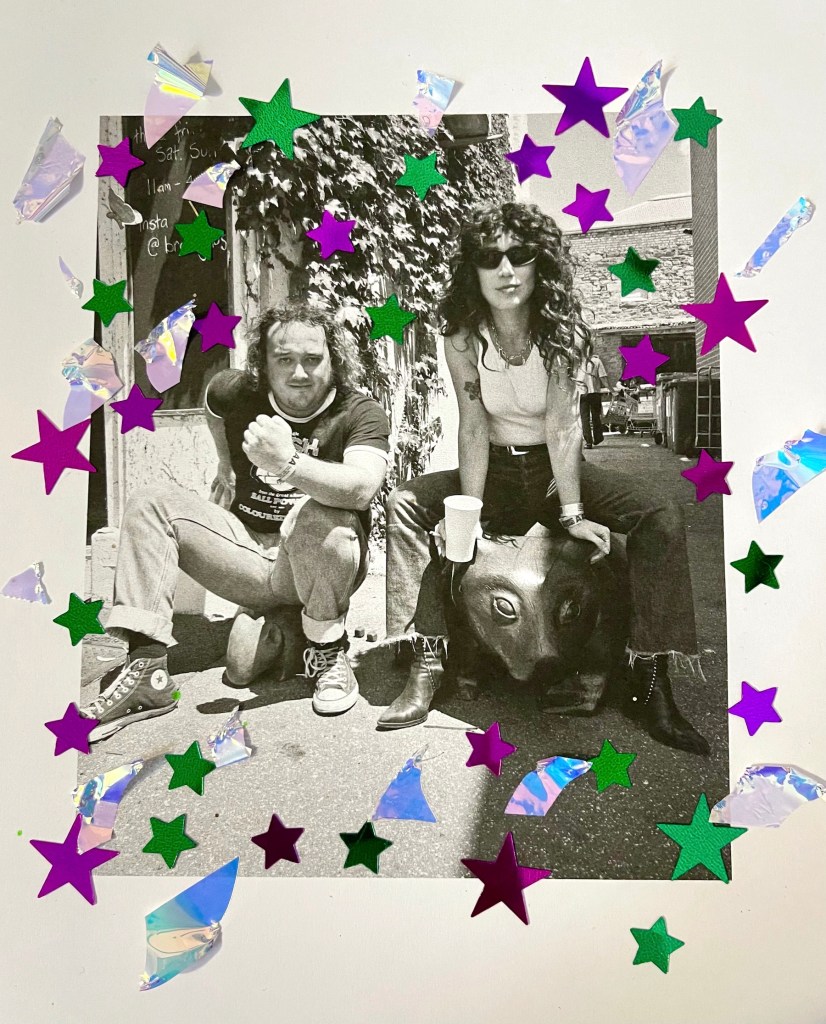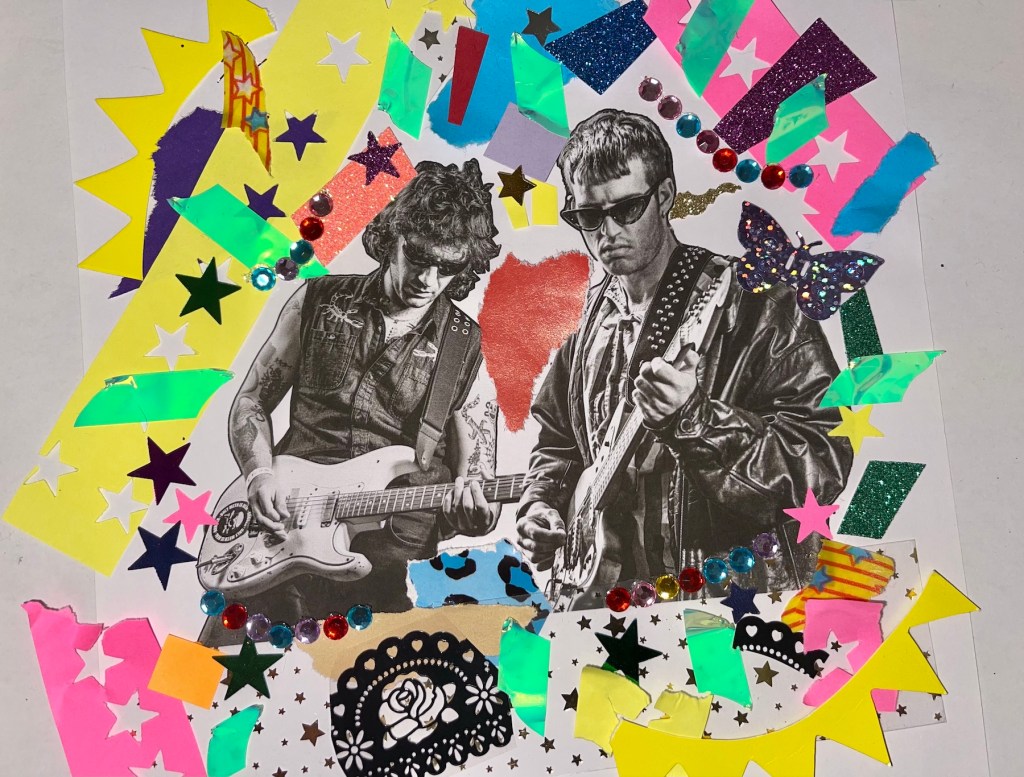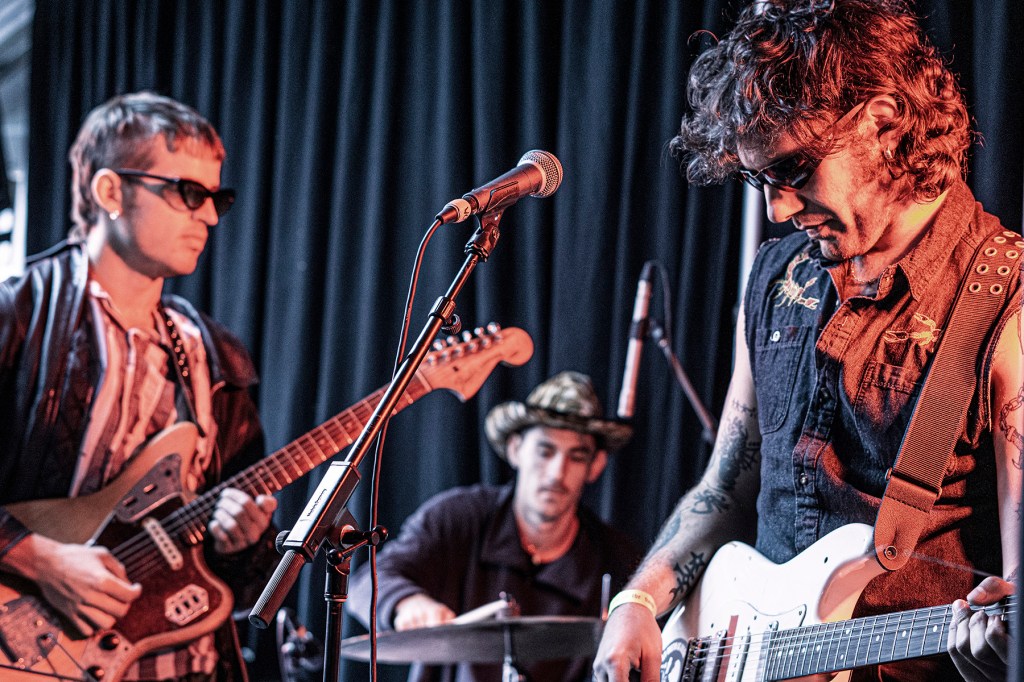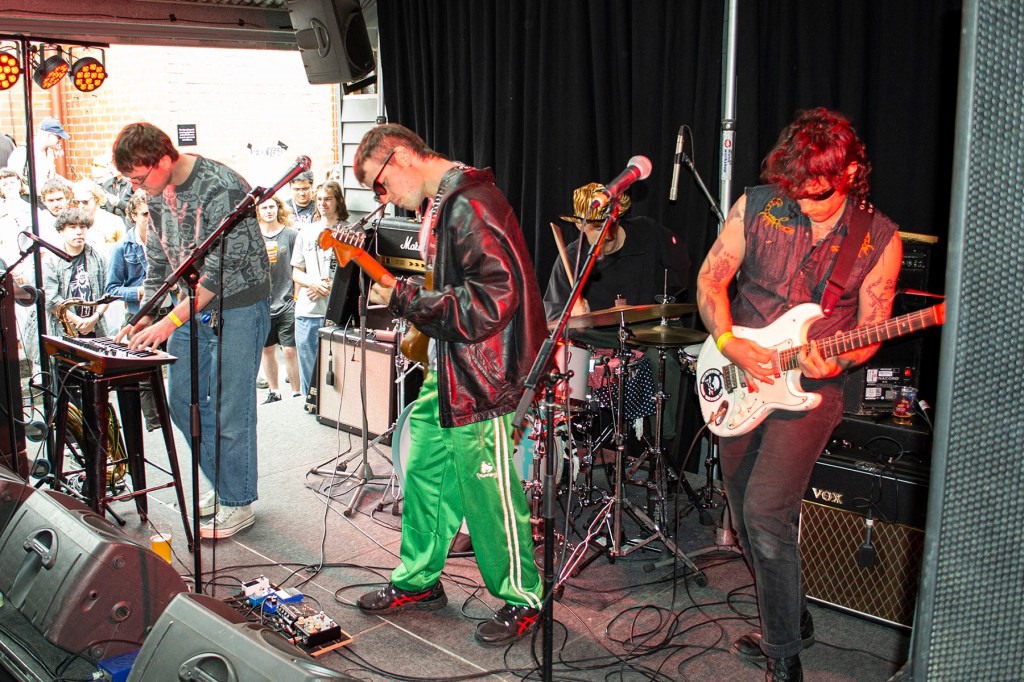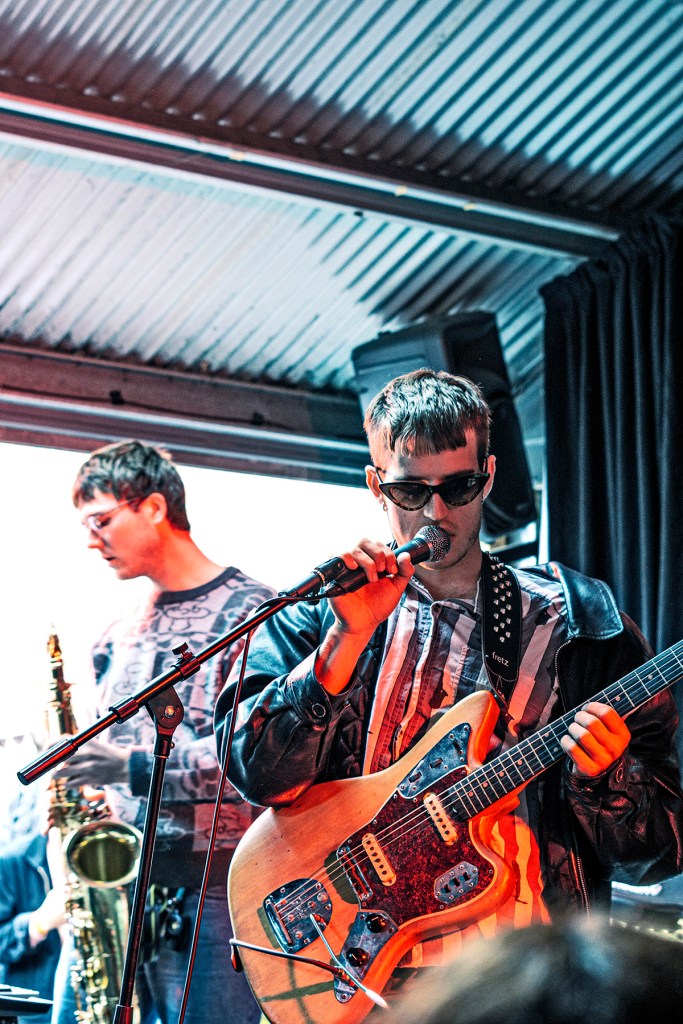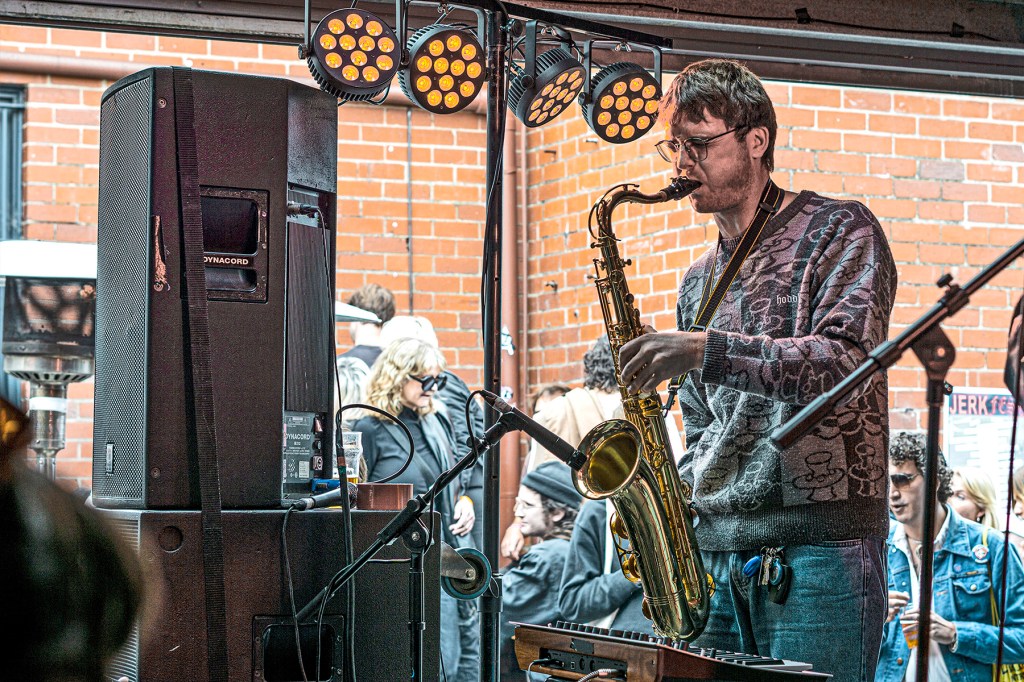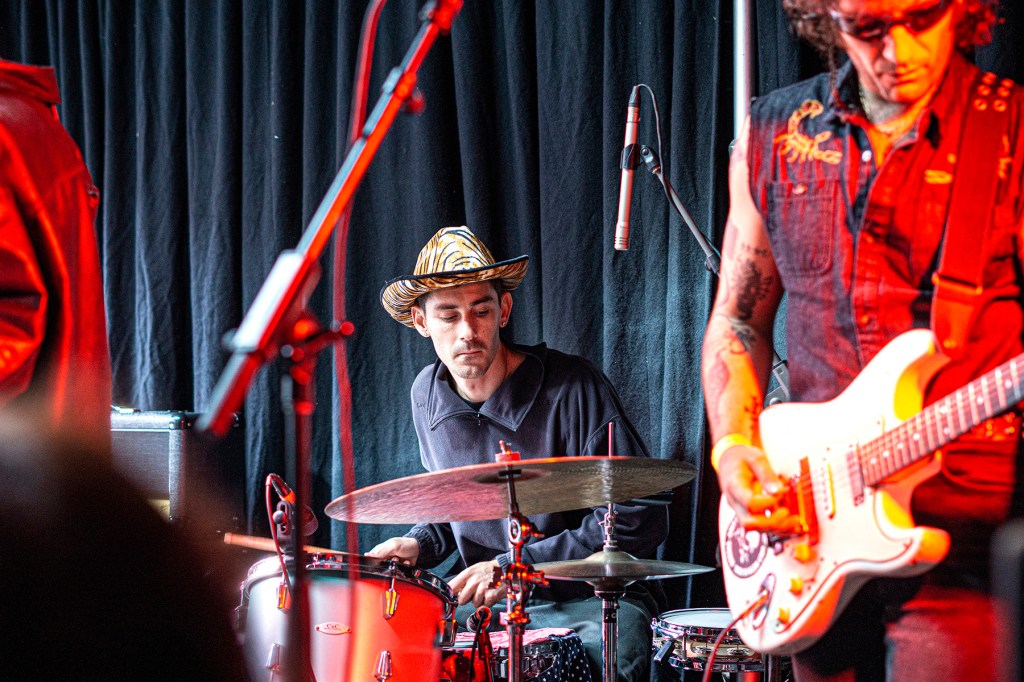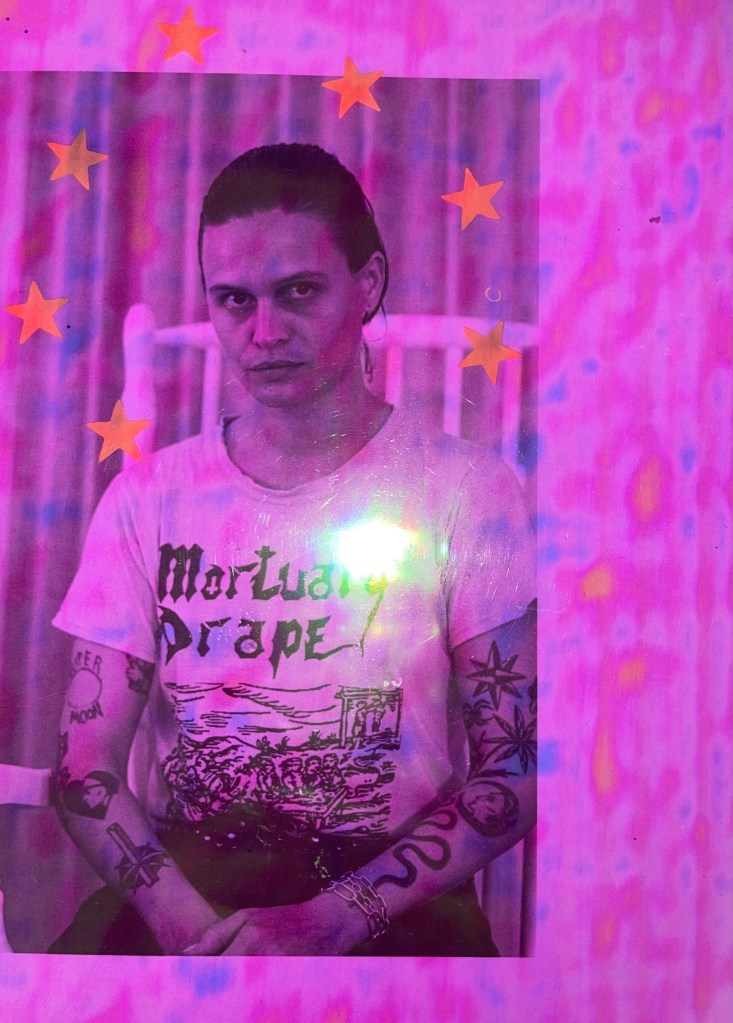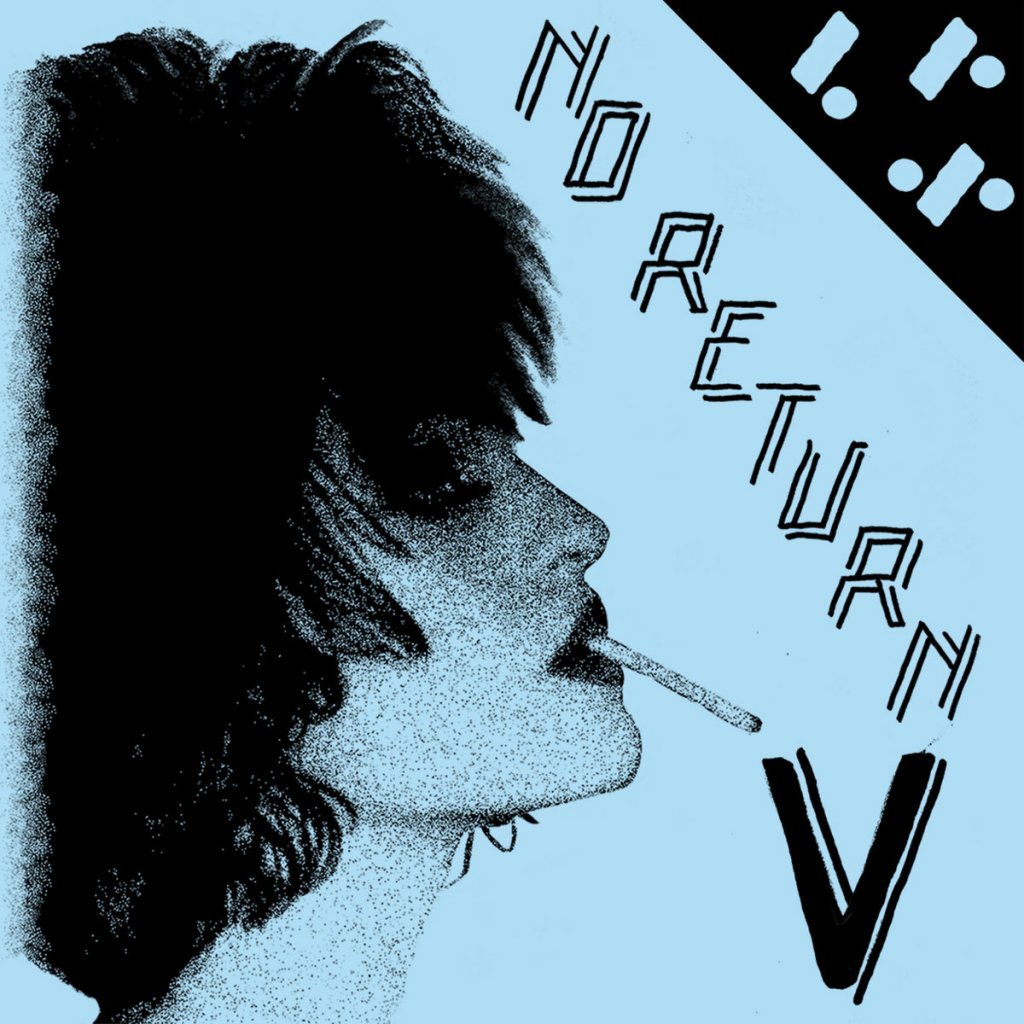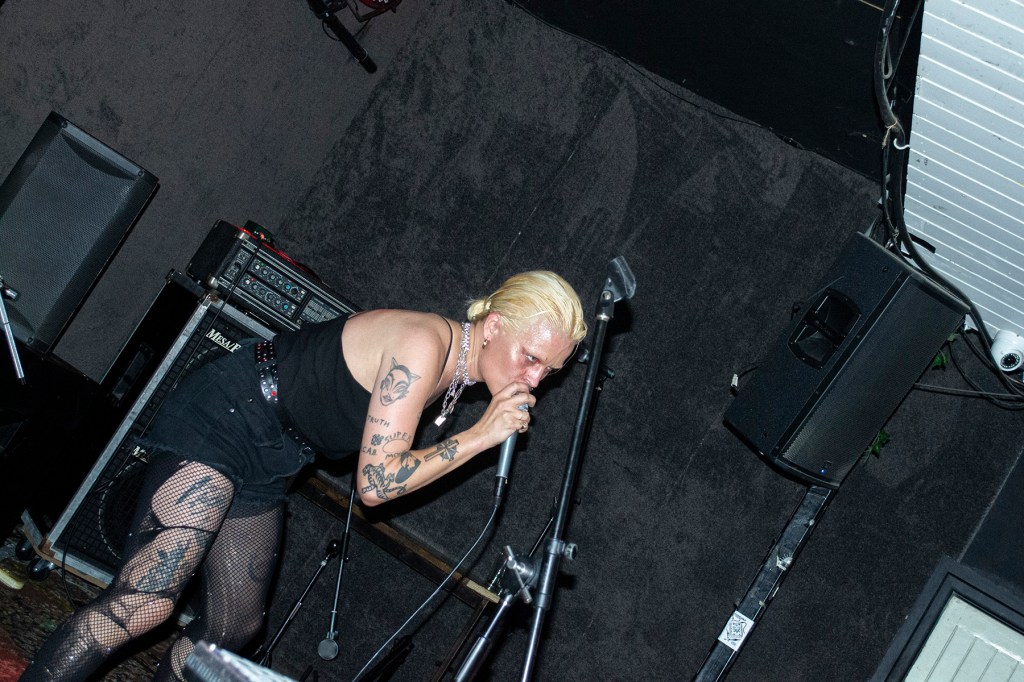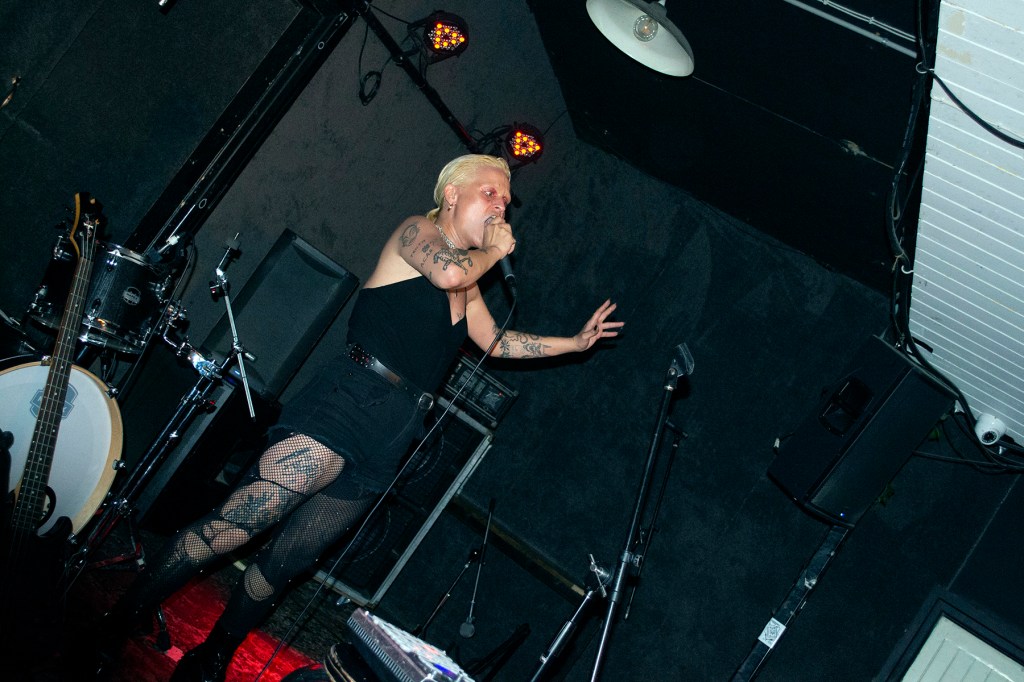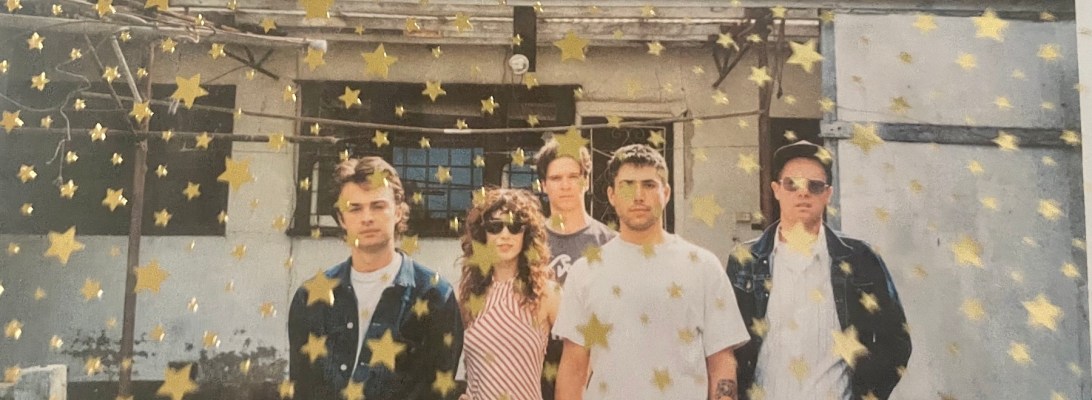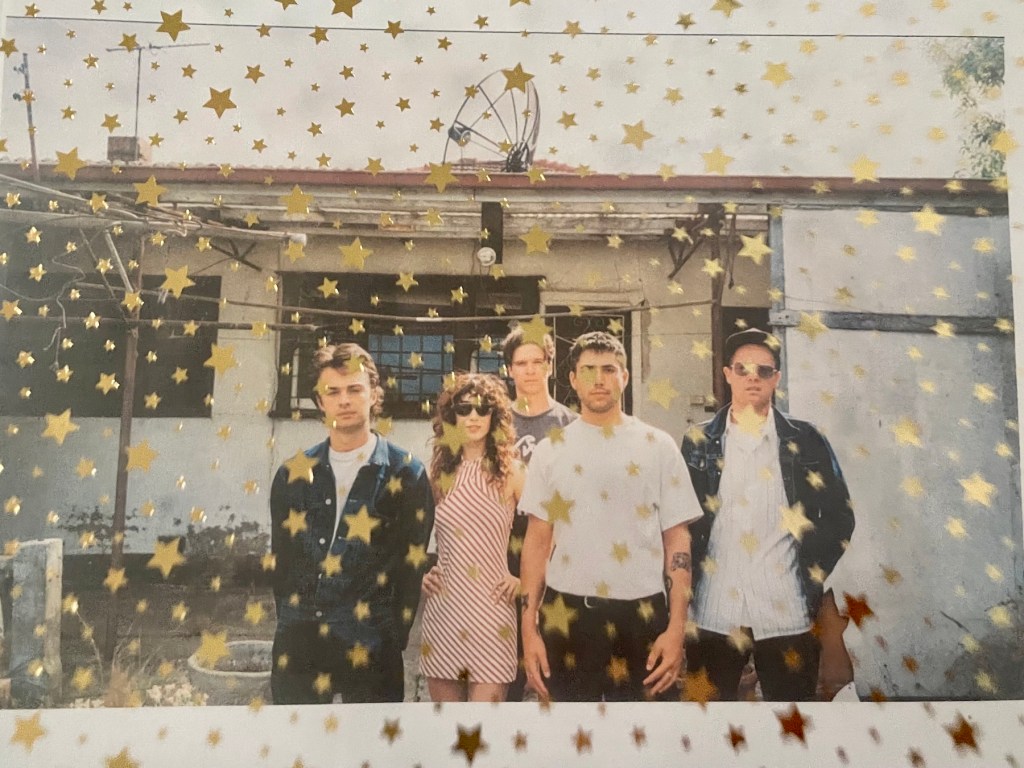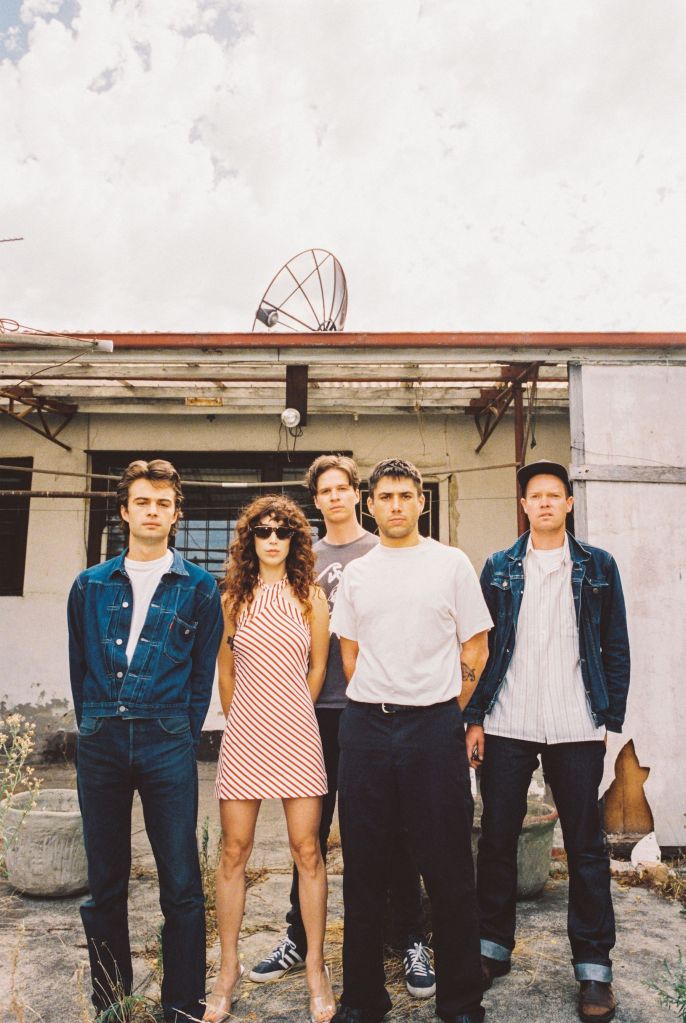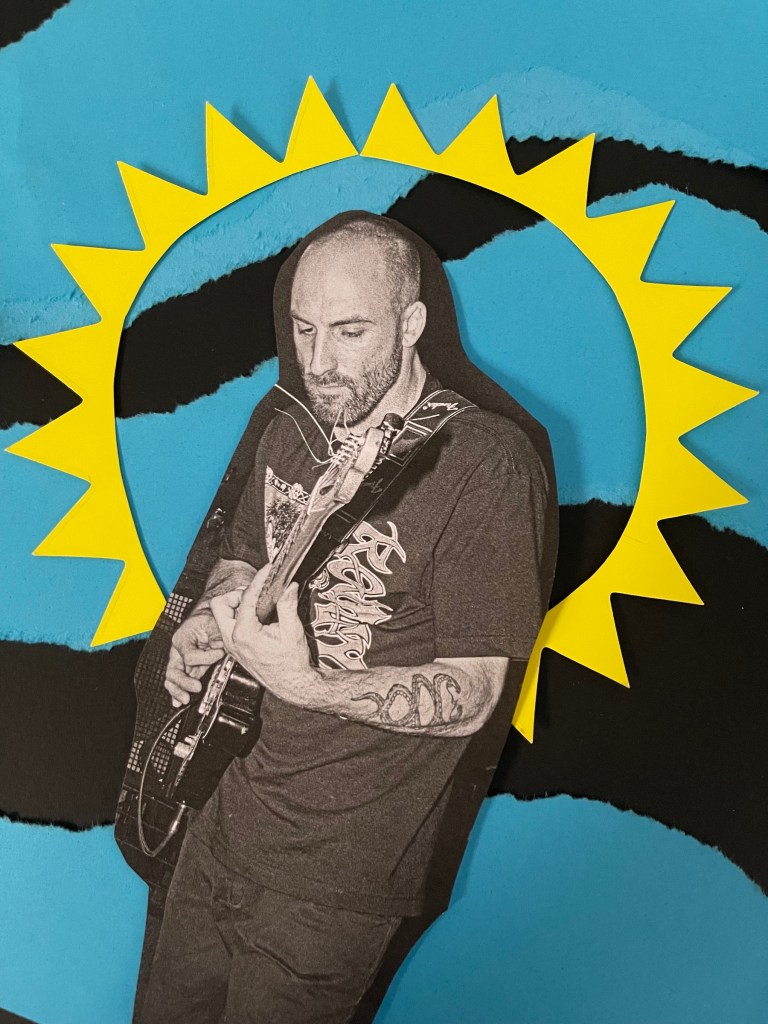
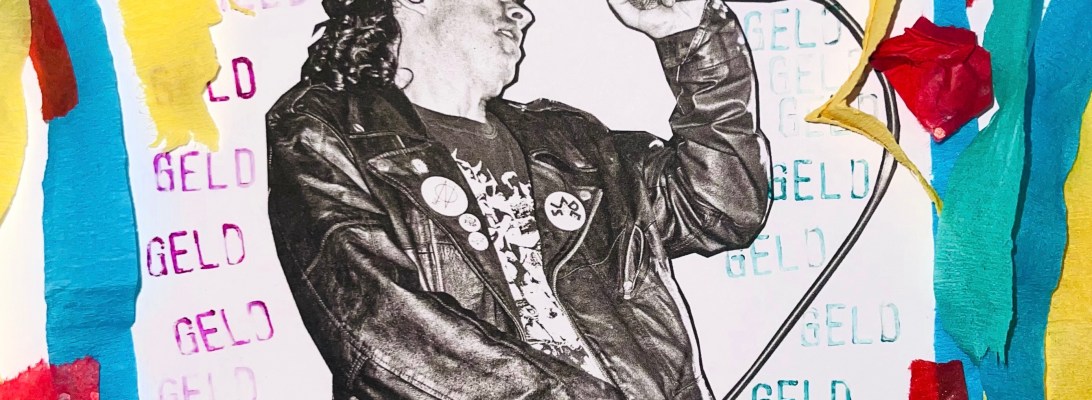
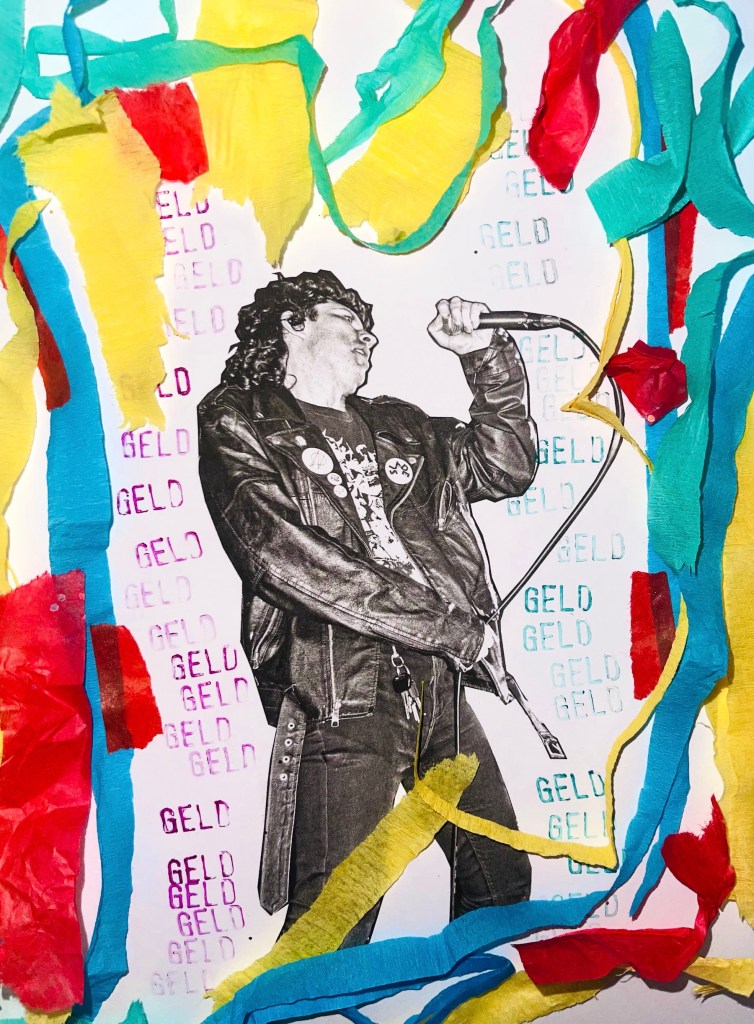
Original photo: Maclay Heriot / handmade collage by B.
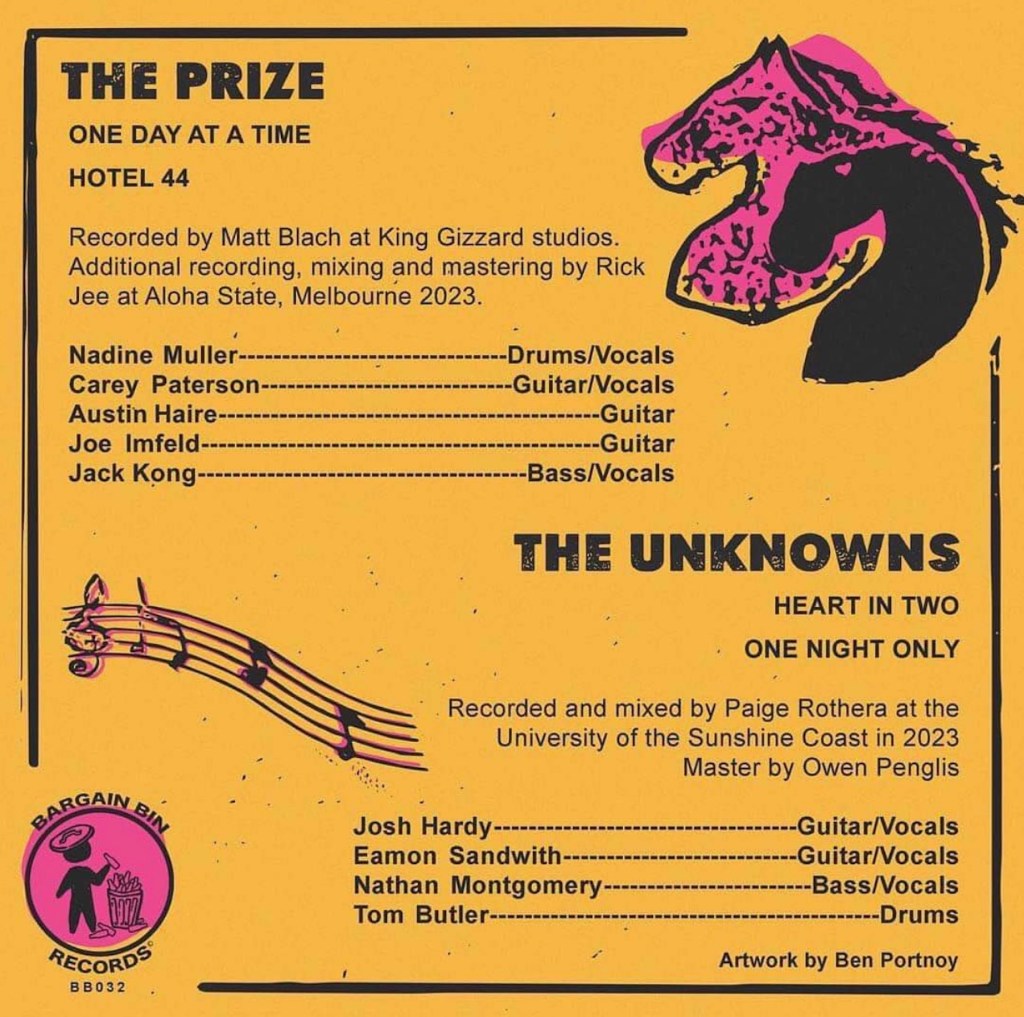
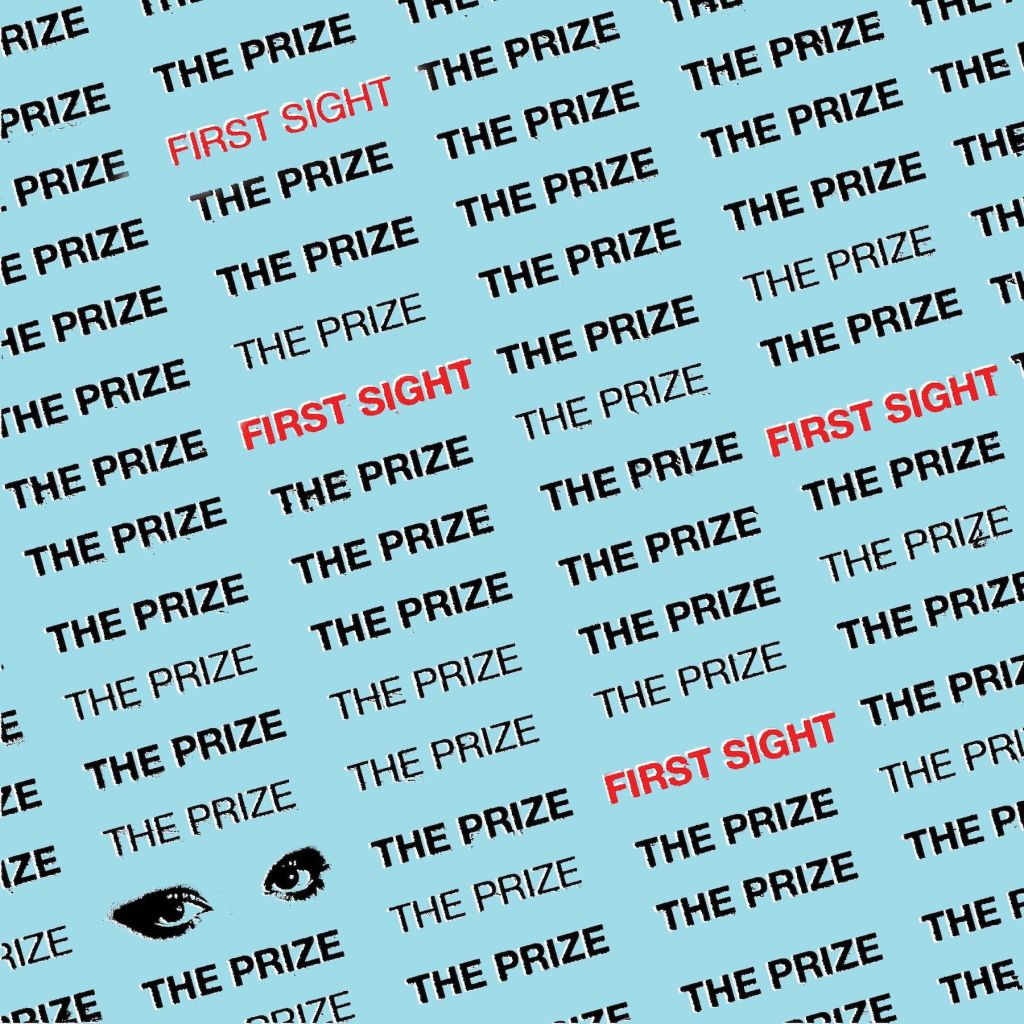
The raw rock ‘n’ roll energy of The Unknowns and the infectious power pop of The Prize are exceptionally well-matched on their new release—a 7-inch featuring two tracks from each band: The Prize’s ‘Hotel 44’ and ‘One Day at a Time’, alongside The Unknowns’ ‘Heart in Two’ and ‘One Night Only’. Drawing inspiration from the rollercoaster of touring life and the complexities of relationships, this collection captures both the struggles and euphoria experienced along the way.
Gimmie sat down with Unknowns’ guitarist-vocalist Josh Hardy and Prize’s drummer-vocalist Nadine Muller, who were indulging in some day drinking, to discuss their recent activities and upcoming plans for the near future.
NADINE: We’re getting drunk now, at 12:32 on a Wednesday! Josh just moved to Melbourne.
JOSH: Me and my girlfriend moved down about three weeks ago. It’s been really good so far. I spent so much time here so it’s pretty fitting I moved.
NADINE: I’ve been hanging out with this guy a lot. We’ve been rehearsing a bit now with the tour starting next week. Josh and I have had a couple of jams too.
JOSH: We’ve been rockin’!
[Laughter]
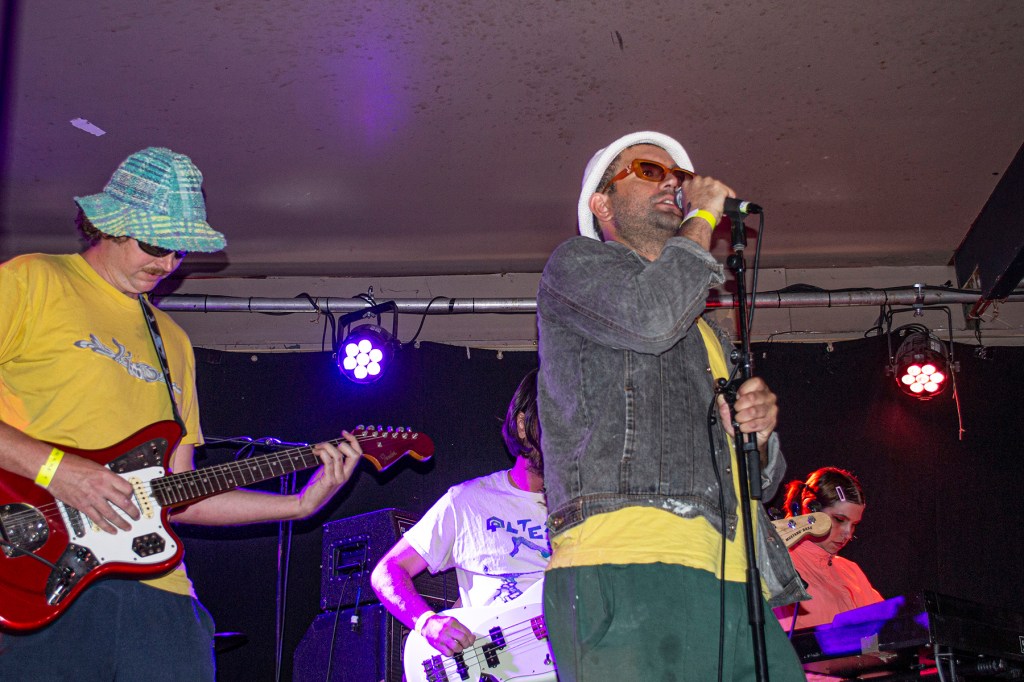
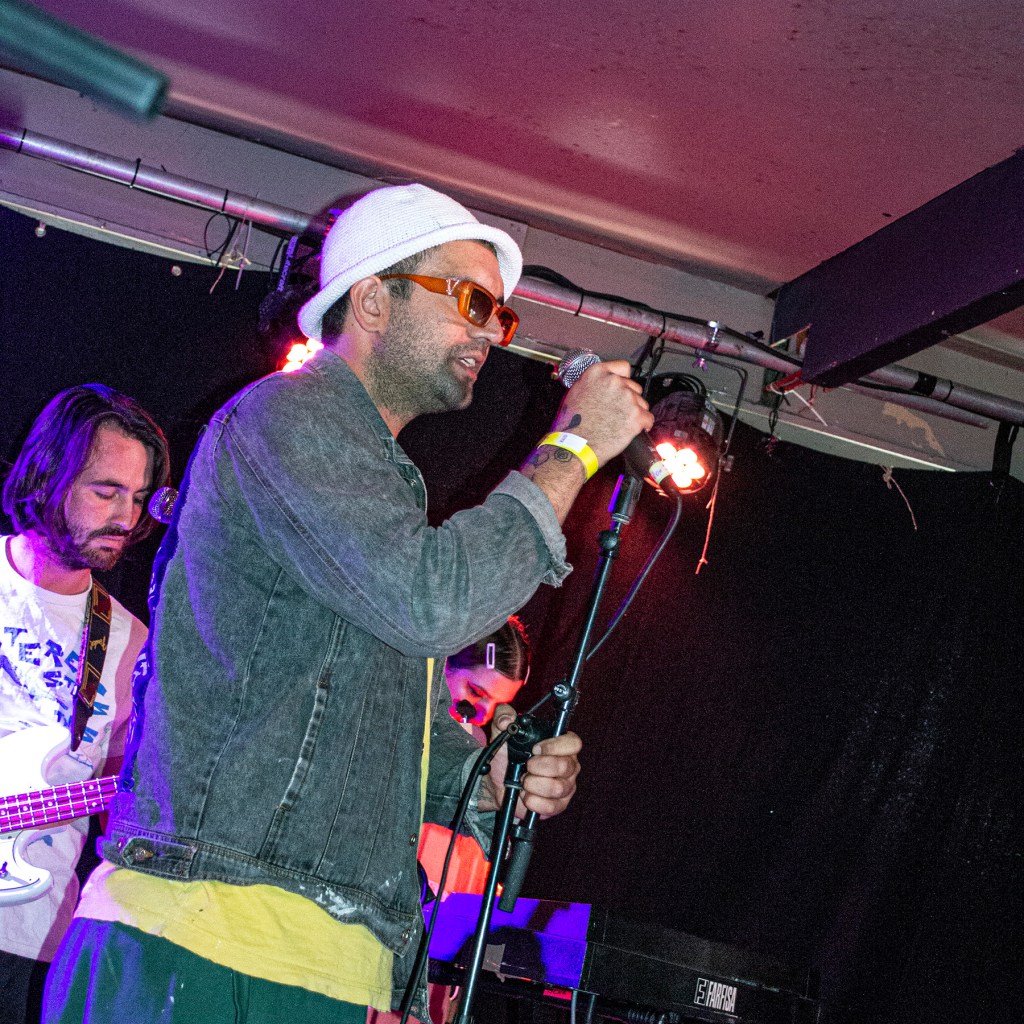
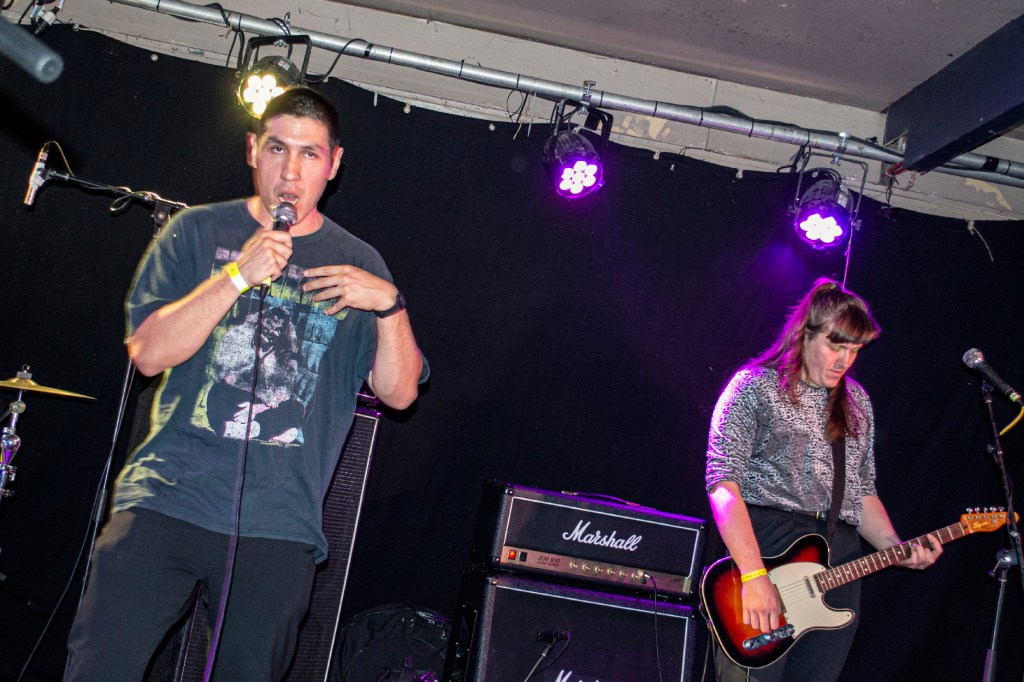
Photo: Maclay Heriot
How much prep goes into tour?
JOSH: Not much [laughs].
NADINE: We’ve got someone filling in on bass for this tour so we’ve been rehearsing a bit more to teach them the parts. We’ve been doing two or three days a week, we usually just do one. It’s always fun.
JOSH: We’ll probably rehearse the day before it starts. It should be alright, I think.
Is there anything that you worry about going on tour?
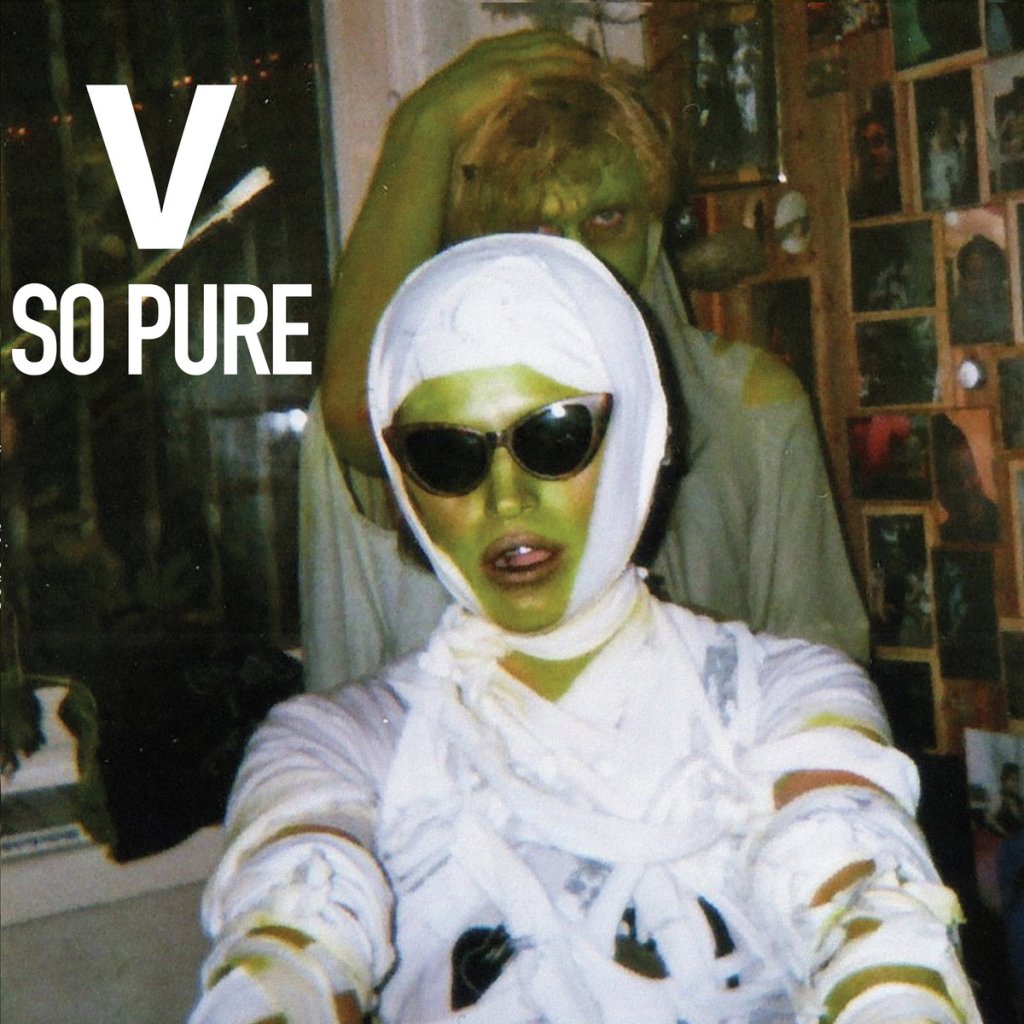
JOSH: I guess lining your ducks up, making sure you remember all the songs, and how they go.
NADINE: I feel excited about this one after just getting back from Europe because it’s a lot less stressful. Travel time between shows isn’t an eight or ten hour drive in the van. It’s gonna be pretty easy in comparison to what we both just did a couple months ago.
What’s some of the coolest things you saw while on tour in Europe?
JOSH: This time I made an effort to wake up earlier and go check out cities we were in. It’s pretty easy to go places and not check out much. You just see venues and service stations
NADINE: That’s all I saw.
JOSH: This time in Paris, it was the first time doing touristy stuff, which was nice. I didn’t see the Eiffel Tower, but I saw what’s that big archway thing, Arc de Triomphe.
NADINE: Did you get any trinkets?
JOSH: I didn’t.
Did you Nadine?
NADINE: Our guitarist, Ausi, was collecting lighters everywhere we went. He ended up with 25 lighters. Our (he and I) flight got cancelled on the way home. We got stuck in Phuket for 24 hours. When we were boarding the next day, my name got called over the speaker, they said, ‘They’ve pulled your suitcase aside. There’s some stuff in it, we need to go through it.’ I was like, ‘Okay.’ It was really stressful. I got driven in a little van down to a security room under the plane. I was like, ‘Oh my god, what did I leave in the suitcase?’ They took me to this room and pulled out this suitcase and it was Ausi’s. I was like, ‘Well, that’s not even mine.’ They’d put my name on his suitcase.’ You’re only allowed to take one lighter on a flight. They kept putting it through the screening machine and kept pulling out lighters and there ended up this like table full. I got back on the plane and he’s like, ‘What happened?’ I was like, ‘You’re the fucking lighter collector. You almost got me stuck in Phuket!’
So, he lost all the lighters?
NADINE: He got to keep one—a Paris one.
How did you first hear about each other’s bands?
JOSH: I listened to Mr. Teenage, Nadine’s old band with Carey, Joe, and Nic—they released this 7 inch I really liked. I thought it was fucking cool. Then Nadine started The Prize so obviously I listened to that as well too.
We started talking via Instagram two years ago and realised we had very similar tastes, and that our bands needed to play shows together.
NADINE: You guys were friends with my dad from The Chats touring with the Cosmic Psychos. And then The Prize’s first tour was with The Chats.
JOSH: For the Get Fucked album.
NADINE: It was a lot of fun!
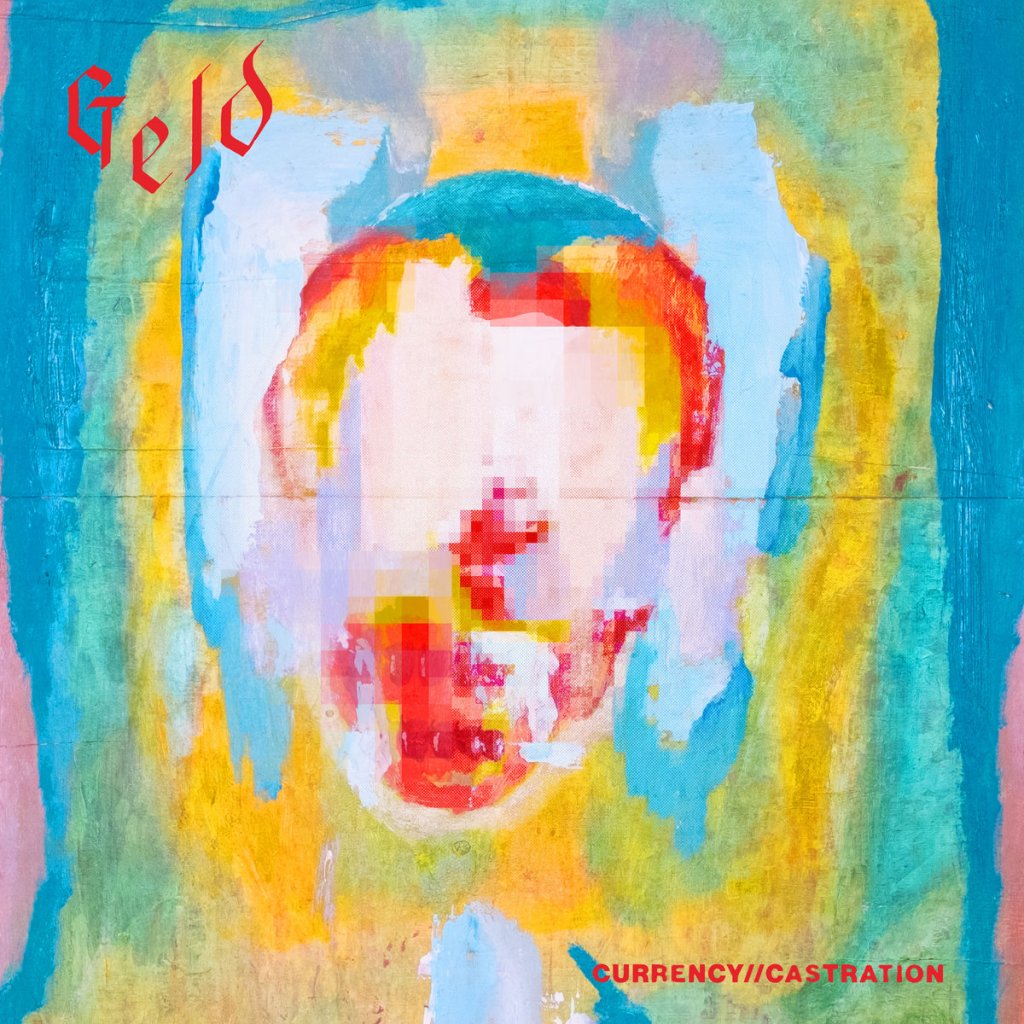
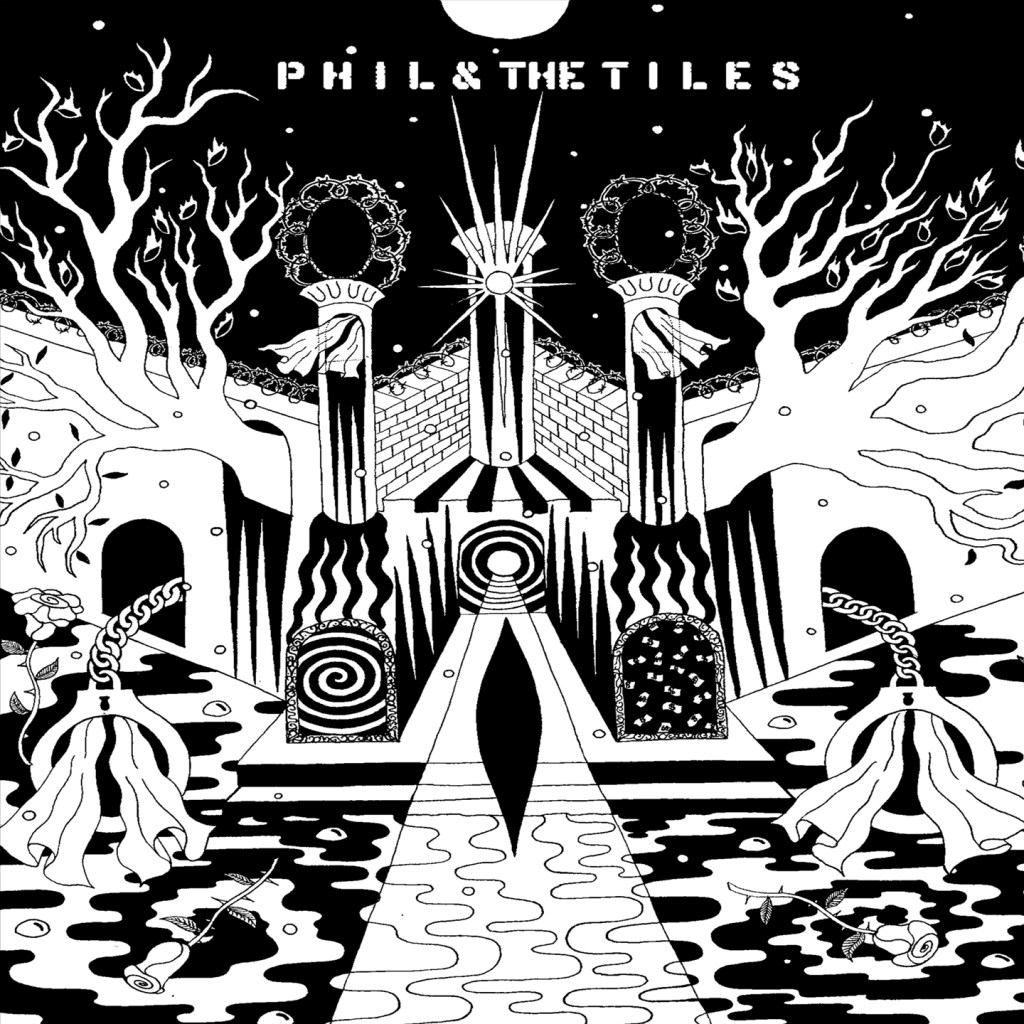
JOSH: We’ve been talking about doing a split release for ages. We discussed it a year ago, then life sort of happened. But we finally got around to putting it together. It’s good that it’s finally happened and it’s coming out. It’s a classic old school kind of split: two songs each band a side. Ben [Portnoy] from C.O.F.F.I.N did the artwork, which I’m stoked about. No A and B-sides.
NADINE: Two A-sides! We just got back from tour [in Europe] and we hadn’t written the songs for it yet. We had 10 days to get it written, recorded, mixed and mastered. It was a good test for us, because usually we can sit on a song for ages and chip away at it and overthink it. This time there was no choice. Just—get it done! Both songs were about being on tour.
JOSH: Those songs that I wrote, probably about a year and a bit ago, it was the same sort of thing; I wrote them coming straight off a five-week tour of the States. They’re about being away for loved ones for so long. We recorded it in February last year.
We’ll have the records, hopefully, the day that the tour starts on the Sunshine Coast. It’s creeping up.
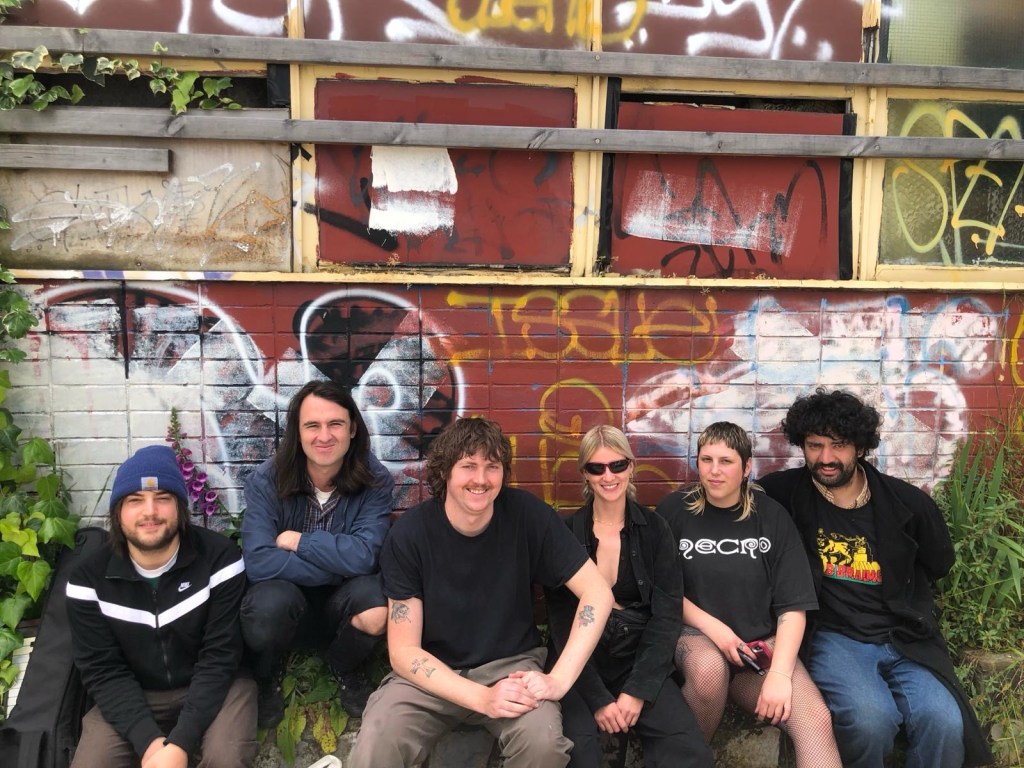
Photo: Maclay Heriot
What are you been listening to lately?
JOSH: I’ve been listening to a lot of like Nervous Eaters. I also got this record from this band called The Klitz, like Blitz, but the Klitz—a Memphis no wave-y garage band with an all-female lineup and it’s produced by Alex Chilton [The Box Tops & Big Star], which is pretty cool. Been listening to that a bit.
Being in Melbourne now, I’ve been buying heaps of records from Rowdy’s and Strange World. Strange World are really sick, because the prices are reasonable and he’s doing bistro for Crypt Records and all these cool labels. They’ve got heaps of cool stuff in there at the moment.
NADINE: For a couple of months now, I’ve been listening to the first Blondie record. I just keep putting that on.
Roky Erickson too. Josh and I did a Rocky Erickson cover the other day, ‘Nothing in Return’. As a two-piece band.
JOSH: I had a friend that saw him 10 years ago and apparently Roky had this guy side stage that would run out after every song and have to tell him what chord the next song starts on. Roky would have no recollection until this guy would like tell him.
NADINE: I saw him play Meredith festival 10 years ago. I was side of stage. I watched some footage from it and you can see me dancing, it’s amazing! [laughs].
What else are your bands put to for 2024?
JOSH: The Unknowns are going to Europe in October, which will be exciting! And we’re writing new songs. I’ve pretty much written three quarters of a new record. Mostly, we’ll play shows in Australia and save as much money as we can to record it this year, so it comes out next year. We’ll see how we go—that’s my goal.
NADINE: We started recording an album a couple of months ago and we’re just finishing it off now. So hopefully it’ll be out mid-year.
JOSH: What have you been up to?
I recently interviewed Lydia Lunch, which was amazing. She’s known for being confrontational but she was incredibly nice and lovely to me.
NADINE: Mr Teenage supported her once at The Corner. I was really intimidated to meet her afterwards. She was pretty staunch, but she was nice to me. I feel like a lot of females from that era have a reputation of being staunch. They had to be. You watch interviews from like the 70s or 80s or even early-90s and the way that a lot of interviewers spoke to them was kind of, I don’t know…
JOSH: Condescending?
NADINE: Yeah, fully! I’ve seen interviews with Debbie Harry and the interviewer talks about her putting on weight. It’s like these women had to go with the ‘fuck you’ attitude because that’s what they received. They had to be prepared for whatever someone’s gonna throw at them. I feel really lucky being a female in music now, that all those women did the hard yards, and now I can walk into something and be like, ‘No one’s gonna fuck with me.’
But when I was a teenager, I was playing in my first band, an all-girl band—this memory really stuck with me—I did a radio interview and we were off-air for a minute and the guy was like, ’Is there anything that you don’t want to talk about?’ I was like, ‘Well, you know, my dad’s in the Cosmic Psychos and I don’t want to talk about that.’ I was 17, and I was always really paranoid and self-conscious about people being like, ‘You’re riding your dad’s coattails.’ I don’t care anymore, though, because I’m thankful for him exposing me to music and playing drums.
As soon as we went back on air the guy goes, ‘So, your dad’s in the Cosmic Psychos!’
Artwork: Ben Portnoy
No! That’s terrible he did that to you, I’m sorry.
NADINE: Then that guy came to our show that night and after we played, he came and apologised. He’s like, ‘Oh, I’m sorry, I just thought you guys were going to be shit. You’re actually good! Sorry I put you in that position.’ That’s something on a very small scale of what I imagine a lot of women in music have had to deal with.
JOSH: Punk was so male-dominated. I’ve got a book that was released by this American lady and it’s about all female punk bands from the late-70s to the early-80s in America. Nikki Corvette did the introduction and that’s what she was saying, that you had to be fucking staunch to do stuff because it was so male-dominated. She said you’d get kicked off line ups or put down the bottom of bills just because you’re female— it was so fucked.
On Gimmie, since day one, we’ve never pointed out someone is a female musician—everyone is a musician.
NADINE: And that’s amazing. That’s a great approach. It should always be like that.
It’s so fun playing music, and we’re so lucky we get to do what we do. I stopped playing music for years and then when I started again, I felt like I found myself again. Music is the best. It forms so many connections: with the audience, with other bands, with your band—that’s healing.
JOSH: Sometimes you have one shot, so I figure you may as well—go for it! I’d rather do it and things go wrong, and learn from that, than talking about how you could have done something.
THE UNKNOWNS ‘Heart in Two’
THE PRIZE ‘ One Day At A Time’
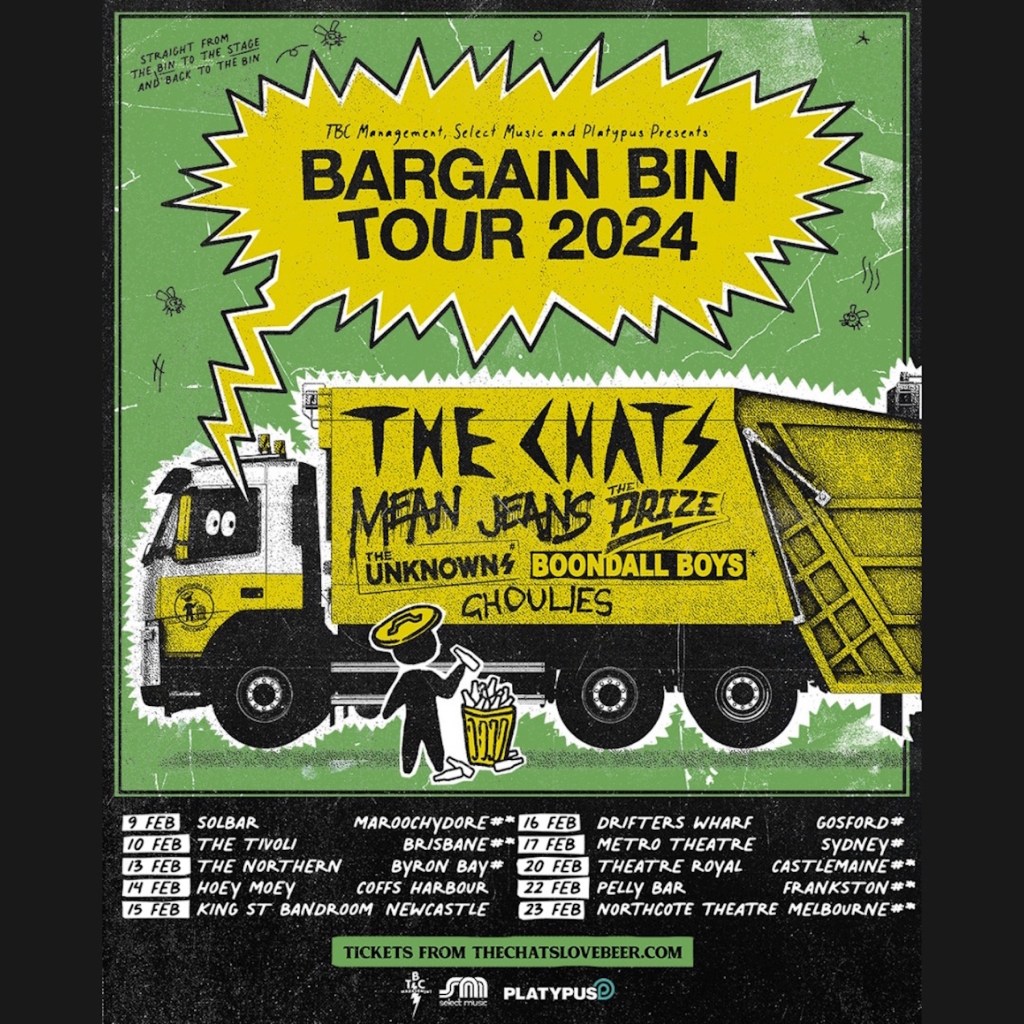
The Prize/The Unknowns split 7-inch out on Bargain Bin – GET it at the BARGAIN BIN 2024 TOUR or via Bargain Bin Records. Follow @the_unknowns_ and @theprize___. Catch them on The Chats’ – Bargain Bin Tour kicking off this week.
Original photo by Jhonny Russell / handmade collage by B
Cloud Ice 9 were one of the most interesting bands we saw at Jerkfest last year. Their hard-to-define music is punctuated with unexpected moments. Delightfully wonky, unfolding like a constantly shifting kaleidoscope, each note rearranging itself into new, mesmerising patterns creating a brand-new galaxy for listeners. Their output is immersive and explores the relationship between sight and sound with limited information about them out in the world, beyond their music and videos—until now. We chatted at length with vocalist-guitarist Jordan, and guitarist Reis. They have a great approach to creativity and life, we think anyone could get something cool out of this read.
REIS: I’m nursing some heartache.
Awww, I’m sorry to hear that.
JORDAN: Things have been up and down. In Melbourne, at least, we’ve been out of lockdown for a year and a bit now. So that initial exciting time of being free and enjoying each other’s company out in the big bad world has sort of simmered down a little bit. It’s gotten a bit more about recalibrating and figuring out one’s general approach to life and your trajectory [laughs]. There’s been lots of changing and fluctuating, mostly for the positive. A lot of people are stressed—money-wise, job-wise, and life-wide. It’s all a little bit turbulent at the moment.
REIS: Definitely. I’d say that there isn’t a single person that I’m dear friends with that is financially secure at the moment. But maybe that’s a reflection on the kind of people we hang out with [laughs]. The general sense of optimism post-COVID has just been crushed by this impending recession and the rise in the cost of living—the whole shebang. As people doing the kind of things we do, a little bit out on the fringes, those waves are definitely felt a lot harder.
JORDAN: But by that same token, I feel like it’s times like these when it feels like the best things kind of come to the surface and to combat that. Winter is coming, I feel like it’s the best time for people to actually generate interesting, positive things to kind of cope and help them manage.
REIS: Easy for you to say, mate. You’re fucking off to Europe! It’s going to be so hard for you.
[Laughter]
JORDAN: I’ve done my time. I wanted to do some writing and some soul-searching. I’m going to Poland, where my family’s from, and I’ve never really been before. Mostly just to explore and take a break. Spend some time being very present and focusing on where am I going to sleep, what am I going to eat, how much money does this mean in my pocket. Be a lot more day-to-day for a couple of months.
Are you both from Naarm/Melbourne?
REIS: The short answer is, yeah, We both grew up in Melbourne for the most part.
JORDAN: I was born in Sydney and moved here when I was four.
REIS: I was born in Turkey and my family came over when I was young. and have gone back and forth a couple of times. For the most part, Melbourne has been home.
How did you get into music?
JORDAN: Pretty differently, I guess. Different ages, different times. I’m turning 29 in a month.
REIS: I’m 28.
JORDAN: We went to high school together and lived together for a while afterwards. I got into music pretty young and was learning different instruments. I went to art school and got spat out and felt pretty dejected by it all. It was then that I moved in with Reis, when we were around 23. That’s when we really started making music.
REIS: I was definitely a big fan of music. I picked up a guitar when I was 21. I had a very different musical upbringing to Jordan. Only from punk and hardcore, that level of accessibility, got me to think about it in any sort of serious way. Then I just played in a band and just went from there. It definitely took over my life in a way that I really didn’t expect [laughs].
JORDAN: That punk accessibility thing, and what Reis had going, was really inspiring for me. Because, like I said, I was feeling dejected and confused about going to art school and getting chewed up and spat out.
Reis would be in the shed, making music on Audacity with iPod earphones and just really winging it—DIY-ing it. That inspired me to get back into doing things in a way that feels very organic. It felt free from any things you might think you need: the right gear or a sound engineer or this and that. Which can all get quite paralysing because it’s not really always feasible.
REIS: Earlier than that, Jordan literally showed me how to hold a guitar and play chords. I learned so much from being around this guy. What I do would be very different if it wasn’t for him.
JORDAN: Our first project was called, Dingo and Rocco. That was born out of Reis letting me stay at his mum’s house when we were younger. We started playing acoustic guitars together and started writing weird, chaotic love ballads.
[Laughter]
REIS: We’d be busking out the front of the IGA.
JORDAN: We’d get $20, say, ‘That’s a hard day’s work,’ then go across the road to the pub and get a pint.
When we were living together in our own place, it became more experimental and bigger. We had a big barn full of Hammond organs and a lot of weird junk we found at tips shops.
REIS: We had a pirate radio station [laughs].
JORDAN: We were experimenting, and Cloud Ice 9 started to form, around 2018 or 2019. It was a fair bit before any thing tangible really came together.
Photo: Jhonny Russell
When you first started hanging out, what were the things you’d bond over?
REIS: Knowing each other in the high school days, I guess, just puberty blues.
JORDAN: We liked weird things. When we lived together, we had this huge, sprawling property in Brunswick West with all these sheds; we had heaps of room. Reis had a van and we’d go pick up a lot of weird gear. We had a huge VHS collection too; we were really obsessed with watching old weird tapes.
The experiment and play surrounded with all these different toys, like broken organs and old pump action pianos, and even balloons in microphones of heaps of delay. We just love to play. We bonded through that musically.
REIS: It felt very insular. It felt like a very small world that we just kind of carved out and spent a lot of raw hours nutting out the details.
JORADN: I liked that it felt like we obviously didn’t have big musical inspirations; what we were doing was far removed from that. Just play and experimentation—that felt like a nice organic process. It inevitably started to take a form. Saying that, we are both very obsessed with Alan Vega and Suicide, and some of those old heads.
REIS: I was watching this interview with Vega where he was talking about some of his sculptures that he’s made, and he has the approach of just making something to make something. I wonder about those kinds of people that are completely unaffected by what’s going on around them—to have such a strong sense of what you’re doing is right. That doesn’t just come with music; it comes with fucking everything. Knowing people that even a salad they’re making is art—it’s a bit much for me, but I like having those people around.
JORDAN: They’re more into the entity and context of the art than the art itself a lot of the time. We both grew up on Brian Jonestown Massacre. I really felt like that was more about that ‘schiz’ dynamic that Anton had orbiting around him. It was more about the life and the headspace and the dysfunctionality of it all—that was more fascinating. The strange creative humans navigating a contemporary civilisation and what comes out of that. There’s a lot of Brian Jonestown Massacre music I could take or leave, but I feel the whole context really adds to it. The same is true for a lot of artists that do inspire us.
When you started Cloud Ice 9, was there anything at all that you had in mind for the project?
JORDAN: It took a long time. It was me, Reis, and Jim in that shed in Brunswick West. It was more about getting stoned and making music that almost wasn’t music. Literally feeling it out and then trying to make sense out of complete nonsense. It slowly formed into actual songs. The songwriting was mostly inspired from books and film. Musically, that stuff was quite intuitive.
Conceptually, I was obviously reading a lot of Kurt Vonnegut at the time and weird sci-fi stuff. I wanted to write music from the perspective of aliens that had come to Earth, and sort of celebrating the apocalypse. Natural musical influences from Suicide and outside of rock came to the surface too. Essendon Airport.
REIS: Definitely all of that. I felt like when we were starting it, we didn’t really have much of a vision of what it was going to be. For me, it felt like it was a really strong anecdote of a lot of the music that was around that we didn’t identify with—kind of how formulaic a lot of it was. It’s funny because I feel like a lot of people have said to me, ‘Cloud Ice 9 is so weird!’ But I think it’s fairly tame.
JORDAN: I always really liked bands that didn’t really sound like anything else. I grew up on the Gorillaz. Demon Days was the first CD I ever owned. Maybe I can break it down a bit more now, but at the time, it sounded like nothing I’d ever heard. It crosses so many genres and has that world-immersive thing that you do feel like it’s its own entity. I don’t know if Cloud Ice 9 is there yet, but I would love it to create its own world and sort of be able to touch on certain things but retain a certain element of its own thing.
REIS: Ben Wallers and the Country Teasers is a definite influence of that—being reminiscent of something you’ve heard before but completely different.
REIS: Something gone wrong.
[Laughter]
People keep asking us what bands we loved most at Jerkfest this year and the ones that resonated most were you guys, Red Hell, and Essendon Airport. Then people ask, ‘What do they sound like?’ That’s hard to answer because you all have created your own thing. I believe that you have succeeded in creating your own world.
JORDAN: That’s sick. So nice to hear. We’re about to put out this album of live takes of improvisations that we’ve been recording and archiving over the years. We’ve got hours and hours and hours of nonsensical jams, essentially. No tangible vocals really. We’re casting a wide net. We’ve been playing for a while, and it only feels like in the last year or so, it’s starting to get a bit of traction.
I’ve been describing it as country sci-fi to people/jazz gone wrong. I like that you can’t really describe it. There’s a lot of bands that sound like a lot of bands around where we’re playing. It’s nice to be a bit different, but I guess we also don’t want to become the ‘weird’ band [laughs]. We want to also write good music!
REIS: I don’t think it ever has mattered what we want, it’s just what we do.
Photo: Jhonny Russell
Jhonny, who I do Gimmie with, mentioned that Cloud ice 9 sounds wonky.
REIS: Yeah!
[Both nod in a agreement]
JORDAN: I like it when music is kind of a walking pace. I like when the beat is like, dun, dun, dun, dun. It kind of gives it that off kilter thing.
REIS: Recently, we have a real point of contention in the band, as to how slow to play one of the songs.
Your album Circus St, is your second album. Where did the title come from?
JORDAN: It was just an idea I had that, basically, life, at the moment felt like that. Coming out of COVID. Cloud Ice 9, in general, is about enjoying a sense of liberation in the fact that the world is kind of ending. Circus St was an embellishment on that—life is a bit of a circus. When you walk out onto the street, it can sometimes feel like that, just the bizarreness and ridiculousness of it all.
It reminds me off, Reis and I, did this interview with this person called Barbara, who’s a puppeteer, and they’re a bit of like an icon around Melbourne. They’d dress up in a wedding dress, this bearded, ragged old man. We actually got them to perform with us a little before Circus St came out. They would busk. That really coined the idea of Circus St to me, because they were this strange clown on the sidelines of the streets of inner-city Melbourne, reminding you of how bizarre and crazy everything is. The acknowledgment of what Barbara was doing was more genuine than a lot of people that are going into Myer and trying on perfumes, or people in suits late for things. It was that acknowledgment of, it’s all a kind of a strange, mad construction. Circus St came out of thebizarreness of our modern little world that we’ve created.
Me and Jordan also do a little label, which all the Cloud Ice 9 stuff comes out on—Happy Tapes.
JORDAN: We’ve kind of slowly been tracking down curious individuals that interest us. Spend a day with them and document them, chatting, and making little things out of it.
I spent hours talking to Barbara on the phone after that. Barbara is coming from a similar place. When we went over to do the doco, Barbara was like, ‘Oh, so are you two with the SBS or the ABC?’ We’re like ‘No, we’re kind of like you. We’re weird dudes.’ We bonded over that.
[Laughter]
JORDAN: They are a very difficult person to track down.
REIS: The latest I heard was that they were sleeping in their car, and their housemate had just gone to jail.
JORDAN: They have a pretty unstable world…
REIS: But, hey, who doesn’t?
Photo: Jhonny Russell
Why’d you call it Happy Tapes?
REIS: It’s just kind of neutral name…
[Laughter]
There’s a lot of ideas in this label. We didn’t want it to be pigeonholed by slapping some sort of like a death metal name on it, or something like…
JORDAN: Spiky Tapes!
REIS: We wanted something that’s open and accessible, like the things we like.
JORDAN: Not always accessible.
REIS: But fairly accessible.
JORDAN: Very eclectic. We do a lot of different stuff, maybe to our detriment sometimes. Stuff that we’re interested in.
What’s something that’s been making you happy lately?
REIS: Music. Me and Jordan did a trip to Vietnam and got some pretty wild cassettes and VHS that we bartered tooth and nail for. We’ve been watching those, listening to a lot of the music that we got from there, and trying to learn how to play it.
JORDAN: Olive bread, and Magic The Gathering, mostly. I’ve been really getting into shakshuka at the moment, I’ve been honing my recipe. Honestly, though, just being with friends and talking has been bringing me the best feelings as of late.
Same. What made you want to seek out interesting people, get to know them and document them?
REIS: I’m doing another video now on this 60 year old Congolese guy, Leona Kakima, who’s been a bit of a local around Footscray. He’s like the Alan Vega of the Congo. This dude is amazing. He’s an absolute superstar that produces all his own music and performs solo to a backing track in little African restaurants and clubs around Footscray.
I really love documenting people that are not getting the recognition that they deserve, or those larger-than-life characters—diamonds in the rough, real assets to culture from my perspective. These are people that never got their little piece of pie cut out for them. The thing that I’d love to see, a commonality between all these people, is that they keep going and keep doing what they do, regardless of what anybody says and regardless of any acclaim anybody gives them or pats on the back. For people who have been doing any sort of creative pursuit for a while, that’s one of the most inspiring things you can digest.
JORDAN: They’re outsiders that don’t really fit the mould and can’t really be commodified in a lot of ways because they don’t fit into our idea of what’s marketable in modern society. That doesn’t matter.
Barbara, for instance, who’s living this chaotic life, It’s a really hard thing to do, but when they perform, it is unwavering. They couldn’t do anything else. There’s something very empowering about that. It’s very inspiring for people like us that also refuse to play ball a lot of the time…
REIS: For better or worse.
JORDAN: There’s a lot of us out there that don’t want to conform, and capitalism, and the way that the world works at the moment, doesn’t make sense for us. You can either morph yourself into a mould that fits the shape of society, or you can go down your weird little dark, off-the-beaten-track trail in the woods and see what you find.
Artwork by Alexandra Obarzanek
That’s where things are most exciting to me! We love the cover artwork for Circus St, your grandma painted it Jordan?
JORDAN: Yeah. I inherited a couple of her paintings. My grandparents house was full of them; I grew up with them. She was an artist her whole life. The painting is from the 80s. It’s called ‘The Feast’. It’s huge, it’s in my bedroom, actually, and it’s intense. It takes up a whole wall; it’s a little weird to witness constantly.
She was a pretty interesting lady. She’s my Polish side. Her, my grandpa, my dad, and uncle lived on a kibbutz in Israel for quite a long time before moving to Melbourne. She was constantly making art, but she never really exhibited or tried to. It’s like Barbara and these people that don’t have that mindset of, how can this fit into something tangible? It just poured out of her. She was actually a very anxious and depressed person, so it never really came to the surface. It always really resonated with me, and I always wanted to find a way to give it new life and celebrate it. It seemed to really fit in with what we were doing. There’s more to come.
REIS: If we can scrape some more money together to keep putting out records, then you’ll see a lot more of her paintings, that’s for sure.
Wonderful! I can’t wait. I find that a lot of artists and musicians can be anxious and depressed people. We make art to help us process everything that’s happening in the world and our world. Also, we create beautiful things to try and connect with something other than our immediate pain, something better.
JORDAN: Yeah, it’s ironic in a way, because if she was able to share that work when she was alive, it would have given her a lot of happiness. But she couldn’t. If she was able to be in a mental position to share it and allow it to resonate with others, then I think it would have helped her. It’s just the way it is sometimes. Maybe that art wouldn’t exist without that sort of headspace in the first place.
REIS: I agree with that sentiment so much. We’re so caught up, we’ve lived our whole lives just in this small skull and experienced the world through these eyes. And there’s very few things that allow you to connect with people beyond anything that you could describe or touch. The function of art, at its purest form, is to make you not feel so alone.
Totally. And your music can go places that you might not get to. How did the Circus St album get started?
REIS: We made one in a lockdown. Jordan’s kind the real pants wearer…
JORDAN: I do wear pants.
[Laughter]
REIS: We come up with a lot of the ideas and the songs together, but when push comes to shove, Jordan really does produce most of the records. I’ll spit out some demos and stuff every now and then, and we’ll work on stuff together. But there’s a couple of couple of songs on there that has got no one else besides Jordan. The reason that the record sounds the way it does is because of his ability. It’s a beautiful thing. We’ve talked a lot about the live thing being a very different kind of rendition of those songs, not trying to replicate the way that it sounds.
JORDAN: We do play a lot together, at home and stuff and we record pretty much everything. What the end product is, is a lot of, me meticulously going through these recordings, taking sections, twisting them and re-recording them. So it all does come from a pretty organic place. Then there’s this arduous production side that I’m pretty obsessive about. Every day I’m unravelling that stuff.
Circus St came from off the back of 8BALL. When 8BALL came out, we didn’t have a fully formed band. We hadn’t played live before. That only started happening even after 8BALL came out, and very infrequently because of sporadic lockdowns. The idea of the live band was a lot less fleshed out and came secondary. Now it feels like the opposite, where the live band is becoming the focal point and the recorded stuff is coming off the back of that.
Circus St was sort of somewhere in between. We were recording, we spent some time at RMIT Studios, scamming some free session time with students. That brought to life a lot more of the band element in the recorded stuff. They are strange renditions of live jams and things. I feel those two worlds are coming closer together now, with this improv album we have. We’ve also got the workings of, not a straightforward album, but songs with vocals. We’ve only had a fully-formed band for two years. So that’s starting to make more sense and inform recorded stuff a lot more in the future.
What inspired the more spoken word vocal?
JORDAN: Aesthetically, it feels more punchy and I like the feeling; they’re more like slogans and announcements than lyrics. I appreciate that. And maybe I’ve just got into the habit of it and forgot how to sing properly [laughs].
REIS: He’s saving his Alicia Keys moments for the record. It’s coming.
Nice! I love Alicia Keys.
REIS: Me too!
[Laughter]
JORDAN: The singing is coming back. Maybe I’m a bit traumatised from my alt-rock Radiohead days.
Photo: Jhonny Russell
You were doing the band, Dull Joys?
JORDAN: Yeah, that was my ‘how to play in a band’ instruction manual through my early 20s. Technically, it was engaging, but stylistically, it was not exactly what I was interested in. But it was very informative. The whole ‘singing your little heart out’ got a bit squashed by all that. It was like, ‘I’m just going to talk now. Keep to casual.’
REIS: I remember listening to ‘Casual Assembly’ by EXEK with you and you really liking that a lot.
JORDAN: Yeah, definitely inspired by a lot of post-punk and new wave. My biggest inspiration for making music was soundtrack music for film. There’s always talking with with music in the background. I really appreciate the atmosphere of the casualness of conversation with a lot more evocative things happening behind it.
We love the video you made for ‘Horny Snail Pyramid’. It’s very Dungeons and Dragons.
JORDAN: Yeah. Me and my girlfriend at the time were very obsessed with old mediaeval films: the dress ups and fantasy element.
REIS: The Soviet Lord of the Rings as well.
JORDAN: Have you seen that?
REIS: Oh, my lord!
JORDAN: You should YouTube it. It’s incredibly terrible. The green screens! Golem is this fucked up alien, gremlin creature in the caves. It’s incredible. Masterfully terrible. Reis had also been honing in on his VHS camcorder craft. So it all just made sense. We were originally wanted to go to a castle but it just ended up as a few green sheets in Reis’ garage. It came out all the better for it.
Doing things yourself you can be uncompromising. You don’t have to diminish or change what you’re doing. You present it how you want to. It doesn’t matter about views, at the end of the day, you have the people that will get it and you appreciate that more. We definitely want to do more film work.
REIS: We’ve got a couple of schemes for the next one. We’re about to release a more instrumental album. It’s us in various sheds and garage around the place just wining it.
JORDAN: It’s an experimental album called Hocus Pocus. We were thinking about doing something more sci-fi for that. It will all come to the surface soon enough.
On your Bandcamp, there was this really great comment that someone left about Circus St, it said: this album fills me with energy of daring and endless possibilities. I feel so alive listening to it.
JORDAN: Yeah, that’s my mum! She’s a very special woman and very supportive.
[Laughter]
Have your parents been to any of you shows?
REIS: No, mine haven’t. But shout outs to all the mums. We dedicate all the Cloud Ice 9 records to our mums and the women who raised us.
JORDAN: Yeah. I reckon my mum comes to about 80% of our shows. She’s very supportive. I love her lots— shout out to my mum. She’s like us in a lot of ways. She appreciates the stranger and more off kilter things. She’s a huge, huge inspo!
REIS: The first Cloud Ice 9 video clip was cut up of a short film that Jordan’s mum made. She used to make short films in the 80s. She gave us a whole bunch of her movies she made on VHS movies.
JORDAN: She used to do Super8 stuff and was part of the Sydney creative scene in the 80s. Similarly, with Grandma’s paintings, I used to work with Mum’s footage and make music to it. It just feels like a nice way to [puts on a Don Vito Godfather voice]—keep it in the family!
[Laughter]
REIS: We love to reappropriate lost media.
That’s awesome. Do each of you have a favourite song from Circus St?
REIS: The last song of the record, ‘Lion Tamer’. I don’t want to pat ourselves on the back too hard but we had this idea for this AI-generated voice and Jordan had written a pretty great little story that flows throughout the record. I like that ambient drone juxtaposed with the AI stuff. That one gets me.
JORDAN: I’ve got such a soft spot for ‘Horny Snail Pyramid’. I feel like that really encapsulates a lot of what we’re trying to do. The song almost doesn’t make sense. It feels like it’s teetering on the edge of falling apart the whole time. We wrote that riff together years and years ago go. We had no idea what to do with it. I slowly formed these words for it and almost wrapped over the top of the guitar line. I was begging these guys to give it a go, showed them with the vocals and they were like, ‘Yeah! Let’s do it.’ It took ages to figure out how the hell that song works.
Photo: Jhonny Russell
Is there anything you guys hope people get listening to Circus St?
JORDAN: I hope the general theme of Circus St and ideas behind it come through. I’m proud of what that album talks about and how it relates to modern society. I don’t know if it’s a car album or background album. There’s a lot of weird AI voices. I do hope people can enjoy it in a pretty relaxed setting in a low key way.
REIS: I hope that after a long day at work, someone who wants to disconnect a little bit can put that record on and get taken to our world.
JORDAN: Like with Barbara, the puppeteer, I hope that it makes you feel like that a little bit; that everything’s a bit wonky and bizarre. That you take a moment to be like, ‘Oh, I am a human being in a modern society; that’s actually not that straightforward.’ It’s actually quite a strange thing as an animal.
[Laughter]
I get it. A lot of things in our society aren’t really geared towards nurturing humans. We’re bombarded with so much every day.
JORDAN: Yeah. There’s a lot of manipulation. There’s a lot of chemicals that need gratifying and become strange obsessions.
REIS: The bottomline is that—life offers you a lot of disconnect. It’s not for the benefit of you but it’s an extraction of your attention. It takes from you but doesn’t give a whole lot back. The power of art and music is that it does have that symbiotic relationship where it can give you something back and it can affect your mood, and you.
JORDAN: The art that makes your brain change is inspiring. You can feel new synaptic waves firing in different directions. It’s what it’s all about.
REIS: 100%. I’ve been listening to Public Enemy so loud over the last week that my neighbour, who I haven’t actually spoken to ever, came over and told me to keep it down.
[Laughter]
Nice! Anything else you’d like to share with me?
REIS: We’re always tinkering. We’re open books. Let the public see it all.
JORDAN: Give the public what they want.
REIS: I don’t know if they want it.
[Laughter]
JORDAN: Give the public what they’re going to get!
Original photo: Jhonny Russell. Handmade collage by B.
Step into the intricate universe of Naarm/Melbourne-based musican, V, an artist whose life story is as interesting and multifaceted as their sound.
V’s journey into music was sparked when a Slits’ concert shattered their perceptions, unveiling the boundless potential of women in music. The transformative power of music and its ability to break down barriers becomes evident as V tells us their story. They vividly describe the turning points, the chance encounters, and the intense passion that fuelled their creative evolution. V taught themselves to record through experimentation with bass and GarageBand, to craft their own unique sound.
V’s musical trajectory was further shaped by collaborations and experiences abroad. Their involvement in various bands, from grindcore to dark wave and experimental projects, exposed them to diverse influences and refined their approach to music. Our conversation delves into their experiences living in Germany for a decade, the challenges they faced, and the lessons learned along the way. V spent time living in Berlin’s Tacheles artist squat.
The interview also explores V’s struggle for legitimacy in an industry that can often be shallow and unyielding. From their insights on the music scene, being dropped from their label, a story of kindness of a well-known fellow musician when V couldn’t afford to eat, and the unending pursuit of self-improvement, V’s authenticity shines through.
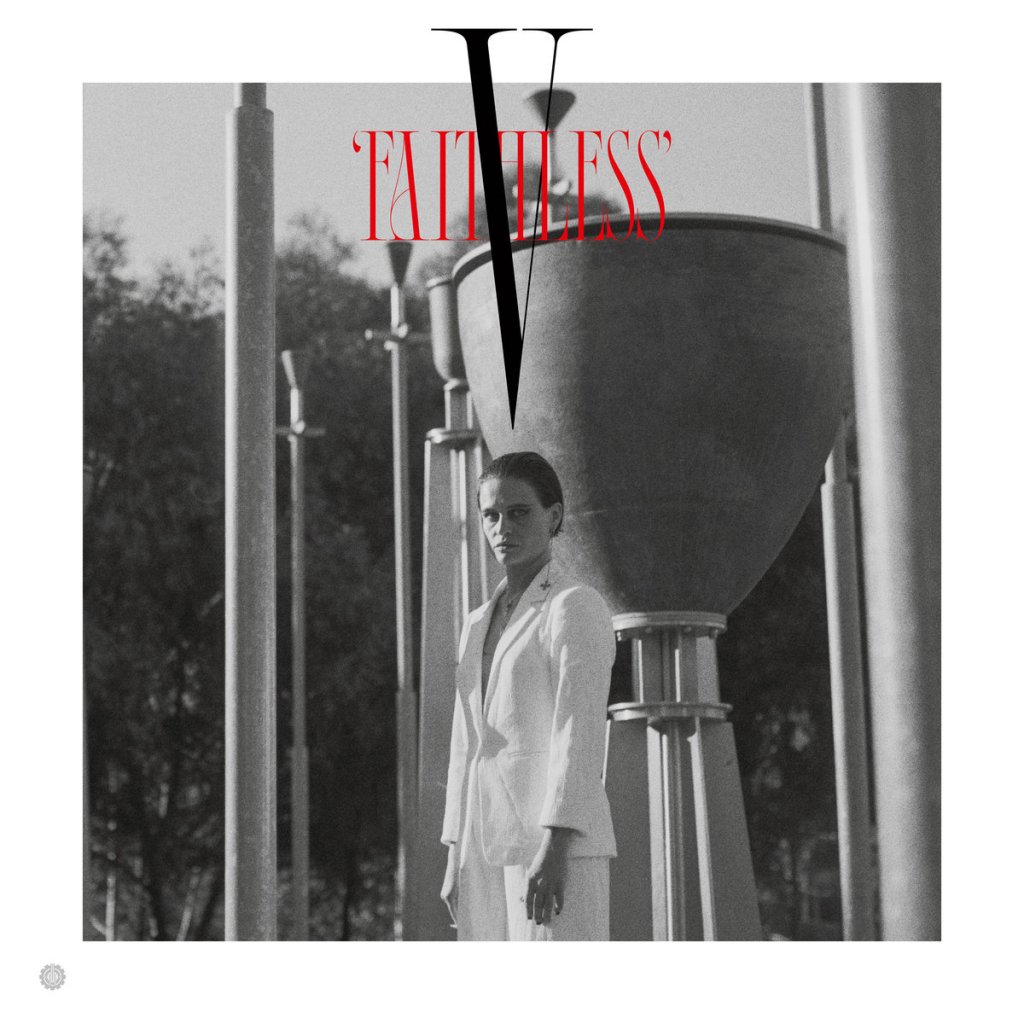
Their third album, Faithless, emerges as a focal point of the discussion. The creative process, the painstaking efforts to capture the right tones and emotions, making the album four times and deleting it, and the significance of collaboration with a choir all come to light. The album’s meaning and themes run deep, loss, yearning, psychic devastation and the failures of mental healthcare in contemporary Australia.
V’s candidness about their emotional struggles, personal losses, and the complexities of finding a sense of belonging adds a raw and intimate layer to the chat. Their passion for their art resonates powerfully throughout. We also touch on latest album, Best Life, a visual album, and a collaborative work between eight directors in Australia and the EU.
Ultimately, this conversation provides a window into the heart and mind of an artist who is unafraid to tackle the challenges of living, confronts personal demons, and channels those experiences into their art.
We chatted earlier this year in-person, while V was in Meanjin/Brisbane to headline the VALE VIVI: A punk eulogy to Vivienne Westwood tribute event at The Tivoli theatre. Their dear friend had passed away a few days earlier, and the chat was very emotional. Tears were shed.
I’m so happy to be talking with you finally. We love what you do, V. You’re incredibly underrated. How did you find music? Has it always been a big part of your life?
V: No, actually, it hasn’t been a part of my life forever. I was introduced to this intense love for music through my sister when I was maybe 16 or 17. Of course I liked music before then. Like, I love the Spice Girls and the Backstreet Boys, but I don’t think my music tastes really extended beyond that then. But I remember my turning point.
My life changed when she was 16. My sister bought me a ticket to The Slits at The Zoo and I’d never heard of them before. It was the best. That show was a turning point because, I just never considered the possibility of women in rock on stage. I remember Ari Up was like, “Girls get up on the stage.” And I got up on the stage. I got my first taste of being on the stage in a rock and roll sense at that show. It maybe took a year or two after that, I’d just play around quietly by myself with one of those organs that every single Brisbane sharehouse used to have.
When I really started making music was when I got an Apple laptop, when I was 21. It came with Garage Band and I just started pumping music out. I started writing music like crazy.
In my mind, I didn’t really know I was making music in my own way. I released ten albums. I burned them on CDs. I had a little separate CD burner, and I literally had ten V albums.
I read about that. Someone that used to be in a band with, I think, David Hantelius?
V: Yeah.
And they mentioned that when they first met you, they sat down with you to hear your music and they thought, oh, I’m just going to hear a demo. And then it was ten albums!
V: Keeping in mind that they were all demos, they were not developed with the structure or anything. I feel like I must have been in a year long manic phase when I first started making that music. Sometimes I get so into it that I’d go for two days. I wouldn’t go to sleep, and I’d just keep doing it. I haven’t done stuff like that in over ten years. I guess I’ve mellowed out in my age. But, yeah, that’s how it kind of started for me, slowly, and also privately. The writing part has always been very private. I never performed till a bit later.
Why was that? Were you scared to put yourself out there?
V: At the time, I was much more invested in being a visual artist. So that was the practise that I showed to the world. Drawing and painting, scenes and comics and stuff.
The turning point to where I kind of started to resemble what I do now, was back in the MySpace days. I was living in Germany at the time and this guy, Obi Blanche, a Finnish producer, contacted me on MySpace. He asked if I wanted to form some Kills-type band together with him. And I spent about a year in his flat, sitting behind his shoulder, watching him on Ableton, putting these demos to life. That’s where I learned about, not technique, but when you have discipline. He had a lot of discipline for music, and I continue that discipline today.
I’m very disciplined now about my approach to music, and I think it’s very informed by Obi. Later on. we had this band called VO – so V and Obi. That was the first official music I ever recorded.
Shortly after that, I joined this grindcore band, Batalj. That’s where I really cut my teeth live. I wouldn’t be making the music I am today if it wasn’t for Batalj. It was with two Swedish guys. David was the one who we mentioned before who came over and listened to demo. It was David and Per and me in that band. Per was good at tour booking. He would book these intense tours. Two week, three week-long tours.
The first tour I ever did was with Monsieur Marcaille, who’s amazing French classically trained cello player. He has two kick drums on either side and then he has the cello in the middle and it’s coming through to two amps. It’s very grotesque in a way because he plays just with the underwear and he’s snorting on the ground and spitting and it’s very loud and almost kind of metal-like.
I never thought about how that might have influenced me because I also had a little fling with him on that tour. There was a huge age gap, but it was fine. I was 23.
More recently you’ve play with band Dark Water?
V: I didn’t really write anything for Dark Water. I was not quite a session drummer. I also had an important role as a cheerleader in that band.
More recently, I’ve been playing bass for Enola. But I’m doing one last show with them because I just think I can’t be in a band where I’m a session musician. I have to have a creative input. What’s the point of me having almost 20 years of experience and just be a session musician? I want to put my creativity into it. I’m not shitting on that band at all. I absolutely loved playing the music. I learnt so much. They taught me about dynamics. How important they are and how much you can get someone’s heart racing by applying the dynamics properly. You have quiet a part, then you have a loud part and then you go quiet again, get loud again, it gets people on edge. It made me a much better musician.
[V holds up their bass guitar and hugs it to their chest]
This is my new bass, Violetta, I upgraded. I’ve been using, Sheila, which is my other bass, that I bought in the Valley when I was 18 with my tax return. Just on a a freaking whim. I went into this music store and they had this deal for a little Orange amp and a bass guitar. I bought it and that was he beginning.
Did you want to play bass or did you get it because you wanted to play something and thought it was cheap enough for you to buy?
V: It was just cheap. In school, I studied classical acoustic guitar, the one where you get the little footstool. But honestly, I didn’t do that in high school because I liked music. I did it because I didn’t like gym. I got the music lessons put on the same time as PE so I wouldn’t have to do PE. I learned technique from that. But I wasn’t passionate about it. I didn’t think about making music when I was a teenager. That came later.
When you started doing your solo thing, V, you were living in Germany?
V: Yeah, the very first show I ever did was for someone’s art show which was held in a derelict abandoned building. I had this battery operated stereo with a CD that I burnt for the backing track. I had a tambourine, no microphone. I was singing along.
I’ve gone through huge transition to get to where I am today. It took a lot of different bands. I’ve gone to the next level with V because of that.
You were talking about dynamics before, I can especially feel that with your new album, Faithless. I’m usually a big lyrics person, they’re a big part of the equation for me, but then with your album, there’s not really that many lyrics. Maybe the last song. You convey so much with just sound.
V: That’s really what I wanted to achieve with that album. It was by far the hardest work I’ve ever created.
Didn’t you make the album four times and then deleted it each time?
V: I did, yeah.
What was missing in the versions you deleted?
V: I got commissioned to do the album, so it had to have the Bells on it. Many of the songs I’d written would have sounded better on synthesiser and my normal thing. And I felt like I was doing a disservice to the Bells by… it’s almost like I just tried to sub them in. I wanted to justify using the bells. For people reading this, they’re the Federation Bells. I did it four times because it had to be good.
It was written during lockdown, a very isolating period. I was in the shed. I smoked more weed than I’ve ever smoked in my entire life. It was a nice period, because obviously, with the lockdown and getting money from the government, I was able to, for the first time in my life, almost just only focus on the music for two years.
I felt so conflicted because I didn’t like how the Bells sounded. And it took me forever to arrive at a point where I could feel justified, to actually release it and feel like it was still my voice and feel like I wasn’t compromising.
Initially did you have an idea of what you thought the Bells might sound like and was the reality different?
V: It was a harsh reality because the Bells are ugly sounding. They hurt. They hurt my ears. The higher ones, anyway. The album pretty much uses almost none of the upper Bells. It’s like, basically mostly the lower five Bells. You think of a bell in a clock tower, it’s like that. They’re upside down on sticks. It’s a very unique instrument. They’re more of an artwork.
I’m not technically trained, I’m self taught, totally. There’s all this technical information about how the tones work and I just have to do it all by ear.
Dark Water also got commissioned, but on the Grand Organ.
I got dropped by DERO Arcade. I don’t mind talking about that. That was crushing. I can’t even begin to say how crushing it was, because I made ten music videos, I spent all this money, savings. But, yeah, it will come out, it’s going to be fine. That was very difficult.
So that’s another album that you’ve made?
V: Yeah, it’s all finished, it’s ready to go. I’m probably going to probably going to release it in three months, because I want to do a European tour at the end of this year. That’s why I’m doing scrappy jobs, so I can get a ticket and go overseas again.
My amazing sister ives in Norway and haven’t seen her in five years, she’s got five cats I’ve never met. She has a van and has agreed to drive me on tour. I’m going to release ten singles, because why not? I can do whatever I want if it’s my own self-release. The first show of the tour will probably be in Berlin, as cliche as that is [laughs].
That makes sense though, you lived in Berlin for ten years.
V:It still feels cliche, it’s the cliche of the Australian that goes to Berlin. Whenever it comes up in conversation, I don’t say the “B” word, I just say Germany, because I’m embarrassed. It’s fun. I’ve been here [Australia] for seven years now, so it was 17 years ago that I moved there. It was just before turning 22, when I moved.
Why’d you move there?
V: The art scene. Initially I had moved to London because my mum is from there and I wanted to reconnect with her side of the family, but I hated it. I felt alienated, didn’t make any friends. I didn’t feel good there.
On a whim, I moved to Berlin, I had this vague friend that had a studio in a massive artist squat, Tacheles, that I ended up living in. I was meant to be there for five days, but on the first day well, no, the first day was horrible, on the second day I was like, oh, I’m not going back to England, I’m going to stay here. I felt free in a way that I’d never felt. Maybe it was because of the language gap, like not understanding advertising and not understanding any conversations on the street.
V live in Meanjin/Brisbane 2021: by Jhonny Russell
That’s really interesting.
V: That’s where I immediately started making those ten albums. When I moved there, I bounced from art studio to art studio. I essentially spent ten years bouncing from place to place. It was very unstable, but it was nice. I wouldn’t want to do that again, though
Is there anywhere that you feel at home?
V: That’s hard because my family is all split all over the world. I guess I do feel somewhat at home in Naarm because my brother is there. He’s married. He has my beautiful niece. She’s so cute. Izzy. She’s the only child in the family, and at this stage, I’m probably not going to have children. It’s nice to have this child, that feels nice and somewhat homelike.
I also grew up in Singapore and South Korea, and so I’ve never really felt connected to Australia. It didn’t really feel like I was leaving home when I went over to London. I was born here in Brisbane, but left when I was six and then came back to Brisbane when I was about 15 or so. So the formative years was spent over in Singapore and South Korea; changed school, changed houses.
Do you remember much from your time there?
V: Oh, yes, very much so. My mind wanders back there sometimes because I went to school with all these expat kids who were from all over the world. That’s what I really liked about Germany, because it is quite multi-cultural, they call it multikulti. There’s ja lot of different nationalities living there. There’s a lot of different people. That’s something I feel really lacking here. It’s so homogeneous. I miss the heavy accents, and broken English and broken German and broken French and whatever language. When you meet someone, you try to find whatever common language you have, and then you speak broken whatever together or use, like, Google Translate to try and communicate.
I’m searching for home. I don’t think it bothers me that much, though. Maybe I’m more like a wandering Ronin [laughs]. But, I would like to find something that feels like home one day. I mean, this kind of feels like home in a way. I’ve had housing instability for literally 17 years. That’s not the worst thing either, because it feeds into my need for stimulation. I’m always searching for new, fresh stimulation.
What’s the significance of album Faithless to you? It’s your third album.
V: It represents legitimacy. There’s nothing more legitimate than the city of Melbourne commissioning you to make a record. It feels like a new phase for me. I want to reach the heights. I don’t want to have to work this shit insurance job that I hate. I hate working these crappy jobs. It sucks my life out. And it means I can’t put as much thought and effort into my music.
Best Life is your other album you’ve made, right?
V: Yeah. It’s about best life. When we were in lockdown, it’s hard not to self-reflect. That’s what that album is all about—self-betterment, self-improvement. Also, isolation.
I’m always wanting to be better, a better version of myself. There’s a whole bunch of stuff that I really don’t like about myself that I’m working on. I can be so passive aggressive, and other things, that I’m trying to work on and I think bit too much about. Self-betterment is what I use music for. With Best Life, with So Pure, I was really looking inwards and looking at myself and asking questions. Faithless, I’m more looking outwards. I didn’t want to write songs about love and of course, I inevitably end up seeing death, which I’m a little bit tired of it, to be honest.
The last song ‘Faithless’ was one of those songs that came fully formed. It came out totally, there was no arrangement later. I didn’t have to revise the lyrics. I feel like that is a bit of an aberration from the rest of the album, which I feel is like more of an exercise in, I tried to go really deep with the oral sonics of it all. The album represents legitimacy for me, which is something I desperately crave.
‘Memories / Dreams’ definitely exists, because Cosey Fanni Tutti exists. This is heavily influenced by Cosey Fanni.
In what ways?
V: I read Art Sex Music. It’s so good. And it will make you look at Genesis P-Orridge in a totally different light. I listened to her discography and also her collaborations that she did with Chris Carter as well.
I also listen to a lot of group A., they’re from Tokyo but based in Berlin. I played with them before, they’re huge now. They’re amazing. Very influenced, because for me, they were at the forefront of this genre. The way they talk about their music is really cool as well. It’s very conceptual. It’s like, this album is all about wood and wood sounds, and then this one is about metal and metal sounds. It’s clever, it’s intellectual.
I get obsessed with things and I listen to the same thing over and over and over and over again. definitely got obsessed with Cosey’s live recordings on SoundCloud.
Have you heard Lydian Dunbar’s new album Blue Sleep? I’m obsessed. That’s one of the ones that I’ve also listened to obsessively on repeat. It’s one of my favourite albums of last year.
We love Lydian! There’s so many great artists in Australia, but the best stuff doesn’t always get known by a wider audience.
V: Yeah. Because of the industry, you see these super talented people get ground down all the time. It’s never the best stuff out there getting attention, but sometimes it is, look at Amyl and the Sniffers! I’m so stoked they blew up. They definitely work hard.
Quick story about them, a few years ago, I had a bit of a mental meltdown about music and I made this social media post that I’m going to quit. I didn’t even have money to eat. This sucks. I hate it. And then Amy from Amyl and the Sniffers wrote me. I’d seen her at shows and stuff. She said, “I’ve just done really well with this Gucci campaign. Please let me send you groceries. I’d never really even talked to her before. After that, there’s no one who’s more of a fan of Amy than me. Not even because of just that, but because of her lyrics, her performances, and everything. She’s super lovely.
Totally! The industry can be such a terrible place. Music media in this country is all pretty bogus too. Artists have to pay to get featured (we never charge, we only cover artists we love). People reach out to Gimmie and ask us how much it costs to be featured ‘cause they’re used to paying other well-known bigger publications to get coverage. Their numbers are fake and engagement is poor. They’re not doing as well as they pretend that they are.
V: What’s happening? Where are we going? What’s the endpoint of this complete homogenisation of culture?
In Melbourne, you’ll see these bands that have hundreds and thousands of monthly listens on Spotify, but then you go see them and there’s only a few people there.
Fucking house of cards, it’s got to come down at one point. How much can we take? I like doing my own thing, staying in my own lane that I’ve made, supporting the things that I love, and that’s it.
I’ve had the opportunity to play with Civic recently and they’re fucking doing so well. Those guys, they’re going to America, twice this year. They’re going to Europe. They got sponsored by Fender. They could choose anything they wanted. That’s a fucking dream.
We saw them on Friday night. We love those guys. Lewis is a total legend, a really nice, talented dude.
V: I wish I could have made that show. I really like them all as people, they’re exceptional. Normally I have no time for all-male bands, no time whatsoever. They’re just so fucking nice. I feel like they deserve it. I know them all individually from their other projects, and I just know they’ve worked so fucking hard to get that. They did twelve shows in four days at South by Southwest. Insane.
In regards to your creativity, what are the things that are important to you?
V:Creativity is part of my entity. I’m always being creative. Integrity and authenticity. Authenticity is the most important thing to me, no compromise. I like the space to do things in my own time and not be forced to be in a schedule. What’s the point if it’s not real, then it becomes shallow entertainment. I’m more interested in creating this simulacrum of my soul. It should be my unique voice.
My creativity is my life force. That’s my purpose in life. Maybe that will change later, but I don’t really have much else in my life besides my music. I have my friends, and I have nice musical equipment, but I feel like it probably would be healthier for me to get some interests outside of the creative sphere, also because my ego is so linked to it. If something goes wrong with my creativity side, or if I perceive that it’s being rejected or something, then it’s like the end of the world.
Yeah, I’ve felt like that too. I used to put on a lot of punk shows and I’d spend time and effort making cool flyers, like, mini artworks, hand them out at places, and then I’d see them just discarded on the floor, it’d be so sad.
V:Yeah, I used to put on a lot of shows too. But I haven’t since COVID times. In Germany, I used to put on shows all the time to the point where people I’d never heard of would write me and ask me to put up shows. I’d listen to the music first and generally not reply to the ones that I didn’t like. I was living on and off in communes that had guest rooms so you could get crust bands up from the Czech Republic, with six members and shove them in the guest rooms.
I remember once, a band called the Piss Crystals, me and a friend put on a show for them and I put them in this guest room, closed the door, went to bed; Later I went down to collect them, there was a big note on the door that said: Scabies. I don’t think anyone got it. Or maybe I just blanked that out my memory [laughs]. But a lot of stories like that in Germany, those were some really loose times back then. Very different from life here.
Were there any specific emotions or things that you were processing while you were making Faithless?
V: With ‘Faithless’, the song itself, I mean, that song is a eulogy for Bridget [Flack]. The songs all have their own meanings but that one is the one that really has a solid. meta meaning. When I got Hunny Machete involved and she brought in the Faithless Choir, it took on this entirely new meaning—the power of community and community care.
When the choir got involved, it was like they were drowning out my cries of, are you faithless? You almost can’t hear me say that because the choir is so loud behind me. They make it uplifting. It’s a very depressing song without it. She wrote the arrangement, just reminds me the power of collaboration, makes me want to collaborate more.
That song, when I wrote it, it was about being faithless and being hopeless and being so completely faithless in the system for people like Bridget, people like me and that we can’t live and thrive in the system. Bridget was badly failed by the Australian mental healthcare system.
‘Cockroach’ is about the apartment I was living in. I wrote the first half in this sharehouse in Brunswick. And the second half, this is Lockdown rent got really cheap in CBD, so I got my own apartment for the first time ever; one year. It was infested with cockroaches. I like the big ones, that’s no problem. Give me a big one any day. The standard bush cockroaches. But it’s the German cockroaches, the tiny ones, they just make me want to vomit. They’re disgusting. I had to throw them away cassettes because they got in there, They got in all my picture frames. It was intense.
What about the song ‘Toll Keeper?
V: It’s kind of like you’re on the river on that boat thing and you’re going to the Afterworld. I feel like that’s the soundtrack to that, in a way that brings you into that.
That was one of my favourites. I went through so many emotions listening to it. Each time I listened, I got something else from it.
V: So awesome to hear. That makes me so happy. I was not sure how it be received because it’s so different. It’s still my same aesthetics and sensibilities but a different approach to meaning. Initially, when I wrote the album, probably the first one that I deleted, I was like, oh, make an album about land rights. Because written on the Bells, there’s a river there, and there’s so much history for the traditional custodians of the land in that area. I started to try and write it. I was like, this is too much to tackle. I also felt like it wasn’t my place to try and write, like I was just trying to be Midnight Oil or something. It wasn’t right. It’s a hard thing to write about, land rights.
I felt quite insecure while writing, because, you know, if I wasn’t going to write directly, direct lyrics about my emotions or anything, I was like, Is it still illegitimate and is there still meaning in it? That’s part of why I wrote and deleted it four times. I felt so fucking insecure about it, and I just wanted to make sure that it rung the right notes, metaphorically speaking.
I was reading about the drum machine that you used. You got it in France, right?
V: I did, for €2. It was sitting in the grass, I half knew what it was when I walked past because it has all the classic buttons, like waltz, samba, all those drum patterns. I was very much trying not to hide my excitement when I was asking the woman selling it, in broken French, how much does it cost? It’s an amazing machine. I mean, it still works perfectly. And it’s over maybe 50 or 60 years old. It’s definitely the jewel in my collection, because I have collected a few really nice pieces throughout the years. I would never sell it, but it’s worth, maybe a grand and a half. And yeah, the history and the sound you would get from it. I was slyly asking her what it was? (I knew what it was). She told me it’s for accompanying the accordion. I was like, oh, okay, maybe I’ll take it. I actually want to get it retroactively fitted with Midi because it doesn’t have Midi, so that was kind of a nightmare, like fixing it or not fixing it.
I’m not going to lie, it was a nightmare to actually technically make this album. Technically it was such a challenge because it wasn’t on the grid and I really should have thought about that. But I’m happy with how it came out. I could have saved myself 300 hours or something, because I did a lot of hand placing, midi notes and things like that. I’ll never do it again. It was a labour of love.
Have you had a chance to play the album live yet?
V: No.
You were going to do it at Fed Square?
V: We got rained out. It was huge no no, because I’m bringing a lot of electric stuff like a laptop. I’m not bringing the drum machine because it would literally be impossible to get it to sync up with what I’m playing. Even a single drop of sideways rain is not allowed to come near my stuff. It’s going to be rescheduled. It’s impossible to take the show on the road. I’m just going to leave it as that one live performance, just have it as this rare one off thing and then the records. That’s going to be the legacy of it. I’m sure I would like to do, like, a ten year reunion with the choir, because the choir is, full of such awesome people and we really bonded.
So you’ll start focusing on Best Life now?
V: Yeah. I just got to get the plan together. I haven’t tried so hard to get another record label. Once I got dropped from DERO Arcade, I wrote all the labels, nobody really replied to me. I got one rejection, which was cool, even to just see that they’d seen my letter. That was so hard.
Obviously, I’m doing well. I have this album out, but nothing’s good enough for me. Nothing’s ever going to be good enough.
What does your best life look like?
V: Right now? Don’t ask me, because I’ll start crying. I don’t know.
Would you be making music full time?
V: No, I wouldn’t be doing music at all.
What would you want to be doing? Would it be visual art?
V: No. [Cries]. I’d probably like to have a family, I think, but I don’t think I’m going to do that. People often say that their songs are like their kids and that making an album is like giving birth. I definitely view my instruments as, I wouldn’t say my child, but, something that replaces that, in some ways. [Craddles their bass guitar]. This feels very comforting for me to be holding Violetta like this. I always give them names.
Outside of capitalism, yes, I would be doing music, I would be doing art. But it’s just so crushing to be creative.
Part of the reason I caught up in my head is I spend way too much time alone. I need to get out there and hang with the young people and go see those bands. Start looking at placing my focus on, am I happy with what I’ve done? Am I happy with what I’m doing? Stop striving for success and just try and keep focusing on making what I like and what I’m happy with.
You’re an amazing, talented, fascinating person V. You should be proud of what you’ve done, it’s so unique, no-one could have done it but you. What is success anyway? I know music doesn’t pay your bills right now but your art really speaks to people, it moves them. We get it. We get you.
V: I am happy with it. I’m going through an emotional time also because another trans friend unfortunately chose to end their life four days ago, the day before this album came out and I was like, oh, god, like, yeah, fucking faithless right there. All that kind of stuff beats you down. When people are actually dying and not just being upset because their record won’t come out, it’s hard to reconcile, but it’ll get there. I’ve got my therapy session tomorrow morning, by the way, so don’t worry about me. I’ve just had a rough, rough few days.
I’m so sorry that you’re having such a rough time right now, our condolences for your friend passing. In situations like this words never suffice. Are you ok?
V: Yeah. I’m sorry for my friend. It’s so sad.
Totally. I was talking to Jackie from band, Optic Nerve, recently. I was talking to them and their new album they’ve just put out is called, Angel Numbers. Thematically, it’s about signs among other things, but it’s also about violence against trans people. It’s such an important record that we feel deserves so much more attention. Jackie was telling me about how they got jumped, multiple times in a few weeks and ended up in the hospital twice.
V: That’s awful. It doesn’t surprise me.
The album is about these things and it’s about community. It’s one of the best hardcore punk records of the year, and it really is for community. It’s incredible. Jackie is an incredible person doing great things.
V: That sounds like an extremely important record and I can’t listen to it. Optic Nerve’s guitar sound is something special.
Anything else you’d like to tell us?
V: We’ve covered A to Z, everything. I have a lot to think about, which I really appreciate. Your questions made me tear up, asking, where is home? And, what would your best life be? I’m always about self-improvement, so I’m going to think about those questions. They really struck chords in me.
Original photo: Jamie Wdziekonski – @sub_lation. Handmade collage by B.
Gimmie love power pop rock ‘n’ roll band, The Prize. We premiered their first EP, ‘Wrong Side Of Town,’ this time last year, and it sold out within the first day. Today, we’re thrilled to premiere their latest single, ‘First Sight,’ from their highly-anticipated second release, set to launch on August 18th through Anti Fade Records and Drunken Sailor.
The Prize has been making waves, gaining attention and acclaim not just locally but worldwide. As we approach August/September, The Prize eagerly awaits their first international tour, joining forces with King Gizzard and the Lizard Wizard and The Murlocs, while also headlining their own dates across Europe and the UK. With their magnetic live shows, fueled by a three-guitar onslaught and dynamic rhythm section, The Prize is undoubtedly a band to know.
Gimmie had the privilege of getting an early glimpse into the upcoming release’s songs. The Prize drummer-vocalist Nadine answered a couple of quick questions about the ‘First Sight/Say You’re Mine’.
Photo: Jamie Wdziekonski.
What inspired the new single ‘First Sight’?
NADINE: Aussie came up with the main riff and he, Joe and Carey workshopped the parts together. It had been kicking around for almost a year but we only managed to finish it the day we recorded.
I’d recently discovered a Blondie song that I’d never heard before called ‘Scenery’ which I think had some influence on my writing.
It’s a classic theme about being out and meeting someone or even just seeing them from across the room and feeling some sort of connection or attraction but in those moments things don’t always play out the way you hope.
Tell us about writing the B-side ‘Say You’re Mine’.
N: Our bass player Jack wrote the riff for ‘Say You’re Mine’ and Carey came up with the catchy bridge. I wish I could put a more interesting spin on it but it’s just another stupid love song!
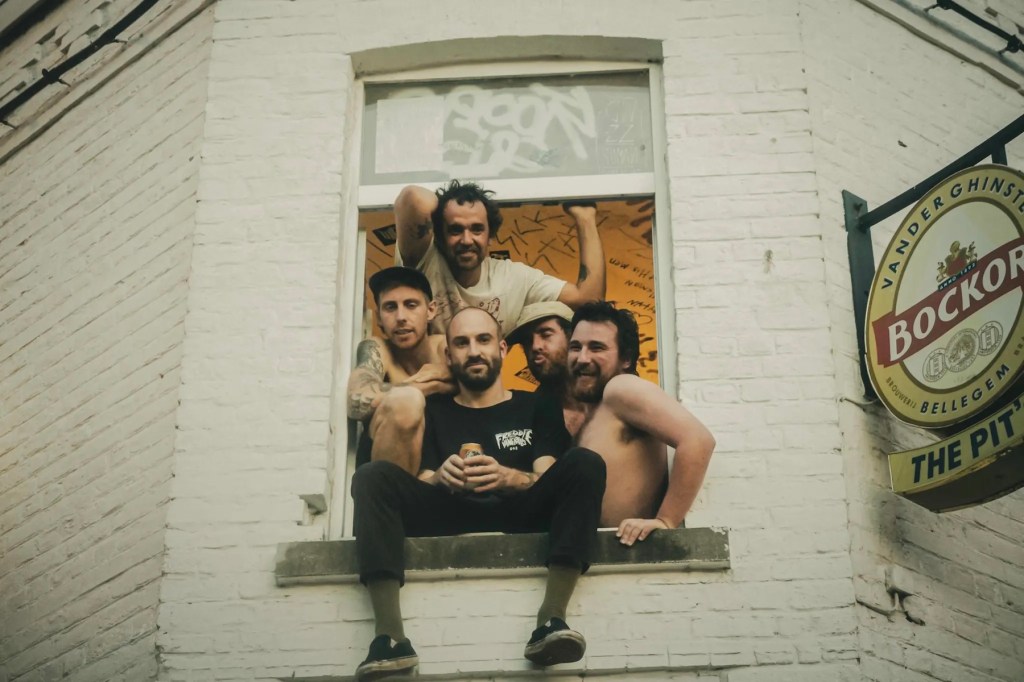
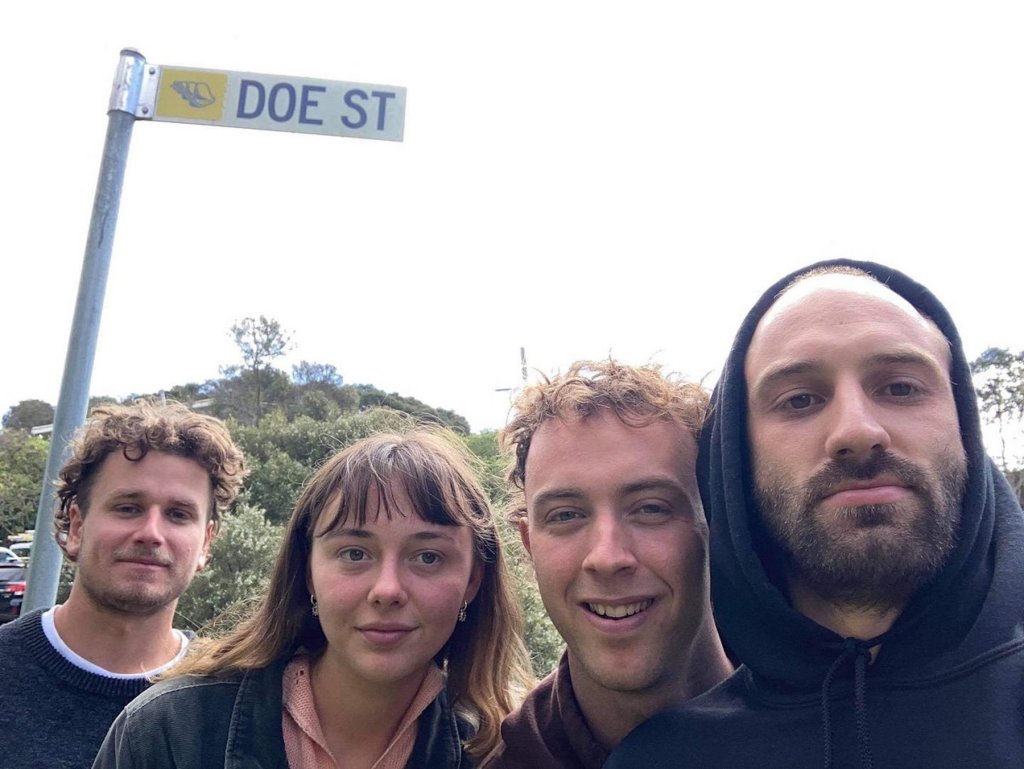
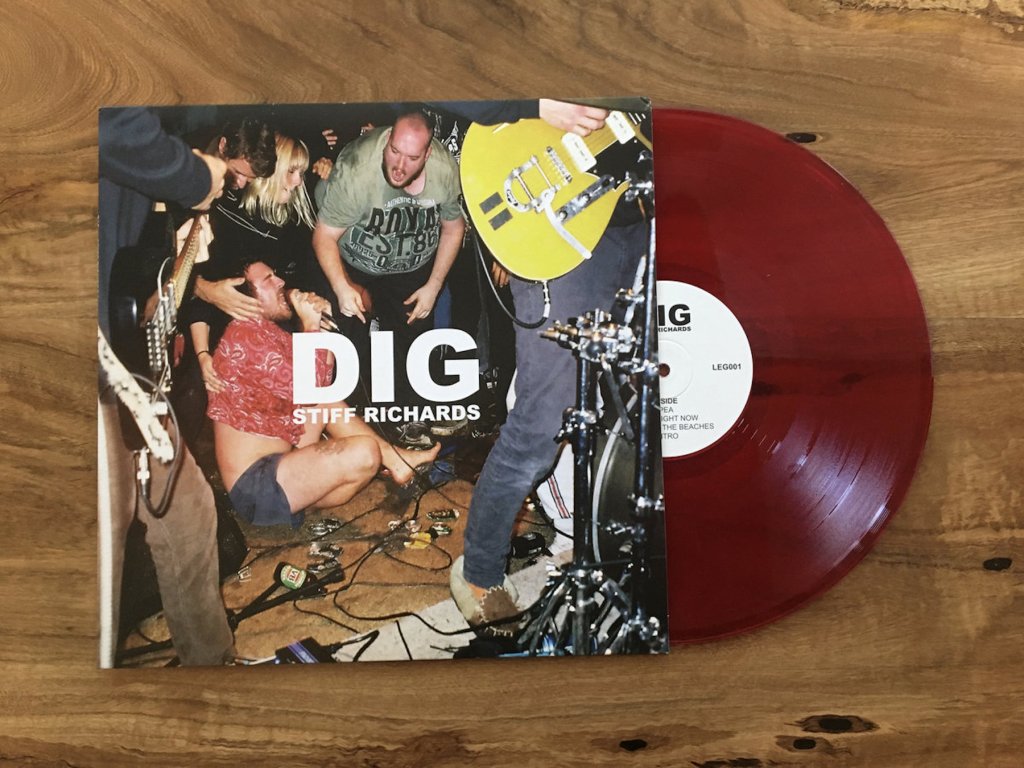
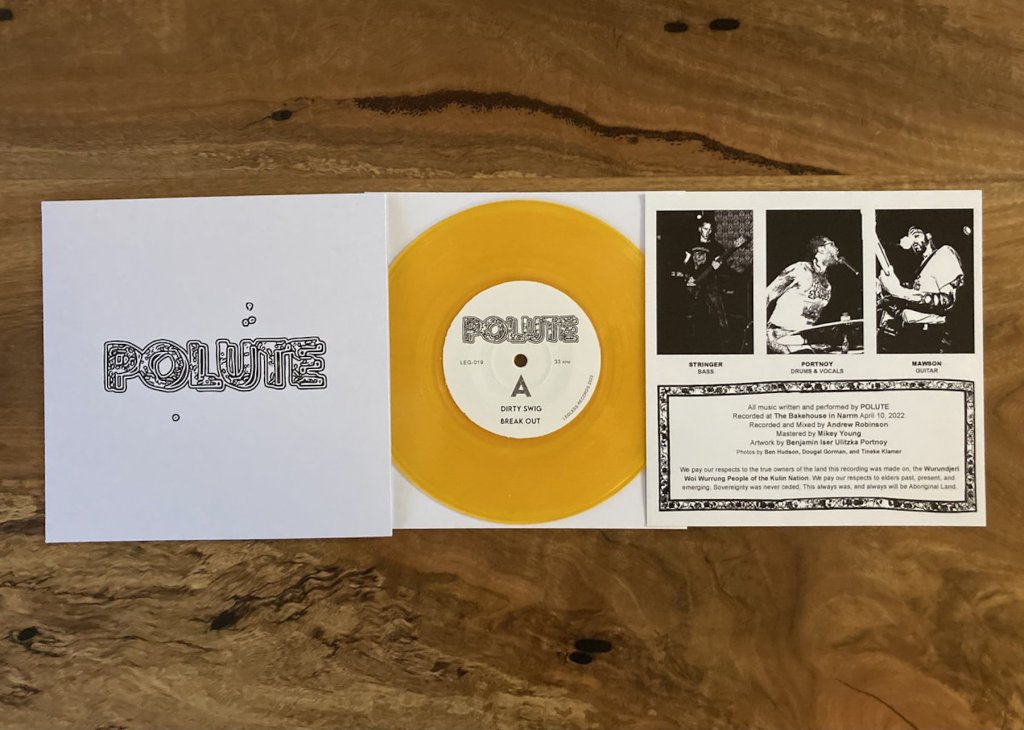
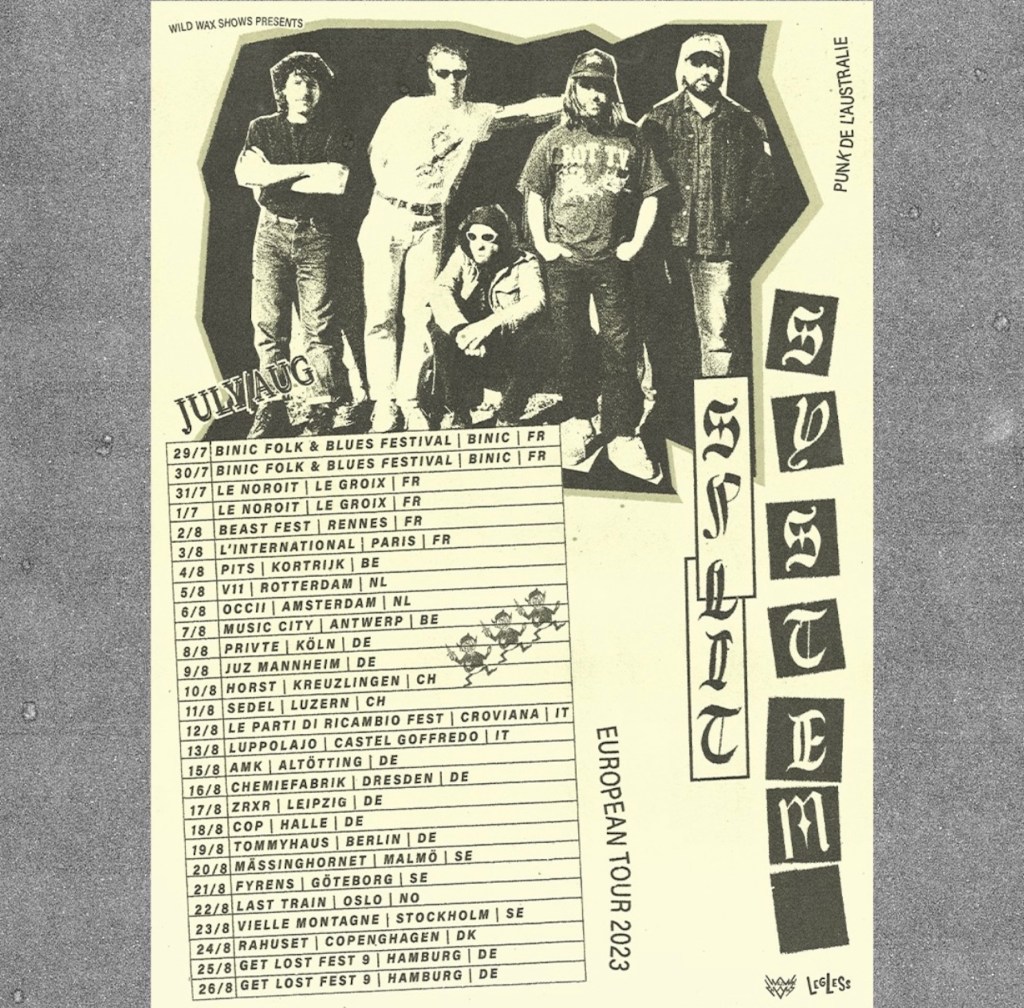
Meet Arron Mawson, a powerhouse behind some of Australia’s most dynamic bands – Stiff Richards, Doe St, Split System, and Polute. But his journey transcends the realm of music; it’s a story of authenticity, passion, and a pursuit of doing things for the right reasons.
For Mawson, making music is a visceral calling he shares with his friends. It’s about connecting through art, driven by an unwavering compulsion that pushes him to create from the heart.
Disenchanted with the traditional music industry, Arron took matters into his own hands, birthing Legless Records – a testament to DIY spirit.
In the whirlwind of the modern underground music community, where countless people, music, events, and distractions clamour for attention, Arron Mawson stands out as a beacon of authenticity and passion. It’s not just the fast-paced punk rock ‘n’ roll anthems or the inspiring DIY achievements that set him apart; it’s the very essence of his character.
Gimmie recently had the privilege of sitting down with Mawson before Split System embarked on their first European tour. In this candid conversation, we explore his bands, creative process, the art of songwriting, his inspirations, and the upcoming label releases. But beyond the music, we venture into the depths of his experiences – trekking in Nepal, confronting mortality, challenging the “too cool” attitudes, and embracing the art of “getting on with it.” Prepare to be inspired and enlightened by someone who embodies dedication, goodness, and the true spirit of the underground.
How’s life been lately?
ARRON MAWSON: Good. Moving house before we go to Europe, me and my partner moved into her mum’s place. That’s been nice. It’s been a really busy year, to be honest. It was sort of like a treadmill, I guess. It felt like it was nonstop, and then it’s finally settled down now right before going away.
I feel like after COVID, there was that massive rush. Everybody was saying “yes” to everything. And it kind of got to mid this year, like maybe a month ago, and I was like, ‘Oh, jeez, I really need to slow down.’ It’s been the craziest twelve months.
There’s so many good things that have been happening for you.
AM: Yeah, I’m kind of ready to go camping or something, though.
I feel like that as well. I work two jobs, freelance, and do all the Gimme stuff on top of that. It’s all fun stuff, but I just don’t have enough hours in the day to do all the things I want to do or that people want me to do. I always feel like I’m letting someone down.
AM: Yeah, exactly. You feel bad because you want to help your friends and you want to help everyone, but just you don’t have that capacity because it takes a lot. It’s been so nice seeing everybody back out after the couple of years that we had. There’s been so many good releases, so much positive energy. I feel like people are a lot more patient now and appreciative. It’s been a really fun year, but I think I can sort of feel it petering out, where it’s like everyone’s sort of chilling out now a little bit.
Definitely. I’ve noticed that as well. Everyone was so excited to get back into it and then we threw ourselves in so much that, like you were saying, you burn out and just want to go camping. I noticed on your Instagram there’s lots of music stuff, but then there’s also lots of nature stuff.
AM: Yeah, well, I guess that’s sort of my other hobby. I love hiking and I love being in nature. I live in Rye, which is about an hour and a half southeast of Melbourne on the coast. So I’ve always been drawn to the country and the coast. When I’m not doing music stuff or working, I’m usually doing something in nature.
I noticed that you trekked in Nepal!
AM:Yeah, I did that a couple of times.
What drew you to going to Nepal?
AM: Don’t really know. I’ve always had a fascination with mountains. When I was younger, I really loved snowboarding. It was less of the sport that actually drew me in. It was more the being in the mountains thing.
Why the mountains?
AM:I don’t know. A form of solitude. It’s cool. Doing a trek in Nepal, I wanted to be on my feet for over a month, and just be me and backpack. That was a place that I could do it.
I don’t know anyone who’s gone off trekking in Nepal for a month; what was the experience like?
AM: It was cool. When I started, I came straight off, I can’t remember what gig it was, but I think we had played a festival in Melbourne on the Saturday night and I left on the Monday, and I was trekking on the Tuesday. You basically basically start at sea level. The first few days it’s really hot and quite dusty and dirty. I was like, ‘Oh, jeez, what have I got myself into?’ But after five or six days I really got into it; I trekked for about five weeks. After a week, it was incredible realising your body’s made for that stuff. You get over the tired part of it and this primal thing kicks in and by the second week, you’re just like a walking beast [laughs]. It’s like, I can walk forever. It’s a pretty cool experience getting in touch with that side of your body a little bit more and switching off, not being on your phone and just being you and your feet.
I assume you’d have a lot of time to think while you trek?
AM: Yeah, it was really funny. I actually wrote more songs. I was humming songs, with the rhythm of my breath. I had walking poles and I ended up getting into a rhythm and writing songs in my head to the beat of my breath.
Wow. I love that.
AM: I’d hum these weird songs into my phone in my voice recorder on my phone. I got back and I had a ton of songs to go through. You get into that different creative headspace, but I didn’t really have an instrument or anything with me, so it was bizarre for me.
I find I get my best ideas when I go for a walk or I’m driving in the car or I’m just doing something else not creative. It’s like you kind of go on automatic pilot. It frees up your brain space to be able to let those good ideas come in.
AM: We’ve got so much noise around us. Walking undistracted with our own thoughts, a lot of people aren’t used to doing that, they don’t get the chance to do it. I think it’s a really important thing for us to do. You can go on hikes and just be alone with your thoughts, which can be quite intimidating sometimes, and then quite liberating as well. Because you’re just out there. You’ve got nothing to hide behind.
Totally. I found that you can never just run away from problems in your life, you can never outrun yourself. Wherever you go, you’ve still got you to deal with. Your problems go with you, until you sort them out.
AM: Totally.
Previously, someone asked you about your philosophy behind all the stuff you do and you said that you just get on with it.
AM: Yeah. I’ve got a pretty full on personality. I’ve met some challenges in my life. Doing this music stuff, especially at the start of COVID, that it really kicked into gear with my label, Legless Records. I used to have a lot of anger and frustration with the world. Sometimes approaching challenges and things with that, you don’t get anywhere. Sometimes you just got to pick yourself up and move forward. I guess the get-on-with-it-thing is, I don’t know how to put that to words, but you’re finding something positive to do. Sometimes getting bunkered down with negativity and anger can stop you from actually achieving things, results.
Yeah, totally. I think that you kind of realise that more as you get older. When I was younger, I was that punk rock kid with the spiky hair and the mohawk, and I was so angry at the world. But a friend told me that you can’t really fight fire with fire. Getting angry at someone when they’re angry is not going to achieve much.
AM: I guess that’s the thing. We have a right to have anger, but it’s your choice how you channel that. I used to get frustrated with the music industry, people around me, there’s so many things. I made that decision to make the positive change that I’m looking for rather than complaining about other people not doing it.
Absolutely. I’ve been doing my own thing for a long time, so I very much get that. That’s kind of why we started Gimmie, There were so many bands that we love all over Australia and no one was covering them.
AM: It’s nice when people do things for the right reasons. It’s out of passion. It’s not for profit or self-glorification or anything like that. It’s just because you’re genuinely interested in it. And I think it shows. Things immediately get grabbed by people because they actually respond well to that—the honesty, the passion.
People hit us up, wanting to give us hundreds of dollars to be on/in Gimmie and we’re just like, no, that’s not us. What were the particular aspects of the music industry that were annoying you?
AM: Well, I guess it can be an element of your own perception of what people are like and the reality. But it felt like a lot of the music scene was really too cool, hard to break, it was hard to get through to radio or record stores would be kind of dismissive. After that experience, I wanted to create an umbrella, sort of make this bubble, that me and my friends can sit under and use each other’s momentum to help each other skip that exclusivity. It does feel like that when you’re at the bottom and it feels like no one cares. And then if we work together, with the momentum of each band, we can give a bit of a spotlight to the next band that comes up. With a lot of people being too cool, I guess, I just wanted to drop that and just let people be a bit daggy and just play music for the sake of playing music. I don’t really know how to put words to it, to be honest. It just felt like unless you knew the right person… if you want to try to get on a festival and you want to try to get on a gig, it’s like, who are you? I was like, well, I’ll just do it myself. Does that make sense?
Yeah, totally. I’ve had that feeling before, that’s why you make your own things!
AM: Yeah. I feel better for it. I don’t really want to throw anyone under the bus, of course. It was actually good that happened, because it stimulated me to do something that I’m now really proud of. With that kind of pushback, it inspired me to do something. Now I’ve got all these incredible people around me. I wouldn’t take it back.
Totally! You’ve been releasing so much amazing stuff on Legless.
AM: Thank you.
I’m really excited that I finally get to talk to you about it all at length. Our favourite people are people that work hard and they just make stuff because they love making it. You’ve told me previously that your dad played in bands and you’ve been surrounded by music your whole life. What kind of bands did he play in?
AM: Dad grew up in Cornwall, in England. He was playing rockabilly, rock and roll bands for most of my life. He was a frontman-guitarist and he sort of switched between a few different bands. And then I lost him, when I was about 21. I had music around me most of my life but I think after losing him, I definitely got more drive having a loss like that at that age. It kicked me into gear. I’d always played music, but where I grew up in Frankston, there was not really many people that I aligned with. It’s a lot of fights, a lot of shit music, shitty clubs and as soon as I got my license, I moved to the beach. Half my mates either moved to the city or to the beach.
That’s where I started jamming with people more, sort of between that 18 to 21-year-old time in my life. Music has always been there, but it wasn’t until then, I sort of started surrounding myself with a few mates, who introduced me to Eddy Current Suppression Ring and stuff like that. For most of my life it was just rockabilly and rock and roll. I listen to Brian Setzer, stuff like that.
A lot of my buddies went to all ages hardcore gigs, but back then, I looked at it as very blokey and people punching each other in the head. I didn’t really find anywhere that I enjoyed until older age, and liking Eddy Current. That put me on to other things like Thee Oh Sees. I was like, what is this world? I haven’t ever experienced it.
I’m so sorry that you lost your dad so young. I’ve lost both my parents as well, so I very much understand what it’s like. Especially when you lose your parent/s when you’re younger. Friends don’t necessarily get it because they still have their parents. It’s just such a massive thing.
AM: Yeah. It’s a bizarre thing, death. I feel like our modern society is really not prepared for it. The loss wasn’t actually the hardest thing. It’s like that’s the only guaranteed thing in this life, is that we’re all going to die. It’s just the inability to process it. We don’t have the sort of community… the word that I’m looking for, like, rituals and stuff to process death properly; I feel like it’s something that we’re missing these days. That was probably the hardest thing, but it’s something that I’m really okay with because I started realising how much people are unprepared for death. It’s really weird. Yeah. Sorry, I’m thinking and talking at the same time.
No, that’s fine. I totally get you. Thank you for sharing that with me. Changing the subject then, I know you play guitar and bass. Which one was first?
AM: Probably guitar. I never really ever played bass. Bass just came with guitar. Guitars were always in the house. I think dad taught me, ‘Johnny B. Goode’ and ‘Smoke on the Water’ when I was real young, and then it was just like through listening to songs. I never really had lessons. Me and my sister would usually just be sitting around, and occasionally jam with dad.
Your sister plays in a band?
AM: She plays in The Miffs. They’re killing it at the moment. They’ve been playing around Melbourne and Australia. I’m really stoked for them!
That must be cool to see your sister ruling it. Is it your little sister or big sister?
AM: Little sister, three years younger. It’s great. The fact that we grew up with dad playing music and now we’re both playing in bands and stuff, it’s really nice. After dad passed away, it was probably about six, seven years there where we were kind of pretty separated, and it’s really heartwarming to be close again.
Lovely. You mentioned, Eddy Current Suppression Ring was such a big band for you..
AM: Where I was getting a bit stuck before, is rock and roll and that environment, it’s very blokey and it just felt really “too cool”. Eddy Current had this daggy, raw energy where everybody felt honest. I wasn’t this big, masculine guy. Eddy Current was such an unorthodox approach to music that I hadn’t heard before. I know there’s so much of that in history, but it was the first thing that I put on and it just blew me away. It was just like, what is going on here? The awesomeness of what Mikey does! This is the first thing that really grabbed me and started an introducing me to bands like UV Race and the Thee Oh Sees, and the plethora of other bands that came from there.
How great are all those bands you just mentioned? I love them all too, especially UV Race. I super love Mikey’s band Total Control too.
AM: Yeah. Eddy Current especially for me. I grew up in Frankston and they’re all Frankston boys as well. So it was like, ‘Oh, there’s someone from here that is actually doing something interesting!’ Growing up it was a lot of fighting and just people that weren’t aligned with anything. I wanted to build bike jumps and cubbies, just hang out, go skateboarding and stuff. But everyone else just wanted to fight. It was just odd.
Yeah. I’ve talked to Jim from Civic about growing up in Frankston a bit.
AM: It’s like this love/hate thing. Split System are playing at Singing Bird tomorrow night. Got our going away fundraiser thing. What Stu’s done there, all ages gigs, he’s got the studios and jam rooms, kind of made this institution for Frankston. It’s nice seeing the next generation of kids, actually having something to do. I don’t hear much of all ages gigs at all anymore. It’s all licensed venues that are based around selling booze. That’s how they profit. What’s for the kids?
Totally. Growing up in the 90s in Brisbane, I used to go to all ages shows most weekends. In my Senior year of high school I went to over 100 shows. It made such a difference in my life. I do all the things I do today because I went to those shows early on, and there was a lot of younger bands, even my age (15-16) at the time, that played, and I was like, wow, I could do that!
AM: Yeah. I was talking to the C.O.F.F.I.N fellas because they played in Frankston just before tour before they went off to the UK. That’s where they started, they all met when they were like 14. One of my favourite live bands now, wouldn’t have existed without that environment for them.
Stiff Richards. Photo: Jack Golding.
What was your first band that you had?
AM: Stiff Richards was the first band that actually did anything. I had like a couple of jam bands with mates. I had a band called Green Waste, which was my buddy, he had a property maintenance company and we all worked mowing lawns for him. Then we’d rock up at his joint, he had a jam room at the bottom of his house. There was a big pile of green waste out the front, every night when we finished. We did a couple of gigs, and that actually kind of led into us making Stiff Richards. Me and Tim, the other guitarist, were in Green Waste. That was pretty funny. That was probably ten random mates that switched in and out on different instruments. Probably seven guitarists trying to bash the drums [laughs].
The next band for you was Split System?
AM: Probably Doe St. Doe St and Split System were roughly a similar time. Polute, a little fun recording project with me, Benny and Stringer, came after that.
Is there much difference for you between the different bands? Do you get different things from being in each of them?
AM: Well, Stiffs, they’ll always be my brothers. We’ve had this journey from playing in sheds to being able to go over to Europe, and just everything that we’ve experienced musically together, is like such a family. I’ll hold that close to my heart forever. It’s a really special friendship. Wolfie, our singer, his sister has kids with Gazzo, the guitarist.
Split System, definitely feels like there’s a member from a bunch of different bands, and that seems to be really productive. They’ve become best friends as well. It feels really good writing-wise. That’s one of my main focuses at the moment, just because it feels really creatively stimulating and everyone’s getting along really well and having a great time.
Doe St, are all friends from the Peninsula that just sort of organically came together. My old house was on Doe St. Everyone was living on the same street or in the same neighbourhood. We wrote all the songs and recorded it there, just friends hanging out.
Doe St, pic courtesy of Legless.
It’s funny, I’m literally thinking out loud right now. There’s not much thought been put into any of them. It’s just things have aligned at the right time and feels good.
Sometimes it’s that simple.Sometimes when you’ve got too much intention with something, you set yourself up to be disappointed.
AM: Totally.
So, Split System is going to Europe?
AM: Yes. Going over for Shock Fest. We’ve got one show at the start of July and then I got a holiday with my partner for a few weeks, and then Split System start with Binick Folk And Blues Festival, which is the 29th of July, I think. Then we’ve got a bit over four weeks. I don’t think we have a day off either. I think we’ve got one night off in a month!
Wow. Do you like touring?
AM: Well, I’ve only done it once with Stiff Richards. And that was last year. It was one of the best experiences I’ve ever had. I’m definitely keen to go back.
What were some of the best things from that tour that you enjoyed?
AM: Honestly, the people, the hospitality in Europe. We had no expectations. We thought we’d be playing for ten people some nights and we ended up selling out almost every show; I don’t mean that in a bragging way. It was just mind blowing that people actually came out, in another country. We haven’t even toured in Australia. We’ve been out of Melbourne once, we went to Sydney, played with Celibate Rifles once and Meanies once. To go over there and have such a good response and such friendly people, it was unreal.
Yeah. Many bands I know that have toured Europe say the same thing and talk about how they have cool squats and places to stay in.
AM: Yeah. You rock up, they’ll have bread and cheese and stuff for you. There’ll always be someone to meet you. A lot of people touring are cramming as much in as possible because it’s quite expensive to be there. You’ll get in, then you set up, and they’ll cook you dinner and sit you down with the other bands and the staff. Sharing a meal with a bunch of people is the best way to break the ice. By the time the gig starts, you’re friends with 30 people. It’s really beautiful.
Stiff Richards Dig LP, pic courtesy of Legless.
Nice! So, you started Legless to put out Stiff Richards’ Records?
AM: Yeah, basically. I guess that comes back to some of those frustrations. It was hard figuring out how to navigate the music industry. I was like, I reckon I could just do this myself. Well, with the help of my friends as well, I feel like we can do this together. Then as mates were asking me how we approached it, I was like, ‘Do you want me to just help you out with it?’
Is there anything that you wish someone would have told you when you started the label?
AM: Well, kind of as I said, those challenges, even though they can be frustrations in the start, they end up being the things that make you stronger. Keep pushing through. Do things for the right reasons. Don’t expect to make money. Do things that make you feel happy and then you’re never going to get bummed out. Do things how you want to. There can be a lot of pressure to get bookers and management and stuff like that. That can work for some people, but if you’re willing to work hard, you can make it work really well for yourself. Positive encouragement for bands and people that want to do stuff. It’s like back yourself and have a crack.
Definitely felt defeated sometimes, it’s hard navigating that world sometimes when you’re outside. If you don’t have any super cool friends or people in the know, you’re just in this big open world. People need to stick on their path and stay true to their art.
Totally! You’re speaking our language. Putting out records with your bands, do you feel like there’s any mistakes that you’ve made along the way that you’ve learned a lot from?
AM: Not really. All mistakes can become lessons if you are aware of them and you utilise them. I can definitely be quite opinionated and get grumpy about things. And that’s where as I get further into things, I know that I shouldn’t have given those things as much fuel as I did, but I wouldn’t have learnt that without going through it. I don’t really regret it. You know what I mean?
Yeah. This is like anything in life, you get frustrated and then you learn to deal with something and you channel it into something else.
You seem it! Did any of the songs that you mentioned that you’d wrote when trekking in Nepal end up on any albums that you’ve put out?
AM: They definitely would have. I can’t remember. I’ve got the most obscene voice memos folder saved on my computer and it’s like pretty funny. Sometimes when I’m drunk with mates, you go back through all your voice recordings and find early takes of songs that you’ve done. That’s like, basically how most of our bands do stuff, record things on the iPhone and then you get a better take of it and it just disappears into the ether. I reckon there’d be some funny recordings of me in Nepal somewhere, like humming a couple of Stiff Richard songs.
Polute self-titled debut release, pic courtesy of Legless.
Do you have a song that you’ve been a part of that you’re really proud of?
AM: It’s weird, I don’t really approach music with heaps of intention. A lot of the time it’s me, grabbing a guitar and mashing chords until stuff starts feeling good. Sometimes it’ll be utter crap for three minutes and then something will feel right. I feel the beauty of a song is when everybody else contributes to it and then it becomes what it does. So I’m equally as proud of everything. Fluff it out with the rest of the team!
What else is in the works for Legless at the moment?
AM: We just finished recording the second Split System album. Can’t wait. I’m pretty stoked on that. That was a really fun process. The first seven inch and album were written, I think we’d only really played with each other properly like five times up until that first Vol. 1.
Wow. It’s a great record.
AM: To have like a year under the belt and a lot of it was done over the phone, sending snippets. We had a couple of jams and recorded Vol. 1 and then with this one, playing with each other for a year and actually having a few jams leading up to it, it was fun.
We’ve got the Stepmother album coming out later in the year as well. There’s a few other things in the pipe works, but I’m still not sure, I don’t want to jump the gun on a few things. Stepmother and Split System you can expect later in the year, most likely.
Split System Vol. 1, pic courtesy of Legless.
Cool! Looking forward to them. What can you tell me about Stepmother?
AM: It’s like a completely bonkers horror movie rock and roll album. It’s pretty crazy. Graham’s done an exceptional job. It’s going to be a split release with Tee Pee Records in the US. That’ll be out later in the year.
Who’s one of the most raddest people that you’ve met through what you do?
AM: Honestly, it’s really funny. I feel like the thing I feel most privileged about is that my favourite bands are the people that I’m actually putting out at the moment. So, between C.O.F.F.I.N, Smooch, you can go through the catalog; they’ve all become really good friends. So equally, everybody. The Rack Off Records girls from Blonde Revolver and all that crew. It’s a really good little community at the moment and everyone’s having a good time.
Before doing any of this, Mikey Young was definitely one of those people I looked up to and he definitely influenced me. When we were in the early days of Stiff Richards, he was a really good mentor without intentionally doing it, just being a good person and making me realise that all the people you’re going to meet in the music industry aren’t just wankers. I’d go around and mix at his house. He’d just be in his boxer shorts and have coffee with you, super casual. I was thinking, ‘Oh, this dude is my hero. And he’s just the most normal guy ever!’ He’d load me up with five records and send me off on my way.
With Gimmie, when we started, we knew no-one. We’ve met so many lovely people in the Australian underground music community. There’s moments when it feels like everyone is really supportive of each other.
AM: Yeah, I think that age of bolstering yourself up, and those “glory” years of, like, oh, look at me, it’s gone. There’s actually strength in supporting each other, and the competitiveness is starting to die out a little bit, and everyone’s kind of bringing each other along with them. So it’s nice.
Yeah. That’s why I really love Nag Nag Nag fest that Greg and Steph from Display Homes put on every year. It just has such a great environment and vibe. Everyone’s just really nice. It was such a nice day this year. Every single band was great. We were there from the very beginning till the end and watched every band, everyone totally ruled!
AM: Oh, totally. And everyone had a happy day. You get a lot of drunk people in a room, and it’s like there’s always one idiot that ruins it for it. But it didn’t seem to be any negative energy there for the whole day, so it was good. It just seemed like a happy family.
Before, you mentioned sometimes you feel defeated by things. How do you flip that for yourself?
AM: I don’t know. I’ve had a lot of things happen in my life that I won’t bore you with, but I just found with a lot of those challenges, even with losing my dad and stuff like that, through processing my own anger, I realised that you don’t get results from letting that negativity have a flame. Move on to something positive and time will heal everything. Life will throw you punches, but it’s a complicated world and it’s never going to be perfect. And if you feel like a victim all the time or let things get you down, you’re never going to get back up. You’ve really got to just keep trucking and do the things that you know is right and elevate yourself instead of complaining about what else is going on. You know what I mean?
Yeah, absolutely.Surrounding yourself with positive things and positive people, really makes a difference too.
AM: Yeah. Everyone has a right to be down and stuff, but unfortunately I feel like unless you can get back into some kind of momentum, it’s easy to get stuck. So I keep busy and do the things that make me feel good. And it’s worked. Like doing the Legless-thing. I run a property maintenance business as well. I do window cleaning. I’ve been really busy, but when I slow down, I realise that I like being occupied. And if I’m not doing stuff, then I’d rather be in nature. I like exerting energy by walking or doing something else. When I get stagnant, I want to go do something.
We go to the beach if we’re having a rough day. Going for a swim or a walk can change your day.
AM: Yeah. The ocean heals a lot of stuff hiking. I do diving, and I go free diving with my partner a bit. I’ve always been drawn to the mountains too.
As we mentioned you’re about to go on tour, what’s the rest of the year hold for you?
AM: That’s going to absorb a bit of time [laughs]. As I said at the beginning of our chat, I’ve just moved house. I’m not back until mid-September, so by the time I get back, and get back into work, I’ve got the Legless releases teed up and then Christmas gets really busy for work for me. Usually once Christmas is over, we get back in a creative mode again once all the craziness of the holidays is over. Then probably start recording stuff again. I’m hoping that Stiff Richards might have some new music sometime next year, we have the intention of trying to record over January, we’ll see.
Will the Split System record come out before the end of the year?
AM: That’s the aim at the moment we’re talking with discussing label options. I’ll definitely be putting it out, but we’re just contemplating a few things at the moment. Before Christmas, otherwise early next year. Probably do a big run of shows for that. See a bit more of Australia.
It was so cool to see Split System at Nag Nag Nag this year! We loved your set!
AM: It was a pretty loose set. We got a bit excited early and were super drunk by the time we played, but it was such a good energy there. We were a little bit worried after, like, oh, jeez, that was pretty rough. Everyone was having such a good time, it didn’t matter.
Check out all the awesome things Mawson does and is a part of:
Original photo: Jacob McCann. Handmade collage by B.
Lothario is here! And we couldn’t be more stoked. A new solo punk project from Naarm/Melbourne-based creative Annaliese Redlich, who is also the host of 3RRR radio show Neon Sunset; producer of podcast All Ears – exploring the ways music challenges, comforts and connects us; she’s also a DJ; AND she’s so much more as you’ll find out reading this conversation.
Lothario debuts with 7” single ‘Drunk Fuck / Black Hair’ – a vulnerable and agitated, raw expression of wildness. We’ve been lucky enough to also hear a sneak peek of her up coming full-length album, which we can attest, is filled with sharp-edged raucous expressions of love and personal power. Heavy underground hitters – Ishka aka Tee Vee Repairmann and Rob Craig aka Buck Biloxi feature on tracks. There’s all kinds of legends in her current live band too.
Annaliese recently stopped by Gimmie HQ for a long yarn about her world. There were tears, joy and laughter, as she shared her story of how she got to where she’s at and where she’s going next.
What’s life been like for you lately?
ANNALIESE: It’s a really wonderful place to start. I feel like life has been at warp speed for me lately. I’ve been finally feeling like so much stuff in my life has been opening up and calling for action from me, in ways and places that will just keep growing. My biggest desire as an energetic person, is to follow through on all of those things. I’m also finally learning a bit of rhythm with my creativity, I’m getting to understand the libido of my creativity. Before, it used to be this thing that kind of jumped through the window and surprised me or affected me at certain times in my life heartbreak and loss. Now it’s its own existing creature that is very active. So, life lately has felt very fast but good, not out of control.
Isn’t it great when creativity comes, almost like a calling, you get this feeling, and you just feel compelled to do it. You have to!
A: That situation has allowed me to be my truest self. I’ve often questioned it, but I’ve just done it anyway, and it’s kind of alarming. But it’s also really good to know that this little thing is stirring inside of you like a magnet, pulling you through all of your own layers of bullshit or self-understanding or terrible narrative towards the thing that is most important for you to do, even if it’s kind of scary or ugly or concerning, or doesn’t often look like it’s going to be the most amazing thing you’ve done. But then a while later you’re like, oh yeah, my compass was working. That was good.
Yeah, previously you’ve mentioned about how you sometimes might have an opportunity, but you realise that it’s not the right time.
A: Yeah. You could say that with relationships too. Timing is everything. If you’re talking about getting something in your life from A to B, if a journey or an experience has got to be linear like, that, cool, I started here and I ended up there; I don’t think life really works like that.
I know in my creative life, in my journey of self-understanding, it’s like it’s all about creating new neural pathways. Maybe it won’t be by the time that I reach that endpoint or reach that next phase that I wanted to, but something else really fucking cool or interesting will happen on the way that will inform me about a whole other landscape that I need to be a part of. You got to be philosophical like that.
You’re originally from Meeanjin/Brisbane?
A: Yeah. Born in Brisbane, moved to Melbourne to finish uni and to just feel a closer connection with music at my fingertips. I hung out in various punk scenes there. I’d go to The Art House all the time, seeing every possible show, and DIY shows across Melbourne.
The first kind of biggest unconscious pull for me, well, other than going to Melbourne, was starting to volunteer at Triple R radio. I loved listening to the radio but I had zero interest in being on it. In terms of having any kind of on air engagement, I was terrified actually. Even going in and volunteering to help out on phones, because I was like, oh, there’s going to be all these cool music people there, and everyone’s going to be probably a wanker, just too cool for me. whatever, let alone any thought about doing on air stuff. The second that I got there, not only did I feel completely comfortable, but in the most sort of surprising way. I was around so many different kinds of people, all with this common pull to this great place that allowed a diversity of being and expression. They were just like, do a read on air and do a graveyard slot. And I was like, no, okay, they kept harassing me. I felt very lucky to be asked to do that stuff, but had zero self confidence with it. Then I was like, wait a minute, I’ve always collected records, I’ve always played music. I did some DJ nights in Brisbane with my rock and roll records. I thought, oh, wait, why can’t I do it? Why not me? Yeah, sure. Not many people get that chance. Not many people get that level of egging on. That turned into a year of a radio show, then two years of a radio show. Now I’m up to nine years, through a few different time slots, which is wild.
Now I’m a podcast producer, it’s shape me now as an audio producer. I have just learned how to multi-track through that and produce the 7” single for Lothario. I’ll be putting out a full record at the end of year, too. It all comes from that, so it’s wild.
We’re really excited for it. I was listening to the Lothario tracks you sent through and I’ve seen some live vids online stuff. It feels like it’s a really powerful project for you. It seems like you’re really stepping into yourself and your own power. Lothario has a real hypersexual-vibe that’s coming from a place of empowerment and self-definition…
A: And, hyper-aggression and hyper-vulnerability. It’s great to hear you say that. It really feels like that for me and that’s not something that I actually anticipated or thought about. The fact that anyone else would pick up on that or care about it means a lot. That was a really beautiful insight.
When I first started this, I had a flood of music ideas at the end of the year last year. I always had this dream to do it. I love playing in bands. I love the energy of other people in the way that, an idea that I might have, when I play it with a group of people or someone brings in a part or mishears it and it changes; it turns into this beautiful other thing. Collaboration, has always been so important to me. But I’ve also just always wondered what it would be like to take something 100% on my shoulders. How maybe that process could happen in myself; what would it feel like to be actually in control of the tool that you’re using and create what it was that was in your mind. I never thought I could do that.
I always wanted to do this kind of multi-tracked, very organic, not kind of clean or clinical in a production sense, but create something with samples or live guitar and vocals. I just always reach this point of I can’t figure it out; I can’t finish the song. Or I finish the composition, but I can’t fucking make it how I want it. I’ve done one guitar track. I’d managed to do some bass in there, but I can’t do the drums – it was this gaffer tape and rubber band situation that did my head in and I gave up. My creative process got totally stifled and the libido got crushed out of it.
When I sat down to have another crack at it, and I wasn’t even consciously doing it, I was like, I’ve got this riff. Cool. Oh, well, I can use Pro Tools now, and I know how to do that because I’ve created podcast series. I thought surely I can give it a go. I don’t know drums, so I’ll just like, bang on the table to do a metronome for it. Wait, I got an idea for a vocal line plugged in. And it’s like, oh, cool. That feels good.
I got talking to my friend Rob Craig in Louisiana, who’s a musician called Buck Biloxi, he’s sort of a (I will say this in kind of hilarious inverted quotes) “elder statesman” of New Orleans punk. He’s a kind of one man band situation himself, but has had a lot of groups Buck Biloxi and the Fucks and Giorgio Murderer. He was like, ‘I’d love to hear your music.’ And I was like, oh, I can’t. No one’s hearing it. It’s very private. I can’t play drums. He’s like, ‘You can figure it out.’
I sent him the tracks, and I was just like, oh, my gosh. Because while he’s a mate, I really hold him in very high esteem. And I was just going through this point in my life where my inner narrative was like, everything you do sucks. Don’t hide your vulnerable self from the world. Do you know how that works? How about you try the other thing? I was actively going through this thing of, yes, but maybe I’ll do the opposite. I thought he was probably going to hate them. Oh, my god.
He wrote back straight away and was really into it.He said, ‘Can I record some drums for you? Would you like that?’ I was like, yeah! He did, and it just worked. Then I was getting flooded with these ideas and had this set up in my living room.
Lothario is a character. I’m not just hypersexual. I’m not just hyper-angry. I’m also vulnerable. I’m all of these things. I’m not hiding, I don’t want to hide anymore. I don’t have like an instrument to hide behind either [laughs].
I’ve done lots of musical projects, mostly in the punk, garage, rock and roll realms, but also, at the same time as doing that, I was the front woman for a late 50s to mid 60s soul and R&B-style band, singing like Etta James. We were called Anna-Lee & the Double Lovers. I did that from 2000 – kind of a foundational Jamaican ska and rocksteady classics thing, not so much Motown. I started it with a bunch of guys that I knew who were all professional players. But we’re all these record nerds because I love collecting 45s. I love that music! There’s all of these amazing tracks, like B-side tracks that nobody knows and they’re the most heartbreaking, gut-wrenching, incredible songs. And we all had these records and I was like, oh, let’s get together.!
I love that idea of putting on a glitter gown and creating a show. I would do my hair in a beehive. And the guys had the right gear, the right amps, and we really worked on the sound. I love performing a show and playing a character. Having nowhere to hide because I was just out the front was really challenging. It was about becoming a better singer. It’s hard work. I love getting physical and being present. I feel I do struggle with the guitar, so I feel a little bit hogtied. So doing this is kind of a bit more freeing. All these Lothario songs, it’s the most exciting, most validating or satisfying thing I’ve ever done.
The live band is Billiam and Locke, who plays with Billiam a lot. Moose from The Uglies is going to play bass and Sarah Hardiman wants to join on guitar for a couple of shows. And, Steph Crase (Skid City, Fair Maiden, Batrider) from Summer Flake. I’ve looked up to them for so long. While I really want to build a relationship, I love these people and I love having people want to be involved in making music with me, particularly this music; I love the idea of it not being the way I started this. Why do we have to be wedded to the same players? It’s important to get the right mix of people. I might even get to play love with my mate Rob from Rob New Orleans that I mentioned. What an honour. How exciting. We’ll see how Lothario evolves.
It must be really liberating to have project that’s so fluid!
A: Yeah. I am going to the States for a couple of months at the end of the year and I already have an American touring band. We’re going to do some dates there, probably in the southern parts. I have mates in LA and New York that could do some shows or I could do some shows, just me, OG Lothario.
Once I realised that the worst demons are the ones that you carry yourself and nobody probably says things bad about you as you bad as you say about yourself… once you can fucking sit down and take a good hard look at that stuff in you, that’s haunting you and holding you back, or can reframe that in good directions for you, then the rest, is pretty easy.
Yeah, you have to do the work. if you look at yourself and you do it honestly (I’ve done that myself in the last few years) and you work on that doubting self-talk and things that haunt you and a finally live your life in the truth, all the best things start to happen for you. There’s a confidence that comes with truth, there’s no my truth, only the truth.
A: It really does. It’s so true. I see a counsellor. I thought I was living in my truth. I was always looking for that truth. There’s a level of confusing shit that you have to go through sometimes to figure out which way your compass points.
I’m always in awe of many of the musicians that we know and love through Gimme that you highlight that are in great bands that really resonate, especially younger people. It’s not about popularity, it’s about, these people are in their skin. You can tell that they’re in their creative skin really early.
Photo: Jacob McCann.
I’m always impressed by passionate people, especially those that find what they love young, dedicate themselves to it, and stay the course. A lot of people in life don’t even know what they’re passionate about, if anything. What made you choose the name, Lothario?
A: It’s kind of a joke! I’m aware that “Lothario” is an attractive man who swindles women out of whatever they have that they want, ruthlessly and in cold blood. I’m interested to know why there’s the double standard of women in music, of the way that our sexuality is presented (I can’t believe we still have to fucking talk about this, by the way) but the fact that if you’re up on stage and performing publicly you’re in the gaze, but you’re not doing it for the gaze. So many things are asked, and are expected, of women and people presenting as women that aren’t even questioned with men. I guess I’m taking stock of my own sexuality and sexual drive. Sometimes people are well-meaning but other times dickheads come up to me, and ask me, ‘Oh, did you write all of that?’
That’s just gross. People would never go up to a male musician and ask if he writes all the songs.
A: Yeah. It’s like thanks for the compliment, you’re essentially saying that you like the riffs, you like the song, you like the chorus. That’s cool, but would you say that to a dude? You fucking wouldn’t.
You’ve told me in previous bands you’d mostly write about love and heartache; is that still the case with Lothario?
A:Yeah. I was going through a tremendous amount of heartache and writing about it. Processing soul crushing heartbreak stuff, and also the potential spark of love again.
I may call my LP this, Loser Songs For Lovers or Love Songs For Losers. It’s not an entirely original idea, but the record is like a trajectory of heartbreak from, like, holy fuck, I don’t even know who you are in a relationship anymore, and where did you go? Then the crushing devastating loneliness and sadness, grief. And, I’m going to go out hook up and crush a beer can against my head. I was kind of leaning into that character of the stupid bloke that you see out in the street on countless strip malls, in countless capital cities every Friday/Saturday night, just charging around, fucking and fighting. I found I have a fair bit of that in me [laughs]. I’ve never fought people, but in my own level of intensity and energy, gone out and destroyed myself. It’s like, oh, gosh, here I am in this incredibly emotionally vulnerable state, and I go out with my couple of my mates, just out all night doing naughty things, but kind of hurting ourselves. What if I made that into a character and it’s just even questioning in myself, am I questioning that because I’m a woman and I shouldn’t be doing that? What if I was a lad, a bloke? I’d be fucking celebrating it. I’m going to fucking fight tonight. Yeah, all right! You just need that no nonsense anthem to charge to, which is a bit of what this is about.
What was the first song that you totally followed through on and finished?
I finished ‘Black Hair’ and ‘Drunk Fuck’ pretty much at the same time. Those songs will be a 7”. It was important to me to pair those because it was a prolific period.
‘Drunk Fuck’ is: Six ft-something with nothing to say / But Saturday night it’ll be okay / Bored and horny, getting dumber by the day / It’s Saturday night in the USA / It’ll be okay / You look all right in the blacklight / Come on and touch me up and give me that drunk fuck. Just fucking take, take, smash, smash!
‘Black Hair’ is about being shut down and shut off, and then seeing that very unexpected spark with someone. Like, whoa! What was that? Do I trust this? No, I don’t trust this. I’ve been here before. Fuck. I don’t want to, but could this be it? Could this be it? It’s a sign. That door is starting to open. And maybe you’re letting that light in a little bit. It was funny to me that I wrote those both at the same time because they were both things that were happening and they’re still both happening.
So you’re still working on tracks for the full-length album; the ones I’ve heard are demo versions?
A: They might not even be. I’ve got another six, so I don’t know. There’s offers to put out 7”’s on other labels, then I’ve got Under The Gun I’ve just confirmed for an LP for around the end of the year.
That’s so exciting. You put a snippet up on your instagram of song ‘Doggy’, which we love.
A: Originally I was going to call it ‘Good Dog’. Ishka from Tee Vee Repairmann plays drums on that one.
Awesome! Ishka is the loveliest and so talented. Do you have a favourite song you’ve written?
A: One of my favourites on the album is labelled as ‘OD’ or ‘Overdrawn’. ‘Overdrawn’ is: Headed out tonight, won’t stop till the daylight / Pretend that you are dead, wish we’d never met / Overdrawn and I’m outta my head an dI feel like shit.It’s really about self-punishing. There’s no libido in that, actually.
A lot of the narrative of the album is about self-loathing and punishing yourself; is there a moment where things change for the positive?
A: Yeah. Kind of stuff with ‘Black Hair’. It’s a bit sweet, but there’s still a whole lot of jdark.
Song ‘Hogtied’ is musically quite dark, it’s all about breaking up with the self. It’s looking inwards. Although, it’s named because my best friend and I sing the Hog’s Breath Cafe theme song to each other a lot, and we were talking about Hogs Breath Cafe. But really, it’s looking inwards and asking; what do I have to do to be enough? What do I have to do to if I do this? If I do that? If I break the crown and kill the king will that wipe the doubt that lies within?
It’s about a dream that I had ten years ago where it was actually, this whole aesthetic of Lothario. I went to sleep one night and I woke up differently the next day. This huge thing in my consciousness had shifted with it, and I wrote it out. It was about the most gruesome gory battle that I had to face of killing the king, who was like my beloved father. I was small and not the same grandeur as him. I pulled out this little tiny knife and I just ended it. There was a lot going on for me at that time, but it’s the insight that I’ve gotten at different points in my life. My dreams are very important to me, and very powerful.
Very much like the dreamer! Proud of you and this project, Lothario, Annaliese. Oh, and FYI just in case you’re still wondering—you’re totally enough, now and always.
Dragnet’s new album The Accession has humour, technique and style, rolling out songs about Tony Hawk’s Pro Skater, horse tranquilliser, arrogance, and feelings. Lyrical one-liners pull punches with impeccable timing; the songwriting their sharpest to date. Gimmie spoke to vocalist Jack Cherry and bassist-vocalist Meaghan Weiley about their record.
What’s life been like lately?
MEAGHAN WEILEY: it hasn’t been too bad. I started a new job at the ASU which has been super fun. I feel like everything is so busy at the moment, so I’m trying not to be busy [laughs].
JACK CHERRY: I feel like I’m at the stage now where both Dragnet and Vintage Crop are both ramping up to do stuff this year. I feel like I’m in the eye of the tornado at the moment, where I feel like I’m not busy, but I know in three weeks time I’m going to be so busy. It’s exciting though, I guess that’s kind of why you do it. I can’t complain too much.
We know a little about your background from our previous chats, Jack; Meaghan how did you come to be in Dragnet?
MW: I met Jack through going to Vintage Crop shows. Vintage Crop were the first band I found through listening to all the stuff on Anti Fade. I found them through going to see shows at The Tote… actually I think the first show was at The Old Bar. I thought the show was so sick. That’s how we connected and met.
A couple of years later, Jack said, ‘I’m doing this new project do you want to play bass in it?’ I was like, ‘Cool. I don’t play bass but I’ll do it’ [laughs]. It sounded super exciting, it’s always exciting to play music with new people or people you never really get to hang out with heaps.
Had you played music before?
MW: I had. I did music in school. For my HSC I played piano but I hadn’t really picked up a guitar or any of that kind of stuff. I had done a band called, House Deposit, which was the only time I had picked up a guitar. We put out an album, but it wasn’t very frequent.
Jack, you’ve previously told me that making your last Dragnet album All Rise For Dragnet was about immediacy and not having to go through the kind of creative process you do with Vintage Crop; has the way you make songs changed since then? I feel like everyone contributes on new album, The Accession.
JC: Yeah, it couldn’t be more different from what I said back then. We recorded this album in November 2021 and it’s coming out now. It’s been the slowest process I’ve had with any album. I really have to eat those words because it’s not immediate. It’s probably better this way though, to be honest, because we had time to work on it and think about it. If we did it the way we did the last one then it probably would have been the same as the last one. This one feels like it’s growth. Everyone contributes. Maybe this album is more about me letting go of a lot of that control-freak-ness. But, I haven’t let go at all; the idea is nice [laughs].
I don’t think it was on purpose for it to sound different. It was recorded to tape this time and we did it all with less of a rush, even though it was done in a full day.
It was recorded live, right? You mention that on the first song.
JC [Laughs] Yeah. It was recoded live and we didn’t use any tricks. What you hear is just us, what you’d hear at a show, but it’s on your stereo instead.
It reminds me of hip-hop albums I love to listen to, it has a braggadocios-ness.
JC: I’m so glad you said that because that’s it, 100% it is. That’s perfect.
We really love the song ‘Lighten the Load’ that you sing on Meaghan!
MW: I actually didn’t write that song. As fas as I know it’s an old Vintage Crop song that didn’t work for Vintage Crop. Jack was like, ‘I have this song, you should sing on it.’ It’s cool because our voices work really well together. That one was fun, I got to yell into a microphone for one take. I really enjoyed doing that. One take and it was good enough.
I love the opening lyric: I want talk about my feelings.
MW: It’s funny because… maybe Jack chose that song for me because a lot of the stuff that I had written prior for House Deposit is quite honest and talking about feeling.
JC: Just to go back a little bit, that song was never a Vintage Crop song. It was always a Dragnet song.
MW: You pranked me?!
JC: Did I tell you it was a Crop song? Because it never was.
MW: Maybe Luke or Tyler told me, they knew that song.
JC: I did a big batch of demos before we started writing that album and I had shown the guys all of the songs but they were never meant for them. I wrote the lyrics thinking of me but then it felt like something Meaghan would sing anyway. I thought it was a good chance to share the song and to literally “lighten the load”. It seemed perfect.
Let’s talk about the song on the new record. Let’s start with ‘M-99’.
JC: I wrote that one in a night, it just happened at the computer. I was like, ‘This is exactly the song and how it will go. It just rips as a band. I don’t know how it happens that way sometimes but it was one of those rare easy songs that came together. Lyrically, it’s about a TV show, Dexter. He uses M-99 horse tranquilliser to subdue his victims, and that’s literally the whole song.
MW: The first time we did it at practice we were like, ‘Whoa, this is sick!’ We were loving it. It’s so fun to play, its really awesome.
When we saw Dragnet at Jerkfest last year it was one of our favourite sets of the day.
JC: Thank you. Awesome! That’s so great to hear.
MW: That’s so cool.
JC: Playing early in the day felt fun in that there’s no expectations, we can just go out there and try and have some fun and it didn’t matter if people didn’t enjoy it or we played sloppy. I find that with performing there’s a line where you want to be exciting and unpredictable but you also want to play well, I’m exploring that a lot more now.
Being just the frontman I din’t have to worry about technical proficiency. I’m still learning the best way to let loose but also still maintain that image of the band. I’m not the sort of frontman that is going to crawl on my knees or do backflips. I’m trying to find the right storage moves. Jerkfest was great for that because we had an audience but it was low expectations.
Artwork by Rowena Lloyd
What about the song ‘Strike’? There’s a video clip for it.
JC: We put it together at a practice in Geelong years ago.
MW: Dragnet has gone through a million different practice spaces for some reason. I think we were in an industrial warehouse in Werribee. Some dude had built a studio there. I remember Jack had the bass line for it and we just played it over and over again. Everyone figured out the right stuff for it.
JC: It had to of been the end of 2019, a long time ago.
MW: Really early Dragnet.
JC: I have a voice recording of it on my phone. I reckon we revisited it two years later. Everyone reconstructed their parts from a poorly recorded phone recording. I remember Dane playing around trying to find this riff because he had forgotten it.
What do you remember from making the video for it?
JC: The whole thing was orchestra by Sam and James. Sam runs Spoilsport Records, he lives with James, who does a lot of our art stuff. Sam had told us he wanted to do a clip of the song and that he and James were going to step out into the video world and make stuff. They said, ‘Let’s do a green screen video.’ They found the other footage. We turned up on the day and played the song twice to a backing track and the rest was all them. We didn’t get a draft of it until two days before it came out and then it was out in the world. Our side of it was really easy, I codlin’t imagine there side was.
MW: I remember that it was really, really hot that day. It was in a converted office space that used to maybe be a dance studio, the walls were lined with mirrors. We also went to the pub afterwards and there was a party at the pub.
What can you tell us about song ‘Birdman’?
MW: That’s a Dane specialty.
JC: [Laughs]. That’s Dane start to finish – he wrote the music and words. We all just try and do it justice.
MW: It’s about Tony Hawk’s Pro Skater. Dane likes to write a lot of songs about gaming. That game is so fun.
JC: Yeah, he insisted that we have those audio grabs for the Tony Hawk game in the song. That breakdown bit, he had already made a 30 second clip with noises from the game that he said we had to use. I respect the vision, it’s great.
MW: I hope we don’t get sued [laughs].
That could be good press for you, with a headline like: Tony Hawk sues Naarm band Dragnet.
MW & JC: [Laughter].
The ‘Interlude’ track is fun!
JC: [Laughs] Yeah. That grew out of, when we first started I was really into it… I had a prerecorded intro which is the first song on the first album ‘All Rise For Dragnet’ and we’d play it over the speakers while we’re on stage going about our business, but there’s a backing track on. It’s like part of the show but it’s not really. It’s almost like a kind of performance art. We used to have an interlude intermission in the live show. We’d press a button on the sample pad and play a 30 second break and we’d all stand around and tune our guitars while the song played. It kind of confused everyone, which I love. I thought it would be even funnier to do an interlude on the album, purely for my own enjoyment. I think the band think it’s funny too…
MW: Yeah I think it’s funny.
JC: The motto of the band is: funny but not a joke. That’s something that we walk the line of really well. That track is funny but it also serves a purpose of being the end of the A-side and and preps you to come into the B-side. I think that’s our brand.
MW: Sometimes I don’t know if it’s a joke or not as well [laughs]. We get so carried away sometimes. People think we’re a funny joke band, and I’m like, ‘Is it?’
JC: That’s the thing, I remember seeing Sam the mixes of the record to see if he wanted to release it. He wrote back: this is so funny. I had to clarify that it’s not meant to be a joke. There’s funny parts but the whole thing is serious.
MW: I think it’s important not to take that stuff seriously. It’s so easy to get caught up in it all—even just in life as well.
Side-B kicks off with ‘Purple Agitator’…
JC: That’s the other one on the album that was made in 2019. It just came out. It still feels like a bit of a weird song for us. When we play it, I’m not quite sure if it suits the band or not. It’s probably one of the most different songs I’ve written. It doesn’t sound like something I’d write. I’m excited for the album to be out, people might enjoy hearings omitting different from us. The three Dragnet singles have all been angular and punky. ‘Purple Agitator’ is more subdued.
It’s one of my favourites on the album. I think it does fit. When I listen to Dragnet I expect the unexpected, so in that spirit it fits.
JC: I guess that’s fair.
Next up is ‘Maths Test’.
JC: That’s Dane as well, he wrote the music and pretty much the lyrics; I jumbled a few tings when we recorded. That one is not about a video game. It’s self-explanatory lyrically. I don’t know if he was exploring anything too metaphorical with that one. It’s just like, no one likes maths.
MW: [Laughs]. We always struggled learning that one. I love the way Dane writes a song because they’re a little bit complicated. It’s always a fun challenge learning his songs.
JC: Dane’s riffs are a nice compliment to the rest of the songs because his influences are a little bit different. We recorded with Billy from Anti Fade, when we did that one as we were recording he asked, ‘Is that one of Dane’s?’He knew just by the riff. That’s a good thing.
‘Sabor Attacks’?
JC: That’s Dane again.
MW: It’s so fun to play, it’s so fast.
JC: He demoed a whole album with songs about the Nintendo 64 game Tarzan. He had 12 songs that were all title after levels in the game. Sabor Attacks is one of the levels. He had the music but nit the lyrics, so I did a deep dive and found a bunch of terms and words for the game. It’s a real time strategy game, it’s in the same format as a scrolling screen. It’s like describing the game, the mechanics of the game, but not what the game is about, which was an artistic choice.
MW: It’s really cool. I used to play that game, and actually still have it on PlayStation. When I heard the lyrics Jack write it really describes the way you feel when you play that level. It’s so frustrating and annoying, and because the song is fast and agitated in a sense, it really compliments it.
How about ‘Faces Around’?
JC: It was one of the earlier ones that I had for the album. I can’t remember the lyrics right now, but I know the “faces around” bit was in my head one day when I was at work and I thought it’d be a good name for a song. It was after my grandmother died and I just kept thinking I was seeing her. It was interesting. She lived in Tasmania and I never saw her very much to begin with. I don’t know why I think I’d see her face. The song isn’t about my grandma though, just that idea. We did the funny thing where the guitars go back and forth and Dragn-ified it. It was probably the most challenging bass riff I’ve written.
MW: It’s a lot of down strokes for me. I remember always thinking when we play it, how am I going to do this for 3 minutes [laughs]. I don’t know how to play bass! We got it in the end! Jack, you actually sing one of my favourite Dragnet lyrics on that song: I don’t talk about the internet / I don’t have it at my house. Every time I hear it I try not to laugh because I think it’s so funny.
JC: [Laughs]. My favourite is on the HMAS Wanker in the middle of the…
MW: [Laughs]. That’s so good!
JC: The lyrics are all from different things. I think not’s good having songs that don’t have to be stories, it can just be words. That probably fits with our don’t take yourself to seriously thing. If something sounds good, it sounds good and you don’t have to worry about it too much.
The last track on the album, when I first heard it, it was labeled ‘New Idea’ but now it’s called ‘Swell Head’…
JC: Originally I wanted to call the album Swell Head. When that feel by the wayside I took it and used it for the song. I was listening to an episode of Hamish and Andy from 2008 or 2009 and they were interviewing Robbie Williams. Robbie said that when he was in high school everyone used to call him “Swell Head” as he was really arrogant. I liked that name for someone that’s arrogant. At the time I felt like I was a Swell Head for a little while. I felt like I was taking Vintage Crop more seriously and that I was being perceived a little arrogant or too self-assured or something and that album name felt like a good way to acknowledge that and make fun of it. It was a great way to poke fun at myself. 75% of my material comes from…
MW: Hamish and Andy! [laughs].
JC: [Laughs]. From quotes from people, movie lines or stuff out of books. Things that make me laugh. Things that are interesting. It’s like it flips and switch and I have all the lines that go with it; I can write a song in half an hour because something just hits in the right spot.
Why were you feeling like a Swell Head at the time you wrote it?
JC: I was at a point where Vintage Crop had just done our first European tour, we were also about to put out a new album. I was wrapped up in the band and taking it seriously. It felt like I might be coming off that way. An inflated sense of self for a while. I was very conscious that, that kind of thing is very visible to people. I wanted to say, I know, I get it, but I can’t help it.’
Tell us about recording with Billy Gardner.
MW: It was really cool. It’s always fun recording with someone you never have before, you get to see how they do everything. His approach was great because I feel Dragnet, for example, will start writing a new song and we’ll be like, how does everyone feel about that? We’d ask Billy and he’d be like, ‘Yeah.’ It was really easy.
JC: I’ve done a few things with Bill before. This one felt like home for me. Billy’s way is very hands off, he presses record and lets you do your thing, and then he gets out a book and reads while you’re playing. It’s nice because you feel like you’re not under the microscope. Because Billy is a friend, no one feels nervous or embarrassed. It’s cruisy. There’s not a whole lot of judgement, which is nice.
You mentioned the album was almost called Swell Head but it ended up titled The Accession; where’d that come from?
JC: When you sit with a name too long it can get stale, same with any idea. We were kind of directionless for a long time, we talked about names and artwork for ages. It took a long time for stuff to fall into place. When it did, the original name no longer fit. We found the right name.
I think I messaged you at midnight one night, Meaghan, to say The Accession would be the album name.
MW: I remember getting the text and being like—that’s it! It ties in well with All Rise For Dragnet.
Rowena Lloyd did the album art?
JC: Her doing the artwork really lit a fire under everything, she couldn’t finish the art until we had the name. I kept putting it off.
Anything else to share with us about the album?
MW: If you play the first album back to back with the send one the last song ‘Dragnet I’ goes into ‘Dragnet II’.
JC: Strangely, that was the most important thing coming into the process—the second need to start where the last one ended. That was the only rule we had. We left it open enough that we can continue it on the third one, if we want. We don’t have to though. We’d play ‘Dragnet I’ at the end of our live shows, cut it and walk offstage. It felt nice to resolve that, even just for ourselves. Everything we’ve got is on the album, nothing left up our sleeves.
Original photos by Jamie Wdziekonski / Handmade mixed media collage by B.
We’re excited to be celebrating one of our favourite creatives and humans – photographer and documentarian, Jamie Wdziekonski (Sub-lation) – as he looks towards his first solo exhibition opening this Friday night (May 5) at NGBE Gallery in Naarm/Melbourne.
Jamie is also releasing a photo-book, For The Record: 2013 – 2023, which highlights Jamie’s photos that feature on albums from bands including, Amyl and the Sniffers, King Gizzard and the Lizard Wizard, Kikagaku Moyo, Parsnip, Tropical Fuck Storm, Traffik Island, Zelkova and many more. Pre-orders for the book quickly sold out online, so the only way you’ll be able to get one is heading along to the exhibition. Don’t miss out, you’ve been warned. We love you Jamie!
After doing what you do for over a decade, why is now the time to finally have your first solo photography exhibition along with accompanying book, For The Record: 2013-2023?
JAMIE WDZIEKONSKI: There was a rush to do it. I got told that the building (53 Lygon Street, East Brunswick) that I have a studio in was being sold; the whole block is going. We have a gallery downstairs that we can use for free (they don’t take commission) and I thought I may as well have a show.
I’ve framed up these Traffik Island offcuts from tests we were doing for the Shrug Of The Shoulders album cover we did at a photo booth; they’ll be at the show. Things basically started with me framing them up. I was going to put those online to sell, but thought they’d look nice in a show.
I’ve always wanted to do a big Sub-lation ten years of photography book. I knew I couldn’t afford to make something that big, so I decided to make a condensed version. I was thinking back to the Traffik Island frames and because they were taken for a record cover, I got the idea to put images in a book that were used in album artwork.
I had thought that when I got back from the Kikagaku Moyo world tour in December, I would start planning it. It’s borderline killed me to get everything together so quickly [laughs], but I’m still here!
Yes, you’ve done it! Yay you!
JW: [Laughs].
Wasn’t Kikagaku Moyo the first album art your photos were featured on?
JW: The first one was The Murlocs’ Loopholes, which was a poster insert with the record, and there was also a lyric booklet with the CD version. There was an image in the gatefold and the front cover of the lyric booklet.
Nice! There’s 58 records featured in the exhibition and book?
JW: Yeah, that I know of [laughs]. I may have forgotten some! I was trying to keep it under 100 pages but then there were just so many releases so it’s now over 300 pages!
Wow! Do you remember how you felt the first time your photos were featured on a release?
JW: It felt really nice.
The Murlocs’ Loopholes came out in around 2014, right?
JW: Yeah, I think. Let me check the book index… [Picks up a proof of the book and flicks through it].
Is that the finished book? Exciting!
JW: Yeah. Each release has a title page and I’ve written what was happening back then and details of labels and when we took the photo.
Have you got notes you’ve written from over the years? Was it easy to get all the info together?
JW: I’m so bad! I call myself a documenter, but haven’t done that properly [laughs].
Same! It’s only recently I’ve started labelling all my interview files properly with date/time/notes etc.
JW: I pulled out my old iPhone and looked back at texts or Facebook messages. Finding a gig is easy, you can type in something like ‘Amyl and the Sniffers, America, 2021’ and you should find information. But, shoot dates for when it was just me and Amyl at Merri Creek; what was that?
The metadata on the files fucked me up because it shows the date something was edited, not taken.
The text bit of the book is what has killed me, the detail that went into the text was definitely an undertaking!
Congrats on all of the hard work! It looks amazing!
JW: Thank you! I’m happy with it. Ben Jones designed the book cover for me.
It’s very cool. Let’s talk about some of the images featured in For The Record. What can you tell us about the shoot for The True Story of Bananagun? That cover is so beautiful.
JW: Nick from Bananagun found the location, the Royal Botanic Gardens in Naarm/Melbourne.
We went out there one day with the intention of shooting without booking a boat and found out you have to book. The guy operating the boats said we could sit in the boat while it’s docked for a couple of photos that we used for press photos, but we had the intention we’d go back for a proper shoot.
We rang them up one day and said we wanted to book one of the gondolas and the guy there goes, “It’s not a gondola it’s a punta.” [Laughs]. You can hire them for an hour and they take you around the lake. The guy that was steering the gondola was picking all of the nice spots to show us. It was one of the easiest shoots because everything was so beautiful and you couldn’t really take a bad photo.
I especially love the photo on the back cover where it’s a bit of a longer distance shot of the band on the boat and there’s like reeds in the foreground.
JW: I took that photo when I first got there. We were going to meet at Fed Square but they all went ahead because I was late. They were already on the boat when I got there and I took that photo as I joined the group. All the colours came up so nice.
Totally! What are some other shoots that you have vivid memories of?
JW: The Amyl and the Sniffers’ Big Attraction & Giddy Up split EP has a photo of Amy in red. It was from my first night watching Amyl & the Sniffers. I had heard their name around and had checked out their ‘70s Street Munchies’ clip on YouTube and thought they looked really cool and that Amy looked really interesting.
They were opening for The Murlocs with Parsnip at Howler. I didn’t meet them until after they played. I didn’t know what to expect – at that point I had never seen a punk band. Amy came out on stage and she was darting back and forth across it, jumping off the foldback speakers. It was the most energetic thing that I had shot at that point. I had only been shooting psychedelic bands, even though everyone is moving they’re still kind of stationery in their spot, this was the first time I’d shot someone that wasn’t—Amy was upside down and everywhere!
I have fond memories of that night. I love Amy, Amy and I are close. I love the Sniffers too. I really connected with them, they were so genuine. It was the biggest show that they had played at that point. They were all wide-eyed and like, ‘You get chips backstage! That’s crazy!’
Amy is totally lovely! I spied the comment she left on your post about your exhibition and book. She said: “You change lives” – and that you’ve changed hers.
JW: That was so sweet. It’s a mutual feeling, they’re changed my life as much as she reckons I’ve changed hers. There’s a mutual uplifting to both of our creative outlets – I love their music and they love my photos and they gel well together.
I know that a lot of people’s introduction to many of the bands you shoot is via the compelling and genuine images you’ve captured.
JW: Amyl and the Sniffers are really fun to shoot!
Your images are really important in raising the visibility and profile of the artists you shoot.
JW: That was the idea and intention behind photographing music. I always wanted to just promote the music that I like and hope that other people will like it too. I never did it because I wanted my work to be in Rolling Stone or something [laughs].
I know that Traffik Island’s album A Shrug Of The Shoulders was a big one for you, as you did the entire layout as well as shooting the photos.
JW: From concept to doing the shoot to layout, even suggesting track listing, which was cool. I’m probably the most proud of that one and the Leah Senior cover for The Passing Scene. They were the albums whose art was my concept. For them to put that trust in me means so much, I really wanted to deliver something cool for them. I think both covers really suits the mood of the album.
Is there specific things you take into consideration when working on a cover project?
JW: Other than those two, most of the other times my photos were used for album covers were photos that I took not knowing they would be used as artwork for a cover; they were live or press shots that were used later.
Are you ever surprised at the photo/s that end up being used?
JW: Yeah. There’s some where I would have chosen different images, but that’s just down to personal taste.
In a way, this exhibition I’m having is curated by everyone – all of the bands that chose those images for their artwork.
That’s really cool to think of it in that way and it’s very much in the spirit of something really important to you—community. I remember you telling me about the studio space you work from in Lygon Street being a real creative community hub.
JW: I don’t love too much attention personally, I much prefer the attention to be on the bands.
Same! That’s how we are with Gimmie too—it’s all about the bands, not us.
JW: [Laughs] Yeah, you know what I mean! It’s weird people asking me for radio interviews and stuff; I feel out of place. It’s nice they care about what I’m doing though.
What you do is totally art, Jamie! You’re an artist in your own right… even though you’re uncomfortable with that…
JW: [Laughs] I feel like if I call myself an artist though I have to deliver.
I was working out that in the last decade your photos have been featured on around ten releases per year.
JW: Yeah.
In 2021, I think there were around 13 releases with your photos. That’s a lot! Very cool. On the opening night of your solo show there’s two bands/artists that you’ve shot photos for their releases that will be launched – Howard Eynon and Zelkova.
JW: I shot a single cover especially for Zelkova, which was cool. It went so well.
Yeah, you showed me the mock up that you’d made in preparation for the shoot and because it was outside I was crossing my fingers all day for you that it wouldn’t rain.
JW: It was a really fun day! There’s a lamp post beside the bridge and it lights it all up at night. They brought screwdrivers with them and unscrewed the little plate in the lamp and under it was the power supply, so we hooked up an extension lead and they played live, which was so cool. It was just me, the band, and the guitarist’s girlfriend that was helping out. I thought to myself, ‘Fuck, I wish more people were here to see this, it’s amazing!’ The sound was reverberating around the bridge. We shot it out in Riddells Creek a couple of weekends ago.
It was the quickest turnaround for me in terms of coming up with a concept, shooting it and designing the artwork for it to be in the book. We shot it on the weekend, I developed the film on Sunday, got it back Monday evening, and had to design the cover Monday evening to be able to put it into my book and submit to the printers in the morning. It was tough but we got there!
Howard is putting out a single, which is really cool. It’s his first official release since his 1974 album.
That’s amazing you were able to inspire him to do that!
JW: I called him and I was like, ‘Howard, I really want you in this show, so I think you’ll have to put out one of your songs in the next two months’ [laughs]. I told him, ‘It’s 2023 – 23 is your favourite number – it’s your year to do it!’ He told me he thought I was right and that he’d really love to.
So good! Howard is so lovely. Thank you for introducing us, it’s always inspiring chatting with him.
JW: Yeah, I’m really stoked that’s happening.
Is there any other albums we can find your work on that you’d like to share a little about?
JW: The Traffik Island one [A Shrug Of The Shoulders] was very involved. We were up at Howard’s place in Tumbi Umbi and it was the last time we’d be going there because Howard sold that property and moved down to Bruny Island. We were having a send off party, there was a stage outside and all the locals they go swimming with, their doctors, dentist and everyone came out for the house show.
Howard was throwing out a bunch of stuff like books, lamps and trinkets; there was a book, Photobooth: The Art of the Automatic Portrait. I ended up keeping it. I loved flicking through it.
Before we went up to Howard’s Zak [Olsen] had asked if I could take a photo for his new album cover. We couldn’t really come up with a concept though and we thought we might just take a photo out in nature. We thought to shoot Zak from a distance and that I’d shoot the trees. I don’t think we even got to try though.
I saw the photobooth book and thought of the idea of shooting the title of the album spelt out in the photobooth. Zak and I still shared a studio at that point so when we got back from Howard’s we knuckled down into planning it out. We went down to the photobooth to measure it out. I stuck up giant post-it notes against the wall of the booth and drew out lines with numbers and shot the test shot so I could see where the frame fits. Luckily the letters needed to be on an A2 size. I brought a bunch of A2 sheets and painted the letters in the studio for ages. We winged it, one night we went down to the booth and it took us three to four hours and put $200 – $300 in gold coins through the photobooth. A few people came up to us thinking we were tagging the photobooth. People were telling us that its heritage listed. Then I took the photobooth strips home and had to scan them into the computer before I could start making the cover. It was really fun! I was so stoked I could do it for Zak because I love his music. He’s probably one of my favourite song writers.
It was really nice too because I had known those songs as demos for so long. He sent me a few tracks years ago. Sharing a studio I’d asked him, ‘Whatever happened to those songs? Why aren’t they on a record?’ It prompted him to think about other demos he had and he decided to make an album.
It’s so cool that you can inspire those whose work inspires you!
JW: I’ve been lucky in picking bands before they take off. Even for me now, it’s quite difficult to shoot a bigger band. I can see why some people that are starting to take photos now would struggle. If you’re starting out now and try to go on tour with Amyl and the Sniffers, it’s difficult. If you pick bands that aren’t popular and that are looking for photographers then you have to put in the yards and fund yourself. Pick bands that you think are going to pop off and that you have a good feeling about and follow them and see what happens.
I’ve only ever really shot bands that I believe in. I don’t want to be a photographer that gets hired to shoot Pitchfork Festival or Coachella. I’d hate to have a list of bands to shoot that I don’t know or like, it would be terrible. I do get to see a lot of cool things and go to really nice places that I probably would have never been to on my own accord. Getting to do that with friends is really nice; it’s so nice getting to know each other and know personalities.
Aside from actually taking photos I think a big, important part of your job is your relationships with people.
JW: Yeah, you have to have a good relationship with a band in order to be in so many situations that others wouldn’t normally be privy too. A greenroom can be such a sacred space for a band, to have unfamiliar photographer in there with you you’re not going to get the best photographs because the band might not be comfortable around you, there could be a barrier. You have to get to know people and you let your guards down and get to know each other—that can really get some nice photos together.
You can tell that, especially from a lot of the Amyl and the Sniffers photos you’ve taken.
JW: I’m lucky that we came together early, and asked if we could go to Adelaide together, which was our first time travelling together. One thing I really remember about them is, how many questions they asked me in the van on the way to Adelaide. They were actually interested in trying to get to know me. Often you’re in a van with a band, and not to say people aren’t interested in you, but with Amyl and the Sniffers they really wanted to get to know me. I was like, ‘Are these guys Suss on me?’ [laughs] ‘Why are they asking me so many questions?’ I’m not that much of a talkative person at best!
I love when people want to really engage and they care about getting to know you and it’s not just about what you can do for them. With Gimmie we never want things to be all business, the humanness is very important.
JW: Yeah, when they’re interested in you and care about what you’re doing. They respond to what you say and don’t go, ‘Oh yeah, yeah, cool.’ They actually ask you questions!
Totally! I hate when people pretend to be your friend just so they can use you to do something for them.
JW: Absolutely. You can generally smell that from a mile away [laughs].
Yep. These days I can usually spot someone like that before they even open their mouth.
JW: [Laughs] I’d believe that.
Anything else you’d like to share with us?
JW: Thank you for writing the foreword for the book.
It’s my pleasure and it was also a privilege. We’ve been a big fan of your work before we even knew you and we became friends. Your images are incredible and important AND besides that you’re one of the loveliest, genuine people we know. When you find incredible people like yourself in life, it’s important to keep them close and look after them. We love you!
Original photo by Jacob McCann / Handmade mixed media collage by B
Dr Sure’s Unusual Practice’s driving force, frontman – Dougal Shaw, has welcomingly leaned further into electronic elements gleaning krautrock, new wave and ambient music in the creation of new release Bubble.
Exisiting in a solo/experimental space rather than the usual full-band and born of solitude over a two-week period, it’s Shaw’s most personal, vulnerable and full of quirk (textures and randomness abounds) collection of songs yet. They explore solitude, sorrow and the line between sanity and insanity, while coloured with the wry humour that has resonated and endeared Dr Sure’s to us over the years.
Listeners of Bubble will get to understand how this period of upheaval in Shaw’s life has been one of great inward reflection and growth as an artist and human. Bubble is a rewarding listen.
What’s life been like lately for you, Dougs? What’s news in your world?
DOUGAL SHAW: I’m a dad! That’s the big seismic shift in my life. I’m really trying to prioritise being with this little human as much as possible. But yeah trying to keep everything rolling outside of that means not sleeping much and just having every spare moment filled up. My partner is a saint and together we can kinda keep it all rolling.
Dr Sure’s have a new release, a “mixtape” of sorts, that was recorded during a two-week period of solitude; what was happening in your life during these weeks to inspire you to focus on making something? What made you want to explore solitude via song?
DS: It was a kind of involuntary solitude haha. It was during the big lockdown in Naarm/Melbourne that went for like six months. My partner was up in QLD visiting family when it started and ended up staying there for about five months. I was backing her to stay up there, it was pretty rough down here, but also I was definitely going a bit loopy alone. I was fairly void of creative energy and then my shed/studio flooded and the carpet was getting mouldy so I decided to pull everything out, got some self levelling concrete and raised the floor so I could seal the walls. A shitty thing ended up giving me some purpose to get outta bed in the morning. Once I set it back up I spent two weeks straight in there, it’d never been so well organised. Everything was patched in and I’d kinda just go in and hit record and wander around the room playing different things and talking to myself. I made the Bubble songs and another album worth of krauty instrumental ambient things or ‘Frog Songs’ as I was calling them.
Bubble is the album’s title; where did it come from? A reference to song ‘Life in a Bubble’? Is this how life was feeling during the two weeks making this collection of songs?
DS: Yeah, they were calling it the ‘bubble’, you couldn’t go further than 2 kms from your home or talk to anyone not in your house. I was in the shedio round the clock, which felt like my own little bubble within the bubble, and the songs were going into a drive folder called ‘BUBBLE SONGS’. ‘Life In A Bubble’ was just instrumental for ages but I found a note/poem from the same day it was recorded, so I got the robot to recite it for me. It ends with the words ‘life in a bubble’ so I thought it was a nice intro to the project. Also, totally unrelated, when the bub was in Liv’s tummy we started calling it Bubble, cos it looked like a little Bubble on the ultrasound. When he was born we called him Bubble for the first three months before he got a name.
What’s the story behind track ‘All My Friends Are All My Friends’?
DS: It’s like a little bit of insanity in a song. It’s about little faces appearing on my limbs and having yarns with them. It says something about keeping it on the down low so I don’t have to put on 13 masks when I leave the house. Eventually the faces start showing up on mugs and other things. It’s essentially about wanting to introduce my partner to all these new friends of mine when she comes back home and navigating how to break the ice. A lot of these songs are addressed to Liv.
We really love the song ‘Low On Time’ – especially the lyrics: No light for you is no light for me / I think we’ve found the light; what’s it in reference to?
DS: Honestly, it feels like a fever dream when these were made, but I’m gonna do my best to speculate. It’s talking about the simple things that seem so much more desirable once they’re no longer accessible, like driving into the night with the one you love. It talks about the joy of seeing other people succeed and wanting the best for them, and wanting to share in that experience. I think maybe that realisation was ‘the light’ that I refer to. It’s kinda like the epiphany ‘HAPPINESS ONLY REAL WHEN SHARED’, in that movie (I’m blanking on the name) where the guy treks to Alaska solo.
‘Outside Looking In’ is another fav; where did the imagery for these intriguing lines: A hostage inthe porridge / An avatar on a dodgem car / A donkey with a house key – come from?
DS: It’s not quite Alaska but seems I was trekking inward haha. A lot of the lyrics were coming from that train of consciousness type writing so it’s a reflection of where my head was at. I was running around this “shedio” and I guess like I was saying about the fever dream, it’s almost like I was outside of myself just watching it all unfold. I think it says, ‘Like a voyeur in the foyer of my mind’. Seems like I was tweaking out a bit. I was trying meditating and some other things to stave off the anxiety and existential rabbit holes my mind was trying to take me down. Just doing whatever I could to hold it together. The music video is a pretty solid visual representation of my headspace.
Was the song ‘Saturday Night’ literally made on a Saturday night? We’re curious, with the line: I just come here for the conversation – what conversation are you talking of?
DS: Yeah it was a Saturday night. Another weekend in the bubble. I just found some handycam footage on a hard drive a couple of days ago, it’s pretty funny, it seems I’d started setting up the camera and kind of chatting to it, documenting the creative process and whatnot. It was 10 or 11pm and I was like ‘it’s Saturday night, I’m back in the shedio solo, let’s party’. It goes for ages like I forgot it was recording and I’m just walking around playing different things and layering up this tune and humming to myself. I think the conversation I’m referring to is with the Juno, my synthesiser. I say something in the song about ‘mother of mars’, which is a reference to Juno in Roman mythology.
Music-wise how did ‘Ophelia’ come together?
DS: I reckon it’s written like the day after I made this Sleaford Mods ‘Jobseeker’ cover for a compilation my pal made on Critter Records. That’s an assumption, but the drum machine is pretty much the same beat. I reckon I walked in the next day and hit ‘start’ on the drum machine and just started layering up fresh sounds from there. Lyrically it’s another one for Liv and talking about how modern technology has failed us cos we can’t hold hands from 3000km’s away and how her internet in Central QLD was really shitty so our convos were always broken.
For us album closer ‘Ghostwriter’ is one of the most interesting on this release; what can you tell us about the ideas behind this track?
DS: So this is like the first and only time I’ve done this but it’s fully improvised. I did the synth, drum machine and vocals in one take and didn’t have anything written down or planned. It’s funny every time the drum machine adds an element I kinda stop playing synth cos I struggle to do both at a time. And I only do the synth lead when I stop singing. The words are ad lib. I guess it’s like the ghostwriter I’m singing about in the song is writing the song. The only overdub is piano which is also one take, as is. To be honest initially I was like oh that’s the rough idea, now I’ll record it properly, I think I tried twice on seperate occasions before realising it just is what it is.
Was there any happy accidents while recording that you actually kept on the release?
DS: Yeah I reckon most of it! I thought about going back and redoing some bits but in the end I think I just decided to keep it true to the time. It’s loose and raw and kind of written free from any idea of a release or a tour or any future to work towards, it was a time of all those things being stripped away and having to face reality and the present. I think that’s why I’ve been anxious to show anyone, it felt a bit too real, a bit too personal. In hindsight after sitting on it for long enough, and having enough distance from that time and that head space, I’m happy for it to exist as it is.
The photo on the cover of Bubble was taken by Jacob McCann; what do you remember most from the day shooting with him? And, what made you go with that image? How is it connected to these songs?
DS: It was at our first annual ODD BALL at Brunswick Ballroom last year. Jacob’s a great photographer, he’s not afraid to give direction and he always pulls something interesting out of his subjects. He spotted that random doorway to nowhere in the green room and got me up there. I just thought it was a striking image that fit with the bubble concept. I always liked cheesy solo album covers with a portrait on them, this is my cheesy solo album moment.
What’s something that you’ve been super into lately that you’d like to share with us?
DS: Mainly hugging my little guy, watching rubby the rubber tree, laying on the floor, learning to crawl. We listen to the Mug record most mornings, it’s his favourite, and mine. And then we listen to Mikey or Cluster & Eno or Gary Numan. We like to get up early and listen to records and let mum sleep in.
What does the rest of the year look like for you both professionally and personally?
DS: Hopefully lots of the aforementioned hugs. This Saturday we’ve got the big double launch with Kosmetika at Northcote Social Club, got Program and Adored on the bill. Last big home headline for the foreseeable but got some tours coming up. Doing a run up the East Coast with Bad//Dreems in June/July. Touring with my other band the Last Drinks, got a new album out this week as well which I’m super excited about. We’re working on new Docs stuff with the band at the moment, polishing a coupla albums worth of songs which I can’t wait to show ya. Some new stuff coming up on Marthouse. Massive thanks to you guys, Bianca & Jhonny, for the support over the years, appreciate you guys heaps and all your do for underground music here in Aus.