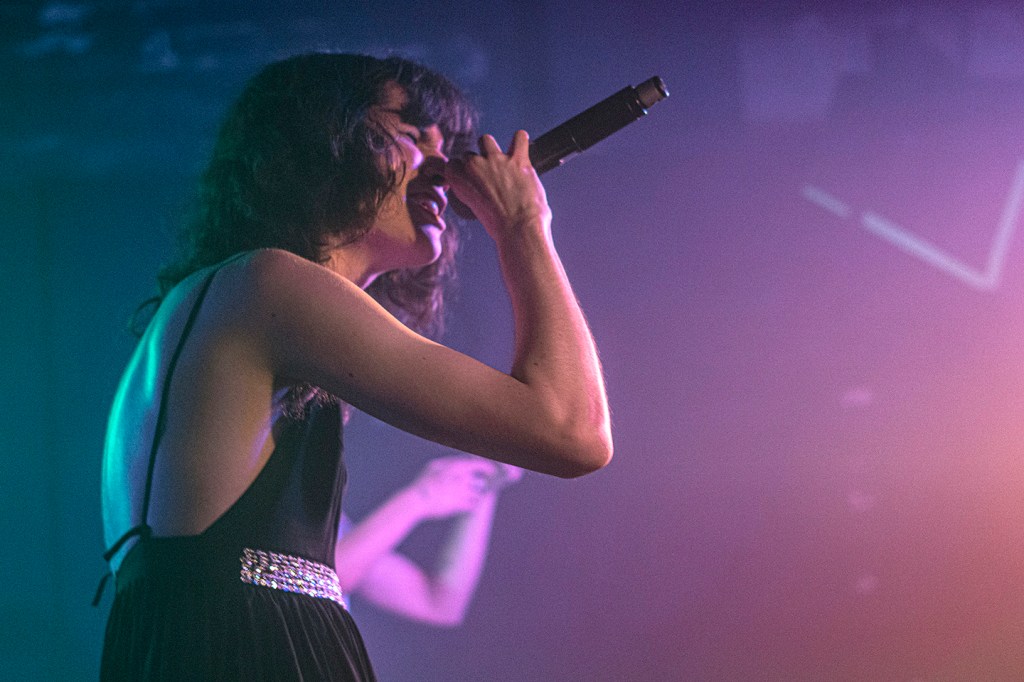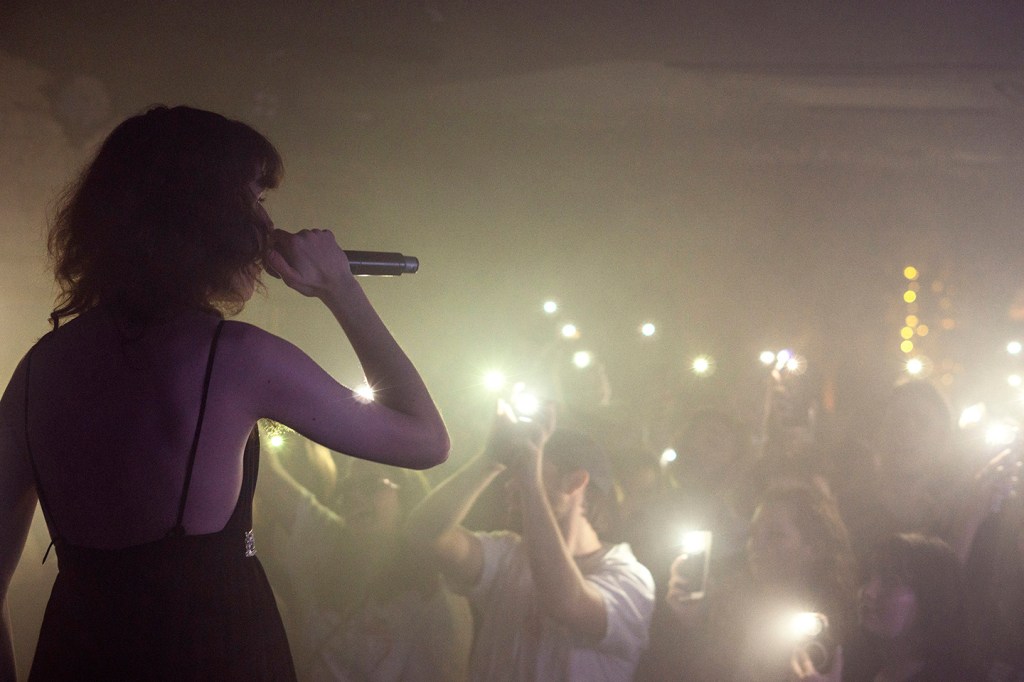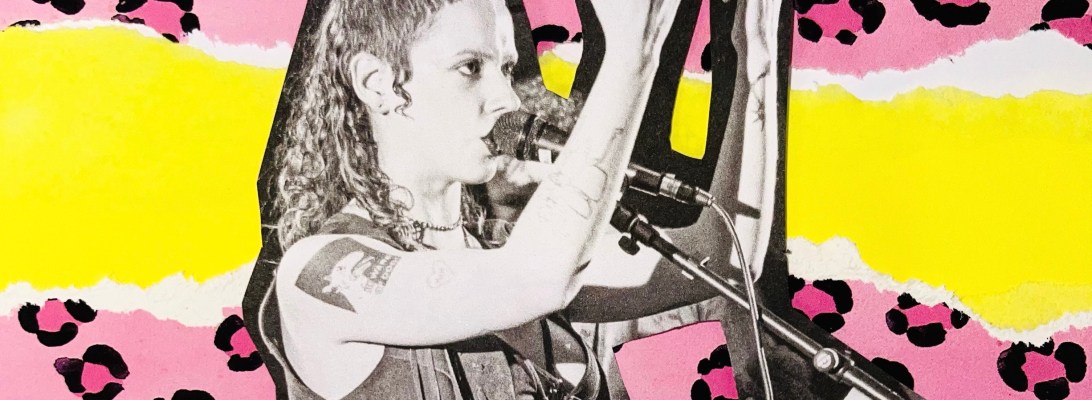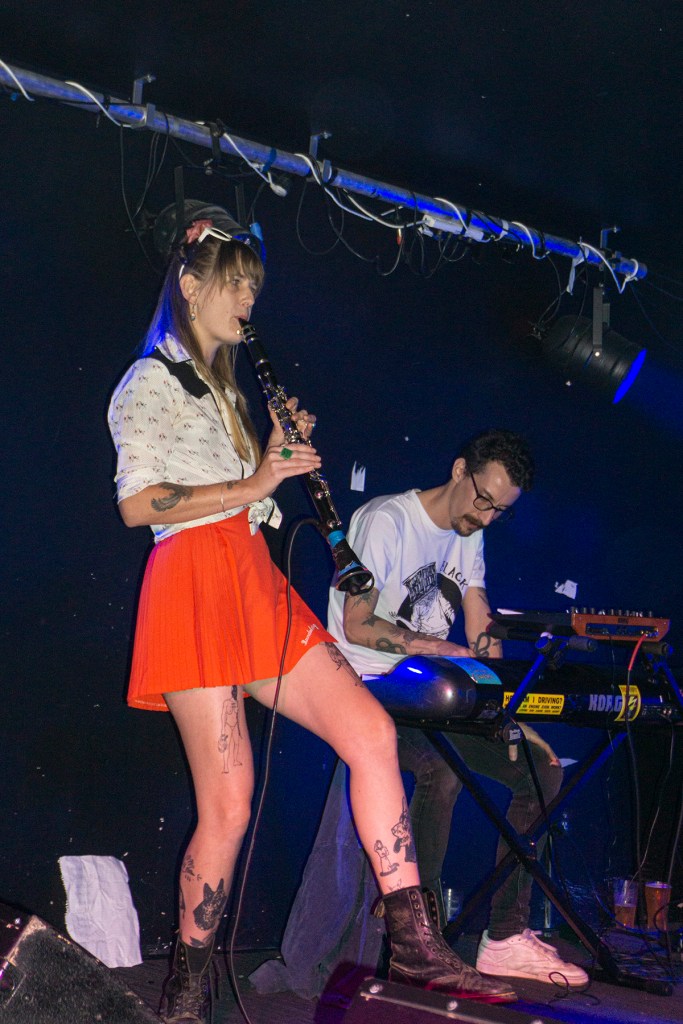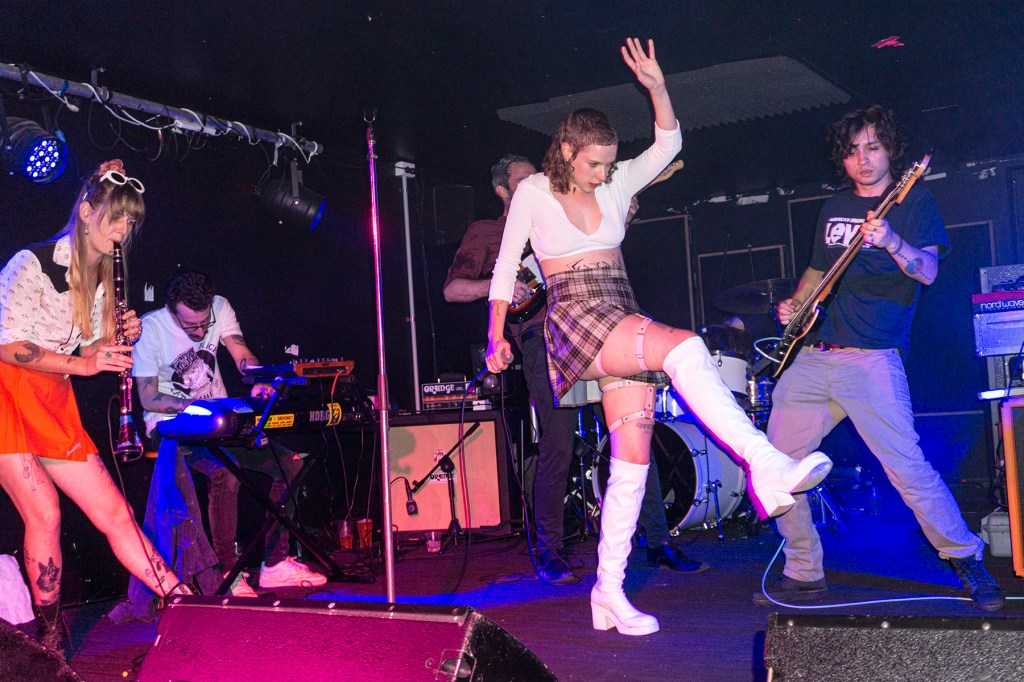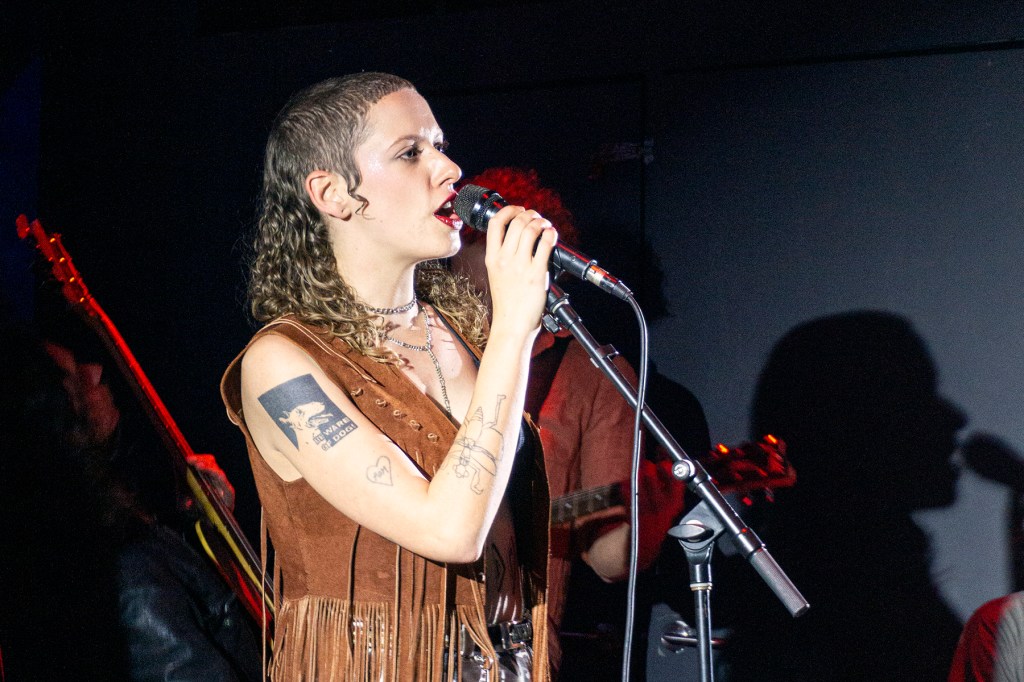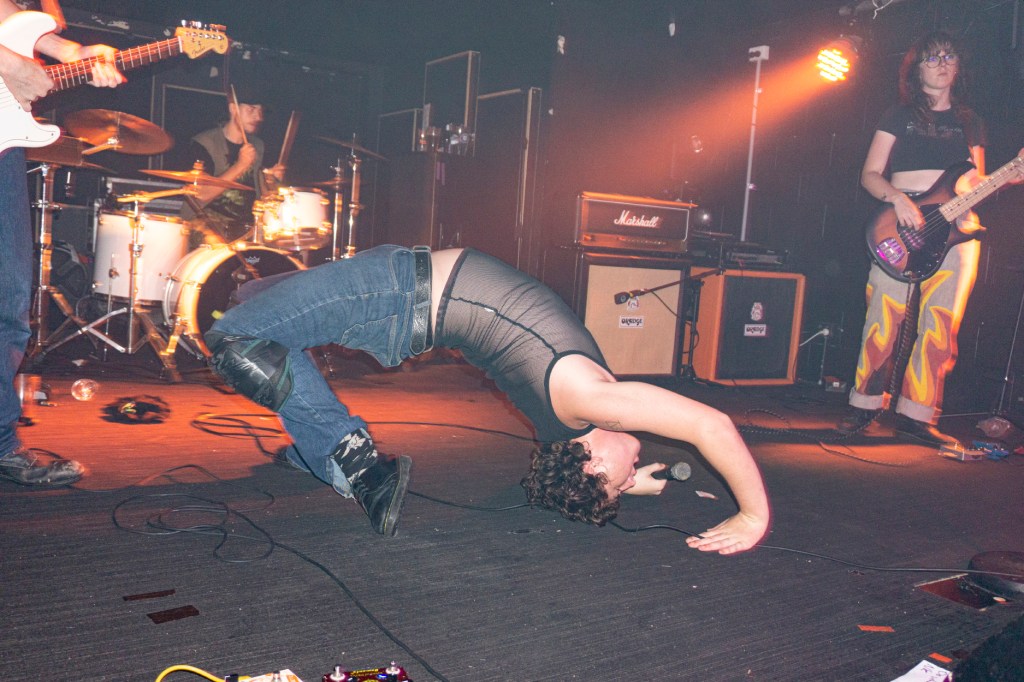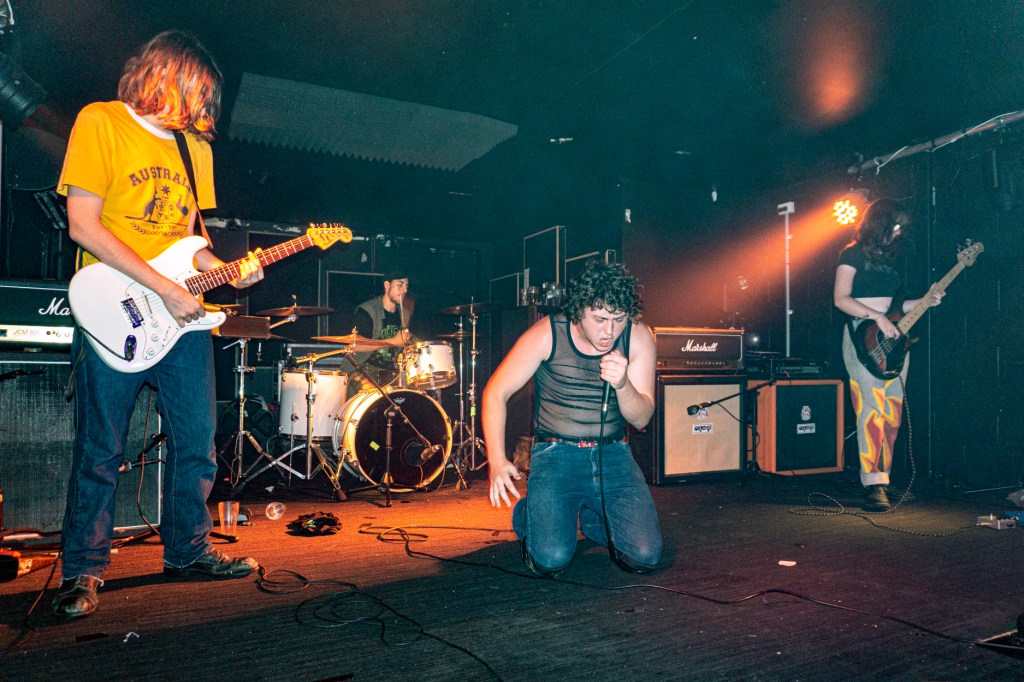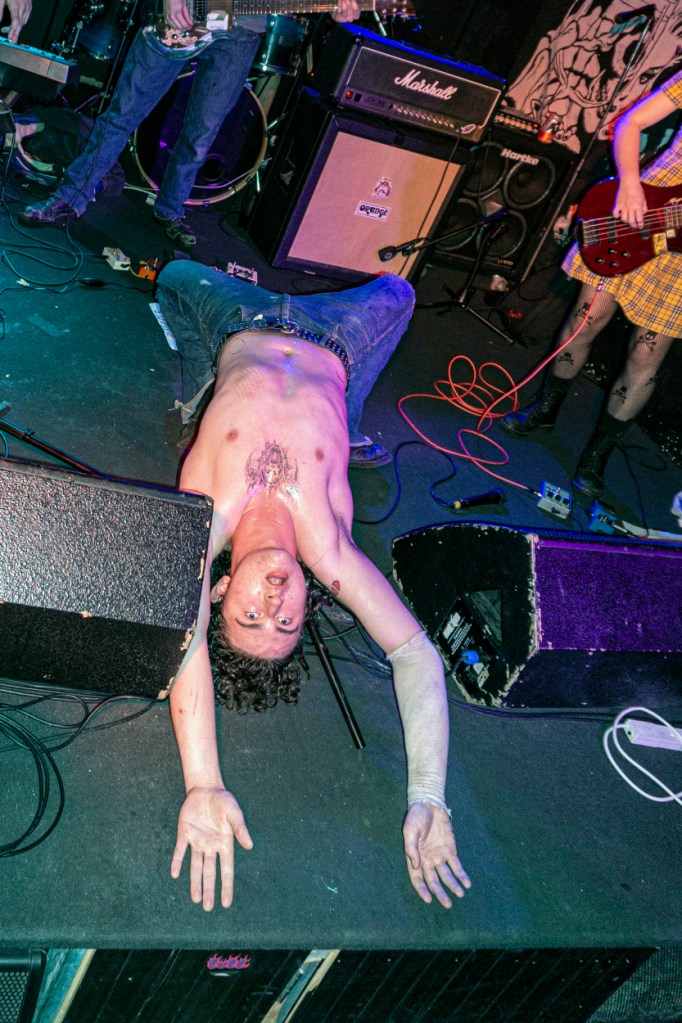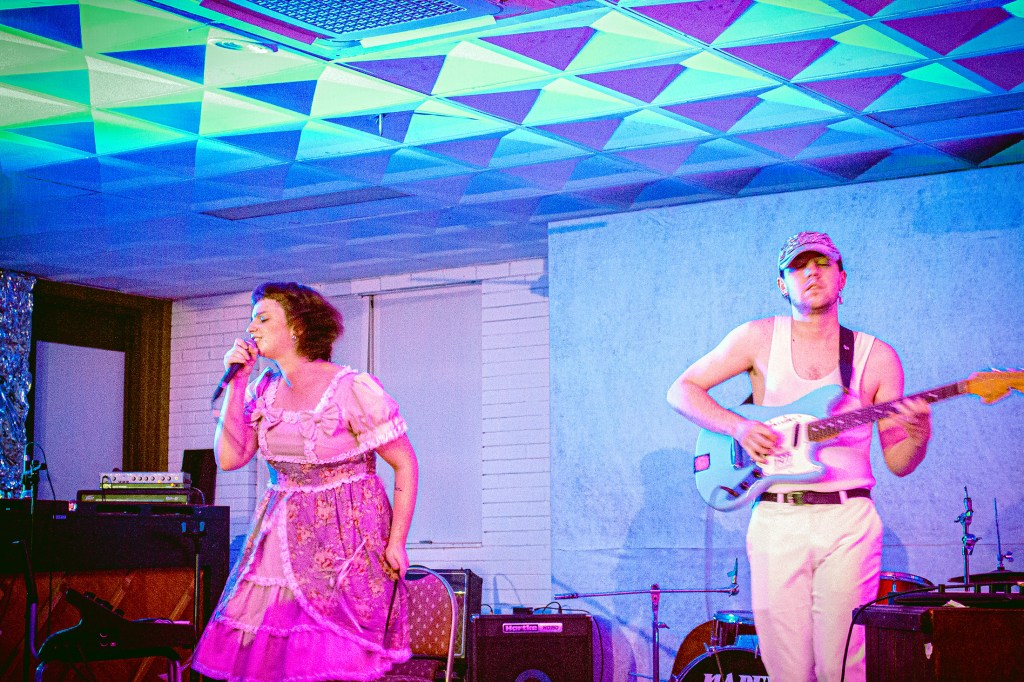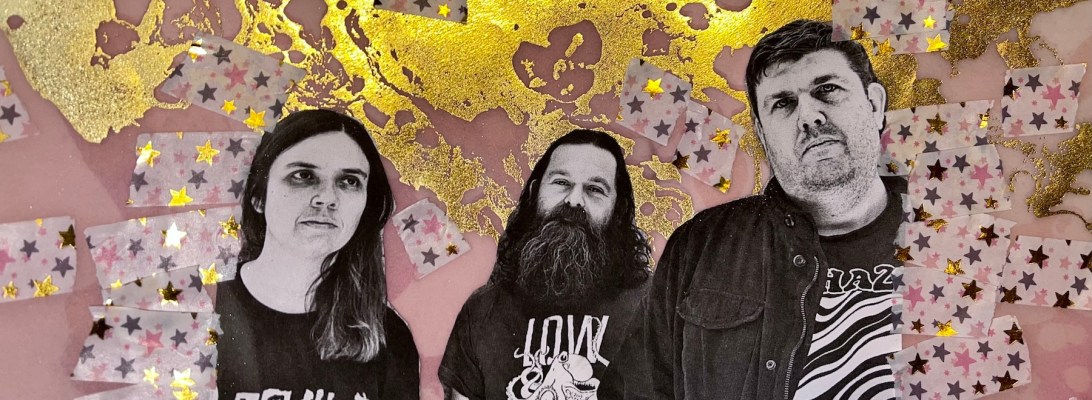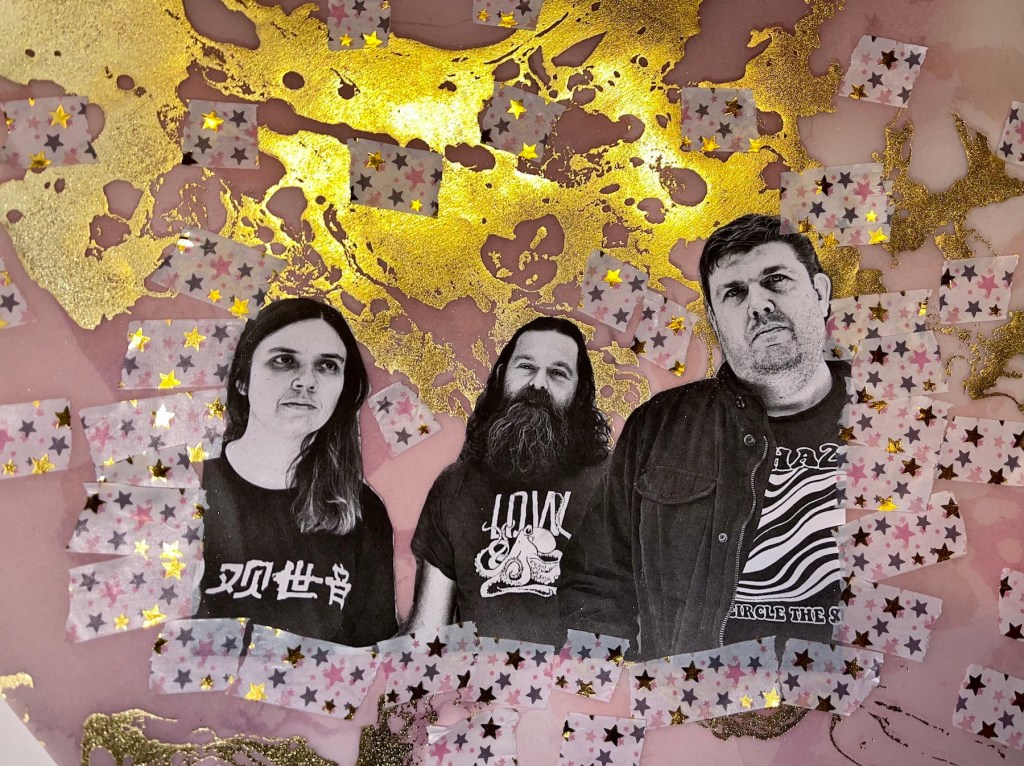
Armour, 100% and Bloodletter’s Lena Molnar: ‘I’ve always been a somewhat confrontational person’

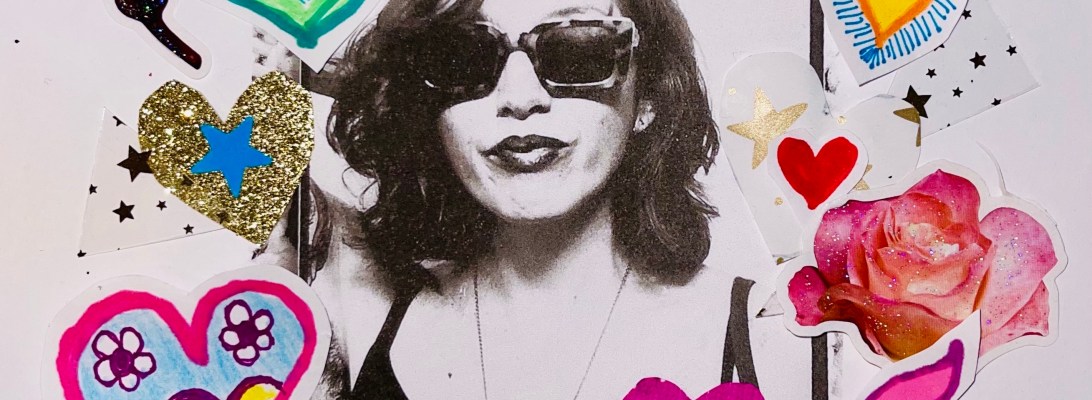
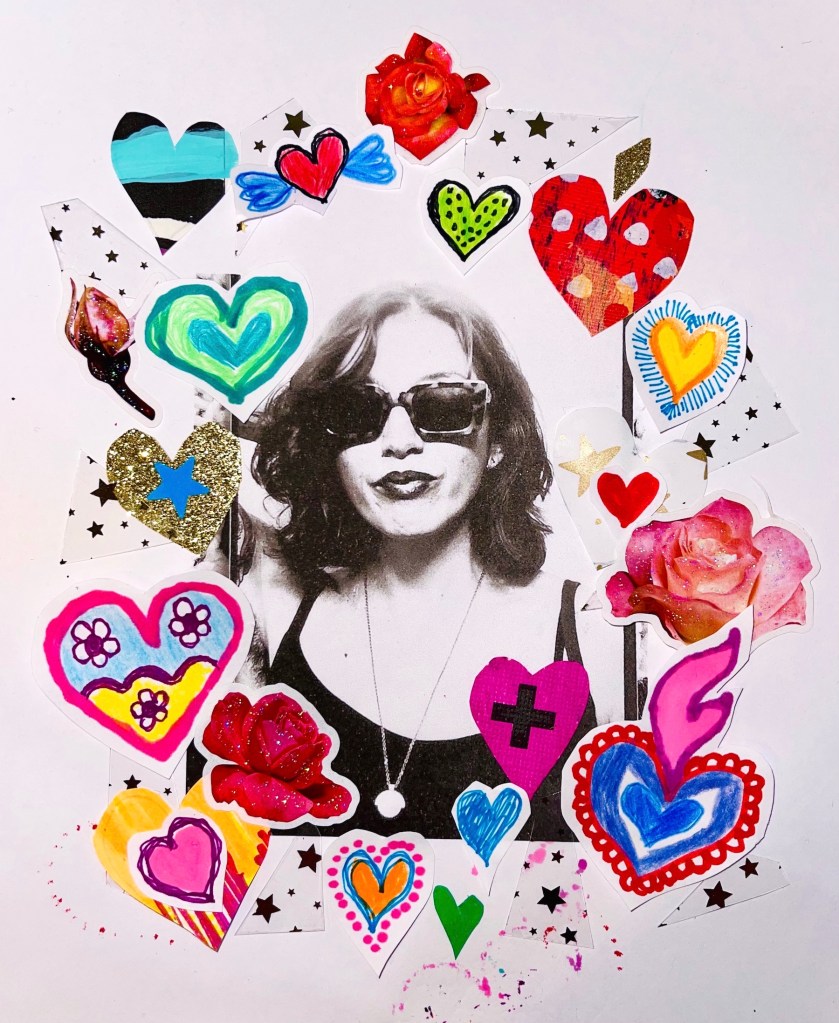
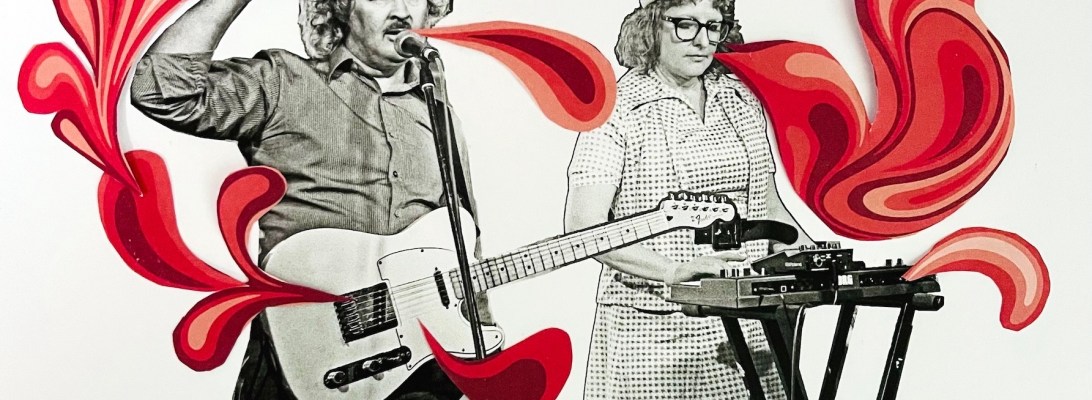
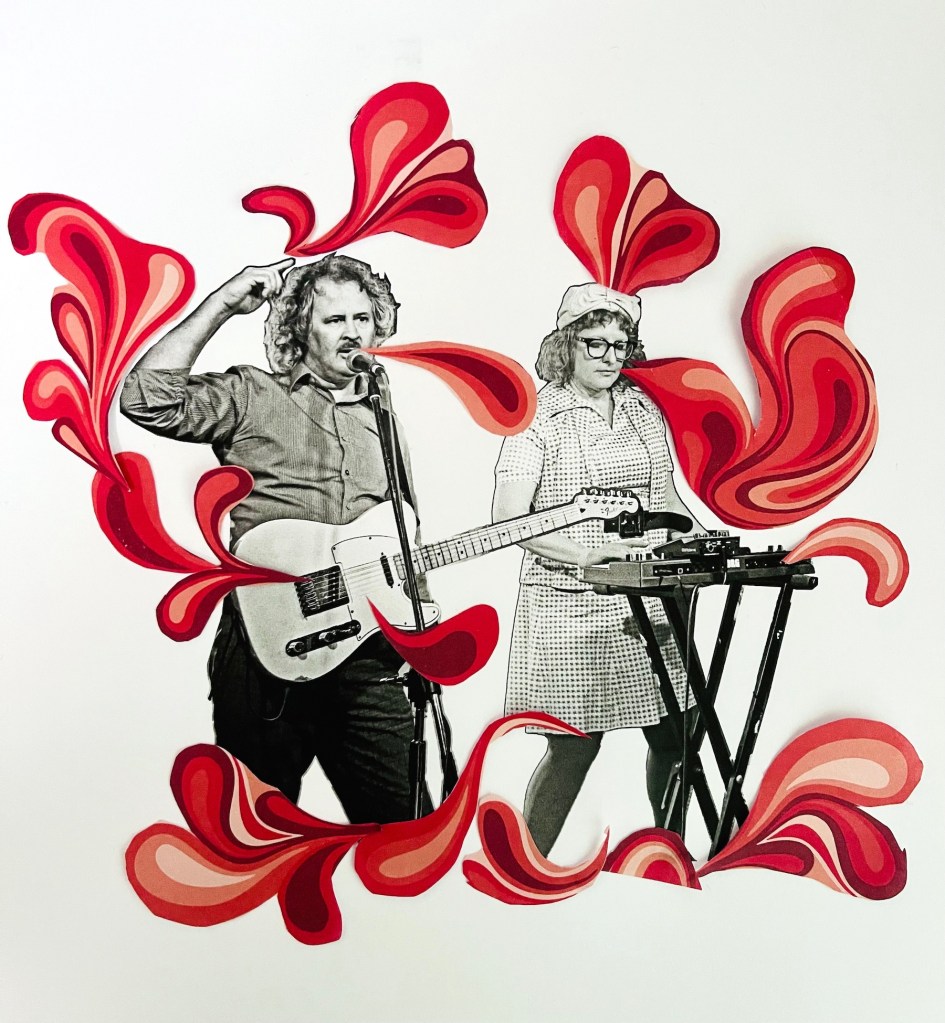
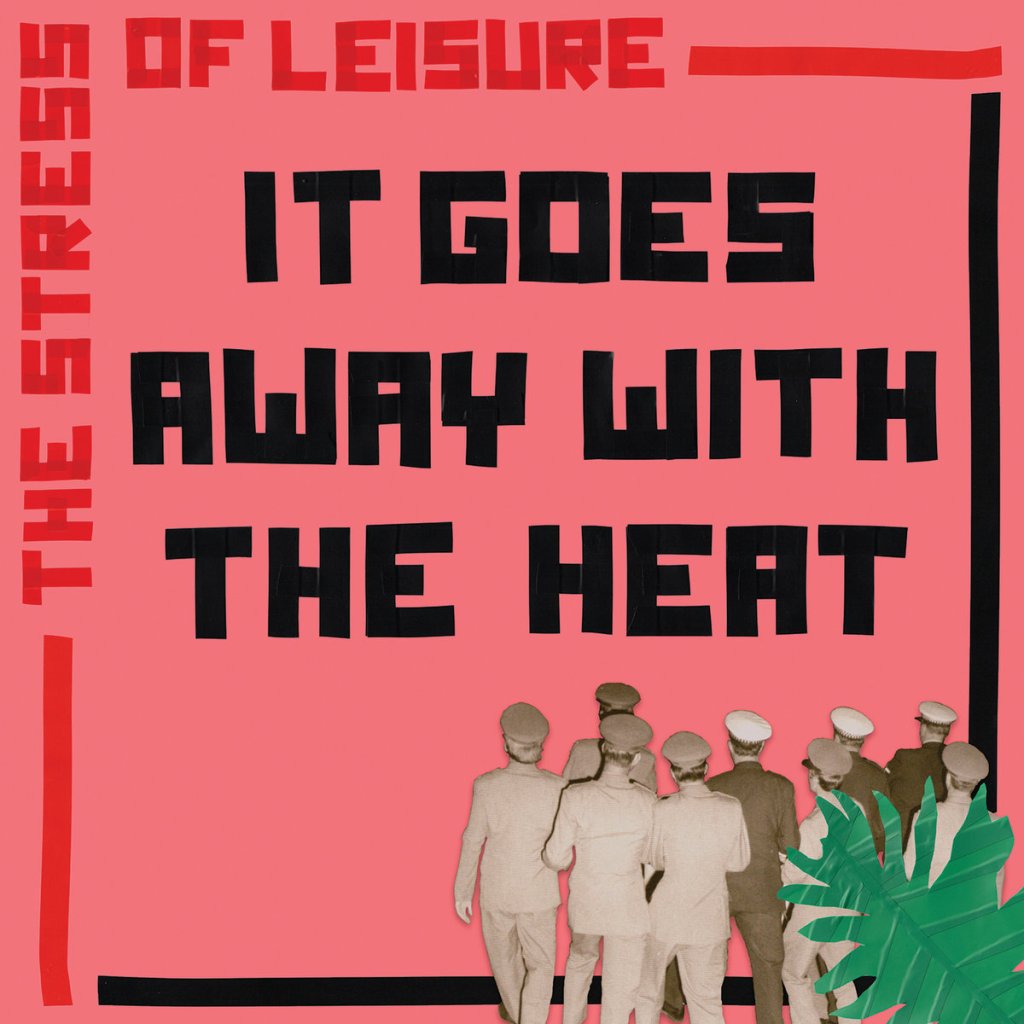
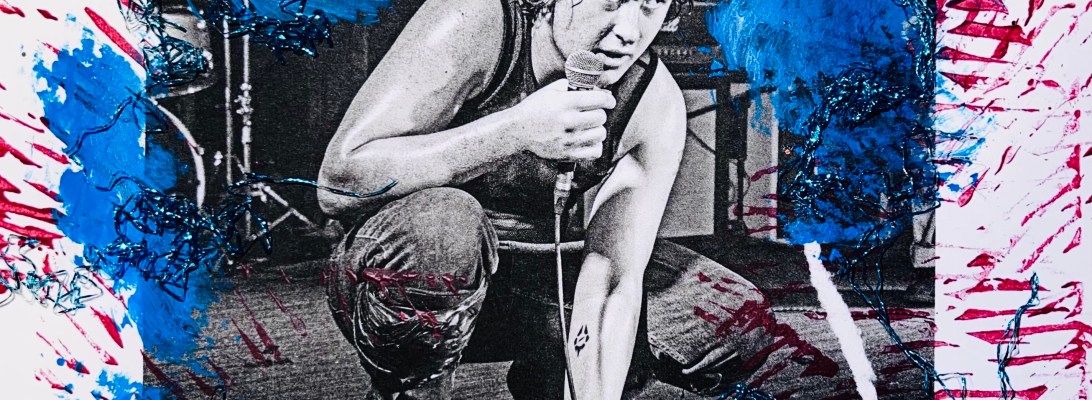
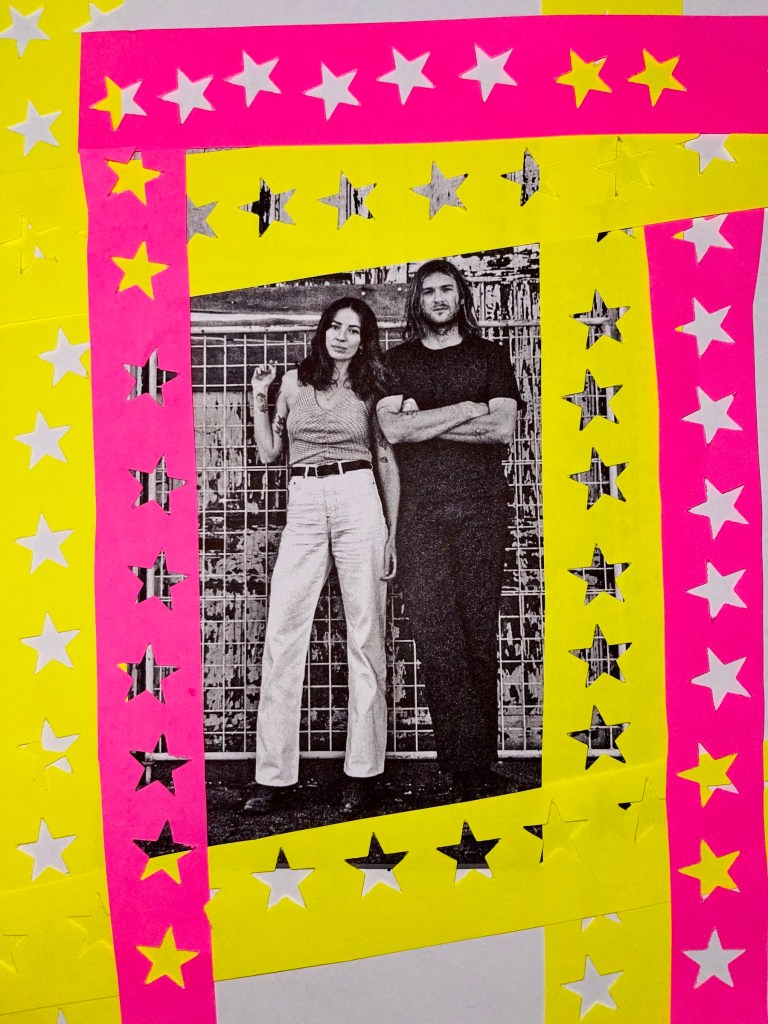
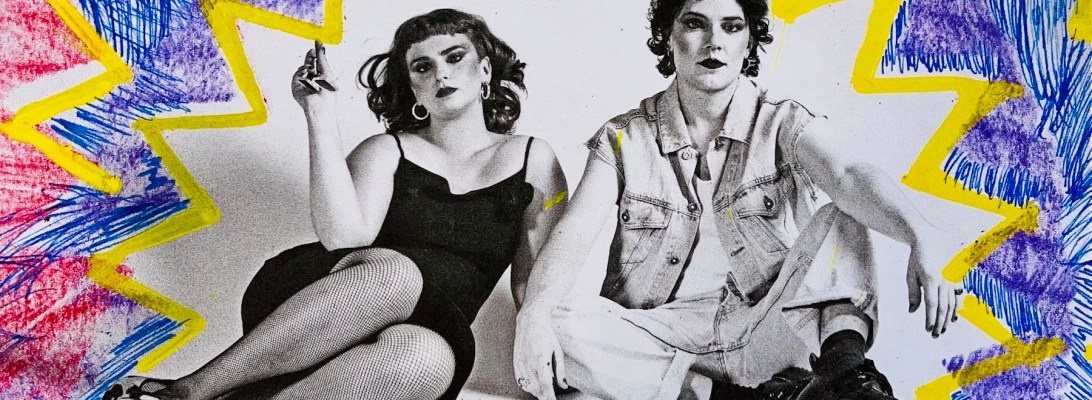
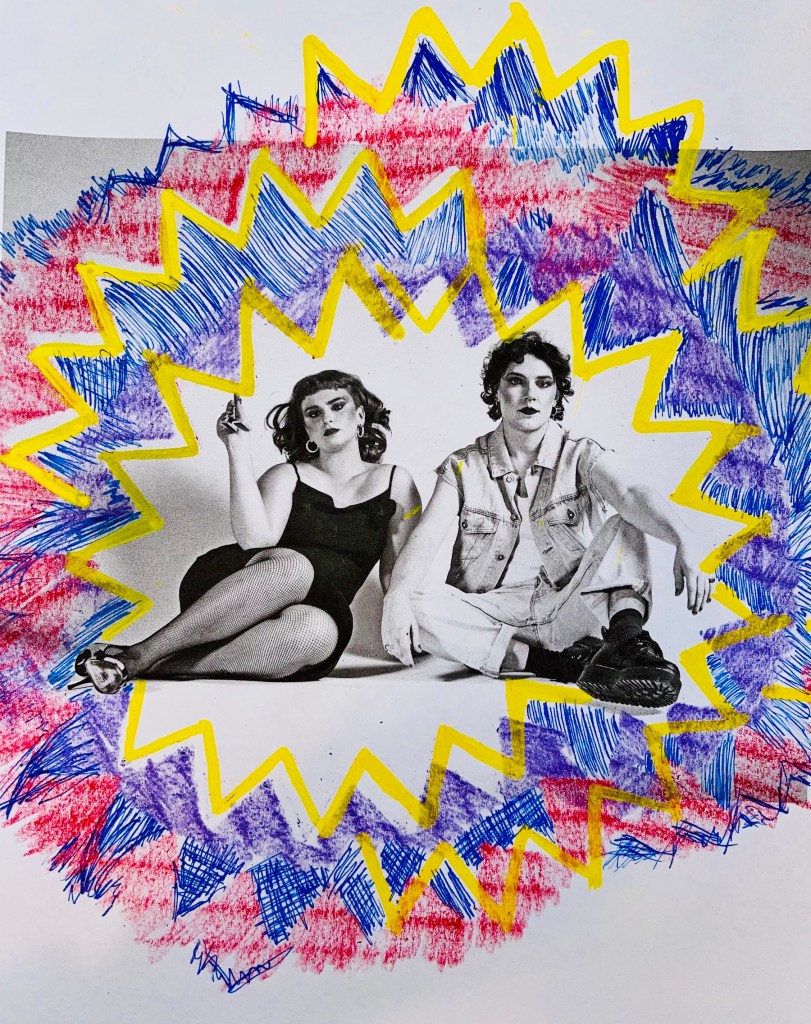
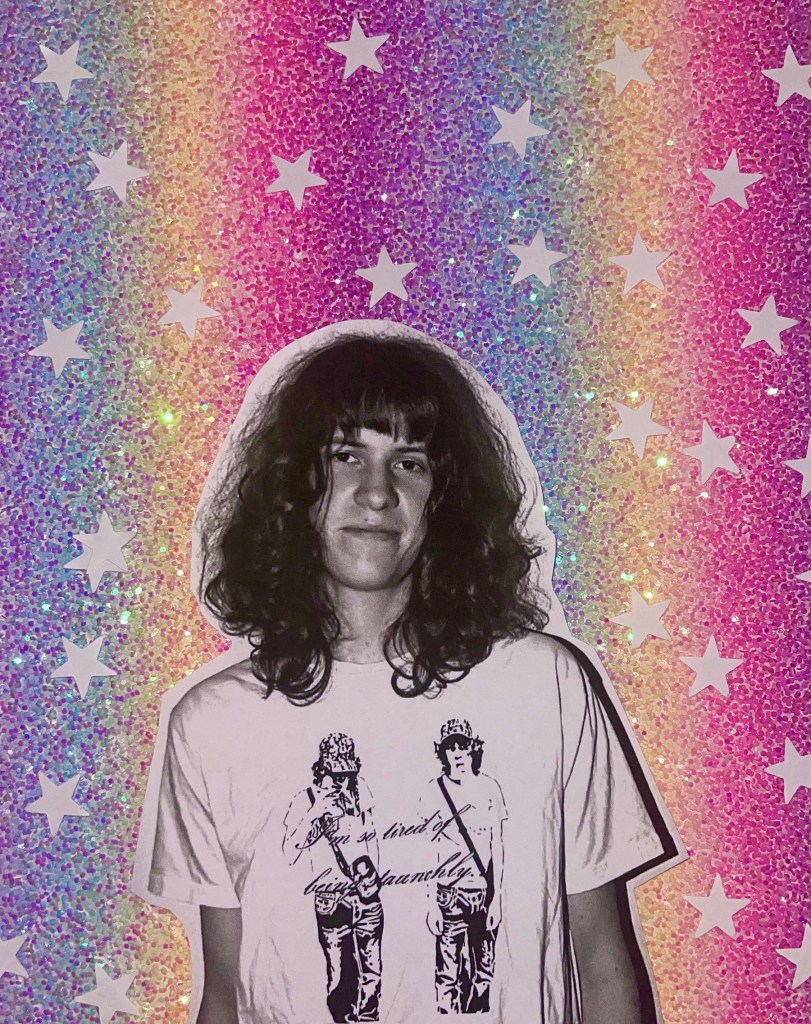
Handmade collage by B

Lena is a force of nature—an advocate, researcher, and community builder whose work spans music, activism, and disability justice. From creating zines to process grief to putting on shows that strived to reshape Meanjin/Brisbane’s punk scene by prioritising non-male artists, to her current efforts in preventing violence against women with disabilities, she is driven by a deep commitment to change.

She’s not afraid to talk about hard things like death, power, and systemic inequality. Lena challenges the status quo through grassroots organising, academic research, and award-winning advocacy, carving out space for those too often overlooked.

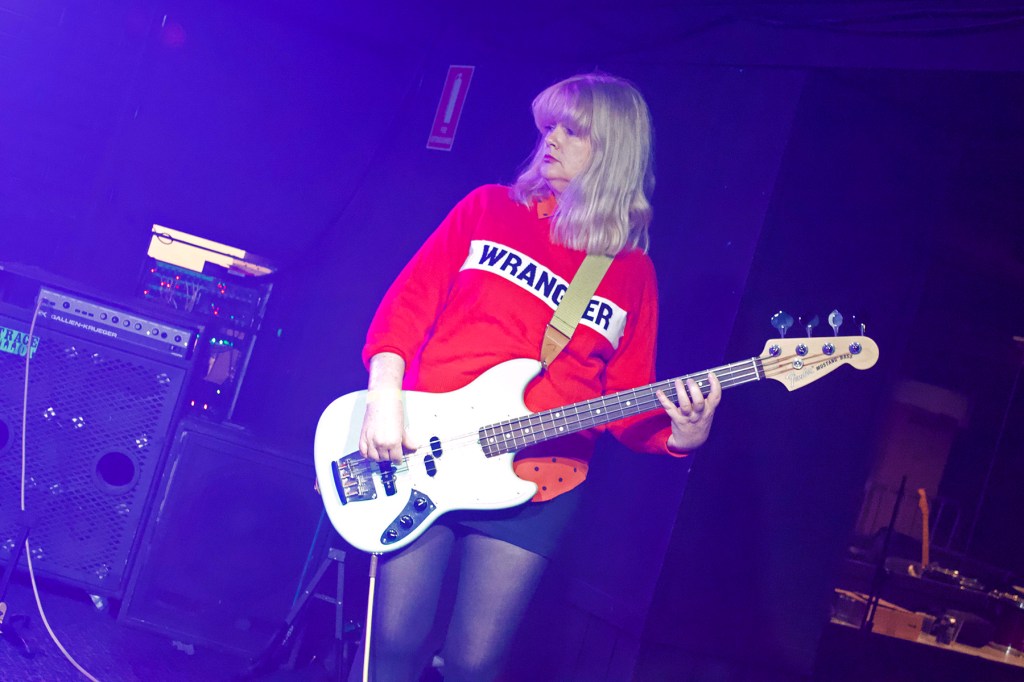
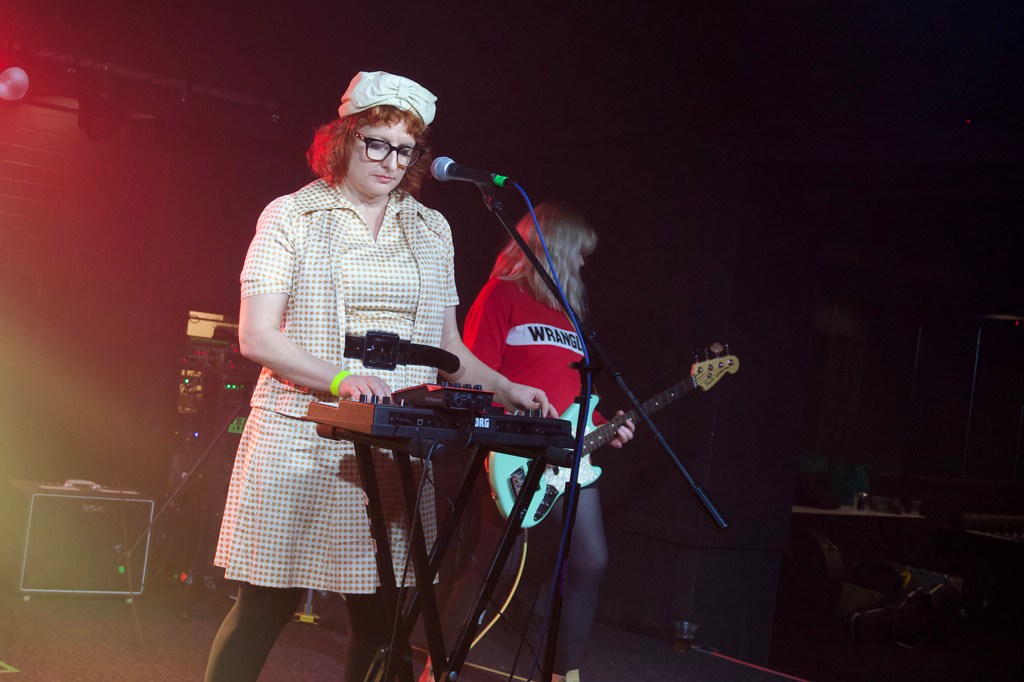
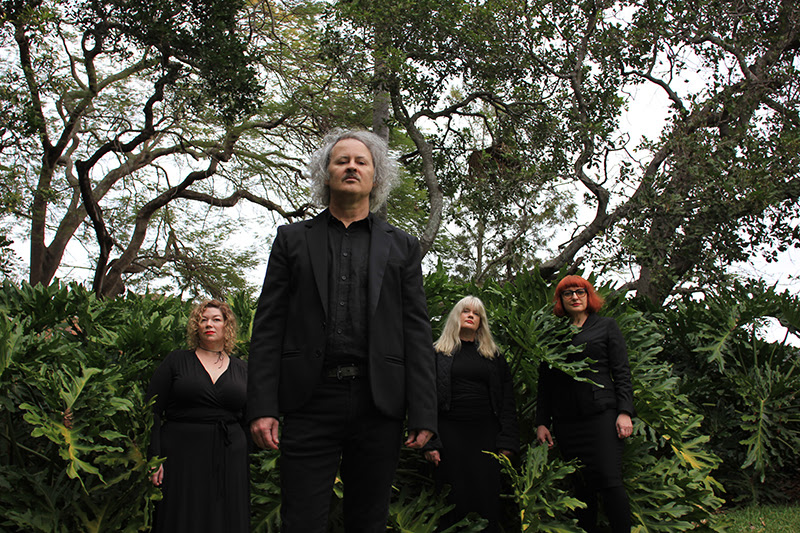
In this conversation, she reflects on loss, activism, and the ongoing evolution of both herself and her communities. Gimmie also dives into her musical journey, creative philosophy, progressive punk ethics, and the themes behind her projects—including her latest Naarm/Melbourne-based goth-rock post-punk band, Armour, as well as 100%, Bloodletter, and more.

 LENA: You’re a really good writer! 

GIMMIE: Thank you! I’ve been doing this for a long time—30 years, in fact. For a really long time, I didn’t believe I was even a writer. I doubted myself because I used to cop so much flack from people telling me I couldn’t write—mostly from guys in the scene. I was actually told that I should go back and pass high school English, along with so many other snarky comments that constantly put me down.

I used to get upset about it, but then one day, something changed for me. I realised: hey, I’m doing what I love, I’m having a lot of fun, I’m making these meaningful connections and doing work that means something to me. I feel like I have purpose.

LENA: There’s a couple of things I want to speak to there. I think you’ll just end up doing the thing that you want to do, regardless of what people tell you or say is the right way of doing something. If you feel good doing it, you’ll just keep on doing it or find a way to do it, because you feel bad when you’re not doing it.

You’ll feel like you’ll be doing it in some way—either professionally, in your own way, or by finding an outlet to do it, like a zine, writing a book, or whatever. Or you’ll just be having those conversations anyway. I’m speaking about you, but that’s the same for doing some sort of art, having a creative practice, or finding whatever your thing is.

If you’re a creative person or have some outlet, there’s always going to be people—especially when you’ve got some sort of marginalised experience—who tell you, ‘nah, the way that you’re doing it is not the way; it’s not my way.’

But if you do it from your heart, it doesn’t matter what the “right way” is. People are going to connect with it. If they connect with it, then it’s going to foster your own community and your own platform. That’s how you know it’s the right way, regardless of what the outlet ends up being.

Whether it’s through a zine, a book, a magazine, a piece of journalism, or even just using the radio or whatever, you’re obviously really good at drawing out conversation and stories from people. You have your own storytelling practice, and that’s really important. Like, fuck the correct writing conventions. People engage with how you tell stories, Bianca. It’s so cool.

Thank you. I just really care about the people I interview. I would never speak to someone whose work I didn’t find interesting or whose work I didn’t enjoy. My time is really limited because I do so many different things, so I have to just focus on what I really love.

I’ve been wanting to chat with you for ages—even as far back as when we saw you at Nag Nag Nag. I especially love your band Bloodletter and your earlier band, Tangle. It’s been really cool to see your evolution as a creative and how one thing informs the next. It’s the coolest thing to watch people grow.

LENA: Thank you. It’s really special that you mentioned Tangle, not my first band, but one of the first bands that played a lot and I got to do a bunch of things with. It’s nice that you can see the connection between what I was doing then and what I’m doing now. One of the privileges of staying in the creative arts community, like punk or any underground scene is seeing the beautiful ways that people change and grow, but become more and more themselves. That’s just an honour to grow up together in the different ways that we do. 

In my experience of community, I’ve seen that sometimes people don’t want things to change—particularly in the punk and hardcore scenes. There’s that other side of things where, when people try to grow and evolve, others want to pull them back, saying, ‘Hey, no, but this is cool. Let’s just stay here.’

LENA: I’ve definitely felt that in many different ways, like with regards to style and genre. Especially in hardcore, there are very fixed ways of thinking. I have a respect for that in some regards, but also, I am not held down to any preconceptions that there’s a certain way to be—for me, at least.

It’s actually quite unhealthy for me to think that I have to be a certain way to be authentic or to be, like, quote-unquote, punk or whatever. That’s sort of the antithesis of how I relate to creative practice and the subculture that I’ve grown to love and be a part of. I wouldn’t want to hold anyone else back that way, but I understand why people sort of feel that way.

I feel it’s really important to hold things down in a particular way. But yeah, it’s a devil’s bargain of, yeah, these are the things that keep us safe and the logics of genre or punk, per se, or hardcore, while also it should be about letting people in and letting people be free to be their freaky selves as well.

I read an interview with you where you talked about growing up with punk and DIY. You mentioned that, in your youth, you noticed conflicts and approaches in hardcore and heavier music that were a little at odds with things in your life.

LENA: I have an interpretation of a punk ethic that is very progressive, very open, and about changing and supporting people to change while being accountable as well. There’s an openness to conflict in that sense, where conflict brings about disruption and change.

But there have been things that have happened in my life where people are very resistant to that kind of accountability—especially because of their own behaviour. These situations have been quite damaging within communities, and it’s severed ties due to the inability to communicate or because of what’s led up to some really poor choices. Yeah, violence and abuse within interpersonal relationships and smaller scenes in communities.

To me, that’s at odds with my personal ethics, which I drew from the people I had the privilege of hanging out with early on when I was coming into punk. That’s really informed my entire life. But I understand not everyone sees punk—or lives in the world—providing that kind of ethos.

And yet, not everyone has the same viewpoint as me, and that’s totally fine. I live in a community where folks don’t all have to agree. But, if you don’t agree with people, what do you do about that? 

It seems like it’s getting harder to have these conversations, even just in everyday life, because everyone is so this way or that way. I’ve always thought that opening up a dialogue with someone is how you can actually start to affect change.

LENA: Totally. If you can’t talk about it, then you probably can’t do anything about it. A lot of people are afraid of being wrong because they think that means they have to change, or that they have to do something that means their way of thinking hasn’t been right. It’s too difficult for them. And that’s not just a punk thing. Every community suffers with that. It’s very nuanced. There are some really beautiful people in our community who are quite open to having these kinds of conversations. I’ve been inspired by them throughout my life. I call a lot of those people my very good friends.

Was punk scene the first community that you came to? 

LENA: I grew up in a household where I had family around a lot of the time. There were a lot of folks who had migrated from the war, in a community with a lot of people who were struggling in different ways. I always lived around a lot of different kinds of people, and my community was always like family—extended family, neighbours.

There were a lot of interesting conversations about ageing and mental health that were normalised very early in my life because of my family’s mixed cultural background. We talked about trauma and death quite a lot, very early.

Those kinds of conversations meant that community was much more of a flexible idea to me: Who’s around you? What are you doing together? But also, what do you need from each other at that time?

I’ve got a really open idea about what community is, but I’ve never been the fixed-group, nuclear-family kind of girl. It’s always been more inclusive. I think that way of growing up has really imprinted on me, it’s a really special way to grow up.

You mentioned growing up where conversations about death were normalised. I know about a decade ago, you did a zine called Good Grief, and it explored grief and loss. I’m interested to talk about this; in the past few years I lost both of my parents. It’s been something that is on my mind a lot.

LENA: I’m sorry that you lost both your parents. 

I’m sorry you’ve lost your dad too. My parents no longer being here is something that still feels really strange for me. I’m not sure if it will ever not feel that way.

LENA: That was basically the reason why my friend Erica [Newby] and I put that zine together. We both lost a parent within a couple of months of each other, and we found that no one except for each other got it. My friends were really beautiful at the time; they tried, but mostly, it was like, ‘If there’s anything I can do,’ or ‘I have no words.’ It was very much like, ‘You tell me,’ like, you do the work. Then I started getting a lot of ‘You’re so strong.’ I’ve been getting that my whole life—‘Look at you go, you’re so strong,’ and ‘You fucking kill it.’ And I’m just crumbling inside.

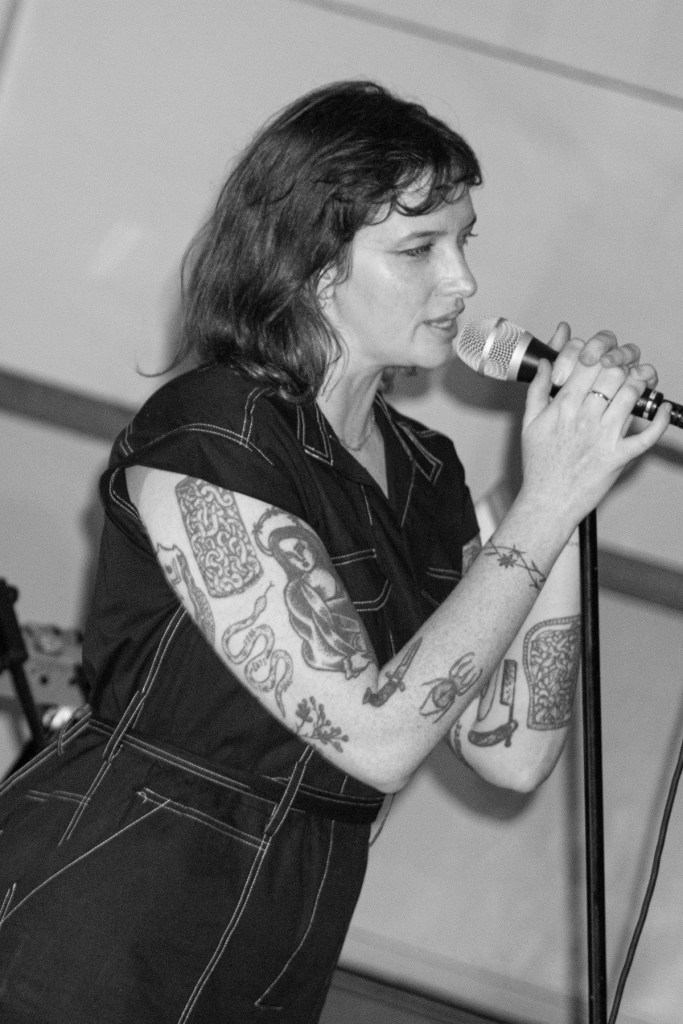
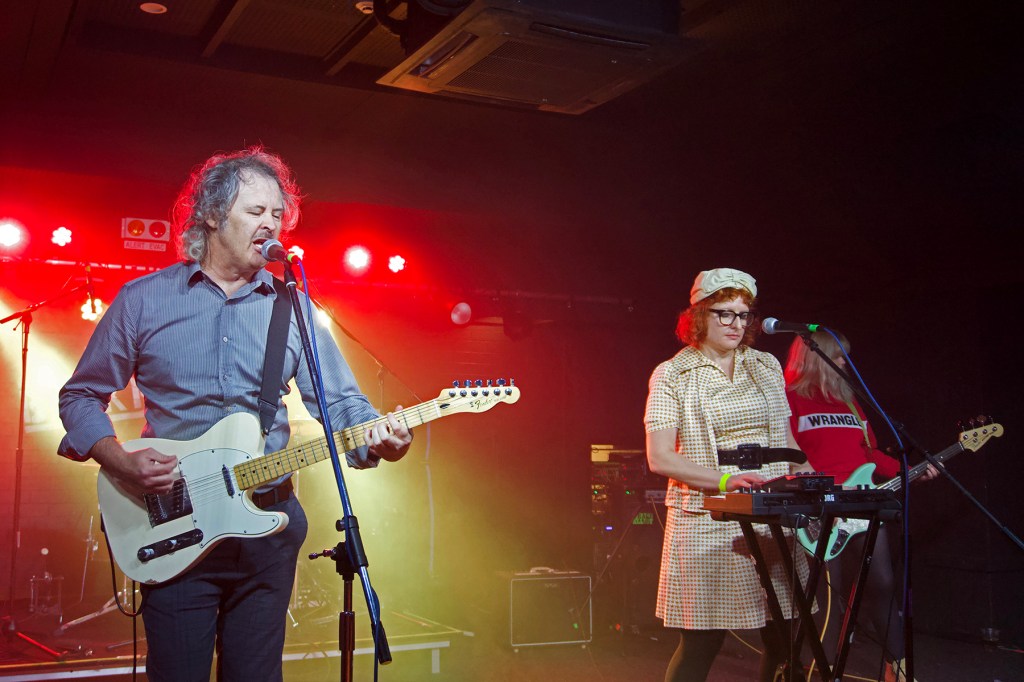
Photo: Jhonny Russell

Same! I also get, ‘You’re always so positive!’ It’s like, yeah, but you don’t see me on my bad days when I’m in a ball, crying and feeling so low.

LENA: I feel like I recognise that about you in the few moments that we have seen each other.

I’ve experienced very deep sadness, depression and crippling anxiety in my life, and in those lowest, low times, I felt no one was there for me, I didn’t have any support despite knowing A LOT of people; obviously that’s changed having Jhonny in my life. But because of those experiences, though, I always try to be there for others and try to remain on the positive side of things. But it’s not always realistic.

LENA: Yeah. And it does damage trying to be like that a lot. I had a feeling that we were gonna talk about death and grief. It’s washed all over me—I’m a death girlie. [laughs]. I’ve always been a spooky little bitch!

[Laughter]

LENA: I guess I had lost people prior to my dad dying; I was 22. But no one so close to me like my dad was. My dad was my best friend. My friend Erica lost her mother to cancer, so it was two very different kinds of grief. My dad passed away very suddenly. I was on the phone to him one day, and two days later, he was dead. Heartbreaking.

Whereas Erica was anticipating the loss of her mother, and that’s also very tragic, as anyone who loses a parent or a loved one over a long illness knows. Both are bad. Especially at that age when you’re still coming to terms with yourself, and everyone around you is still quite young too. In Anglo-Queensland, where we were, people offered lots of prayers but weren’t really sure what to do. So we came up with the idea of doing the zine. We reached out to folks that we knew, and beyond, to submit whatever creative stuff they had about their experience of loss—about what it felt like. We wanted to share that with others so they could gain some insight into what grieving can be like, and to normalise those conversations a little bit at that stage in our lives.

I still have a copy of one of the masters of that zine I made, and I look at it every now and then. I’ve lost people since. We’ve already talked about change, and now we’re talking about death. The only constants in life are change and death. I’m continuously reminding myself of that. I talk about it with my staff. You just have to roll with that—change and death. Those are the constants in life. You can’t be afraid of it. The better you get at anticipating it, but not living in fear of it—living in spite of it and building your life around the choices you make despite these things being inevitabilities—you’ll make better choices.

But you’ve got to be able to support people in their fear of those things as well. Especially folks who aren’t brought up in a way or are unable to come to terms with talking about it. It is scary, and people run away from it. In the disability community, there’s a very close relationship between how people perceive disability and death. We’re living reminders of mortality, and that you don’t have all the strength you think you do. Something could happen to you, and the world isn’t built for that.

You recently won the National Disability Award for Excellence in Innovation.

LENA: My organisation did. I delivered a program through my organisation called Changing the Landscape, which provides resources on preventing violence against women with disabilities. The program targeted a national audience of practitioners in the disability service sector, as well as gender-based violence workers. These resources include videos, posters, and materials based on a 100-page document detailing the rates of violence and what can be done to stop it. They’re beautiful resources that I’m very proud of, especially considering I did a lot of that work just after a significant surgery. While I’m the program manager for that suite of resources, it took a lot of work on my part, but I’m just happy to have been part of such a dedicated team.

What motivated you to start working in that kind of space? 

LENA: Gendered-violence or disability?

Both.

LENA: I have experiences of both. I had trained as a sociologist and did my honours thesis in urban sociology about gentrification—specifically, how people perceive their role in changing public space in a highly gentrified area known as West End. I was really interested in some things that didn’t end up getting discussed in the findings or didn’t emerge from the data. And that’s because I didn’t draw out a particular feminist analysis on the project, which was limited by the nature of an honours project.

So, I then just got into the swing of being a research assistant. But all the while, I was doing activist work on the side.

Before that, I had been doing activist work around gender-based violence, fundraising and learning how to mediate through grassroots organisations. I had been involved in this kind of work for a while. 

After the publication of Good Grief, people started asking Erica and me if we were going to table the zine somewhere or if we were planning to do a distro. At the time, we had no intention of doing anything like that. We just wanted to create the zine and put it out there. But after people kept reaching out, asking us to do more, we realised there was a need in the zine space. We thought about what we would want to do, and we decided to start collecting and distributing zines written by women and queer people to sell at a market in West End.

We started doing that, and then I began incorporating records that were not just from cis men—bringing in women and non-binary people into the lineups. Eventually, Erica didn’t have the energy to keep going, so I continued on my own. Because of my priorities in the music scene, it ended up being a little more music-focused than zines, but I always maintained a bit of both.

This background relates to your question because, in doing all of this, I began booking shows here and there. The key was that there would never be an all-male band on the lineup. As a result, the shows I booked in Brisbane at the time had very creative lineups—something different from what was happening in the punk scene. At that time, it was mostly bands with the same members, and while they were really talented, the shows felt repetitive. Sometimes that’s cool, but when it’s the only type of show you can attend, it becomes limiting. I wanted to create something different.

Every other show I did would be a fundraiser for an organisation like Sisters Inside. I also started selling secondhand T-shirt runs to raise money for Sisters Inside. It became a part of what I was doing—some form of fundraising or activism, mediation, and being that girlie who always had something to say about what was going on and why certain things were such a problem. I became a little bit problematic but just stopped caring.

Going back to my time as a research assistant, after finishing my degree, I had no intention of working in the gender-based violence space. However, when a scholarship came up at RMIT University, it seemed to align perfectly with my skill set. They were looking for someone with experience in visual methods and a background in gender-based violence activism to research how young people engage with social media to prevent gender-based violence. I saw it as an opportunity to do something new, to align something I was already doing with my skillset, and to see what would happen. I had never really thought about doing a PhD, but it seemed like a good opportunity, especially since I was starting to feel burnt out being that girlie in Brisbane.

I had a lot of friends in Melbourne who knew what I was about and wouldn’t make me feel like I was alone. So it just felt like a good time to take the opportunity and run with it. 

When I got to the end of my PhD, I was looking for work outside of academia because I don’t see the point in doing research if you can’t share the knowledge and apply it somewhere. I still feel like that. One of the roles that was coming up was at this organisation that I work for now, which is called Women with Disabilities Victoria.

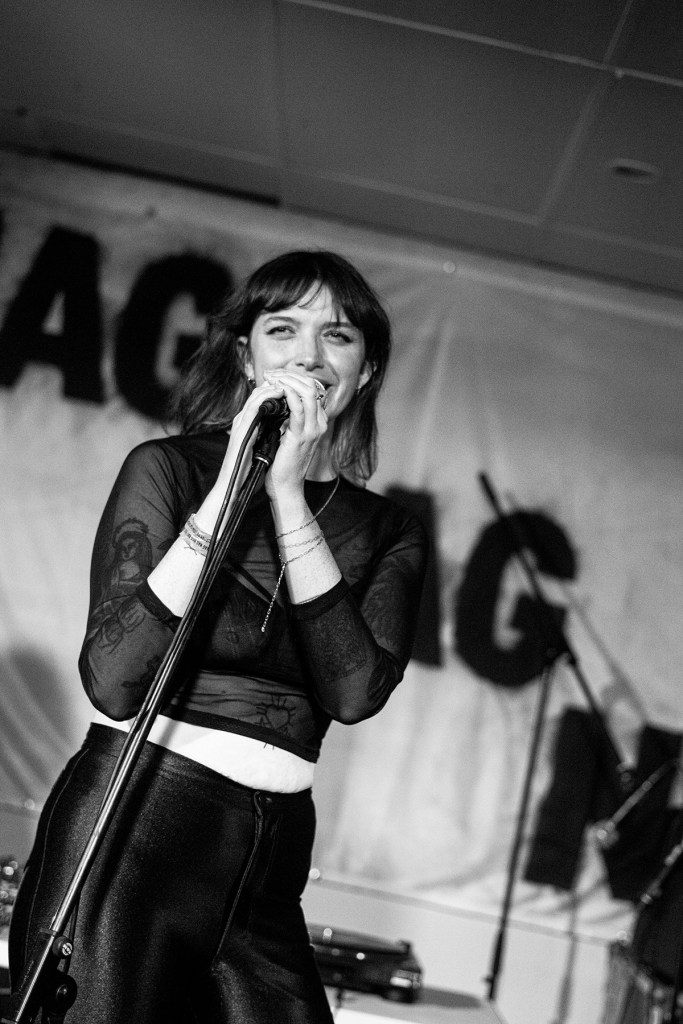
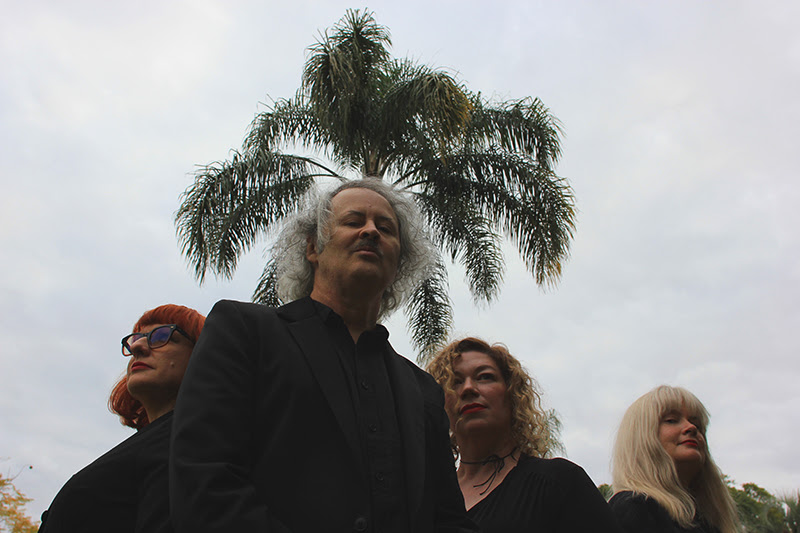
Photo: Jhonny Russell

To bring the conversation back to music, do you feel that each bands you’ve been a part of has represented different parts of your personal and musical development? 

LENA: I wouldn’t say different parts because I don’t like to separate the self. Maybe at one point, I would have, but I’ve gone through a bunch of stuff in the last couple of years, and I’ve done a lot of deep reflection on everything—the shit, all the little things I’ve done. Definitely, in my younger years, other people would have asked, ‘How do you make sense of all this? You do this, and you do that, and you do this—how is it all the same?’ But in my mind, when I look at all that stuff, I see it as the same girl. I see the common thread. It all makes sense to me, and I can see where it can go.

Creatively, I’ve done a lot of stuff that might not connect together on paper, but it all informs one another. It’s always been about asking, ‘What else can I do? How else can I express myself? That sounds fun, or I haven’t done that before’. That was the thinking at the time—‘I haven’t done that before. That sounds fun. That’s a nice group of people, or an interesting group of people to work with. I would really like to try that. Let’s give it a go.’ And when it stops feeling like that, you let go of it.

There have been a couple of times when I’ve been super passionate about something, and you can probably tell when you’re listening to it. It’s like, ‘Oh, all those steps, all those little pieces I’ve put together, they’ve come into play.’ But it also goes back to an old band I did. It’s like, ‘Oh, she’s still doing that. She’s still thinking about that thing, and it still matters.’ That’s how I know it’s always been about finding the best way to express myself. It doesn’t matter the genre or the medium.

I had some downtime a couple of months ago, and I was drawing a lot. To me, my drawings are the same—they’re about the same things that I write my lyrics about.

You mentioned threads; what are they?

LENA:That’s something that I’m less open about. I’d like to hear what you think. 

Thinking of your new band, Armour, even just in the name, there’s a really strong imagery to begin with. Armour feels like it’s both defensive and empowering. People go into battle wearing armour, so I was wondering if you’re exploring internal struggles or if it’s something larger and more outward?

LENA: Always, for sure. That’s always been a part of the ideas I’ve written about, throughout my practice as a creative person — as a poet, as a lyricist, as a writer. It’s stuff that I explore in my academic space as well.

I’m fascinated by struggle and change, and what people do to avoid it, or what people do when they are confronted. And that’s not necessarily a negative type of struggle or defence. It’s not something I’m always consciously aware of; it’s just something that I’m drawn to.

…I know that I’ve healed from some stuff I’ve gone through in my life because, working in the prevention of gender-based violence, for example, I see the long game. I can talk about violence all day, for example, because I know what the point is. And I see how to make change.

That’s why I’ve always been a somewhat confrontational person. But I know how to use those skills to get people, hopefully, going. I’ve got a good sense of humour to get people to think about things in a different way and bring them along for the ride, where it doesn’t have to be like this.

Part of why I really love your band 100% is because there is a lightness. I’ve read you say that the vibe of 100% is kind of like your aunt or Dolly Doctor. Any time I’m seen 100% live, it’s so joyful.

LENA: We have a cute little world that we created in that band. Like, it is what you imagine girlhood to be. And also, what maybe I do have nostalgia for. I did have moments of that typified girlhood with my friends when I was a teenager. But there’s the the dreaminess of that band— that was still, make-shift and put together through our own DIY lens, or in a futurist way of, like, what would the ideal be like? And what would we tell ourselves?

A lot of the lyrics were , okay, what would I want to hear if I was in this situation? And drawing from a few different situations that I did know about. Or if I was watching a movie, I’d think, what project would write the sweetest songs and charm each other through that? It was about supporting different aspects of songwriting between the three of us. None of us had ever done something like that before. It was really magical.

Yeah, well, it’s that— even though I really like the cover you put out that had the cake on it. That spoke to me in so many ways. One of my best friends made that cake too.

You mentioned a dreaminess, I feel Armour has a dreaminess, but a different kind of dreaminess. 

LENA: Armour is the step between 100% and Bloodletter with a touch of Tangle. But in terms of tone, it’s definitely, at times soft sweetness. But also, I’m sweet, but, if you fuck up me or my family, I will fucking kill you vibes! [laughs]. That’s what being community minded is about, right?

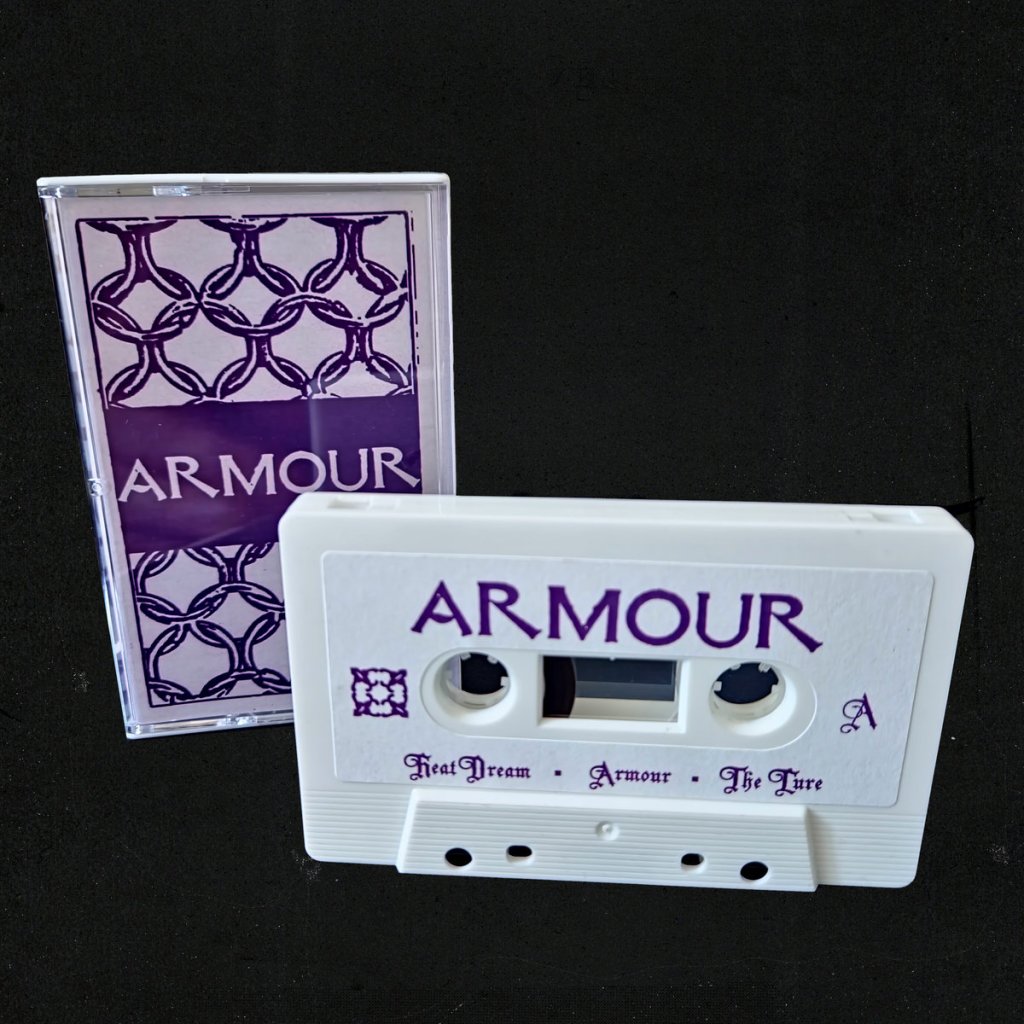
[Laughter]. One of the songs I really love on the EP is ‘Heat Dream’. It has this surreal vibe. 

LENA: What makes you say that? 

Well, for one thing, the imagery, the fantasy and the dreaming in its lyrics.

LENA: There is a literalness of, like, I don’t do well in the heat [laughs]. It’s verbatim describing my experience of not doing well on a hot night. Knowing that others feel the same as well and taking it to the extreme. Growing up in the tropics, like in Brisbane, but also, like, there’s definitely being— like, is this fantasy? Am I awake right now? What was going on? What the fuck was that dream?

Your song ‘Sides of a Coin’ has a bit of a different tone to the others. 

LENA: People are really engaging with that song. It’s really nice. I wrote the lyrics to that one really quickly. Those ones that just poured out. We weren’t sure whether or not we liked it as a band. So I tried to do something else with it. But I just kept going back to, this is how it has to be. 

Lyrically it mentions about breaking the chains and setting yourself free, and there’s a sense of freedom from constraint. Maybe a feeling of liberation? You mention seeing the coin from the other side; what’s the significance of that?

LENA: I’m going to speak abstractly, because people will have their own interpretations. When I wrote that, I was thinking about the nature of truth. 

I really like to write songs that engage with other songs, that sort of build a world. But that song, in itself, is a conversation. You see the coin from the other side—truth is subjective. There’s evidence, obviously. But if a rock fell between you and me, and someone who couldn’t see the rock asked us to describe it, how would we do so?

From your side, you might see the rock has some moss on it, some speckles, maybe a big crack from when it hit the ground. Thankfully, neither of us were hurt. From where I’m sitting, I can see that there’s light behind you, so you can notice details that I can’t. On my side, it’s the same rock, but all I see is grime. This rock is dirty. I mostly see the shadow of this rock right now.

We’re having a conversation about what we see, and to describe the rock, the arbitrator asks, ‘Are you sure you’re looking at the same rock?’

Yes, it’s the rock on this street, blah, blah, blah. So, what is the evidence? Are we going to fight about whose rock is the correct one? Do we get an opportunity to look at the other side of the rock? Or can we agree that on your side, it’s a nice green, sparkly rock with a crack, and on mine, it’s a funky, dark, grimy rock with webs?

It’s the same rock. And it’s a beautiful rock. And we’ve both survived.

Wouldn’t it be nice if everyone could be open to each other’s side of the rock? 

LENA: Yeah, well, you don’t always get to that part of the conversation [laughs]. Sometimes you’re just like, can I just move the rock? 

Do you see a narrative arc for the EP? 

LENA: We just thought they sounded good in that order. Most of the songs were written at the same time. From my side, as the lyricist, they probably represent different aspects of things I was processing and responding to. I also added other bits in terms of lyrical content and other elements. 

Was there a particular thing that comes to mind when you think about that period and what you were kind of writing to? 

LENA: Something I really like about Armour is that it feels authentic as a band. I think there’s a lot in my part of it, which is about bringing people together—for healing, but also for a fight.

I was interested in the EP closer, ‘Last Train,’ because a last train could be a powerful metaphor for endings, choices, or opportunities. I also got a sense of exploring how distance or endings can bring clarity—or even healing.

LENA: That’s a really apt interpretation, without getting into the direct inspiration for that song itself. Each song has its initial influence, but if a song is conceptually strong enough, it will have a meaning that resonates with anyone’s experiences. And that was definitely something I was going for with ‘Last Train’: how do we move past an ending? What choices can we make? It’s about ownership of choice as well.

There’s a line in it that talks about breaking apart and yet making amends. Sometimes, those things can be in contradiction with each other.

LENA: A long time ago, in my early 20s, I came across the notion of creation and destruction, either in a zine or on someone’s bum patch or something like that. I spoke to it at the beginning of our chat—how, as a particular kind of troublemaker, I see change as good. But confrontation, too, can be a way to make change. It’s not the only way, of course, but I’m not afraid of conflict because it means things are moving. It can mean things are moving, as long as you know what to do with it. I try not to be too stuck in place.

That doesn’t mean I’m not stubborn. Things can hurt when you’re forced to do things outside of your control, but learning to let go is a big part of life. When you know things are ending, there’s a beauty in being open to what happens next.

I’m a big fan of saying no, so that you can rest and open yourself up for what the next yes is. I really respect when other people do that, even if it means they’ve said no to me [laughs].

I say no to a lot of things now. As Gimmie grows and so does my book and editing work, I get asked to do a lot of events, projects and stuff. I used to always say yes to everything because I felt I had to. But I’m a lot better at saying no now. I listened to this interview with a writer [Shonda Rhimes] and it really stuck with me. She talked about saying no to things without saying sorry or giving a million excuses for why you can’t do something. I used to feel bad for saying no, or people would get upset with me for not doing what they wanted or not meeting their expectations. I felt I had to apologise or explain myself. I felt bad for saying no. The writer shared that she simply replies: ‘No, I’m unavailable for that.’ And the first time I did that myself, I felt so good. That should be good enough.

LENA: It’s really respectable to know exactly where your limits are and hold up your boundaries, especially at the stage of life I’m at now. It’s a valuable thing to model for others. It’s scary how many people-pleasers I see, or how much people-pleasing behaviour I observe, where folks take on so much because they think, ‘Yeah, that’d be fun. That’d be cool. I gotta do it. Nobody else is gonna do it, or nobody else is going to do it the way I think it should be done.’

There’s a huge risk, not only in overloading yourself but also in not allowing someone else the opportunity to do it. Even if they do it a way you wouldn’t necessarily agree with, or do it differently from how you would, there’s a control aspect for some people. It’s also just a fear — the fear that if people recognise you now, they might forget that you exist later.

But there’s a beauty in being comfortable enough to say, ‘My time will come again.’

I love that! I think coming from the punk and hardcore community, something I’ve struggled with is allowing yourself to have success and actually celebrating that. I’ve always thought the mentality was weird — that when something becomes more popular, people stop liking it, even though the people creating it are still doing what they did with the same heart.

LENA: It’s not just the punk thing, but also the punk and tall poppy syndrome thing that comes with being in Australia. Like, ‘Oh, if it’s popular, it must be shit.’ 

But I’m talking about when it’s the same — or it’s probably even better than when they started. 

LENA: Yeah, like ‘sellouts,’ all that shit. I understand sort of where that skepticism comes from. I goes back to what we were talking about with gatekeeping and of the purpose in small communities — why you would gatekeep, so that you keep your community safe. You want it to be special. You also don’t want yucky people or horrible people to come in and exploit what you worked so hard for or what was so important to you and gave your life meaning, to become like an open house necessarily. So, there’s a meaningfulness and care that goes into people saying, ‘No, no, no, no, no. It’s not for everyone. You go away.’

Lately, I’ve seen a lot of gross elements coming back into shows, stuff that was happening in the ‘90s and early ‘00s, there seems to be more violence and shit behaviour from crowds. Did you see what happened at Good Things festival on the weekend? In Brisbane there was lots of young girls reporting sexual assaults with older guys grabbing at them and not allowing them to exit the pit to safety. Also, people were crowd killing and going around punching people in the pit. Predictably, Good Things festival were deleting comments about it on their social media.

LENA: Something that I was thinking about when I was talking about, the ideal part of gatekeeping is that it keeps you safe, but the thing is, in my experience, a lot of the folks who end up doing that can also be the ‘yucky’ people — or they end up being the yucky people who have the loudest voices, saying, ‘This is what punk is.’ Like, ‘If you don’t like it, go back to the back of the room, don’t come into the mosh pit,’ and all this shit. And it does, regardless of how into being part of the mosh pit you are, or your perception of what’s a good time in a shabby mosh pit, and where the boundaries are, it does impact your engagement. Like, how ready am I to participate? Or when am I going to fuck off? Because, like, ‘Oh, that person’s there. This is no longer a fun time.’ Where, like, yeah, I can withstand a little bit of pushback. But like violence is different to what we recognise as like a mosh pit. For some people who come, there are some people who come to punk spaces or hardcore spaces because they’re attracted to being enabled to be violent. 

They then — and this goes back to some folks having adopted a totally different ethos than what I found in my punk upbringing — and that’s on them, and that’s on me. But, you know, part of it is not being able to have conversations about, like, ‘Is that a way to treat another human being who’s also trying to have a good time? Can you recognise when you’ve crossed the line?’ And then bringing in other factors, like sexual assault and ableist behaviour. I’ve been at shows where folks using mobility aids are completely dehumanised, completely objectified, or treated as though they’re not even there. Or their wheelchair is just a piece of furniture that people can dump their bags on. That hurts my feelings — as an audience member, as a performer, as a member of the disability community — to see that folks in the audience, my peers, my community members, are not being recognised as human beings who are afforded the same right to enjoyment. For whatever reason, they’re either not actually being seen in the space, or where they are, the things that enable their participation are being used as, like, dumping grounds, just regular furniture for other folks. And it’s going to impact their freedom. It’s not good enough. It’s not right. But, folks just don’t think about everyone.

Exactly. That’s my point. I don’t think it’s asking too much of people to be thoughtful and mindful of other people in the same space. I’m tired of being told by bros that I’m too sensitive and punk rock is about violence and I should get out of the way so they can have fun.

LENA: You’re not too sensitive. You see everything and, yeah, I do too. Stuff that other people just don’t see. It would just take the smallest change, hey?

Yes! What are some things that never fail to make you smile? I saw you had a little gathering yesterday of friends.

LENA: Every end of year, my friends do a barbecue before everyone goes away for the holidays. My friends are really good at getting together and eating food. My friends are big eaters. We’re really good at doing nice things together.

I’m very motivated to find a thing that folks will like to do, like a movie or a thing that’s happening out in the regional areas, getting folks in a car together. Or going on a trip.

I love my friends. I’ve got the most beautiful people in my life. I’ve had some really tough things happen in the last couple of years. And it previously has been really hard for me, and it’s still really hard for me to ask for help, but they’ve shown the fuck up for me. That speaks to stuff that I’ve done for them and for community as well.

I can smile so hard, I cry when I think about the beauty of my friends, that I have the privilege of keeping in my life.

I love bringing people together. That’s a big reason why I like like to do music with other people. It brings people together in a beautiful way to think about what we have in common.

I saw in your Insta bio, that you said you’re: living deliciously. What’s that mean to you?

LENA: I really try to hold on to the good moments and make space, ‘cause my work is really hard. It’s really stressful. I’ve had a lot going on. I really try to make sure that I have delicious moments in my life and indulgent times, or even just me time. I strategically place me-time in my life, but also I have so much time for my friends. They’re beautiful, beautiful, beautiful.

I try to hold that up, and I don’t think it’s just only trying to look on the sunny side of life. It’s making sure everything is in balance. ‘Cause I can easily tell when the scales have shifted to the side of no, no, no, no, no. It’s about going the other way.

Before we wrap up, I’d like to talk about Bloodletter a little more. 

LENA: Bloodletter was a band that I felt like, well, finally, I’m doing something that is the stuff that teenage me would be so proud of. I’m very proud of the recordings that we did. Fantastic group of people who liked music with some really heartbreaking songwriting. Some songs, every time we’d play them, I’d say, ‘Can we not play this song? It hurts my feelings.’

But I learned something every time I was a front person in a band. I learned how to work through that kind of thing—how much of myself to put into something—because I think it’s impossible for me not to put myself into it. But also, I learned how to work through it so it doesn’t feel like I’m bearing my soul every single time.

Jasmine [Dunn], who was in Bloodletter, played second guitar. She also plays in Armour. Moose is the main songwriter in Armour, and he had been sitting on five out of six of the songs on this current cassette for a few years. He’d demoed them and just been sitting on them. He’s a songwriting wunderkind, and we’ve been friends since maybe I was 20 or so. It’s a really lovely, long-standing friendship—he’s like a brother.

I was trying to figure out a solo project. I was teaching myself Ableton, which is still very hard. So, like, maybe in 20 years, there’ll be a solo project! [laughs]. But anyway, I sent him something I was tooling around with, and Moose said, ‘Lena, you need to be singing in a band. I’ve got some stuff I’ve been sitting on. Would you like to listen to it?’

I was like, ‘I’ve been waiting for you to tell me you had something. I’ve been waiting for a time where we were both available. Let’s do it.’ So he sent me five of the six songs that are on this tape in demo form, and I pretty much had two and a half of those songs written within a week. I broke away, and I was like, ‘I know exactly what to do. I’ve got stuff.’ It all just came out of me. I thought, ‘Perfect. This is gonna work out great.’

I knew exactly who to get as a second guitarist. When we got to that point, we filled out the band, and I thought, ‘Jasmine is someone I’ve always enjoyed working with in this kind of band.’ We had such a good time in Bloodletter together, and she lives in Melbourne now too. She’s so talented, as is everyone in Armour, so lovely to be in a room with.

That’s where that sound sort of comes in. Jasmine knows the tone, and she knows what I like. It’s very cheeky. Everyone in the band is very cheeky. They’ve got a good sense of humour, very chill, which makes it easy to be in that group.

With Bloodletter, you could lean into the horror, lean into the spooky stuff, while still talking about my lived experience. I really needed to do that band at that time. It was a good move away from having been in some ratty little punk and hardcore bands, which were great at the time, but Bloodletter was so different. Especially coming from Brisbane at that point in time, we were like, ‘Yeah, this is something else.’

Do you think that’s the band where you really started to find your voice?

LENA: I think so. I’ve always sung, but I definitely found my power in my voice at that time. I felt like I gained the most confidence through singing then. I was like, ‘No, I know this is what I have to do.’

And that connects to what we were talking about at the beginning. You go through all kinds of phases or times in your creative practice where people tell you the right way to do things, or what things need to sound like, or whatever. But if you trust yourself, you know.

This is the thing I always end up doing. This is the thing I’ve always done. I’ve got different ways of doing it. I’ve got my own way of doing it. But no one’s going to tell me how to use my voice.

Bloodletter in particular—and now in Armour as well—I don’t sound like anyone else. I trust the way that I sing. It’s not always in key, but it always sounds like me.

Follow: @armourmusicgroup + Armour bandcamp + 100% bandcamp + Bloodletter bandcamp.

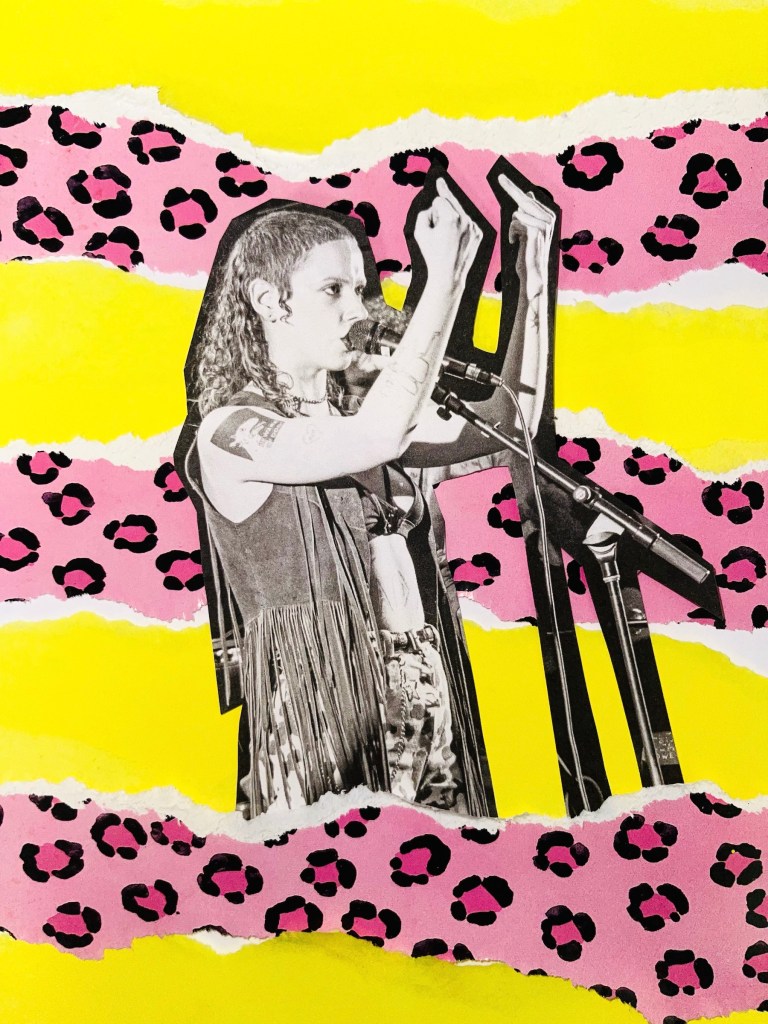
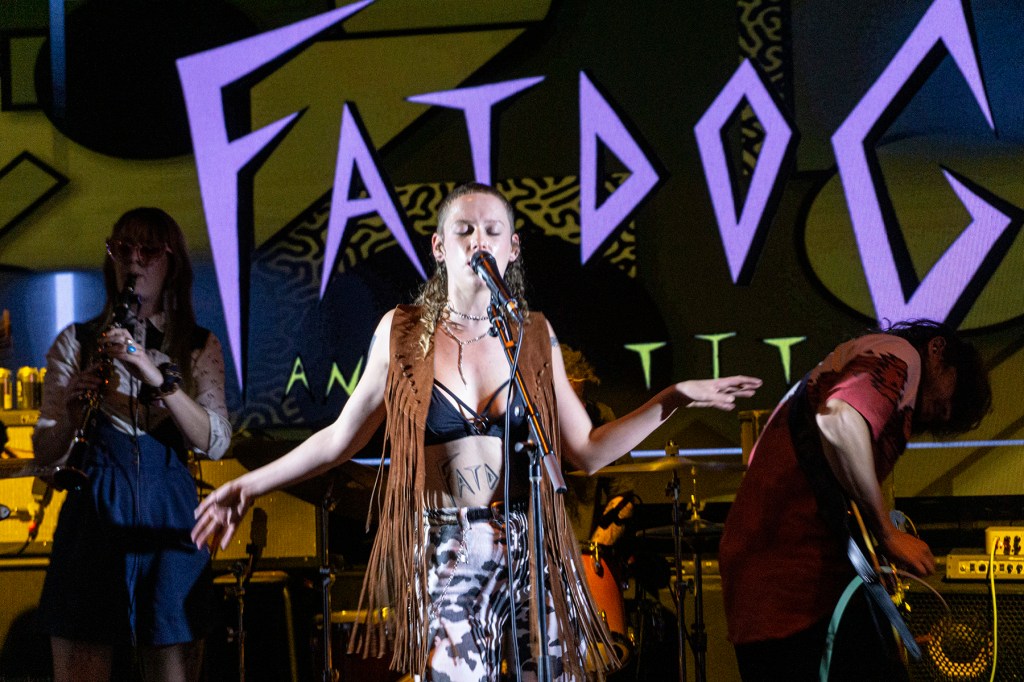
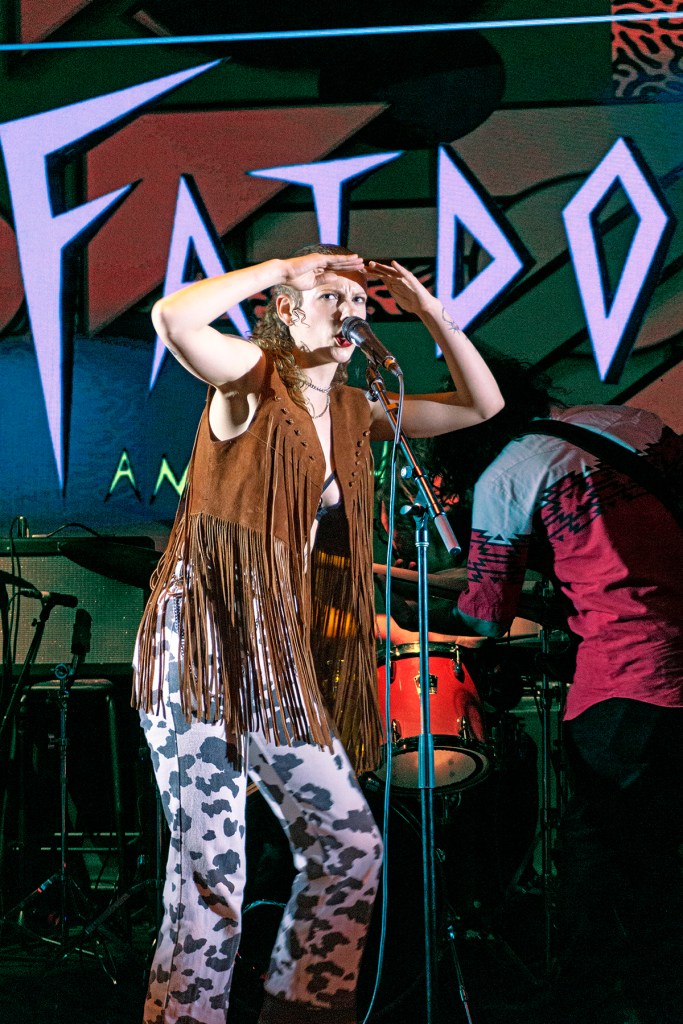
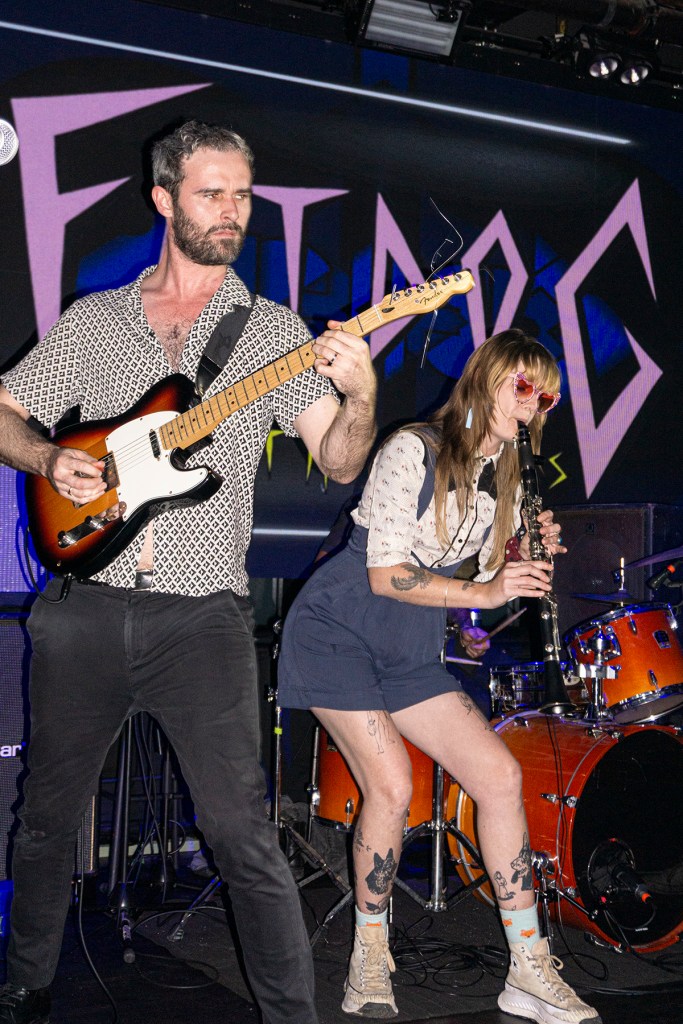
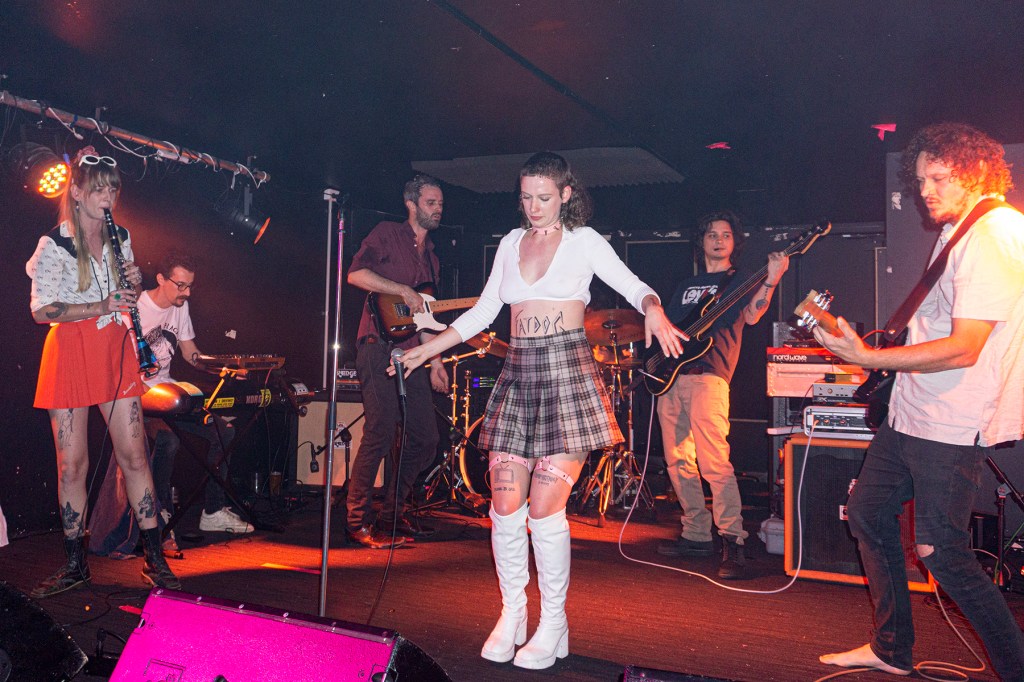
Fat Dog and The Tits vocalist Sam Taylor: ‘I’m a little alien, and I need to run around and do weird stuff.’

Original photo by Jhonny Russell / handmade collage by B

Community, vulnerability, and creativity are at the heart of Sam Taylor’s evolution—from a self-described “ignorant punk” to the electric frontperson of Meanjin-based band Fat Dog and The Tits. In this in-depth conversation, Sam delves into the transformative power of balancing strength with softness.

With raw honesty and humour, she recounts the pivotal moments that shaped her journey—from life-changing encounters high at festivals to mistakes made to painting skateboards to emotional revelations mid-performance that left her in tears and more. As Fat Dog prepares to release their stellar Pepperwater Crocodile EP and embark on an exciting new chapter, Sam reflects on the value of meaningful relationships, the courage to let go of judgment, and her ability to turn life’s toughest moments into art. Their EP has already made our Best of 2025 list!

SAM TAYLOR: I came back from tour and moved house. I was living in the middle of West End, and it was too much—too inconvenient and hectic to come home to. There was nowhere for my friends to park if they came over, and the house was really small and dingy. But now I’ve moved to Holland Park West, and I have the whole underneath of a house to myself for all my art and music shit. Happy days!

Nice! How did you grow up?

ST: I grew up in Brisbane with Mum, Dad, and my sister. I got into art and music right towards the end of high school. I was always into music because of my cousin. My sister got a guitar off him, but she never played it. I copied everything my sister did, so I started playing guitar and ended up loving it.

In Grade 11 and 12, I got into art class—accidentally. I’d applied to get into it every year but never got in. I don’t know why—maybe it was just the way the schedule lined up.

I changed English teachers because I didn’t like the way one of them taught. I really wanted to read the book the other class was reading. My schedule got changed, and I got plonked into art class. You needed prerequisites to get in, like doing art in Grades 8, 9, and 10, but I hadn’t done any of that. I had no prior experience, no idea what I was doing.

Nice! What was the book the other class was reading that you wanted to read?

ST: Jasper Jones. It’s a beautiful book. It’s amazing. A modern classic. The book my original class was reading was about cricket!

Oh, really?

ST: Yeah. The teacher had a very… interesting teaching style. Someone from head office actually came down and sat in on one of the classes to see what I was talking about. They were like, ‘Yeah, okay.’, that’s valid. And then, everything kind of worked out amazingly [smiles].

Your teen bedroom was covered wall-to-wall with images ripped out of skateboarding, surfing, and music magazines. You had posters up—Nirvana, Descendents and stuff like that. It was definitely a vibe and reminded me of my room when I was a teen. What kind of bands really inspired you then?

ST: Back in the day, I was very into heavier sort of shit—I loved Parkway Drive and all of that stuff. Nirvana was the big one for me, for my dad, he liked heaps of punk shit. NOFX was massive for me. I definitely love punk a lot.

There was a bit of a hardcore phase when I had all the posters in my room. I’d go see Amity Affliction and all that. But I’ve kind of definitely grown out of that now. It helped me at that time, very much so.

With all the skate and surf shit—Dad surfed, and he had a bunch of mates, including my godparents, who were all into skate and punk stuff. But when I really started delving into music—like, when I found things like The Cramps and B-52s—that really opened up my brain. I was like, I found my shit!

With the hardcore stuff, that was me being influenced by friendship groups and the people I was hanging out with. But once I found my shit, I went over to my godmother Anna’s house and spent some time in her record collection. She had a record player, and I was just putting on different records. I’d originally found B-52s through Mum, but when I first listened to it, I thought—fucking sick! The Cramps and B-52s were the ones that really started my brain opening, like, oh god, I really want to do this!

The Runaways were huge for me as well, including the movie—that was super inspiring. I love Joan Jett, love Cherie Currie. Even Suzi Quatro was something I learned from. Love all of that. Bikini Kill too—definitely a huge influence.

A lot of the bands you mentioned, like The Cramps and B-52s, they’re real outsiders and weirdos. They build their own entire world, and it’s not just musical—it’s visual as well, and it’s performance.

ST: Yeah. The Vandals are a really good one for that in the punk scene. When I was finding everything, I’d watch their music videos—they’ve got the funniest, most amazing, movie-style music videos. So inspiring, so funny.

Photo by Jhonny Russell

Why is music and art important in your life?

ST: It’s a way I can function in this world. Whether it’s me listening to it—being able to get through whatever mood I’m in, enhance that mood, or help me feel a feeling—or doing art. Whether I’m creating through feeling or just zoning out and not having to think about things, it’s always been it for me.

Once I finally found that towards the end of high school, I was like, okay, this is what I can do. This is me. This is how I function. It’s genuinely in my blood, and it felt so good to finally find that and be like, Okay, cool.

Towards the end of high school, when you’re looking at university and what you want to do—I was like most people, wondering. But as soon as I found art and music, I thought, That’s me. Whenever I listened to music, I could see myself doing it. Whenever I saw people’s art, it didn’t make me want to create like that—it just gave me more go.

In 2014, as you were finishing high school, you thought for a brief moment that you might join the Navy, and you had an interview booked to go to. But knowing you through your art and music now, I could never imagine you doing that!

ST: I know, I know! Honestly, I was like, I don’t know what to do! I had this friend, and we were going to go to the Navy together. He went for his interview, and he was like, ‘Honestly, don’t—don’t fucking do it.’ And I was like, ‘OK.’ He went through with it for a while. Served his however long he had to serve until you can get out of it.

I’s bizarre how much I thought I had to do something. It took Mum and Dad a bit to understand that I’m not a conventional person. I’m not going to have a conventional 9-to-5 job. That’s just not happening. It did take a while for them to come around, but as soon as they were on board, a couple of years out of high school, they understood. They heard me play and saw my art, and they were like, ‘OK, this is you, and we can’t change that.’ They jumped right on board as soon as they understood that it wasn’t a phase.

Have you always enjoyed singing?

ST: Yeah, loved it. Mum had an office downstairs, and I would blast Christina Aguilera, Lauryn Hill or whatever the fuck, and literally sing to the top of my lungs, whatever I was feeling at the time—out of desperation or sadness.

You have such a unique voice. It makes you really stand out, especially with the music Fat Dog and the Tits play.

ST: Thank you. Honestly, if I could show like 15 or 17 year old me the music that we’re making now, I would absolutely shit my pants! In a good way [laughs]. Sounds weird, but you know what I mean? It’s so exciting. 

We’ve got a song, ‘Should,’ and that was the first song I ever wrote back in the day. I would be over the moon to know that I’m a part of something like what I am now.

‘Shoulda’ is our favourite song of the ones you sent through from the up coming release. I love them all, but that song hits me in the feels every time I hear it. There’s something so amazing about the melody you sing, and I noticed that the melody is similar to another song, ‘Bad Boy Blues,’ that you did when you were just doing Fat Dog acoustic stuff on your own.

ST: Yes, oh my god, yeah, it was! That’s the first song I ever wrote after my first breakup ever. When we were jamming and thinking of new songs, I showed them that, and they were like, ‘What the fuck? Yes, let’s do it!’ And then, we made it what it is now. I’m like, ‘Oh, that’s crazy!’

With songwriting, I can’t force it. We have a jam, and words come to me or whatever. Sometimes there are some songs where I’ve just been like, boom. I sit there, and I write it in one go, and that’s the song. Like, it just… sometimes I can’t choose when that happens, but I love when it does.

Yeah, my friend Gutty, who taught me a lot in music, we used to have a country band called Fat Dog in the Boners. He came up to me one day and was like, ‘You should sing something about a junkyard, like being Fat Dog. I don’t know, it just seems like a program.’ And I was like, ‘Cool.’

‘Queen of the Junkyard’ and ‘Queen of the Gas Station,’ which Lizzy Grant did when she—or Lana Del Rey, when she was Lizzy Grant—was my kind of ode to that. But yeah, it just, again, just pooped out of me.

Photo by Jhonny Russell

Are ‘Money,’ ‘Should,’ and ‘Junkie Witch’ all songs that you’ve written previously and then expanded on with the band?

ST: No, no. ‘Queen of the Junkyard’ I wrote for the band. It could have been either/or—it could have been for my solo project or for the band—but the way it was written, it’s definitely for the band. But ‘Shoulda’ was pre-written, and ‘Solitude’ was pre-written. I did that for my solo stuff as well. That’s probably the most recent one that I’d written, um, that I showed the band, and they were like, ‘Yeah, let’s do it.’

But ‘Junkie Witch’ was a jam because we had a friend who was… ‘Junkie Witch’ is for either if you’ve got a friend who’s obviously going down the wrong path and you’re trying to pull them out of it. Or yourself. It was both for my friend and for me too.

But that one was literally just Rob sitting there on the keys going, and then the band joined in, and then I started yelling shit. A few of our songs are written like that—purely just a jam.

As well as heavy stuff, there’s humour. That’s what it’s about, honestly we’re goofy. I’m really excited to get this music video for ‘Queen of the Junkyard’ out there.

What do you remember most from shooting it?

AT: Oh god! Everyone in the band was fucking late; not all of the extras, though. That was hectic. I remember being towards the end of filming, but I still had two more band members to bash in the clip… there was the part where, finally, the car got crushed because we had to wait right until the end to get it crushed. My most vivid memory is me on top of a tire, going like, ‘Ahhh!’ And the director was like, ‘Give it all you got, give it all you got.’ I literally almost fainted. You can kind of see it in the video—I felt myself go forward, and I was like, ‘No, no, no, keep going!’ There was only one shot; you can only crush a car once. It was such a fun day. I felt bad for the band because it was pissing down rain and they had to lie in puddles.They were like, The shit we do for you!’ [laughs]. I was like, ‘I know! I’m sorry.’ It would look really good on film. It looks amazing. Jess Sherlock and Leo Del’viaro, the Director of Photography—fucking killed it. 

Every scrapyard we’d called, they were just like, ‘Nah.’ As soon as I brought up the idea—’Nah, nah, nah.’ But her dad was delivering coffees one day to a scrapyard, and then he started talking to John, who said we could film there.

Photo by Jhonny Russell

It looks great! Where did the name Fat Dog come from? You’ve been using it for a long while, for your art and your music projects before Fat Dog and The Tits. 

ST: I got a t-shirt a friend gave me in high school, and it said: ‘Fat Dog Planet.’ And my brain just exploded. I was like, ‘What is that? Where do I find it? Who is it? Where? What?’ So I searched the ends of the fucking internet and everywhere I could to find it. But couldn’t. So I was like, ‘Fuck it.’ And, I won a competition with Converse to design a skateboard. I was like 17. I used Fat Dog for it. I changed my Instagram name, and everyone clued onto it straight away. Everyone started calling me Fat Dog, and I was like, ‘This is perfect.’

There is a band in the UK now called Fat Dog. They probably started in about 2021. Not mad, though, because there’s a lot of bands called Fat Dog. At first I was like, ‘Oh no, what do I do?’ And I was like, ‘Bitch, you stole the name from a t-shirt, you can’t say anything.’ Fat Dog from the UK is really good too. I love their music. We follow each other. All good, no harm, no foul.

Your first solo art exhibition was all your art on skateboards?

ST: Yeah, I mainly painted skateboards. That was from that Converse Cons pro thing I did. I got to design a skateboard, and I fucking loved it. I was stoked! The skateboarders, the crew helping, and the graphic design—it was the best. One of the skaters, I think it was Andrew Brophy, saw this little draft sheet I had with all these fucked up drawings for the skateboard. He grabbed it and was like, ‘What the fuck?’ I ran around showing it to everyone, thinking, ‘Is this me? Am I becoming me right now?’ Oh my god, it was really cool.

I noticed in a lot of dicks and vag in your art; where’s that come from?

ST: When I got into the art class without any prerequisites, the teacher fucking hated me for it. She’d tell me I’d gotten unfair treatment and made things hard for me. She’d come up behind me and say, ‘Your people look weird. Do you even know how to hold a paintbrush?’ She was a proper cow, to put it nicely. Really mean, and made me feel like shit. So, I started drawing all this messed-up shit, just because we could. At first, it was a fuck-you, but then I kind of liked it. The reactions I’d get—whether positive or negative—didn’t bother me. I wasn’t trying to offend anyone, but I did like pushing people’s boundaries and seeing how they reacted. Not physically, but mentally.

You’ve done art for Woodford. You always seem to have interesting things on the go.

ST: Yeah, I was working for Screen Queensland just before we went on tour, but now that contract’s ended. I’m not sure what’s next. But I love that kind of work—it suits me. It’s way better than doing the same thing over and over. I genuinely get depressed, my heart hurts, my stomach aches, and I get all anxious if I can’t create things.

It’s hard when you’re stuck within these little boundaries. It’s nice to poke out and see what happens and the reactions. People feel something, even if it’s just a little ‘oh.’ It doesn’t matter how they feel—it’s about stepping out of that cookie-cutter mould. Breaking free from that feels really good.

I know you like a lot of different music, besides the punk and hardcore we’ve talked about I’ve seen you rock a Beastie Boys shirt and also a Crowded House one. I know you like reggae too. It makes sense you’re in the band you are because Fat Dog and the Tits have a real eclectic mix musically. 

ST: ‘We’re specialised in genre-bending!’ People ask us what we are. I used to say doom-funk-cunt-punk. And Rob’s like, ‘It’s not that.’ He fucking hates it when I say that. So I stopped saying it [laughs].

I was like, ‘What are we? What would you call it then?’ And he’s like, ‘Contemporary Australian rock.’ And I was like, ‘Shut the fuck up! No, I’m not. What do you mean?’

Then we kind of recently came up with the idea of junk rock, which is like jazz musicians playing punk rock.

You’ve been recording over the last year?

ST: Yes. Milko, our bassist, he recorded, mixed, and mastered everything. It’s completely in-house. It sounds exactly like how we fucking sound. He is an absolute genius. He’s a very smart, amazing man. I think it sounds, honestly, fucking amazing.‘

We’ve heard four tracks from it, which totally do sound amazing! How may songs will the final release have? Will it be an album?

ST: We’re in debate about that now, because we’ve got a few old songs that we used to play, like ‘Nancy’ and ‘Desert Dog’, which we’ll still play.

There’s a few older, slower songs we had recorded when we originally did the album, and it didn’t go as well as we wanted it to. We weren’t ready to record, basically. We were trying to jump the gun. So we’re thinking of releasing a five-track EP called Pepperwater Crocodile. Can you tell how high we were when we came up with that? [laughs]. Although, I’m pushing for a double-sided vibe. One side as the five-track EP, and the other side with different vibes, like doing a split EP with ourselves as, Sammy Taylor and the Brake Failures, that’ll have all those slow songs. I don’t know, though, I’m not sure where we’re at with that. Seven people in a band can be hard.

Tell us about the song ‘Solitude’.

ST: When I wrote it, I was coming out of being really sad—I went off the rails a little bit. I had to move back with my parents, they live in Kawana on the Sunshine Coast.

I sat at the beach, I took my guitar to this little spot where I always sit. I wrote it as a reminder to myself. Like—When the sun doesn’t shine like it used to, when your mind doesn’t operate like it should. When the sky turns a different shade of blue, all I needed was solitude.

I’m very much a social butterfly. I can get so carried away in that. I’ve learned better now, it’s an ongoing process.

The song was a reminder that when it gets shit, it does get better. And you can spend time alone and get through it. Or, you don’t have to do it alone. But sometimes, for me, solitude really does fucking help. Coming back to being grounded. I’m a bit spiritual, so reconnecting with all of that. Just fucking breathing and being with the moon, the ocean, and the earth.

Photo by Jhonny Russell

Yes! You’re talking my language. I totally get that. Do you feel like you went off the rails in part because the subcultures and social aspects of skateboarding, the art scene, heavy music and punk communities are places where people often gravitate towards partying and you kind of can get caught up in that?

ST: Absolutely. And when something happens, or you’re stressed, or even just after a hard day at work, and you’re like, fuck, I can’ t wait to get home and smoke a bowl, or fucking drink beer…Or, you know, it’s like, can’t wait for the weekend! You don’t give a fuck about the whole week; you’re a zombie, just living to go out. 

That’s what the ‘Solitude’ song is exactly about—you just need to come right back to centre and notice all of these energies and things that you’ve collected over time.

What is yours? What are you feeling that is actually fucking yours? What do you want? Or do you just get persuaded so easily? Who you’re around and what you’re around can really affect your psyche and how you deal with things. It’s like, Well, fuck it, I’ll just go out with them!’ And you don’t actually deal with the thing. You think you’re dealing with it, but you’re not.

100%! Do you find that you get more of a buzz now from doing your art and music?

ST: Absolutely! Towards the start of the year, I was off it. I was not drinking, completely sober. We played a show, and the energy was fucking insane. I felt like I did the biggest line of cocaine, but it was natural energy that came from me. It felt so good; it felt so pure.

It was a show at The Bearded Lady. There was a lot of our regular crowd and friends—it was really sick. I could feel everything and see everything. Like, holy fuck!

It’s almost daunting, in a sense, because I’d be so used to at least having a couple of beers before a gig, like at very least, you know? So it’s nice. Honestly, it was really refreshing to see that I don’t need anything to do what I do.

I saw at the very first show you ever played, it was just you by yourself, playing acoustic guitar and singing. You got so nervous, your hands started shaking, and a friend had to get up with you and play guitar.

ST: Yeah, I was shaking so much! I’d rehearsed the song, but I actually could not fucking do it. I was so fucking scared. I’d never wanted to do anything more in my life, but I was so genuinely afraid. 

Especially with solo gigs, I still get nervous getting on stage. Even the first time with the band it was like that—oh my God! Even though I wanted to do it so bad, there’s the other side of it where it’s like, this is everything, you wanted to do this, but I don’t want to fuck it up. I was almost fucking paralysing.

Having seen you play, I would never have guessed you get like that.

ST: Before the floods happened in Lismore, I thought it was going to flood up on the Sunshine Coast. Everyone was feeling super anxious at the time. I remember posting, I had a Bob Marley song playing, and I was dancing. I’d been painting a commissioned skateboard while watching the water come up into the house, and I was just like, oh fucking fuck! Feeling super anxious. So I posted to, number one, make me feel a little bit less anxious and maybe be able to talk to people about it. But, number two, also do the vice versa and be like, hey, if anyone’s feeling anxious, I’m pretty sure we all are—everything’s a bit weird right now.

Then I had a few responses, people were like, oh my God, you get anxious?. Believe me, I’m in my brain, I’m one of the most fucking cripplingly anxious people ever. But, because I go outward instead of inward—I appear very boisterous and really loud and weird.

You seem like a vibrant creative, really individualistic person, also someone that’s really caring and compassionate for those around you.

ST: I love dogs so much. I have seven dogs tattooed on me!

I didn’t get through the whole spiel about when I got the Fat Dog Planet shirt, but when I got it, my brain exploded, and I saw my vision.

After my music and art career, when I’m ready to settle, there’ll be a three-level house thing. The bottom level will be an animal sanctuary, starting with dogs and birds. Easy stuff, probably near the beach, but in the bush. 

Second level will be an op shop to help fund it. If you’re First Nations, experienced DV, or facing homelessness, or feel disadvantaged in any way, you come in, get what you want, and you’re good to go. You can also hang out with the animals—pat them, chill with them, whatever.

And then the top level will be a skate park venue. That’s the dream, the goal, the vision. But later. I’m busy right now [laughs].

Photo by Jhonny Russell

It seems like everything you do is community-based and collective. 

ST: I always want to keep that as a huge part of it. Solitude is important, but community is just as important. Life gets very sad very quickly without it. It doesn’t have to be a huge community, and it doesn’t matter who’s in it. It’s about what you can do, what you can make, and how others can be involved.

It’s important to remember, we can always contribute something. 

ST: Yes, exactly. Because some people, you know, you’ll think that you have nothing, so you’ve got nothing to give. But it’s not only monetary things that have value. That’s fuck all in this grand scheme of things.

Sometimes it’s just even having a conversation with someone or listening to someone. People crave that companionship; they need someone to connect with.


ST: Yeah, absolutely. 

Photo by Jhonny Russell

Have there been any moments that have really helped change your life?

ST: Oh, yeah, a few. I’m having a wave of memories flash in my brain. I feel like there were a few moments at Woodford when I was in my really ignorant punk phase. I remember I went to the planting, first of all. My friend and her mum took me there kind of like a, ‘You need this,’ sort of vibe, like, ‘You’re a little ignorant motherfucker.’

I went, and I’m sitting there like an old punk. And that experience kind of cracked me like an egg a little bit—opened my brain a lot.

I came from a bit of a judgmental background, had that attitude ingrained in me. I was very standoffish and didn’t give people a chance. As soon as I did, I learned so fucking much, honestly. It cracked me like an egg.

I used to be a bully. Like, in high school, I was a little fucking asshole. I was a worse bully in primary school. When I got to high school, people started fighting back. But I don’t remember anyone turning around and saying, ‘Why the fuck are you doing this?’

And one day, I was just like, ‘Fuck, why am I doing this?’ It just broke me. I went from like, ‘Fuck you,’ to, ‘Oh my god, what am I doing? Why am I fucking doing this?’

I was bullying my best friend, Angie, at the time on the internet. She was like, ‘I’m about to call the fucking cops on you. Like, why? What are you doing?’ We ended up working through that and breaking it down. I learned a lot from that. After that, she gave me the Fat Dog Planet shirt I told you about.

And then that led you into doing what you do now and being called Fat Dog?

ST: Yeah, I’ll spare the details, but we got there eventually. It’s amazing the connections that you can have if you let them happen. 

School was hard for me, and I always felt like I had to be the tough girl because I got bullied a lot and I wanted people to leave me alone. I always felt I had to have a harder exterior. But as I got older, I found that there’s a real beauty in softness.

ST: Absolutely. There’s a time for toughness, and that can get you some places, but a lot of the time, that vulnerability—when you let that happen with people—is so magical. It’s so beautiful. Like, I love so much when even something as simple as walking past someone and smiling at them. That softness can be so valuable. There is strength in softness. It took me a very fucking long time to learn that, but I got there.

Photo by Jhonny Russell

What are you most looking forward to in 2025? 

ST: Releasing the EP! We’re going to do a proper Australian tour and then head overseas. I know we recently celebrated our second birthday this year, but that’s as a playing band. We’ve actually been together for like three years now. We’re all absolutely gagging for it. We’re ready to go.

What made you want to take your music  from doing the solo thing to having a band?

ST: I always wanted a band. Last minute, a festival called Forest Fuzz—one of the sickest festivals that our mates ran—came up. I was doing this mentorship program with Alison Mooney, and she said, ‘Always carry a little card in your pocket with your manifestation.’ And then, right before the festival, I was like, ‘I’m going to get a band out of this. I don’t know how, but it’s just going to happen. And I’m really grateful for it.’

I played my little solo set. I cried through three songs. I still had three songs left to play, and I started bawling my fucking eyes out. I had to recompose myself, then play.

After, I ran back to the campsite, just to smoke some weed, because I was like, ‘That was hectic.’ Matt and Glenzy, the drummer and one of the guitarists in the band now, were sitting there like, ‘Hey, do you want a band?’ They’re both from Bricklayers. And I was like, ‘Yep, fuck yep!’

I love doing the solo stuff, but I always wanted to run around with a fucking microphone in a band. Having a guitar is fucking annoying. I’m a little alien, and I need to run around and do weird stuff [laughs].

Photo by Jhonny Russell

What was it that made you cry mid-set? 

ST: I was dating someone at the time, and I sang a song. Subconsciously, I realised, ‘Fucking nah, I’m very unhappy.’ And, it kind of hit me. That’s what the song is about. ‘Thank you for showing me that I’m not alone,’ is the last lyric, and you kind of wail that, like Alice Phoebe Lou’s ‘Something Holy’—it’s a beautiful song. I was singing the last lyrics, and I was like, ‘Oh, yeah.’It was hectic, and I was ugly crying.

You know when you’re in a relationship where people want you but don’t want the responsibility of you? Not dealing with what’s in the handbag, never cleaning the handbag out, but just fucking shoving shit in there—that’s it. That’s all I’m here for.

I’m a super, super emotional person. Art is how I process that. How I’m feeling about the situation just comes out in song. I’m just so fucking grateful that there’s a band of six other Tits that are so keen to do this with me. I would not be doing this without them. To have a literal dream come true is amazing. I’ve been spiritually and mentally and physically feeling that it’s like, strap in, it’s about to get real. If you want to do something, you’ve got to fucking figure it out—make it happen!

Follow: @fatdogandthetits and @fatdogplanet + Fat Dog on Facebook. LISTEN/BUY here.

Gentle Ben and His Shimmering Hands: ‘It’s been a strange year.’

Original photo & handmade collage by B.

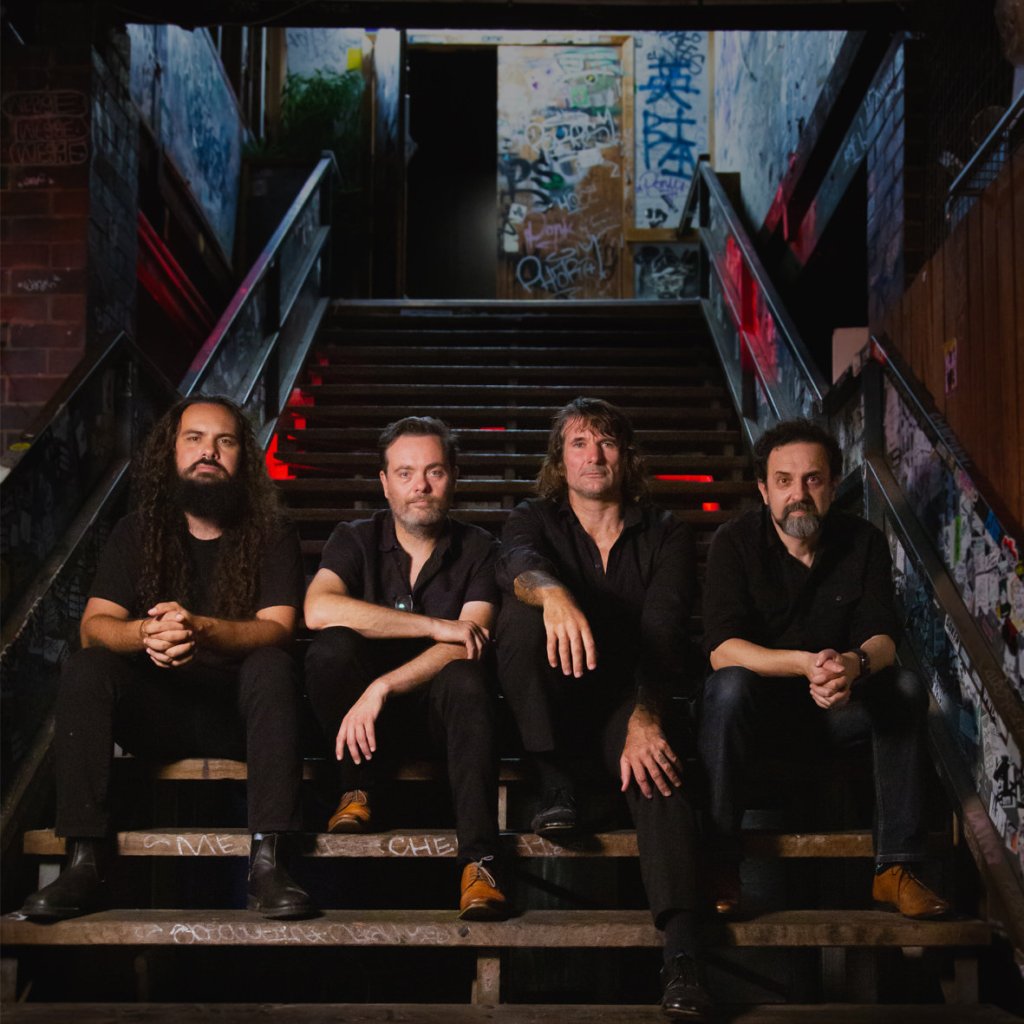
Ben Corbett, the frontman of Meanjin/Brisbane band Gentle Ben and His Shimmering Hands, knows a thing or two about following your passion, loss, mental health, and persevering. In our candid chat, he offers an intimate glimpse into the highs and lows of a career spanning over 30 years.

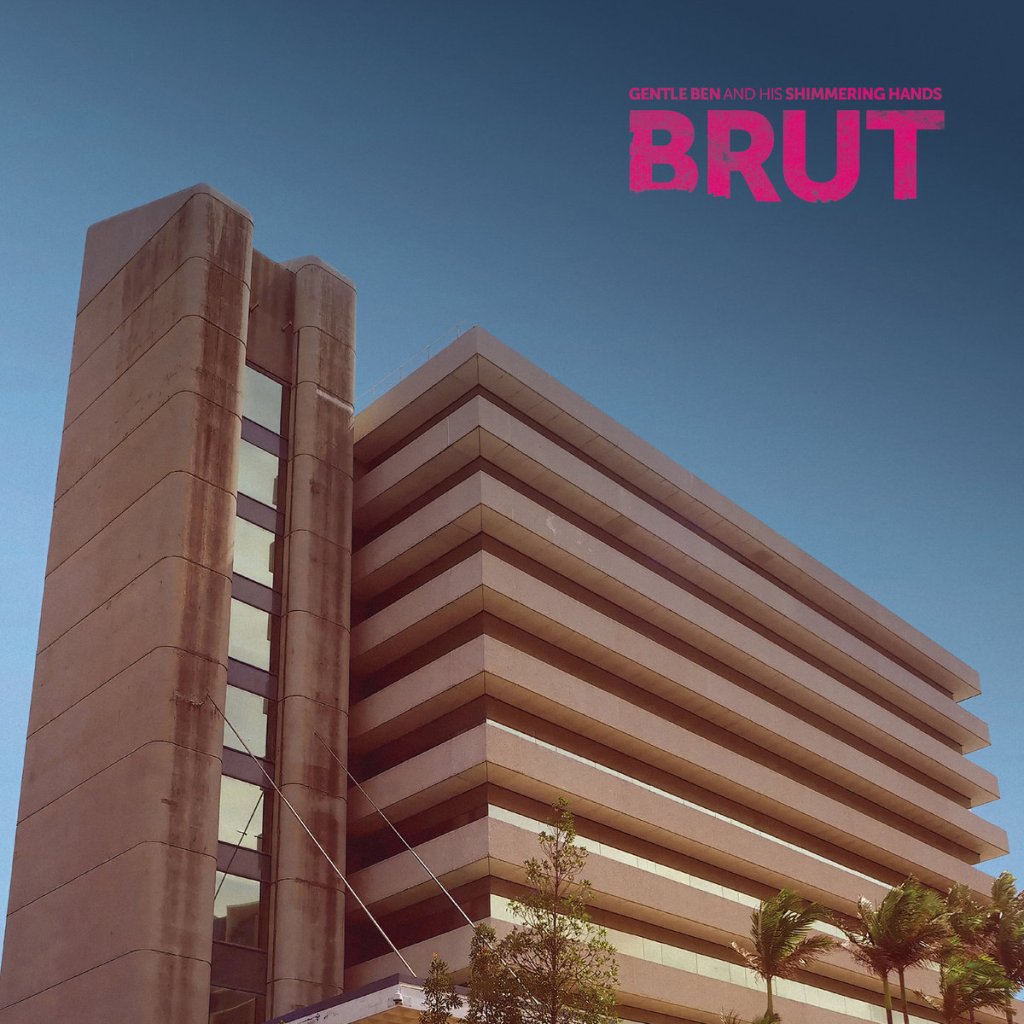
He shares with Gimmie the journey behind Shimmering Hands’ long-awaited album BRUT, their first release in a decade. A triumphant return, the album blends sass, wit, and satire as it weaves through themes of fractured hearts, minds, and bodies within a capitalist nightmare, offers critical commentary on colonialism, rock ‘n’ roll eulogies, and shines a spotlight on male violence, control, and toxic dynamics in relationships, particularly towards women. Yet, BRUT hasn’t received the attention it deserves. It was one of our top album of 2024 to come out of Meanjin. Tragically, a week after its release, Corbett and his friends experienced the heartbreaking loss of close friend, bandmate in Six Ft Hick, and local punk icon Fred Noonan, which we discuss.

The frontman also reflects on the importance of supporting younger musicians, the raw physicality of his performances, and what kept him away from making music for so long. With authenticity and vulnerability, Ben offers a heartfelt look at both Gentle Ben and His Shimmering Hands—and at himself.

I’m excited to be talking with you again! I’m sure you don’t remember but I first interviewed you for my first punk zine back in the 90s before a Six Ft Hick show at Crash n Burn.

BEN CORBETT: I bet I said some really intelligent shit back then. 

[Laughter]

I have no memory of that whatsoever. I’m sorry. And it’s probably for the best because I would have had some real hot takes in the 90s! It’s nice we finally get to connect again.

Totally. How have you been?

BC: Ooh, jeez, fine. The world is pretty horrible at the moment. It’s been a strange year. There’s been a couple of deaths of people close to me, which has made me value life a bit more. Which is good, I suppose.

And then there’s obviously the horror of what’s happening in Palestine that’s weighing on me every single day.

Apart from that, life is good. I’m blessed. I’m very fortunate. I’ve got a beautiful family, and a house to live in— all that good stuff. I get to sometimes go and make music, which is great, because there were a few years where that didn’t really happen very much. And now it’s finally happening again. I feel really privileged to be in a position to not only be able to make music, but when we release that music, people actually want to buy the records, listen to the records, and come to the shows.

Getting to do interviews like this. It’s all a bit of a balm for my soul. After however many years—30, whatever years of playing music—I can still rustle up some interest. It’s really lovely. Thank you.

Well, it’s lovey that you’re still making great art. Thank YOU for that. I’ve been following all the stuff that you’ve done for that long, and I gotta say that your latest record is one of the best things you’ve done yet. 

BC: I think so. That’s lovely to hear. This is a record that’s the sound of a bunch of people learning to get out of their own way. We’ve, in the past, really struggled to get things down. It was always dealing with each other’s egos, dealing with our own egos, and just not really being able to listen to each other’s ideas.

What has changed, in recent years, is that we’re all on the same page creatively. And a lot of that has to do with just setting aside—not differences, but just setting aside our preconceived notions of what we want to achieve—and actually weighing up ideas on their own merit. Which has been a really cool change to the creative process.

Even though it’s my name—or my stage name—at the front of the band, it’s really a group effort in everything we do.

I know Dan Baebler (bassist), has been part of your life for a really long time. You guys went to high school together?

BC: Yeah, we’ve been really close friends since we were like 14. We used to go skateboarding together and hang out all the time. He’s been a constant. We tried to form bands when we were about 17. That didn’t really happen. And then Six Ft Hick coalesced into some sort of being when we were 18. We’ve obviously done Six Ft Hick for a long time. But then Dan jumped in on this new project, and it’s kept on rolling with him, which has been great.

Because he’s an incredible creative spark. He has this wonderful sort of cynicism that drives a lot of what he does, which is really important to have. What we create is as much about what we’re not into as it is about what we are into. A lot of that influence, those negative influences, like, all we don’t want to sound like, or we don’t want to roll out that cliché. So it’s really cool to have someone like that to bounce ideas off. He’s creative in all kinds of ways. He’s a musician. He’s an incredible videographer. He made the main film clip for the album song,Spices’.

He travels around Australia, filming in Indigenous communities and doing all this great work. I hadn’t really seen a lot of his work or how he does his work. Then we turned up to film this clip at this crazy reservoir that looks like a part of an ancient ziggurat, with these giant concrete steps. He pulls out a drone and starts flying it. I was like, ‘How did you learn to fly and film with a drone?’ He’s like, ‘Well, this is what I do for a job.’ I’m like, ‘This is insane!’

It’s cool to see your friends do all these interesting things because I have a very limited skill set. I have a very particular set of skills, and they’re not very useful. I’m kind of like a really crappy Liam Neeson [laughs].

Of course, Tony is not just a great guitar player, but an incredible graphic designer. He has an Instagram page and a website called Guitar Nerd. He really is just a wealth of knowledge about guitars. He’s so enthusiastic about guitars, about music, and about the history of things. That energy is just incredible to be around.

Jhindu is a monster behind the drums, but then just the loveliest, most incredibly calm and level person to be around. He brings his own beautiful energy to the band.

Nothing would work the way it does without what everyone brings, which is a nice thing to recognise and acknowledge. Part of recognising and acknowledging is learning how best to work with all of those elements.

That’s part of what you’re hearing. Those elements of our personalities are given, not free rein, but the right amount of freedom. Because we’re pretty good at dumping each other down when it’s necessary. That includes me being stomped down because that’s necessary sometimes as well.

Well, that’s definitely working, the album is really fucking cool! You grew up on a chicken farm in Woombye about an hour and a half from Brisbane? 

BC: It wasn’t a working farm for very long after I was born, so I have really vague memories of there being chickens. We kept the farm in the family, and it’s still there. I go up there pretty regularly to hang out with Mum and do a bit of work.

Lately, we’ve been collecting tons and tons of scrap metal from around the farm. When my dad was alive, he wouldn’t let you throw anything away, literally. There were sheds and sheds full of scrap metal, rough pieces of stuff, old plows, and machinery. I’ve been doing a lot of that with my brother Geoff as well.

At the time, I didn’t really appreciate how good I had it. I wanted excitement and thought I’d be better off as a city kid. I thought that was where it was at. Now, I don’t think city kids have it any better than country kids—except maybe they have slightly lower death and injury rates!

I still go up there pretty regularly, and it’s beautiful. The highway is encroaching on it fairly rapidly, unfortunately, but one side of the farm is still great.

Around the time you grew up there, I think the town had only a few hundred people?

BC: Woombye was a pretty small town, and we weren’t actually in the town—we were about 5 km south of it, a little bit isolated in that sense. It wasn’t like we were out in the sticks or on a cattle property in Longreach. It only took us about 10 minutes to drive to school, so it wasn’t a big deal.

But for me, as a young person, I wanted to be elsewhere because the highway ran past. I couldn’t wait to get out and move to Brisbane. That was my big goal: to move to Brisbane and make music or do whatever it was I wanted to do. That was freedom. When I became old enough, my brother Geoff, who’s seven years older than me, was living in Brisbane. I would catch the train down, go see bands, and sneak into pubs. No one would check IDs in those days, and I looked older. I had this stupid goatee that was awful, but it got me into pubs and stuff. I’d go watch bands, and that was quite formative.

As soon as I could, I moved down to Brisbane with Jeff and started trying to make music with Dan. We had a few abortive attempts at starting bands, and then Six Ft Hick kind of happened.

I understand that your mum used to make you do eisteddfods and things. Was that was your first introduction performing?

BC: Yeah, she got me onto the stage. She was a speech and drama teacher. A schoolteacher originally, and then after she got married, apparently, you couldn’t be a married schoolteacher in Australia in the 60s. Pretty insane, right?

So, she started doing private elocution lessons, which is pretty funny. I can speak cultivated Australian English when I want to, and my mum, well, everyone says she speaks like the Queen [laughs].

She got me doing eisteddfod things—poetry readings, mime, all that kind of stuff. I did it when I was quite young, but then I lost interest as I got into high school.

Did you enjoy performing? 

BC: I did enjoy parts of it, but the nerves would get to me. I really liked being praised and being told that I’d done a good job. If I won a medal or something, I was really stoked. But if I didn’t, I’d be devastated, you know?

I guess I’m still really easily discouraged now. Well, I can’t be that easily discouraged because I’m still doing bloody stupid bands—and I’m nearly 50! I’m thin-skinned but also bloody-minded.

How did you first discover music? 

BC: Through my brother’s influence, I started getting into music during my teenage years. He was at that age where he was really exploring different sounds. He’d play me records by The Cure or Dead Kennedys. There was a limited amount of alternative music available on the Sunshine Coast back then unless you had a way to access it, so I’d just listen to whatever he brought home.

When he moved to uni and went to art school, he started bringing home more records that influenced him, including country music. That’s where my love for outlaw country—Johnny Cash, Hank Williams, and the like—began. It was an uneasy appreciation at first but grew into a genuine love, alongside punk rock like Black Flag.

In high school, I got into skateboarding, which introduced me to a mix of punk rock and metal through friends. Some of it was great; some of it, not so much. I made a few questionable choices in music, but some stuck with me over the years.

I started hanging out with musicians, like Dan and a few other friends, trying to form bands that never quite got off the ground. I always felt like I should have learned an instrument, but I was lazy, so I just sang. That eventually morphed into what I do now.

Did you look up to Geoff?

BC: Absolutely. He was totally my hero. I really wanted to be in a band too. I got up on stage with him for a couple of things he did in one of his bands. Then, we did the play. He was very kind to me, because he was really encouraging of everything I did. He probably didn’t have to include me in any of that stuff, but he did. And I think that’s what set me on this path. So, we did Six Ft Hick for a few years, and then I wanted to try something different. That’s when I formed Sensitive Side, and that kind of had its own life, which was really cool.

What did the earlier attempts at bands with Dan sound like? 

BC: Terrible. Like, really, really fucking bad. It was some sort of—I don’t even know what to call it—some kind of ’90s math rock bullshit. Just terrible. Really naïve, but not in a good way. I live in fear that someone’s going to unearth a tape of it one day. Early Hick is bad enough, but there’s some truly awful shit from back then. Sorry.

So, your brother was already living in Brisbane, and then you moved down there. When you first arrived, you were studying for a while—what were you studying?

BC: I studied Humanities because I had no idea what I wanted to do. I just thought, ‘Oh, I guess I’ll do that.’ I really didn’t know what I was in for and was quite a poor student. I ended up getting a job at the uni as a research assistant, but I dropped out at the same time. So I was working at the same uni where I was failing.

After that, I started working in hospitality, as a lot of people do in their first job after leaving home. I washed dishes for a long time, made coffee, and waited tables for years. That kept me going through the early years of Six Ft Hick when we were touring a lot. It was really handy because I could take time off whenever I needed.

We would go on tour down to Melbourne, Sydney, or wherever, usually by road, every few weeks for a while. It was ridiculous. We’d drive straight for 20 or 22 hours, play three shows, and drive home again. We did that for years because we thought that’s what we were supposed to do. It made us very tight as a band and road-hardened.

Six Ft Hick was always about the live show. We never really captured what we did on record, and that’s fine. It was always more about the moments we shared with an audience.

Didn’t Six Ft Hick start from a play that you wrote as a teen?

BC: The play was called Country Style Livers, and it was a play on words referencing the magazine Country Style Living, which was a fancy homes and gardens thing. But it was born out of this idea that I wanted to write a play about the clichés of country music, country music tropes. 

The main character is a wheelchair-bound ex-truck driver addicted to heroin. His younger sister is a sex worker who’s being pimped out, in this town that’s devastated because the main character had a truck crash that wiped out a school bus with all the town’s children on it. It’s this ridiculous, over-the-top idea of the country music tragedy.

It was meant to be funny, but it also had some intense elements. It was a silly idea that I wrote when I was 18 or 19. But a lot of the ideas in it were really quite strong.

We had a house band in that play, and that house band was what became Six Ft Hick. Craig was on drums, Karim (who we’ve lost contact with) was on guitar, and Dan played bass in those days. Geoff and I kind of sang these songs, we were almost like narrators in between the scenes of the play.

We put it on at Metro Arts in the city and had a cool little run.

That’s pretty ambitious  to write an entire play at that age.

BC: I didn’t know any better at that stage. You know, I had that sort of confidence of youth, the kind where you think, I’ll just do this. I’ll just go ahead and do this, and we’ll put it on. And somehow, it just happened.

That was probably a lesson I should have learned and carried forward—to be a bit more ambitious with the rest of my life.

Did like your love for the written word and words in general come from your mum? 

BC: Yeah, I was a really big reader as a child. Now I have a daughter who’s an even bigger reader, which just makes my heart sing. She can carry on a conversation with any adult, and it’s wonderful to see. We always had books around when I was growing up. More than music, really—we weren’t much of a musical family in my early years—but books were everywhere.

There was definitely a reverence for the written word, and probably the spoken word as well, because of my mum’s influence. I still feel there’s so much power in how language can be used. I try to tap into that with lyrics—not just the lyrics themselves, but how they’re delivered. I don’t really think of myself as much of a singer. A better word might be performer, because I’m always trying to project something when I’m singing, whether on stage or recording.

There’s something unique about singing—it lets you play not only with the meaning of the words but also with melody, with texture. You can shape phrases in ways that go beyond language. I find that process fascinating. Sometimes writing a song feels like solving a puzzle; other times it’s an outpouring of something difficult to express. But if you can find the right combination of tone, words, and texture, it all comes together.

It’s like a galaxy of options opens up to you. It’s thrilling, really—though, ironically, sometimes I’m completely lost for words trying to describe it. The delicious irony of that, right? [laughs].

I’ve noticed that certain themes seem to come up a lot in your work: death, true crime, politics—and a touch of self-loathing in the mix as well. It’s an interesting combination.

BC: Yeah, look, guilty as charged. These are all things that I just have a fascination for, or some experience of. And, you know, I’d rather—with something like, the self-loathing—that I’d be able to work that out in a song. It’s better to do it that way than just to live it constantly, if you can.

I really love the song ‘Gold Leaf’ off of BRUT.

BC: It’s basically a bit of a nod to, I guess, when I wrote that play. I had the confidence of youth back then, and I’ve lost a lot of that aspect of myself as I’ve gotten older. I’m not really sure why. I’m a pretty harsh critic of myself. As I mentioned earlier, I’m quite thin-skinned, so it’s really easy for me to fall into the mindset that nothing I do is good enough. That kept me away from making music for quite a while. In fact, I had years where I couldn’t write a song.

Was there a catalyst?

BC: I don’t know, life just kind of got… I don’t even know. I really don’t. It possibly coincided with me drinking a lot— to the point where it became quite ridiculous. I was drunk every day for two years, and that’s not an exaggeration; it was literally like that. I’ve quit drinking now— I’ve been sober for a few years. And, look, I miss it. I really do miss drinking. There are so many things about it that I loved, obviously. But I also think it was wreaking havoc on my mental health. And as I quit drinking and started to regain some sort of clarity, that’s probably what began to help me write music again. Maybe I just had more room in my mind for concepts, rather than just anxiety and misery.

Thank you for sharing that. I stopped drinking and doing all that kind of stuff years ago too, because I reached the point where there’s so much I want to do, and if I’m hungover or whatever, I can’t do all these things I really want to accomplish.

BC: Yeah, yeah, definitely. Also, I’ve got a kid, and I realised that I was a much better parent when I was sober. It’s not like I was some sort of monster when I was drinking, but I think almost that was part of the problem. I was a very good drunk, you know? I was very functional. I was also used to being in bands all the time. I could get up, hungover, and still do things, but I wasn’t very present. I wasn’t as present as I should have been.

So, I’m definitely a much better parent, probably a better husband, you know, as a non-drinker. And I’ve never said, ‘I’ll never drink again.’ Basically, I’m just feeling it out. I kind of expected that I might take a year off or a couple of years, and then, if I feel like I’ve got a handle on it, I’d get back to it.

But honestly, the idea, at the moment, at this point in my life, doesn’t really appeal to me. It’s not that it doesn’t appeal to me, it’s that it kind of scares me a bit. So, I’m like, ‘Yeah, I don’t think I’m gonna take that up again.’ You know, I’m not an angel; I’ll do other things occasionally, but yeah, drinking—it’s proven its worth to me, and I have to be very careful about it. I know that.

It’s great that you felt inspired and your creativity came back and you were able to write this new album!

BC: The album has been a long process. Everyone in the band works full-time jobs and has children and other commitments that are arguably much more important than just playing music. Writing the songs, getting in to record, and even the time between recording and releasing the album—it all took about a year. We just didn’t have the time or money to put everything together.

It was difficult to make the money because it was hard to get everyone together to play shows, especially since some band members were traveling for work a lot. These were the things we had to navigate. Iit’s been a really long process to get to the release of BRUT.

Finally, we were able to tour the album—go to France, and go back to Melbourne. And, it had been five years since Sydney. It was amazing to finally have the time, and the money in the bank to do it. We played enough shows to afford to buy flights and do these things.

We did really well to get over to France, too. We were supposed to go last year, but we just couldn’t afford it, so we postponed. We said, ‘Alright, we’ve got to make this happen. We’re going to commit.’ And we did.

I really owe a lot of people over there some good shows, especially our French record label and some of the people who have been loyal fans of both Six Ft Hick and the general band over the years. They’ve done wonderful things for us. We really owed it to them to go over and do what we do.

I’m so happy for you guys that you could do it. I noticed that when BRUT came out, about a week later, Fred passed away. I can just imagine how difficult and devastating that must have been. How did you kind of balance everything? I mean, this was the first album the project had put out in 10 years, and then something so devastating as losing a loved one happened. I can imagine you must have been feeling so much, such opposite feelings happening all at once. It must have been so hectic for you.

BC: This year has been one of those times, and I’ve spent a lot of it just kind of functioning in this weird state of, ‘Yeah, look, grieving’s fine, but I’ve got work to do.’ I think that happens to a lot of people when you reach a certain age, and people start dying. If you’re lucky, that age is older, but you’re also at that age where you have a lot of responsibilities. So you kind of just have to keep on going if you can, and that’s kind of what everyone did. It was a really shit time.

Mainly, I think one of the worst things about it was Fred told us that he’d been given a terminal diagnosis. He said, ‘Look, what I want to do is play shows,’ and we were like, ‘Yep, that’s great, let’s get together.’ We had a band practice just a few days after he’d told us, and we played through the Six Ft Hick set. Fred was great—he was obviously in a bit of pain and a bit tired, but he just played like it was muscle memory. He played beautifully, and we thought, ‘Wow, this is cool. We can just get together and do this.’ So we said, ‘Okay, cool, we’ll book some shows.’

Then he said, ‘Okay, I’m just going to go down to Tasmania for a week, just have some time to get my head together, and then we’ll get back and book some shows.’ He went down to Tasmania, but then got COVID—probably on the flight back. From then, until he passed away, he was just in and out of the hospital. We never got to play together again, and that was a really hard thing. I know it was awful for Fred because he felt like he’d been cheated out of the things he wanted to do with his last days on Earth. We all felt that way—that we’d been cheated out of this time with him that we wanted to spend.

It was a really strange time. We all went and visited him in hospital the day before he passed away. It was pretty fucking awful and intense. I think I’m still processing it. It was devastating for everyone in Six Ft Hick because, you know, we were in that band for over 30 years. We did a lot of stuff, a lot of touring, a lot of time together in vans and planes, sleeping on floors, doing all that stuff. It never seemed like he would go. It didn’t make sense to any of us.

Dan said that Fred just seemed like he was set in stone. Always the same person, no matter who he was speaking to. You always got the same Fred—completely devoid of pretence or anything. And, yeah, I still feel like I’m going to run into him at the shops. We used to run into each other at our local shops because he lived not far from me.

It’s strange. But we all decided—everyone in Six Ft Hick—well, that’s it. We’re never going to play those songs again. There’s no Six Ft Hick without Fred. There’s no tribute shows, nothing like that. It’s just over.

That’s a lot to process. I’m sorry. I remember when I’d see Fred at shows, especially when I was a teen and he was always lovely to me. Always had time for me. In fact, you guys were always lovely to me whenever I’d see you at a show or at the cafe. I always remembered that kindness because being younger, a lot of the older punks weren’t so nice to me. But you guys were. That meant a lot to me.

BC: There’s a real, really weird sort of conservatism that runs through a lot of the older musicians, particularly the men, obviously. They can be really, really dismissive of young people, particularly young women, unless they’ve got some ulterior motive. It’s really gross. I find that kind of attitude lame, for want of a better word. It’s so boring. It’s boorish. You don’t have to love what every musician in the world does, but I think about myself at age 18, 19, and throughout my 20s, and what I would give for just a bit of encouragement from people who were older than me, who’d been doing it for a while. Just a simple ‘Oh, cool,’ would have meant the world.There’s nothing to be gained by ragging on youth. 

One of the things I’ve really enjoyed, having worked in hospitality for most of my working life, is that you often work with a lot of younger people. The energy they bring is amazing. The other thing I think is really important—maybe it’s the internet, I don’t know—but I know so many young people now who are so fucking switched on. They have a lot more knowledge, and so much more ability to navigate complex ideas and situations.

I think about myself and how absolutely clueless I was in so many areas, and then I see people who are just light years ahead. It’s taken me years to reach this point where I think, ‘Yeah, okay, I’ve got some progressive thoughts and ideas, maybe.’ But I still know there’s work to do on myself. I feel like so many young people start at a better point than I was able to. And I think that’s wonderful.

So that gives me some hope—that someone might fix the world that, you know, our forebears have fucked up so completely.

Yeah. Doing Gimmie we’re constantly around and inspired by younger creatives. Do you find, now that you’re getting older (I think you said you’re almost 50), with all the physicality you’ve put into your shows over the years, are you starting to feel the effects of being so physical in your performances?

BC: Not weirdly, but probably because I haven’t really played Six Ft Hick shows in many years. Some of the injuries I got from that band were fairly substantial, with a few hospital visits and ongoing issues that messed me up a bit. But I really like being a physical person and performer. So far, I don’t really feel like I’m falling apart—yeah, I have aches and pains, but that’s just normal. I had those in my twenties. 

When I used to wash dishes for a living, I was a mess. My back felt like I’d been hit with a cricket bat all night. So, one of the things I’m pretty lucky about is that I still get around fine. The only real issue is that my hearing is shot, and my eyesight’s starting to go. But I can still run around like an idiot, and that’s pretty cool [laughs]. I’ll probably face some awful mid- to late-life process when that starts to desert me, but so far, I’m doing all right.

I had a herniated disc in my neck ten years ago, and that was pretty scary. I was about a week away from getting spinal surgery to fix it because one of my arms was going completely numb. Then it started to feel better, so I went back to the doctor, and they said, ‘If it’s starting to feel better, let’s hold off on the surgery.’ Thankfully, I’m fine now—I can still do all this stupid shit. I just have to be careful about how I sit. If I sit with my neck in a weird position, my fingers start to tingle. So, I need to sort out my posture.

I’ve really realised that your body is very much a ‘use it or lose it’ thing. If I stop doing things, that’s when I notice all the aches and pains. But if I keep on moving, then things seem to sort themselves out. 

I’m just really happy for people to fucking hear the music, that people still care. If they like it, great. And probably the greatest compliment you can pay me or anyone else in the band is when people say, ‘I listened to your record.’ Not ‘I listened to it,’ but ‘I listened to your record. I listened to it over and over. I listened to it more than once.’ That is a huge, huge thing to me because I know the records I’ve done that with and how much I revered those pieces of art. That’s cool, that’s what it’s about. And people actually bothering to fucking leave their homes and come to shows! That’s fucking cool. That is really cool. That means the world.

I remember when I first went and saw a Six Ft Hick and got into you guys, all my friends hated you guys so hard. They really did! But I didn’t care, I loved that your were really original. I had nothing see anything like you guys before and after seeing shows for 30 years I still don’t think I’ve seen anything else like you guys.

BC: That’s cool. That makes me happy! Like your friends, I hated us then too [laughs]. I think we got better, but it took a while. We got a lot better. 

What changed? When did you feel you found your feet? 

BC: We had these opposing forces in the band—trying to do something that had cool time signatures, changes, and all that, while we also had Fred, who was very straight down the line, punk rock. We played this show in Byron Bay and in between songs, some pissed guy yelled, ‘Play some straight beats, you faggots.’ Somehow, the comedy of that moment struck home, and I think we just realised that we didn’t have to be technical. Technicality wasn’t what was going to push the band into new heights; it was the intensity of how we played. That’s when we started to change the way we wrote songs. It got both dumber and smarter, and that’s when we really started to find our feet. We just played so many shows, and every time we played, it was like we tried to outdo ourselves. That became how we rolled.

Follow: @gentlebenandhisshimmeringhands and check out gentlebenandhisshimmeringhands.com. LISTEN/BUY here

The Stress of Leisure Turn Up the Heat on Hyper-Politics with Their New Album!

Original photos: Jhonny Russell. Handmade collage by B.

Following the success of their 2020 album Faux Wave, Meanjin/Brisbane’s own The Stress of Leisure return with their eighth studio album, It Goes Away With The Heat. This album sees the quartet dive back into their signature mix of post-punk, faux-wave, and a touch of weirdo.

It Goes Away With The Heat was recorded at Phaedra Studios in Melbourne by John Lee (known for his work with Mod Con, The Murlocs, The Stroppies, Laura Jean, Lost Animal, and Beaches). The band embraced a rawer, more live feel, channeling the energy of early Modern Lovers recordings with minimal takes and a spontaneous edge. The album’s themes resonate with today’s era of hyper-politics, and the world feeling like it’s moving both too rapidly and too slowly at once. The album is full of tension, with brooding heat and simmering between quiet and thunderous outbursts, much like a sub-tropics summer storm. The album also speaks of the impacts we can have on one another.

A few weeks ago, TSOL’s Ian Powne and Pascalle Burton dropped by Gimmie HQ to chat about their latest album—a reminder that in rock ‘n’ roll, having fun and being a songwriting wiz aren’t mutually exclusive. They’re sly subversives, crafting playful tracks packed with sharp social commentary that are guaranteed to light up the dance floor. It Goes Away With The Heat is one of the best albums to come out of Brisbane this year.

PASCALLE: We just launched the album It Goes Away With The Heat,which was really exciting. We recorded it July last year so it’s a relief to have it out now. 

IAN: The new songs are fun to play and I’m feeling optimistic about it. 

You said that the songs are really fun to play because you wrote them so they’re easier? 

IAN: Yeah, because a lot of the guitar lines I’ve been doing more recently—probably the last five or six years—are guitar lines where you’re playing, and you have to think about the physicality of playing the guitar. Not all, but a lot of them, are guitar riffs or lead lines mixed in with rhythm. Whereas this is more straight-up rhythm, and so I’m more of a rhythm guitarist than a lead guitarist. Lou Reed said that as well. They’re fun to play in the sense that I can just sit in and enjoy the performance more. Usually I don’t know anything that’s going on, in terms of a vibe of a crowd or anything. I’m not nervous, I’m just consumed with the physicality of concentration. Generally I’m getting it 90% right. With these songs I can look around a bit more, which is fun. 

When did each of you start playing the instrument you do?

IAN: The 1990s. I was intrigued by music. I had a curious mind when I’d hear songs, and I really loved music. I didn’t have a broad experience of cultures or genres; I just heard the music that I could access. I was always looking for something, that sense of defining ourselves through music—how we identify and what our identity is through it. I was on that road of exploration. My mum played the piano, and she was always urging me to play a musical instrument. I don’t think she had the patience to teach me the piano, but I think she must have planted a seed of musicality. So, it was a combination of curiosity, music, and a desire to identify and have fun. I always had a creative mind, so I was interested in where that curiosity would lead me, in terms of both a musical instrument and the influence of music—especially my mother’s.

What about you Pas?

PASCALLE: I started playing keys in The Stress of Leisure. I had always been singing, and that was a constant thing, whether it was just as a hobby or in a project. I remember Ian asked me to sing backing vocals on the album, and I had always really loved The Stress of Leisure’s music. This would have been album two, Hour to Hour. As I watched the process a little bit more and was listening more deeply to the music, I said to Ian, ‘You should have synths in your band.’

[Laughter]

He said, ‘Well, who’s going to do it?’ I said, ‘I’ll give it a shot.’ And that was the first time I really started playing. So, I started learning while I was in the band. I feel like I always had a feel for music but just not music theory. That can be an advantage because you don’t know the rules you just know the feel.

But you’ve done a lot of performance art and poetry before, so you were kind of used to performing? 

PASCALLE: Yes, used to the idea of a creative space, and very interested in creativity, poetry, sound. I really loved playing with sound, with poetry as well. As I kept playing in The Stress of Leisure I increased that in my poetry as well. 

I’ve always wanted to ask both of you what kind of music were you listening to growing up? We’ve talked about music a lot but never that.

IAN: I grew up in Western Queensland, and I remember the influence of Countdown in the ’70s. I was always really into watching it, even as a four-year-old. Through that show came artists like Sherbet, ABBA, Bob Seger—I’m not even sure how they came through Countdown—but there were all these artists of the ’70s: Dolly Parton, of course, Kenny Rogers, and Slim Dusty, who was everywhere. There was a strong country music influence; Slim Dusty and Johnny Cash would play on the rodeo speakers. At community events, you’d hear a lot of Slim Dusty, Johnny Cash, and others of that ilk. So, you’ve got that kind of music embedded in you.

It was exciting watching shows like Countdown and seeing glam artists, people in glam suits like ABBA, which contrasted with what you were surrounded by. Then there were the country rockers, like John Denver, Kenny Rogers, and Dolly Parton. So, there was this multitude of different influences. When you looked at AC/DC, for example, they might seem cartoonish now, but as a kid, they felt dangerous and masculine—songs like ‘Jailbreak’ and ‘Dirty Deeds Done Dirt Cheap’ really stood out.

I remember listening to a lot of compilations, like the Bullseye! record. It started with John English’s ‘Hot Town,’ which was, in a way, like a country ballad mixed with glam disco. It was weird but unforgettable. And then there was the Bat Out of Hell album by Meat Loaf, which was a big discovery for me as an eight-year-old. All that ’70s music just seeped in. It was a long way from London or New York and the kind of universe we inhabit now, but that was my ceiling back then.

Photo: Jhonny Russell.

How then does that childhood music go to where you ended up? 

IAN: It’s a respect for the fun of music, because a lot of people get really serious about what music is. But when you think of it as a kid, you’re looking at the fun angle—like ABBA. A lot of those songs are just outright fun, like ‘Money, Money, Money.’ I used to walk around singing that song. Maybe I was a young capitalist! [laughs]. But I guess the idea is that there’s fun to be had in music, and it’s a shared experience when everybody likes a song.

What I find really interesting is that even people who are deeply involved in underground or indie scenes will unite when a popular song comes on. That’s what I think is the fun element—it’s recognising that music can be, at its core, a lot of fun.

Totally!

PASCALLE: My mom was really into music, and she was a singer who put a lot of value on singing quality. So, the artists we listened to were people like Kenny and Dolly, Linda Ronstadt, Air Supply, and Anne Murray. I remember thinking that if you’re a good singer, that’s really important.

The radio station we would play in our house was 4KQ. We weren’t really wealthy, but we had a few tapes—maybe the Grease soundtrack and Annie the musical. With cassettes, it was that whole thing of playing them over and over again: stop, turn it over, and play again. I knew these songs by rote or by nature because we listened to them so much.

I remember our neighbour, Nava, introducing us to The White Album by The Beatles, and it just blew my mind. I thought, ‘Wow, this is amazing!’ Throughout my life, it’s been a gift when someone says, ‘Have you heard this?’ or ‘Have you heard that?’ I remember hearing the techniques and just going, ‘Oh my god, they’re amazing!’

It’s that whole experience of people in your life randomly giving you the gift of opening your mind. That’s pretty exciting. 

Yeah. I grew up listening to a lot of that too. I had four older siblings, and my parents, who all listened to music. When The Highwaymen came out, my parents went to see them. My mum took photos of Elvis on the TV when he performed. A sister started a Bay City Rollers fan club. I’d watch Annie, The Wizard of Oz, and The Rocky Horror Picture Show after school everyday.

PASCALLE: And theret’s something about repetition that is important maybe to a childhood journey. 

IAN: It’s interesting because our family used to come down to the Gold Coast for holidays around the summer, and I always remember a record shop in Pacific Fair that I was really excited about going to because I had a record in mind: Racey’s Smash and Grab. There was also KISS’ Dynasty. I remember really wanting those records. They’re some of my earliest memories of my passion for music—buying, actually being a consumer of music.

PASCALLE: I was more of a mainstream consumer, loving Gloria Estefan, Mariah Carey, and Salt-N-Pepa. There was no real exploration beyond what I was being fed. Then, there was Mojo magazine and things like that; you would go there, and that was kind of setting you up to be a music lover. The first thing I bought myself might have been Michael Jackson’s Thriller. 

IAN: I bought that as well. 

PASCALLE: Knowing that completely off by heart, and Whitney Houston.

IAN: My buying habits in 1982-83, when I was in upper primary school, included Michael Jackson’s Thriller, Prince’s 1999, and Hot Chocolate’s Greatest Hits. It really blows my mind to think about my taste because those are the things I really wanted to buy.

We own them all!

PASCALLE: There’s that story about you, Ian, and Billy Ocean’s ‘When the going gets tough’ song.

From Romancing The Stone.

IAN: You’d listen to the Top 40 late at night on your pillow. I remember the song ‘When the Going Gets Tough’ was like number 38. I turned to my mate Steve and said, ‘Mark my words, this is going straight to number one.’ [Laughs]. And next week, it got to number one! He turned to me and said, ‘You were right, Powney. It went straight to number one.’ It’s the only time I’ve ever predicted a hit. Yeah, and it was from Romancing the Stone.

I love how we all listen to all kinds of music.

PASCALLE: I’ve never had that thing of anything is out of bounds from listening to I might not love it but I’m open to and have a initial you know fundamental respect that people make music whether you know whether it’s my cup of tea or not .

That’s why I hate reviewing stuff. It’s just one person’s opinion, and often—at least with the reviews I read—the writer is uninformed, has limited reference points, tries to get too fancy or intellectual, or attempts to be gonzo, or doesn’t really try, like parroting the press release. I always think that anyone who makes something deserves credit. It’s hard to put a lot of yourself into something, put it out there, and be vulnerable. The attitude that someone else’s preference shouldn’t exist is rubbish. I’ve seen a lot of reviewing that is more about someone trying to have power themselves than actually anything of value.

PASCALLE: I have a pretty strong attitude when I read someone rubbishing a piece of art. I go, ‘Why’d you do that? What’s the point in doing that?’ There’s more value in someone telling me, ‘I love this for this reason,’ than in saying, ‘This is bad. I agree with you that “good” or “bad” shouldn’t exist; it should just be art.

IAN: I guess the theme is open-mindedness. You can go into creating stuff and be very closed, holding on to your ideas really tightly. I kind of did that initially with songwriting and, as it’s gone on, I’ve found that the fun side of making music is giving up all those preconceptions of what you bring and being open to other people’s perspectives within the group you’re working with. That’s fun, even though there’s still an imprint of yourself in the lyrics and guitar lines and stuff. It’s kind of coming to terms with one’s own ego. 

PASCALLE: And what happens when you let go to see what happens when people take on different ideas? 

IAN: Pharrell Williams talks about trusting a producer. I think he had a chat with Rick Rubin or something, and they talked about trust. He goes, ‘When you’ve got your partner, you trust that. When your partner says that you snore, you snore.’ So, if you’re working with a producer and they say that your voice would sound better in this context, there’s a level of trust: do you trust what they say to do it like that? That’s what I mean when I say being open-minded is about listening to other people and saying, ‘Yeah, I will try that.’ Just be open to it; that sense of openness is quite scary, I think. There are some artists who are really courageous in going there, but there are also artists for whom that would never work. But, yeah, I just think that the older you get—especially for me (though that could be a generalisation)—it’s just about being open to, ‘Hey, you’d sound good doing this; why don’t you try it?’

PASCALLE: Often, when you try something, it can lead to something else, and that something else wouldn’t have happened had you not tried the idea in the first place. So that whole ‘let’s explore what happens when we do collaborate.’ 

When we saw you out at a show, you talked about how you’ve been jamming and writing these songs, and mentioned that this album is more of a collaborative process…

PASCALLE: That was the last album.

IAN: Yeah, definitely the case with Faux Wave. It’s still collaborative with this one, but I was talking more about how there are more guitar shapes, and they’re easier to play. I brought in more of those sorts of guitar lines instead of what I was doing previously, where I was playing off everybody. This one’s a bit more about the idea than expanding.

PASCALLE: Faux Wave was purely collaborative and Ian would say bring in a line, bring in a line, we see where it goes and we jammed our way to those songs on that album. We didn’t do that this album. This album almost, if you go back to the Stress of Leisure discography, it kind of has ties to Ian’s songwriting in those earlier albums because this one seemed to me that Ian brought more ideas. 

IAN: I was fighting against that because I like the collaborative model of what happens when you do this. 

PASCALLE: We still collaborated in bringing the songs to life, but this album, in particular, is more Ian’s songwriting-driven. 

Photo: Bea Maglai.

I’ve noticed that there are different themes and imagery that carry over through your albums Obviously, politics is a big thing.

IAN: Yeah, I’m heavily invested in noticing what’s going on. 

Your songs seems to be more observation than super personal. But there is personal too, you mentioned a song your wrote that was inspired by you walking in New Farm Park. 

IAN: ‘Unhappy Wedding Photographer’. People smile or laugh when they hear that title because they can relate. They’re painting the picture already for themselves with that title. It came out of, I was living in the UK and came back to Australia. I was already aware of the politics of Australia and where it was, but with how it is, and that Liberal Government had been in power for, six years by that stage. You could see there was a change to the country; it got a bit meaner.

It was really interesting because it came from that era of [Paul] Keating around ’96, where there was sort of, progressive hope. Then when I came back, I was coming from a really cosmopolitan place full of so many different people, such as London, and coming back to Australia and just looking at it. You get this knee-jerk reaction because you’ve just been in a big city in the world, and you’re coming back, and you’ve still got those thoughts. But just looking at the entitlement and the small-mindedness of what this country can be, I’m saying it could be so much bigger.

I was thinking, and it was kind of judgmental. I don’t like to be judgmental, but I couldn’t help but feel it. It was definitely a feel of the country. So when I’m writing that song, I’m going right back to that point, and it feels like it’s at the start of what the Stress Of Leisure is. It feels like that’s where I started. A daily walk through New Farm Park, seeing people do whatever they’re doing, and just total ease with what the country was like.

You’ve had the children overboard thing, and all that stuff was in full swing, so all those politics were really rife and vicious. So just with that, I’m looking at a different life, feeling like an outsider, and I guess that’s where it comes from.

PASCALLE: For me, ‘Unhappy Wedding Photographer’ is very cinematic. I feel like it’s the narrative of the subject of the song, it unfolds and I feel like that’s a real style of your songs. 

IAN: It’s intentionally grotesque. But it’s cloaked in the humour of it. 

Photo: Jhonny Russell.

I like that your songs are about heavy or important issues but there is a humour, which makes them more palatable and relatable so people will kind listen more.

IAN: Mm-hmm. Yeah. The country’s changing again from what it was then but I definitely feel like it’s an inception song For The Stress Of Leisure. 

PASCALLE: And then, It Goes Away With The Heat has many songs on it that are responding to the world right now.

For example, the title track. It was inspired by something Donald Trump said?

IAN: Yeah [laughs].

PASCALLE: He was saying that COVID goes away with the heat.

IAN: It was such a good title because it’s got a local reference: we’re living in the subtropics, it’s hot, and then it’s got the global references, such as global warming. You look at all the temperature graphs, and they seem to be going up from all the different readings. You’ve got a good way of putting it, Pascalle.

PASCALLE: I feel like It Goes Away With The Heat, capturing a local experience as well as that global experience—the tensions of the world at the moment, which are just almost unbearable; the climate is unbearable.

IAN: I had a friend remark to me—he’s not at all political or interested in politics—and we were just driving somewhere. He said, ‘Yeah, it feels like everything in the world, like something that’s happening on the other side of the world, matters to us now, and everybody gets really upset about it at one time.’ I went, ‘Wow, that’s really interesting; that’s actually true.’

There are a lot of things happening in the world that we feel way more connected with than we may have three decades ago, and maybe that’s the insularity I was talking about. We’re at a weird moment in the world where there’s been this globalisation, but I think there’s a knee-jerk reaction against globalisation in terms of the way economies are going—tariffs and being closed-off economies—while at the same time being influenced by everything that’s happening. So it’s kind of this paradox we’re in at the moment.

PASCALLE: I also feel that you’ve got the media and politicians really wanting us to have blinkers on certain things. But we can’t have blinkers on certain issues because they’re visible to us. We can see what’s happening in Palestine and Lebanon; we can see what’s happening in the climate crisis all over the world because it’s being covered.

IAN: We can see what’s happening in the Northern Territory. 

PASCALLE: The other reference is the heat, which is police. 

IAN: Queensland has the Fitzgerald inquiry and the whole white-shoes gang of the Gold Coast, and everything has always been what I’ve grown up with in Queensland. The whole Joe Bjelke-Petersen government, the influence of which still permeates Brisbane to this day, I believe, and a lot of people who were involved within that government—observers, participants, critics—are still alive and active. It’s still a real history, and it feels like it still has a way to play out in terms of where we are in the world. So it’s forever interesting.

Before, you were talking about how, when you came back from the UK, you were observing everyone going about their business and doing what they do, while all these other terrible things were happening, and people kind of just accepted it. That’s something you still see now with everything happening on a global scale. But then it’s also hard because sometimes you feel helpless in the face of such massive events, like the genocide and wars that are happening.

PASCALLE: I wonder if things like, you know, people taking photos of their food and having this social media presence is a coping mechanism for the trauma of the world today. It certainly could be a response to that, a coping mechanism. 

IAN: It’s the stress of leisure. 

It’s so interesting that we live in an age where we can see what’s really going on in places by everyday people posting about the situations. I find it very hard to trust mainstream media.

PASCALLE: Yeah, I feel the same way. I feel that it is really hard to ignore the fact that the media is biased in its representation. 

Yes, you have to just look at the language they use.

PASCALLE: We’re critical thinkers. You have to look through the language and see, if you’re positioning this person as not human or dehumanising someone in the way you’re reporting, then it’s very important for us to hold them to account.

IAN: I’ve got a heavy blanket of cynicism but I’m also a wide-eyed optimist. I think that communities can work together really well, and I’ve seen what happens in disaster situations, like the floods that occur in Brisbane. People come together, and those who don’t normally talk with each other want to connect; they want to help. There’s inherent good in a lot of people. We’re just continually distracted by stuff which we don’t need [laughs].

PASCALLE: And we’re controlled by the systems in place as well.

IAN: There are countless tensions and distractions that often keep us from living.

Musically a lot of songs on the album do have tension and tell a story, you’ve captured that feeling in sound.

IAN: I always felt we’re always adjacent to some sort of discomfort or hostility, and that’s been an ongoing thing. There’s something happening, and it’s kind of very uncomfortable. I think that’s part of life: dealing with discomfort and how much we attenuate that.

PASCALLE: Maybe musically, too, the bands, as a style, tend to fit into each other, not over each other. We don’t tend to layer over each other; we fit in the spaces in between each other. So, there is a tension in that as well, in between the instruments.

Photo: Jhonny Russell

The second track on the album is ‘Expectation Confrontation.’

IAN: That actually came from, I guess, being around a lot of anxiety, and it’s really a song about— it stems from hyper-vigilance and reacting to potential future situations. It’s also like references to bullying and everything in that song, but I feel I come across more people who sort of struggle with the day-to-day.

PASCALLE: The stress of what is potential. 

IAN: Being around people who were blanketing and putting a filter on stuff, which, you know, this is a potential thing, and negotiating the world through that. At once, it’s humorous, but also it’s real for a lot of people in the world [laughs]. Especially when you go online now, and it’s full of outrage and tension, and people are brought to your attention who you normally wouldn’t have any contact with. All of a sudden, we’re exposed to the person in the dark corner of the web, whereas we’d usually have to go to a bar and sit near them to hear their theories, but now they’re telling us off on the online thread. Sometimes, you put something out there and you go, ‘Well, I’m expecting some form of pushback with this.’ This constant experience of hyper-anxiety, when you actually do say something, especially in the media space, comes back against you.

PASCALLE: I was seeing that Moo Deng, the hippo, and the absolute joy Moo Deng is bringing everybody. Then I saw a post from another zoo, kind of competing, saying, ‘Our hippo is better,’ and I was like, that is typical internet—to go from something nice to challenging them.

IAN: A hippo confrontation.

[Laughter].

The internet is and technology is another theme often in your work.

IAN: If you drive around this city, any city, and you look at the passengers in cars, nine times out of ten, they’re on their phones. It’s just uncanny. It’s just what people are doing now; it’s like everybody is living these online lives. Next time you’re out and about and you happen to be a passenger, look at the other passengers.

PASCALLE: But we write about the internet, not only from the users perspective, but also from the tech bros. Looking at those who are controlling that space. 

IAN: References to Bezos, Musk, and Branson—though he isn’t really a tech broker; he’s rich. There’s this thing that’s increasingly being referred to as techno-feudalism, especially in something like Amazon, which is basically just charging rent for doing nothing. It’s like the old form of feudalism. It can be described a lot better than I can by other intellectuals, but that word is kind of part of my thinking in that song. But also, it’s the fact that it’s coupled with the simple joy of enjoying a coffee. For me, I love a coffee, and it’s that meditation of 15 minutes before the tech world ruins it. You’re kind of like you’re online, and then your high is slowly disintegrating into some online fight that you’re looking at, and it keeps you engaged for another 10 minutes or something.

It’s an unusual chord-y song for us. Another fun song to play cuz it’s got all this space in it. Pardon the pun. 

[Laughter].

But there are stops and elongated spaces within it, and it works in that sense. It’s an odd song structurally. John Lee, who runs Phaedra Studios and has probably recorded a lot of bands that are on Gimme, is a really good listener. If he’s not vibing on something—like if he doesn’t feel it—because we knew him after working with him once, we came in quite prepared. If we did a song and we got all the way through and John didn’t make any notes on that song, it was a clear signal to us. That’s great. We got we got another one through! It was the only song where he said, ‘Let’s try stuff.’

PASCALLE: He picked out that we wrote it really close to going down to record it. He picked that it wasn’t fully formed yet.

IAN: He basically stretched it out. It was this enclosed, dense song, which he then basically helped us craft the space in it. So all those elements were there.It’s fun to play now because of that.

It was recorded over five days?

IAN: Yeah. We recorded 11 songs in five days and so 10 songs made the album. Most of the vocal takes are all on the last day, so it was kind of pretty heavy going. 

Your vocal is different on this record. You’ve still got all the character but it sounds like you’re almost at peace with it. Maybe you’re more confident?

IAN: It’s the first album I’ve listened to where I can hear my vocal and go, ‘Oh yeah, got that right.’ Maybe it’s all about doing it in one day, and that one day I was in the right headspace. We inhabited these songs for a long time, and they were the songs we built over the pandemic. We were kind of arriving at them over a long period of time, so spending a lot of time with them helps. But yeah, I see where you’re coming from because I look at it, and it doesn’t feel pushed or out of place or like it’s trying to vibe on something that isn’t already there in the attack of the vocal.

PASCALLE: Because there wasn’t time to waste as well, you were a powerhouse that day. 

IAN: It was just bang, bang, bang, bang.

PASCALLE: That might also suggest that you felt really comfortable with the lyrics as well?

IAN: Yeah. 

Comfortable in what way? 

IAN: Like, ‘Unhappy Wedding Photographer’. I have inhabited that song for a long time. The other songs just felt right, syncopation-wise, because a lot of my vocalising is, like everything, I guess, syncopation. It’s hitting the mark at the right time, and I think it just happened that that mark wasn’t—it’s kind of felt in line in every song. It wasn’t complex.

PASCALLE: My experience is that when Ian and I write lyrics together, it has to feel right in his mouth. If I’m writing something and in the past that’s been difficult to write for his mouth. 

IAN: Pascalle really developed the melody line for ‘It Goes Away With the Heat’. She wrote out a whole lot of phrases, and that kick-started it, working out the syncopation of the melody in that song. Pas is an experimental poet; she can deliver lines and uses a lot of cut-up techniques, where she combines different phrases and rearranges them. I think ‘Expectation Confrontation’ was largely Pascalle’s work and I’ve added little things like ‘Maybe take the long way home.’

PASCALLE: When we’re rehearsing, Ian improvises like…

IAN: Like, I’m speaking tongues. 

PASCALLE: He’s speaking gibberish, and then we record the demos. I listen to how he’s phrasing, and I feel like that’s something I’ve done better this time. When we do that, I’ll go, ‘We’re keeping that line!’—like, I’ll hear something and think, ‘That’s in!’ So I make sure it stays. I think it’s pretty fun to listen to the gibberish and try to work out what might fit in there.

IAN: We’re heading for an Elton John/Bernie Taupin writing relationship.

[Laughter]

Just kidding!!

PASCALLE: Yeah, no, no. 

Photo: Jhonny Russell.

Where did the title for song ‘Man Who Make A Racist Comment’?

IAN: I’ve had for a long time and that would predate even probably around Achievement time that would have come out.

PASCALLE: It sounds like a Betoota Advocate headline. 

IAN: You read it as a headline. It could be a Courier Mail headline, really [laughs]. But that’s where the starting point for that song is, and the words kind of flowed out when we were playing it. A lot of the building blocks for that song just came out spontaneously. We worked on it a little bit at home, but yeah.

We face the situation where, if you go outside the inner city and actually venture into some regional areas of Queensland, you might find yourself in a situation where someone will come and say something…

PASCALLE: However, having said that, the inner city does racism in a very different way. So, the song is not about any particular context; it’s about the micro-aggressions, the different oppressions that are found in day-to-day life.

IAN: But what I’m trying to say is that it could be the outer suburbs. The inner city is very cosy, and it can be very comfortable with the sentiment that it’s great and all that sort of stuff. I’m generalising—it’s a big generalised thing. What I’m saying is, you go out into a situation where you’re confronted with racism, and a lot of people are in shock. In that situation, you do nothing, or whatever.

PASCALLE: Or if you do say something, then that person has that white fragility response of objecting… 

I find that a lot of racist people often don’t even realise they’re being racist. 

PASCALLE: Yeah, that’s right. 

IAN: Once again, the song is observational. I’m trying to take judgement out of it, even though it’s a big judgement in the sense of what it is. People can take extreme exception to it straight away, as soon as you say the title. I realise the tension in that, but the tension is within the song—these micro-situations you encounter, but then there’s the macro. So the first verse is the micro, and the second verse is the macro. You know, corporation charity balls—throwing them under the bus, why not?

[Laughter]

It’s being adjacent to hostility that we face. It’s something that is continually in the culture, unfortunately, and there’s a lot of world-weariness to it as well, because it’s something that’s been there—it’s just existed for eternity.

PASCALLE: It’s such an easy take to to cry about being called on your behaviour you know. I like the song because it does point that out, it points out that sometimes people resort to calling themselves a victim when they been out of line. 

IAN: It feels like a long bow, but I think of the title as something like the Jam’s titles, such as ‘Down in the Tube Station at Midnight’ or ‘A Bomb on Wardour Street.’ In the same vein, it’s a really strong, descriptive phrase that you can repeat, and it becomes something. So there’s that as well, in terms of the songwriting. They’re not a group of words you would expect to be drawn into singing as a refrain.

PASCALLE: Because it’s quite a catchy song, I think. People have come up to me and said, ‘Oh, I can’t get that song out of my head.’ And it’s kind of like… that’s a funny phrase to be the thing that’s going around and around.

IAN: I love that thing of starting a song with the chorus. I know a lot of Chic songs, and Nile Rodgers would always start songs with that. Starting with the chorus sets up what the song is, and I’ve always loved when you try to flip the script—starting with what is the hook, or if there ever is a hook, and then going from there. 

There are all these references, I think, when you’ve been writing songs. That’s the element of fun we’re talking about before—there are so many fun elements when you’re a curious music listener. You listen to something and think, ‘Oh, that’s fun. I like the way they did that.” At the end of the day, they’re all playful. I know we’re talking about a serious subject here, but the songwriting, in the sense of where you place particular things, is playful.

You made a video for the song!

PASCALLE: We filmed in our community space with Ben Snaith (Orlando Furious) and Asia Beck. Phil Usher and Beáta Maglai were a big part of tit too. Bea played the guitar, and Phil also helped with camera work and creative input. It was pretty low-fi. We got the silver backdrop and taped that up, and the masks we had in mind already. I found them online, and you had to buy a bunch of them to see if they were going to work—and they did the trick. Ian had the wig on, and it reminded me of those 70s variety shows, where very inappropriate things were said.

IAN: It was like Tim Heidecker. 

[Laughter]

PASCALLE: Throughout, we weren’t trying to point the finger at ‘this is what racism looks like.’ We wanted to keep it wide open and try to say that racism can look like anything. We were looking for this extra thread to kind of go through it, and Ian thought of the pillow, which really symbolises that fragility.We’ll be right back. 

IAN: Poor guy. Hugging his silver pillow. The red writing is meant to be distraction, that’s the heart of racism as well. We don’t want to go too much into it otherwise you  sound too much like art wankers.

[Laughter]

I didn’t get to ask you about the imagery of ‘Unhappy Wedding Photographer’ before; where did it come from?

IAN: I love the rose beds in New Farm Park. People are getting photographed over there, so you immediately get the sense, and I’d observe people in the park. There’d be all these guys just standing around together, and they had all their sunglasses on their heads. I went, well, there you go. That’s where the title comes in—it’s just observation. You see these scenes playing out, and they happen too many times to count. So, you’re in these elaborate suits, and they’ve got sunglasses on their heads. That’s just the detail… nothing’s quite right when you look at the scene.

PASCALLE: It makes it like a movie because then he introduces the unhappy wedding photographer after setting that up. So it’s kind of almost like stage directions—enter this character, enter these characters.

It leads back to the idea of the wedding, what the wedding represents as well. You know, it’s supposed to be the most perfect day of your life; you spend a shit ton on it, and the photographer is accountable for capturing everything of the best day of their life.

IAN: It’s a lot of pressure on the photographer, and it’s not a stretch for them to be unhappy, yeah, because of all the demands made on the day and the tension and stress around it.

PASCALLE: Whenever there’s a big family event, like a big family event, it has its own drama. So, Ian talks about it being in the eyes—it’s in the eyes of the photographer, it’s in the eyes of the subjects of the photos. You know, there’s a lot of drama going on.

IAN: You get a lot from people trusting their intuition about micro-expressions in people’s eyes and faces, and the camera can capture that. The camera can capture that micro-expression when you’re looking pretty upset with somebody. That’s what I think the fun is—focusing in on the eyes.

Photo: Bea Maglai.

What can you tell us about song ‘Dead Man Golfing’?

IAN: It’s another Trump reference. It still goes on, he’s still golfing. It was a phrase from a newspaper article that Paul Curtis texted to me. I thought, ‘what a title!’ We went to rehearsal and it just came out and that was it, like, wow, the system works. It was a real collaborative effort where everybody’s got a different line and they had these ideas and they just kind of meshed together, bang, done. At the end of Trump’s presidency, and there’s that shot of him walking back from the chopper or on the golf course where he’s really quite forlorn. That’s where it comes from. There’s the whole thing about golf and the prestige of golf.

The song ‘Hot Lawyer = Hot Song’ carries through a theme you’ve explored on other albums, that of a lawyer.

IAN: We’ve got something for lawyers, and hot lawyers [laughs]. It’s fun to play with these concepts because it’s all about the idea of contracts. Whenever you’re entering into a contract, it’s immediate and unnatural. You used to have your word, but now you can’t rely on that anymore—you have to write it down and sign it. This need for written agreements is what stems the legal profession. The legal profession is making so much money.

PASCALLE:  And, in absurd ways, like the defamation cases where it just actually makes that person look really bad. 

IAN: It’s related to the continuum of the music industry. Whenever lawyers are involved, things aren’t great. I think of Ian MacKaye and Dischord Records—he doesn’t do contracts with people; it’s just an open agreement. I reflect on that in terms of the music industry.

PASCALLE: What would it be like if we operated that way? 

IAN: Yeah, and like getting a lawyer to look over an agreement that you’re making with somebody and I guess whatever you have digital aggregation like with Spotify or iTunes, we are signing agreements ostensibly but it’s just the relationship of you and your music within the legal… 

PASCALLE: Talk to my people.

IAN: Yeah. In order to be really big, you need a hot lawyer because if you’re going to be in that business model, that’s where you get the big songs. I guarantee all the big songs of the world, there’s all legal representation behind it. That’s the way I’m looking at it. It’s my next Big Sound keynote.

[Laughter] 

You gotta get a hot lawyer, everybody! [laughs].

On this album you’ve done an R.E.M. cover.

IAN: It just made sense. We’ve played that live multiple times before, but we thought, because Jane has this really moving bass line, it would be good to capture it since it feels a bit different. It’s taken it from a minor to a major kind of key, and the attack of the song, along with the bass, moves around. It was interesting, and I think if you’re ever going to do a cover version, you should deconstruct the original and do your own thing. This is a great example of deconstructing the original, and we enjoyed the result. It has these Television-esque guitar lines mixed with a funk guitar line.

PASCALLE: I guess it’s disco kind of. 

IAN: The skeleton of the hook in the R.E.M. song is great—just throwing that little line in the chorus. Those little things in the open space felt very New York disco, kind of— not no wave, but it has that underground vibe to it, which attracts us.

PASCALLE: Ian and I love covers. 

IAN: The lyric is about a sociopath, and the times are right for sociopaths. This is the time!

[Laughter]

That lyric is a really simple, direct lyric, and it’s not about love. So that’s what I like, because we don’t really do love songs, and this is kind of like not a love song either. 

PASCALLE: But also known for being played in contexts where people play a lot of love songs. 

What about your song ‘Silent Partner Jam’? I took that to be a love song.

[Laughter]

IAN: A silent partner could be a business relationship too. 

PASCALLE: Well, there is love in every one of the songs.

IAN: I think of ‘Silent Partner Jam’ as being about the guy who has a silent partner and runs a law firm in the suburbs. They eat at restaurants by themselves, disconnected from society, and there’s a lot going on as they try to connect with the world.

My interpretation was so much more lovelier and romantic than that.

IAN: Stay with that.

PASCALLE: But also like it’s a slinky little song and I think that’s enough if it brings the slink, then that’s a love song  [laughs].

IAN: That song, I feel, has a lot of the humidity of Brisbane in it. I feel the darkness and the humidity in that song in the subtropical locale. I feel very embedded in it. Meanwhile, ‘Unhappy Wedding Photographer’ is in New Farm Park, while ‘Silent Partner Jam’ could be in The Gap—somewhere lush, green, and sticky.

I love that, as we were talking about before, the heat can be so many things throughout your work.

IAN: I love bands from Athens, Georgia. There’s R.E.M., Pylon, the B-52’s, and Of Montreal too. Neutral Milk Hotel also has an association with Athens, along with the Elephant 6 gang. There’s so much creativity within that scene, and it’s kind of weird, freaky, and full of misfits. They’re people expressing themselves artistically, and they don’t fit in with the mainstream. They’re not doing the same thing as everyone else—they’re just doing their thing.

There’s an idiosyncratic quality to it, but it’s also embedded in the Georgian heat. You think of that place, and I mean, R.E.M. had the kudzu on all their album covers—the Murmur album covers, with that plant or shrubbery, that vegetation. That feeling of the southern heat. I relate to that. Like New Orleans has the humidity and stickiness, and the musicality, and Brisbane has those elements too. It feels like we all share this experience in different ways around the world. What is that? How does that humidity and heat and location embed itself in our music? 

PASCALLE: I’m going to go in a completely different direction in response to your statement about the different meanings of heat. The other day, I was boiling the kettle, and our kettle is one of those see-through ones. I was just standing there watching it, observing the water move from still and room temperature to a rolling boil, and then the steam coming out. I had this little epiphany—wow, that’s like an emotional range of what we go through from moment to moment. We move from stable to heightened, to elevated, or even ecstatic. We go through all of those different levels of heat.

Follow: @thestressofleisure. Check out thestressofleisure.com and listen to their music HERE. Watch our TSOL live videos HERE.

Shock Value: ‘All I want to do is scream and roll around on the floor, but society has forced me to have a job and wear clothes.’ 

Original Photo: Jhonny Russell. Handmade mixed-media collage by B.

Meanjin/Brisbane punk band Shock Value’s live shows are fun, primal fury & unhinged moments. After we saw them the first time, we knew we’d seen something special. 

Gimmie sat down with Shock Value’s 19-year-old frontman George, while he was recovering from surgery. He’s renowned for his wild stage antics that resemble a character from the Conjuring franchise, as he contorts, howls, and grunts, while his bandmates keep the jams solid. He shared a lot with us: his up bringing in Mt Isa, being mob, the lessons learned from fighting, the attitude that drives Shock Value’s music, his experience at a Hillsong camp, having an Eminem haircut, being punched in a Domino’s, organising all-ages DIY punk shows at an old substation, online bullying, and more. 
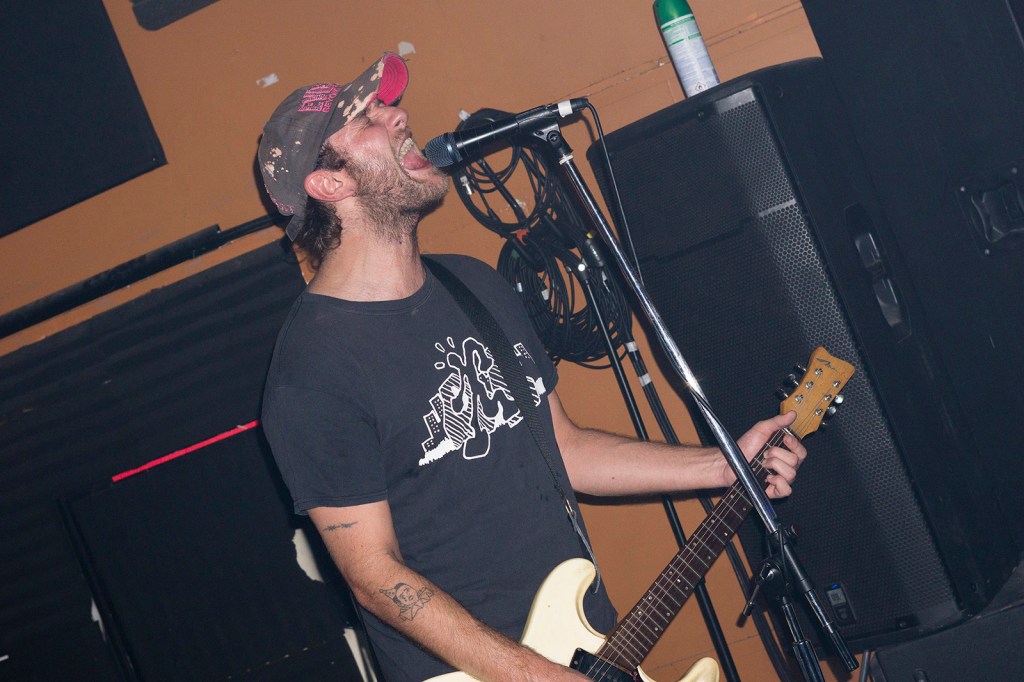
It’s been a full-on week for you. You’ve had tonsillitis, undergone surgery, gone through a breakup—and one of your heroes, Dennis from the MC5, passed away.

GEORGE: Yeah. I held a heavy service for him at my house. I’ve been playing the MC5 all day. I stepped outside and walked down a couple of houses—you could hear it [laughs]. They got their play today! Like that quote, ‘When I listen to Led Zeppelin, my neighbours listen to Led Zeppelin!’

[Laughter] Nice. Have you always lived in Meanjin/Brisbane? 

G: Oh no, I’m from Mount Isa. 

When did you move to Brisbane? 

G: When I was seven or eight.

Do you remember much from growing up in Mount Isa? 

G: A little bit. It’s a tough place, but it’s pretty nice. 

Tough in what way? 

G: A lot of fights and stuff like that. You learn how to defend yourself. When I moved to the city, it was much different, kids wouldn’t be fighting at all. 

One time in Mount Isa, I was in this sand pit, in Year 2, and this kid was punching me in the head, he had me on my back and then suddenly he ran away. I thought it was because he just had enough, but there was actually a red belly black snake slithering up next to him—that was wild. But I’m glad I grew up in the country. 

How else was coming to the city different for you? 

G: It was cold. Even in Brisbane, it was so cold, to me. I also felt like people were a bit more judge-y down here. In Mount Isa everyone was poor, man, so no one really cared about what shoes you wore or what toys you had. Everyone was just going through it. But, when I came to Brisbane I got like made fun of ‘cause I didn’t have Nike’s or the cool shoes or whatever.

How did you first discover music? 

G: My mum always played music in the car, like Carole King, Powder Finger, stuff like that. On my sister’s 16th birthday she got a record player and my dad got a couple records for her, one from The Strokes.

I don’t think you hear it as a kid and go, ‘Oh, this is music.’ But the more I listened to it, the more I was captivated by what you could do with production. It’s an art form. They put so much wacky stuff in that album, and that’s why I love it so much. Then, I really got into The Beatles. 

In Year 5, I got a SoundCloud account. I’d go on SoundCloud in the computer lab at school because my mom is a principal. She got a good job, which is why we moved here to Brisbane. I didn’t know it at the time, but I was listening to weird versions of songs on SoundCloud. I was really into David Bowie, Green Day, Talking Heads, and—oh, I can’t remember his name—he’s a rapper [Ludacris], and he raps something like ‘Move, bitch, knock out your lights.’ I was really into that. A bit of Dead Kennedys too, because my dad’s a massive fan. I’d find these remixes and bring them to my parents, saying, ‘Oh, I found this cool song by Talking Heads,’ and they’d listen and say, ‘Oh, we haven’t heard that version before.’ It was some weird remix [laughs].

By Year 7, I had a phone, and that let me go on Spotify. After then, it was over—I couldn’t stop.

Sorry if I sound a bit foggy—I’m on oxycodone at the moment.

No probs. Hope you have a speedy recovery from your surgery.

G: Thanks. Also, my dad was so big into punk—he was always trying to push it onto me. But I’ve always been really into gangsta rap. My dad gave me this massive CD case, and in it was all the Public Enemy, N.W.A., Ice Cube, and Tupac stuff. That’s what got me into band music, because I was really nervous about singing. When I’d practice, I would rap Tupac, which is kind of cringe now, but at least it got me singing. It’s still a main influence of mine.

That’s awesome! We love hip-hop too, we both grew up on it, as well as punk and all kinds of music. I’ve been binging on Tyler the Creator’s Igor album.

G: Cool! He has a lot of beautiful stuff. I really love his first album, it was more shocking. I love stuff that can be shocking.

I’ve been getting into a lot of depression-esque classical. I was just listening to the classic radio channel in the hospital. I thought, oh, why not just listen to music while I’m here? I can’t stand TV ‘cause it has ads. Even on my phone, I switch off the sound and colour when ads come up. So, they can’t even get me with the pretty colours [laughs]. I wish classical songs had better names, though. I’ve been listening to a lot of Charlie Chaplin and classical instrumental stuff. I listen to music every day, it’s a journey. I’ve got a big wall, a sort of shrine dedicated to the Germs in my room. 

I know one of your other heroes was Blues musician, Lightnin’ Hopkins. 

G: Yeah, big time! I got onto him through Parquet Courts, that’s one of the first probably rock bands I was really, really into because my sister got their stuff on vinyl. They were doing a record plunge and were talking about Lightnin’ Hopkins. I already liked a lot of Texas music, so I thought I might like his—it blew me away. Not only his guitar playing is a really big influence on me, but the way he makes stories too. I like a lot of Blues music, but Lightnin’ has the most character, which is all that you really need. 

All the music, like we were talking about—the MC5, Germs, and also The Stooges—seem to have big characters that you’re really drawn to.

G: Yeah. I’ve always been into dressing up and creating characters. I was thinking back to a novel I just made. I used to make comic books when I was little and make up my own superheroes. One was called The Iron Butterfly—it was purple and yellow, which, looking back, I think is a dastardly arrangement of colours for a superhero.

It works for the Los Angeles Lakers! That’s cool you create across different mediums. How did you start playing music yourself? 

G: I wanted to play the guitar so bad when I was in primary school, but at school when you get to choose an instrument, they try it out on you and then they like pick one for you. I tried guitar and they were like, ‘No, it’s too big for you.’ It annoyed me so much, and now kids can go on mini guitars. They could have given me one of those but they gave me a 12-string acoustic guitar, which is obviously gonna be too big for a nine-year-old, so they gave a clarinet. But then I got demoted to percussion, not drums, but random miscellaneous percussion—‘cause you can’t fuck that up much [laughs]. 

Photo: Jhonny Russell.

Ha! 

G: I think that was good for me.

You like to paint too, right?

G: Yeah, I’ve been really enjoying painting again, because I just got a full -time job so I haven’t been able to paint as regularly. It’s so relaxing but I’m doing this dot painting right now it is pretty arduous. I was known as an artist at school but I wanted to do music—that’s so much cooler. I said to my parents, ‘I’m not going to make art for two years. I’m going to see what this music thing does.’ So I did that and I thought I’d probably never go back to art but then I came back to it this year. It’s so much fun. I forgot how much fun it is! 

Did you get into painting through school or was it an interest you found outside of school?

G: I used to work at Kmart in Chermside, and they had these art supplies. I’ve always done art at school and elsewhere, but not on canvas. I always thought canvas painting was a bit superior, because it’s different to drawing. While working at Kmart, restocking the shelves, I’d always see stuff and want to buy it. One day, I got a bunch of art supplies and set up my own studio in my room.

I like mob paintings; I like to do that style, and tie it in with optical illusion stuff. My grandma’s from Dharug, but there’s no connection to Country because she was stolen from her family.  

I didn’t know you were mob too!

G: Yep. But I don’t know much of where we’re from, it’s hard to connect, because my grandma was moved from Parramatta to Perth. And they made her be like a white person. 

I’m sorry. Same happened in my family. Disconnection from Country and kin is real. It’s a hard thing.

G: Yeah. It’s hard to connect. In Mount Isa, most of my friends were Indigenous too, but when I moved to Brisbane kids would ask me, ‘What percentage are you?’

If you’re Indigenous, you’re Indigenous; there’s no different levels of Aboriginally as some people think; and it’s definitely not defined by your skin tone or appearance.

G: It’s the way you walk the earth and taking care of your surroundings.

It’s—who you are. Its community, the Ancestors too; in lore, everything is connected.

G: Yeah. At one stage I wanted to be a lawyer. I was top of my class at my old school, but I got kicked out and moved to a different one. The teacher was so mean, she wouldn’t even let me go to the toilet when I needed to. I would always eat cereal at the beginning of the day, and I’m lactose intolerant, her class was at the start of the day, so I would always need to go to the toilet. I dropped that class, and joined Music in Practice class, which is not actual music theory. 

Me and the drummer wrote a version of Green Day’s ‘American Idiot ‘ but it was school-based, we called it ‘Kedron Idiot’. We had so much fun doing it, we thought, ‘Making songs is so much fun!’ And we’ve been recruiting band members ever since.

We were kind of a rap punk thing to start off with because I was so into Eminem at the time. I actually had an Eminem haircut. [Laughs]. It was very, ah, very… something. 

[Laughter]. It’s okay, dude. I actually knew a lot of guys that had that hair cut ‘cause they loved Eminem. It was a whole thing. 

So you mentioned that you got kicked out of your first school; how come? 

G: For fighting mainly. The first school I went to from seven to nine, I got bullied heaps. They actually called me, Shmuel, the boy from that movie The Boy in the Striped Pajamas because I had a buzz cut and big ears. It was quite cruel. 

I’m so sorry that happened to you. Kids can totally be cruel. I copped a lot at school too, so I know it can really hurt.

G: Yeah. People would kick me in the back at school and then somehow I’d be the one in trouble and I’d have to apologise to them for making a big scene. I was under the tuck shop block one time, I didn’t have a hat on but I was undercover, and the teacher came up to me and was pressing me a little bit, and I wasn’t having a good day and I came up in his face and pushed him. I got expelled for that. He said he could have charged me with assault but I was only like 11! He was a 40-year-old man. So I went to another school.

Another time, someone was picking on me and I brewed on it, sometimes I don’t really act in the moment, I plan on things. This kid beat me up one day, and then the next day I came in with a bike wrench and hit him over the head. He almost died—that was a wake-up call. At the time I was very violent. I was taking boxing lessons. My stepdad was a steroid junkie, so it was a very angry household.  

I just never liked school. I’m so happy I’m out of it. 

Same! I used to get into fights too. My dad and my brother taught me how to fight and defend myself against bullies. I was always getting in trouble. One day a “friend” called me the n-word and kicked me, bruising my leg bad, because she was losing the game we were playing. And then I ended up in front of the class with her being made an example of, and the teacher produced a photo from his Africa holiday, of a black hand shaking his white hand, and I had to shake the girls hand and we had to apologise to each other.

G: Was this in the 90s or something?

It would have been 1989, I think. It’s interesting how being bullied can shape you.

G: Yeah. 

Did it inspire you to gravitate towards art and music, to help express or process stuff?

G: I think it has pushed me that way. When I was in Year 12, I really got into punk. I found out about Henry Rollins and Ian MacKaye. I shaved my head and every day I would listen to SSD, Teen Idles, and Minor Threat. I’d walk around with this angry look on my face. I was so angry. Once I heard about anti-cool music, I just frothed it. 

What helped you to become less angry?

G: I’m actually reading a Hindu book at the moment, so things are very peaceful. I’m not violent. It’s a book by Srila Prabhupada; a kind of 10 Commandments on how to live your life. I’m yet to read the Bhagavad-Gītā; I got a copy for $20.

There’s something really nice about painting, but it can be a worst enemy at times too. 

In what ways? 

G: Sometimes I go too hard on a painting and stay up for days and days.Then I get super paranoid about things. I think sometimes the urge to create can overrun your psyche.It can be the thing that saves you or the thing that ruins you. Look at [Vincent] Van Gogh [laughs].

Where do you feel you’re at lately creative-wise? 

G: I’m just having fun because it’s not becoming my job. I think that’s when it really affects you. Whenever you’re going through something really bad, creativity helps you through it. But whenever I’m doing good, I’m like, ‘Oh, I should be creating more.’ But what I’m creating then isn’t very good.

You mention in correspondence that you had some news; what is it?

G: We just got picked up by a Wild Wax and we get to go tour Europe in 2025!

That’s exciting! We’re so stoked for you!

G: We’re so excited too! When we got off last weekend’s tour, I felt like going back on the road again straightaway—it’s an addictive thing.

Photo: Jhonny Russell.

Have you traveled much? 

G: No, not at all. We’re very, very inexperienced. We haven’t even been to Naarm/Melbourne. 

That’s okay, I’m sure you’ll get there. Not everyone can get to places, especially with how expensive things are right now. You’re going to Europe in a while, and that’s rad!

G: Yeah! We’ll be in Germany, France, and Finland, are the main ones. We’re not going to UK, though, so no Bovril sandwiches [laughs]. I’ve been using that joke a lot! I’m a big prankster, down to the soul. 

One of my earliest memories pranking was, my dad, he was a fly in fly out worker. I used to scare him from behind the car. I’d sneak out and hide behind the bushes and then when he turned off his car, I’d go under the car and then scare him as he got out. 

I just love pranks and shocking people. It makes sense as to why I would pick this genre of music to play.

Is that why you called your band, Shock Value? 

G: Exactly. We were going to be called The Shakes because I have nerve damage and I shake a lot, but I didn’t think it was a very good name at all. I got nerve damage because I fell from the top of a spider web [climbing net] at the play park. I’ve always been shaky since.

Oh-no. I’m sorry that happened. How did everyone in the band meet? 

G: George [SV’s former drummer] and Christina are from the music class I joined. We didn’t really play together for a long time until Isaac introduced himself to me; he plays guitar now. It was at one of the all-ages substation shows, and I had that awful Eminem haircut, he could spot me easily [laughs]. I really wanted to be his friend because he was so cool. I went over to his house to ask to borrow an amp, but I wasn’t actually going to use—I just wanted to hang out with him. I’m sure there were other ways I could have asked, but it seemed like the only logical way to me at the time. We went to hang out in his shed, and as soon as I walked in, I saw all his stuff everywhere and thought, ‘Wow, this guy’s into everything that I’m into—the same art, the same bands, the same movies, the same books. I’d just finished reading Junky by William Burroughs, and he had it pinned to his wall! 

Photo: Jhonny Russell.

Can you tell us something about each person in Shock Value? 

G: We’re sort of like a hive mind at this point, a well-oiled machine. We know what ticks each other off and what doesn’t. I don’t think we’ve ever really had a big fight. It’s like Christmas day, you act how you need to act for the presents to be given to you. 

We’re all big readers. Me and Christina like horror books. She’s a big knitter and likes to crochet.

How did you start doing the Project Punk all-ages gig stuff?

G: No one would book us, so I had to. My friend Kaleb was putting on gigs. I had no idea what to do, and it’s not like it was my idea or anything — people have been putting on gigs forever. What makes it even more unoriginal is that I stole his whole website and copied and pasted it to mine, but just changed the name. I told him this, and he was fine with it — even down to the ticket link and all the stuff on the tickets. That made it so easy. But, obviously, I did my shows differently to him; I just copied all the hard administration work [laughs].

Kaleb does Casualty Records too, right?

G: Yeah. I think he’s gone into 18+ gigs now, which I don’t know how it’ll go with all these venues shutting down. 

We used to ask him for shows so much but we were a bad band, there was no hiding it [laughs]. We knew we had to play gigs to get better—we’ll bite the ball. 

One of the first Shock Value shows was at the the LBNP Centre?

G: Yeah, where I’m doing my art gallery. It’s a great place. There’s actually a documentary on it. 

Rest In Peace?

G: Yeah. I was watching that the other night. I didn’t watch it all, it’s hard to watch. 

I thought you made made some good points featured in it. You said something like, ‘at shows you can have fun but don’t ruin other people’s fun.’ 

G: It’s something I took out of the Bible. I’m not religious whatsoever. I just really like reading. 

I don’t like the whole hardcore thing. I’ve never really been into, like, doing that circle thing, and tackling other people. I think a mosh is way better—it’s more passionate. I went to see DRI and there were so many Nazis there. They were all doing that hardcore thing, flexing their guns and sieg heiling. They were pretending to punch people, it was so lame. Stop like pretending that you’re so tough, just go away. It’s old men trying to relive the old days.

Nazis can fuck off! Some for the most interesting music and art out there right now is being made by people of colour. Another point you made in the documentary was if people were thinking of starting a band that they should just do it. And I love how you said, ‘I want you to succeed.

G: There’s not enough rock n roll bands these days. Rock n roll is so easy compared to other stuff. There’s too many shoegaze bands in Brisbane, it’s so, so sad. 

I liked how you’re supportive of others. I think sometimes when you’re in a band and it starts to get successful or seemingly successful to other people, some people get kind of jealous and they try and tear you down rather than uplift each other. 

G: There’s always going to be that. It’s a long way to the top, if you want to rock and roll [laughs]. It’s such a good song. So true to. 

I saw with the Project Punk stuff that you were coping a lot of hate recently.

G: Yeah. It’s just 14 year olds. It’s annoying. I don’t really want to be doing too many more gigs if it’s like that, threatening me. It’s just a headache. People were threatening to do stuff, and I don’t want to get the police involved. Especially Brisbane police, they find a way to mess everything up and scare as many people as possible. 

Hopefully they’ll grow up and realise how lame they’re being. I’m sure they’ll get bored of harassing you soon enough. We first met you at a Project Punk show at the sub station, last year, on your 18th birthday. It was really cool to see that so many people showed up to the gig.

G: Yeah… it was the Unknowns show. I’d been wanting to book them for so long. It sucked that the fucking mics weren’t working. I bought a Piss Shivers LP off you that night. That’s basically all I remember. 

I’ve stopped getting so drunk now. I had a bad period recently where I’d been drinking red wine every day, from dusk to dawn. Some bad stuff happened, and it was a wake-up call. I’m trying to control myself a bit more on stage because I think alcohol makes you lazier and a worse performer. It’s hard trying to be total chaos and then trying to control it as well. There’s a thin line you have to walk.

It’s interesting because I’ve been watching drugs come back into the scene and heavy drinking, and in turn shit behaviour. I’m not against drugs and alcohol, people can do what they want, but it’s been breaking my heart to see friends go down bad paths. People in bands I know, have OD’d recently but luckily they survived. I saw a friend from a band recently, and when he turned up to the venue he was his normal lovely self and then after some drinks and whatever he turned into a total jerk, wondering around like a zombie, smashing glasses and trying to fight the band that was playing. People have problems in their life and rather than facing them and doing something about it they numb themselves, zone out, and self-destruct. I don’t want to lose any more friends to that stuff.

G: Yeah. I had an altercation with my friend the other night because when he gets drunk, he gets really drunk and he speaks his mind when he’s suffering. He was getting up me because, I have another band and like some people in the band, they’re not very agreeable to him. He was getting angry at me because he thought that I like didn’t like him because these people didn’t like him and he punched me in the middle of a Domino’s when we were getting pizza. I was like, ‘Fuck. Dude!’ I didn’t do anything back. I was just like, ‘Don’t punch me! What the fuck? I’m your friend.’ I’m never one to retaliate because I’ve learned that lesson. But fuck, it was hard not to. I was so embarrassed because the Domino’s lady laughed at me. I had to go sit outside because I couldn’t do anything because it would make him more mad. I just had to sit there. I hate how alcohol affects some people. It’s 20/20 vision, I guess. It pisses me off, you can advertise it in gyms and hospitals, but marijuana is so illegal. I guess, it’s becoming less illegal but you still gotta jump through hoops to get it. It’s a plant! 

Photo: Jhonny Russell.

Shock Value’s debut album, was released on Christmas Eve. 

G: We just wanted to have an album in 2023 and then another one in 2024. We’re going to release our next one mid-year. It’ll be more blues-oriented and it has a small storyline. We have three songs—‘Angry Joe,’ ‘Iron Joe,’ and ‘Tibetan Joe.’ I feel way more proud of it because it’s so us. The first one is like Saints’ style punk rock, but this is more Little Richard meets the Germs. I’ve been working on more melodies too, like the Beatles and Carole King stuff. We’ve got a second vocalist, which really complexifies the choruses. Having a couple of voices makes it more interesting.

I love bluesy punk. That’s a big reason I loved Pale Horsey so much. I’m still sad they broke up. 

G: Cordell from Horsey is recording a cracker of an album right now on a cassette 4-track in his basement. When I first saw Pale Horsey, that was a big, big change for me. It was seeing something different in real life rather than seeing something on a Youtube video. Cordell taught me that you can do whatever and no one really gives a shit. 

That’s exciting news! I’ve been waiting to see what he does next. Have you recorded the new album yet? 

G: No. But we’ve got the Nepo baby set up, though. So my uncle—I just found out after we recorded the first album that he has a studio; he has two supercars parked in there. He’s mega-rich. My family isn’t rich, but he is. He’s got the Channel 10 News mixing desk from the ’70s. It sounds so good; like any rock album recorded before 1990. We’re going to have the drums isolated on this one, so there’ll be more bass and cleaner drums. I’m honestly just waiting for my hair to grow a little bit longer to release the album [laughs].

You should go back to the Eminem style. That’d be funny.

G: And pigs fly. I’m never cutting my hair again!

Where do you write most of your songs? 

G: I always write the words, and about 30–40% of the time, I make a guitar riff for it. Most of the previous album consists of songs that I wrote on guitar or bass and then made words for. I used to write them at school, on the bus, and sometimes at home after a concert or something. I find it helps with making guitar riffs and lyrics. I used to really be into taking stories from books and making them my own to write a song. But now, I don’t know; it’s organic. I feel a rhythm or hear a rhythm, and I sing it until I can make some words. Then I make another set of words, and I maybe think about what the song is going to be about and then get the chorus down. It all starts from very ‘50s and ‘40s stuff. But it’s hard. I find that if I’m in new places, I write the best songs. I always like going on walks, that helps.

Is there any songs from your first LP that remember writing while walking or being out and about? 

G: The only one I’m distinctly thinking of is I was in class. And wrote ‘White Bliss’. I was at uni in Media Training class. it was for my Music & Songwriting diploma. I don’t really hold a lot of attachment to songs anymore. Like Ed Sheeran says, ‘Once I write a song, I sort of don’t like it anymore.’ 

‘White Bliss’ sounds very bad, I know, but it’s not. It’s about this girl I was into who had long white hair and watching her dance. But I was too afraid to talk to her, and then I just went home. I got a song from it, though. I developed a story—what lust does to a man. I just finished watching the movie The Witch, and I tied that in. It’s about this pretty girl with long white hair who attracts this man out to the forest, and for lust, he’ll do anything. Eventually, she leads him into her cave and reveals herself to be this old, demon-like woman. So basically, it’s about how far a man’s mind can be taken by lust. But a lot of people think it’s about white people, and I’m like, ‘Shit, man.’ But the first lyric is like, ‘long white hair.’ We copped a lot of hate for it, people thought, ‘These guys are Nazis’ [laughs]. White supremacists are dumb, because everyone comes from Africa.

Photo: Jhonny Russell.

There’s a lot of reasons why white supremacists are dumb!

G: One formative thing in live music for me: I always wanted to go to a strict Christian camp, like a summer camp, because I thought I would meet cool, rebellious teens there. But I went to Hillsong. No parental guidance; I just went there myself. I went on this camp, and it was so lame. I thought I would be scared straight, but it was more free love—free love unless you were in another religion [laughs]. It was a kids’ festival sort of thing.

They had this really interesting thing like King of the Hill, but you had to put detergent on your body. There was water and tarps everywhere, and you were genuinely beating kids up. It was on a pile of couches, and you would fall down pretty far. I don’t know who signed off for that, but they could have gotten hurt pretty badly [laughs].

It was good, but I already knew what music I liked and what music I hated because they would play Pop music—really bad Hillsong stuff. I didn’t mind it, but the music? I thought it was going to be gospel, which I like, but no, not at all.

We have some piano on the new music but he can’t do tours yet, because old mate’s only 17 and his mum won’t let him. But she will let him go to Europe when we go.

You mentioned early that in social situations your sometimes feel awkward, and I know that you’ve said early on, you felt nervous singing; do you get that now?

G: I don’t really get nervous. It’s something that I really want to do. I never really get to express myself in a normal day. All I want to do is scream and roll around on the floor, but society has forced me to have a job and wear clothes.

You make music and paint, is there any other kind of mediums or that that you’d be interested in trying? 

G: i’ve been trying pottery. I’ve just found a clay deposit under my house. I was just digging one day and found 100% clay, pure stuff. I’ve been processing that, it’s very arduous and a lot of labour but it’s fun. I like work with my hands. No one can tell me what to do—I’m the master of my own trade [laughs].

I guess, working with your hands to create, is something where you get to have some kind of control in your life. 

G: Yeah—that’s deep! [laughs].

Follow: @shockvalueband. LISTEN to Shock Value HERE.

Gimmie Records new release!!: piss shivers

Original photo: Jacob McCann @blokeyoucantrust. Handmade collage by B.

Today we’re excited to announce Gimmie Records’ second release, the highly anticipated self-titled debut from Meanjin/Brisbane punk duo, Piss Shivers – Caleb Stoddart (guitar/vocals) and Gemma Wyer (drums). Their raucous on stage energy, which you may have witnessed at their shows supporting Amyl and the Sniffers, Civic, The Unknowns, C.O.F.F.I.N, Mini Skirt, and Arse, has been captured in a 16 minute and 30 second towering onslaught of explosion of focused fury and wry self-deprecation, by Pious Faults’ Tom Lipman’s live-in-the-room production style. Piss Shivers’ songs are emotionally charged and undeniably raw, manifested from being in one’s own head too much, driven by anxieties, addiction, a tumultuous homelife, and the premature loss of friends. The album has both depth and humour. Jack Mitchell from Guppy guests on the high tension track ‘Rats’ as well as painted the album cover art. The record was mastered by Mikey Young. Piss Shivers’ record unequivocally earns its spot as one of our top picks for Punk Album of the Year, that’s why we put it out.

We first saw Piss Shivers play in 2021 and were in awe of how full and huge they sounded. And, if you read Gimmie issue 5 you’ll already be familiar with them via the chat we featured with them (despite them never having released a song yet) and know that they met at a Propagandhi show, and of Gemma singing with Jello Biafra at a gig moments before acquiring a black eye!

We’re excited to be putting this record out. We love Piss Shivers and hope you will too!!

Piss Shivers finally have music coming out into the world. I know you were sitting on it for such a long time. When did you record it? 

CALEB: We recorded it in November 2021, it’s crazy it’s 2023 now. We recorded it in a National storage shed in Bowen Hills, which is where we currently practise. 

GEMMA: Deep underground. 

CALEB: It’s really tinny, it’s has the corrugated-iron-kind-of-roller-door-vibe. We tracked all the instruments live.

Who recorded it? 

GEMMA: Connor and Tom from Pious Faults. Tom agreed to record us, he’s looking to branch out and focus a little bit more on recording. 

CALEB: He wanted to practice recording so he said he’d do it for a couple of hundred bucks. 

GEMMA: Connor has done, like, audio engineering stuff before, so he kind of helps out, particularly with setting it up, like mic-ing everything and getting the sound right. You can imagine what it sounds like in a storage shed as opposed to a purpose built room. 

Maybe that’s why it sounds the way it does?

GEMMA: It has a pretty massive sound. When we practise there, if we take a recording on our phone, the drums particularly sound massive. That sound translated really well because obviously there’s only two of us, without bass. Having the drums and the cymbals and the big guitar sound fill that and occupy that space. It worked well for our sound. Tom mixed it and Mikey Young mastered.

Photo: Jhonny Russell.

How long did you take to record it? A few days? 

GEMMA: Two nights basically, all live.

CALEB: Then I just overdubbed another guitar. We recorded vocals at Dutch Vinyl…

GEMMA: In, like, a storage room filled with boxes of records. 

CALEB: Tom used to work there. After work I’d come up after the shop closed. 

GEMMA: That’s where Jack from Guppy came as well, to recorded vocals for ‘Rats’. We know, Guppy. We know she’s amazing. We gave her full control over that, and she came in and smashed it. She had a very specific idea of what she wanted.

It sounds pretty hectic. 

CALEB: [Laughs]. Evil or something!

Yeah. What else do you remember from the recording?

CALEB: I got grumpy at Gemma. We had this fight. In one of the songs ‘Hoodie’ when I sing a part it lets me know when I’m going to change, in the recording I thought the bit was going longer. I was like, ‘It’s three times!’ Gemma was like, “It’s four times!” I was like, ‘Bruh, it’s three!’ We were swearing at each other [laughs].

GEMMA: The whole thing was that you kept changing at three but you were counting four. I’d be like, one, two, three, four. You changed on the three. We were having a back and forth. Caleb was like, ‘For fucks sake!’ Tom was just sitting there listening…

CALEB: It was a bit awkward for him.

GEMMA: Tom was like, “It’s actually four Caleb.”

[Laughter]

CALEB: I was like, ‘You’re fucking gaslighting me. I know how it’s supposed to be.’ Then I was like, oh, yeah.

GEMMA: Basically, I’m always right [laughs].

CALEB: Also, we were going to do another bit of tracking and there was a bloke that was sleeping in one of the storage sheds down he was very angry and told us to “Shut the fuck up!” He was bashing on the roller door and we were all like, holy fuck! 

GEMMA: Jack was there, we were going to record her vocals for ‘Rats’.  We didn’t end up doing it because we didn’t want to piss off this guy again. 

CALEB: He went on a five minute rant of ‘Your mum hates you and your grandmother hates you.’ Very psychotic. 

GEMMA: It was really trippy. We were like, everybody be quiet, oh shit, hide.

CALEB: He was yelling. 

GEMMA: You were just warming up. It was so annoying because bands practise there all the time and nobody’s ever had that issue before. People run business out of there and I reckon there’s a few people that live in them.

CALEB: There was a guy there the other day belting it out singing, he must have been playing electric drums because you could hear him banging on something. 

GEMMA: There’s still like a piece of cardboard that I wrote:  hi, we’re just recording music, if you want to talk to us, please knock lightly, that we ended up sticking on the outside of the roller door. 

Let’s talk about the songs on your self-titled debut. What can you tell me about opener ‘Red Stripe’?

CALEB: We wanted to do like more of a hardcore song, like L.A. hardcore. Lyrically, it’s just about being brain dead [laughs]

GEMMA: It’s a common theme [laughs].

Do you write all the lyrics, Caleb?

CALEB: Songs are about alcoholism, drinking, displeasure. ‘Red Stripe’ is one of my favourites to play. 

Do you have a favourite song, Gemma? 

GEMMA: Funny, actually, because it’s sometimes my least favourite to play. I really like ‘Onerous’. 

Why is it your least favourite to play? 

GEMMA: Because there’s this part that fucking every single time… 

CALEB: This is the first time I’m hearing this [laughs]. 

GEMMA: The fill that I do. I don’t know what to call it. Like, the drum roll kind of thing. When we were recording, I feel like we were pretty tight. I felt drum fit. I felt like we had practise so much that we were really ready, but that was the one part that I couldn’t nail in recording. So in the record now, in the first section, I do that fill, I do it properly, and in the second one, I do like a sort of really stunted kind of like half, four notes instead of eight, and it really sticks out to me. It’s so frustrating to listen to. We tried it, like, ten times when recording, and I just couldn’t get it. They were like, “oh, it’s fine, no one will notice.” And now it’s forever on the record. And I’m just like it really gives me, like, a skin crawl. But I think our newest song that we haven’t recorded is probably my favourite to play now.  It’s called the ‘New, New, New Song’ [laughs].

CALEB: I’ve got vague lyrics in my head, but it always changes.


What’s song ‘Onerous’ about?

CALEB: It’s about being stuck in my own head. 

A lot of the album, except for maybe ‘Eyes Off You’, is in that theme. 

CALEB: Yeah. It’s all about being stuck in your head. Getting down about yourself, struggles with lifestyle choices.

Is that how you were feeling when you were writing this collection of songs? 

CALEB: Yeah. I was definitely in a place when I was writing it, coming up to writing the lyrics I wasn’t very happy. 

Was there anything in particular that was contributing to that? 

CALEB:I was doing a lot of drinking and drugs. I wasn’t happy in my work. I had a lot of friends falling out or moving away. That all contributed to that. 

GEMMA: Big time. 

CALEB: Yeah. You just go through the motions. I’m definitely in a way better place now. It’s funny, it’s kind of bittersweet sometimes singing, I want to die! Actually, I don’t want to die now. I have a nice job. I’ve got a cool girlfriend. 

Do you think letting all that stuff out through music, though yelling about it, helped?

CALB: Yeah, it did. It was cathartic. I don’t know if it is now. I feel like I’ve tried to change the way I look at them so I can sing them without being so bummed out.

GEMMA: Being detached a little bit. 

CALEB: Yeah, maybe it’s like, there’s always someone going through that. For me, even when I’m going through a shit time, certain songs stick out. So I’ve kind of tried to change the thing of like, well, maybe I don’t feel like that anymore but maybe if someone else bought the record and heard the songs they’d be like, fucking hell, this is exactly how I’ll feel!

Some of the saddest fucking things I can think of musically, like, a real harrowing song, can really make me happy. You think it shouldn’t be like that but listening to something that’s just so fucking sad and harrowing it can bring joy. 

GEMMA: That human connection, I guess, that you get through knowing that other people experience what you’re experiencing. You feel like, I’m not alone. You’re matching the vibe. Of course. Yeah, I get it. 

Photo: Jhonny Russell.

‘Hoodie’ is a relatable song. Every time over the winter I’ve put my hoodie on I get that line from the song in my head: I want to hide in my hoodie forever.

CALEB: [Laughs] True? When I was a teenager, I would sneak out of home a lot. I just love putting my hoodie on. If I’m walking home late at night I’ll have my hoodie on and it’s like, don’t talk to me. It’s like my safety thing [laughs]. It’s like the headphone trick, no one will want to talk to you.

Tell us about the song ‘Eyes Off You’ that I mentioned earlier. 

CALEB: That song was kind of just like a dumb one that we wrote. I kind of came up with the lyrics on the spot. It was at least something different for us. 

GEMMA: It’s a slutty club song.

[Laughter]

I guess there’s that feeling for everyone, you’re drunk in a gig and you see someone and you’re like, oh, they’re kind of cool. That’s a universal thing too.

It’s a fun song that definitely provides a lighter moment on a dark album.

GEMMA: Yes, definitely. I guess it’s you’re having a dark day, you have a few drinks and go out and have that moment of…

CALEB: Oh, there’s a really cute person over there.

GEMMA: Then you go home and sleep it off…

CALEB: And a few more beers and you’ll be back to it. To “I’ve cooked it”.

GEMMA: The funniest part about song is that when we first started playing it, I vividly remember a time at The Zoo where we started playing it at completely different tempos. That was quite a big gig. And, like, I cooked it massively! 

[Laughter]

CALEB: There’s a bit in the song  where I’m like, blah, blah, blah, because I didn’t want to keep singing it [laughs]. 

What about song ‘Chained’?

CALEB: It’s about [sings] marijuana.

GEMMA: They’re all about marijuana in a way.

CALEB: The first bit is kind of ripped off an Offspring song.

GEMMA: Oh my god, you said you wouldn’t say that.

CALEB: But it is [laughs]. I do this thing where I’m playing and then I’ll sing random words. When playing that song I just had the line in my head: Every day it’s the same… that’s from an Offspring song. 

GEMMA: Shut up.

[Laughter]

CALEB: The other part of the song is about losing someone. The songs have different meanings sometimes, there’s different little bits of things.It’s a fun one to play, its fast.

GEMMA:  I know. We originally called it ‘Mosh’ because we were like, please, someone mosh at our shows.  I feel like that’s the biggest dream of mine, to have a crowd moving. I haven’t really had that before, like, in CNT EVN. You kind of feel like, I guess, it’s not gonna happen. Seeing that movement and that energy in a crowd is the best.

CALEB: The show we played at Mo’s Desert Clubhouse when we played with C.O.F.F.I.N was kind of weird, half the crowd’s these tanned, blonde surfer chicks who were like “raaaaah” “blaaaah” and smacking each other on the walls. It was fun to watch. They were the last people you’d think you’d see going wild in the pit. Such a funny dynamic.

GEMMA: How about those lights? Hectic.

CALEB: They were a bit too much. 

GEMMA: It’s really off putting when you’re playing.

CALEB: It was a bit overkill.

Yeah, the lights were almost like a strobe but it’s just they were changing so fast, like every second. Way too much. It’s distracting from the band and it just becomes not fun. What can you tell us about the song ‘Aren’t Ever’’?

CALEB: When I was younger, my mum was pretty depressed and had a lot of episodes. I feel like I couldn’t talk to anyone about it. The line: You aren’t ever going to believe it… crying in the night and screaming or whatever. I often get up really early and watch Rage, from six until I was in high school. I’d focus on that and zone into the TV when all this shit would be going on around me. 

Music has been really helpful in your life, an escape? 

CALEB: Yeah. I just didn’t think that, well as a young person, I was ten, you couldn’t really talk about what was happening and no one in the family ever really acknowledged it. The second half to it is getting into the mischief. There’s a period, a couple of years ago, I had a friend overdose, and one go to rehab. Then sometimes I’d have to go to work and be like, oh, I have a nice job… like you don’t know what someone is going through.

GEMMA: As a teenager you are totally egocentric. You’re focused on your own identity and working out who you are and your whole being is sort of inward focused. Then you get to the stage where you understand a bit more about yourself, are more confident in yourself, and you can start to look outwards. I guess, start to observe those things in other people and think about it like the iceberg. You see a tip of someone’s experience. Their behaviour is that outward thing, but what’s underneath? You have no fucking idea. It’s better to give people the benefit of the doubt all of the time. No one really wants to be horrible, no-one wants to be mean. I’d like to think that we’re all doing our best, but some people have a lot of shit going on, I guess. 

We touched on it earlier; what can you tell us about song ‘Rats’?

CALEB: I had rats in our house for a little. The lyrics speak for themselves. There were some people that I worked with and I was like, yeah, you’re a bit of a rat [laughs], you talk shit behind my back. I was like, what else can I associate with rats? Rats in my work. Rats in the phone. Rats in my house… 

Jack has a pretty unique style, like how she screams in Guppy. I was really happy with it.

GEMMA: It makes it more dynamic.

Gemma, would you ever have a go at doing Jack’s vocal live if she couldn’t be there?

GEMMA: Sitting behind a drum kit feels really safe to me, but, like, vocals are such a it’s just you, it’s not you in an instrument, it is all you. It feels so vulnerable and really scary to me. We’ve tried to practise but I’m uncoordinated and it’s hard to sing and drum. Watching Ben from C.O.F.F.I.N, I’m like, fuck! It’s wild. He’s so good.

Album art by Jack Mitchell.

Or like when Jake Roberston plays at speed in SMARTS and sings.

GEMMA: It’s wild! Maybe is I was a more confident drummer. I used to get sick before we would play. I would feel so nervous, not even consciously. Say if we had a gig on a Saturday, on a Thursday I’d start being like, oh, I don’t feel too great. I’m feeling really jittery, I’m feeling really irritable, whatever, not feeling good. I’d realise on the Saturday when I was sweating bullets and freaking out and be like, fuck. I’ve been really nervous this week about the show. Performing in front of people was really, really big for me. So I think having the drunk, it’s almost like the barrier, I like being behind that. It’s my little fortress [laughs]. The vocal part really freaks me out because we there was a point where we lived together when we made an electronic thing…

CALEB: I was making beats and really wanted to do a Crystal Castles project. I still do.  I really wanted a femme voice to scream and be distorted over the top of this track. I got Gemma to try and do it.

GEMMA: I had to make him just go outside. He couldn’t even be in the house when I was doing it. So no vocals for me at this stage.

We super love song ‘Energy’!

CALEB: I met this person who was like a Ritalin child, heavy Ritalin child. He went off the rails and fried his brain. I thought that was an interesting concept. Amphetamines and frying your brain.

Musically, when we first started playing, I really wanted to be a Danzig-style vocalist, cos I love the old Misfits songs. I stopped doing that. I think ‘Energy’ was kind of in that vein. I feel like I just yell everything now [laughs]. In recording there’s more dynamics.

Was that kind of intentional? 

CALEB: Yeah, I definitely want to have that in the recording, but when I’m playing live, I get so nervous. It all comes out on stage.

GEMMA: It’s better now. We used to set each other up, freaking out from nervous. I’d say, oh, I feel nervous and he’d be like, “Don’t say that, now I’m nervous.” 

[Laughter]

We wouldn’t talk all afternoon so we didn’t freak each other out. 

CALEB: That’s when we first started playing. We haven’t played much together.

GEMMA: It’s started to feel good. Playing is something that I’m actually starting to look forward to. It feels like a bit of a build up and a release. I never really understood when people said that before. People would be like, “I love getting up there. It’s so much fun.” I’d be like, you’re fucking crazy! That is a crazy thing to say. But now I kind of get that. It’s that adrenaline rush. You go for it and then afterwards you’re riding that adrenaline wave. 

The last song on the album we haven’t talked about yet is ‘Gold Chains’. 

CALEB: ‘Gold Chains’ is a song that we wrote together. 

GEMMA: With a bottle of wine in COVID, sitting on the backstairs.

CALEB: Let’s write a song about this guy who’s…

GEMMA: Selling drugs [laughs]. 

CALEB: He just quit his job and dropped out of school and he’s got a gold chain and is still doing it, but it’s like nothing’s going right. There’s a slight narrative there. 

GEMMA: It’s the cheesiest song. The only song I’ve had any lyrics put on is of course rubbish lyrics.

[Laughter]

It’s like, what rhymes with chain? Good direction! 

CALEB: Co-writing lyrics is a fun thing to do!

Piss Shivers launch their album next Saturday August 12 at The Bearded Lady, West End. Get tickets HERE.

Get Piss Shivers’ debut self-titled album from Gimmie Records HERE.

Doggie Heaven’s new single ‘Haircut’: “A bop that you can dance that pain away to”

Original photo by James Caswell. Handmade mixed-media collage by B.

Dynamic Meanjin/Brisbane based pop duo Doggie Heaven pull from well-worn paths of new wave and post-punk to create a freshness with their expressive and magnetic sound. There’s twinkling magic offset by emotional lyrics with bite on latest release double single Berghain / Haircut. We’re premiering song ‘Haircut’ today. Gimmie caught up with vocalist Isobel and multi-Instrumentalist, producer Kyle.

How did you both first meet?

KYLE: We met back in early 2020, at a call centre we both worked at. We were both stationed in different sections of the office, so we didn’t actually interact with one another properly until we bumped into one each other at rave one time.

Did you grow up in a creative family?

ISOBEL: Not particularly, although I definitely have a lot of music enthusiasts/snobs in my family. Growing up, my mum, uncle and I would have discos in my living room with blankets covering the windows listening to weird electronic music. Mum is mental for Bjork. My Granddad is super into his rock and jazz so I spent a lot of time listening to records with him from a young age. I was basically not allowed to listen to pop, which is ironic because I love cheesy pop music now. 

K: No, not at all, although my grandad was a professional jazz musician. I think he even released a few albums, though, I’ve never been close with him/ had much to do with him.

Is Doggie Heaven the first band/musical project you’ve been a part of?

K: yeah pretty much, but I’ve been producing music alone for years without ever releasing it. 

I: I was in a punk band a few years ago that never really amounted to anything unfortunately. I never imagined myself making music until that point because I was basically just a huge drama kid who loved to write and perform and didn’t (and still don’t) know how to play any instruments.

What made you want to make music with each other?

I: Kyle and I instantly bonded over our love of New Wave music from the 80s and I think we just balance each other out really well in terms of our creative approaches and skill sets. Kyle is incredibly good at all the things I have no idea how to do. Without him, I would probably just be doing terrible stand-up comedy or something.

K: Yeah, I think me and Izzy clicked pretty quickly over our shared taste in music. Even beyond the new wave and 80s stuff; we both listen too many styles and genres and are always sharing new discoveries with one another. Aside from that, after meeting Isobel I very quickly learned how fun and unique she was. I remember her telling me she could sing early on, but even before we’d ever sat down to jam or whatever I knew there was something special about her; and then yeah, shit just kinda worked/clicked immediately.

Doggie Heaven’s name is a Simpsons reference; do you have a favourite character or episode?

K: Yes it is, haha. I love the Simpsons so much. I was raised on that shit. Tough question, I couldn’t tell you what my favourite episode is, but my favourite character is Mr. Burns.

I: There are too many brilliant episodes… but I definitely always go back to the episode where they go to New York. Mr Burns is for sure the best character, but also Marge is so hot and I love her sexy voice.

We’re premiering song ‘Haircut’; what inspired it lyrically and musically?

I: ‘Haircut’ is the tortured tale of having a crush on someone when you have an anxious-preoccupied attachment style. You just want to feel butterflies and excitement, but it’s clouded by an overwhelming feeling of stress. Having said that, this is undoubtedly a bop that you can dance that pain away to.

K: I did the instrumental for haircut around this time last year. I wasn’t really sure what our sound was supposed to be yet, (and we’re still figuring that out!) But I remember I was defs inspired and listening to a lot of 80s pop and new wave tracks (which you will still find me doing regularly). Think Madonna, Tears For Fears and New Order etc.

‘Haircut’ along with song ‘Berghain’ is out as a double single 7” on Colossus Records; what can you tell us about the cover art image?

I: So that’s a photo of me when I was around 6 years old dressed as Cruella Deville from 101 Dalmations. We thought it was very fitting for our band name. Photo credit to my Grandma, Margaret.

You’re launching your release soon; how do you feel when performing? What was the best or worst show you’ve ever played and what made it so?

K: I used to be a little nervous at first, but now I really enjoy getting into it and try to put on a show. The way I write/record music is maybe a little less traditional than your typical band, I kinda just sit down and record every individual part, layering everything as I go. And there’s also no real limitations when you’re in a studio environment, I can sit down and just do a hundred takes on a part to get it right if I have to. So it can get kinda tricky when It comes time to translate it all to our live show, especially when the part I’ve written is outta my reach skill-wise. I think I learned pretty quickly that I’m not at all the musician I thought I was in terms of discipline after performing regularly. Huge wake-up call there.

Hard to pick a best or worst show; a bad show can be a fun show and a good show can be a stressful one. It’s what you make of it really, and I’m just happy to be here. I think they’re all great. 

I: I’ve been performing basically my whole life so as cringe as this sounds, I think I feel a lot more comfortable on stage than I do off it. I would definitely agree with Kyle in that a bad show is kind of fun and hilarious. There has been a couple of times that we’ve played in front of like 5 people and we really just let loose and had a laugh. Obviously it’s just such a beautiful feeling to perform for a full house who are dancing and know some of the words though.

Photo: Jhonny Russell.

What excites you the most about music at the moment? What have you been listening to lately?

I: I’m loving discovering local music at the moment. There’s nothing like turning up to a show and not knowing what to expect then being blown away! Some local acts that I’m obsessed with would be Square, Scraps, Verity Whisper, Guppy and Naaki Soul. 

K: I just loving writing new music. It’s so fun and fulfilling. It never gets old. I’ve been super into Show Me The Body’s new album, Alex G’s new one and also Dry Cleaning’s!

What’s your most precious possession?

K: I would say my cat but he isn’t exactly classed as a “possession” lol. Probably my bed or something. Idk. I really love sleeping. I would sleep more if I could.

I: I have this Teletubby toy that is the most munted thing you’ve ever seen in your life. She’s been mauled by a dog and out clubbing to the valley a few times but still going strong.

What’re you looking forward to and what’s in the works for Doggie Heaven in 2023?

I: Super keen to get an EP out soon. Our sound is already developing a lot and we can’t wait to show you how much it’s grown! 

K: Looking forward to taking our live show interstate and maybe overseas. The Doggie Heaven EP is half done, aiming for a late summer – early autumn release!

Doggie Heaven’s Berghain / Haircut out now via Colossus Records – GET the digital version HERE & the 7” vinyl HERE.

Doggie Heaven launch their double single tonight (Friday Nov 18) at The Bearded Lady in Meanjin.

Grungegaze sludgepop trio Terra Pines: “Love, Burnout, Escapism” 

Original photo courtesy of Terra Pines. Handmade mixed-media collage by B.

Meanjin band Terra Pines are dropping one of the albums of the year and we’re premiering it! Dynamic arrangements, elastic overdrive, atmospheric production, sugary harmonies, melodies washing over you in pulsating waves, glorious crescendos—this is the stuff that dreams are made of. Gimmie caught up with Terra Pines to get insight into making album Downbeats

What’s life been like lately?

KELLY (guitar/vocals): Life has been pretty interesting adapting to this post-plague world. We are about to go on tour again and I’m definitely feeling the “Will everything be cancelled” anxieties.

CAM (drums/vocals): It’s kind of a weird time to be in a band. Getting some momentum into being active again has a been a bit of a challenge.

OWEN (guitar/vocals: I’m really excited that we’re finally getting to put these songs out. It’s been a long couple of years. 

Is there anything that’s been engaging you lately that you’ve been watching, listening to, or reading lately?

KELLY:I’m going through a phase of listening to a lot of music at the moment. Enjoying the new Sasumi record Squeeze. Also really excited for the new Gilla Band record- the two singles ‘Eight Fivers’ and ‘Backwash’ have been superb. 

CAM: Count me as another who is very excited about new Gilla Band. Also listening to the relatively recent Springtime and Infinity Broke records a lot. Low’s ‘Hey What’ is still getting a lot of play for me, too – such amazing production combined with Low’s usual quality songwriting. There’s been lots of really good local stuff, too, like the A Country Practice album from last year and the upcoming Renovators Delight album.

OWEN: Both Cam and Kelly’s other bands (Spirit Bunny and Ancient Channels) put out records semi-recently that I really enjoyed, and still listen to. The new Infinity Broke, Tropical Fuck Storm and Springtime records are all favourites of mine.

New album Downbeats is your second LP. You were putting finishing touches on it in January 2021; when did you start writing for it? How did you get into writing for this record?

KELLY: I’m always writing so I’m not sure if there was a point that kicked it all off. There are some songs on Downbeats that predate a lot of the songs off our first record. Songs like Sun Spells for instance (the album opener). It didn’t fit the first record and we weren’t sure what we wanted to do with it or even if we would do anything with it for a while.

CAM: There was probably a little break after the first album before we started working on things as a band. There’s usually a pretty big backlog of unused demos and song ideas that we can work on, so it’s great to be able to cherry pick the best ideas that get us all excited. From memory we had the vast majority of the album pretty well planned out before we started recording, maybe there might have been a song or two that was added in late in the piece (and perhaps knocked some other songs off the record, I think we’ve got another three or four somewhat completed songs that didn’t quite make the cut).

OWEN:I think we started with 16 rough ideas, 13 of which were recorded. And as Kelly suggested, sometimes they don’t fit the general direction of the record. Hopefully they’ll get used later on. There’s still good songs predating the first record that haven’t fit either album.

How did the writing evolve as you went along?

KELLY: We basically wanted to pick up where we left off at the end of the first record. The final songs on that record had a lot more layers and textures and were a bit more stylised. We wanted to explore that a bit more, I like to think about ‘Downbeats’ as more of a studio record. 

CAM: We just wanted to push ourselves a bit more, try a few new things and experiment a bit more with song structures. A lot of the first album was us figuring out what we were as a band, so with this one we had that base already established so we could play around with things a lot more right from the get-go.

OWEN: There’s way more lead and less walls of guitar on this one, which left a lot more space for vocals and other things to come through. 

Did Covid or the pandemic impact Downbeats

KELLY: Definitely, we had mostly finished recording a few weeks before covid hit Australia. That absolutely messed with our momentum for a while with the stop/starting of the economy.

CAM: Yeah, things came to a screeching halt in 2020. We were almost finished with all of the tracking for the album, but weren’t quite far enough along to really get stuck into mixing etc. It took a long time for us to regroup and get things finished. Luckily once we restarted our enthusiasm for the songs was rekindled.

Did you have any ideas of what you did or didn’t want to do on your sophomore album?

KELLY: We didn’t want to make the same record again and we wanted to incorporate different sounds, ideas and atmosphere. Speaking for myself, I wanted to really cut the fat and have a really sharp record, all killer no filler etc. In order to do that we had to cut a few songs but I’m glad we did that.

CAM: Refinement and progression from the first record, really, with a few new twists thrown in. We wanted to try to add a bit more non-guitar instrumentation, which is something we started playing around with towards the end of making the first album. And as Kelly said, just making sure that songs didn’t meander or outstay their welcome, that they were always moving towards something.

Where does your love of melody come from?

KELLY: I’m a slave to melody so if there isn’t a nice hook I’m gone, bye! I’d say most of that comes from the music I’ve consumed throughout my life. Hooks are what resonates with me among other things. 

CAM: As much as we’re a noisy, shoegaze-punk kind of band, we’re also a pop band. We want to add as much beauty and catchiness as we can to the feedback and fuzz. That tension between the extremes is a major part of what makes the best Terra Pines music.

What kinds of stories are you telling listeners with your lyrics in this collection of songs?

KELLY: A lot of these songs were written in 2019 so most of the lyrics are in response to what was going on around then. Some songs are inspired by the bushfires (‘Pinos Altos’ and ‘Indoor Kid’). Some are about love, burnout, escapism etc… I like to keep things a bit vague, lots of imagery and metaphor. I don’t like to be explicit in what I’m talking about. Classic Pisces. 

Why did you choose Downbeats as the album title? 

KELLY: The title worked on a few fronts for us, the gloomy nature of the record but also as a musical reference. We thought it was cool.

CAM: We had the pseudo- title track ‘Downbeat’ for quite a long time, it was one of the first songs written for the record and I think the first one we started playing live regularly. We kind of liked it as an album title but thought it might be a bit much, perhaps a bit too blatant to call a moody rock record ‘Downbeat’. Making it Downbeats gave us the double meaning.

The record was self-recorded again by Cam at Incremental Records. Tell us about the process. 

KELLY:It’s such a privilege to have the engineer as part of the band. To begin with we recorded live demos in the studio in order to get the structure of the songs solid. Structure was something we thought a lot about this time around. When we got around to recording the songs we took our time and played around with sounds.It was lots of fun.

CAM: It’s also just practical. It allows us time and it saves us money, plus we felt like we hadn’t really explored the limits of what we could do in that context with the first album. The first record was recorded almost all live, at least in terms of the drums and guitars. There’s actually not a lot of overdubbing on that record other than the vocals, some keys and a smattering of extra guitars here and there. This record, while not necessarily being THAT much more layered than the debut, was recorded more piecemeal, building things up from the drums, guitars, vocals, etc. It was just a different way of working that allowed us a bit more time to focus on individual parts and sounds. We could take the time to vary the sonics a bit more.

How did you push the boundaries of creativity for yourself writing or recording Downbeats

KELLY: I think we thought about the songs a lot more this time, the first record was all instinctual at least from a writing perspective. This time around a lot more thought went into structure and tone. I also spent a lot more time trying to workshop vocal melodies.

CAM: For me, I came into the first album very much as just being ‘the drummer’ – all of the songwriting was done by Kelly and Owen back then and I was just support for their ideas. I don’t think I was even going to be singing at first, that really only came about once we started playing some shows and we realised that it worked better if someone could harmonise with Kelly’s vocals. It wasn’t until towards the end of writing and recording that album that I started collaborating on songwriting. With this album there was a lot more workshopping the songs as a band, the songs were often coming in a little bit more skeletal than on the first one and there was a lot more room for adding new parts and really playing with structures and melodies. We were able to do some cool things like on the song ‘Pinos Altos’, where none of the choruses are played the same way twice. Just cool little unexpected changeups where previously we might have played things a lot straighter.

OWEN: There’s always things in the original demos that we’re trying to recapture, which presents its challenges, especially if the part is off the cuff, like most of the guitar solos tend to be. 

What do you value about each other personally and creatively?

KELLY: I love the way Owen plays guitar, he doesn’t play like anyone I’ve ever heard. The way he accents notes and his playing style is so out there to me! As for Cam, I love his ideas around structure and his extensive knowledge of music in general. I’m glad we all get on personally because that would be very uncomfortable if we didn’t.

CAM: There are definitely some brutal truths uttered between us when writing and recording! We’re all working towards the same goal though, to make something which excites us. I think we’re one of those bands where we’re really a mix of each of our musical personalities, if you swapped any of us out it would be quite a different thing. I think showing your musical personality can sometimes be a challenge when you play a style that’s hidden behind so much fuzz and volume. Kelly and Owen have such unique ways of playing and writing, generally I’m just trying to slot myself in amongst them in a way that holds it all together – in all of my other drumming projects I don’t really play drums the way I have to in Terra Pines, I’m usually a lot looser.

OWEN: They’reboth great singers, and I like that this record has allowed that to shine through. 

Downbeat’ was the first single released from the album back in October of last year; why did you choose this track to kick off sharing this album to the world?

CAM: It just seemed like a good indication of the record, and it has a good chorus and a cool momentum throughout. We’d been playing it live for a while and it had been getting a good reaction so we just went for it.

What influenced the album track sequencing?

KELLY: I think the sequencing selection happened organically, we all arrived at more or less the same conclusions based on flow. Certain songs just make sense as openers, closers and everything in between.

CAM: When we were listening to the demos we had a playlist order that over time became the album tracklisting. Along the way we added a few newer songs which meant that some others got bumped off, but for the most part that demo playlist stayed relatively consistent. I think for the most part there was mostly a consensus between us, and there were some songs that just seemed obvious, eg: starting the record with ‘Sun Spells’ and also starting side B with ‘Pinos Altos’. A couple of songs were maybe a little contentious in terms of their placement on the album, I think there was maybe a little bit of debate about closing the record with ‘Nightshade’?

OWEN: I’m pleading the fifth on this one hahaha 

How does the album make you feel? 

KELLY: Chuffed! 

CAM: Really proud. I think it’s a cool record, I still listen to it occasionally from front to back for my own enjoyment, even after spending hours and hours recording and mixing it. I think it sets up a real mood while still going to lots of different places, which can be a challenge with the style of music that we play.

OWEN: I’m super proud of it. It improves upon all the elements of the first one, and that’s all you can ask for really.

What’s one of your personal favourite moments on the album? What do you appreciate most about it? 

KELLY: My favourite moment on the record is Wiseacre. It nearly didn’t happen because I didn’t want to go there. It was an old demo we had lying around in the dark recesses of our google drive. The original demo was faster and more post-punk in nature, Cam had the idea of slowing it down and making it more doomy. I’m glad he convinced me because now it’s my favourite song on the record.

CAM: That’s happened twice now, I’m pretty sure Kelly’s favourite song on the first album had a similar story. I think my favourite moment is the changeup with the alternate chords in the final chorus of ‘Blood Moon’, I really like the way that it makes that song feel really epic. There are other cool moments though, like the outro of ‘Indoor Kid’, or the solo in ‘Downbeat’. ‘Wiseacre’ is indeed a favourite, we were trying to turn it into a bit of a slowcore song, like heavy Low or Codeine. It turned out really well, I think it’s my favourite song production-wise.

OWEN: Nightshade’ is definitely a highlight for me. Kelly’s vocals set such a mood. I really like where ‘Wiseacre’ and ‘Green’ ended up as well. Both of those songs changed considerably in the recording process.

Album art and single art features buildings and architecture; what was the idea behind representing these songs with this imagery? 

CAM: Kelly had been doing some collages, a lot of which combined superimposed images of architecture combined with these cosmic backgrounds. Owen and I both loved them, so we all went out one day and took a bunch of photos of some brutalist architecture around Brisbane and basically recreated the vibe of Kelly’s mockups but in a slightly higher quality. We just really loved that combination of the rough, monolithic feel of all of that concrete brutalism, juxtaposed against the inherent sense of craft and beauty. Taking that and combining it with the epic scale of the night sky seemed to work well as a representation of our music.

You’re heading out on the road for an Australian tour to support Downbeats; what’s the best and worst things about being out there?

CAM: The travel is sometimes the best thing and sometimes the worst thing. Seeing the beauty of the spaces in between the major cities is wonderful, but it can be gruelling, especially when combined with struggling through peak-hour traffic in unfamiliar cities. I’m not a fan of the lack of sleep that generally goes hand in hand with touring, I like my sleep. But on the flip-side you meet some really cool people, see some really cool bands, hopefully get some time to eat some good food (as opposed to roadside maccas). Probably the worst thing these days is being away from family, so if you’re going to go on tour you’d best make it worthwhile.

KELLY: The food is both the best and worst part of touring.

OWEN: Catching up with mates that we don’t get to see that often, and exploring different cities is always a lot of fun. Eating good food, not drinking too much and getting enough sleep is crucial. Roadside Maccas is acceptable if Lord of the Fries is shut. 

Terra Pines’ Downbeats is out tomorrow (Sept 2) on False Peak Records – order it HERE. Follow @terra_pines and find the on Facebook terrapinesband.

Meanjin band Lackadaisies: “Buy Lackadaisies tape now”

Original photo courtesy of Zang! / Handmade mixed-media collage by B

Indie slacker rock three-piece Lackadaisies (whose members also play in Full Power Happy Hour, Blankettes, Married Man, No DOZ and Camping) released EP Payphone Text a week ago. The EP has the band sounding lucid and at their breeziest yet, and its casual hookiness is hard to resist. Gimmie asked guitarist-vocalist Nathan Kearney, bassist Grace Pashley and drummer Marnie Vaughn about Payphone Text, what makes them nervous, the most romantic thing they’ve done for someone and what other projects they’re each working on. 

When you were starting our as a musician, was there anyone that you looked up to? What was it that you admired about them?

NATHAN KEARNEY: I spent all my pocket money on bargain-bin tapes as a kid and didn’t mind what I listened to. The first act I was really obsessed with, though, was Boys II Men. I thought they were cool as hell and I still do

MARNIE VAUGHN: Patience Hodgson from The Grates, I love her energy, she is so bold and fearless. 

GRACE PASHLEY: I am a big Erica Dunn fan. Everything she does is excellent, such a humble shred lord. One day I hope to play guitar like that!!

As a musician is there anything that you ever get nervous about?

NK: I only have one guitar and it breaks down a bit. Sometimes in cool sounding ways. I worry it’ll cark it on stage on day, though.

MV: Mainly forgetting how to play the drums or the drum stool falling off the back of the stage but both of those things have happened to me and I think I’m ok about it. 

GP: Yeah I get scared to sing sometimes! I’d never played bass before Lackadaisies so there were lots of pre-gig stress dreams about the bass neck morphing into a snake and biting my hand. But mostly I’m fine now!

You have a new album Payphone Text, which was recorded over three weekends in each of your respective homes. Why did you chose to record in several places? What were the pros and cons of making your album that way?

NK: We were gonna do it at Marnie’s brother’s house in Northern Rivers but COVID closed the borders. I woulda liked getting out of the city but the comforts of our own homes was the next best thing

MV: It was a logistical nightmare moving the set up between houses and having to trouble shoot new issues in each house. But the pros were grand, we got to play our own instrument in the place we felt the most comfortable and everyone got a turn at being a the host. 

GP: Look if we had our time again… maybe we would only record in one place! But we couldn’t make that work, and it was fun to hang out in everyone’s houses eating pancakes and curry, lots of coffees. 

EP art by Angelica RW

The title track’s lyrics were inspired by Nathan’s ex-partner sending him a payphone text once when they were away. It takes ages to type one of those on the phone dialpad. If you were sending a payphone text, who would you send it to and what do you think it would say?

NK: To Dad “In town. Can U pik me up” for nostalgia

MV: My best friend is a writer and would probably get the biggest kick out of it. I would say “DIS A PAYPHONE TXT B CUS I LUV U – MARN” 

GP: I’d spam as many people as I could to say “Buy Lackadaisies tape now”

Also, going to the effort to payphone text someone a message is pretty romantic; what’s one of the most romantic things you’ve ever done for someone?

NK: I make things for people I love and people who know me best generally make things for me. I’m not that materialistic and mainly hold onto sentimental items. I’ve been writing songs for friends lately, which is a nice change from writing for/about romantic partners.

MV: I made my partner a scrap book photo album of all the memories since we met. It had a timeline at the front and everything. Also, when I was the front person in a punk band I wrote a love song for my puppy. It was really sweet.  

GP: I’ve written so many love songs about my partner which I think is romantic but I think he might get embarrassed by it… hehe whatever sometimes you just gotta scream it from the rooftops etc. 

Going into the writing for the album, did you have an idea of how you wanted it to sound? Or what you did or didn’t want to do?

NK: I’m most comfortable with 4 track recording and I thought the Lackadaisies record would suit that saturated sound. We drove everything so that it was peaking to get that natural crunch over everything. The last release we just threw whatever mic out and hoped for the best. This time it was more considered cos we had James helping. He’s really clever

MV: Not really, I remember hanging out with Nathan when he first moved back to Bris and talking about playing music together. I really like his previous bands and solo albums so I think I wanted to be apart of something like that but I probably didn’t communicate that very well. 

GP: I was just keen to get our existing songs recorded, we weren’t too precious about it which is pretty standard for us! I think something we definitely didn’t want to do was….pay for it haha hence why we did it all ourselves! Well we did pay James a wee bit but god knows it wasn’t enough for the tribulations he dealt with. 

How do Lackadaises songs often come together?

NK: Fuck around til it feels good. We’re not the type of band that talks about genres or tries to be one thing. Whatever a song sounds like is what we sound like is how I figure it

MV: For me… either Nathan and Grace will bring a song or the ideas for a song to jamming and it goes from there. I’m sure it’s a much more lengthy process for them.  

GP: Nathan is really the genesis for our material. He’ll bring a melody or chord progression and maybe I’ll write some lyrics but more often than not he has a zillion fresh ideas that we try out til something sticks. Its really fun that way (because Nathan does all the work ; )))

Not all bands we speak with do demos. Are you a band that demos? Did the songs change much during the process to what appears on the album?

NK: Phone demoes to remember ideas but if we have a mic out then that seems like serious release territory haha.

MV: We released our first Demo. We were thinking of re-recording the songs for this but we were like nahhhhh.

GP: Haha yeah…again, the lackadaisical approach. I wonder if Nathan finds the recordings demo-ish, he has added a few different parts to some songs once we laid down our tracks and now those new bits are my fave parts of the songs. Like the organ part on Payphone Text, that didn’t exist before we recorded it. 

Photo courtesy of Lackadaisies Facebook.

Tell us the story of one of your favourite tracks on the album.

NK: ‘How’d You Get This Number?’ Is a nod to me and Marnie meeting  playing in bands that did dumb little 30 second songs. The lyrics are about phone scammers who were calling with numbers that looked like mine. I imagined they were bizarro versions of myself trying to make contact, like in a sci-fi movie. It also has a Freaky Friday reference.

MV: ‘The Comeback’ or ‘Payphone Text’ because I get to do screaming and that is fun for me. 

GP: Yeah I love ‘The Comeback’. It’s got a creepy carnival energy, like a house of horrors with the lights on. The story of ‘Your Face’ is about this time when I thought I saw an old flame in the crowd, but it wasn’t him. Just a doppelgänger. But then I got to thinking about how he kind of sucked!! And THEN I thought wow imagine if that was him that would have been awkward. I guess this all happened at the time we needed lyrics to this song. 

J.E. Walker recorded the album; what was one of you the most memorable moments you shared with him during the recording process?

NK: My memory is shot in general but James is a gem. Always a pleasure.

MV: James was so encouraging, he thought everything was magic and it was so nice to be around that energy. 

GP: What an angel. Carted all his gear to three different houses, was an absolute saint when it took me hours to nail the guitar part for Your Face. We were recording to tape so you had to get the whole song right in one go, which is really not a strength of mine. I probably would have gotten embarrassed and quit if anyone else had been recording us but James was so patient and lovely. 12/10 person, j’adore!!!

How did you feel when you listened back to the entire album for the first time after mixing and mastering? Where were you when you were listening to it?

NK: Lying on my couch and looking out the window. I have a cassette deck I bought with my old bandmate, Allie, to dub our old releases and I listened on there. It’s a fun, little album. That’s what we were aiming for so I’m happy. I collect cassettes by local acts too so it’s nice to add something of my own that was also pressed properly.

MV: We had a sneaky listen at Nathans house when the recording / mixing process was happening and that was super exciting for me. 

GP: It was such a neat surprise hearing the album after Nathan had put some really great finishing touches on all the songs, like I said earlier there were a few new parts that he added that are the real heroes of the dish. 

Can you hear any of your influences on any of the songs?

NK: The Breeders. I love them. 

MV: My current influences are Party Dozen, Loose Fit and Petey. I think so.

GP: Maybe less the influences for me, but I can really hear all of us. The blood sweat and tears of DIY tape recording. I feel very proud of it!!

Besides Lackadaisies, what else is happening in your world? I know you have other bands or have other interesting projects on the go.

NK: Camping is my alt-country band with James Walker, Skye McNicol and a few other mates. We’re kicking around and gonna record an album soon.

MV: Yeah, new girl band in the works… Blankettes

GP: Yes me n Marnie started a new band called the Blankettes! With our friend Gemma (CNT EVN, Piss Shivers). I convinced my favourite punks to make a pop (ish) band hehe. And my other band Full Power Happy Hour has a tonne of stuff going on this year too!

What’s the rest of the year look like for both the band and you personally?

NK: Good shows coming up with the band. I don’t think they’re announced yet but we get to play with some sick bands and head interstate. Personally, I’m finishing a horticulture degree and making beats on my MPC otherwise.

MV: Band, I’m hoping to do some little tours with Lackadaisies, it’s been so long since I’ve been on tour and I love it. Personally, I have a toddler that my heart melts for and new job that I’m pretty into, so things are looking good. Thanks for asking. 

GP: I think it’s gonna be busy!! Heaps of music stuff which is great. I am hoping to kick my terrible Tiktok addiction but I honestly don’t see that happening any time soon.

Get the Lackadaisies EP Payphone Text on Zang! Records HERE. Find them @lackadaisies_ + on Facebook and check out Zang! Records.