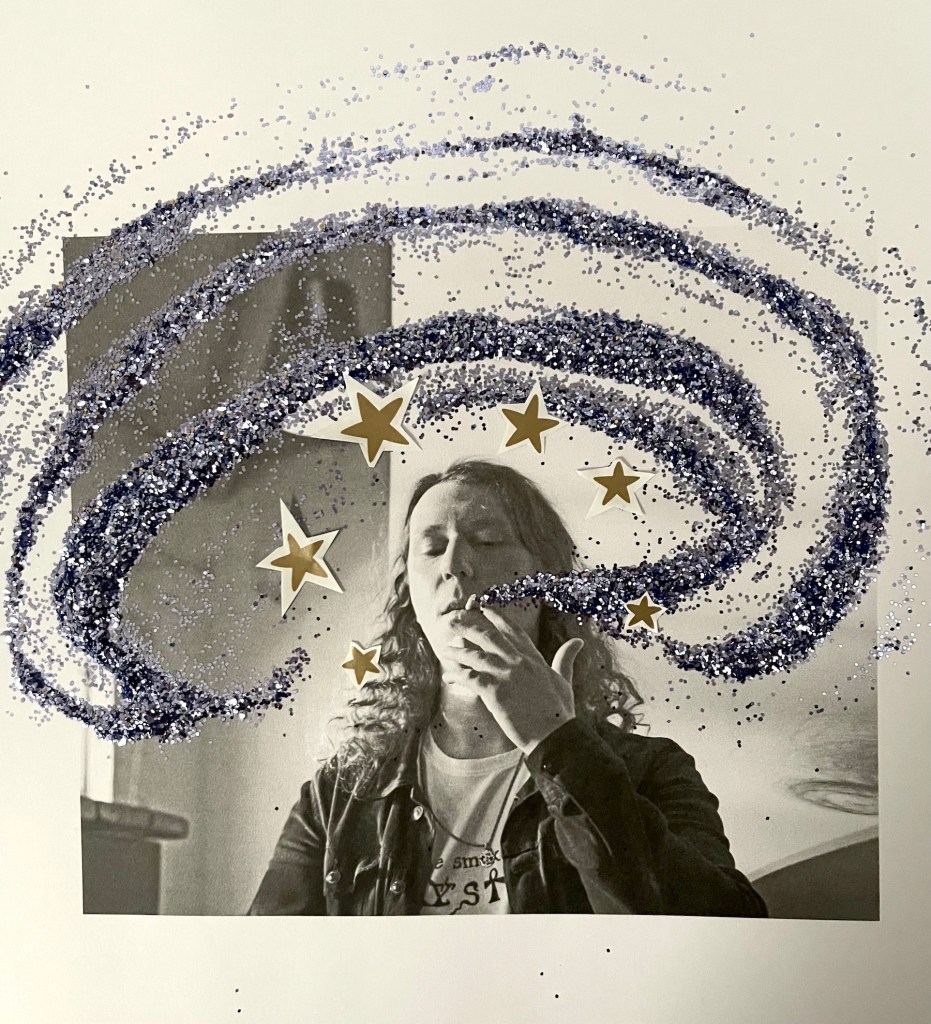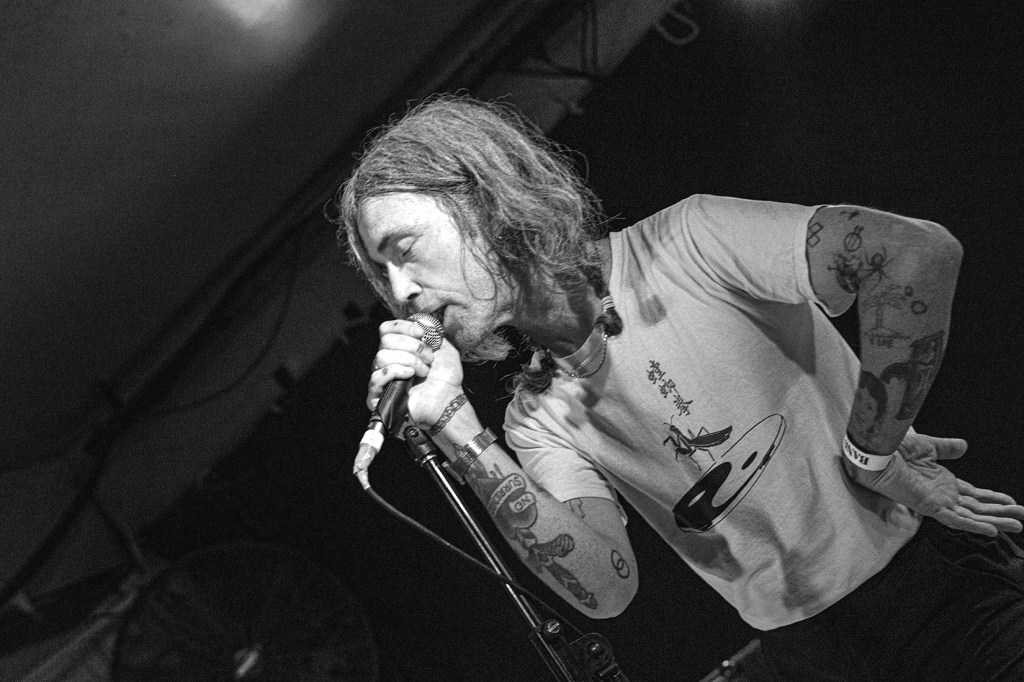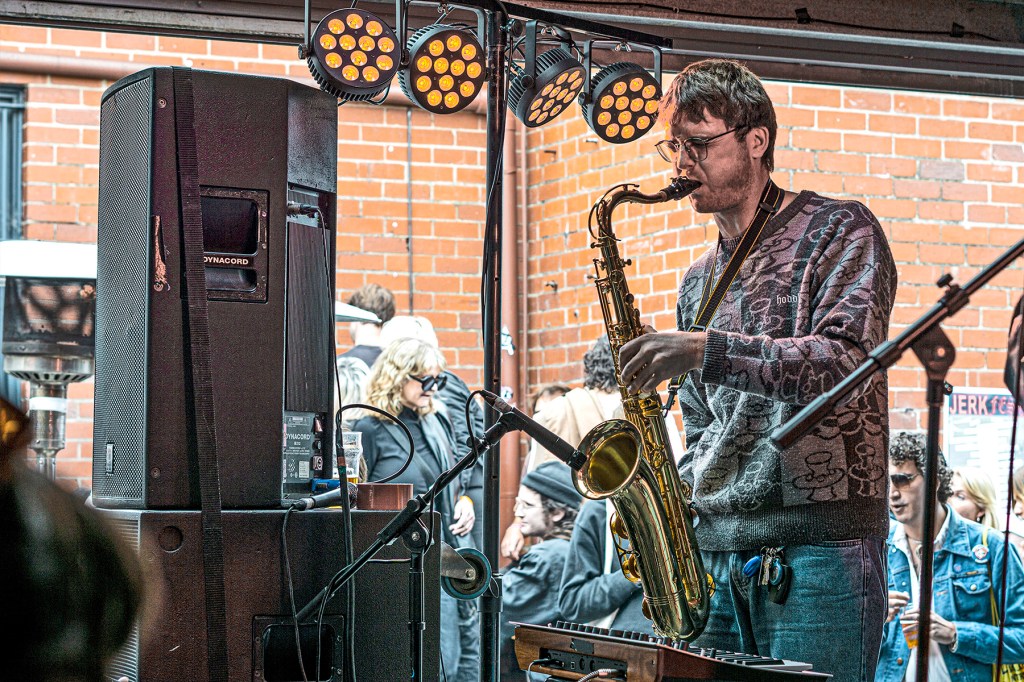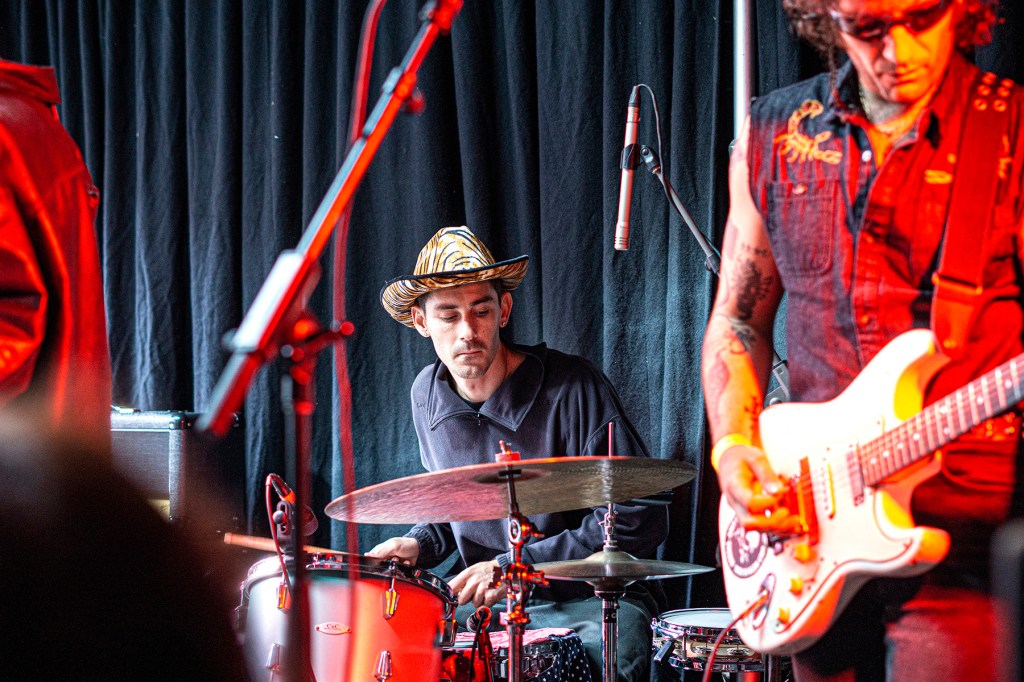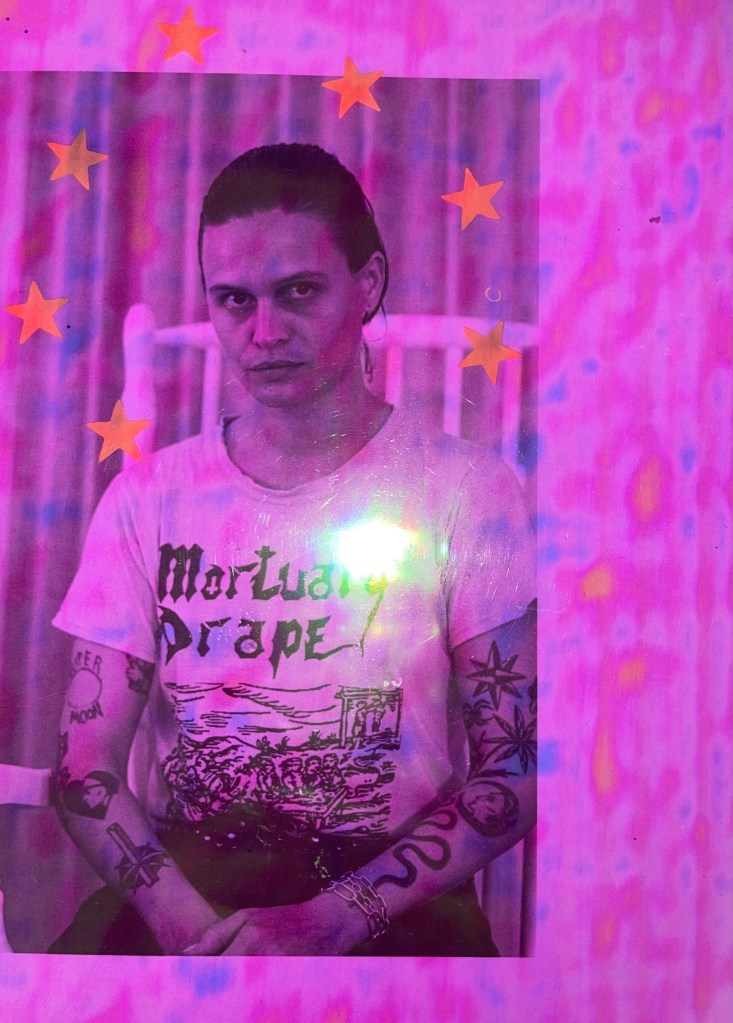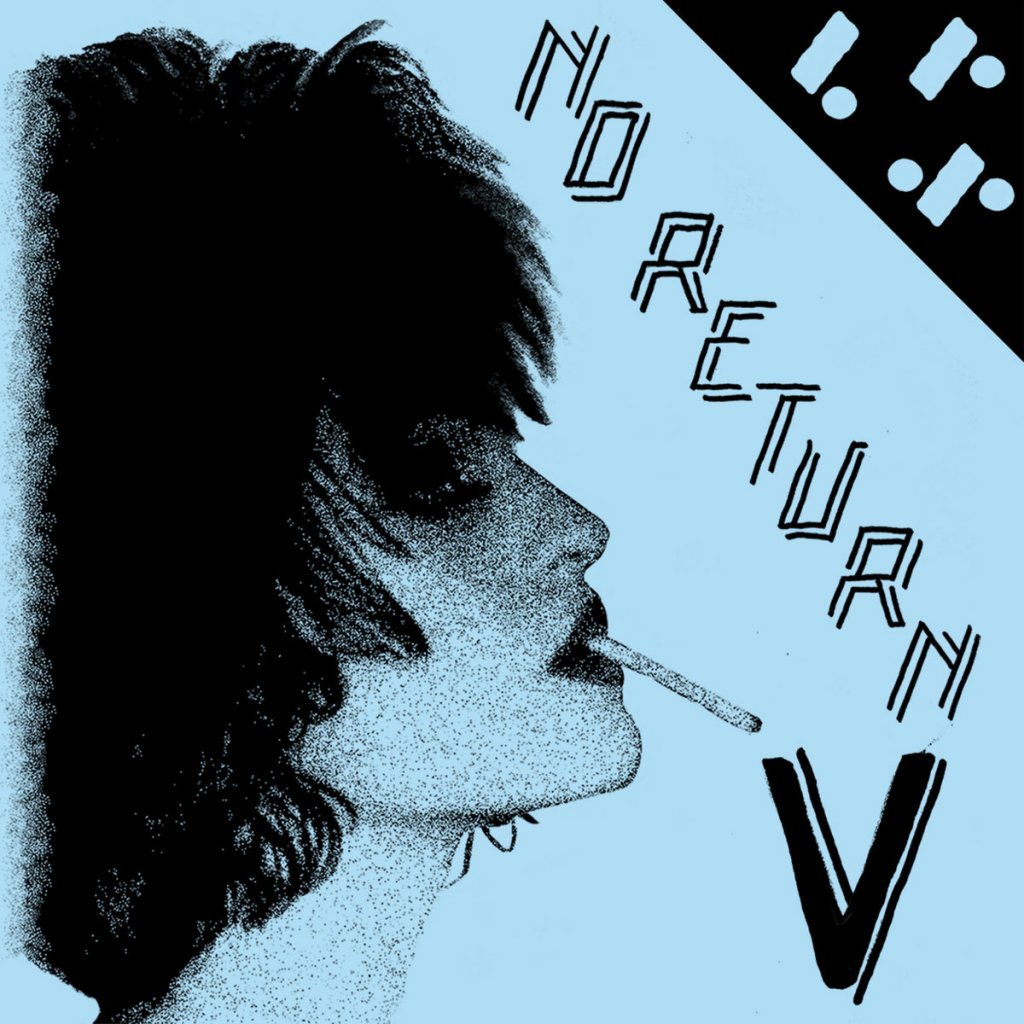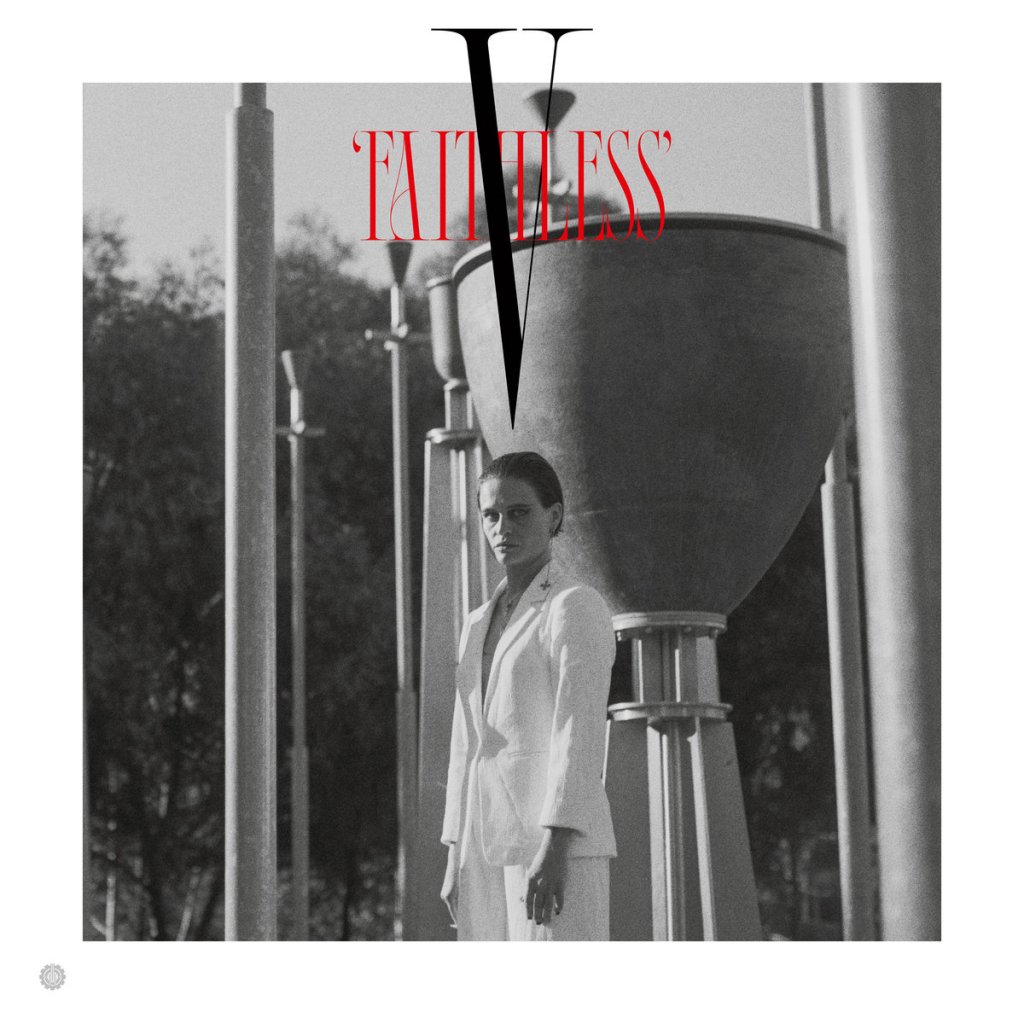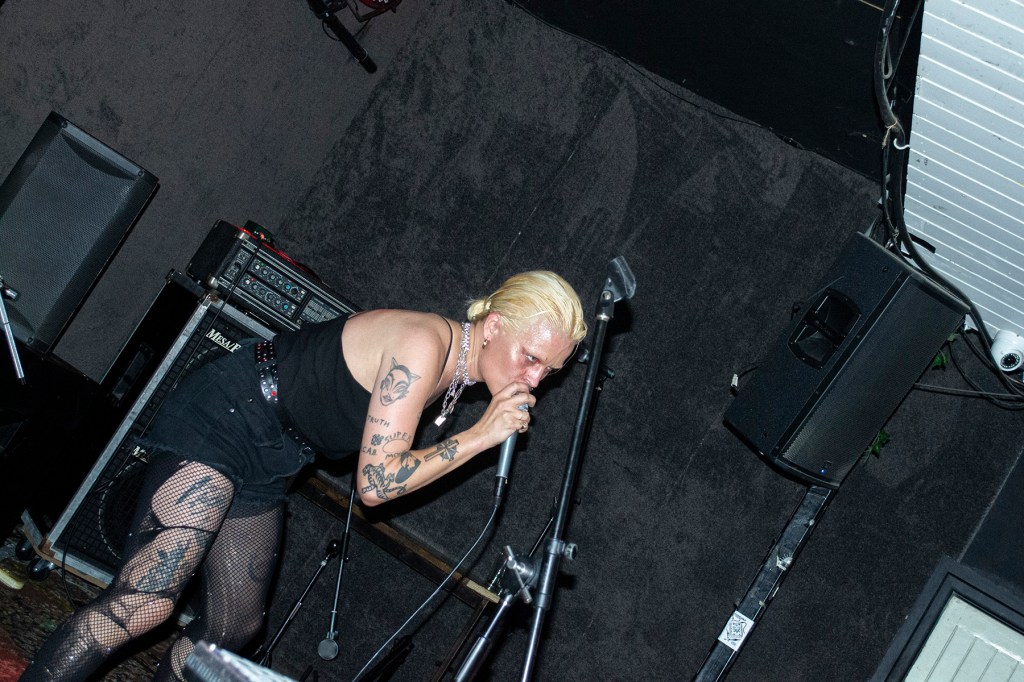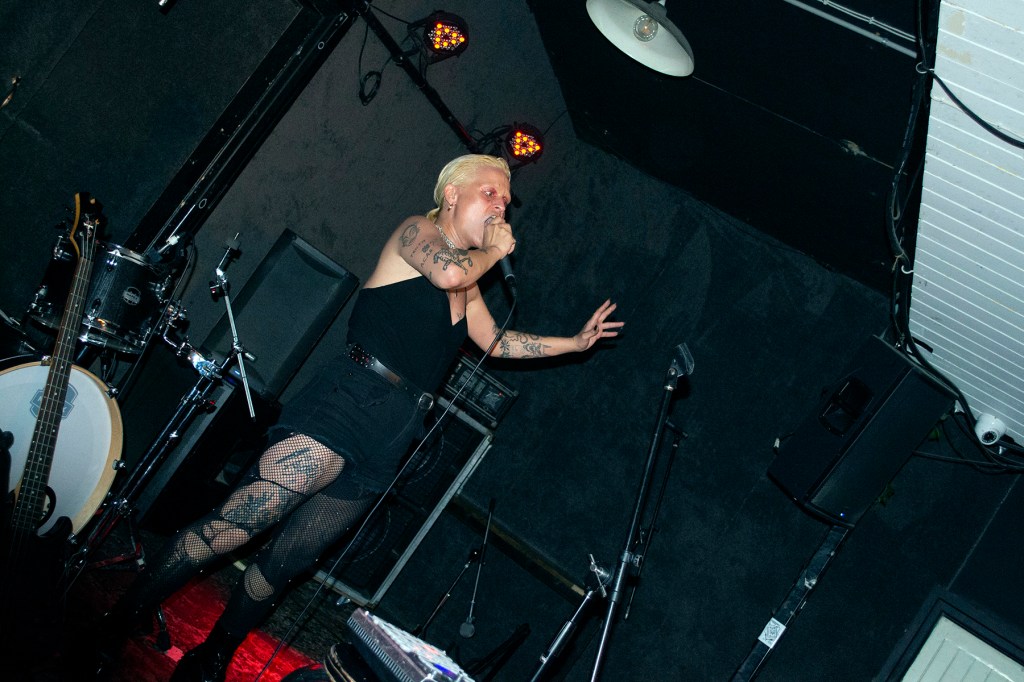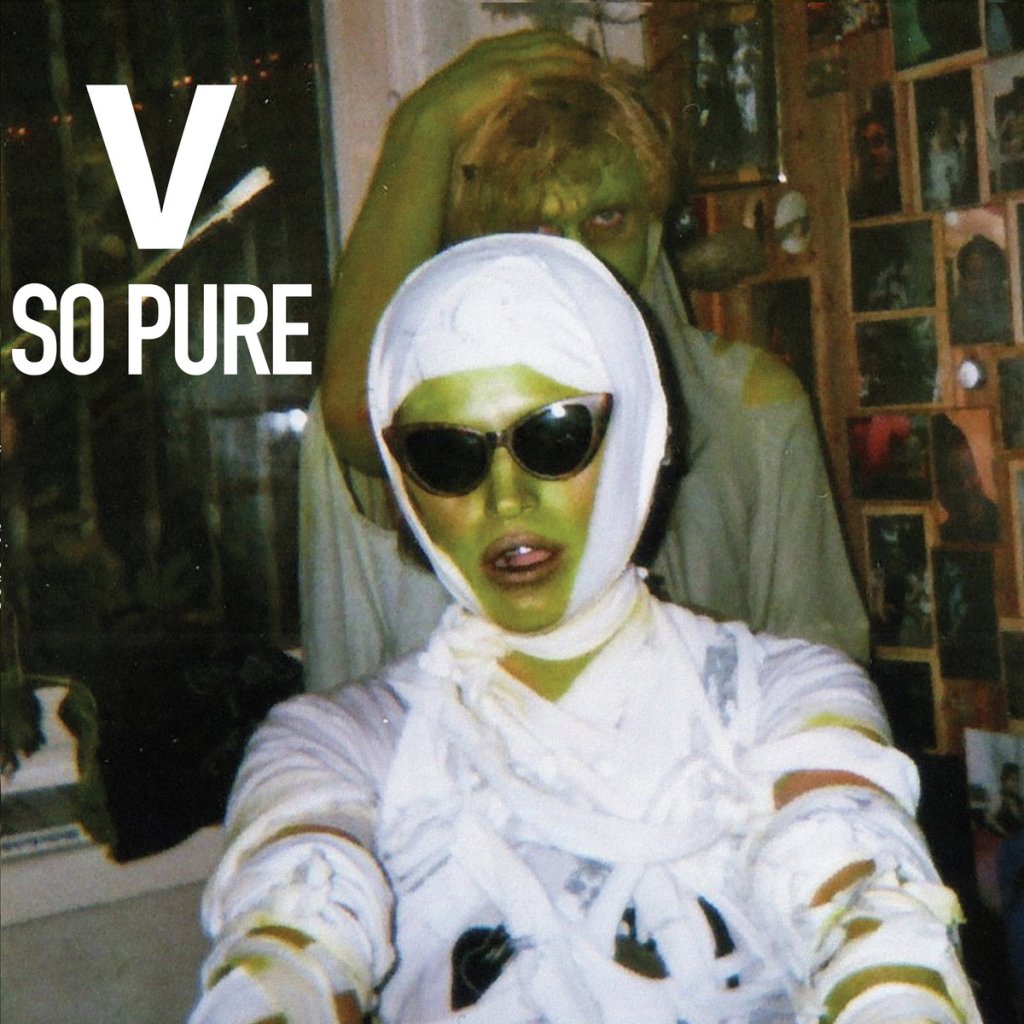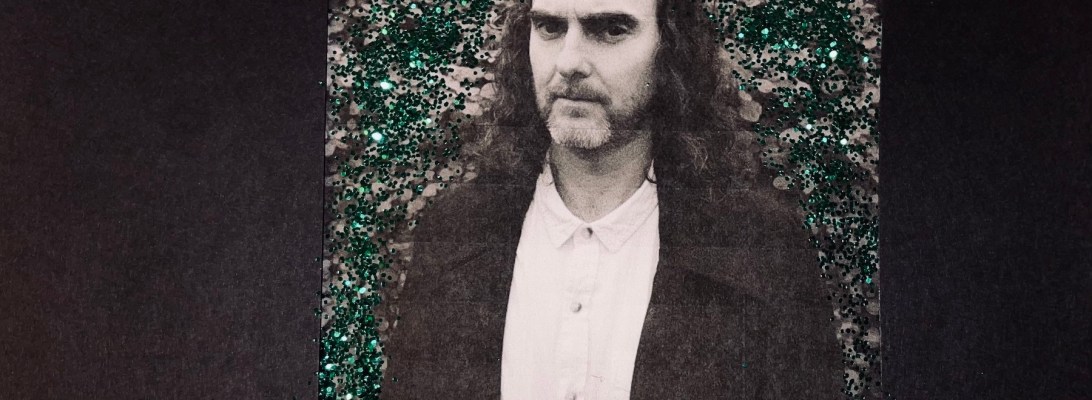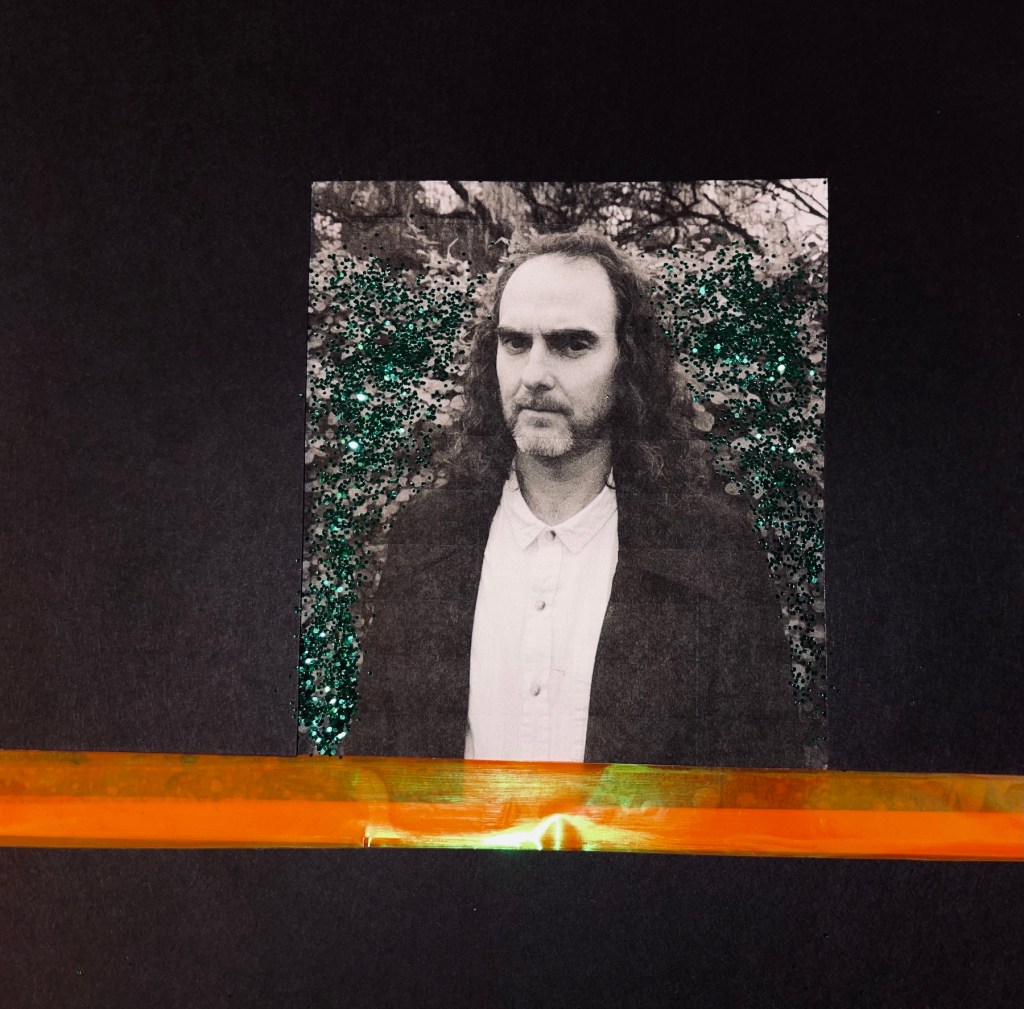
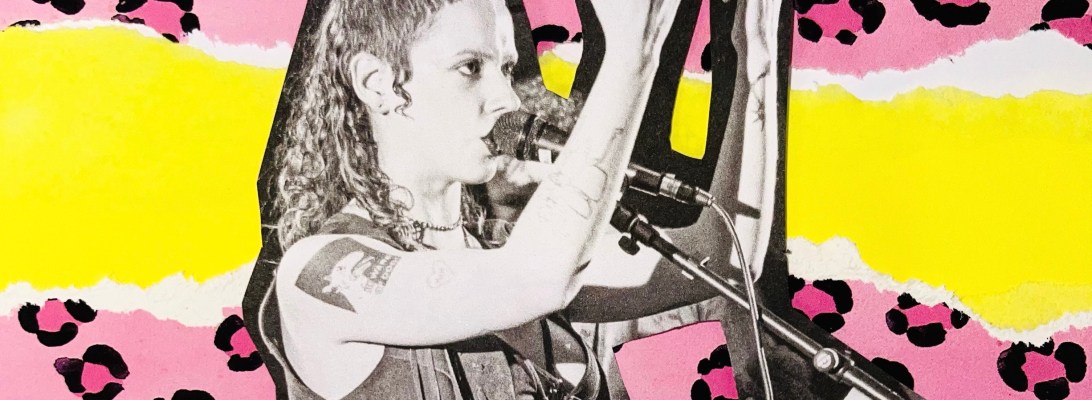
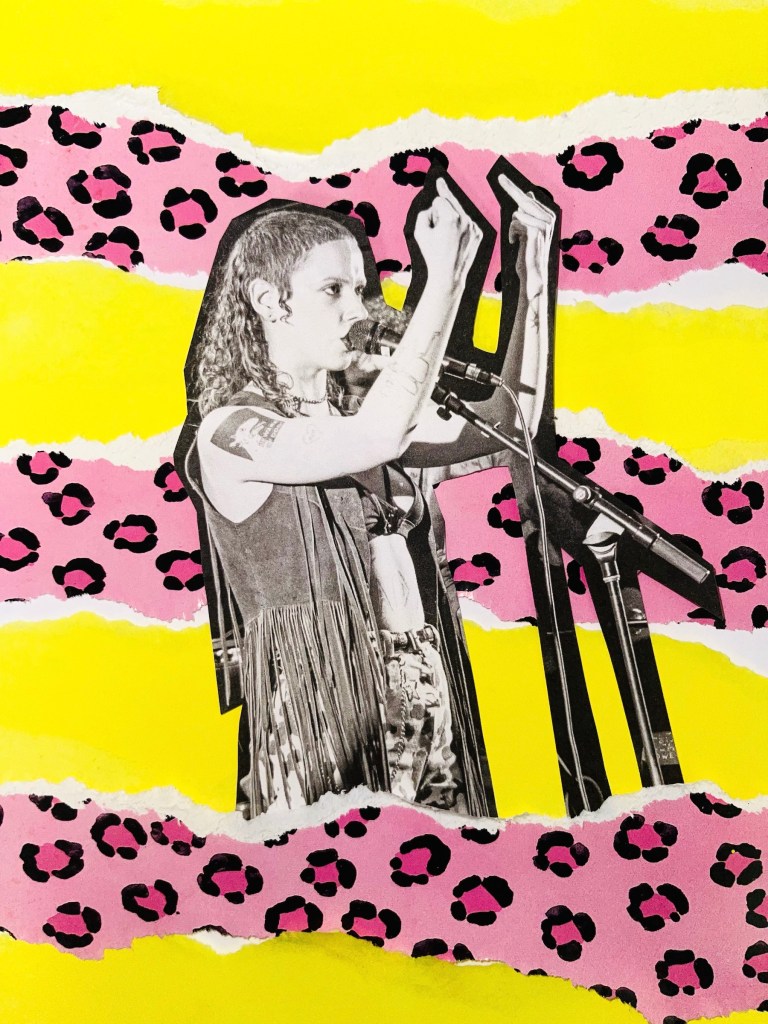
Fat Dog and The Tits vocalist Sam Taylor: ‘I’m a little alien, and I need to run around and do weird stuff.’

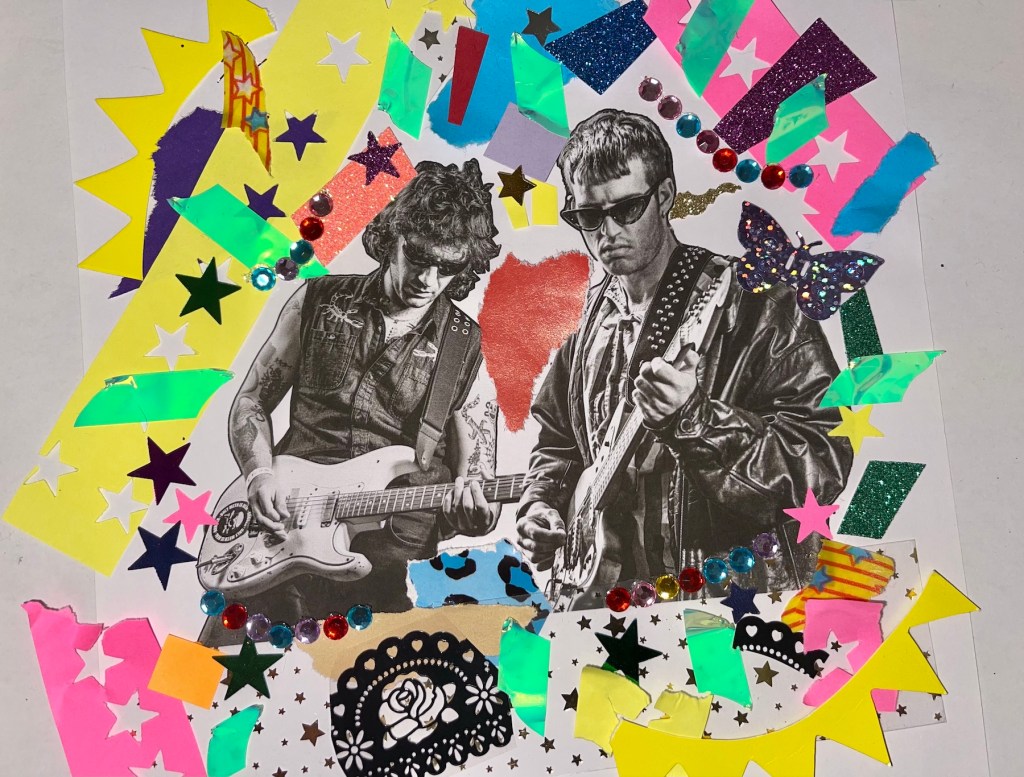
Original photo by Jhonny Russell / handmade collage by B

Community, vulnerability, and creativity are at the heart of Sam Taylor’s evolution—from a self-described “ignorant punk” to the electric frontperson of Meanjin-based band Fat Dog and The Tits. In this in-depth conversation, Sam delves into the transformative power of balancing strength with softness.

With raw honesty and humour, she recounts the pivotal moments that shaped her journey—from life-changing encounters high at festivals to mistakes made to painting skateboards to emotional revelations mid-performance that left her in tears and more. As Fat Dog prepares to release their stellar Pepperwater Crocodile EP and embark on an exciting new chapter, Sam reflects on the value of meaningful relationships, the courage to let go of judgment, and her ability to turn life’s toughest moments into art. Their EP has already made our Best of 2025 list!

SAM TAYLOR: I came back from tour and moved house. I was living in the middle of West End, and it was too much—too inconvenient and hectic to come home to. There was nowhere for my friends to park if they came over, and the house was really small and dingy. But now I’ve moved to Holland Park West, and I have the whole underneath of a house to myself for all my art and music shit. Happy days!

Nice! How did you grow up?

ST: I grew up in Brisbane with Mum, Dad, and my sister. I got into art and music right towards the end of high school. I was always into music because of my cousin. My sister got a guitar off him, but she never played it. I copied everything my sister did, so I started playing guitar and ended up loving it.

In Grade 11 and 12, I got into art class—accidentally. I’d applied to get into it every year but never got in. I don’t know why—maybe it was just the way the schedule lined up.

I changed English teachers because I didn’t like the way one of them taught. I really wanted to read the book the other class was reading. My schedule got changed, and I got plonked into art class. You needed prerequisites to get in, like doing art in Grades 8, 9, and 10, but I hadn’t done any of that. I had no prior experience, no idea what I was doing.

Nice! What was the book the other class was reading that you wanted to read?

ST: Jasper Jones. It’s a beautiful book. It’s amazing. A modern classic. The book my original class was reading was about cricket!

Oh, really?

ST: Yeah. The teacher had a very… interesting teaching style. Someone from head office actually came down and sat in on one of the classes to see what I was talking about. They were like, ‘Yeah, okay.’, that’s valid. And then, everything kind of worked out amazingly [smiles].

Your teen bedroom was covered wall-to-wall with images ripped out of skateboarding, surfing, and music magazines. You had posters up—Nirvana, Descendents and stuff like that. It was definitely a vibe and reminded me of my room when I was a teen. What kind of bands really inspired you then?

ST: Back in the day, I was very into heavier sort of shit—I loved Parkway Drive and all of that stuff. Nirvana was the big one for me, for my dad, he liked heaps of punk shit. NOFX was massive for me. I definitely love punk a lot.

There was a bit of a hardcore phase when I had all the posters in my room. I’d go see Amity Affliction and all that. But I’ve kind of definitely grown out of that now. It helped me at that time, very much so.

With all the skate and surf shit—Dad surfed, and he had a bunch of mates, including my godparents, who were all into skate and punk stuff. But when I really started delving into music—like, when I found things like The Cramps and B-52s—that really opened up my brain. I was like, I found my shit!

With the hardcore stuff, that was me being influenced by friendship groups and the people I was hanging out with. But once I found my shit, I went over to my godmother Anna’s house and spent some time in her record collection. She had a record player, and I was just putting on different records. I’d originally found B-52s through Mum, but when I first listened to it, I thought—fucking sick! The Cramps and B-52s were the ones that really started my brain opening, like, oh god, I really want to do this!

The Runaways were huge for me as well, including the movie—that was super inspiring. I love Joan Jett, love Cherie Currie. Even Suzi Quatro was something I learned from. Love all of that. Bikini Kill too—definitely a huge influence.

A lot of the bands you mentioned, like The Cramps and B-52s, they’re real outsiders and weirdos. They build their own entire world, and it’s not just musical—it’s visual as well, and it’s performance.

ST: Yeah. The Vandals are a really good one for that in the punk scene. When I was finding everything, I’d watch their music videos—they’ve got the funniest, most amazing, movie-style music videos. So inspiring, so funny.

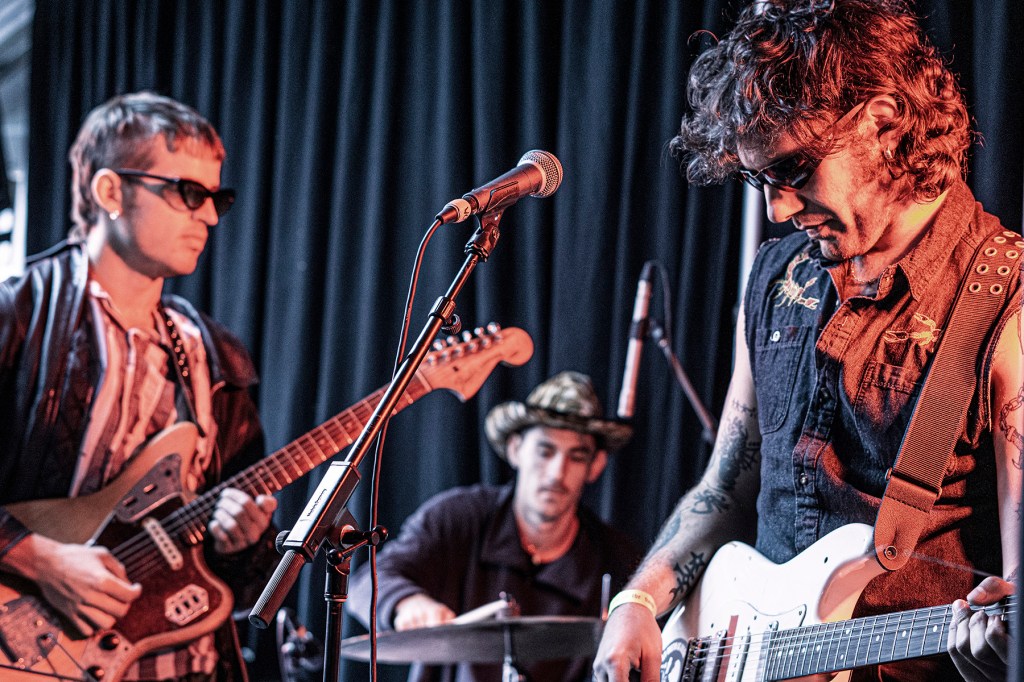
Photo by Jhonny Russell

Why is music and art important in your life?

ST: It’s a way I can function in this world. Whether it’s me listening to it—being able to get through whatever mood I’m in, enhance that mood, or help me feel a feeling—or doing art. Whether I’m creating through feeling or just zoning out and not having to think about things, it’s always been it for me.

Once I finally found that towards the end of high school, I was like, okay, this is what I can do. This is me. This is how I function. It’s genuinely in my blood, and it felt so good to finally find that and be like, Okay, cool.

Towards the end of high school, when you’re looking at university and what you want to do—I was like most people, wondering. But as soon as I found art and music, I thought, That’s me. Whenever I listened to music, I could see myself doing it. Whenever I saw people’s art, it didn’t make me want to create like that—it just gave me more go.

In 2014, as you were finishing high school, you thought for a brief moment that you might join the Navy, and you had an interview booked to go to. But knowing you through your art and music now, I could never imagine you doing that!

ST: I know, I know! Honestly, I was like, I don’t know what to do! I had this friend, and we were going to go to the Navy together. He went for his interview, and he was like, ‘Honestly, don’t—don’t fucking do it.’ And I was like, ‘OK.’ He went through with it for a while. Served his however long he had to serve until you can get out of it.

I’s bizarre how much I thought I had to do something. It took Mum and Dad a bit to understand that I’m not a conventional person. I’m not going to have a conventional 9-to-5 job. That’s just not happening. It did take a while for them to come around, but as soon as they were on board, a couple of years out of high school, they understood. They heard me play and saw my art, and they were like, ‘OK, this is you, and we can’t change that.’ They jumped right on board as soon as they understood that it wasn’t a phase.

Have you always enjoyed singing?

ST: Yeah, loved it. Mum had an office downstairs, and I would blast Christina Aguilera, Lauryn Hill or whatever the fuck, and literally sing to the top of my lungs, whatever I was feeling at the time—out of desperation or sadness.

You have such a unique voice. It makes you really stand out, especially with the music Fat Dog and the Tits play.

ST: Thank you. Honestly, if I could show like 15 or 17 year old me the music that we’re making now, I would absolutely shit my pants! In a good way [laughs]. Sounds weird, but you know what I mean? It’s so exciting. 

We’ve got a song, ‘Should,’ and that was the first song I ever wrote back in the day. I would be over the moon to know that I’m a part of something like what I am now.

‘Shoulda’ is our favourite song of the ones you sent through from the up coming release. I love them all, but that song hits me in the feels every time I hear it. There’s something so amazing about the melody you sing, and I noticed that the melody is similar to another song, ‘Bad Boy Blues,’ that you did when you were just doing Fat Dog acoustic stuff on your own.

ST: Yes, oh my god, yeah, it was! That’s the first song I ever wrote after my first breakup ever. When we were jamming and thinking of new songs, I showed them that, and they were like, ‘What the fuck? Yes, let’s do it!’ And then, we made it what it is now. I’m like, ‘Oh, that’s crazy!’

With songwriting, I can’t force it. We have a jam, and words come to me or whatever. Sometimes there are some songs where I’ve just been like, boom. I sit there, and I write it in one go, and that’s the song. Like, it just… sometimes I can’t choose when that happens, but I love when it does.

Yeah, my friend Gutty, who taught me a lot in music, we used to have a country band called Fat Dog in the Boners. He came up to me one day and was like, ‘You should sing something about a junkyard, like being Fat Dog. I don’t know, it just seems like a program.’ And I was like, ‘Cool.’

‘Queen of the Junkyard’ and ‘Queen of the Gas Station,’ which Lizzy Grant did when she—or Lana Del Rey, when she was Lizzy Grant—was my kind of ode to that. But yeah, it just, again, just pooped out of me.
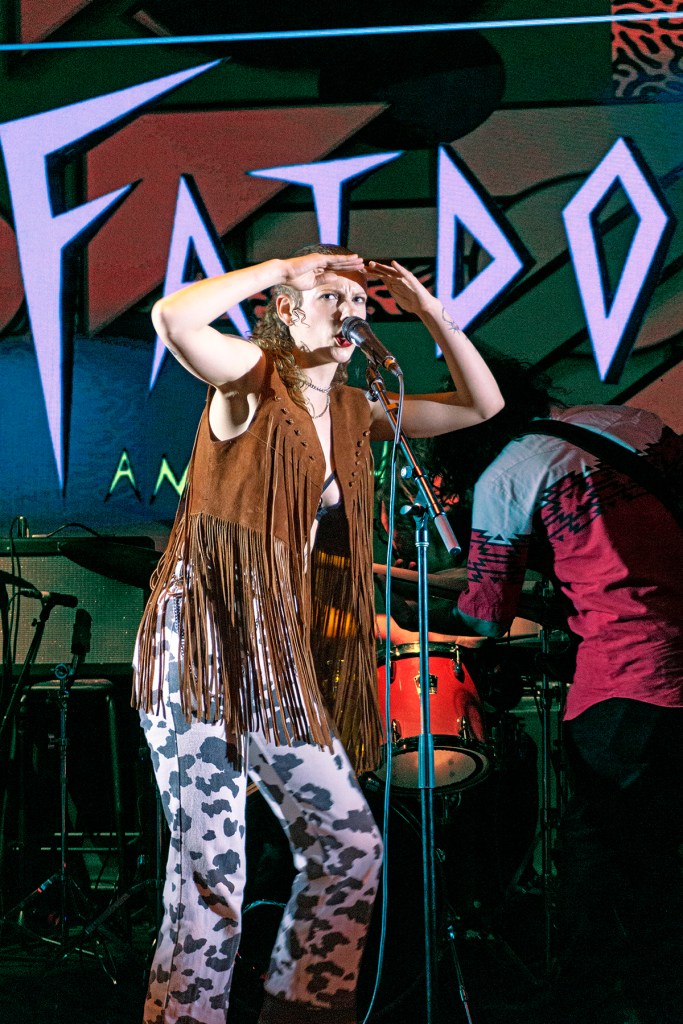
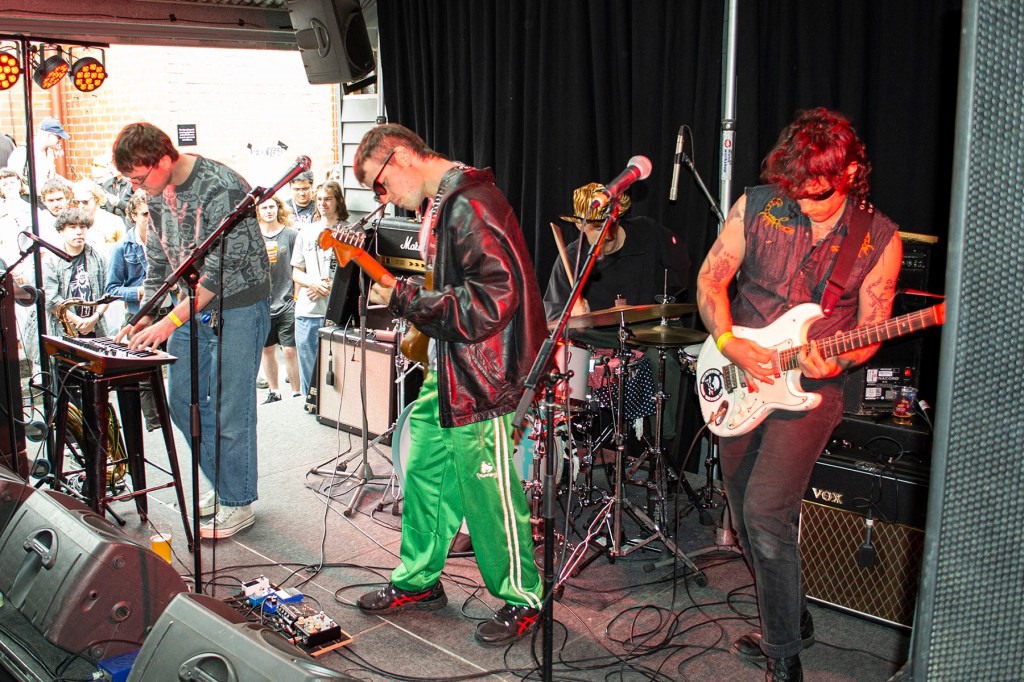
Photo by Jhonny Russell

Are ‘Money,’ ‘Should,’ and ‘Junkie Witch’ all songs that you’ve written previously and then expanded on with the band?

ST: No, no. ‘Queen of the Junkyard’ I wrote for the band. It could have been either/or—it could have been for my solo project or for the band—but the way it was written, it’s definitely for the band. But ‘Shoulda’ was pre-written, and ‘Solitude’ was pre-written. I did that for my solo stuff as well. That’s probably the most recent one that I’d written, um, that I showed the band, and they were like, ‘Yeah, let’s do it.’

But ‘Junkie Witch’ was a jam because we had a friend who was… ‘Junkie Witch’ is for either if you’ve got a friend who’s obviously going down the wrong path and you’re trying to pull them out of it. Or yourself. It was both for my friend and for me too.

But that one was literally just Rob sitting there on the keys going, and then the band joined in, and then I started yelling shit. A few of our songs are written like that—purely just a jam.

As well as heavy stuff, there’s humour. That’s what it’s about, honestly we’re goofy. I’m really excited to get this music video for ‘Queen of the Junkyard’ out there.

What do you remember most from shooting it?

AT: Oh god! Everyone in the band was fucking late; not all of the extras, though. That was hectic. I remember being towards the end of filming, but I still had two more band members to bash in the clip… there was the part where, finally, the car got crushed because we had to wait right until the end to get it crushed. My most vivid memory is me on top of a tire, going like, ‘Ahhh!’ And the director was like, ‘Give it all you got, give it all you got.’ I literally almost fainted. You can kind of see it in the video—I felt myself go forward, and I was like, ‘No, no, no, keep going!’ There was only one shot; you can only crush a car once. It was such a fun day. I felt bad for the band because it was pissing down rain and they had to lie in puddles.They were like, The shit we do for you!’ [laughs]. I was like, ‘I know! I’m sorry.’ It would look really good on film. It looks amazing. Jess Sherlock and Leo Del’viaro, the Director of Photography—fucking killed it. 

Every scrapyard we’d called, they were just like, ‘Nah.’ As soon as I brought up the idea—’Nah, nah, nah.’ But her dad was delivering coffees one day to a scrapyard, and then he started talking to John, who said we could film there.
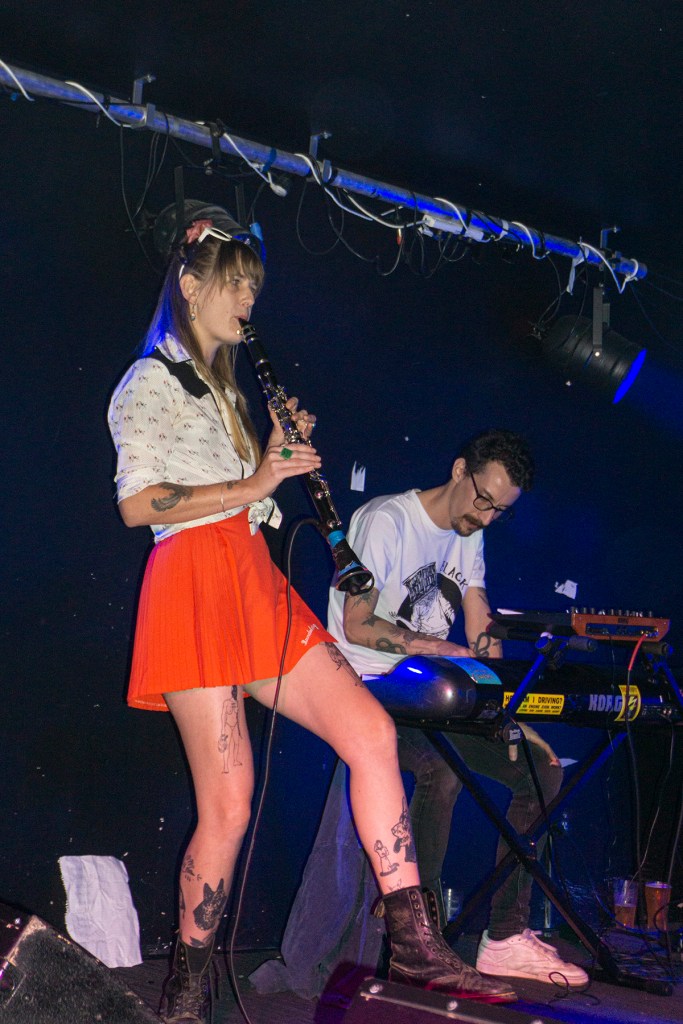
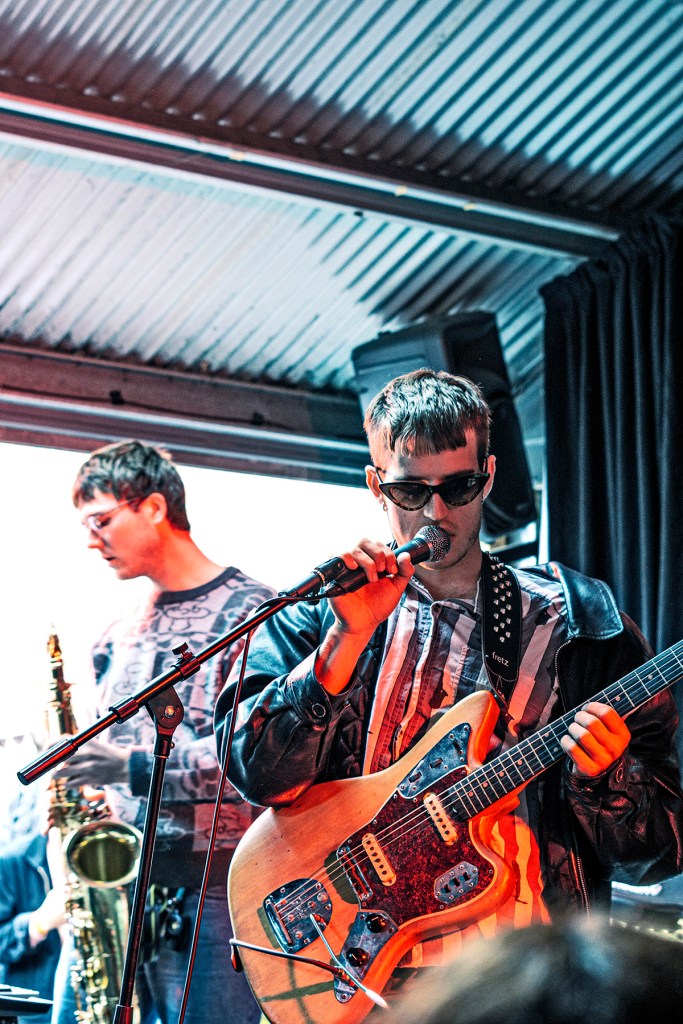
Photo by Jhonny Russell

It looks great! Where did the name Fat Dog come from? You’ve been using it for a long while, for your art and your music projects before Fat Dog and The Tits. 

ST: I got a t-shirt a friend gave me in high school, and it said: ‘Fat Dog Planet.’ And my brain just exploded. I was like, ‘What is that? Where do I find it? Who is it? Where? What?’ So I searched the ends of the fucking internet and everywhere I could to find it. But couldn’t. So I was like, ‘Fuck it.’ And, I won a competition with Converse to design a skateboard. I was like 17. I used Fat Dog for it. I changed my Instagram name, and everyone clued onto it straight away. Everyone started calling me Fat Dog, and I was like, ‘This is perfect.’

There is a band in the UK now called Fat Dog. They probably started in about 2021. Not mad, though, because there’s a lot of bands called Fat Dog. At first I was like, ‘Oh no, what do I do?’ And I was like, ‘Bitch, you stole the name from a t-shirt, you can’t say anything.’ Fat Dog from the UK is really good too. I love their music. We follow each other. All good, no harm, no foul.

Your first solo art exhibition was all your art on skateboards?

ST: Yeah, I mainly painted skateboards. That was from that Converse Cons pro thing I did. I got to design a skateboard, and I fucking loved it. I was stoked! The skateboarders, the crew helping, and the graphic design—it was the best. One of the skaters, I think it was Andrew Brophy, saw this little draft sheet I had with all these fucked up drawings for the skateboard. He grabbed it and was like, ‘What the fuck?’ I ran around showing it to everyone, thinking, ‘Is this me? Am I becoming me right now?’ Oh my god, it was really cool.

I noticed in a lot of dicks and vag in your art; where’s that come from?

ST: When I got into the art class without any prerequisites, the teacher fucking hated me for it. She’d tell me I’d gotten unfair treatment and made things hard for me. She’d come up behind me and say, ‘Your people look weird. Do you even know how to hold a paintbrush?’ She was a proper cow, to put it nicely. Really mean, and made me feel like shit. So, I started drawing all this messed-up shit, just because we could. At first, it was a fuck-you, but then I kind of liked it. The reactions I’d get—whether positive or negative—didn’t bother me. I wasn’t trying to offend anyone, but I did like pushing people’s boundaries and seeing how they reacted. Not physically, but mentally.

You’ve done art for Woodford. You always seem to have interesting things on the go.

ST: Yeah, I was working for Screen Queensland just before we went on tour, but now that contract’s ended. I’m not sure what’s next. But I love that kind of work—it suits me. It’s way better than doing the same thing over and over. I genuinely get depressed, my heart hurts, my stomach aches, and I get all anxious if I can’t create things.

It’s hard when you’re stuck within these little boundaries. It’s nice to poke out and see what happens and the reactions. People feel something, even if it’s just a little ‘oh.’ It doesn’t matter how they feel—it’s about stepping out of that cookie-cutter mould. Breaking free from that feels really good.

I know you like a lot of different music, besides the punk and hardcore we’ve talked about I’ve seen you rock a Beastie Boys shirt and also a Crowded House one. I know you like reggae too. It makes sense you’re in the band you are because Fat Dog and the Tits have a real eclectic mix musically. 

ST: ‘We’re specialised in genre-bending!’ People ask us what we are. I used to say doom-funk-cunt-punk. And Rob’s like, ‘It’s not that.’ He fucking hates it when I say that. So I stopped saying it [laughs].

I was like, ‘What are we? What would you call it then?’ And he’s like, ‘Contemporary Australian rock.’ And I was like, ‘Shut the fuck up! No, I’m not. What do you mean?’

Then we kind of recently came up with the idea of junk rock, which is like jazz musicians playing punk rock.

You’ve been recording over the last year?

ST: Yes. Milko, our bassist, he recorded, mixed, and mastered everything. It’s completely in-house. It sounds exactly like how we fucking sound. He is an absolute genius. He’s a very smart, amazing man. I think it sounds, honestly, fucking amazing.‘

We’ve heard four tracks from it, which totally do sound amazing! How may songs will the final release have? Will it be an album?

ST: We’re in debate about that now, because we’ve got a few old songs that we used to play, like ‘Nancy’ and ‘Desert Dog’, which we’ll still play.

There’s a few older, slower songs we had recorded when we originally did the album, and it didn’t go as well as we wanted it to. We weren’t ready to record, basically. We were trying to jump the gun. So we’re thinking of releasing a five-track EP called Pepperwater Crocodile. Can you tell how high we were when we came up with that? [laughs]. Although, I’m pushing for a double-sided vibe. One side as the five-track EP, and the other side with different vibes, like doing a split EP with ourselves as, Sammy Taylor and the Brake Failures, that’ll have all those slow songs. I don’t know, though, I’m not sure where we’re at with that. Seven people in a band can be hard.

Tell us about the song ‘Solitude’.

ST: When I wrote it, I was coming out of being really sad—I went off the rails a little bit. I had to move back with my parents, they live in Kawana on the Sunshine Coast.

I sat at the beach, I took my guitar to this little spot where I always sit. I wrote it as a reminder to myself. Like—When the sun doesn’t shine like it used to, when your mind doesn’t operate like it should. When the sky turns a different shade of blue, all I needed was solitude.

I’m very much a social butterfly. I can get so carried away in that. I’ve learned better now, it’s an ongoing process.

The song was a reminder that when it gets shit, it does get better. And you can spend time alone and get through it. Or, you don’t have to do it alone. But sometimes, for me, solitude really does fucking help. Coming back to being grounded. I’m a bit spiritual, so reconnecting with all of that. Just fucking breathing and being with the moon, the ocean, and the earth.
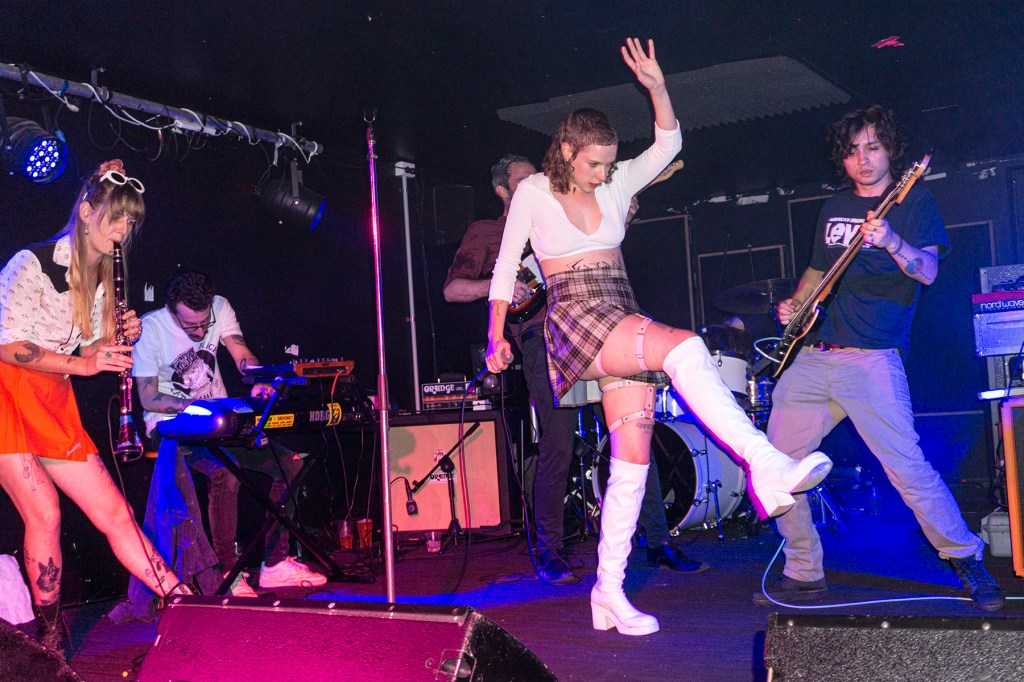
Photo by Jhonny Russell

Yes! You’re talking my language. I totally get that. Do you feel like you went off the rails in part because the subcultures and social aspects of skateboarding, the art scene, heavy music and punk communities are places where people often gravitate towards partying and you kind of can get caught up in that?

ST: Absolutely. And when something happens, or you’re stressed, or even just after a hard day at work, and you’re like, fuck, I can’ t wait to get home and smoke a bowl, or fucking drink beer…Or, you know, it’s like, can’t wait for the weekend! You don’t give a fuck about the whole week; you’re a zombie, just living to go out. 

That’s what the ‘Solitude’ song is exactly about—you just need to come right back to centre and notice all of these energies and things that you’ve collected over time.

What is yours? What are you feeling that is actually fucking yours? What do you want? Or do you just get persuaded so easily? Who you’re around and what you’re around can really affect your psyche and how you deal with things. It’s like, Well, fuck it, I’ll just go out with them!’ And you don’t actually deal with the thing. You think you’re dealing with it, but you’re not.

100%! Do you find that you get more of a buzz now from doing your art and music?

ST: Absolutely! Towards the start of the year, I was off it. I was not drinking, completely sober. We played a show, and the energy was fucking insane. I felt like I did the biggest line of cocaine, but it was natural energy that came from me. It felt so good; it felt so pure.

It was a show at The Bearded Lady. There was a lot of our regular crowd and friends—it was really sick. I could feel everything and see everything. Like, holy fuck!

It’s almost daunting, in a sense, because I’d be so used to at least having a couple of beers before a gig, like at very least, you know? So it’s nice. Honestly, it was really refreshing to see that I don’t need anything to do what I do.

I saw at the very first show you ever played, it was just you by yourself, playing acoustic guitar and singing. You got so nervous, your hands started shaking, and a friend had to get up with you and play guitar.

ST: Yeah, I was shaking so much! I’d rehearsed the song, but I actually could not fucking do it. I was so fucking scared. I’d never wanted to do anything more in my life, but I was so genuinely afraid. 

Especially with solo gigs, I still get nervous getting on stage. Even the first time with the band it was like that—oh my God! Even though I wanted to do it so bad, there’s the other side of it where it’s like, this is everything, you wanted to do this, but I don’t want to fuck it up. I was almost fucking paralysing.

Having seen you play, I would never have guessed you get like that.

ST: Before the floods happened in Lismore, I thought it was going to flood up on the Sunshine Coast. Everyone was feeling super anxious at the time. I remember posting, I had a Bob Marley song playing, and I was dancing. I’d been painting a commissioned skateboard while watching the water come up into the house, and I was just like, oh fucking fuck! Feeling super anxious. So I posted to, number one, make me feel a little bit less anxious and maybe be able to talk to people about it. But, number two, also do the vice versa and be like, hey, if anyone’s feeling anxious, I’m pretty sure we all are—everything’s a bit weird right now.

Then I had a few responses, people were like, oh my God, you get anxious?. Believe me, I’m in my brain, I’m one of the most fucking cripplingly anxious people ever. But, because I go outward instead of inward—I appear very boisterous and really loud and weird.

You seem like a vibrant creative, really individualistic person, also someone that’s really caring and compassionate for those around you.

ST: I love dogs so much. I have seven dogs tattooed on me!

I didn’t get through the whole spiel about when I got the Fat Dog Planet shirt, but when I got it, my brain exploded, and I saw my vision.

After my music and art career, when I’m ready to settle, there’ll be a three-level house thing. The bottom level will be an animal sanctuary, starting with dogs and birds. Easy stuff, probably near the beach, but in the bush. 

Second level will be an op shop to help fund it. If you’re First Nations, experienced DV, or facing homelessness, or feel disadvantaged in any way, you come in, get what you want, and you’re good to go. You can also hang out with the animals—pat them, chill with them, whatever.

And then the top level will be a skate park venue. That’s the dream, the goal, the vision. But later. I’m busy right now [laughs].
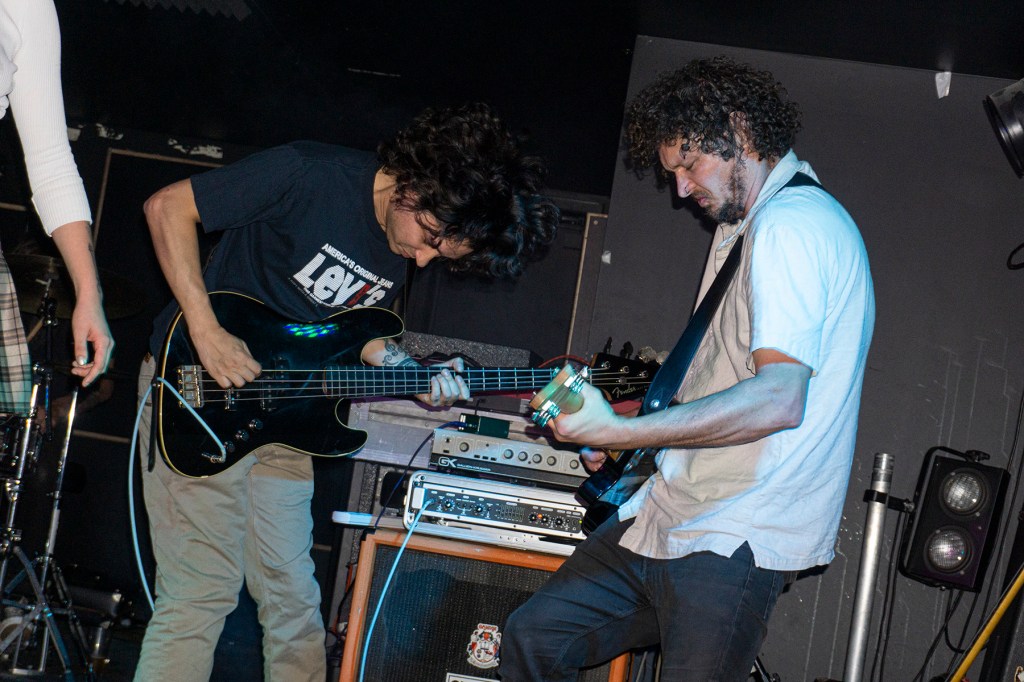
Photo by Jhonny Russell

It seems like everything you do is community-based and collective. 

ST: I always want to keep that as a huge part of it. Solitude is important, but community is just as important. Life gets very sad very quickly without it. It doesn’t have to be a huge community, and it doesn’t matter who’s in it. It’s about what you can do, what you can make, and how others can be involved.

It’s important to remember, we can always contribute something. 

ST: Yes, exactly. Because some people, you know, you’ll think that you have nothing, so you’ve got nothing to give. But it’s not only monetary things that have value. That’s fuck all in this grand scheme of things.

Sometimes it’s just even having a conversation with someone or listening to someone. People crave that companionship; they need someone to connect with.


ST: Yeah, absolutely. 
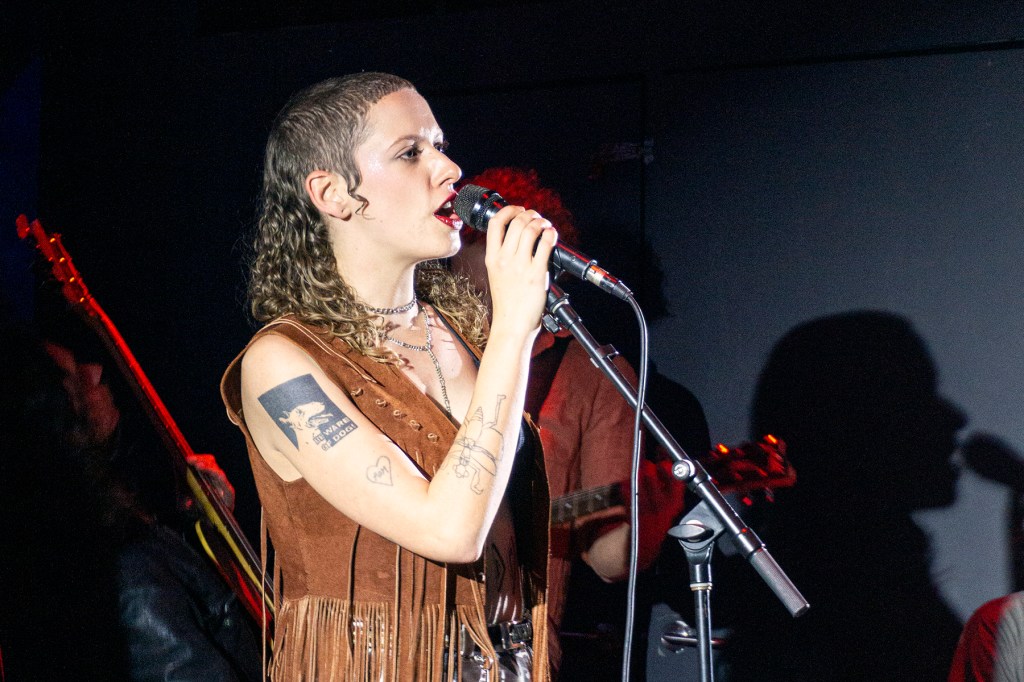
Photo by Jhonny Russell

Have there been any moments that have really helped change your life?

ST: Oh, yeah, a few. I’m having a wave of memories flash in my brain. I feel like there were a few moments at Woodford when I was in my really ignorant punk phase. I remember I went to the planting, first of all. My friend and her mum took me there kind of like a, ‘You need this,’ sort of vibe, like, ‘You’re a little ignorant motherfucker.’

I went, and I’m sitting there like an old punk. And that experience kind of cracked me like an egg a little bit—opened my brain a lot.

I came from a bit of a judgmental background, had that attitude ingrained in me. I was very standoffish and didn’t give people a chance. As soon as I did, I learned so fucking much, honestly. It cracked me like an egg.

I used to be a bully. Like, in high school, I was a little fucking asshole. I was a worse bully in primary school. When I got to high school, people started fighting back. But I don’t remember anyone turning around and saying, ‘Why the fuck are you doing this?’

And one day, I was just like, ‘Fuck, why am I doing this?’ It just broke me. I went from like, ‘Fuck you,’ to, ‘Oh my god, what am I doing? Why am I fucking doing this?’

I was bullying my best friend, Angie, at the time on the internet. She was like, ‘I’m about to call the fucking cops on you. Like, why? What are you doing?’ We ended up working through that and breaking it down. I learned a lot from that. After that, she gave me the Fat Dog Planet shirt I told you about.

And then that led you into doing what you do now and being called Fat Dog?

ST: Yeah, I’ll spare the details, but we got there eventually. It’s amazing the connections that you can have if you let them happen. 

School was hard for me, and I always felt like I had to be the tough girl because I got bullied a lot and I wanted people to leave me alone. I always felt I had to have a harder exterior. But as I got older, I found that there’s a real beauty in softness.

ST: Absolutely. There’s a time for toughness, and that can get you some places, but a lot of the time, that vulnerability—when you let that happen with people—is so magical. It’s so beautiful. Like, I love so much when even something as simple as walking past someone and smiling at them. That softness can be so valuable. There is strength in softness. It took me a very fucking long time to learn that, but I got there.
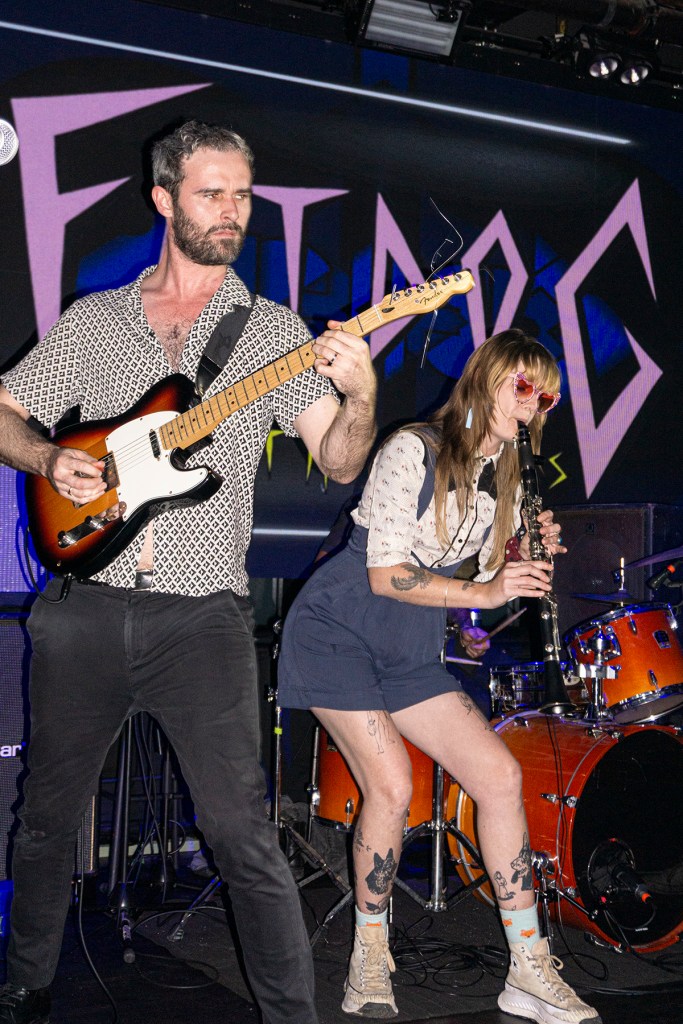
Photo by Jhonny Russell

What are you most looking forward to in 2025? 

ST: Releasing the EP! We’re going to do a proper Australian tour and then head overseas. I know we recently celebrated our second birthday this year, but that’s as a playing band. We’ve actually been together for like three years now. We’re all absolutely gagging for it. We’re ready to go.

What made you want to take your music  from doing the solo thing to having a band?

ST: I always wanted a band. Last minute, a festival called Forest Fuzz—one of the sickest festivals that our mates ran—came up. I was doing this mentorship program with Alison Mooney, and she said, ‘Always carry a little card in your pocket with your manifestation.’ And then, right before the festival, I was like, ‘I’m going to get a band out of this. I don’t know how, but it’s just going to happen. And I’m really grateful for it.’

I played my little solo set. I cried through three songs. I still had three songs left to play, and I started bawling my fucking eyes out. I had to recompose myself, then play.

After, I ran back to the campsite, just to smoke some weed, because I was like, ‘That was hectic.’ Matt and Glenzy, the drummer and one of the guitarists in the band now, were sitting there like, ‘Hey, do you want a band?’ They’re both from Bricklayers. And I was like, ‘Yep, fuck yep!’

I love doing the solo stuff, but I always wanted to run around with a fucking microphone in a band. Having a guitar is fucking annoying. I’m a little alien, and I need to run around and do weird stuff [laughs].
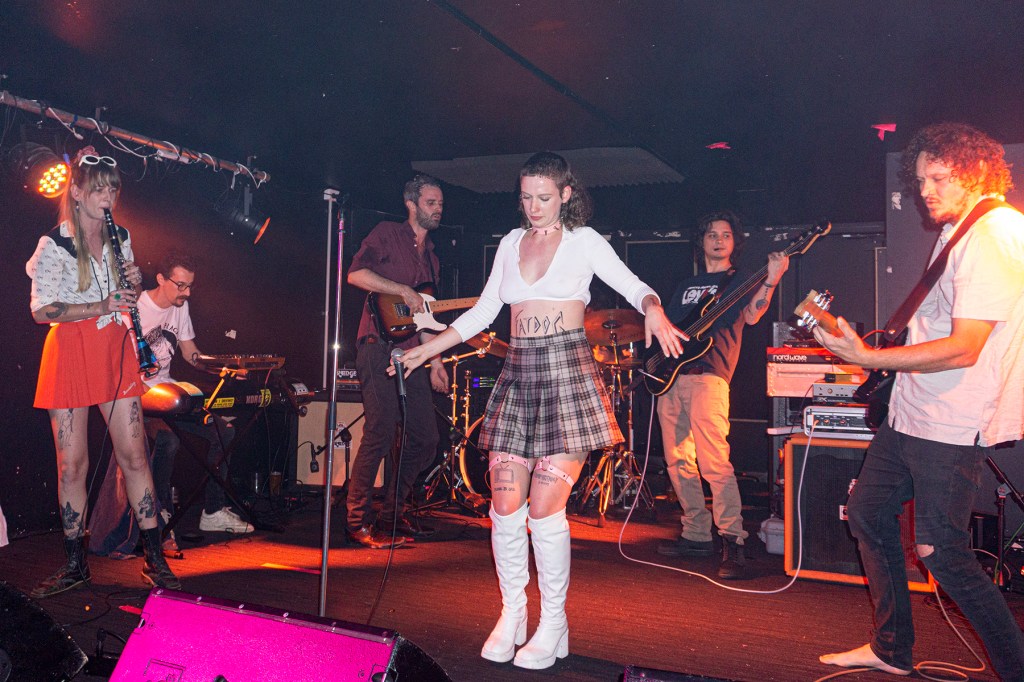
Photo by Jhonny Russell

What was it that made you cry mid-set? 

ST: I was dating someone at the time, and I sang a song. Subconsciously, I realised, ‘Fucking nah, I’m very unhappy.’ And, it kind of hit me. That’s what the song is about. ‘Thank you for showing me that I’m not alone,’ is the last lyric, and you kind of wail that, like Alice Phoebe Lou’s ‘Something Holy’—it’s a beautiful song. I was singing the last lyrics, and I was like, ‘Oh, yeah.’It was hectic, and I was ugly crying.

You know when you’re in a relationship where people want you but don’t want the responsibility of you? Not dealing with what’s in the handbag, never cleaning the handbag out, but just fucking shoving shit in there—that’s it. That’s all I’m here for.

I’m a super, super emotional person. Art is how I process that. How I’m feeling about the situation just comes out in song. I’m just so fucking grateful that there’s a band of six other Tits that are so keen to do this with me. I would not be doing this without them. To have a literal dream come true is amazing. I’ve been spiritually and mentally and physically feeling that it’s like, strap in, it’s about to get real. If you want to do something, you’ve got to fucking figure it out—make it happen!

Follow: @fatdogandthetits and @fatdogplanet + Fat Dog on Facebook. LISTEN/BUY here.
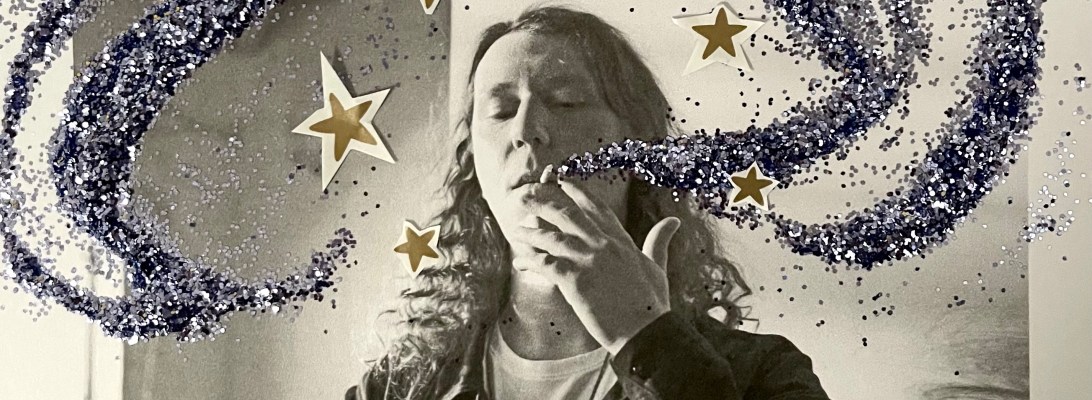
Conversations with Punx – romansy’s Alessandro Coco: ‘We are full of potentiality’

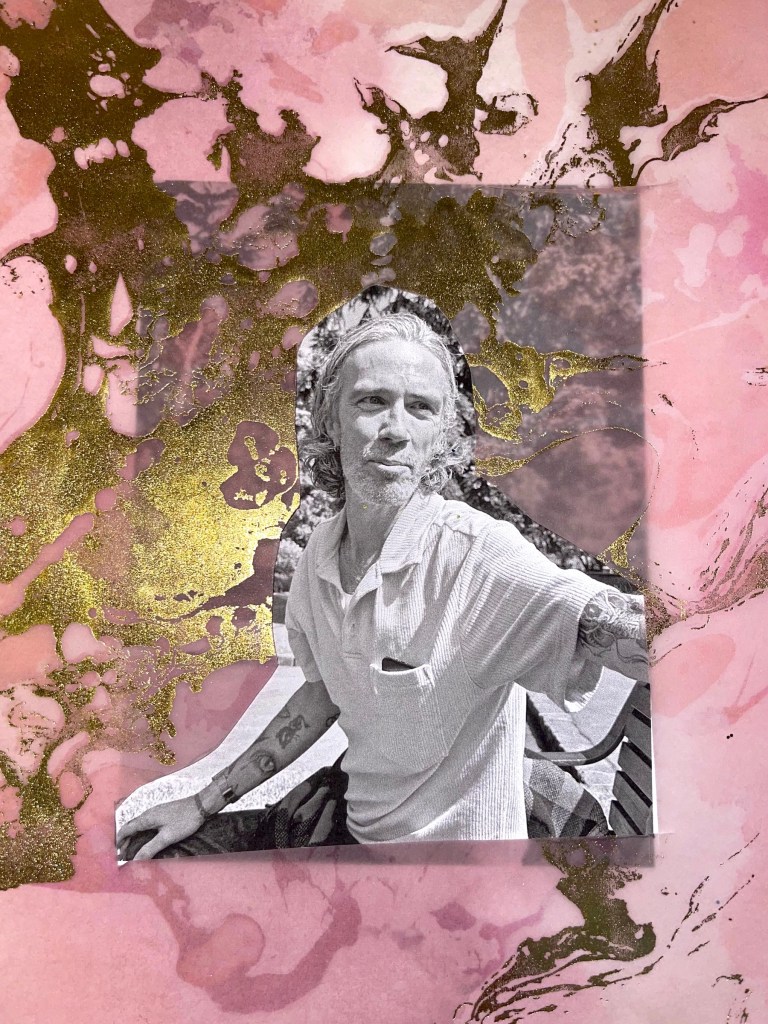
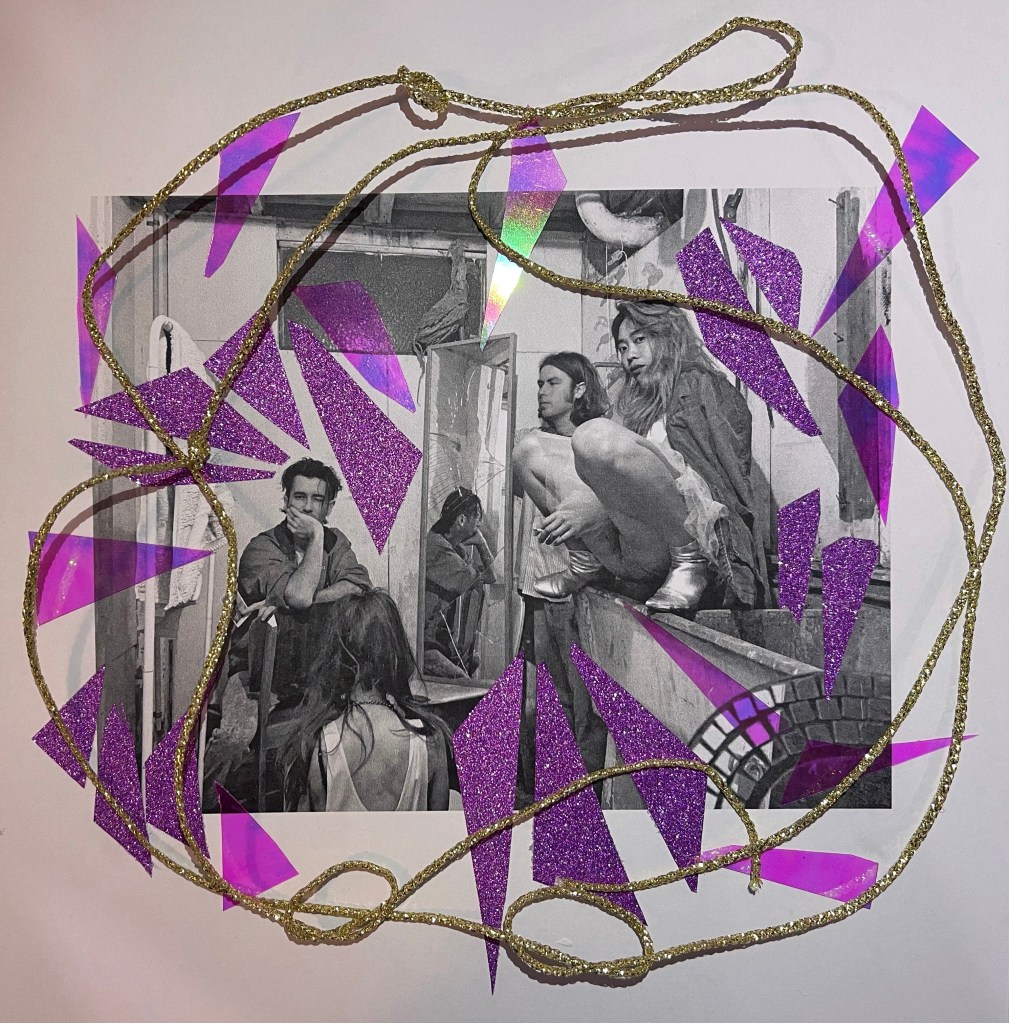
Original photo: courtesy of Coco / Handmade collage by B.

When you walk into Lulu’s, Naarm’s (Melbourne) beloved underground record shop, one of the friendly faces behind the counter is co-founder Alessandro Coco. Along with friends, he helped establish label Cool Death Records too, that’s gifted the world record collection essentials from bands like Low Life, Tyrannamen, Oily Boys, and Orion. A stalwart of Australia’s hardcore punk community, Coco has played in bands Leather Lickers and Erupt, among others. These days, he fronts Romansy, a band channeling the hectic, spirited energy of Zouo, The Clay, Necromantia, Septic Death, and GISM.

A few years back, I (Bianca) was chatting with Al Montfort (Straightjacket Nation, Sleeper & Snake, UV Race, Terry…) about my punk and hardcore book, Conversations with Punx: A Spiritual Dialogue. Al suggested I reach out to Coco for a conversation—so I did.

What followed was an hours-long discussion that covered self-enlightenment, spirituality, creativity, the DIY ethos, and Coco’s introduction to it all. We talked about the importance of really supporting one another both creatively and personally, navigating struggle and insecurity, and embracing who you are and your own worth. We yarn about the scene and its dynamics, as well as idolisation. Coco also spoke about messing up, owning it, and growing from those experiences.

The initial manuscript for my book was over a quarter of a million words. To bring it to a publishable length, I had to cut it in half, which meant not every full conversation made it in. A few days ago, Lulu’s announced they would be closing their High Street shop. Lulu’s has spent nine and a half years of hard work, creating a hub that felt like a second home for many of us in search of great underground music, connection, and community. Reflecting on Lulu’s reminded me of the chat with Coco—and the timeless insights we shared. Which Gimmie now shares with you.

Al informed me that you’re always talking about philosophical, deeper, spiritual kinds of stuff. So I thought I’d reach out for this chat for my book.

COCO: Yeah, I definitely am. I’m surprised that more people don’t talk about it, but I get it. Everyone has those thoughts and ideas, but they tend to keep it personal. Sometimes it’s something people think, or feel but don’t really focus on. They might not dedicate hours in the day, week, month, or year to hone in on it. It’s just there, part of who they are, which is cool as well. Star signs are back in a big way, which is kind of cute, but that’s where it usually stops with a lot of people [laughs].

It’s obviously something that you focus on? 

COCO: For sure. I do my own thing with it. I don’t attend regular church meetings or group gatherings. It’s something I focus on in my own time, putting energy into it. You can find powerful, positive, and profound results from doing that. It suits me.

Once you’re aware of that kind of power and presence, you can’t ignore it. It’s right in front of you, you just have to meet it halfway.

When did you first became aware of it? 

COCO: I couldn’t pinpoint it exactly. I grew up attending Catholic schools, and that was fine, but it always felt strange to me. You’re presenting something profound and serious—something meant for adults—to children who can’t fully grasp it. Kids aren’t taught philosophy in primary school, and rarely in high school, yet religion is essentially a philosophy. It’s no surprise they don’t understand it.

When you grow up with that, you either follow along and risk developing a warped perspective, misunderstanding it, and running in the wrong direction with it, or you reject it altogether. That rejection is understandable but often comes with throwing out the good with the bad. There are powerful, useful aspects to it, but they can get overshadowed by the parts that seem cruel, wicked, or nonsensical. This can lead people to turn their backs on it.

As for me, I don’t know exactly how I came back to it. I’ve always been fairly optimistic and positive when I can be. Maybe it started with playing music and spending time with friends. A lot of us got into heavy metal around the same time, and that genre is steeped in spiritual symbolism. You start noticing it, paying attention, and digging deeper into what those symbols mean.

Symbols are fascinating. They condense grand ideas into something small and simple, like a logo anyone could draw. Exploring those symbols led me to rediscover some ideas and reconnect with them. As an adult, with more maturity and life experience, you can approach those concepts differently. You start deciding what they mean for yourself. Once you’re on that path, it’s easy to keep going and noticing it everywhere.

Absolutely. What is spirituality to you?

COCO:  At its core, I would say it’s our way of experiencing our environment and identifying ourselves within it. What does that mean? Well, it’s philosophy. That might be an oversimplification, but I think it holds true.

For example, I might have a buddy who doesn’t consider himself spiritual. Yet, if he goes hiking or visits the beach, he tells me how connected and wonderful he feels. He mentions how the everyday things that seem so important drift away, leaving him with a new sense of connectedness and a different way of experiencing and being part of his environment.

To me, that is spirituality. He might not identify as a spiritual person, but that experience—feeling in tune with the world—is exactly what spirituality is about.

Totally. I get that from nature, I get that from listening to music, or creating something too.

COCO: It’s a weird kind of connectedness. It’s about relating to and experiencing life, but not in a social or political way, or in all the other ways we tend to focus on. It’s just you and the world—whatever that is. That’s often what it comes down to. It leads to other things, sure, but at its core, it’s just you in that moment.

Take music, for example. Black Sabbath is my favourite band. There are certain moments—like after a few beers, when the ‘Wheels of Confusion’ riff in the middle hits—that completely takes me away. That connection, that rush of vital energy and passion, what it does to your body and mind—it’s ecstatic. It’s an experience that feels almost otherworldly.

And that happens with all kinds of music. It’s that feeling, that sense of being taken out of yourself and into something bigger. Is that spiritual? I don’t know. Some people might not call it that. Maybe if you’re just bopping along to a pop tune, it doesn’t feel the same. But everyone has their own way of looking at these things.

For me, it’s huge. It’s a big part of how I see spirituality—not putting it all into neat little boxes, but recognising it in moments like these. It’s also about being present in mind and body, living fully in the moment. That idea comes up a lot in Eastern philosophy and spirituality: being present, not caught in thoughts, just experiencing and being.

You can get that from listening to music, from live performances, even from watching sports. Everything else drifts away, and it’s just you and the experience—the present moment. Nothing else exists in your head or your being at that time. It’s pure, and it’s wonderful.

Absolutely. Are there any other practices or rituals you have? 

COCO: I don’t meditate in the traditional sense—not the sitting down with eyes closed, yoga-style meditation. Instead, I try to get in touch with things in my own way. I’ll light incense, light candles, or pull out the tarot deck. Sometimes I pray, just to connect with what feels like it’s always there, everywhere, all the time. It’s about getting in tune with it.

Whether it’s positive thinking, willing something into existence, or something else entirely, it’s a complicated idea to explain. I don’t follow a strict practice, but I definitely have my own ways of engaging with the universe—and sometimes even the unseen universe.

Have you looked into any specific philosophies? 

COCO: I mostly find myself drawn to Western esoteric traditions, whether that’s Kabbalah, Christian mysticism, or other forms of Western magic. Many of these traditions also look to the East for inspiration. While I don’t spend as much time exploring Eastern ideas or philosophies, I do visit them occasionally. I think there’s truth in all of it, and something valuable in every tradition for everyone.

I can’t say any one path is greater or better than another—it depends on how you approach and understand it. For me, Kabbalah feels especially useful and powerful. I probably came to Kabbalah through reading [Aleister] Crowley. It resonates with the way my mind works and how I think about things. Similarly, Christian mysticism makes sense to me, likely because of my Catholic school upbringing. I’m already familiar with the imagery, symbols, language, and framework, so it feels accessible.

That familiarity allows me to focus on those traditions without the overwhelming task of learning something entirely new—like the canon of all Hindu gods, for example. That said, I do enjoy exploring other traditions when the opportunity arises. You can use whatever word you want for it, like, religion, philosophy, magic, spirituality, they all lead to the same place. Obviously, there’s different ways of practicing it or experiencing it, but hey’re all part of the same tree. 

Do you think your interest in these things stems from trying to understand life or yourself better?

COCO: Yeah—it’s about seeking truth. It’s about seeking experience, seeking understanding. Sometimes, it’s about finding another way—a useful way—of looking at the world, another lens that can open your mind.

I used to smoke a lot of pot. I don’t anymore, but at that time, I think anyone who first forms a relationship with that—or with psychedelics—definitely experiences a kind of opening of the mind. It starts you looking at things differently and even experiencing things outside the box. Once that door opens, things can just keep opening.

It’s not like psychedelics are the only gateway to that kind of exploration, but I think, for a lot of people, they are one of them.

Where did you grow up? 

COCO: When I was a kid, I lived in the western suburbs of Melbourne. During high school, I moved out to the country in Victoria and stayed there for 10 years. A few years ago, I moved back to Melbourne because everything I do and participate in is based here. There’s not much of that up in Ballarat, where I lived, so had to come back to Melbourne to be part of things the way I wanted to.
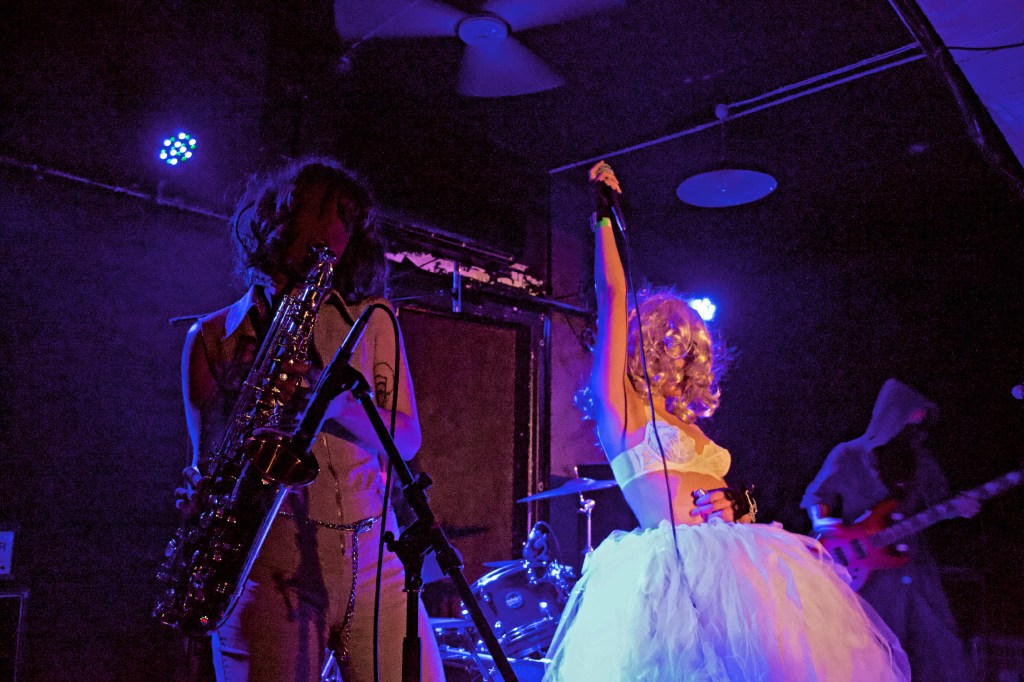
How did you first get into music?

COCO: When I was younger, I got into The Offspring, Nirvana—cool stuff like that. Some buddies in high school were into similar punky music, and I ended up getting a Punk-O-Rama compilation. Not long after, I got into the whole Australian metalcore scene, which quickly led me to Australian hardcore and melodic hardcore—the stuff that was happening about 15 or 20 years ago. From there, I dove into more classic punk and eventually got into the underground scene.

Both my parents are big fans of music, but they didn’t listen to punk or anything like that. Over time, though, I’ve come around to their tastes. My dad schooled me on a lot of classic and important blues, and my mum actually got into punk after I did. She loves it now, along with hip hop—she just vibes with that kind of stuff.

So, yeah, there was music in the house, but I didn’t really find my own music until punk came along. Something about it just made sense—the attitude, the volume, the aggression, the appearance. It’s the kind of thing that captures a young mind full of energy but unsure where to direct it. There’s also that rebellion, which is so easy to identify with, especially if you’ve never really had a way to express it before. You see it, and you think, Oh, yeah. That’s it.

What was your first introduction to DIY? 

COCO: When I was getting into metalcore—it called itself hardcore at the time—I started to realise that these bands were actually touring and playing at venues I could go to. For all the flaws in that scene, they did a lot of all-ages shows, which was great for younger people to access. That made it feel like something real and achievable.

It wasn’t happening in my own backyard, not where I was from, but it was close enough to get to. Tickets were like 15, 20, maybe 30 bucks, and you could actually go and experience it. At first, I thought of it as a concert, but then I realised it wasn’t this big, untouchable event—it was just a gig. And at those gigs, everyone had their band T-shirts, their merch, and it all felt alive. You’d see one gig, and then there’d be another, and you’d just go further down the rabbit hole.

I started to see that this scene was happening in the present—it existed right here and now. In Melbourne, we were lucky because there was so much going on. One thing led to another, and you’d discover these whole communities of people doing it themselves.

Missing Link Records in Melbourne was super important for me. They were really supportive of younger people like me. I’d go in, buy a CD, ask questions, and they’d help order stuff in or give recommendations. Even at the gigs, there’d be distro tables with records and CDs for sale. You’d chat with someone there, and they’d put you onto new bands or scenes.

I remember this one guy who ran a label. Looking back, it wasn’t the coolest label, but at the time, he was so enthusiastic. I laughed when he handed me something and said, ‘Dude, you’ll love this.’ I was grabbing Jaws’ new thing on Common Bond Records, and he’s like, ‘Oh man, if you like that, check out Government Warning.’

I bought the CD No Moderation, and that just flipped everything for me. I was like, man, this is unreal. And yeah, it’s just about having your eyes opened to the fact that it’s all around you—you just have to notice it, or be introduced to it, and then experience it and break into it yourself.

The local scene came from local shows. The DIY thing? You just kind of follow the rabbit hole, chat to different people, explore different things, and then you realise it’s all there.

And now you get to do that—recommend new stuff to people who come into Lulu’s! I read in Billiam from Disco Junk’s zine Magnetic Visions that he mentioned how, when he went into your store, Lulu’s, it was the first place where he actually felt like he kind of belonged. He said he didn’t feel like he was inconveniencing anyone, and he could actually have a chat with people. I could relate to that. Growing up, many people behind the counter at my local record stores were really pretentious and condescending but then there were a couple of cool dudes that would take the time to talk to me and suggest stuff, and that made all the difference. It’s like, not everyone can know everything.

COCO: Yeah. That’s my favourite part of Lulu’s: being able to chat with people, connect with them on a personal or musical level, share things we think are cool, and point people in a direction—like, ‘Oh, you like this? Maybe you’ll like this. Check this out! Have you heard of this?’ Then encourage them to do what they’re doing. 

Billy was young doing his own music, and I was like, whatever you do, buddy, bring in your tape, bring in whatever you make, to encourage and support that. I was lucky enough, when I was younger, to have people be really friendly and supportive of me. I always thought it was important to pay that back. I was shown kindness and support, and I thought, ‘Yeah, I absolutely want to do that for anyone else I get the opportunity to help down the line.’ Thankfully, I’ve been lucky enough to be in a position where I can do that. DIY is a hell of a thing.You get to learn a lot of lessons your own way. 

If you want to do a band—do it! Nothing’s gonna stop you, no one’s gonna stop you. Make your tape; the first tapes we did we dubbed by hand. I spray-painted the covers. You just have to give it a shot. Put your effort into it: use your brain, your heart, your passion— it can pay off for you. 

Early on, that was super valuable to learn; it’s influenced the way the following years of my life have gone. If I wanna do something, chances are I can do it. I’ll always encourage others to be themselves and do their thing. It’s easy not to do something. When you do, though, the satisfaction, the joy of people digging it too, appreciating it, and caring about it, is huge!

Encouraging people to be themselves is something that’s really important. More people need to know that it’s okay to be yourself—to ask: What do you like? What don’t you like? What would you enjoy without the influence of others?—and to know that they are enough already. A lot of people seem to think they need fixing but if you look around at the world, what we get bombarded with, messages we’re sent, and systems that are in place, it’s no wonder you feel how you do.

I know from talking to a lot of creatives over the years (and through my own experiences) that many of us tend to be really insecure. We compare themselves to others, which fuels feelings of self-doubt, not being good enough, low self-worth, fears of not having what someone else has, and can lead to anxiety. Over time, that can start to really get you down.

COCO: Totally. A lot of people would be lying if they said they didn’t compare themselves to others. And we do—we look to friends, family, community, media. We idolise certain people from the past or present, or whatever it is. That’s all well and good; it can also lead you on a good path. A lot of those influences can be good and healthy. I don’t think there’s anything wrong with that.

But at the end of the day, the lesson to be learned is to be yourself, be proud of that, and do your thing. Do it to the best of your ability—do things your way. It can work, and it can be really satisfying. It’s so nice to break free of expectations you don’t believe in or value. Then you can just go on and do your own thing.

Even with all the spiritual stuff—whatever it is—it doesn’t mean you have to be a goody two-shoes, or a badass, or anything else. Break down all the bullshit that doesn’t matter to you. Use your head, listen to your heart, and let them guide you. Find your own way in the world. Being yourself, doing your thing, and keeping it real—that’s the only way to go.

We’ve all experienced the opposite of that, you know? I think probably everyone who’s made it through their teens knows what it’s like to not be like everyone else—not be as good at something, not be as good-looking, not have the cool clothes, or whatever it is you’re valuing. Not be good at sports, or whatever—blah, blah, blah.

Even me—I’m not the best musician, I know. I’m not the best artist, or whatever. But I know what I like, and I know how to do what I like. Doing that has provided me with so much satisfaction. And it’s been great too, because certain things I’ve gone on to do have had a positive flow-on effect. If I hadn’t done them, maybe someone else wouldn’t have heard something or experienced something at all.

That snowball effect, that ripple effect—it’s insane how the things anyone does can touch another person for the better. That’s why you have to be yourself, because if you don’t do it, no one else will. The world would be a fucking dull, miserable place without people going out and being themselves, almost no matter what the cost.

It’s given us some of the best things we’ll ever know—some of the best art, ideas, thoughts, and all those things we care about. All the cool stuff.

What was your first band? 

COCO: An awful band in high school that I played bass in for a bit [laughs].

When I first started doing my own thing—writing music, doing it with my friends, and making it the way we wanted—it really felt like mine. That was, Kicked In, which we started in Ballarat with Tom, who does Cool Death with me and Lulu’s as well.

That band was around for a little while, but then our guitarist and singer decided they wanted to do other things and didn’t want to continue with it. We made a few cool tapes, though. When we got a new guitarist and singer, we decided to change the name, and that’s what became Gutter Gods.

Gutter Gods ended a few years ago—toward the end of summer 2015–16. We split up, which was a bummer at the time. But you know, it led us all into other things. The work we did with that band really opened up the world for us. It gave us confidence, and we got our kicks with it.

You make friends, you make connections, you build confidence. It made us all really comfortable with starting other bands and putting that same passion from Gutter Gods into new projects.

What do you get from playing music? 

COCO: One of my favourite things—it might sound cheesy—is just jamming. A good jam with your friends is like nothing else. Whether you’re making something up on the spot and it all just flows out of you, or someone’s written a song and you come together to play it for the first couple of times, it’s really like nothing else. I don’t know why or what it is, but it’s the joy of creation—seeing and feeling something while you’re hearing it being made real.

It starts coming out of the amps, the drums kick in, vocals hit the mic, and it all has this vital energy. You’re like, Wow, that started off as nothing. It’s basically making something out of nothing, and when that happens, it’s huge.

Playing shows, though, I have a weird relationship with. Sometimes I don’t love it; other times, it’s brilliant. It’s funny how often you think a set was awful or you played badly, and then people come up to you later saying it was excellent and they loved it. Other times, you think you’ve absolutely killed it, only to find out they couldn’t hear the guitar the whole time. It’s like, I thought we smashed it, but everyone thought it died because of the sound or the crowd, or whatever.

It’s really hard to put my finger on what I love about playing or making music. It’s like I have an impulse to do it—it just has to be done.

I was watching this documentary on the blues recently, and there was this line someone said that really resonated with me. I can’t recall it off the top of my head now, but I sent it to a friend, and they said, Yeah, that’s exactly how I feel too. It was something about the blues being not for anyone else—not for anything—it’s just you. It’s like yelling into the universe: Here I am. Here’s this feeling, this atmosphere, this whatever. It’s just a way of creating something that’s in some way a part of you. And then it becomes this sound, this artwork, this song—this thing that is its own entity.

Have you read The Plague by Camus’? There’s that guy in the apartment trying to write the perfect book. He’s obsessing over writing the perfect book. Throughout the whole story, he’s sort of like a Kramer—just crashing in, chatting, getting in the way, and showing this one line he’s been working on. He keeps trying to perfect that single line and never gets past it.

It’s funny to think about because it’s kind of sweet. When you’re making a song or whatever it is, it’s not like your last will and testament. You can’t sum up everything you are, think, feel, or believe in one song, one lyric, one riff, or one painting. So, when you’re creating, all these things are just little parts of you that get to have a life of their own.

With music especially, it’s often a collaborative thing. Every member of the band gets to put a piece of themselves into that song or sound, and it happens over and over again. It’s interesting when it comes to expressing yourself, though. That’s such a big part of it, but you can be expressing so many different parts of yourself.

Take punk, for example—super aggressive, super in-your-face. But that doesn’t mean you don’t have another outlet where you express something completely different. It’s all part of expression.

Even then, like, you know how when you listen to a great song, you feel that connection? Sometimes you find that with your own work, too, and it’s really satisfying—hearing or performing your own song. It’s a way of speaking, particularly with instruments, without using words. You create this thing—an atmosphere, an energy—that becomes intangible but still real for you and for anyone who comes into contact with it.

Sometimes, even when you look back at stuff you’ve created, the meaning of it can change from when you made it—or even when you play it live. It can keep evolving long after the initial spark of it coming into being.

COCO: I totally agree. Even bands might have a slow version of a song they play live, or some track you like live. Like, oh, what? They did an acoustic version of this concert in 1976, and you check it out—it’s like, whoa, that just carries a totally different feeling, or a more powerful version of the original feeling. The song you write, the words you write—particularly with words—you can look back at things later, and you’re right, that meaning, can evolve.

That’s the other part that is on a spiritual tip. Sometimes when we’re creating things, it feels like it’s not necessarily yours. You really are just channeling something else, and you’re there as a conduit for that. In doing so, you often put your own thing on it because it’s coming out of you, but it’s expressing some idea. Whether that idea is always going to be universal—whether it’s archetypal or whatever—it doesn’t really matter. Whether it’s coming from you or somewhere else, it’s as real as anything else is.

Yeah. When I interviewed Randy from Massappeal for the book, he was telling me that when they had practices, some of those were even better than his favourite live shows they played. He shared with me the moment during a practice where he had a massive spiritual epiphany!

COCO: 100%, I stand by it that, like, the best music I’ve ever played has been in the practice room. Some of those experiences we’ve had in the practice room—where the vibes are right, the atmosphere is there, and everything just happens—whether it’s, you know, a bit floppy or whether it’s tight or whatever. Yeah, easily the best music, the best sound I’ve ever made, has been in this practice room, and I don’t know what that is. I don’t know if it’s just, you know, being able to cultivate that vibe with yourself and the people you’re playing with, or if it’s just like, you know, a probability thing. It’s like, well, you probably practice more than you play live, so the odds are you’ll do the best version of a song, you know, one in a hundred times, and that happens to be in the practice room. I totally, totally vibe with what Randy said.

It’s a pretty special thing, too, that you only share with these people who are in that same frame. A good jam is better than good sex. At the height of it, it’s easily one of the best things I’ve ever experienced—having a good run through a song or a set, or making something up on the spot, just creating without words. That’s another reason why I’d encourage anyone who ever thinks about picking up an instrument, playing music, or starting a band—whatever it is—I’m always like, do it. You have no idea how good it can be until you do it. Anyone who ever mentions it, I encourage them right to the ends of the earth.

Same! At Gimmie we’re definitely cheerleaders for humans creating art!

COCO: I totally get that feeling—you can only describe it so much, but there’s a whole other layer to the experience that you can’t pass on. It’s like, you really have to be in it, feel it, and discover it for yourself. That’s what makes it so special, and it’s hard to convey unless someone’s really there.
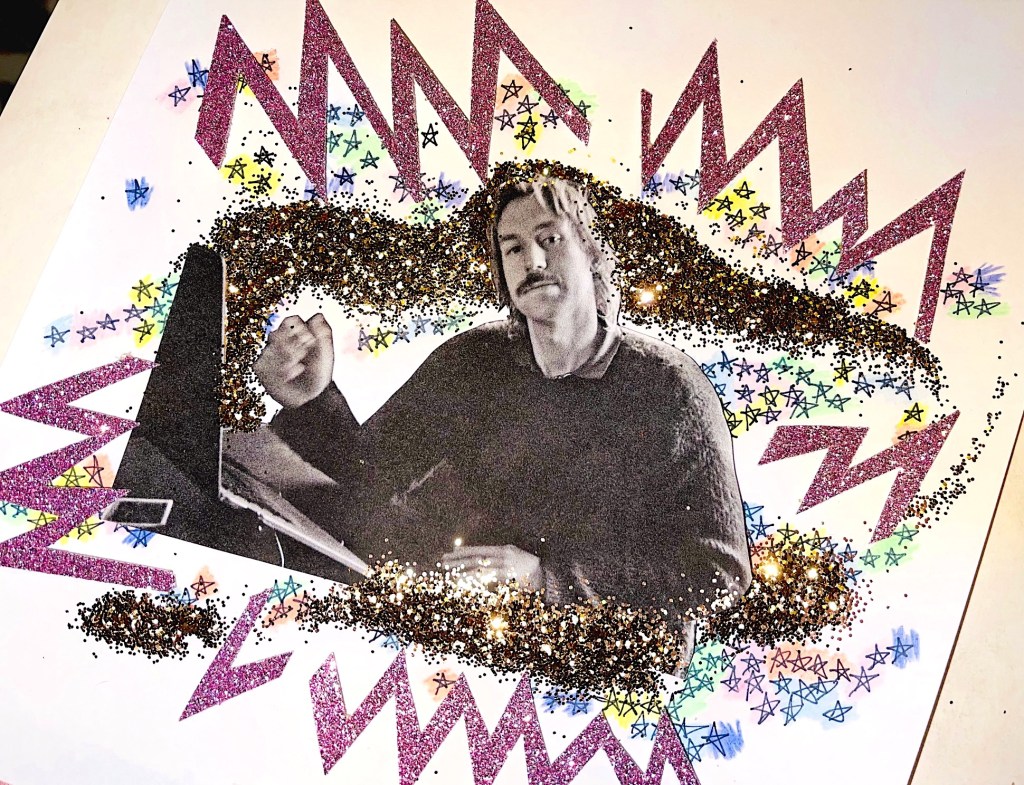
It’s amazing how much music can shape people’s experiences, emotions, and connections. It’s its own language that transcends words, and I love helping others explore and articulate their musical thoughts. 

Do you play in a band?

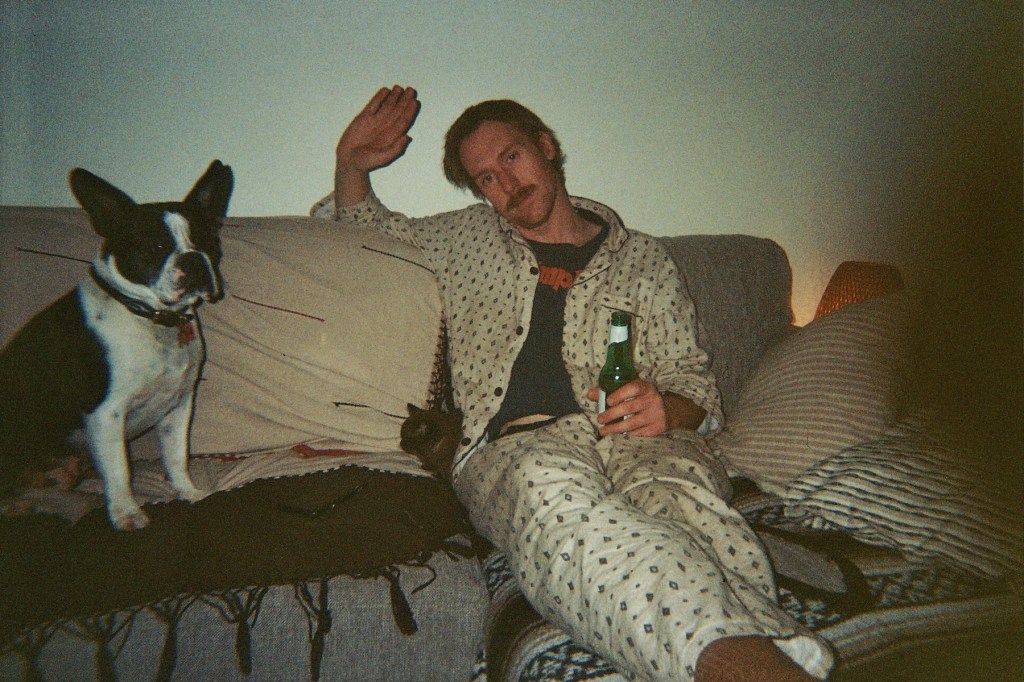
I had bands when I was younger, I’ve made music just for myself my whole life. Jhonny and I have a little project we’re working on just because we love making stuff together, it’s fun. Jhonny has taught me so much about creativity, and helped me overcome self-doubt and to learn to trust myself, and to play and explore. He has some of the coolest and most beautiful ideas about creativity. I feel so lucky to spend every day with him. I wish more people knew just how brilliant he is.
COCO: That’s cool! Yeah, I totally get what you’re saying. Certain songs I write, when I pick up my guitar, a lot of the time, I’ve got songs from years ago. I don’t know if I’m ever going to use them or whatever, but they’re there, and I enjoyed writing them. Just being there with your guitar or your amp or whatever it is—or sitting on the drum kit and playing the fucking D-beat for as long as you can!

I remember having this taxi driver once. I told him I was a drummer, and he’s like, ‘Oh man, that’s really cool. There’s just something so human and so real about drumming.’ I reckon at the end of the world, there’s this guy sitting on a mountain playing 4/4. I’m like, ‘Dude, I totally believe that.’ It’s like the strangest, silliest, most poetic thing. Once he said it, I’m like, ‘That’s it, man.’ [laughs].
There’s just something about music. It’s profound because it doesn’t make sense to other animals. It barely makes sense to us. The reason we have our own connections with it, a lot of it, is in us and inherited—whether it’s culturally or biologically. It can easily get mystical, and it’s really hard to understand why it makes us feel the way it does, but you know it does. That’s why you pursue it, I guess. Sometimes you just have to fucking say, ‘See you later’ to that logic and rationale and whatever, and try to understand things or break things apart. That reductionist thing—it’s like, fuck, it’s real. Go for it. I’m going to be in that realness, because it makes me feel better than almost anything.

Absolutely!

COCO: I’ve had a few epiphany moments. Some have been without so much thought or words. It’s this experience, like I said, with encouraging people to play music or do whatever. It’s often said of any spiritual pursuit—more enlightenment in the East—I can’t give that to you. Like, even if I had enlightenment or I had the meaning of life or I had this understanding, if you ask me the question, the answer I give you isn’t then going to convey that knowledge or that same understanding to you. You have to just experience it for yourself.

With life-changing moments, that’s a really similar thing in that it might be impossible to convey. But some of how it happens is often this sense of a sort of ecstasy and interconnectedness and maybe synchronicity. I mean, the good life-changing moments, not the absolutely awful ones that shatter your world. But again, they’re actually quite fucking similar. They just feel a lot worse, I guess.

But it feels like everything has conspired to meet in this moment, and it just happens, and it takes you away from everything else. You feel it in your body, in your mind. The beautiful ones, they often follow a lot of similar patterns. Often things happen on a whim, maybe slightly unplanned. They’re always unexpected. There’s not necessarily ingredients or a mathematical formula that you can put in and the result is a big life-changing moment. These things happen, and one leads to another, and all of a sudden, you find yourself in this state of sort of awe. You feel fulfilled and completed in that moment, and perfect. It’s like you couldn’t be any better. You couldn’t be any more perfect. Things are exactly as they’re meant to be, and it’s that weird, sublime feeling that culminates.

I know exactly what you’re talking about, I’ve been getting that feeling every step of the way making this book, Conversations with Punx, that we’re chatting for. Most of its journey has been synchronistic, and one path leads to the next. It’s all been intuitive. Each conversation I’ve had for it, I’ve walked away with something that’s helped my own life be better.

COCO: That’s one of the rewards for following your own path and going on your journey and doing that thing that is you—being real to you and being nothing but yourself. You totally get that. It’s you and the universe interacting. It’s hard to explain. It’s like, right now, if I look out my window and I saw a fucking dove fly past carrying a rose in its beak, I’d be like, ‘Wow, that was…’ and I tried to explain it, and it’s like, well, what? It was just a bird, you know? But it was more to me. It’s really hard to convey those things to someone else. But when you experience it, it’s like, you realise this couldn’t have happened unless I took that step that I took and the one I decided to take before that. If you take that step, something else happens and meets you. That journey—is the dance of life that people talk about. It’s good to be an active participant in that. 

You have to put a trust in yourself and back yourself. I had to do that with this book. Especially in the beginning, I’d tell my friends what I was working on and a lot of them would be like, ‘Punk and spirituality? Religion! Fuck that.’ They totally did not get it. 

COCO: Yeah, there can be all these outside things when we do stuff that will try to discourage you or not get what you’re doing. You’re definitely not alone in that. But then you keep going, you do you, and you meet people who do get it. It helps give you this affirmation or indication that what you’re doing is what you are meant to be doing. That’s a wonderful feeling.

Yeah, absolutely. If I didn’t keep going, we wouldn’t have had this conversation, I wouldn’t have got to have such an epic chat with Dan Stewart (Straightjacket Nation/UV Race/Total Control) last week, and I wouldn’t have had a the beautiful chat I had with HR (Bad Brains) a few weeks ago. Or anyone else in the book. I still can’t believe I get to make this book! It’s wild.

COCO: I’m dying to read them! 

I can’t wait to share them with everyone. HR was really lovely. Talking to him can be a bit of a roller coaster. I’ve spoken to him a few times over the years. It went a lot better than my chat with Dr Know from Bad Brains, who was condescending and difficult and he kept calling me ‘baby girl.’

COCO: It’s a weird one when you realise that with some people, their creation and who they are, they’re different things. That’s what they say about meeting your heroes sometimes. Maybe people need to not expect the wrong things of people. They are just people. They might be dicks but they might have made something that I may find inspiring and powerful. But if I had a beer with them I might not get along with them but that’s okay too. 

Of course, I don’t always agree with what people do but I like their art. I don’t vibe with people being condescending, though. To me, being called ‘baby girl’ is demeaning, I’m not a fucking child. That brings up the conversation of separating artists from their art. Why sometimes we can do that and sometimes we can’t. 

COCO: Some people, unfortunately, are just a bit horrible to women or outsiders or whatever they might perceive that to be, and that’s a shame that, I guess, we live with. People are fucking complicated. 

I’m glad that HR was cool. Bad Brains, to me, they’re the greatest hardcore punk band of all time. I still, after all the years I’ve listened to stuff and gotten into the best, most obscure bands—whenever that conversation comes up, like the top five bands—it’s easily Bad Brains. They give me everything I want from this music. There’s something really otherworldly and powerful about what their music did.

They’ve had every type of punk and hardcore in their songs. Their performance was amazing. The way it can make you feel—they had you in the palm of their hands. They often said they were channeling stuff. For HR to be able to do those fucking backflips at the end of a song and land on this feet on he last beat—what the fuck, man? That’s crazy. The dude’s not a gymnast. He’s not an athlete. He’s not going to the Olympics. It was this other energy going on, tapping into it and being a part of it.

And that’s why they’re so enduring. We even talked about some of the controversies, like the song ‘Don’t Blow Bubbles’ being anti-gay. He said that at the time it was him following his religion; Rastafarians are known to be homophobic. He said that he feels very differently about it now and would never want to do or say something that harms someone. I think that’s a good example of someone growing and evolving. Often in the world, people don’t give others that room to learn and change and grow, they cancel them rather than have constructive conversations. Like, rather than hate on Bad Brains for it, I asked them about it.

COCO: Totally. We’ve all said and done bad things in the past, and unfortunately, a lot of us will say and do bad things in the future. But when you can come around, realise those things were mistakes, and understand on a deeper level why they were hurtful, it’s part of growing, being yourself, and experiencing the world around you.

Bad Brains were from America—a weird place. D.C., New York, and whatever were weird places at the time. A lot of stuff, like homophobia, was unfortunately really normalise. These strange societal norms can culminate in bad behaviour that maybe wouldn’t happen now, with the benefit of hindsight, growth, and progression. Through conversations and new perspectives, we kind of go, ‘Oh yeah, I don’t say that word anymore. I don’t treat people different from me that way anymore because I realise it’s fucked up.’

That’s really important, especially with all the cancel culture nowadays. Education and thoughtful conversations with people can change lives, open them up to new perspectives, and hopefully, ultimately help make things better for everyone.

COCO: It all comes down to whatever your thoughts and beliefs are. The things that dictate your actions have to come down to effectiveness. If you’re going to shun someone for a certain thing—a word, an action, or whatever—maybe that’s the best way to go about it. But I think, in a lot of cases, it’s not actually the most effective way of dealing with the issue or the person.

Sometimes you need to be more patient with them. I also understand that some people have run out of patience. For example, someone might say, ‘How many men do I have to explain misogyny to? I’m sick of it.’ And that’s fair. In those cases, you might hope there’s someone else who can have that patience and show the person another path. We all draw our own lines in our own places.

That said, there are certain scenarios where I might feel justified in fighting someone or being physical with them. Admittedly, those would be pretty extreme situations—hypotheticals, really. I don’t think it’s the first way to solve problems. But sometimes, it can feel like the quickest and easiest way to get through to someone. For example, if the only way you think they’ll understand is if you hit them, well, not everyone will agree with that approach. It’s a weird one, you know?

People have so many sides to their personalities. It’s not always about being the nicest or the most morally upright. If you look at archetypes throughout human history, war is one of them. Whether it’s a war of thoughts, words, or actions, battles happen everywhere, and we participate in them. Confrontation can take different forms, and that’s okay too. You don’t have to be a pacifist.

Pacifism can sometimes lead to situations where people don’t speak up. I’m not saying violence is the answer, but we’ve all been in situations where someone says something bigoted, and we bite our tongues or walk away. Later, we feel terrible for not saying anything. You end up thinking, ‘I wish I said something’ or, ‘Why didn’t I stand up for what I believe?’

If you’re in a position to do so, you might ask yourself: did I let them know I don’t agree? Did you say, ‘Hey, that’s not cool’? I get that some people might not feel safe speaking up because it could jeopardise their job, physical safety, or social wellbeing. But sometimes, that fire—that fiery nature—exists for a reason.

If you hear something and feel the need to stand up, then stand up. Use your words first. But if people react badly, it’s a different story. I’m lucky enough to be healthy, male, and confident in my body. I’m not afraid of someone trying to punch or fight me. But I know plenty of people who don’t feel that way, and I understand why they might avoid confrontation.

Still, I think it’s important for everyone to find a way to feel powerful and confident in themselves—so they can say and do what they need to without fear. Everyone deserves to be able to stand their ground when and where it matters.

What’s some things that you believe in? What do you value?

COCO: That’s a big question. Like we’ve touched on, I value being yourself. I value respecting other people and their right and ability to be themselves, without harming others. 

I personally believe in connection. To ourselves, our heads and hearts and spirit and imagination, to each other, to the world around us and inside us, seen and unseen. 

I feel that we are full of potentiality, but I recognise just how much we can be stifled at seemingly any turn. Life will be a struggle for everyone and everything at some point, and every living thing finds its own way of facing this struggle. It perhaps is fitting to include something which I wrote on the anniversary of the death of a musician near and dear to my heart. 

In recent times a lot of us are coming face to face with ourselves; with our bodily health, our mental health, our wellbeing and what that truly means. We are confronting our own framework for caring for ourselves and each other; our existence, our mortality and what that means. I am reminded that each and every one of us have something wonderful to offer and many truly rich things to experience. I am reminded, and would like to remind you, that by pursuing our ambitions we can also reach and impact others in a way which is meaningful, mighty, magical and immortal.

We have to look out for each other and take care of each other and support each other. 

The societies and cultures we find ourselves in say that they value people becoming and being their best selves but instead their collective actions show us, and what we perhaps sadly see more commonly, this ruling class sanctioned sort of life which values a certain order and commodity structure which really does not have everybody’s best interest at its heart. I imagine it’s been this way for a long time. I think this is where we find people gravitating towards an underground culture or a community which people can be a part of where in its best or ideal instances will dictate its own values and nurture people in its own way. Whether or not it’s perfect, at the very least it’s an alternative, and it’s often the lesser of many evils for a lot of us; a step in our own direction. 

I have respect for the natural world—all the critters and creatures out there in the land, sea, and air, and the plants. We just get in touch with who we are and what’s real in the world—that’s really important. Stay up all night, watch the sun go down, and then watch it rise again. There are all these things that help us find our own values through our experiences. We have to work these things out for ourselves.

Like any of us, it’s the things that lead to joy and fulfilment. I’m not talking about cheap joy or fake things. There’s a lot of weak, weak pleasures out there—stuff that’s just not worthwhile. Again, we will draw our own lines there. I’m talking about a healthy way of leading to satisfaction and joy, and bringing love.

A lot of the time, we circle back to when we were angry about something, or when we feel the need to fight, shout, or rebel over something. That often comes from a place of love too. If you hate something, it’s because you love something, whatever that is. It’s just about working out why that is and understanding it. And guiding yourself from there. Sometimes you might get angry over something, and it might be like, ‘Oh man, that’s because I love my comfort, and now something’s going to happen and inconvenience me.’ And now I’m really angry. It’s like, well, shit, man, that’s not really worthwhile, is it?

Anything else you’d like to share?

COCO: We all should be valued, but those weird lines about where you are, what you do, and whether that’s considered valuable or not in scenes really bum me out sometimes. Some people that are known and popular get treated better than others, especially in underground music. It bothers me that some people get a pass, and all this adoration—or whatever the fuck it is that people suck up to—while someone else, who’s a genuinely nice person doing cool stuff, doesn’t get noticed or respected the same way. They don’t get treated equally, and that really does bother me.

That bothers me too. It’s weird that even in underground music communities there’s a hierarchy and it’s about popularity. And I’ve never bought into liking something because everyone else does, often it’s not the most popular things that are the raddest. Doing Gimmie we know so many talented people that consistently put out great, great work but it largely goes under appreciated. If you were to look at mainstream music publications or even indie blogs etc. in this country as a guide of what is happening in Australian music, you’d think it was fucking lame. But we know there’s a whole underground making Australia one of THE best places in the world for music right now.

COCO: Totally! The world is a richer place because of people like you guys doing your thing and sharing stories with ideas where artists are equal, and through your words promoting meaningful, worthwhile things to the world. We’re all better off because of that. Gimmie adds so much value to our community and the world. I totally believe in that.

LISTEN/BUY Romansy here. FIND/EXPLORE Lulu’s here and Cool Death Records here.

Fun facts: Around the time of our chat, Coco was listening to MMA and philosophy podcasts, a lot of obscure black and death metal (including the latest StarGazer (SA) LP, Psychic Secretions), some country blues, and Pop Smoke and Stormzy. At the gym, he was rolling with the (then-new) EXEK and Low Life records and thought the new Romero LP was “smashing.” He’d recently picked up the Sick Things 7”, which he enthused was “a total ripper.”

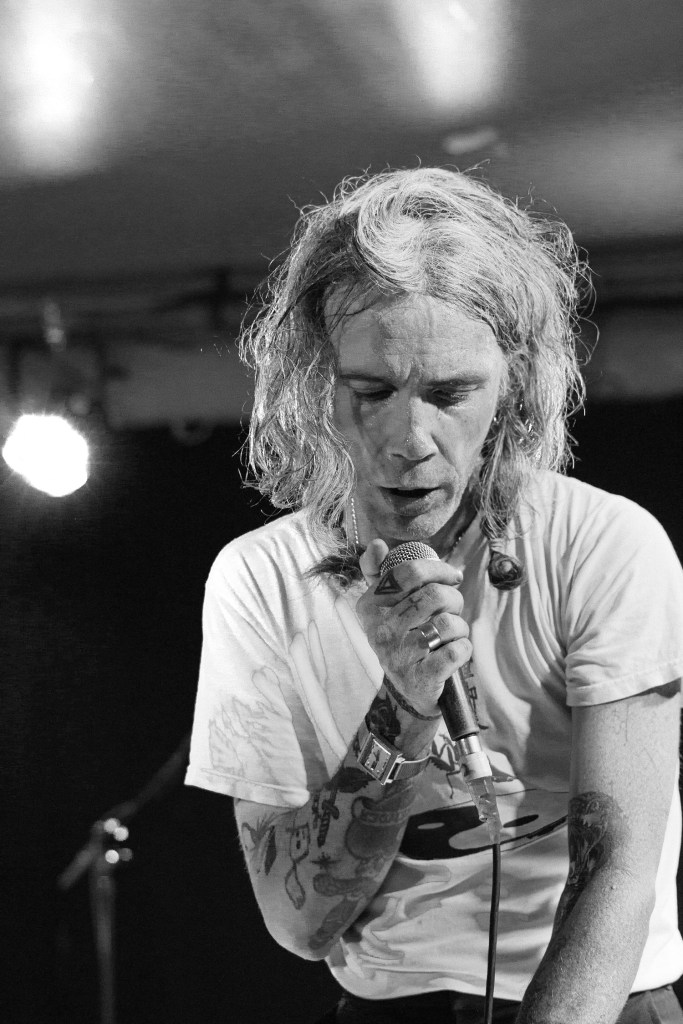
Lost Animal: ‘I don’t want to sound like anything else.’

Photo: Jhonny Russell / handmade collage by B

To us here at Gimmie HQ, Jarrod Quarrell, creator of Lost Animal, is one of the most underrated songwriters in Australia and one of our all-time favourites. He creates poetic expressions. His work is very interesting in a highly original way and richly emotional. The songs reveal themselves more over many listens and always feel fresh. His powerful, beautiful, transformative, and unforgettable songs possess the vast depth of the human spirit. Last time we were in Naarm/Melbourne, we met Jarrod in Fitzroy Gardens, a historic park lined with elms and autumn leaves, to chat about life, feeling good, and the music he’s working on in his own time.

It meant a lot to have this chat—enjoy!

Thanks so much for meeting us today! We’ve been having such a nice time in Naarm/Melbourne. It’s always such a pleasure to come down here for Jerksfest out in Djilang/Geelong, Billy does such a wonderful job. It’s nice to explore the city too. We went to a shop that sold all these old movie day bills. We got this awesome Breakin’ one!

LOST ANIMAL: Breakin’ was one of my favourite movies as a kid. I was in a breakdance gang in Papua New Guinea called, The Rap City Connection. 

That’s awesome. Do you reckon you could still do it. 

LA: I’m sure I could do a dolphin dive or something. Might hurt myself, though [laughs]. 

I’ve always loved breakdancing too, but I was so bad at it!

LA: Well, yeah, I was the worst in the game. They were all legit dudes in Papua New Guinea. They had afros, were good dancers, and did helicopters and headspins. I couldn’t do all that. 

How’s life been lately? It seems like you’re in a really good place.

LA: Life’s really good. I’m making a new record, so that’s probably got a lot to do with it. Always happy when I’m making tunes. I’m very well. Thanks for asking. 

I remember you saying once that, ‘Music on records I make, are a fuck you to the bad things in my life.’

LA: Yeah, I guess. The new music feels like I’ve transcended all that shit and I’ve finally got to a good place, where I can just be good and make tunes.

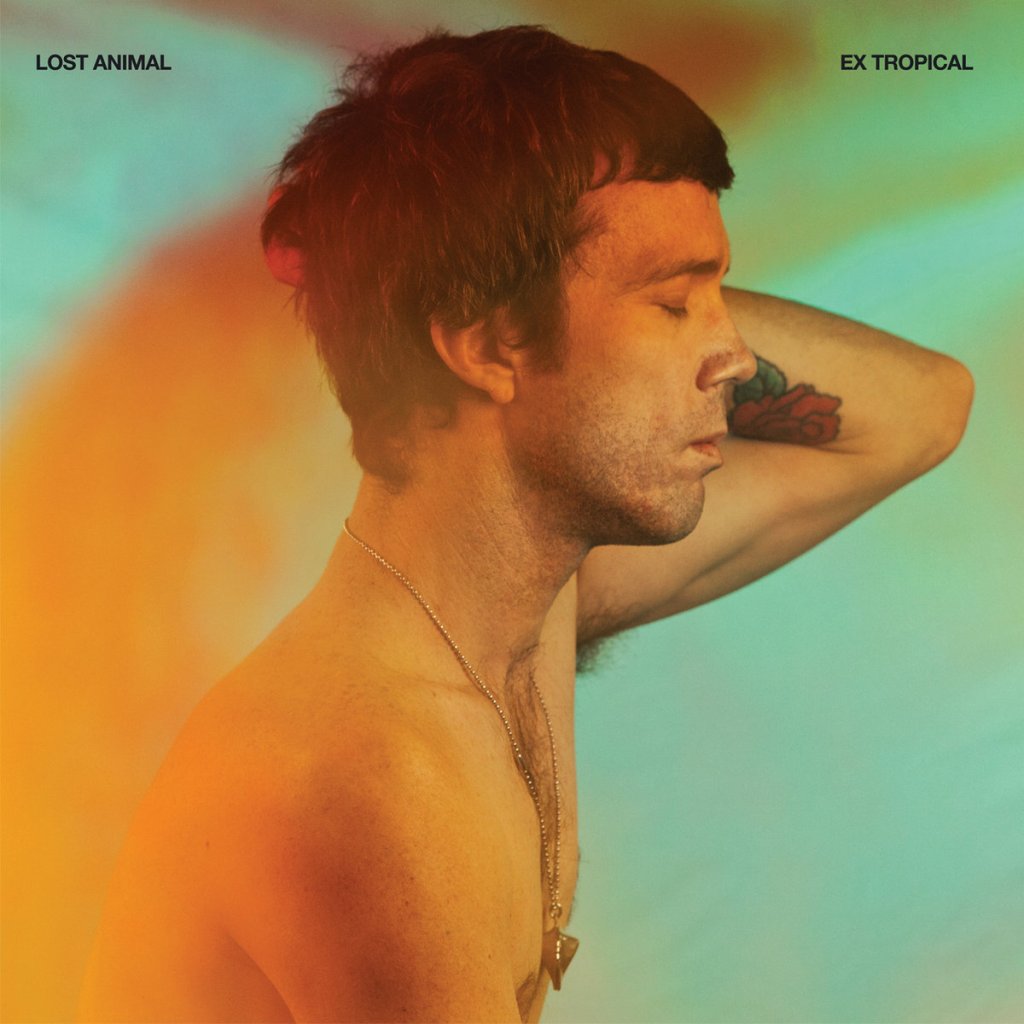
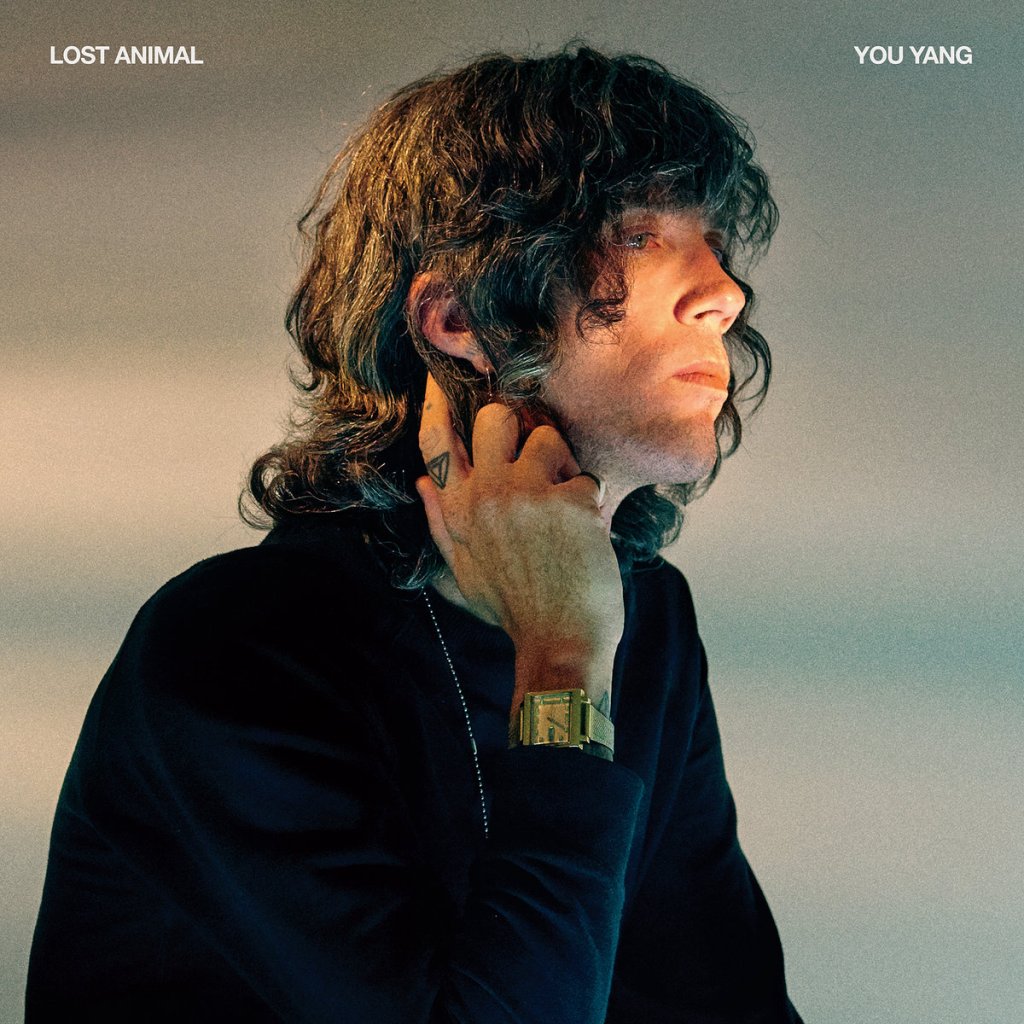
I was talking about it to a friend recently. Those were dark times for me—those two records, Ex Tropical (2011) and You Yang (2016), were hard to make. It was my spirit trying to get out, trying to shine through when I wasn’t well, trying to overcome all the shit that gets you down.

The music you created before Lost Animal was darker as well?

LA: The lyrics are a bit dark. I always wanted Lost Animal music to not be dark; I wanted that to be up. 

When I listen to a lot of your songs, even though they are dark lyrically, the music is uplifting.

LA: Yeah. You can dance to it. Lyrically, it’s hard to write songs about feeling well, I’ve found, without sounding like an idiot [laughs]. I’m rewriting lyrics a lot on this record. Like, I write them and think, yeah, that’s it. Then I’ll go to record and think, is it because it’s cheesy? Or not because it’s cheesy—just because I want to nail it. I really want to get it right. I’m more engaged. I am happy making the effort, happy just doing it.

What are the things that have helped you be more engaged? 

LA: Therapy. Psychedelics. Music.

Jerk Fest last year was probably the impetus for it all. When Billy asked me to play, my instinct was to say ‘yes,’ but I kind of didn’t want to do it. Even up until the day, I didn’t want to go. But then I had a great time and really enjoyed playing. It dawned on me how lucky I was to be able to do it, and how fortunate I was to be asked to play good shows like that, six years after putting out my last record. It hit me. Then, around that time, I started feeling better. I found a good therapist after searching for one and going through a few bad ones. That gradually led to writing the right tunes.

I started a side project with a friend, Stuart from Primitive Calculators. That really helped with the playing. I was always just a songwriter—I wrote, and I was a front guy. So it was really good to just play. All those things combined put me in a better place.

Photo: Jhonny Russell

Jerk Fest is a pretty special event. It’s such a great opportunity to see so many bands play, and catch-up with people.

LA: Yeah, that was part of it—nice people saying nice things.

We were so stoked to see you play! You mentioned being asked to play shows six years after you put out your last record, those albums are timeless. You could listen to them today, and they still sound so fresh. I don’t know anything else that sounds like that. 

LA: That’s cool. I’ll take that [laughs].

We love that there’s so many different elements from all over the place. I know you’ve got a punk rock background and like you were saying there’s a love of hip-hop, and then there’s rock and electronic elements.

LA: That’s where the new record is. It’s kind of along those lines but maybe a little less electronic. Lost Animal, to me, has been beats and piano chords, songs built like that. Now it’s just become a bit more jamming in one key and building songs around grooves and little riffs rather than me writing songs. Then they turn into songs. It could go any number of ways. I was trying to make it go that keyboard chord way, and it really wasn’t working.

We had two songs we were working on that I thought were shit. Then I wrote one that was good, and four months later we had the whole record. You Yang was mostly written in the studio. I had a handful of songs I’d written. So for this record, I was like, I’m never going to do that again. Because it’s expensive, taxing, and stressful, but I really like doing it—almost writing songs to tape.

Before, I’d always done demos to write. With this new record, I got to a point where I’d written a song and recorded it, and then we had nothing else to do, so we wrote two songs in a day, Dan Luscombe and I, who I’m making the record with. It’s been written in the room together. I’m usually the impetus, and he’s the finesse guy, making me redo things or asking, ‘How about you try it this way?’

Are you ever surprised at how he finesses things? 

LA: I’m surprised at everything. I try to say ‘yes’ to everything he suggests and just try it. If I don’t like it, I’ll tell him later. But I don’t think it’s come to that. I’m less controlling now. There’s co-writes with him; I’ve never done that before. Maybe once with Shags [Chamberlain]. 

So you’ve been more controlling? 

LA: Yeah, way more. Now, I feel like the less I try to control things, the better things are. And if you’ve got a talented person in the room that wants to do something cool, you should probably shut your mouth and let them do it.

He’s the man. He finessed the fuck out of Amyl and the Sniffers for their latest album. 

LA: Was it a big change? 

Yeah. He really brought their sound together. Comfort To Me is miles ahead of their other releases. Sonically it sounds really big. It’s so cool seeing them progress as songwriters too.

LA: Dan’s got really good taste. He can play anything. He’s got that classic songwriting sensibility, but is open to stuff. He’s played with everybody. 

I remember a post you made on Instagram a while back and at the time you mentioned you were exploring Middle Eastern scales. 

LA: Yeah, because I never learnt how to play. 

You’re self-taught?

LA: Yeah. When I started this thing with Stuart, because it’s a guitar duo, I thought, ‘I better brush up on my guitar playing.’ I loosely learned different scales from around the world, but mostly I stuck to the blues minor pentatonic. Most of the new record is in the blues minor pentatonic, which is the first thing everybody learns.

I’ve kind of grown up on some basics, and that was enough because I’ve been playing for so long. My playing feels pretty good. Even if you’re not trying to learn, if you play music for 30 years, you’re going to learn.

How many songs do you have? 

LA: Right now, we have 10. So we’ve got an album on tape. They’re not all finished, but they’re all pretty much structured up and I’m writing the lyrics.

Do you usually write lyrics afterwards? 

LA: Yeah. If I demo something, often there’ll be a phonetic vocal line, so sounds or sometimes, whole lines will jump out. But I often don’t finish writing the lyrics until all the songs are done and it’s time to put the vocal on. Sometimes a whole vocal will just fall out with the song. But generally I’ll wait till the end because it can change. And there’s always a better fucking line.

Is there any lines that you’ve written at the moment that you really love? 

LA: Yeah. Some say that life’s a game, it’s just a setting. Some but life’s a bowl of berries, so come get some. I wrote a really trad soul ballad, ‘The Sun Cleared the Rain’ which I’m really proud of.


Was there anything in particular that inspired that one? 

LA: I was just writing a song. I was sitting playing keyboard. It was one of those things where I’ll mumble it a line, and it just all fell out of my mouth. I was listening back to it. Sometimes that happens, but it’s really rare. It kind of feels like channelling. You’re not really thinking about it too much. Trying not to think about it. I try to not direct it and not control it. I try to let it come and to recognise what it is and let it become that. 

You’re really great at writing narratives.

Narratives? Really? I don’t feel like I write that, really. I feel like I’m a surrealist. It’s just feelings. But sometimes they do turn into stories. ‘Lose The Baby’ is a little bit like that, I guess. But ‘The Sun Cleared the Rain’—that’s kind of just telling. That’s a narrative. There you go. It’s about when you need something and something comes along into your life, but it’s not necessarily great for you. It’s quite relatable for everyone, I think. Very universal.

What else are you writing? 

LA: There’s a song called ‘On A Bird Now,’ which is about transcendence—about turning into a bird. I wrote it when I got back from Indonesia. I was trying to write proper haikus: five, seven, five syllables, which is fun. And that led to that song. We just pressed record. It was a weird way to record a song. That’s fine. It’s just about being in the now, transcendent. Maybe a bit psychedelic. Maybe a bit witchy. 

I noticed in a story on Instagram you posted a photo of a book on the occult.

LA: I am reading those books, yeah. I’m just a curious guy. I like to read. It’s too early for me to talk about that stuff. I’m learning. But it’s definitely not what people think it is. It’s an occult universe, for sure. There’s more out there that people don’t get. 

Totally. So many unseen things!

LA: Yeah. I guess that’s what the record is about. 

You mentioned Indonesia, I know travelling there recently inspired you. You said you cured your insomnia while there.

LA: I don’t know what it was. Maybe the weather; it was the wet season, balmy, raining. Maybe it was because we were busy doing a lot, and I wasn’t concerned about shit. I was with my godson and my best friend, so I was chill. I was fucking glad though, man, because when we left, I was literally sleeping two hours a night. It’s fucking horrible. At home you’ve got your routine, your comforts when you wake up in the middle of the night, you don’t have that shit when you’re away. So that was a challenge. Gradually, like a week into the trip, I started sleeping better. By the end of it, I was sleeping 8 hours a night. 

How did that feel? 

LA: It felt amazing. I cried with happiness, a few times, on that trip because I was just so relieved to be out of the country and to be sleeping. I used to live in New Guinea, and the smells are the same, the weather felt the same, it brought a lot of things back. It was very emotional. Also lots of fun.

Was there anything in Indonesia that you saw that was really cool? 

LA: I saw the fucking devotion. Because there’s Hinduism, there’s Buddhism, there’s Christianity, there’s Islam. Hinduism especially seems really just present. They put out offerings every day. Light a candle. They’re more present. It’s so chaotic. But the chaos kind of works. I thrive in chaotic places.

I felt I got mega-stressed when I got off the plane back here. It was a culture shock. It was just like, oh, fuck, this again. Back to all that shit. I was cool, though. Went back in the studio, wrote two songs, wrote two songs a week after that.

You asked me what I liked about Indonesia? Probably the sense of connection. It just seems so fucking ancient, too.

Is there any other places you feel really connected to?

LA: I feel kind of connected to Castlemaine, because I was born there, and conceived there. But no, not really. 

You mentioned that a lot of your album and just in general, your life lately, has been about being present. When did you first start noticing that?

LA: Therapy. She helps sort me out. 

A good therapist makes all the difference. I’ve been through some terrible ones. 

LA: Yeah, well, the first ones I went to were. She spoke to me for half an hour and then prescribed me something which made me feel awful.

This lady I’m seeing now is a psychologist, so it’s just talk therapy. A little bit reiki as well. So feels me out. Sometimes if we get stuck, she does tarot. In a nutshell she was like, ‘You’re awesome. Just be awesome.’ And I was like, ,What? I’m so fucked up. What are you talking about?’ It took me months to get on that. 

I guess the therapist could see beyond all the stuff you’re hung up on to see that real you, which IS awesome! 

LA: As soon as I walked in the door, she could see what I was, and what I’d forgotten, or it was a flickering flame, and she put that in me back there.

That’s so great! Do you have any thoughts on what your album you’re working on might be called?

LA: Yeah. A Dragon Ascending Toward Heaven

Where inspired that? 

LA: A friend did my my birth chart when I was 21, and he was like, ‘That’s what you are. You’re a dragon ascending toward heaven.’ I was like, ‘Okay!’ [laughs]. 

I was going to call it I’m a Bird Now. But we were recording the song and Dan’s like, ‘There’s an album called, I’m a Bird Now.’ Luckily, I’d already thought of the other title, and decided to call it that.

I think that one’s seems really fitting. That’s exciting! I’ve got goosebumps as soon as I heard it. 

LA: [Laughs]. It suits it. 

Have you thought about cover art yet? I know you paint, have you thought of painting it yourself? 

LA: I won’t paint it. I haven’t been painting much. I tend to do other things like that if I’m not writing to try and have an outlet. I’m not sure what it will be yet. The last albums have been a side profile shot, maybe it could be a side profile shot of an animal or a bird. I did some photos with a friend, and one was double exposed, that looks really good. 

Have you tried anything different on this album? 

LA: I’m playing a lot more guitar. I’ve be singing a bit more rather than just sort of the talk singing I do.

Is singing something you’ve always done since you were little? 

LA: Yeah, I always wanted to be a singer. Always wanted to be a front man. 

Who was the first performer to inspire you?


LA: Michael Jackson. No one’s done it like Michael Jackson has done it. Maybe Prince too. 

The first people that made me think I want to do that more, was maybe Bob Dylan, and songwriters like that. Dylan is a big fav. If I could write songs like he’s writing when he’s fucking 85 or whatever he is, that’d be cool. I just don’t want to sound like that, though. I don’t want to sound like anything else. 

That’s the best thing anyone can do—not be a replica of something that already exists. That’s the highest achievement you can get. 

LA: I think so. People ask me, ‘What kind of music do you make?’ I just say—good. I refuse to describe it. I can’t describe it. That’s all a little bit stupid. 

Most reviews these days should just be called ‘comparisons’ because that’s all they do. But they’re really bad with the comparisons. I find that a lot of people who write about music don’t have many reference points; they have a real limited knowledge and just compare it to something popular, even though it doesn’t sound anything like it.

LA: Oh, man. You shouldn’t seen some of the comparisons we got in America. One said we were a cross between Pearl Jam and Gorillaz. I mean, yeah, there’s a little bit of dubby stuff and melodicas and stuff. It’s like, ‘Okay, your record collection is big Billboard Top 20 stuff, right.’ I used to get really annoyed at all that. I’ve just let it all go. 

I used to go see a psychic, and I’ll always remember a piece of advice she gave me: what other people say about you is none of your business. 

LA: Very true. Yeah. My therapist really helped me with that.

You don’t want to take on that energy they’re putting out there. It really has no effect on you unless you let it. 

LA: Yeah, totally. 

Or people will say something to you and they haven’t even really thought about it much, but then you take it to heart and it’s a big deal for you and upsets you, but it doesn’t do a thing bad from them.

LA: Yeah. And perception is a funny thing too. A lot of times someone has been a bit standoffish and I thought, they haven’t liked me. But it’s come to pass that they’re just a bit shy and actually admire me. Sometimes your perception is off of what people think.

Some people definitely mean it, though [laughter]. I always take people on a case by case basis because sometimes you can hear things about people, but then whatever your interaction is with them could be different.

LA: Yeah, it’s a good way to be. 

In front of us is, over there, is a fairy tree apparently and it was created as a place that is sacred and safe and it’s a place for kids to imagine and dream. I was wondering, do you have a place like that? 

LA: Yeah. 

Where’s your fairy tree? 

LA: In my mind, my consciousness is my fairy tree. 

Do you meditate?

LA: Yeah, I meditate. I’m reading a book on Astral travel, which is basically a form of meditation. 

I’ve meditated on and off for about 20 years. I find it really useful, especially for my mental health.

LA: I did a short course on Transcendental Meditation. They gave me a mantra.

I’ve always wanted to try that. 

LA: Just make up your own. 

Really? 

LA: It’s like, we know what to do. Just make up your own mantra, really. That’s all it is. I changed mine because I didn’t like it. It didn’t feel right. I was like, well, fuck that, I’m just going to change it.

And then it felt right?

LA: Perfect. Yeah. 

That’s very punk rock! [laughter]

LA: [Laughs] Well, meditation is pretty punk rock, I guess. 

Photo: Jhonny Russell

Has it helped with being present?

LA: Yeah. Or maybe not. No, it definitely does. I’ve been thinking about meditation. People think you’ve got to quiet the mind. That’s not it. It’s like getting away from your mind—like, consciousness is here, it’s not in there. It has to be nothing. I feel like that’s what I’ve seen. Consciousness feels like that. And I feel like I’ve got consciousness on multiple levels. My instinct feels like it’s here. My intuition is in my solar plexus. Sometimes I can feel things going on behind me, in my back. I’m just starting to become aware of things that maybe I had little inclinations towards and maybe ignored. I’ve looked at these things in the past but never stuck to them, never really put them into practice in any kind of way. I’m becoming a bit more disciplined about it, being more disciplined about my mental health and doing what it takes to protect it. If I’m tired, I rest. If I’m stressed, I don’t go to those places that stress me out. Hard-earned lessons. Same mistakes made over and over again.

A lot of stuff in Buddhism and different spiritual texts, say that you’re just going to keep learning a lesson over and over and over until you get it.

LA: Yeah, that makes a lot of sense to me. 

And then if you get it—you level up. 

LA: Yeah, I think so. 

It’s so good to see you healthy and it’s such a good place and making music. Like, you mentioned to us before that you were thinking, you have this opportunity, you’re still here to make music, you can do this! 

LA: Yeah. I realise that’s a great thing about music. It’s not like we’re the people that are going to come up with the thing that’s going to save the planet, but it might be the people that write the song that inspires the person that saves the planet, and that’s enough. Just play your part and do it the best you can. 

I love that when we make a song it can inspire and go places that we may never go, and affect people in ways we’ll never know.

LA: Yeah. I get people write to me all the time, from Europe and America. Or they’ve heard, Tropical Fuck Storm do my song [‘Lose the Baby’] and they reach out to me. So, yeah, it’s beautiful. 

How did you feel when they did your song? How did it come about? 

LA:They told me they were playing it. Dan was still in The Drones; they’d done a side project thing and played the song a few times, so I knew that. Then Gareth wrote to me and said, ‘Look, we’ve been playing the song, and we want to put it on a 7”.’ I played it with him a couple of times. It was cool.

I was in a band called St. Helens. Towards the end of St. Helens, I’d started Lost Animal and had written ‘Say No To Thugs,’ ‘Lose The Baby,’ and a bunch of the songs on Ex Tropical. I thought, oh, maybe I should give them to St. Helens. So I tried them in St. Helens. The St. Helens version of ‘Lose The Baby’ isn’t too far off from the TFS version. It’s a long version. To me, the TFS version just sounded like the St. Helens version, but they wouldn’t have heard that. Gareth is a great songwriter, and he wanted to do my song—that’s cool.

Both you and Gareth are my all-time favourite Australian songwriters.

LA: Oh, really? 

Yeah, for real!

LA: I’m playing on a song of Gareth’s next week. He’s reissuing his solo album, he’s re-recording a song. 

Awesome! I know you grew up in the bush, like country Victoria, and Papua New Guinea, and you lived in Geelong.

LA: Yeah. Castlemaine too. Some other places, and then I moved to Melbourne when I was 21. 

Why Naarm/Melbourne?

LA: When I was a teenager, Geelong was awesome. Heaps of fucking great bands three to four nights a week. 

What bands did you see? 

LA: Bored!, Magic Dirt. There was Warped and She Freak, they were Geelong bands. There’d be bands that tour, like, Meanies, and Hard-ons. And then international bands. Especially back in the 90s, like Shellac and Fugazi. They’re probably the best live band I’ve ever seen, as far as energy goes. 

We love those bands. I saw Fugazi when I was younger and they were incredible. When you play, is there a kind of, like, energy that you try to bring? When we saw you play at Jerk Fest, you brought a really cool vibe to the room.

LA: I just try to be open. I try to give as much of myself as I can and not hold back. 

When you first started doing Lost Animal, that was the first time you were playing with a backing track, and I understand that was challenging in the beginning?

 LA: Yeah. I used to shake.

Really? Wow. 

LA: Yeah. But that’s what I wanted to do, so I just made myself do it.

It’s good to put yourself in situations that scare you sometimes, I feel like we really grow in moments like that. What are the things that are making you happy right now? 

LA: I’m happy knowing I don’t feel like it’s a struggle anymore. I feel like I could sit down and write a song anytime I want to. I just hope I keep feeling like that. It feels like after this record, the next one will be ready in a year and a half. I’d be very surprised if there weren’t four records in the next five years. That’s how I feel. We’ll see.

I hope your creativity keeps flowing. We’re so here for as many Lost Animal records as you’ve got! 

LA: Let’s hope! I feel good, which is nice. 

Follow @lostanimal_. Listen to/Buy Ex Tropical HERE. Listen to/Buy You Yang HERE.

Conversations with Punx book

Imagine having the opportunity to engage in profound conversations with the creators of punk and hardcore, spanning from its inception to the present day, diving into the most timeless and perplexing questions about life. These inquiries explore forging a path on your own terms, the art of creating something out of nothing, standing up for what you believe in, changing what you don’t like, the ethos of DIY, the power of community and purpose, and the highs and lows of life’s struggles and wins. Plus, the journey of transforming your life and the lives of those around you, while navigating this often tough world. There are moments of clarity, connection, insight, and profound beauty waiting to be discovered in the pages of Conversations with Punx, a book that formed in its own time over two decades.

When I (Bianca, Gimmie’s co-creator) was 24 years old in 2004, I faced a confusing, difficult, and heartbreaking situation. Seeking answers and tools to process and cope with what was happening, I turned to interviewing, something I had been doing since I was 15 through making punk zines. I found answers through deeper conversations with individuals from bands that provided the soundtrack to my life: Black Flag, DEVO, Agnostic Front, Suicide, Bad Brains, Radio Birdman, Crass, Straitjacket Nation, X-Ray Spex, Gorilla Biscuits, Ramones, The Stooges, Zero Boys, The Bronx, Misfits, The Slits, The Bouncing Souls, Minor Threat, Suicidal Tendencies, At The Drive-In, Special Interest, Bad Religion, Sick Of It All, Adolescents, Operation Ivy, Eddy Current Suppression Ring, Poison Idea, Bikini Kill, Youth of Today, Hard-Ons, Avengers, Descendents, Big Joanie, Amyl and the Sniffers, and many more. From these 150+ conversations emerged surprising insights. Maybe the wisdom, resilience, and humanity at the heart of punk can spark something in your own life too and change how you see the world.

This isn’t just another book on punk and hardcore; it’s a book on life. It’s not a documentation of a certain place at a certain time, because punk is dynamic and ever-evolving. It’s not a thing of the past; it’s happening right now in cities and towns all over the world. What you know of punk is not its only story; what you know of life is not the only possibility. Punk is a big wide world with a lot to offer.

The book is limited edition. 450 pages.

Cover art by: Mike Giant

GET the book at: https://conversationswithpunx.bigcartel.com

Cloud Ice 9: ‘The function of art, at its purest form, is to make you not feel so alone.’ 

Original photo by Jhonny Russell / handmade collage by B

Cloud Ice 9 were one of the most interesting bands we saw at Jerkfest last year. Their hard-to-define music is punctuated with unexpected moments. Delightfully wonky, unfolding like a constantly shifting kaleidoscope, each note rearranging itself into new, mesmerising patterns creating a brand-new galaxy for listeners. Their output is immersive and explores the relationship between sight and sound with limited information about them out in the world, beyond their music and videos—until now. We chatted at length with vocalist-guitarist Jordan, and guitarist Reis. They have a great approach to creativity and life, we think anyone could get something cool out of this read. 

REIS: I’m nursing some heartache.

Awww, I’m sorry to hear that.

JORDAN: Things have been up and down. In Melbourne, at least, we’ve been out of lockdown for a year and a bit now. So that initial exciting time of being free and enjoying each other’s company out in the big bad world has sort of simmered down a little bit. It’s gotten a bit more about recalibrating and figuring out one’s general approach to life and your trajectory [laughs]. There’s been lots of changing and fluctuating, mostly for the positive. A lot of people are stressed—money-wise, job-wise, and life-wide. It’s all a little bit turbulent at the moment.

REIS: Definitely. I’d say that there isn’t a single person that I’m dear friends with that is financially secure at the moment. But maybe that’s a reflection on the kind of people we hang out with [laughs]. The general sense of optimism post-COVID has just been crushed by this impending recession and the rise in the cost of living—the whole shebang. As people doing the kind of things we do, a little bit out on the fringes, those waves are definitely felt a lot harder. 

JORDAN: But by that same token, I feel like it’s times like these when it feels like the best things kind of come to the surface and to combat that. Winter is coming, I feel like it’s the best time for people to actually generate interesting, positive things to kind of cope and help them manage.

REIS: Easy for you to say, mate. You’re fucking off to Europe! It’s going to be so hard for you.

[Laughter]

JORDAN: I’ve done my time. I wanted to do some writing and some soul-searching. I’m going to Poland, where my family’s from, and I’ve never really been before. Mostly just to explore and take a break. Spend some time being very present and focusing on where am I going to sleep, what am I going to eat, how much money does this mean in my pocket. Be a lot more day-to-day for a couple of months.

Are you both from Naarm/Melbourne? 

REIS: The short answer is, yeah, We both grew up in Melbourne for the most part. 

JORDAN: I was born in Sydney and moved here when I was four.

REIS: I was born in Turkey and my family came over when I was young. and  have gone back and forth a couple of times. For the most part, Melbourne has been home.

How did you get into music? 

JORDAN: Pretty differently, I guess. Different ages, different times. I’m turning 29 in a month.

REIS: I’m 28.

JORDAN: We went to high school together and lived together for a while afterwards. I got into music pretty young and was learning different instruments. I went to art school and got spat out and felt pretty dejected by it all. It was then that I moved in with Reis, when we were around 23. That’s when we really started making music.

REIS: I was definitely a big fan of music. I picked up a guitar when I was 21. I had a very different musical upbringing to Jordan. Only from punk and hardcore, that level of accessibility, got me to think about it in any sort of serious way. Then I just played in a band and just went from there. It definitely took over my life in a way that I really didn’t expect [laughs]. 

JORDAN: That punk accessibility thing, and what Reis had going, was really inspiring for me. Because, like I said, I was feeling dejected and confused about going to art school and getting chewed up and spat out.

Reis would be in the shed, making music on Audacity with iPod earphones and just really winging it—DIY-ing it. That inspired me to get back into doing things in a way that feels very organic. It felt free from any things you might think you need: the right gear or a sound engineer or this and that. Which can all get quite paralysing because it’s not really always feasible.

REIS: Earlier than that, Jordan literally showed me how to hold a guitar and play chords. I learned so much from being around this guy. What I do would be very different if it wasn’t for him.

JORDAN: Our first project was called, Dingo and Rocco. That was born out of Reis letting me stay at his mum’s house when we were younger. We started playing acoustic guitars together and started writing weird, chaotic love ballads.

[Laughter]

REIS: We’d be busking out the front of the IGA. 

JORDAN: We’d get $20, say, ‘That’s a hard day’s work,’ then go across the road to the pub and get a pint. 

When we were living together in our own place, it became more experimental and bigger. We had a big barn full of Hammond organs and a lot of weird junk we found at tips shops.

REIS: We had a pirate radio station [laughs].

JORDAN: We were experimenting, and Cloud Ice 9 started to form, around 2018 or 2019. It was a fair bit before any thing tangible really came together.

Photo: Jhonny Russell


When you first started hanging out, what were the things you’d bond over? 

REIS: Knowing each other in the high school days, I guess, just puberty blues. 

JORDAN: We liked weird things. When we lived together, we had this huge, sprawling property in Brunswick West with all these sheds; we had heaps of room. Reis had a van and we’d go pick up a lot of weird gear. We had a huge VHS collection too; we were really obsessed with watching old weird tapes.

The experiment and play surrounded with all these different toys, like broken organs and old pump action pianos, and even balloons in microphones of heaps of delay. We just love to play. We bonded through that musically. 

REIS: It felt very insular. It felt like a very small world that we just kind of carved out and spent a lot of raw hours nutting out the details.

JORADN: I liked that it felt like we obviously didn’t have big musical inspirations; what we were doing was far removed from that. Just play and experimentation—that felt like a nice organic process. It inevitably started to take a form. Saying that, we are both very obsessed with Alan Vega and Suicide, and some of those old heads.

REIS: I was watching this interview with Vega where he was talking about some of his sculptures that he’s made, and he has the approach of just making something to make something. I wonder about those kinds of people that are completely unaffected by what’s going on around them—to have such a strong sense of what you’re doing is right. That doesn’t just come with music; it comes with fucking everything. Knowing people that even a salad they’re making is art—it’s a bit much for me, but I like having those people around.

JORDAN: They’re more into the entity and context of the art than the art itself a lot of the time. We both grew up on Brian Jonestown Massacre. I really felt like that was more about that ‘schiz’ dynamic that Anton had orbiting around him. It was more about the life and the headspace and the dysfunctionality of it all—that was more fascinating. The strange creative humans navigating a contemporary civilisation and what comes out of that. There’s a lot of Brian Jonestown Massacre music I could take or leave, but I feel the whole context really adds to it. The same is true for a lot of artists that do inspire us.

When you started Cloud Ice 9, was there anything at all that you had in mind for the project?

JORDAN: It took a long time. It was me, Reis, and Jim in that shed in Brunswick West. It was more about getting stoned and making music that almost wasn’t music. Literally feeling it out and then trying to make sense out of complete nonsense. It slowly formed into actual songs. The songwriting was mostly inspired from books and film. Musically, that stuff was quite intuitive. 

Conceptually, I was obviously reading a lot of Kurt Vonnegut at the time and weird sci-fi stuff. I wanted to write music from the perspective of aliens that had come to Earth, and sort of celebrating the apocalypse. Natural musical influences from Suicide and outside of rock came to the surface too. Essendon Airport.

REIS: Definitely all of that. I felt like when we were starting it, we didn’t really have much of a vision of what it was going to be. For me, it felt like it was a really strong anecdote of a lot of the music that was around that we didn’t identify with—kind of how formulaic a lot of it was. It’s funny because I feel like a lot of people have said to me, ‘Cloud Ice 9 is so weird!’ But I think it’s fairly tame.

JORDAN: I always really liked bands that didn’t really sound like anything else. I grew up on the Gorillaz. Demon Days was the first CD I ever owned. Maybe I can break it down a bit more now, but at the time, it sounded like nothing I’d ever heard. It crosses so many genres and has that world-immersive thing that you do feel like it’s its own entity. I don’t know if Cloud Ice 9 is there yet, but I would love it to create its own world and sort of be able to touch on certain things but retain a certain element of its own thing.

REIS: Ben Wallers and the Country Teasers is a definite influence of that—being reminiscent of something you’ve heard before but completely different.

REIS: Something gone wrong. 

[Laughter]

People keep asking us what bands we loved most at Jerkfest this year and the ones that resonated most were you guys, Red Hell, and Essendon Airport. Then people ask, ‘What do they sound like?’ That’s hard to answer because you all have created your own thing. I believe that you have succeeded in creating your own world.

JORDAN: That’s sick. So nice to hear. We’re about to put out this album of live takes of improvisations that we’ve been recording and archiving over the years. We’ve got hours and hours and hours of nonsensical jams, essentially. No tangible vocals really. We’re casting a wide net. We’ve been playing for a while, and it only feels like in the last year or so, it’s starting to get a bit of traction.

I’ve been describing it as country sci-fi to people/jazz gone wrong. I like that you can’t really describe it. There’s a lot of bands that sound like a lot of bands around where we’re playing. It’s nice to be a bit different, but I guess we also don’t want to become the ‘weird’ band [laughs]. We want to also write good music!

REIS: I don’t think it ever has mattered what we want, it’s just what we do. 

Photo: Jhonny Russell

Jhonny, who I do Gimmie with, mentioned that Cloud ice 9 sounds wonky. 

REIS: Yeah!

[Both nod in a agreement]

JORDAN: I like it when music is kind of a walking pace. I like when the beat is like, dun, dun, dun, dun. It kind of gives it that off kilter thing. 

REIS: Recently, we have a real point of contention in the band, as to how slow to play one of the songs.

Your album Circus St, is your second album. Where did the title come from?

JORDAN: It was just an idea I had that, basically, life, at the moment felt like that. Coming out of COVID. Cloud Ice 9, in general, is about enjoying a sense of liberation in the fact that the world is kind of ending. Circus St was an embellishment on that—life is a bit of a circus. When you walk out onto the street, it can sometimes feel like that, just the bizarreness and ridiculousness of it all. 

It reminds me off, Reis and I, did this interview with this person called Barbara, who’s a puppeteer, and they’re a bit of like an icon around Melbourne. They’d  dress up in a wedding dress, this bearded, ragged old man. We actually got them to perform with us a little before Circus St came out. They would busk. That really coined the idea of Circus St to me, because they were this strange clown on the sidelines of the streets of inner-city Melbourne, reminding you of how bizarre and crazy everything is. The acknowledgment of what Barbara was doing was more genuine than a lot of people that are going into Myer and trying on perfumes, or people in suits late for things. It was that acknowledgment of, it’s all a kind of a strange, mad construction. Circus St came out of thebizarreness of our modern little world that we’ve created. 

REIS: I made a documentary about Barbara.

Me and Jordan also do a little label, which all the Cloud Ice 9 stuff comes out on—Happy Tapes.

JORDAN: We’ve kind of slowly been tracking down curious individuals that interest us. Spend a day with them and document them, chatting, and making little things out of it. 

I spent hours talking to Barbara on the phone after that. Barbara is coming from a similar place. When we went over to do the doco, Barbara was like, ‘Oh, so are you two with the SBS or the ABC?’ We’re like ‘No, we’re kind of like you. We’re weird dudes.’ We bonded over that. 

[Laughter]

JORDAN: They are a very difficult person to track down. 

REIS: The latest I heard was that they were sleeping in their car, and their housemate had just gone to jail. 

JORDAN: They have a pretty unstable world…

REIS: But, hey, who doesn’t?

Photo: Jhonny Russell

Why’d you call it Happy Tapes? 

REIS: It’s just kind of neutral name…

[Laughter]

There’s a lot of ideas in this label. We didn’t want it to be pigeonholed by slapping some sort of like a death metal name on it, or something like…

JORDAN: Spiky Tapes!

REIS: We wanted something that’s open and accessible, like the things we like. 

JORDAN: Not always accessible.

REIS: But fairly accessible. 

JORDAN: Very eclectic. We do a lot of different stuff, maybe to our detriment sometimes. Stuff that we’re interested in. 

What’s something that’s been making you happy lately?

REIS: Music. Me and Jordan did a trip to Vietnam and got some pretty wild cassettes and VHS that we bartered tooth and nail for. We’ve been watching those, listening to a lot of the music that we got from there, and trying to learn how to play it.

JORDAN: Olive bread, and Magic The Gathering, mostly. I’ve been really getting into shakshuka at the moment, I’ve been honing my recipe. Honestly, though, just being with friends and talking has been bringing me the best feelings as of late.


Same. What made you want to seek out interesting people, get to know them and document them? 

REIS: I’m doing another video now on this 60 year old Congolese guy, Leona Kakima, who’s been a bit of a local around Footscray. He’s like the Alan Vega of the Congo. This dude is amazing. He’s an absolute superstar that produces all his own music and performs solo to a backing track in little African restaurants and clubs around Footscray.

I really love documenting people that are not getting the recognition that they deserve, or those larger-than-life characters—diamonds in the rough, real assets to culture from my perspective. These are people that never got their little piece of pie cut out for them. The thing that I’d love to see, a commonality between all these people, is that they keep going and keep doing what they do, regardless of what anybody says and regardless of any acclaim anybody gives them or pats on the back. For people who have been doing any sort of creative pursuit for a while, that’s one of the most inspiring things you can digest. 

JORDAN: They’re outsiders that don’t really fit the mould and can’t really be commodified in a lot of ways because they don’t fit into our idea of what’s marketable in modern society. That doesn’t matter.

Barbara, for instance, who’s living this chaotic life, It’s a really hard thing to do, but when they perform, it is unwavering. They couldn’t do anything else. There’s something very empowering about that. It’s very inspiring for people like us that also refuse to play ball a lot of the time…

REIS: For better or worse.

JORDAN: There’s a lot of us out there that don’t want to conform, and capitalism, and the way that the world works at the moment, doesn’t make sense for us. You can either morph yourself into a mould that fits the shape of society, or you can go down your weird little dark, off-the-beaten-track trail in the woods and see what you find.

Artwork by  Alexandra Obarzanek

That’s where things are most exciting to me! We love the cover artwork for Circus St, your grandma painted it Jordan? 

JORDAN: Yeah. I inherited a couple of her paintings. My grandparents house was full of them; I grew up with them. She was an artist her whole life. The painting is from the 80s. It’s called ‘The Feast’. It’s huge, it’s in my bedroom, actually, and it’s intense. It takes up a whole wall; it’s a little weird to witness constantly. 

She was a pretty interesting lady. She’s my Polish side. Her, my grandpa, my dad, and uncle lived on a kibbutz in Israel for quite a long time before moving to Melbourne. She was constantly making art, but she never really exhibited or tried to. It’s like Barbara and these people that don’t have that mindset of, how can this fit into something tangible? It just poured out of her. She was actually a very anxious and depressed person, so it never really came to the surface. It always really resonated with me, and I always wanted to find a way to give it new life and celebrate it. It seemed to really fit in with what we were doing. There’s more to come.

REIS: If we can scrape some more money together to keep putting out records, then you’ll see a lot more of her paintings, that’s for sure. 

Wonderful! I can’t wait. I find that a lot of artists and musicians can be anxious and depressed people. We make art to help us process everything that’s happening in the world and our world. Also, we create beautiful things to try and connect with something other than our immediate pain, something better. 

JORDAN: Yeah, it’s ironic in a way, because if she was able to share that work when she was alive, it would have given her a lot of happiness. But she couldn’t. If she was able to be in a mental position to share it and allow it to resonate with others, then I think it would have helped her. It’s just the way it is sometimes. Maybe that art wouldn’t exist without that sort of headspace in the first place.

REIS: I agree with that sentiment so much. We’re so caught up, we’ve lived our whole lives just in this small skull and experienced the world through these eyes. And there’s very few things that allow you to connect with people beyond anything that you could describe or touch. The function of art, at its purest form, is to make you not feel so alone. 

Totally. And your music can go places that you might not get to. How did the Circus St album get started?

REIS: We made one in a lockdown. Jordan’s kind the real pants wearer…

JORDAN: I do wear pants.

[Laughter]

REIS: We come up with a lot of the ideas and the songs together, but when push comes to shove, Jordan really does produce most of the records. I’ll spit out some demos and stuff every now and then, and we’ll work on stuff together. But there’s a couple of couple of songs on there that has got no one else besides Jordan. The reason that the record sounds the way it does is because of his ability. It’s a beautiful thing. We’ve talked a lot about the live thing being a very different kind of rendition of those songs, not trying to replicate the way that it sounds.

JORDAN: We do play a lot together, at home and stuff and we record pretty much everything. What the end product is, is a lot of, me meticulously going through these recordings, taking sections, twisting them and re-recording them. So it all does come from a pretty organic place. Then there’s this arduous production side that I’m pretty obsessive about. Every day I’m unravelling that stuff. 

Circus St came from off the back of 8BALL. When 8BALL came out, we didn’t have a fully formed band. We hadn’t played live before. That only started happening even after 8BALL came out, and very infrequently because of sporadic lockdowns. The idea of the live band was a lot less fleshed out and came secondary. Now it feels like the opposite, where the live band is becoming the focal point and the recorded stuff is coming off the back of that.

Circus St was sort of somewhere in between. We were recording, we spent some time at RMIT Studios, scamming some free session time with students. That brought to life a lot more of the band element in the recorded stuff. They are strange renditions of live jams and things. I feel those two worlds are coming closer together now, with this improv album we have. We’ve also got the workings of, not a straightforward album, but songs with vocals. We’ve only had a fully-formed band for two years. So that’s starting to make more sense and inform recorded stuff a lot more in the future.

What inspired the more spoken word vocal?

JORDAN: Aesthetically, it feels more punchy and I like the feeling; they’re more like slogans and announcements than lyrics. I appreciate that. And maybe I’ve just got into the habit of it and forgot how to sing properly [laughs]. 

REIS: He’s saving his Alicia Keys moments for the record. It’s coming.

Nice! I love Alicia Keys.

REIS: Me too!

[Laughter] 

JORDAN: The singing is coming back. Maybe I’m a bit traumatised from my alt-rock Radiohead days. 

Photo: Jhonny Russell

You were doing the band,  Dull Joys? 

JORDAN: Yeah, that was my ‘how to play in a band’ instruction manual through my early 20s. Technically, it was engaging, but stylistically, it was not exactly what I was interested in. But it was very informative. The whole ‘singing your little heart out’ got a bit squashed by all that. It was like, ‘I’m just going to talk now. Keep to casual.’

REIS: I remember listening to ‘Casual Assembly’ by EXEK with you and you really liking that a lot. 

JORDAN: Yeah, definitely inspired by a lot of post-punk and new wave. My biggest inspiration for making music was soundtrack music for film. There’s always talking with with music in the background. I really appreciate the atmosphere of the casualness of conversation with a lot more evocative things happening behind it.

We love the video you made for ‘Horny Snail Pyramid’.  It’s very Dungeons and Dragons. 

JORDAN: Yeah. Me and my girlfriend at the time were very obsessed with old mediaeval films: the dress ups and fantasy element.

REIS: The Soviet Lord of the Rings as well. 

JORDAN: Have you seen that? 

REIS: Oh, my lord! 

JORDAN: You should YouTube it. It’s incredibly terrible. The green screens! Golem is this fucked up alien, gremlin creature in the caves. It’s incredible. Masterfully terrible. Reis had also been honing in on his VHS camcorder craft. So it all just made sense. We were originally wanted to go to a castle but it just ended up as a few green sheets in Reis’ garage. It came out all the better for it.

Doing things yourself you can be uncompromising. You don’t have to diminish or change what you’re doing. You present it how you want to. It doesn’t matter about views, at the end of the day, you have the people that will get it and you appreciate that more. We definitely want to do more film work.

REIS: We’ve got a couple of schemes for the next one. We’re about to release a more instrumental album. It’s us in various sheds and garage around the place just wining it.

JORDAN: It’s an experimental album called Hocus Pocus. We were thinking about doing something more sci-fi for that. It will all come to the surface soon enough.

On your Bandcamp, there was this really great comment that someone left about Circus St, it said: this album fills me with energy of daring and endless possibilities. I feel so alive listening to it. 

JORDAN: Yeah, that’s my mum! She’s a very special woman and very supportive.

[Laughter]

Have your parents been to any of you shows?

REIS: No, mine haven’t. But shout outs to all the mums. We dedicate all the Cloud Ice 9 records to our mums and the women who raised us.

JORDAN: Yeah. I reckon my mum comes to about 80% of our shows. She’s very supportive. I love her lots— shout out to my mum. She’s like us in a lot of ways. She appreciates the stranger and more off kilter things. She’s a huge, huge inspo!

REIS: The first Cloud Ice 9 video clip was cut up of a short film that Jordan’s mum made. She used to make short films in the 80s. She gave us a whole bunch of her movies she made on VHS movies.

JORDAN: She used to do Super8 stuff and was part of the Sydney creative scene in the 80s. Similarly, with Grandma’s paintings, I used to work with Mum’s footage and make music to it. It just feels like a nice way to [puts on a Don Vito Godfather voice]—keep it in the family!

[Laughter]

REIS: We love to reappropriate lost media. 

That’s awesome. Do each of you have a favourite song from Circus St?

REIS: The last song of the record, ‘Lion Tamer’. I don’t want to pat ourselves on the back too hard but we had this idea for this AI-generated voice and Jordan had written a pretty great little story that flows throughout the record. I like that ambient drone juxtaposed with the AI stuff. That one gets me.

JORDAN: I’ve got such a soft spot for ‘Horny Snail Pyramid’. I feel like that really encapsulates a lot of what we’re trying to do. The song almost doesn’t make sense. It feels like it’s teetering on the edge of falling apart the whole time. We wrote that riff together years and years ago go. We had no idea what to do with it. I slowly formed these words for it and almost wrapped over the top of the guitar line. I was begging these guys to give it a go, showed them with the vocals and they were like, ‘Yeah! Let’s do it.’ It took ages to figure out how the hell that song works.

Photo: Jhonny Russell

Is there anything you guys hope people get listening to Circus St?

JORDAN: I hope the general theme of Circus St and ideas behind it come through. I’m proud of what that album talks about and how it relates to modern society. I don’t know if it’s a car album or background album. There’s a lot of weird AI voices. I do hope people can enjoy it in a pretty relaxed setting in a low key way.

REIS: I hope that after a long day at work, someone who wants to disconnect a little bit can put that record on and get taken to our world. 

JORDAN: Like with Barbara, the puppeteer, I hope that it makes you feel like that a little bit; that everything’s a bit wonky and bizarre. That you take a moment to be like, ‘Oh, I am a human being in a modern society; that’s actually not that straightforward.’ It’s actually quite a strange thing as an animal.

[Laughter]

I get it. A lot of things in our society aren’t really geared towards nurturing humans. We’re bombarded with so much every day.

JORDAN: Yeah. There’s a lot of manipulation. There’s a lot of chemicals that need gratifying and become strange obsessions. 

REIS: The bottomline is that—life offers you a lot of disconnect. It’s not for the benefit of you but it’s an extraction of your attention. It takes from you but doesn’t give a whole lot back. The power of art and music is that it does have that symbiotic relationship where it can give you something back and it can affect your mood, and you.

JORDAN: The art that makes your brain change is inspiring. You can feel new synaptic waves firing in different directions. It’s what it’s all about.

REIS: 100%. I’ve been listening to Public Enemy so loud over the last week that my neighbour, who I haven’t actually spoken to ever, came over and told me to keep it down. 

[Laughter]

Nice! Anything else you’d like to share with me? 

REIS: We’re always tinkering. We’re open books. Let the public see it all.

JORDAN: Give the public what they want. 

REIS: I don’t know if they want it.

[Laughter]

JORDAN: Give the public what they’re going to get!

[Laughter]

Check out the home of Cloud Ice 9 – HAPPY TAPES here. Follow @happytapes. They’re playing at Jerkfest again this year – don’t miss them – get tickets HERE.

V: Living Their Best Life!

Original photo: Jhonny Russell. Handmade collage by B.

Step into the intricate universe of Naarm/Melbourne-based musican, V, an artist whose life story is as interesting and multifaceted as their sound. 

V’s journey into music was sparked when a Slits’ concert shattered their perceptions, unveiling the boundless potential of women in music. The transformative power of music and its ability to break down barriers becomes evident as V tells us their story. They vividly describe the turning points, the chance encounters, and the intense passion that fuelled their creative evolution. V taught themselves to record through experimentation with bass and GarageBand, to craft their own unique sound. 

V’s musical trajectory was further shaped by collaborations and experiences abroad. Their involvement in various bands, from grindcore to dark wave and experimental projects, exposed them to diverse influences and refined their approach to music. Our conversation delves into their experiences living in Germany for a decade, the challenges they faced, and the lessons learned along the way. V spent time living in Berlin’s Tacheles artist squat.

The interview also explores V’s struggle for legitimacy in an industry that can often be shallow and unyielding. From their insights on the music scene, being dropped from their label, a story of kindness of a well-known fellow musician when V couldn’t afford to eat, and the unending pursuit of self-improvement, V’s authenticity shines through. 

Their third album, Faithless, emerges as a focal point of the discussion. The creative process, the painstaking efforts to capture the right tones and emotions, making the album four times and deleting it, and the significance of collaboration with a choir all come to light. The album’s meaning and themes run deep, loss, yearning, psychic devastation and the failures of mental healthcare in contemporary Australia. 

V’s candidness about their emotional struggles, personal losses, and the complexities of finding a sense of belonging adds a raw and intimate layer to the chat. Their passion for their art resonates powerfully throughout. We also touch on latest album, Best Life, a visual album, and a collaborative work between eight directors in Australia and the EU. 

Ultimately, this conversation provides a window into the heart and mind of an artist who is unafraid to tackle the challenges of living, confronts personal demons, and channels those experiences into their art.

We chatted earlier this year in-person, while V was in Meanjin/Brisbane to headline the VALE VIVI: A punk eulogy to Vivienne Westwood tribute event at The Tivoli theatre. Their dear friend had passed away a few days earlier, and the chat was very emotional. Tears were shed.

I’m so happy to be talking with you finally. We love what you do, V. You’re incredibly underrated. How did you find music? Has it always been a big part of your life?

V: No, actually, it hasn’t been a part of my life forever. I was introduced to this intense love for music through my sister when I was maybe 16 or 17. Of course I liked music before then. Like, I love the Spice Girls and the Backstreet Boys, but I don’t think my music tastes really extended beyond that then. But I remember my turning point.

My life changed when she was 16. My sister bought me a ticket to The Slits at The Zoo and I’d never heard of them before. It was the best. That show was a turning point because, I just never considered the possibility of women in rock on stage. I remember Ari Up was like, “Girls get up on the stage.” And I got up on the stage. I got my first taste of being on the stage in a rock and roll sense at that show. It maybe took a year or two after that, I’d just play around quietly by myself with one of those organs that every single Brisbane sharehouse used to have. 

When I really started making music was when I got an Apple laptop, when I was 21. It came with Garage Band and I just started pumping music out. I started writing music like crazy. 

In my mind, I didn’t really know I was making music in my own way. I released ten albums. I burned them on CDs. I had a little separate CD burner, and I literally had ten V albums. 

I read about that. Someone that used to be in a band with, I think, David Hantelius? 

V: Yeah. 

And they mentioned that when they first met you, they sat down with you to hear your music and they thought, oh, I’m just going to hear a demo. And then it was ten albums! 

V: Keeping in mind that they were all demos, they were not developed with the structure or anything. I feel like I must have been in a year long manic phase when I first started making that music. Sometimes I get so into it that I’d go for two days. I wouldn’t go to sleep, and I’d just keep doing it. I haven’t done stuff like that in over ten years. I guess I’ve mellowed out in my age. But, yeah, that’s how it kind of started for me, slowly, and also privately. The writing part has always been very private. I never performed till a bit later. 

Why was that? Were you scared to put yourself out there? 

V: At the time, I was much more invested in being a visual artist. So that was the practise that I showed to the world. Drawing and painting, scenes and comics and stuff.

The turning point to where I kind of started to resemble what I do now, was back in the MySpace days. I was living in Germany at the time and this guy, Obi Blanche, a Finnish producer, contacted me on MySpace. He asked if I wanted to form some Kills-type band together with him. And I spent about a year in his flat,  sitting behind his shoulder, watching him on Ableton, putting these demos to life. That’s where I learned about, not technique, but when you have discipline. He had a lot of discipline for music, and I continue that discipline today. 

I’m very disciplined now about my approach to music, and I think it’s very informed by Obi. Later on. we had this band called VO – so V and Obi. That was the first official music I ever recorded. 

Shortly after that, I joined this grindcore band, Batalj. That’s where I really cut my teeth live. I wouldn’t be making the music I am today if it wasn’t for Batalj. It was with two Swedish guys. David was the one who we mentioned before who came over and listened to demo. It was David and Per and me in that band. Per was good at tour booking. He would book these intense tours. Two week, three week-long tours. 

The first tour I ever did was with Monsieur Marcaille, who’s amazing French classically trained cello player. He has two kick drums on either side and then he has the cello in the middle and it’s coming through to two amps. It’s very grotesque in a way because he plays just with the underwear and he’s snorting on the ground and spitting and it’s very loud and almost kind of metal-like. 

I never thought about how that might have influenced me because I also had a little fling with him on that tour. There was a huge age gap, but it was fine. I was 23. 

More recently you’ve play with band Dark Water?

V: I didn’t really write anything for Dark Water. I was not quite a session drummer. I also had an important role as a cheerleader in that band. 

More recently, I’ve been playing bass for Enola. But I’m doing one last show with them because I just think I can’t be in a band where I’m a session musician. I have to have a creative input. What’s the point of me having almost 20 years of experience and just be a session musician? I want to put my creativity into it. I’m not shitting on that band at all. I absolutely loved playing the music. I learnt so much. They taught me about dynamics. How important they are and how much you can get someone’s heart racing by applying the dynamics properly. You have quiet a part, then you have a loud part and then you go quiet again, get loud again, it gets people on edge. It made me a much better musician.

[V holds up their bass guitar and hugs it to their chest] 

This is my new bass, Violetta, I upgraded. I’ve been using, Sheila, which is my other bass, that I bought in the Valley when I was 18 with my tax return. Just on a a freaking whim. I went into this music store and they had this deal for a little Orange amp and a bass guitar. I bought it and that was he beginning. 

Did you want to play bass or did you get it because you wanted to play something and thought it was cheap enough for you to buy? 

V: It was just cheap. In school, I studied classical acoustic guitar, the one where you get the little footstool. But honestly, I didn’t do that in high school because I liked music. I did it because I didn’t like gym. I got the music lessons put on the same time as PE so I wouldn’t have to do PE. I learned technique from that. But I wasn’t passionate about it. I didn’t think about making music when I was a teenager. That came later. 

When you started doing your solo thing, V, you were living in Germany?

V: Yeah, the very first show I ever did was for someone’s art show which was held in a derelict abandoned building. I had this battery operated stereo with a CD that I burnt for the backing track. I had a tambourine, no microphone. I was singing along.

I’ve gone through huge transition to get to where I am today. It took a lot of different bands. I’ve gone to the next level with V because of that.

You were talking about dynamics before, I can especially feel that with your new album, Faithless. I’m usually a big lyrics person, they’re a big part of the equation for me, but then with your album, there’s not really that many lyrics. Maybe the last song. You convey so much with just sound. 

V: That’s really what I wanted to achieve with that album. It was by far the hardest work I’ve ever created. 

Didn’t you make the album four times and then deleted it each time?

V: I did, yeah. 

What was missing in the versions you deleted?

V: I got commissioned to do the album, so it had to have the Bells on it. Many of the songs I’d written would have sounded better on synthesiser and my normal thing. And I felt like I was doing a disservice to the Bells by… it’s almost like I just tried to sub them in. I wanted to justify using the bells. For people reading this, they’re the Federation Bells. I did it four times because it had to be good.

It was written during lockdown, a very isolating period. I was in the shed. I smoked more weed than I’ve ever smoked in my entire life. It was a nice period, because obviously, with the lockdown and getting money from the government, I was able to, for the first time in my life, almost just only focus on the music for two years. 

I felt so conflicted because I didn’t like how the Bells sounded. And it took me forever to arrive at a point where I could feel justified, to actually release it and feel like it was still my voice and feel like I wasn’t compromising. 

Initially did you have an idea of what you thought the Bells might sound like and was the reality different?

V: It was a harsh reality because the Bells are ugly sounding. They hurt. They hurt my ears. The higher ones, anyway. The album pretty much uses almost none of the upper Bells. It’s like, basically mostly the lower five Bells. You think of a bell in a clock tower, it’s like that. They’re upside down on sticks. It’s a very unique instrument. They’re more of an artwork. 

I’m not technically trained, I’m self taught, totally. There’s all this technical information about how the tones work and I just have to do it all by ear.

Dark Water also got commissioned, but on the Grand Organ.

I got dropped by DERO Arcade. I don’t mind talking about that. That was crushing. I can’t even begin to say how crushing it was, because I made ten music videos, I spent all this money, savings. But, yeah, it will come out, it’s going to be fine. That was very difficult. 


So that’s another album that you’ve made? 

V: Yeah, it’s all finished, it’s ready to go. I’m probably going to probably going to release it in three months, because I want to do a European tour at the end of this year. That’s why I’m doing scrappy jobs, so I can get a ticket and go overseas again. 

My amazing sister ives in Norway and haven’t seen her in five years, she’s got five cats I’ve never met. She has a van and has agreed to drive me on tour. I’m going to release ten singles, because why not? I can do whatever I want if it’s my own self-release. The first show of the tour will probably be in Berlin, as cliche as that is [laughs].

That makes sense though, you lived in Berlin for ten years.

V:It still feels cliche, it’s the cliche of the Australian that goes to Berlin. Whenever it comes up in conversation, I don’t say the “B” word, I just say Germany, because I’m embarrassed. It’s fun. I’ve been here [Australia] for seven years now, so it was 17 years ago that I moved there. It was just before turning 22, when I moved. 

Why’d you move there?

V:  The art scene. Initially I had moved to London because my mum is from there and I wanted to reconnect with her side of the family, but I hated it. I felt alienated, didn’t make any friends. I didn’t feel good there. 

On a whim, I moved to Berlin, I had this vague friend that had a studio in a massive artist squat, Tacheles, that I ended up living in. I was meant to be there for five days, but on the first day well, no, the first day was horrible, on the second day I was like, oh, I’m not going back to England, I’m going to stay here. I felt free in a way that I’d never felt. Maybe it was because of the language gap, like not understanding advertising and not understanding any conversations on the street. 

V live in Meanjin/Brisbane 2021: by Jhonny Russell

That’s really interesting. 

V: That’s where I immediately started making those ten albums. When I moved there, I bounced from art studio to art studio. I essentially spent ten years bouncing from place to place. It was very unstable, but it was nice. I wouldn’t want to do that again, though

Is there anywhere that you feel at home? 

V: That’s hard because my family is all split all over the world. I guess I do feel somewhat at home in Naarm because my brother is there. He’s married. He has my beautiful niece. She’s so cute. Izzy. She’s the only child in the family, and at this stage, I’m probably not going to have children. It’s nice to have this child, that feels nice and somewhat homelike. 

I also grew up in Singapore and South Korea, and so I’ve never really felt connected to Australia. It didn’t really feel like I was leaving home when I went over to London. I was born here in Brisbane, but left when I was six and then came back to Brisbane when I was about 15 or so. So the formative years was spent over in Singapore and South Korea; changed school, changed houses. 

Do you remember much from your time there? 

V: Oh, yes, very much so. My mind wanders back there sometimes because I went to school with all these expat kids who were from all over the world. That’s what I really liked about Germany, because it is quite multi-cultural, they call it multikulti. There’s ja lot of different nationalities living there. There’s a lot of different people. That’s something I feel really lacking here. It’s so homogeneous. I miss the heavy accents, and broken English and broken German and broken French and whatever language. When you meet someone, you try to find whatever common language you have, and then you speak broken whatever together or use, like, Google Translate to try and communicate. 

I’m searching for home. I don’t think it bothers me that much, though. Maybe I’m more like a wandering Ronin [laughs]. But, I would like to find something that feels like home one day. I mean, this kind of feels like home in a way. I’ve had housing instability for literally 17 years. That’s not the worst thing either, because it feeds into my need for stimulation. I’m always searching for new, fresh stimulation.

What’s the significance of album Faithless to you? It’s your third album. 

V: It represents legitimacy. There’s nothing more legitimate than the city of Melbourne commissioning you to make a record. It feels like a new phase for me. I want to reach the heights. I don’t want to have to work this shit insurance job that I hate. I hate working these crappy jobs. It sucks my life out. And it means I can’t put as much thought and effort into my music. 

Best Life is your other album you’ve made, right? 

V: Yeah. It’s about best life. When we were in lockdown, it’s hard not to self-reflect. That’s what that album is all about—self-betterment, self-improvement. Also, isolation. 

I’m always wanting to be better, a better version of myself. There’s a whole bunch of stuff that I really don’t like about myself that I’m working on. I can be so passive aggressive, and other things, that I’m trying to work on and I think bit too much about. Self-betterment is what I use music for. With Best Life, with So Pure, I was really looking inwards and looking at myself and asking questions. Faithless, I’m more looking outwards. I didn’t want to write songs about love and of course, I inevitably end up seeing death, which I’m a little bit tired of it, to be honest. 

The last song ‘Faithless’ was one of those songs that came fully formed. It came out totally, there was no arrangement later. I didn’t have to revise the lyrics. I feel like that is a bit of an aberration from the rest of the album, which I feel is like more of an exercise in, I tried to go really deep with the oral sonics of it all. The album represents legitimacy for me, which is something I desperately crave.

‘Memories / Dreams’ definitely exists, because Cosey Fanni Tutti exists. This is heavily influenced by Cosey Fanni.

In what ways? 

V: I read Art Sex Music. It’s so good. And it will make you look at Genesis P-Orridge in a totally different light. I listened to her discography and also her collaborations that she did with Chris Carter as well. 

I also listen to a lot of group A., they’re from Tokyo but based in Berlin. I played with them before, they’re huge now. They’re amazing. Very influenced, because for me, they were at the forefront of this genre. The way they talk about their music is really cool as well. It’s very conceptual. It’s like, this album is all about wood and wood sounds, and then this one is about metal and metal sounds. It’s clever, it’s intellectual.

I get obsessed with things and I listen to the same thing over and over and over and over again.  definitely got obsessed with Cosey’s live recordings on SoundCloud. 

Have you heard Lydian Dunbar’s new album Blue Sleep? I’m obsessed. That’s one of the ones that I’ve also listened to obsessively on repeat. It’s one of my favourite albums of last year.

We love Lydian! There’s so many great artists in Australia, but the best stuff doesn’t always get known by a wider audience.

V: Yeah. Because of the industry, you see these super talented people get ground down all the time. It’s never the best stuff out there getting attention, but sometimes it is, look at Amyl and the Sniffers! I’m so stoked they blew up. They definitely work hard. 

Quick story about them, a few years ago, I had a bit of a mental meltdown about music and I made this social media post that I’m going to quit. I didn’t even have money to eat. This sucks. I hate it. And then Amy from Amyl and the Sniffers wrote me. I’d seen her at shows and stuff. She said, “I’ve just done really well with this Gucci campaign. Please let me send you groceries. I’d never really even talked to her before. After that, there’s no one who’s more of a fan of Amy than me. Not even because of just that, but because of her lyrics, her performances, and everything. She’s super lovely.

Totally! The industry can be such a terrible place. Music media in this country is all pretty bogus too. Artists have to pay to get featured (we never charge, we only cover artists we love). People reach out to Gimmie and ask us how much it costs to be featured ‘cause they’re used to paying other well-known bigger publications to get coverage. Their numbers are fake and engagement is poor. They’re not doing as well as they pretend that they are. 

V: What’s happening? Where are we going? What’s the endpoint of this complete homogenisation of culture? 

In Melbourne, you’ll see these bands that have hundreds and thousands of monthly listens on Spotify, but then you go see them and there’s only a few people there.

Fucking house of cards, it’s got to come down at one point. How much can we take? I like doing my own thing, staying in my own lane that I’ve made, supporting the things that I love, and that’s it. 

I’ve had the opportunity to play with Civic recently and they’re fucking doing so well. Those guys, they’re going to America, twice this year. They’re going to Europe. They got sponsored by Fender. They could choose anything they wanted. That’s a fucking dream. 

We saw them on Friday night. We love those guys. Lewis is a total legend, a really nice, talented dude. 

V: I wish I could have made that show. I really like them all as people, they’re exceptional. Normally I have no time for all-male bands, no time whatsoever. They’re just so fucking nice. I feel like they deserve it. I know them all individually from their other projects, and I just know they’ve worked so fucking hard to get that. They did twelve shows in four days at South by Southwest. Insane.

In regards to your creativity, what are the things that are important to you? 

V:Creativity is part of my entity. I’m always being creative. Integrity and authenticity. Authenticity is the most important thing to me, no compromise. I like the space to do things in my own time and not be forced to be in a schedule. What’s the point if it’s not real, then it becomes shallow entertainment. I’m more interested in creating this simulacrum of my soul. It should be my unique voice.

My creativity is my life force. That’s my purpose in life. Maybe that will change later, but I don’t really have much else in my life besides my music. I have my friends, and I have nice musical equipment, but I feel like it probably would be healthier for me to get some interests outside of the creative sphere, also because my ego is so linked to it. If something goes wrong with my creativity side, or if I perceive that it’s being rejected or something, then it’s like the end of the world. 

Yeah, I’ve felt like that too. I used to put on a lot of punk shows and I’d spend time and effort making cool flyers, like, mini artworks, hand them out at places, and then I’d see them just discarded on the floor, it’d be so sad. 

V:Yeah, I used to put on a lot of shows too. But I haven’t since COVID times. In Germany, I used to put on shows all the time to the point where people I’d never heard of would write me and ask me to put up shows. I’d listen to the music first and generally not reply to the ones that I didn’t like. I was living on and off in communes that had guest rooms so you could get crust bands up from the Czech Republic, with six members and shove them in the guest rooms. 

I remember once, a band called the Piss Crystals, me and a friend put on a show for them and I put them in this guest room, closed the door, went to bed; Later I went down to collect them, there was a big note on the door that said: Scabies. I don’t think anyone got it. Or maybe I just blanked that out my memory [laughs]. But a lot of stories like that in Germany, those were some really loose times back then. Very different from life here. 

Were there any specific emotions or things that you were processing while you were making Faithless

V: With ‘Faithless’, the song itself, I mean, that song is a eulogy for Bridget [Flack]. The songs all have their own meanings but that one is the one that really has a solid. meta meaning. When I got Hunny Machete involved and she brought in the Faithless Choir, it took on this entirely new meaning—the power of community and community care. 

When the choir got involved, it was like they were drowning out my cries of, are you faithless? You almost can’t hear me say that because the choir is so loud behind me. They make it uplifting. It’s a very depressing song without it. She wrote the arrangement, just reminds me the power of collaboration, makes me want to collaborate more.

That song, when I wrote it, it was about being faithless and being hopeless and being so completely faithless in the system for people like Bridget, people like me and that we can’t live and thrive in the system. Bridget was badly failed by the Australian mental healthcare system.

‘Cockroach’ is about the apartment I was living in. I wrote the first half in this sharehouse in Brunswick. And the second half, this is Lockdown rent got really cheap in CBD, so I got my own apartment for the first time ever; one year. It was infested with cockroaches. I like the big ones, that’s no problem. Give me a big one any day. The standard bush cockroaches. But it’s the German cockroaches, the tiny ones, they just make me want to vomit. They’re disgusting. I had to throw them away cassettes because they got in there, They got in all my picture frames. It was intense. 

What about the song ‘Toll Keeper? 

V: It’s kind of like you’re on the river on that boat thing and you’re going to the Afterworld. I feel like that’s the soundtrack to that, in a way that brings you into that. 

That was one of my favourites. I went through so many emotions listening to it. Each time I listened, I got something else from it. 

V: So awesome to hear. That makes me so happy. I was not sure how it be received because it’s so different. It’s still my same aesthetics and sensibilities but a different approach to meaning. Initially, when I wrote the album, probably the first one that I deleted, I was like, oh, make an album about land rights. Because written on the Bells, there’s a river there, and there’s so much history for the traditional custodians of the land in that area. I started to try and write it. I was like, this is too much to tackle. I also felt like it wasn’t my place to try and write, like I was just trying to be Midnight Oil or something. It wasn’t right. It’s a hard thing to write about, land rights. 

I felt quite insecure while writing, because, you know, if I wasn’t going to write directly, direct lyrics about my emotions or anything, I was like, Is it still illegitimate and is there still meaning in it? That’s part of why I wrote and deleted it four times. I felt so fucking insecure about it, and I just wanted to make sure that it rung the right notes, metaphorically speaking. 

I was reading about the drum machine that you used. You got it in France, right? 

V: I did, for €2. It was sitting in the grass, I half knew what it was when I walked past because it has all the classic buttons, like waltz, samba, all those drum patterns. I was very much trying not to hide my excitement when I was asking the woman selling it, in broken French, how much does it cost? It’s an amazing machine. I mean, it still works perfectly. And it’s over maybe 50 or 60 years old. It’s definitely the jewel in my collection, because I have collected a few really nice pieces throughout the years. I would never sell it, but it’s worth, maybe a grand and a half. And yeah, the history and the sound you would get from it. I was slyly asking her what it was? (I knew what it was). She told me it’s for accompanying the accordion. I was like, oh, okay, maybe I’ll take it. I actually want to get it retroactively fitted with Midi because it doesn’t have Midi, so that was kind of a nightmare, like fixing it or not fixing it. 

I’m not going to lie, it was a nightmare to actually technically make this album. Technically it was such a challenge because it wasn’t on the grid and I really should have thought about that. But I’m happy with how it came out. I could have saved myself 300 hours or something, because I did a lot of hand placing, midi notes and things like that. I’ll never do it again. It was a labour of love. 

Have you had a chance to play the album live yet? 

V: No. 

You were going to do it at Fed Square?

V: We got rained out. It was huge no no, because I’m bringing a lot of electric stuff like a laptop. I’m not bringing the drum machine because it would literally be impossible to get it to sync up with what I’m playing. Even a single drop of sideways rain is not allowed to come near my stuff. It’s going to be rescheduled. It’s impossible to take the show on the road. I’m just going to leave it as that one live performance, just have it as this rare one off thing and then the records. That’s going to be the legacy of it. I’m sure I would like to do, like, a ten year reunion with the choir,  because the choir is, full of such awesome people and we really bonded. 

So you’ll start focusing on Best Life now?

V: Yeah. I just got to get the plan together. I haven’t tried so hard to get another record label. Once I got dropped from DERO Arcade, I wrote all the labels, nobody really replied to me. I got one rejection, which was cool, even to just see that they’d seen my letter. That was so hard. 

Obviously, I’m doing well. I have this album out, but nothing’s good enough for me. Nothing’s ever going to be good enough. 

What does your best life look like? 

V: Right now? Don’t ask me, because I’ll start crying. I don’t know.


Would you be making music full time? 

V: No, I wouldn’t be doing music at all. 

What would you want to be doing? Would it be visual art? 

V: No. [Cries]. I’d probably like to have a family, I think, but I don’t think I’m going to do that. People often say that their songs are like their kids and that making an album is like giving birth. I definitely view my instruments as, I wouldn’t say my child, but, something that replaces that, in some ways. [Craddles their bass guitar]. This feels very comforting for me to be holding Violetta like this. I always give them names. 

Outside of capitalism, yes, I would be doing music, I would be doing art. But it’s just so crushing to be creative. 

Part of the reason I caught up in my head is I spend way too much time alone. I need to get out there and hang with the young people and go see those bands. Start looking at placing my focus on, am I happy with what I’ve done? Am I happy with what I’m doing? Stop striving for success and just try and keep focusing on making what I like and what I’m happy with. 

You’re an amazing, talented, fascinating person V. You should be proud of what you’ve done, it’s so unique, no-one could have done it but you. What is success anyway? I know music doesn’t pay your bills right now but your art really speaks to people, it moves them. We get it. We get you.

V: I am happy with it. I’m going through an emotional time also because another trans friend unfortunately chose to end their life four days ago, the day before this album came out and I was like, oh, god, like, yeah, fucking faithless right there. All that kind of stuff beats you down. When people are actually dying and not just being upset because their record won’t come out, it’s hard to reconcile, but it’ll get there. I’ve got my therapy session tomorrow morning, by the way, so don’t worry about me. I’ve just had a rough, rough few days. 

I’m so sorry that you’re having such a rough time right now, our condolences for your friend passing. In situations like this words never suffice. Are you ok?

V: Yeah. I’m sorry for my friend. It’s so sad. 

Totally. I was talking to Jackie from band, Optic Nerve, recently. I was talking to them and their new album they’ve just put out is called, Angel Numbers.  Thematically, it’s about signs among other things, but it’s also about violence against trans people. It’s such an important record that we feel deserves so much more attention. Jackie was telling me about how they got jumped, multiple times in a few weeks and ended up in the hospital twice. 

V: That’s awful. It doesn’t surprise me. 

The album is about these things and it’s about community. It’s one of the best hardcore punk records of the year, and it really is for community. It’s incredible. Jackie is an incredible person doing great things.

V: That sounds like an extremely important record and I can’t listen to it. Optic Nerve’s guitar sound is something special.

Anything else you’d like to tell us? 

V: We’ve covered A to Z, everything. I have a lot to think about, which I really appreciate. Your questions made me tear up, asking, where is home? And, what would your best life be? I’m always about self-improvement, so I’m going to think about those questions. They really struck chords in me.

Find V at: 

vlovescats.bandcamp.com/music

instagram.com/vlovescats

facebook.com/Vlovescats/

soundcloud.com/vlovescats

Michael Beach: “No rules ever. Keep it wild and free.”

Original photo by Sarah Gilsenan. Handmade mixed-media collage by B.

Naarm/Melbourne-based musician and songwriter Michael Beach is back with new song ‘Out In A Burning Alley’ from his forthcoming self-titled EP. Beach is intensely cool and has become a master of writing and harnessing beautiful melodies, creating a spontaneous feel in his songs, wrapped up in a lively, elegant squall of garage rock n roll and swirls of distortion. Beach’s work is always engaging and vulnerable. ‘Out In A Burning Alley’ reminds us of what makes him an excellent songwriter. 

How are you? What’s life been like lately for you? You’re currently in the US spending time with family.

MICHAEL BEACH: I’m well, thanks! It’s been real nice to get back to California after too long away.  We came over to visit my parents but my mom got COVID the day before we got here, so we’ve had to improvise a bit. Life was pretty busy before I left…a ton of work to do with the new record coming out, but Goner and Poison City have helped so much, so I feel pretty lucky. Off to Big Sur today, plus a visit to Robinson Jeffers house in Carmel. Stoked!

We’re premiering your new song ‘Out In A Burning Alley’ the first single from your up coming 12” EP that will be out in September; were there any specific influences for this song?

MB: Thanks! I recall wanted to cross a Saints-style guitar tone with a Peter Laughner rambling narrative—not sure why but I think those were my compass points for this one.


What’s one of the biggest things you’ve learnt about while songwriting for your new EP? Do you have any rules for yourself?

MB: No rules ever. Keep it wild and free. Ha!  The old ‘serve the song’ maxim is a good one. Otherwise I’d say the more time goes on, the less I know.  ’m gradually unlearning everything. My brain is decaying nicely by this point.

What was the experience like of recording ‘Out In A Burning Alley’?

MB: It was a grand old time. Andy/Poison City offered up his family’s country house for us to record in. I moved my 8-track up there and we spent a couple winter days recording, eating, and drinking. Excellent memories with excellent friends—it was a totally enjoyable recording experience. 

Video Directed by Alexandra Millen.

You’ve been making music for some time now; who or what helps you trust your instincts in relation to your creativity?

MB: As far as trusting myself, I think friends help a lot, and I’m lucky to have such excellently creative friends. Time and experience have helped. I enjoy the process of creation so that’s enough most of the time.  

You’ll be touring the US in September/October and play this year’s Goner Fest; what is something that you have to do before a performance?

MB: Yeah, can’t wait to be back in Memphis! Before a show…stay connected to the band, connected to the audience, connected to spirit of the thing I’m trying to get across. Keep it connected!! 

What’s something that’s been bringing you a lot of joy of late?

MB: Nan Shepherd’s The Living Mountain. Anybody out there wanna book me some shows in Scotland?!

Michael Beach will launch the new EP in Naarm on October 29 at The Curtin. MB’s music via Poison City Records and in the US on Goner Records.

More Michael Beach: michaelbeach.org + @michaelbeach__ + facebook.com/MBandtheartists + michaelbeach.bandcamp.com.

Read our previous chat with Michael: “Good Things In My Life Have Happened Because Of Music.”

guppy ‘lipshitz’ premiere – “I step into the part of myself that doesn’t give any fucks and it’s completely liberating in a sexual hyper-feminine way”

Photo courtesy of Guppy. Handmade mixed media art by B.

Meanjin/Brisbane band Guppy don’t sound like anyone else. It’s post-punk, it’s noise rock, it’s No Wave, it’s art-pop, it’s guitar-less, there’s wild saxophone, but saying all that only tells part of the story—it’s a dizzying array of cool. There’s an accidental alchemy formed from the simplicity and joy of friendship and explorational, experimental jams. After seeing Guppy live earlier this year, we loved them so much we interviewed them and put them on the cover of our print publication of Gimmie Issue 2. Those that have seen their hectic live show can attest to their magnetism. Guppy features members of some QLD’s most exciting bands of the last decade Clever, Cured Pink, Per Purpose, Psy Ants and Come Die In Queensland.

Today we’re premiering their DIY debut video and song ‘Lipshitz’ from their forthcoming highly anticipated first album, 777antasy . We spoke with Guppy’s vocalist, Pam, who represents a new kind of thrilling frontwoman.

We’re excited to be premiering Guppy’s debut clip for song ‘Lipshitz’ from your forthcoming debut album in the works; why did you choose this song for your first video?

PAM: We’d been tossing round ideas for clips we could put together ourselves and in the process of spitballing one night we decided to demo this lip-syncing idea, thinking we could use some green paint around my mouth and key it out and it would look a bit like that Mulligrubs show. Because this song’s full of attitude, it made sense to try it out with this track. We did a bunch of takes that progressively became more complicated, with little cameos from Jack [saxophone-vocals] and Callum [drums] interweaved between closeups of Mitch [bass-vocals] and I, but in the end, the best take was basically our first one. I guess the choice of song wasn’t so deliberate, it was just meant to be.

How did the song initially get started? What’s it about?

P: As usual, the music came first. It had a real tense, unnerving undercurrent that held lots of space to drag out the tension. Jack wanted to make a lovemaking song. When it came to writing the lyrics, I knew it wouldn’t start with a melody. The gups joked that I should approach it like a rap. So I did. I was thinking more about words with bite, phrasing, repetition. It was like a word collage, guided by this book I got from the lifeline superstore Thugs and the Women That Love Them by Wahida Clark. It’s titillating stuff. And subconsciously it was helping me express parts of myself that I usually keep to myself. She snake-charmed the rude outta me. It felt good. Next prac, it came out in a blaze and I thought it was done, but I think Mitch could see the potential of more narrative if he were to voice the male perspective. And it made it even better. He’s not afraid to be tacky but also vulnerable. I think we get a real kick out of both our characters.

What do you love most about it? We love the co-vocals and attitude in the delivery, along with the hectic energy sonically.

P: Yeah I think you’re onto it. For me it’s less about the story and more about how it feels to deliver it. I step into the part of myself that doesn’t give any fucks and it’s completely liberating in a sexual hyper-feminine way. That’s probably what I love about it most, that it’s so fun to play live. Everyone’s so animated. Like, Mitch chugs this heavy bassline along with Cal who’s holding it down, holding the tension, and then Jack comes in at the end of every line with some sass, punctuated by this squealing skronk. Everyone’s suddenly moving more as the song builds. Yeah it’s got good energy. 

Photo by Jhonny

Can you tell us a bit about recording it? What do you remember from the session?

P: We recorded in this little studio tucked away in Stafford just across from the Stafford Tavern. The roof was covered in egg cartons and Callum was propped up on this platform with what felt like a huge drum kit covered with mics. The drums really filled the room. We were so close together but listening to each other through headphone sets. It didn’t take long for us to get the final take. 

We recorded vocals on a different day. For most of the day I’d recorded vocals alone but for this song Mitch and I recorded together and I remember it felt like I was properly hearing his lyrics for the first time. It just poured out of him, enunciated in the way that only he can do. It was so natural to him. It was cool, I remember him coaching me through my parts trying to get the gold outta me. 

What is the symbol that appears at the beginning of the clip?

P: Well we decided to call the record 777antasy, like ‘zan-ta-see’. We were humouring ourselves with shit like ‘we belong to the fantasy genre’, ‘with roots in karaoke’ and a ‘smack of funk’, etc etc. Anyway, it stuck. And Jack came to practice with this symbol she’d fashioned at work, cut out from lino. It was perfect. If you look closely in the circle it reads 777antasy without being too obvious. The sevens cut down the centre and into each other in this angular way. Then I extruded it and warped it in cool 3D world. We’ll be using the symbol in slightly different incarnations across other videos and the record. 

You made the video yourselves. What went into the making of it? 

P: Well I feel like we almost lucked out with getting a one-take-wonder that night we were mucking around. Jack just got on my phone and started filming, fixing weird things to our heads that she’d rummage out of her car, giving us directions. She’s super resourceful that Jack. A few beers later and it’s as if the video made itself. It felt like the hard part was done cause we had the raw footage but little did I know how painstaking the video editing process would be. Feels like new territory. Lots of fun but lots to learn. I edited the clip in After Effects and used Blender to animate the opening sequence. The pain was worth it though, that 3D opening puts a big fat smile on my face everytime. 

What’s one of the biggest lessons you learnt making the clip?

P: Just cause you have a million effects doesn’t mean you’ve gotta use them all. 

What’s happening next for Guppy?

P: We’re working on a band website and album art so we can launch it early next year with the help of Gimmie (THANK YOU!). Also working on ideas for more videos… We like the idea of producing them ourselves so that we can put our own stank on it. There’s something about the way we work together, jamming and editing ideas that feels magical and we want that to come through in our videos, everything that we do. Plus, we’re gonna have more downtime so we can work on new songs and prepare for the 777antasy launch. That should be a hoot. I want it to be over-the-top larger-than-life, an extravaganza! That’s if I had it my way. 

Follow @itsguppybaby. Listen to Guppy’s first single ‘Creepin’ at itsguppybaby.bandcamp.com.

Pipe-eye’s Cook Craig on new album Dream Themes plus new song and video premiere

Original pic courtesy of Flightless Records. Handmade mixed-media art by B.

Cook Craig returns with Pipe-eye release number four, Dream Themes. The record is adventurous and playful, crafting stories without needing words, in the tradition of the greatest soundtracks and Library Music, but with his own twist. Gimmie chatted with Cook in-depth for an hour about Pipe-eye’s beginnings, songwriting, his creative process, new passions that emerged in lockdown, finding a love of jazz in his “twilight years”, we get a little peak into his home life, and of King Gizzard and the Lizard Wizard touring. Today we’re premiering the song and clip for first single ‘Ancient 5G Aliens’ along with an extract of the chat; the full interview will appear in our next print zine, Gimmie Issue 5.

Where did the title of your new album Dream Themes come from?

COOK CRAIG: I had the idea that all of the songs on the new album would be theme songs, instrumental. I wanted to match them with the song titles, that they were weird dreams; they weren’t real TV shows. I thought it just sounded cool too. 

It does have a nice ring to it—Dreeeammm Themmmes!

CC: [Laughs] Yeah! And, I googled it and there weren’t many things called dream themes.

Did this collection of songs come from dreams?

CC: Kind of. Just wacky day dreams. Day dreams about my cat and my dog [laughs]. ‘Detective Dogington’ is about my dog, Homer. He’s really snoopy and walks around investigating things. ‘Martina Catarina’ is about my cat, Martina. She’s real crazy, she’s like a kitten. 

Are all of the songs on the album from something in your life?

CC: Yeah, or things like current events, like ‘Ancient 5G Aliens’ is about deadshit conspiracy theorists [laughs]. I usually write the music first and then try to think up titles and themes that I think match the vibe of the music. It’s what naturally comes out when I sit down. I wasn’t going for an overall theme or vibe for the album. In terms of the titles, they’re not particularly linked.

For you are the songs linked musically?

CC: Definitely. I pretty much wrote all of the songs at the one time, within a week. It was actually on my honeymoon.

Is that where ‘Let’s Get Married’ comes from?

CC: Yeah. We got married in our backyard the day before the very first Covid lockdown. We did that because we had an overseas wedding planned, but had to can it. We went to an Airbnb for two weeks and were locked down, and that’s when I wrote all of those songs. The Airbnb was really isolated in a costal country town, we didn’t really have that much to do, so I’d sit down for a couple of hours every day in the morning and wrote a song at a time.

I’m guessing just having got married and being on your honeymoon you would have been in a really great mood and that might have helped your creativity and productivity.

CC: I definitely had some gusto! Normally I’m not like that, I usually take ages to do anything. When I have an idea, it doesn’t take me long to write a song, but it takes me a while to get started and to get motivated. 

Is there anything that helps you get motivated?

CC: I have to just sit down and force myself to do it sometimes, I’m so busy with my other bands, with Pipe-eye I find it hard to get the time to sit down and write a song, or I don’t feel like it because I’ve been at band practice all week and I’m mentally fatigued or musically fatigued. Sometimes I’ll just sit down for a week and write a bunch of songs, and that will last me for the next six months.

How did the song we’re premiering ‘Ancient 5G Aliens’ come together?

CC: I made a lot of the songs on the album to drum machines that I had programmed. Later on, I got Cav (Michael Cavanagh the drummer who plays in King Gizz) to drum on it. I was going for a fast afro-esque groove, looped that a heaps of times, and it turned into a song from there. The title was inspired by the History Channel, it’s really funny now. It’s all about Ancient Aliens [laughs], it’s all about that crummy, really trash kind of TV. 

Ha! I remember watching the first couple of episodes of Ancient Aliens thinking, ok, maybe there’s a little something here, but then as the series continued on, it just really, really started to stretch things and make some wild claims. 

CC: Yeah. I was sold on it! Still am I reckon! [laughs].

Was it a conscious choice to make this album instrumental (of course besides the song ‘Chakra’ that has the part where the word is said over and over)?

CC: I started it without any intention of doing that and as it went on, I thought a lot of the songs were strong without vocals. I thought it would be cool to take a different direction for a change and focus really hard on the music itself, rather than… I normally make songs then I write the lyrics, the vocals as an afterthought. I wanted to change it up. 

Was there a freedom or relief that came from not having to write words for the songs this time around?

CC: A little bit. I like writing lyrics, but making the music is definitely my favourite part. 

What’s the first song you wrote for this album?

CC: ‘Let’s Get Married’. I wrote it when I was engaged.

Awww. How did your partner feel when you showed her?

CC: She liked it. She likes it when I sing though, and I don’t think she quite got the whole instrumental thing [laughs]. She was still appreciative.

‘Oakhill Avenue’ was the last one I wrote. I wrote it to fill a gap in the songs in terms of vibe, another slow kind of chill vibe song. I wanted to do something in a different time signature that wasn’t in 4/4. 

Most of the songs are fairly in my comfort zone. I feel like when I do Pipe-eye stuff it’s never that challenging, because I’m writing everything myself; I don’t’ necessarily write hard parts. In general, it was challenging to find sounds that I hadn’t used on albums before. I’ve done keyboards and synths a lot, I tried to push that a fair bit more on this record.

I noticed that. Do you ever bounce your ideas of someone else when you’re working on Pipe-eye material?

CC: It’s pretty much just me. Sometimes it’s good to get Michael, who drummed on it, I’ll send him a song and not really give him much instruction on what kind of drums to play, which is good because sometimes he sends it back and it’s completely different to what I would have thought of, and I’ll roll with that.

As the album progressed and evolved where there many other changes you noticed in the songs?

CC: The main one was just deciding to make it instrumental. I was halfway through when I decided to do that. I just plod along and slowly do things.

No stress! I assume with other projects you’re a part of it could get real hectic. With Pipe-eye you have control over everything yourself and no urgency to do anything, you can just take your time.

CC: Exactly! I don’t play live with Pipe-eye, it’s just a recording project. There’s less stress to do albums by deadline. It’s not like I have to do an album to do an album tour and promote it. I take my time and do it as it comes… 

When I first listened to Dream Themes, I was wondering is you’d be listening to a lot of soundtracks and Library Music?

CC: Yeah, 100%, I always listen to that kind of stuff…

There’s also a film clip to go with ‘Ancient 5G Aliens’; what can you tell us about it?

CC: It’s made by a guy called Jake Armstrong, he’s from The States. I learnt about him because Ambrose hit him up for a Murlocs clip; he did the ‘Skyrocket’ clip. I hit him up out of the blue and he was keen. It’s animation. His stuff is pretty kooky and playful, but there’s an underlying vibe of darkness, I guess. With this clip, he’s never done anything like it before. He fully went animation, they kind of look like PlayStation 2 graphics! It’s real cool. It’s kind of got a storyline, there are these two aliens fighting and it’s in a cityscape. It looks like the old kind of not-quite-there graphics, that PlayStation 2 kind of graphics.

Yeah, I remember those and Sega and Atari and all the games! 

CC: [Laughs] Yeah. I still game a bit. I got a PlayStation 5 recently! There’s not too many games out on it yet, so I haven’t got to play it too much. I was playing Ghost of Tsushima where you get to play a samurai, it’s a bit like playing open world. Pretty nerdy!

Pipe-eye Dream Themes out November 26th through Flightless Records.